
Mathematics
A vertical tower stands on a horizontal plane and is surmounted by a vertical flagstaff of height h. At a point on the plane, the angle of elevation of the bottom of the flagstaff is α and that of the top of the flagstaff is β. The height of the tower is :
Heights & Distances
2 Likes
Answer
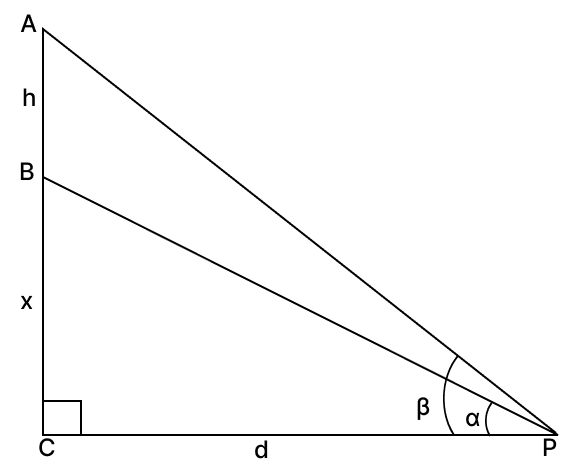
Let the height of the tower (BC) be x and the height of the flagstaff (BA) be h.
Let P be the point on ground from foot of tower at distance d.
In triangle PCB,
In triangle PCA,
From (1) and (2), we get :
x tan β = (x + h)tan α
x tan β = x tan α + h tan α
h tan α = x tan β - x tan α
h tan α = x(tan β - tan α)
x =
Hence, option 4 is the correct option.
Answered By
2 Likes
Related Questions
From the foot of a tower, the angle of elevation of the top of a column is 60° and from the top of the tower, which is 25 m high, the angle of elevation is 30°. The height of the column is:
14.4 m
37.5 m
42.5 m
43.3 m
An observer standing 72 m away from a building notices that the angles of elevation of the top and the bottom of a flagstaff on the building are respectively 60° and 45°. The height of the flagstaff is:
52.7 m
73.2 m
98.3 m
124.7 m
A flagstaff of height of the height of a tower is mounted on the top of the tower. If the angle of elevation of the top of the flagstaff as seen from the ground is 45° and the angle of elevation of the top of the tower as seen from the same place is θ, then the value of tan θ is:
Two poles of equal heights are standing opposite to each other on either side of a road, which is 30 m wide. From a point between them on the road, the angles of elevation of the tops are 30° and 60°. The height of each pole is:
4.33 m
6.5 m
13 m
15 m