
Mathematics
The vertices of a parallelogram in order are A(1, 2), B(4, y), C(x, 6) and D(3, 5). Then (x, y) is:
(6, 3)
(3, 6)
(5, 6)
(1, 4)
Section Formula
1 Like
Answer
In a parallelogram, the diagonals bisect each other. Therefore, the mid-point of AC = mid-point of BD.
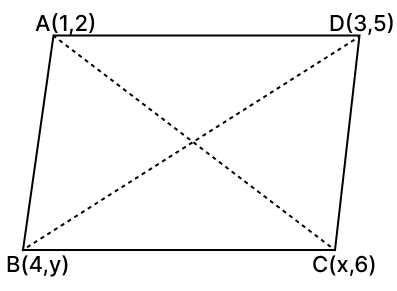
By mid-point formula,
(x, y) =
Substituting values, we get :
For diagonal AC :
For diagonal BD:
Since both mid-points are equal, we equate their coordinates:
(x, y) = (6, 3).
Hence, Option 1 is the correct option.
Answered By
2 Likes
Related Questions
The centre of the circle having end points of its one diameter as (-4, 2) and (4, -3) is:
(0, -1)
(2, -1)
A circle has its centre at (4, 4). If one end of a diameter is (4, 0), then the coordinates of the other end are:
(0, 4)
(4, 8)
(4, -8)
(-4, -8)
The fourth vertex D of a parallelogram ABCD whose three vertices are A(-2, 3), B(6, 7) and C(8, 3) is:
(0, 1)
(0, -1)
(-1, 0)
(1, 0)
A(1, 4), B(4, 1) and C(x, 4) are the vertices of ΔABC. If the centroid of the triangle is G(4, 3), then x is equal to:
2
1
7
4