
Mathematics
The volume of a cuboid of dimensions x, y and z is V and its surface area is S. The value of is :
Mensuration
1 Like
Answer
Given,
Volume of cuboid = V
Surface area of cuboid = S
Dimensions of cuboid = x, y, z
Volume of cuboid = length × breadth × height
V = xyz
Addition of the reciprocal values of the given dimensions,
⇒ =
By substituting the value V = xyz, we get
⇒ =
⇒ V = yz + xz + xy ……….(1)
We know that,
Surface area of cuboid = 2 (lb + bh + hl)
S = 2(xy + yz + zx)
⇒ = xy + yz + zx
By substituting the value of xy + yz + zx in equation (1), we get :
Hence, option 1 is the correct option.
Answered By
3 Likes
Related Questions
Assertion (A) : The perimeter of one face of a cube is 20 cm. Its volume is 64 cm3.
Reason (R) : Volume of a cube of edge a is given by a3.
A is true, R is false
A is false, R is true
Both A and R are true
Both A and R are false
The area of a base of a cuboidal water tank is 6500 cm2 and the volume of water contained in it is 2.6 m3. The depth of the water is :
5 m
4 m
3.5 m
3 m
If a cube has surface area S and volume V, then the volume of the cube of surface area 2S is :
2V
In the figure, four faces of the solid are shaded. The shaded area is :
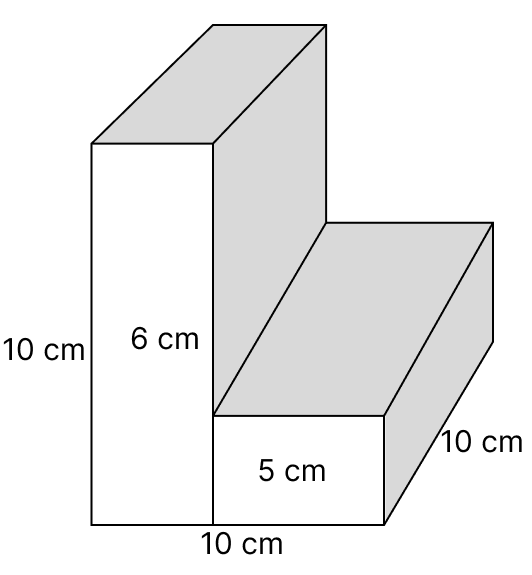
100 cm2
150 cm2
200 cm2
300 cm2