
History & Civics
What were the objectives and activities of the East India Association founded in 1866?
Nationalism Growth
5 Likes
Answer
The East India Association was founded in London on 1st October, 1866 by Dadabhai Naoroji. Its objectives were as follows-
- It aimed at providing members of the British Parliament information regarding India's genuine grievances.
- The Association attracted a lot of Englishmen who sympathised with India's distress.
- The Association recommended the abolition of cotton duties and petitioned the government to withdraw the Vernacular Press Act.
- The Association soon became popular and soon had branches in Mumbai, Kolkata and Chennai.
Answered By
2 Likes
Related Questions
He led a movement in India that called for the creation of a new social order in which no one would be subordinated to the upper-caste Brahmans. He also fought for women's rights, believing that education was essential to bringing about social change.
Identify the social reformer from the given passage. Name the organisation he established in 1873 with the aim of securing social justice for the weaker sections of society.
Read the excerpt given below and answer the question that follows:
"From the mid-18th century, it was a European corporation, the East India Company - run from the City of London by merchants and accountants, with their ledgers and careful accounting - that ran amok and seized and subjugated a fragmented and divided India in what was probably the supreme act of corporate violence in history."
—William Dalrymple(a) What term is used to describe the East India Company's act of running India's trade and finance from the city of London? How did it work?
(b) What was its impact on the artisans and craftsmen?
(c) The author has described the East India Company's act as 'Corporate violence'. What term was used by Dadabhai Naoroji for such an act? Describe how it worked.
Analysing the picture given below, identify the statement that does NOT align with its content.
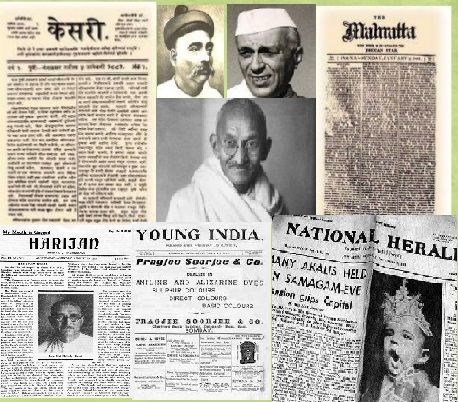
- The press spread modern liberal ideals such as liberty, freedom, and equality among the populace.
- The press provided a platform for various social groups from different regions of the country to exchange their views.
- The press played an important role in organising political movements.
- The press regularly praised the policies of the British Government in India.
To benefit British industry, British rule pursued a policy of free trade in India. The nationalists were generally concerned about the lack of public investment in agriculture and argued that the British were trying to turn India into a valuable source of raw materials and a consumer of British-manufactured goods to make India an extension of the British economy.
(Source: History of Modern India by Bipin Chandra.)
Discuss how the British empire deindustrialised India.