Computer Applications
Which logical values are recognized by most of the functions? What are the corresponding numeric values of those logical values?
MS Excel
13 Likes
Answer
In Excel, logical values are represented by the TRUE and FALSE values. These logical values are widely recognized by most functions for conditional testing and logical operations. The corresponding numeric values are:
TRUE — corresponds to the numeric value 1.
FALSE — corresponds to the numeric value 0.
When we use TRUE or FALSE in a numeric context, Excel automatically treats them as 1 and 0, respectively.
Answered By
5 Likes
Related Questions
Can we find the average of more than one range of cells? If yes, what will be the structure of such a function?
What is the significance of COUNT() function? What type of data entries does the COUNT() function recognize?
Suggest the Excel functions which can be used for the following:
(a) To calculate the average marks obtained by a student in SA1 assuming that his/her marks of individual subjects are given.
(b) To find the highest marks of Hindi in your class, if marks of all students are given.
(c) To calculate the quarterly sales of a sales executive, if the sales data of all months are given.
(d) To find out the minimum quoted tender rates submitted by various companies to the Govt. of India.
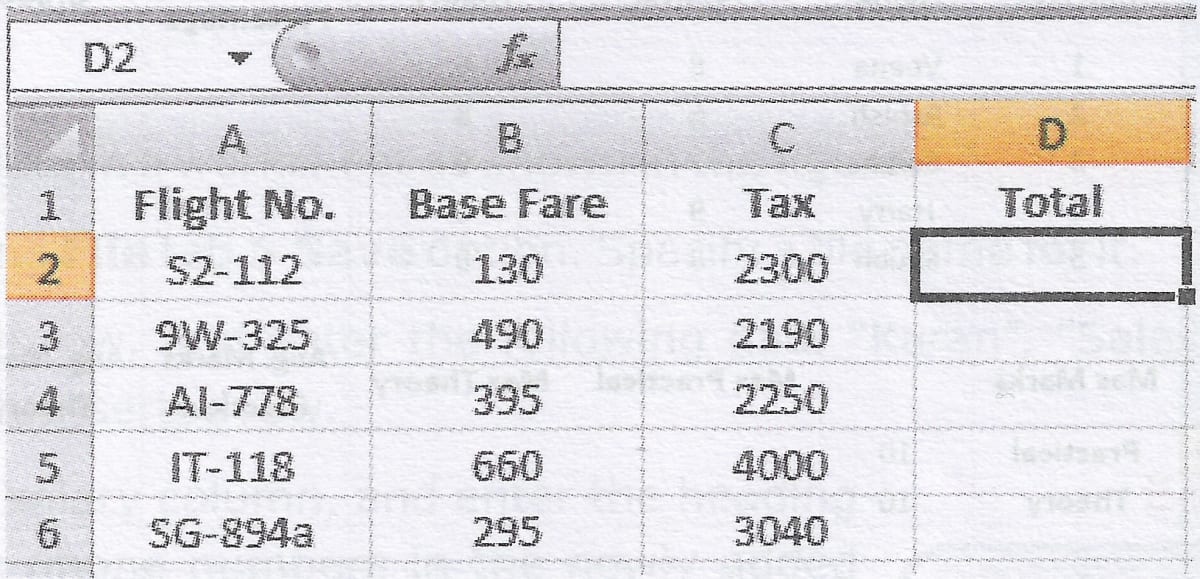
An assignment was given to Sanjiv and Vibha by their teacher. They were shown the screen shot given below and were asked to answer the following questions:
(i) What happens when the formula = B2 + C2 is entered in D2?
(ii) What happens when the formula of D2 is copied over to D6?
(iii) What will happen if we modify the formula in the cell D6 to = ?
(iv) What happens when we copy the formula of D6 to D3?
(v) If we delete the value of C3, what will be the new value of D3?