
Physics
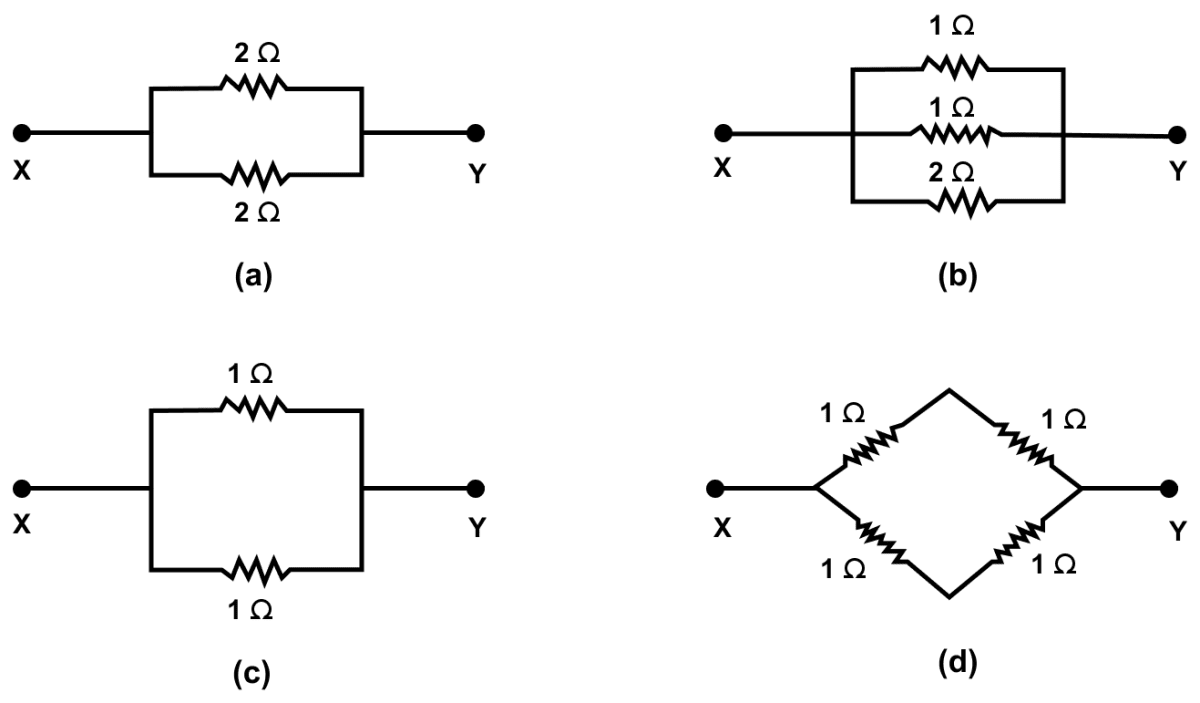
Which of the following combinations have the same equivalent resistance between X and Y?
Current Electricity
20 Likes
Answer
(a) and (d) have the same equivalent resistance between X and Y.
Reason —
(a) In the circuit, two resistors of 2 Ω each are connected in parallel. In parallel, the equivalent resistance is RP, then
Hence, RP = 1 Ω
(b) In the circuit, three resistors of 1 Ω, 1 Ω and 2 Ω are connected in parallel. In parallel, the equivalent resistance is RP, then
Hence, RP = 0.4 Ω
(c) In the circuit two resistors of 1 Ω each are connected in parallel. In parallel, the equivalent resistance is RP, then
Hence, RP = 0.5 Ω
(d) In the circuit there are three parts. In the first part two resistor of 1 Ω each are connected in series. In series, the equivalent resistance is R'S, then
R'S = (1 + 1) Ω = 2 Ω
In the second part two resistor of 1 Ω each are connected in series. In series, the equivalent resistance is R''S, then
R''S = (1 + 1) Ω = 2 Ω
In the third part,R'S and R''S are in parallel, the equivalent resistance is RP, then
Hence, RP = 1 Ω
Therefore, on observing the values we can say that (a) and (d) have same equivalent resistances i.e., 1 Ω.
Answered By
12 Likes
Related Questions
Write the expressions for the equivalent resistance R of three resistors R1, R2 and R3 joined in (a) parallel, (b) series.
State how are the two resistors joined with a battery in each of the following cases when —
(a) same current flows in each resistor,
(b) potential difference is same across each resistor,
(c) equivalent resistance is less than either of the two resistances,
(d) equivalent resistance is more than either of the two resistances.
State two differences between the e.m.f. and terminal voltage of a cell.
Name two factors on which the internal resistance of a cell depends and state how does it depend on the factors stated by you.