
Biology
With regard to germination in bean seed, answer the following questions:
- State the function of the 'micropyle'.
- Name the part of the seed that grows into the seedling.
- Name the part of the seed that provides nutrition for the growing seedling.
- Draw a neat labelled diagram of a mature bean seed.
Seeds
304 Likes
Answer
- The 'micropyle' serves two important functions:
- Allows absorption of water and makes it available to the embryo for germination.
- Enables diffusion of respiratory gases for the growing embryo
- The embryo of the seed grows into the seedling.
- The cotyledons of the seed provide nutrition for the growing seedling or the embryo.
- Below is the diagram of a mature bean seed:

Answered By
213 Likes
Related Questions
The figure shown below represents the internal structure of a certain seed. Study the figure and answer the following questions.

(a) Identify the seed and mention whether it is mono or dicotyledonous.
(b) Label the guidelines 1 to 4.
(c) Write an important role of part 2.
(d) Mention the food component found in part 4.
(e) What kind of germination takes place in the above mentioned seed ?
Kiara visited a forest with marshy land. She observed that in some of the plants, the seeds germinate inside the fruit while still being attached to the parent plant. A part of the plant and a seedling are shown below in the diagram, answer the questions that follow.
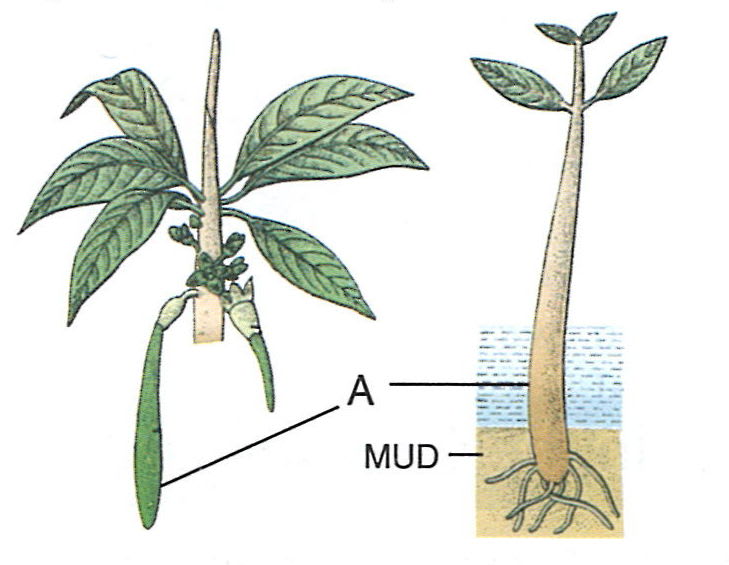
(a) What kind of germination is shown above in the figure ?
(b) Give two examples of the plants which germinate by this kind of germination.
(c) Mention the part shown in the figure as 'A'.
Assertion (A): Fruit is the enlarged ripened ovule which protects the seeds.
Reason (R): Fruits develop from the ovary of the pistil after the process of pollination and fertilization. Ovarian wall forms the pericarp.
- Both A and R are true and R is the correct explanation of A.
- Both A and R are true but R is not the correct explanation of A.
- A is true but R is false.
- A is false but R is true.
Assertion (A): Dicotyledonous seeds are always exalbuminous (non-endospermic).
Reason (R): All dicotyledonous seeds contain two cotyledons which store food material for the developing embryo.
- Both A and R are true and R is the correct explanation of A.
- Both A and R are true but R is not the correct explanation of A.
- A is true but R is false.
- A is false but R is true.