
Mathematics
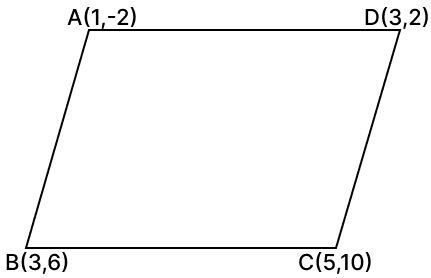
Without using distance formula, show that the points A(1, –2), B(3, 6), C(5, 10) and D(3, 2) are the vertices of a parallelogram.
Straight Line Eq
1 Like
Answer
By using slope formula,
m =
Given, points A(1, –2), B(3, 6)
Substituting values we get,
Given, points C(5, 10) and D(3, 2)
Substituting values we get,
Given, points B(3, 6), C(5, 10)
Substituting values we get,
Given, points A(1, –2), D(3, 2)
Substituting values we get,
mAB = mCD and mBC = mAD
∴ AB is parallel to CD and BC is parallel to AD
Since both pairs of opposite sides are parallel, the quadrilateral ABCD is a parallelogram.
Hence, proved that ABCD is a parallelogram.
Answered By
2 Likes
Related Questions
If the straight lines 3x – 5y = 7 and 4x + ay + 9 = 0 are perpendicular to each other, find the value of a.
Without using Pythagoras Theorem, prove that the points A(1, 3), B(3, –1) and C(–5, –5) are the vertices of a right-angled triangle.
Given that A(5, 4), B(–3, –2) and C(1, –8) are the vertices of a ΔABC. Find:
(i) the slope of median AD
(ii) the slope of altitude BM
Find the equation of the line parallel to the line 3x + 2y = 8 and passing through the point (0, 1).