
Mathematics
The work done by a body on the application of a constant force is the product of the constant force and the distance travelled by the body in the direction of the force. Express this in the form of a linear equation in two variables (work w and distance d), and draw its graph by taking the constant force as 3 units. What is the work done when the distance travelled is 2 units? Verify it by plotting it on the graph.
Polynomials
3 Likes
Answer
Given:
Work done = constant force × distance travelled
Let the constant force be F units, work be w units and distance be d units.
So, w = F × d.
When the constant force is 3 units, the equation becomes:
w = 3d
This is a linear equation in two variables w and d.
To draw the graph, we identify the below points:
When d = 0, w = 3(0) = 0. Point: (0, 0).
When d = 1, w = 3(1) = 3. Point: (1, 3).
When d = 2, w = 3(2) = 6. Point: (2, 6).
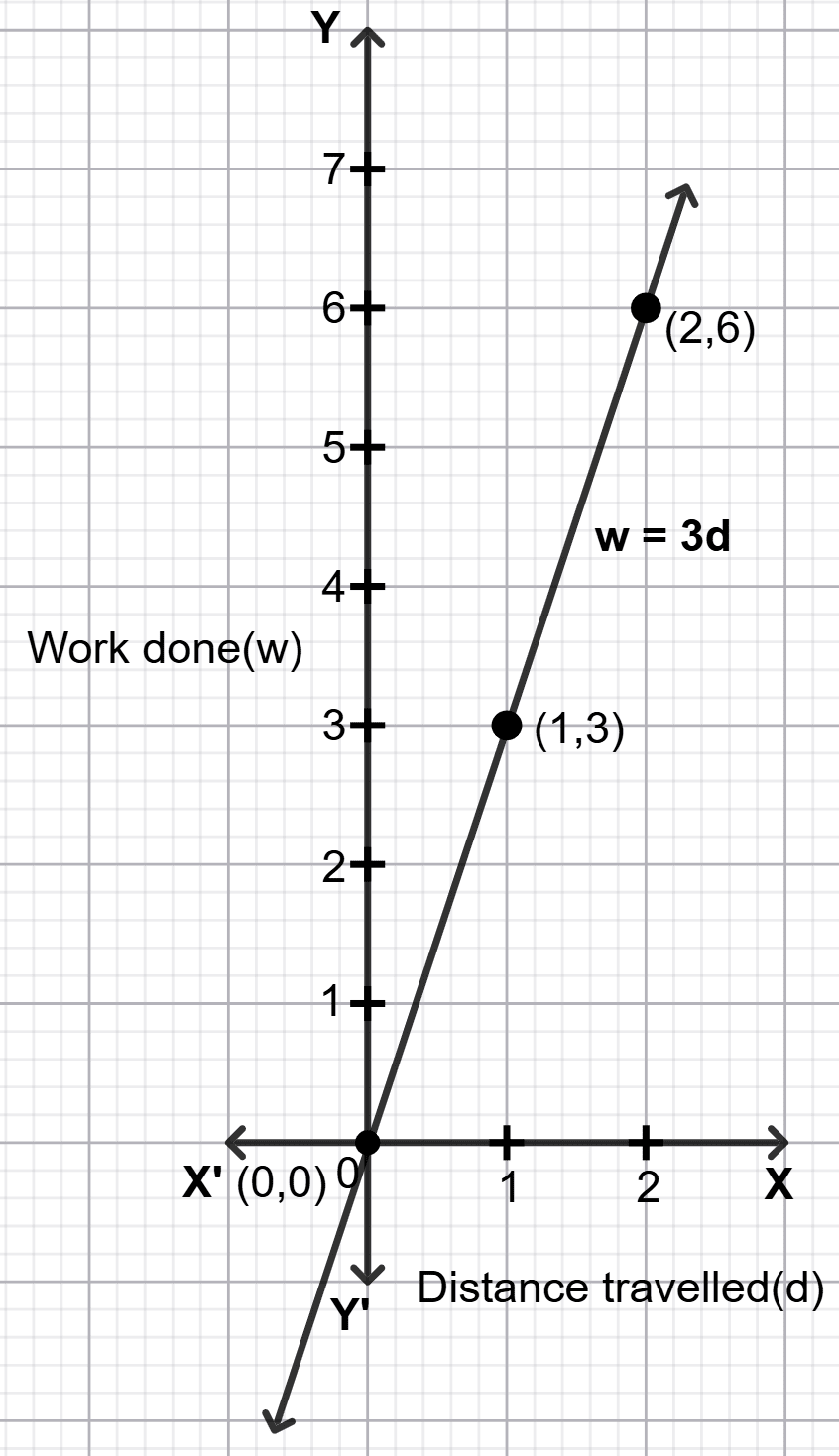
Work done when d = 2:
Substituting d = 2 in w = 3d:
w = 3(2) = 6 units
∴ The work done when the distance travelled is 2 units is 6 units.
This is verified by the graph, since the point (2, 6) lies on the line w = 3d.
Answered By
2 Likes
Related Questions
Draw the graph of the following equations, and identify their slopes and y-intercepts. Also, find the coordinates of the points where these lines cut the y-axis.
(i) y = –3x + 4
(ii) 2y = 4x + 7
(iii) 5y = 6x – 10
(iv) 3y = 6x – 11
Are any of the lines parallel?If the temperature of a liquid can be measured in Kelvin units as x K and in Fahrenheit units as y °F, the relation between the two systems of measurement of temperature is given by the linear equation y = (x – 273) + 32.
(i) Find the temperature of the liquid in Fahrenheit if the temperature of the liquid is 313 K.
(ii) If the temperature is 158 °F, then find the temperature in Kelvin.The graph of a linear polynomial p(x) passes through the points (1, 5) and (3, 11).
(i) Find the polynomial p(x).
(ii) Find the coordinates where the graph of p(x) cuts the axes.
(iii) Draw the graph of p(x) and verify your answers.Let p(x) = ax + b and q(x) = cx + d be two linear polynomials such that:
(i) p(0) = 5.
(ii) The polynomial p(x) – q(x) cuts the x-axis at (3, 0).
(iii) The sum p(x) + q(x) is equal to 6x + 4 for all real x.Find the polynomials p(x) and q(x).