
Mathematics
Write true (T) or false (F) :
(i) A kite possesses a linear symmetry but no rotational symmetry.
(ii) The order of rotational symmetry of a regular hexagon is 6.
(iii) A parallelogram does not have any line of symmetry.
(iv) A square has a point symmetry but rhombus does not.
(v) The letter N does not possess a rotational symmetry.
Symmetry
3 Likes
Answer
(i) True
Reason — A kite has exactly one line of symmetry i.e., the diagonal connecting the vertices of the equal sides. However, it does not look like its original self at any point during a rotation until it completes a full 360° turn.
(ii) True
Reason — For any regular polygon, the order of rotational symmetry is equal to the number of its sides. Since a regular hexagon has 6 equal sides and angles, it maps onto itself 6 times in one full rotation.
(iii) True
Reason — A general parallelogram cannot be folded along any line to produce two matching halves. While it has rotational symmetry, it lacks linear symmetry.
(iv) False
Reason — Both a square and a rhombus possess point symmetry. Any figure that looks the same after a 180° rotation (upside down) has point symmetry. Since both shapes map onto themselves after a half-turn, they both have it.
(v) False
Reason — The letter N possesses rotational symmetry of order 2. If we rotate the letter N by 180°, it looks exactly the same as it did in its starting position.
Answered By
2 Likes
Related Questions
Which of the following letters of English alphabet has a rotational symmetry?
- C
- K
- N
- T
Fill in the blanks :
(i) A circle has …………… lines of symmetry.
(ii) The letter S does not possess …………… symmetry.
(iii) A semi-circle is symmetrical about the …………… of its diameter.
(iv) The letter H has …………… line(s) of symmetry.
(v) A quadrilateral having 4 lines of symmetry as well as rotational symmetry of order 4 is …………… .
Assertion: Order of rotational symmetry for the given figure is 4.
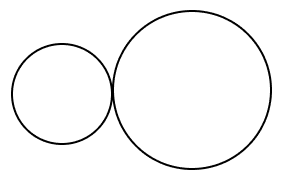
Reason: A figure is said to possess rotational symmetry if it fits on itself more than once while being rotated through 360°.
- Both Assertion (A) and Reason (R) are true and Reason (R) is the correct explanation of Assertion (A).
- Both Assertion (A) and Reason (R) are true and Reason (R) is not the correct explanation of Assertion (A).
- Assertion (A) is true but Reason (R) is false.
- Assertion (A) is false but Reason (R) is true.
Assertion: The number of lines of symmetry of a regular polygon is equal to its number of vertices.
Reason: A figure that possesses point symmetry always has line symmetry.
- Both Assertion (A) and Reason (R) are true and Reason (R) is the correct explanation of Assertion (A).
- Both Assertion (A) and Reason (R) are true and Reason (R) is not the correct explanation of Assertion (A).
- Assertion (A) is true but Reason (R) is false.
- Assertion (A) is false but Reason (R) is true.