
Select the group in which all organisms have the same mode of nutrition.
options
- Cuscuta, yeast, legumes, leeches and tapeworm
- Cactus, ticks, lice, leeches and cow
- Cuscuta, ticks, lice, leeches and tapeworm
- Cactus, grass, lice, lion and tapeworm
Answer
Cuscuta, ticks, lice, leeches and tapeworm
Reason — Cuscuta, ticks, lice, leeches and tapeworm have same mode of nutrition since all the organisms in this group exhibit a parasitic mode of nutrition.
In parasitism, an organism (the parasite) lives either on or inside another living organism (the host) and derives nutrients from it, often harming the host in the process.
- Cuscuta (Amarbel) is a parasitic plant that absorbs nutrients from the host plant using special structures called haustoria.
- Ticks and lice are external parasites that suck blood or feed on the skin of animals.
- Leeches are also external parasites that feed on the blood of other organisms.
- Tapeworms are internal parasites that live inside the intestine of their host and absorb digested food.
Thus, cuscuta, ticks, lice, leeches and tapeworm share the same mode of nutrition — parasitic.
Which of the following options indicates the products formed after breakdown of the glucose in our muscle cells when there is lack of oxygen?
options
- Ethanol + carbon dioxide + Energy
- Lactic acid + Energy
- Lactic acid + carbon monoxide + Energy
- Carbon dioxide + Water + Energy
Answer
Lactic acid + Energy
Reason — In our muscle cells, when we perform vigorous physical activity such as running or exercising, the demand for energy increases. However, the oxygen supply becomes insufficient for complete breakdown of glucose through aerobic respiration.
Under this condition, anaerobic respiration takes place in the muscle cells. During this process, glucose is partially broken down in the absence of oxygen to form lactic acid and a small amount of energy.
The chemical equation for this process is:
C6H12O6(Glucose) → C3H6O3(Lactic acid) + Energy
The accumulation of lactic acid in the muscles causes muscle fatigue and cramps. Once oxygen becomes available again, lactic acid is converted back into carbon dioxide and water with the release of more energy.
Thus, in the absence of oxygen, glucose breaks down into lactic acid and energy in human muscle cells.
Which of the following is a correct combination of function and part of the brain?
options
- Posture and balance: Cerebrum
- Salivation: Medulla in midbrain
- Hunger: Pons in hindbrain
- Blood pressure: Medulla in hindbrain
Answer
Blood pressure: Medulla in hindbrain
Reason — The medulla, which is a part of the hindbrain, controls several involuntary activities essential for survival. These include regulation of heartbeat, breathing, blood pressure, swallowing, and digestion. It acts as a control center for the body’s autonomic functions — those that occur automatically without conscious effort.
- Posture and balance are controlled by the cerebellum, not the cerebrum.
- Salivation is regulated by medulla, but it is part of the hindbrain, not the midbrain.
- Hunger is controlled by the hypothalamus in the forebrain, not by the pons.
- Blood pressure is indeed controlled by the medulla in the hindbrain.
Hence, the correct pairing is “Blood pressure — Medulla in hindbrain.”
The blood glucose level in a patient was very high. It may be due to inadequate secretion of:
options
- Growth hormone from pituitary gland
- Oestrogen from ovary
- Insulin from pituitary gland
- Insulin from pancreas
Answer
Insulin from pancreas
Reason — The pancreas secretes the hormone insulin, which helps to control the blood sugar level in our body. If the pancreas does not produce enough insulin, the blood glucose (sugar) level rises, because glucose cannot be taken up by the cells for energy production.
This condition is called diabetes mellitus and people suffering from this condition are often given insulin injections to maintain their blood sugar at a normal level.
So, when the blood glucose level in a patient is very high, it is due to inadequate secretion of insulin from the pancreas.
In a cross between black furred rabbit (B) and white furred rabbit (b), all offspring were found to have black fur. What can be inferred about the genetic makeup of the parent rabbits?
options
- BB X bb
- Bb X Bb
- Bb X bb
- bb X bb
Answer
BB X bb
Reason — In rabbits, the gene for black fur (B) is dominant, while the gene for white fur (b) is recessive because when a homozygous black-furred rabbit (BB) is crossed with a homozygous white-furred rabbit (bb), all the offspring receive one dominant allele (B) from the black parent and one recessive allele (b) from the white parent.
As a result, all offspring have the genotype Bb, which expresses the dominant black fur trait.
Thus, since all the offspring are black-furred, it indicates that the black parent was homozygous dominant (BB) and the white parent was homozygous recessive (bb).
Which are the correct statements related to ozone?
(a) Ozone layer helps in increasing the UV radiations reaching earth.
(b) Ozone is a deadly poison.
(c) Ozone layer shields the earth from UV radiations.
(d) Ozone layer prevents UV rays which cause skin cancer.
(e) Ozone is formed with the help of Chloroflurocarbons.
options
- (a), (b), (c)
- (b), (c), (d)
- (c), (d), (e)
- (a), (d), (e)
Answer
(b), (c), (d)
Reason — Ozone (O3) is a gas present in the stratosphere, where it forms the ozone layer that protects life on Earth.
- Statement (a) is false because ozone layer reduces, not increases, UV radiation reaching Earth.
- Statement (b) is true because, at the ground level, ozone is harmful and toxic to living organisms when inhaled.
- Statement (c) is true as the ozone layer absorbs most of the harmful ultraviolet (UV) rays from the Sun.
- Statement (d) is also true because by blocking UV rays, the ozone layer protects living beings from skin cancer, cataracts, and DNA damage.
- Statement (e) is false because ozone is not formed by chlorofluorocarbons (CFCs); in fact, CFCs destroy ozone molecules.
Hence, the correct combination of statements is (b), (c), and (d).
Which of the following human activities has resulted in an increase of non-biodegradable substances?
options
- Organic farming
- Increase in tree plantation
- Use of plastic as packaging material
- Composting of kitchen waste
Answer
Use of plastic as packaging material
Reason — Plastics are non-biodegradable substances, which means they cannot be decomposed by natural microorganisms. When plastics are widely used for packaging materials, they accumulate in the environment and remain there for many years without breaking down. This leads to soil, water and air pollution, harms animals that may swallow plastic waste and disturbs natural ecosystems.
On the other hand, activities like organic farming, tree plantation and composting of kitchen waste are environmentally friendly practices that promote the recycling of natural materials and do not contribute to non-biodegradable pollution.
Therefore, the use of plastic as packaging material is the main human activity responsible for the increase in non-biodegradable substances in the environment.
Assertion (A) : Tallness of a pea plant is controlled by an enzyme.
Reason (R) : The gene for that enzyme makes proteins which help the plant to be tall.
options
- Both A and R are true, and R is the correct explanation of A.
- Both A and R are true, and R is not the correct explanation of A.
- A is true but R is false.
- A is false but R is true.
Answer
Both A and R are true, and R is the correct explanation of A.
Reason —
Assertion (A) is true because the height (tallness) of a pea plant is influenced by a specific enzyme that helps in the production of growth hormones such as gibberellins. The presence or absence of this enzyme determines whether the plant grows tall or remains dwarf. Thus, tallness is controlled by a gene that governs the formation of this enzyme.
Reason (R) is true because genes contain the instructions to make specific proteins and in this case, the gene produces the enzyme (a type of protein) required for the synthesis of growth hormones. These hormones stimulate cell elongation and division, making the plant tall.
Hence, both A and R are true, and R is the correct explanation of A..
Assertion (A) : Vulture will always have the least amount of pesticides in a food chain.
Reason (R) : Vulture occupies the last trophic level and it gets only 10% of energy of the previous trophic level.
options
- Both A and R are true, and R is the correct explanation of A.
- Both A and R are true, and R is not the correct explanation of A.
- A is true but R is false.
- A is false but R is true.
Answer
A is false but R is true.
Reason —
Assertion (A) is false because vultures, being top carnivores or scavengers, actually have the highest amount of pesticides in their bodies, not the least.
This happens due to a process called biological magnification, in which the concentration of harmful chemicals like pesticides increases at each higher trophic level of the food chain.
Therefore, since vultures feed on other animals that already contain pesticides, these toxins accumulate in their bodies in maximum concentration.Reason (R) is true because vultures occupy the last trophic level and receive only 10% of the energy from the previous level according to the 10% law of energy transfer. However, this concept is related to energy flow, not to the accumulation of pesticides
Hence, A is false but R is true.
Unlike animals, plants do not have any excretory products as they do not eat food. Comment upon the statement with justification.
Answer
It is completely wrong to say that plants do not produce any excretory products. However, plants use completely different strategies for excretion than those of the animals. They get rid of these wastes in different manner :
- Oxygen, a photosynthetic waste, is removed through stomata.
- Excess water is removed by transpiration through stomata.
- Other metabolic wastes are either stored in dead cells, resins and gums or are removed through falling of old leaves.
- Many waste products are stored in cellular vacuoles
How many chambers are there in the heart of the following organisms? How is mixing of oxygenated and deoxygenated blood prevented in their body?
(a) Fishes
(b) Humans
Answer
(a) Fishes have a two-chambered heart.
Their heart pumps only deoxygenated blood to the gills. Oxygenated blood from gills goes straight to the body without re-entering the heart. This prevents mixing of oxygenated and de-oxygenated blood.
(b) Humans have a four-chambered heart.
Right (deoxygenated) and left (oxygenated) sides are separated by the septum, with one-way valves keeping flows apart preventing mixing of oxygenated and de-oxygenated blood.
Explain the mechanism by which the water is transported in plants?
Answer
Water is transported in plants through a continuous system of xylem vessels, which extend from the roots to the leaves. The process begins when the root hair absorb water from the soil by osmosis which passes through the root cortex and enters the xylem of the root. From there, it moves upward through the stem to the leaves.
The upward movement of water is caused by three main forces :
- Root pressure – It is the pushing force created by the continuous absorption of water by roots.
- Capillary action – Water rises through the narrow xylem vessels due to adhesion and cohesion between water molecules.
- Transpiration pull – The evaporation of water from the stomata in leaves creates a suction force that pulls water upward through the plant.
Thus, water transport in plants occurs due to the combined action of root pressure, capillary action and transpiration pull through the xylem.
About 100 acres of forest land was declared as Natural reserve park. The following organisms were predominant in the Natural reserve park :
rabbit, frog, grass, fish, fox, water insects, zebra, peacock, snake, trees, bird, owl, insects, tiger, vulture, duck.
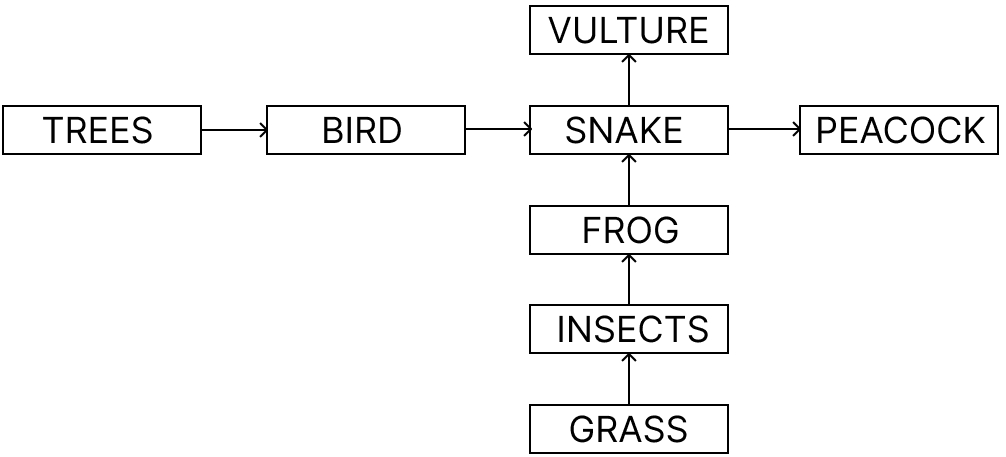
Create a food web comprising two separate food chains with different producers by using the above data.
Answer
Food chain 1:
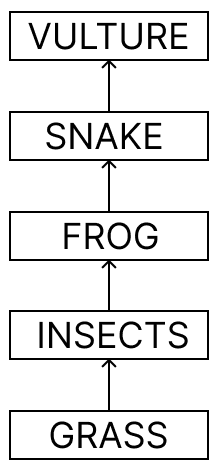
Food chain 2:
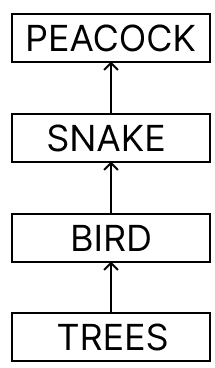
Food web:
Draw and explain how the nerve cells help in transmission of impulses?
Answer
Diagram of a nerve cell is shown below :
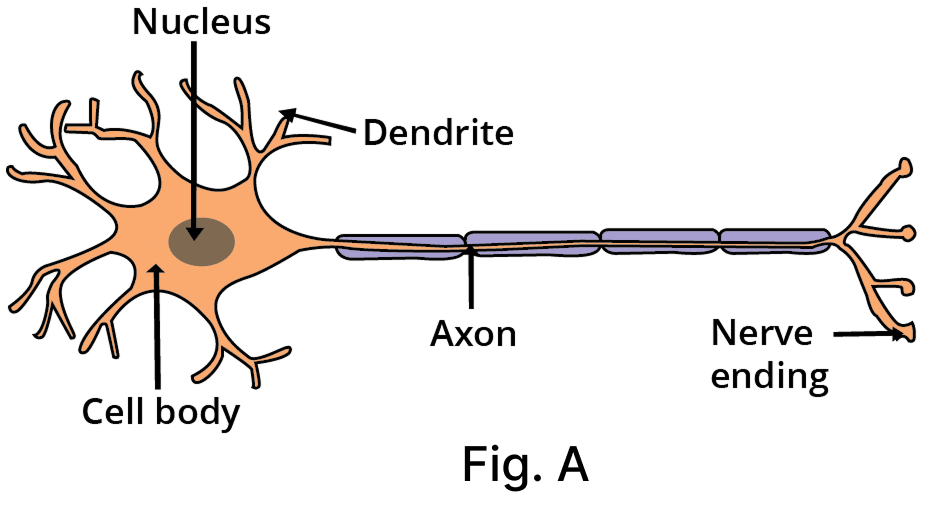
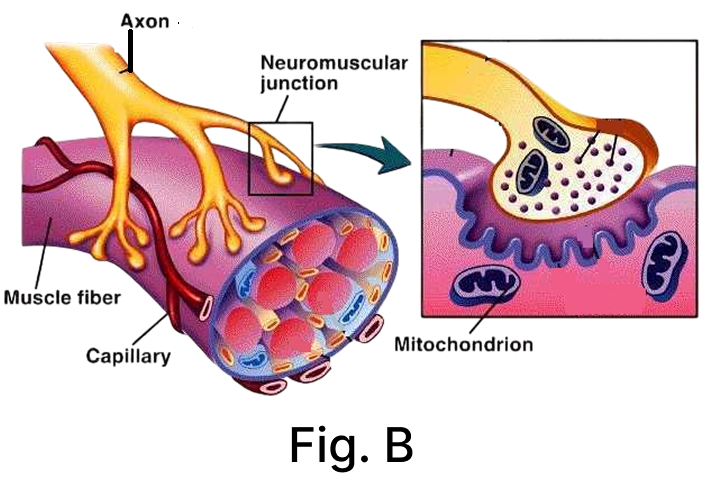
- All information from our environment is detected by the specialised tips of some nerve cells and the information acquired at the end of the dendritic tip of a nerve cell (Fig. a), sets off a chemical reaction that creates an electrical impulse.
- This impulse travels from the dendrite to the cell body and then along the axon to its end. At the end of the axon, the electrical impulse sets off the release of some chemicals.
- These chemicals cross the gap, or synapse and start a similar electrical impulse in a dendrite of the next neuron. This is how nervous impulses travel in the body. (Fig b).
In a genetic experiment, plants with pure round green seeds (RRyy) were crossed with plants with wrinkled yellow seeds (rrYY).
(a) Show the gametes formed when F1 was self-pollinated.
(b) A total of 144 seeds were produced which developed into saplings.
Show the ratio in which these traits are independently inherited in these 144 sapling.
Answer
Given : Round (R) dominant over wrinkled (r); Yellow (Y) dominant over green (y).
RRyy (round, green) × rrYY (wrinkled, yellow) → F1 : RrYy (round, yellow).
(a) Gametes formed when F1 (RrYy) is self-pollinated
By independent assortment, each F1 produces four types of gametes in equal proportion i.e.,
RrYy x RrYy → RY, Ry, rY, ry
So the self cross is RrYy × RrYy, with both parents making RY, Ry, rY, ry.
(b) Phenotypic ratio among 144 F2 saplings
The dihybrid self gives the classic 9 : 3 : 3 : 1 phenotypic ratio
Round Yellow (R_Y_) =
Round Green (R_yy) =
Wrinkled Yellow (rrY_) =
Wrinkled Green (rryy) =
So, the F2 saplings are in the ratio 9 : 3 : 3 : 1 (Round Yellow : Round Green : Wrinkled Yellow : Wrinkled Green).
Neha consumed boiled sweet potatoes and boiled eggs for breakfast. Help her to understand some steps in the process of digestion of the food taken by her by answering the questions given below.
Attempt either subpart A or B.
(a) Which of these food items is rich in proteins? In which part of the alimentary canal is the digestion of this component initiated? Name the enzymes, conditions required and the glands associated with the digestion here.
OR
(b) Which of these food items contains fats? How is it digested?
(c) Which of these food items is rich in starch? How is its digestion initiated?
(d) The figure given below represents parts of the human alimentary canal. Which of these parts will have the maximum amount of digested food as soon as the process of digestion is completed?

Answer
(a) Eggs are rich in proteins.
The digestion of proteins is initiated in the stomach. Gastric glands present in the wall of the stomach release hydrochloric acid, a protein digesting enzyme called pepsin and mucus. The hydrochloric acid creates an acidic medium which facilitates the action of enzyme pepsin.
OR
(b) Eggs contain fats.
Bile juice from the liver breaks down large fat globules into smaller ones for increasing the efficiency of the enzymes and making the medium alkaline. Emulsified fats are digested by lipase secreted by pancreas.
(c) Sweet potatoes are rich in starch.
The saliva secreted by salivary glands present in buccal cavity contain an enzyme called salivary amylase that breaks down starch which is a complex molecule to give sugar.
(d) Small Intestine will have a maximum amount of digested food as the process of digestion is completed in the small intestine.
Neha consumed boiled sweet potatoes and boiled eggs for breakfast. Help her to understand some steps in the process of digestion of the food taken by her by answering the questions given below.
Attempt either subpart A or B.
(a) Which of these food items is rich in proteins? In which part of the alimentary canal is the digestion of this component initiated? Name the enzymes, conditions required and the glands associated with the digestion here.
OR
(b) Which of these food items contains fats? How is it digested?
(c) Which of these food items is rich in starch? How is its digestion initiated?
(d) How will the digested food be taken up by the alimentary canal?
Answer
(a) Eggs are rich in proteins.
The digestion of proteins is initiated in the stomach and gastric glands present in the wall of the stomach release hydrochloric acid, a protein digesting enzyme called pepsin and mucus. The hydrochloric acid creates an acidic medium which facilitates the action of enzyme pepsin.
OR
(b) Eggs contain fats.
Bile juice from the liver breaks down large fat globules into smaller ones for increasing the efficiency of the enzymes and making the medium alkaline. Emulsified fats are digested by lipase secreted by pancreas.
(c) Sweet potatoes are rich in starch.
The saliva secreted by salivary glands present in buccal cavity contain an enzyme called salivary amylase that breaks down starch which is a complex molecule to give sugar.
(d) The digested food in the small intestine is absorbed by its inner lining, which has many tiny finger-like projections called villi.
These villi greatly increase the surface area for absorption and each villus contains fine blood capillaries and lymph vessels that take up the nutrients.
Puneet wanted to grow banana plants.
(a) Based on your knowledge on plant reproduction should he opt for seeds or any alternate method of reproduction. Justify your answer.
(b) Offsprings of a banana plant usually show very little variation. What causes variation and are variations good or bad? Justify.
Answer
(a) Puneet should not choose seeds because modern banana plants have lost the ability to produce viable seeds. Instead, he should use an alternate method of reproduction, such as vegetative propagation through stem cuttings or suckers.
(b) The offspring of banana plants show very little variation because they are produced through asexual reproduction (vegetative propagation), where no fusion of gametes or exchange of genetic material takes place.
However, variations can still arise due to errors during DNA copying which can be beneficial or harmful :
- Beneficial variations help some individuals survive under unfavourable conditions such as diseases or environmental changes.
- Harmful variations may lead to the loss of desirable traits or make the plant less adaptable to its surroundings.
Annie was conducting research on the number of fruits produced by watermelon under different conditions. She grew 25 watermelon plants each in both glass house A and B. She introduced pollinators in glass house A only.
(a) What difference will she observe in the number of fruits produced in the two glass houses? Explain with reason.
(b) List 3 changes that will occur in a flower once it gets fertilized.
Answer
(a) Watermelon plants have unisexual flowers, meaning that male and female flowers are separate.
In glass house A, where pollinators were introduced, these pollinators will help transfer pollen from the male flowers to the female flowers, leading to successful fertilization and hence a greater number of fruits.
In glass house B, where no pollinators are present, the chance of pollen reaching the stigma of the female flowers is very low, resulting in fewer or no fruits being produced.
(b) Three changes that occur once a flower is fertilized are:
- The ovule develops a tough outer coat and becomes a seed.
- The ovary enlarges and ripens to form the fruit.
- The petals, sepals, stamens, style and stigma usually dry up and fall off, leaving behind the fruit that protects the developing seeds.
Which of the following equations represent redox reactions and what are the values for ‘p’ and ‘q’ in these equations?
- Equation 1 :
- Equation 2 :
options
- Only equation 1 is a redox reaction, p = 1 and q = 3
- Both equations 1 and 2 are redox reactions, p = 2 and q = 4
- Only equation 2 is a redox reaction, p = 2 and q = 10
- Both equations 1 and 2 are redox reactions, p = 2 and q = 10
Answer
Both equations 1 and 2 are redox reactions, p = 2 and q = 10
Reason —
Equation 1 is a thermit reaction in which Al is oxidized to Al2O3 and Fe2O3 is reduced to Fe thus it is a redox reaction which is given by:
So, here, p = 2Equation 2 is reaction of combustion of butane in which carbon and hydrogen are oxidized but oxygen is reduced to O in CO2/H2O thus it is a redox process which is given by:
So, here, q = 10
Hence, both equations 1 and 2 are redox reactions, p = 2 and q = 10.
Four statements about the reactions of oxides with dilute hydrochloric acid and aqueous sodium hydroxide are listed.
I. Aluminium oxide reacts with both dilute hydrochloric acid and aqueous sodium hydroxide.
II. Calcium oxide reacts with dilute hydrochloric acid and aqueous sodium hydroxide.
III. Zinc oxide reacts with both dilute hydrochloric acid and aqueous sodium hydroxide.
IV. Sulphur dioxide does not react with either dilute hydrochloric acid or aqueous sodium hydroxide.
Which statements are correct?
options
- I and II
- I and III
- II and IV
- III and IV
Answer
I and III
Reason —
Aluminium oxide (Al2O3) and zinc oxide (ZnO) are amphoteric in nature so they react with dilute HCl (acid) to form chlorides and with aqueous NaOH (base) to form soluble aluminates/zincates → I and III true.
Calcium oxide (CaO) is basic so it reacts only with dilute HCl but not with NaOH → II false.
Sulphur dioxide (SO2) is an acidic oxide so it does react only with NaOH (forming sulphite/bisulphite) though not with HCl → IV false.
Hence, statements I and III are correct.
An iron nail is added to each of the two test tubes ‘P’ and ‘Q’ containing aqueous copper (II) sulphate and aqueous silver nitrate respectively. Which of the following observation is correct?
options
- In test tube ‘P’ iron nail is coated with a blue coating and in test tube ‘Q’ there is no reaction.
- Iron nail is coated with a brown coating in test tube ‘P’ and silver coating in test tube ‘Q’.
- There is no reaction in either of the test tubes ‘P’ or ‘Q’.
- There is no reaction in test tube ‘P’ but a silver coating on iron nail is seen in test tube ‘Q’.
Answer
Iron nail is coated with a brown coating in test tube ‘P’ and silver coating in test tube ‘Q’.
Reason —
In test tube ‘P’, the solution contains copper (II) sulphate (CuSO4) so when an iron nail is dipped into it, a displacement reaction occurs because iron (Fe) is more reactive than copper (Cu).
Iron displaces copper from copper sulphate, forming iron(II) sulphate (FeSO4) and brown copper metal, which gets deposited on the nail.
Fe(s) + CuSO4(aq) → FeSO4(aq) + Cu(s)
Thus, the nail becomes coated with brown copper.
In test tube ‘Q’, the solution contains silver nitrate (AgNO3). Again, iron is more reactive than silver (Ag), so it displaces silver from the solution, forming iron(II) nitrate (Fe(NO3)2) and depositing shiny silver metal on the nail.
Fe(s) + 2AgNO3(aq) → Fe(NO3)2(aq) + 2Ag(s)
Hence, in test tube ‘P’ the nail gets a brown coating of copper and in test tube ‘Q’ a silver coating is formed.
Methyl orange is added to dilute hydrochloric acid and to aqueous sodium hydroxide. What is the colour of the methyl orange in each solution?
| Sample | Colour in dilute hydrochloric acid | Colour in aqueous sodium hydroxide |
|---|---|---|
| A | Orange | Red |
| B | Red | Yellow |
| C | Red | Orange |
| D | Yellow | Red |
options
- A
- B
- C
- D
Answer
B
Reason — Methyl orange is an acid-base indicator that changes colour depending on the pH of the solution:
- In acidic solutions (like dilute hydrochloric acid), methyl orange turns red.
- In basic solutions (like aqueous sodium hydroxide), it turns yellow.
Hence, Methyl orange turns red when added to dilute hydrochloric acid and yellow when added to aqueous sodium hydroxide.
Which of the following substances when dissolved in equal volume of water, will have the highest pH value?
options
- Sulphuric acid
- Acetic acid
- Magnesium hydroxide
- Sodium hydroxide
Answer
Sodium hydroxide
Reason — The pH value of a solution indicates how acidic or basic it is :
- Acids have low pH values (< 7).
- Bases (alkalis) have high pH values (> 7).
Now,
- Sulphuric acid (H2SO4) is a strong acid, so it has a very low pH.
- Acetic acid (CH3COOH) is a weak acid, so its pH is slightly higher than that of sulphuric acid but still below 7.
- Magnesium hydroxide (Mg(OH)2) is a slightly soluble weak base, so it has a moderately high pH, but not the highest.
- Sodium hydroxide (NaOH) is a strong base, completely dissociates in water to produce a large amount of OH- ions, giving it the highest pH value (around 14).
Hence, when equal volumes of these substances are dissolved in water, sodium hydroxide will have the highest pH value.
When excess of carbon dioxide is passed through lime water, the milkiness disappears because
options
- Water soluble calcium carbonate converts to water soluble calcium bicarbonate.
- Insoluble calcium carbonate converts to water soluble calcium bicarbonate.
- Water soluble calcium carbonate converts to insoluble calcium bicarbonate.
- Insoluble calcium carbonate converts to insoluble calcium bicarbonate.
Answer
Insoluble calcium carbonate converts to water soluble calcium bicarbonate.
Reason — When carbon dioxide (CO2) is first passed through lime water (Ca(OH)2), it reacts to form calcium carbonate (CaCO3), which is insoluble in water and gives milkiness to the solution.
Ca(OH)2 + CO2 → CaCO3(↓) + H2O
However, when excess CO2 is passed, the freshly formed calcium carbonate reacts further with carbon dioxide and water to form calcium bicarbonate (Ca(HCO3)2), which is soluble in water. The dissolution of this product causes the milkiness to disappear.
CaCO3 + CO2 + H2O → Ca(HCO3)2
Thus, the milkiness disappears because insoluble calcium carbonate gets converted into water-soluble calcium bicarbonate.
In the reaction of aqueous solution of barium chloride with aqueous solution of sodium sulphate, the aqueous solution formed will be:
options
- BaCl2
- BaSO4
- Na2SO4
- NaCl
Answer
NaCl
Reason — When aqueous barium chloride (BaCl2) reacts with aqueous sodium sulphate (Na2SO4), a double displacement reaction (also called a precipitation reaction) takes place.
In this reaction, barium sulphate (BaSO4), which is insoluble in water, gets precipitated, and sodium chloride (NaCl) remains dissolved in the solution.
The chemical equation is :
BaCl2(aq) + Na2SO4(aq) → BaSO4(s)↓ + 2NaCl(aq)
Here:
- BaSO₄ is a white insoluble precipitate, and
- NaCl remains in the aqueous solution.
Hence, the aqueous solution formed is sodium chloride (NaCl).
Assertion (A) : C4H8, C4H6 and C4H10 are members of the same homologous series.
Reason (R) : C4H8, C4H6, C3H4, C3H6, C2H4, C2H2 are unsaturated hydrocarbons.
options
- Both A and R are true, and R is the correct explanation of A.
- Both A and R are true, and R is not the correct explanation of A.
- A is true but R is false.
- A is false but R is true.
Answer
A is false but R is true.
Reason —
Assertion (A) is false because a homologous series is a group of organic compounds that have the same functional group and show a regular difference of –CH2– between successive members.
Here :
- C4H10 is an alkane (saturated hydrocarbon).
- C4H8 is an alkene (one double bond).
- C4H6 is an alkyne (one triple bond).
Since they belong to different functional groups (alkane, alkene and alkyne), they cannot be members of the same homologous series.
Reason (R) is true because all these compounds contain either double or triple bonds, which makes them unsaturated hydrocarbons.
Hence, A is false but R is true.
The following activity is set-up in the science lab by the teacher. He clamped an aluminium wire on a stand and fixed a pin to the free end of the wire using wax. Then he heated the wire with a burner from the end where the wire is clamped. Students observed the pin fall off.

(a) If the teacher replaces aluminium wire by silver wire, will the students’ observation change? Justify your answer.
(b) Will the aluminium wire melt? Give reason for your answer.
Answer
(a) The pin will drop but will take less time to drop because silver is a better conductor of heat than aluminium which means that heat will reach the waxed end faster, melting the wax sooner and causing the pin to fall quickly.
(b) No, the aluminium wire will not melt because metals have high melting points so the heat supplied by the burner is not enough to melt the aluminium; it only transfers along the wire to melt the wax.
An element ‘X’ is stored in kerosene and cannot be extracted from its ore using a reducing agent. ‘X’ forms an ionic compound on reaction with chlorine.
(a) Can we store ‘X’ in water? Give reason to support your answer.
(b) Identify element ‘X’. Name the process used and write the equation for extraction of ‘X’ from its ore.
Answer
(a) No, element ‘X’ cannot be stored in water because it is a highly reactive metal. It will react vigorously with water, producing hydrogen gas and releasing a large amount of heat, which may cause the metal to catch fire or even explode.
Hence, it is stored in kerosene to prevent contact with moisture or air.
(b) Element ‘X’ is sodium (Na).
Sodium is so reactive that it cannot be extracted from its ore by chemical reducing agents like carbon; instead, it is obtained by electrolysis of molten sodium chloride (NaCl) — a process known as electrolytic reduction.
The reactions involved are:
- At cathode: Na+ + e- → Na
- At anode: 2Cl- → Cl2 + 2e-
The domes of many building in Europe are made of copper. These domes now appear greenish in colour.
(a) Why do the domes appear greenish though copper is orange-red in colour?
(b) In your opinion, should the copper domes be replaced by iron domes to overcome the problem of change of colour of copper domes?
(c) Domes used to be made from thin sheets of metals. Why did the ancient architects use copper to make domes?
Answer
(a) The domes appear greenish because the copper surface reacts with moist air and carbon dioxide over time, forming a layer of basic copper carbonate (CuCO3·Cu(OH)2), which is greenish in colour. Although copper is originally orange-red, the formation of this compound gives the dome its characteristic greenish appearance.
(b) The copper domes should not be replaced with iron domes since iron reacts with moisture and oxygen to form iron oxide (rust), which is reddish-brown and flakes off, exposing fresh metal to further corrosion which makes iron weak and unstable over time. In contrast, the green coating on copper forms a protective layer that prevents further corrosion, keeping the dome strong and durable.
(c) Ancient architects used copper because it is a highly malleable metal, its thin sheets can be used to give different shapes of roofs, like the shape of a dome.
Amrita electrolysed distilled water using the set-up shown in figure 1. She was expecting two gases to be evolved at the anode and cathode respectively.

Suddenly, she realised that the bulb in the circuit did not glow when she used distilled water (figure 2)
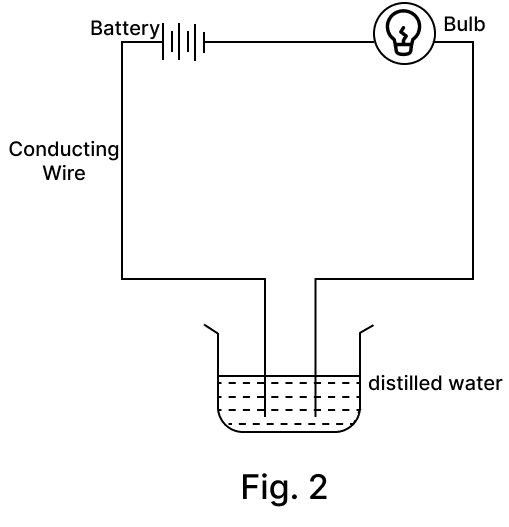
After this realization, she added a substance to the distilled water for electrolysis to take place.
Answer the following questions based on the information given above:
(a) Which gas was she expecting to be formed at the anode and which one at the cathode respectively?
(b) Why did the bulb not glow when Amrita passed electricity through distilled water?
(c) Which substance was added by Amrita to distilled water to get the expected result?
Answer
(a) Amrita was expecting oxygen gas to be formed at the anode and hydrogen gas to be formed at the cathode.
(b) The bulb did not glow because distilled water is a poor conductor of electricity. Pure water has few ions, which are necessary to carry electric current. Since it lacks free ions, current cannot flow through it, and therefore, electrolysis cannot take place initially.
(c) To make the water a good conductor, Amrita added a few drops of dilute sulphuric acid (H2SO4) or a small amount of sodium chloride (NaCl).
Identify the type of reaction :
(a)
(b)
(c)
Answer
(a) Redox reaction.
Explanation — In this reaction, carbon reduces zinc oxide (ZnO) to zinc (Zn) while itself gets oxidized to carbon monoxide (CO). Hence, both oxidation and reduction occur simultaneously, which characterizes a redox process.
(b) Decomposition reaction.
Explanation — In this reaction, zinc carbonate (ZnCO3) breaks down on heating to form zinc oxide (ZnO) and carbon dioxide (CO2). It is also an endothermic reaction because heat energy is absorbed during the decomposition process.
(c) Combination reaction.
Explanation — In this reaction, magnesium (Mg) combines with oxygen (O2) to form magnesium oxide (MgO). It is also an exothermic reaction because a large amount of heat and light is released during the formation of magnesium oxide.
Sara took 2 mL of dilute NaOH solution in a test tube and added two drops of phenolphthalein solution to it. The solution turned pink in colour. She added dilute H2SO4 to the above solution drop by drop until the solution in the test tube became colourless. 40 drops of dilute H2SO4 were used for the change in colour from pink to colourless. When Sara added a drop of NaOH to the solution, the colour changed back to pink again.
Sara now tried the activity with different volumes of NaOH and recorded her observation in the table given below :
| S. No. | Volume of dil. NaOH taken (mL) | Drops of dil. H2SO4 used |
|---|---|---|
| 1 | 2 | 20 |
| 2 | 3 | 30 |
| 3 | 4 | 40 |
Answer the following questions based on the above information:
(a) If Sara used concentrated H2SO4 in place of dilute H2SO4, how many drops will be required for the change in colour to be observed?
- 40
- < 40
- > 40
Justify your answer.
(b) Sara measured 20 drops of dil. H2SO4 and found its volume to be 1 mL. If Sara observed a change in colour of NaOH solution by using 3 mL of H2SO4, how many mL of NaOH did she add to the test tube initially?
OR
Sara takes 10 drops of dilute H2SO4 in the test tube and adds two drops of phenolphthalein solution to it. Then she adds NaOH dropwise. Sara observes a change in colour after adding 20 drops of NaOH. What change in colour would she observe and why?
(c) Write a balanced chemical equation for the reaction taking place in the above experiment. Which of the following is true and why? The reaction is a
- neutralisation and double displacement reaction
- neutralisation and precipitation reaction
- precipitation and double displacement reaction
- neutralisation, double displacement as well as precipitation reaction.
Answer
(a) < 40 drops.
Concentrated H2SO4 provides more H+ ions per drop than dilute acid, so fewer drops are needed to neutralise the same amount of NaOH and discharge the pink colour of phenolphthalein.
(b) From Sara’s note, 20 drops = 1 mL.
If she used 3 mL H2SO4, that is 60 drops and her table shows the drops of acid are proportional to the mL of NaOH (20 drops per 2 mL NaOH → 10 drops per 1 mL NaOH).
Thus 60 drops of acid would neutralise 6 mL of NaOH.
OR
If she starts with dilute H2SO4 plus phenolphthalein and then adds NaOH dropwise, the solution will change from colourless to pink when the solution becomes basic, because phenolphthalein is colourless in acid and pink in base.
(c) Balanced equation:
2NaOH + H2SO4 → Na2SO4 + 2H2O
This is a neutralisation and double displacement reaction because the acid and base react to form salt + water (neutralisation). Ions exchange partners (Na+ with H+/SO42-), so it’s double displacement. It is not a precipitation reaction because sodium sulphate (Na2SO4) is soluble in water.
A hydrocarbon with the formula CxHy undergoes complete combustion as shown in the following equation :
2CxHy + 9O2 → 6CO2 + 6H2O.
(a) What are the values of ‘x’ and ‘y’?
(b) Give the chemical (IUPAC) name of the hydrocarbon.
(c) Draw its electron dot structure.
(d) Name the alcohol which on heating with conc. H2SO4 will produce the above hydrocarbon CxHy.
(e) Write a balanced chemical equation for the reaction of CxHy with hydrogen gas in presence of Nickel.
Answer
(a) From conservation of mass,
Number of carbon atom on L.H.S. = Number of carbon atom on R.H.S
⇒ 2x = 6
⇒x = = 3
Also,
Number of hydrogen atoms on L.H.S. = Number of hydrogen atoms on R.H.S
⇒ 2y = 2 x 6 = 12
⇒ y = = 6
So the hydrocarbon is C3H6.
(b) IUPAC name of C3H6 is Propene.
(c) Electron-dot structure of propene is shown below :

(d) Propanol.
(e) Hydrogenation with Ni:
The electronic structures of atoms P and Q are shown below :

Based on the information given above, answer the following questions:
(a) If P and Q combine to form a compound, what type of bond is formed between them?
(b) Give the chemical formula of the compound formed.
(c) The compound so formed is dissolved in water. Is the resultant solution acidic or basic in nature? Justify your answer.
(d) Write the chemical equation for the reaction between ‘Q’ and ethanol.
(e) What will be the formula of the compound formed when ‘P’ undergoes bonding with carbon?
Answer
(a) Ionic bond.
Atom Q has 1 valence electron and atom P has 6 valence electrons so Q transfers its one electron to P (which needs two electrons to complete an octet), so ions Q+ and P2- attract electrostatically and form an ionic bond.
(b) Because two Q+ ions are needed to balance the -2 charge on one P2- ion, the simplest whole-number ratio is Q2P.
(c) As, Q2P is a metal oxide and metal oxides react with water to give alkalies, so the solution turns basic.
(d) 2C2H5OH + 2Q → 2C2H5OQ + H2 (↑)
(e) If P is oxygen-like (valency 2), carbon (valency 4) combines to give CP2 (analogous to CO2).
A hydrocarbon with the formula CxHy undergoes complete combustion as shown in the following equation:
2CxHy + 9O2 → 6CO2 + 6H2O
(a) What are the values of ‘x’ and ‘y’?
(b) Give the chemical (IUPAC) name of the hydrocarbon.
(c) Is CxHy a saturated or an unsaturated hydrocarbon?
(d) Name the alcohol which on heating with conc. H2SO4 will produce the above hydrocarbon CxHy.
(e) Write a balanced chemical equation for the reaction of CxHy with hydrogen gas in presence of Nickel.
Answer
(a) From conservation of mass,
Number of carbon atoms on L.H.S. = Number of carbon atoms on R.H.S
⇒ 2x = 6
⇒ x = = 3
Also,
Number of hydrogen atoms on L.H.S. = Number of hydrogen atoms on R.H.S
⇒ 2y = 2 x 6 = 12
⇒ y = = 6
So the hydrocarbon is C3H6.
(b) IUPAC name of C3H6 is Propene.
(c) CxHy = C3H6 is an unsaturated hydrocarbon as it fits the general formula CnH2n and contains a C=C double bond, so it undergoes addition reactions.
(d) Propanol.
(e) Hydrogenation with Ni:
Oxygen can combine with both metals and non-metals. It combines with Calcium to form CaO and with carbon to form CO2.
(a) What type of bond is formed between carbon and oxygen?
(b) Identify the type of bond formed between Calcium and oxygen.
(c) Which of the above compounds will be a good conductor of electricity in molten state and why?
(d) Comment on the physical state (solid, liquid or gas) of CaO and CO2.
(e) What is the valency of carbon in CO2?
Answer
(a) The bond formed between carbon and oxygen is a covalent bond because both are non-metals and share electrons to complete their octets.
(b) The bond between calcium and oxygen is an ionic bond. Calcium, a metal, donates two electrons to oxygen, a non-metal, forming Ca2+ and O2- ions held together by electrostatic attraction.
(c) Calcium oxide (CaO) will be a good conductor of electricity in molten state because in this state the ions are free to move, allowing electric current to pass.
(d) CaO is a solid, while CO2 is a gas under normal conditions because CaO is an ionic compound with strong electrostatic forces, whereas CO2 is a simple covalent molecule with weak intermolecular forces.
(e) The valency of carbon in CO2 is 4, as each carbon atom forms two double bonds with two oxygen atoms to complete its octet.
Arnav was making notes and he wrote down the following statements from his understanding of reflection from curved surfaces.
I. Concave mirrors can produce both real and virtual images depending on the position of the object.
II. Convex mirrors always produce real, inverted images regardless of the object’s position.
III. In both concave and convex mirrors, the image location can be determined using the mirror formula where is the focal length, is the image distance, and is the object distance.
Choose from the following the correct option that lists the correct statements about reflection from curved surfaces.
options
- I and II
- I, II and III
- II and III
- I and III
Answer
I and III
Reason —
- I is true because a concave mirror forms real, inverted images when the object is beyond the focus, and a virtual, erect image when the object is between the pole and focus.
- II is false because a convex mirror always gives a virtual, erect, and diminished image—never real.
- III is true because for both concave and convex mirrors, the mirror formula applies (with the appropriate sign convention).
Hence, statements I and III are correct.
Choose the correct option from the below which explains the reason for us to perceive the day sky as blue.
options
- As sunlight passes through the atmosphere, shorter wavelengths, such as blue are scattered more than other colors.
- The sky appears blue because all colors are scattered equally, but blue light is stronger and more visible to the human eye.
- The blue color of the sky is due to longer wavelengths like red and orange scattering more than shorter wavelengths, making blue stand out more.
- The atmosphere contains blue-colored particles that give the sky its blue appearance.
Answer
As sunlight passes through the atmosphere, shorter wavelengths, such as blue are scattered more than other colors.
Reason — When sunlight enters the Earth’s atmosphere, it interacts with tiny air molecules and dust particles which is known as Rayleigh scattering.
The amount of scattering is inversely proportional to the fourth power of the wavelength, meaning shorter wavelengths (like blue and violet) are scattered much more than longer wavelengths (like red and yellow).
Although violet light is scattered even more than blue, our eyes are more sensitive to blue light.
Therefore, the sky appears blue to us during the day due to difference in scattering amount for different colours (wavelengths).
Assertion (A): A point object is placed at a distance of 26 cm from a convex mirror of focal length 26 cm. The image will not form at infinity.
Reason (R): For above given system the equation gives v = ∞.
options
- Both A and R are true, and R is the correct explanation of A.
- Both A and R are true, and R is not the correct explanation of A.
- A is true but R is false.
- A is false but R is true.
Answer
A is true but R is false.
Reason —
Assertion (A) is true because For a convex mirror with = +26 cm and an object at = −26 cm (in front of the mirror), the mirror formula gives;
Hence, the image is not at infinity.
Reason (R) is false because using the same formula does not give v = ∞.
Therefore, A is true but R is false.
The below image shows the formation of an image with an optical instrument.

(a) Identify the optical instrument (shown schematically as a rectangle) in the image.
(b) What type of image is formed in this case?
(c) Based on the measurements given in the image, calculate the focal length of the instrument.
Answer
(a) It’s a concave (diverging) lens since the emergent rays diverge and their backward extensions meet on the same side as the object.
(b) Virtual image is formed.
(c) From the figure,
- Object distance () = -20 cm
- Image distance () = -10 cm
Let, focal length of the lens be 'f'.
By using the lens formula,
So the focal length is −20 cm where negative sign accounts for a concave lens.
(a) Under what conditions can a convex lens form a virtual image?
(b) Why does a piece of paper catch fire if we allow sunlight to pass through a convex lens onto the paper?
Answer
(a) A convex lens can form a virtual image when the object is placed between the lens and its focal point (F). In this case, the refracted rays diverge but their backward extensions appear to meet on the same side as the object, forming a virtual, erect, and magnified image.
(b) A piece of paper catches fire when sunlight is passed through a convex lens because the lens converges the parallel rays of sunlight to a single point called the focus. This concentration of light increases the energy density and temperature at that point. When the temperature rises above the ignition point of paper, it catches fire.
Find out the following in the electric circuit given in the figure-

(a) Effective resistance of two 8 ohm resistors in the combination.
(b) Current flowing through the 4-ohm resistor
Answer
(a) From the figure, two 8 ohm resistors are connected in parallel combination. Their effective resistance is given by,
Here, = 8 ohm,
Hence, the effective resistance of two 8 ohm resistors in the combination is 4 ohm.
(b) Since and 4 ohm resistance are in series, their effective resistance is given by,
Let net current flowing through the circuit be ''.
Now, this same current flows through and 4 ohm resistance then
Hence, the current flowing through the 4 ohm resistor is 1 A.
Study the circuit and find out-

(a) Current in 12 ohm resistor
(b) Difference in the readings of ammeter A1 and A2 if any
Answer
(a) From the diagram,
Two resistors of 24 ohm are connected in parallel and their effective resistance is given by,
Here, = 24 ohm,
Since and 12 ohm resistance are in series then their effective resistance is given by,
Let net current flowing through the circuit is ''.
Now, this same current flows through and 12 ohm resistance then
Hence, the current flowing in 12 ohm resistor is 0.25 A.
(b) The total current flowing from the battery passes through A1, A2 and the resistors and finally returns to the battery. Since no current is lost or divided at any point, A1 and A2 will show the same reading of 0.25 A.
Then,
Difference in the readings of ammeter A1 and A2 = 0.25 - 0.25 = 0 A
Hence, the difference in the readings of ammeter A1 and A2 is zero.
You are given four resistors each having resistance of R ohm. Find the maximum and minimum resistance that can be made with these four resistors.
Answer
Given,
- Value of each resistor = R ohm
Maximum resistance
To get the maximum resistance, connect all four resistors in series combination where the total resistance of the combination is given by,
Minimum resistance
To get the minimum resistance, connect all four resistors in parallel combination where the total resistance of the combination is given by,
Hence, the maximum resistance is and minimum resistance is .
A copper wire has a length L = 2 m, a cross-sectional area A = 0.5 mm2, and resistivity ρ = 1.7 × 10⁻⁸ Ωm. Calculate the resistance of another wire made of the same material whose length is twice the length of the wire but has the same cross-sectional area.
Answer
Given,
- Initial length (L) = 2 m
- Initial area (A) = 0.5 mm2 = 0.5 x 10⁻⁶ m2
- Resistivity (ρ) = 1.7 × 10⁻⁸ Ωm
- Final length (L') = 2 x L = 2 x 2 m = 4 m
- Final area (A') = A = 0.5 mm2 = 0.5 x 10⁻⁶ m2
Resistance when L = 2 m is given by,
Resistance when L' = 4 m is given by,
Hence, the resistance of the wire when the length is double is 0.136 Ω.
The below image shows a corrective measure for a particular defect of vision.

(a) Identify the defect of vision and state what kind of lens is used to correct this deficiency.
(b) Draw and label a ray diagram that shows the defect of vision in the above case before correction.
Answer
(a) The defect of vision shown is hypermetropia (long-sightedness).
Explanation : In this defect, the eye cannot focus clearly on near objects because the image of a nearby object is formed behind the retina so to correct this, a convex (converging) lens is used in front of the eye. The convex lens first converges the diverging rays from the near object so that, after refraction through the eye lens, the image forms exactly on the retina
(b) The labelled ray diagram showing hypermetropia defect is given below :

(a) What is dispersion of light?
(b) Explain the condition under which dispersion happens?
(c) Give one reason that causes presbyopia.
Answer
(a) Dispersion of light is the phenomenon in which white light separates into its component colours (spectrum) when it passes through a medium, such as a prism. Different colours of light bend through different angles with respect to incident light, thus becoming distinct.
(b) Dispersion occurs when light passes from one medium to another where the speed of light is different for each wavelength. For example, in a prism, each colour of light has a different refractive index due to varying wavelengths, causing each colour to bend at different angles as they exit the prism. Dispersion only happens if the medium has a variable refractive index across different wavelengths, like glass or water.
(c) Presbyopia is caused by the gradual loss of flexibility in the lens of the eye, which occurs with aging. This reduced flexibility prevents the lens from changing shape effectively to focus on close objects, making it difficult to see them clearly.
A student needs to make a 0.12 Ω resistor. She has some copper wire of 0.80 mm diameter. Resistivity of copper is 1.8 × 10⁻⁸ Ωm
(a) Determine the cross-sectional area of the wire.
(b) Calculate the length of wire required for the 0.12 Ω resistor
Answer
Given,
- Resistance () = 0.12 Ω
- Diameter of the wire () = 0.80 mm = 0.80 x 10⁻³ m
- Resistivity of copper () = 1.8 × 10⁻⁸ Ωm
(a) Area of cross-sectional () is given by,
Thus, the cross-sectional area is approximately 5.02 x 10⁻⁷ m2.
(b) Let length of the conductor be ''.
Now, resistance (R) of the wire is given by,
On putting values,
The student needs a length of approximately 3.34 m of given copper wire to make a 0.12 Ω resistor.
Magnetic field lines are shown in the given diagram. A student makes a statement that the magnetic field at X is stronger than at Y.

(a) Explain with reason if the student’s claim is correct.
(b) Also redraw the diagram and mark the direction of magnetic field lines.
Answer
(a) The student’s claim is correct because the strength of a magnetic field is indicated by how close together the magnetic field lines are. Near point X, which is close to the pole (N) of the magnet, the field lines are closer, so the magnetic field is stronger there and at point Y, the field lines are more spread out, so the field is weaker.
(b) The completed and marked diagram is shown below :

The below image is that of a Digital Single Lense Reflector (DSLR) Camera which are used to take high resolution photographs by professional photographers. The second image of the below two is a schematic diagram of how an image is formed on the sensor of the camera. Based on your understanding of the lenses, answer the following questions.
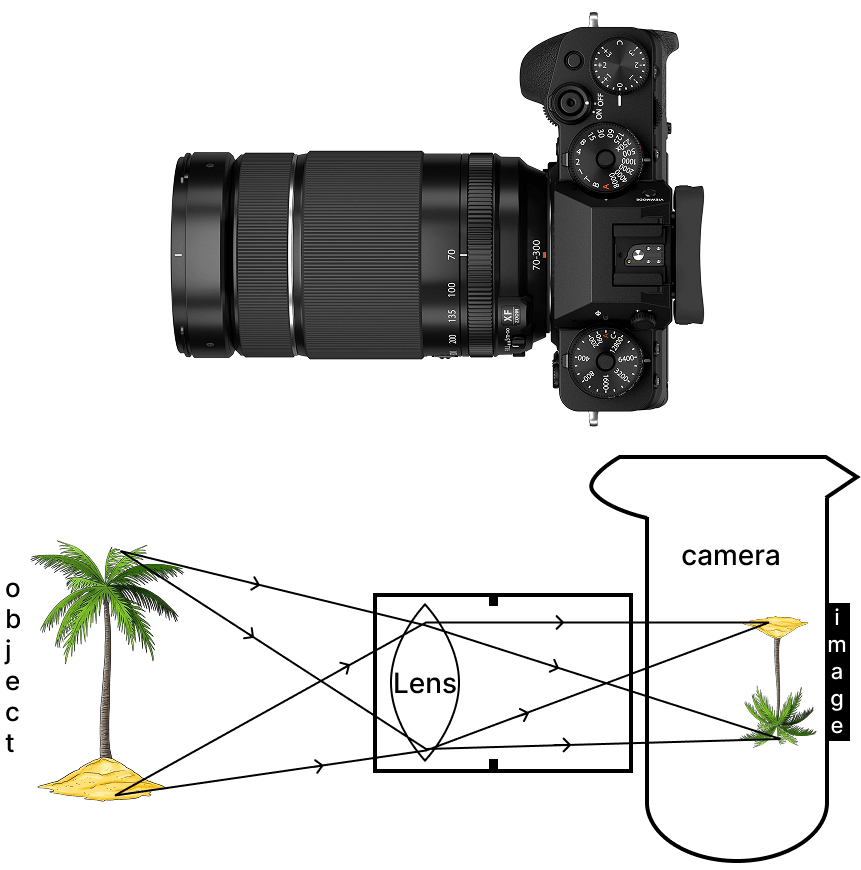
(a) What type of lens is used in the DSLR camera shown in the image?
(b) What type of image is formed on the sensor?
Attempt either subpart C or D.
(c) A photographer is using a DSLR camera with a lens of focal length f = 50 mm to take a close-up photograph of a small object. The lens projects an image onto the camera sensor that is located 60 mm behind the lens. Calculate the object distance (i.e., the distance between the object and the lens).
OR
(d) A photographer is using a DSLR camera to take a picture of a flower. The flower is positioned 150 mm away from the camera lens. The actual height of the flower is 80 mm, and the image height formed on the camera’s sensor is measured to be 20 mm. Calculate the focal length of the camera lens.
Answer
(a) Convex Lens.
(b) Real and Inverted.
(c) Given,
- Focal length of the lens () = 50 mm
- Image distance () = 60 mm
Let, object distance be ''
By using the lens formula,
Thus, the negative sign indicates that the object is located 300 mm in front of the lens (on the opposite side from the image).
(d) Given,
- Object distance () = -150 mm
- Actual height of the flower () = 80 mm
- Image height of the flower () = -20 mm
Here, negative sign indicates that the object is in front of the lens and the image is inverted.
As, magnification () of a lens is given by,
Let, image distance be ''.
Then,
Let, focal length of the lens be ''.
Then, by using the lens formula,
Hence, the focal length of the camera lens is 30 mm.
Zarina worked as an apprentice in a factory where flashlights and solar cookers are made. She learnt to make the circuits, the design of the light-box and light concentrators of the solar cookers as well. She learnt the uses of lenses in making all those tools. Based on your understanding of lenses, answer the following questions.
(a) What kind of lenses are used in the flashlight and light concentrator of the solar-cooker?
(b) Give reasons for your choices in your answer for part A.
Attempt either subpart C or D.
(c) An object is placed 40 cm away from a lens which is normally used in a solar-cooker. The image formed is twice the size of the object. Calculate the focal length of the lens.
OR
(d) An object is placed 20 cm in front of a lens which is used in a flashlight, and the image is formed 10 cm away from the lens on the same side as the object. Calculate the focal length of the lens.
Answer
(a) Concave Lens for Flashlight and Convex Lens for solar cooker.
(b) Concave lens diverges the light rays which is needed for a wider reach of the flashlight and convex lens converges the rays which helps to raise the temperature of the place where rays converge.
(c) Given,
- Object distance () = -40 cm
- Size of the image () = -2 x Size of the object ()
Here, negative sign indicates that the object is in front of the lens and the image is inverted.
As, magnification () of a lens is given by,
Let, image distance be ''.
Then,
Let, focal length of the lens be ''.
Then, by using the lens formula,
Hence, the focal length of the lens is approximately 26.67 cm.
(d) Given,
- Object distance () = -20 cm
- Image distance () = -10 cm
Here, negative sign indicates that both the object and the image are in front of the lens.
Let, focal length of the lens be ''.
Then, by using the lens formula,
Hence, the focal length of the lens is -20 cm, indicating it is a diverging lens (concave lens).
The arrangement of resistors shown in the below figure is connected to a battery.

The power dissipation in the 100 Ω resistor is 81 W. Calculate
(a) the current in the circuit
(b) the reading in the voltmeter V2
(c) the reading in the voltmeter V1
Answer
Given,
Power dissipated in 100 Ω resistor () = 81 W
(a) Let, current in the circuit be ''.
Then,
Hence, the current in the circuit is 0.9 A.
(b) From the figure, two 25 Ω resistors are in parallel and their effective resistance is given by,
The reading in the voltmeter V2 is same as the potential difference across which is given by,
Hence, the reading in the voltmeter V2 is 11.25 V.
(c) Now, is in series with 100 Ω resistor and their effective resistance is given by,
The reading in the voltmeter V1 is same as the voltage supply of the battery which is given by,
Hence, the reading in the voltmeter V1 is 101.25 V.
An electric heater consists of three similar heating elements A, B and C, connected as shown in the figure below. Each heating element is rated as 1.2 kW, 240 V and has constant resistance. S1, S2 and S3 are respective switches.
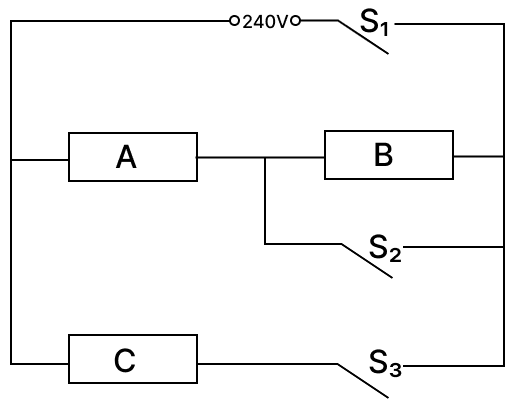
The circuit is connected to a 240 V supply.
(a) Calculate the resistance of one heating element.
(b) Calculate the current in each resistor when only S1 and S3 are closed.
(c) Calculate the power dissipated across A when S1, S2 and S3 are closed.
Answer
Given,
- Power rating of each heater () = 1.2 kW = 1.2 x 1000 W = 1200 W
- Voltage rating of the heater () = Voltage supply = 240 V
(a) Resistance of one heating element is given by,
Hence, the resistance of one heating element is 48 Ω
(b) When S1 and S3 are closed then heating elements A and B are in series and this whole arrangement is in parallel combination with C.
Then,
Potential difference across A and B = Potential difference across C = 240 V
Now,
Since A and B are connected in series then their effective resistance is given by,
Then,
Hence, current through heating elements A nd B is 2.5 A and through C is 5 A.
(c) When S1, S2 and S3 are closed then current only flows through A but no current flows through B since current takes path of minimum resistance.
So elements A and C are in parallel and have same resistance it means current flowing through them will be equal.
Current through A = Current through C = 5 A
Then,
Hence, power dissipated across A is 1200 W.
(a) Explain why in household circuits only the fuse is connected in series with all the rest of the appliances but all appliances are connected in parallel to each other.
(b) In a household circuit, an electric heater of power 1500 W and a fan of power 500 W are connected in parallel to a 220 V supply. A fuse rated for 10 A is connected to the circuit to protect it from excessive current.
- Calculate the total current drawn by the heater and the fan.
- Determine whether the 10 A fuse is appropriate for this circuit or if it will blow.
Answer
(a) In household circuits, the fuse is connected in series with all appliances to ensure that it can cut off the entire circuit in case of excessive current, preventing hazards like fires or damage. This way, any overload or short circuit causes the fuse to blow, protecting all appliances.
Appliances are connected in parallel to ensure each receives the same voltage from the mains and can operate independently. This setup allows appliances to work simultaneously and efficiently, with each drawing only the current it needs, without affecting others.
(b) Given,
- Power rating of the heater () = 1500 W
- Power rating of the fan () = 500 W
- Supply voltage () = 220 V
- Current rating of the fuse () = 10 A
(a) Let, current passing through the heater be and through the fan is .
Then,
Similarly,
Total current drawn by the heater and the fan = = 6.82 + 2.27 = 9.09 A
Hence, the total current drawn by the heater and the fan is about 9.09 A.
(b) As, I > 9.09 A
Since 9.09 A < 10 A, the fuse will not blow and is appropriate for this circuit, as the total current is within the fuse’s capacity.
Two resistors, R1 = 6 Ω and R2 = 12 Ω, are connected in parallel to a 24 V battery. The circuit operates for 5 minutes.
(a) Calculate the total heat generated in both resistors.
(b) If each resistor has a power rating of 100 W, determine whether it is safe to use these resistors in the circuit.
Answer
Given,
- R1 = 6 Ω
- R2 = 12 Ω
- Battery voltage () = 24 V
- Operating time of the circuit () = 5 minutes = 5 x 60 = 300 seconds
(a) Since the resistors are connected in parallel, the voltage across each resistor is the same as the battery voltage, = 24 V.
On using Ohm’s Law ,
Then, current through R1 is given by,
And, current through R2 is given by,
On using Joule’s Law of Heating (),
Now, heat generated in R1 is given by,
Similarly,
Heat generated in R2 is given by,
Total heat generated = = 28800 + 14400 = 43200 J
So, the total heat generated in both resistor is 43200 J.
(b) Given,
Power rating of each resistor = 100 W
The power dissipated by each resistor can be calculated using
Then,
Power dissipated by R1 is given by,
Similarly,
Power dissipated by R1 is given by,
As, R1 is operating at 96 W and R2 at 48 W, which is within the 100 W limit.
Hence, it is safe to use both R1 and R2 in the circuit.