
Which of the following statement(s) is/are correct?
Statement 1: A market refers to a physical place where buyers and sellers meet to exchange goods and services.
Statement 2: A market can also refer to a mechanism through which products and services are exchanged without the necessity of a physical meeting.
- Only Statement 1 is correct
- Only Statement 2 is correct
- Both statements are correct
- Both statements are false
Answer
Both statements are correct
Reason — In common language, a market refers to a physical place like a haat, bazaar or shopping mall where buyers and sellers meet. However, in a wider sense, a market is a mechanism through which products and services are exchanged, sold and transferred — even when buyers and sellers transact through telephone, internet or other means without meeting each other. Hence both statements describe valid concepts of a market.
In a consumer's market, goods are purchased for further production rather than for personal consumption.
- True
- False
Answer
False
Reason — A consumers' market is a market where goods are purchased for personal consumption. The market in which goods are purchased for use in further production is called a producers' market.
Which is intangible among the following?
- Product
- Services
- Products & services
- Sales
Answer
Services
Reason — Services are intangible acts or performances which cannot be seen, touched or physically possessed. A product, on the other hand, is tangible and has a physical form. Hence, among the given options, services are intangible.
Selling involves ............... of goods and services.
- Distribution
- Exchange
- Advertisement
- None of these
Answer
Exchange
Reason — Selling is essentially the exchange of goods and services between a buyer and a seller for money or money's worth. The transfer of ownership from the seller to the buyer takes place through this exchange.
Which of the following is not the feature of marketing?
- Exchange mechanism
- Customer value
- Corrective action
- All of these
Answer
Corrective action
Reason — Exchange mechanism and customer value are essential features of marketing. Corrective action is a control function of management and not a feature of marketing. Marketing is concerned with creating, communicating and delivering value to customers.
Which function of management starts before production and continues even after sale?
- Planning
- Controlling
- Marketing
- Directing
Answer
Marketing
Reason — Marketing begins with the identification and understanding of customer needs (before production) and continues even after the sale through feedback, customer service and after-sale services. It is a continuous process that integrates all activities of the enterprise around customer satisfaction.
............... philosophy suggests, that, the organisation should earn profit through volume of production.
- Production concept
- Marketing concept
- Pricing concept
- Societal concept
Answer
Production concept
Reason — The production concept assumes that customers will buy products that are inexpensive and easily available. Hence, organisations focus on mass production to reduce cost and earn profit through high volume of production and wide distribution.
Which marketing concept places importance to attract and persuade customers to buy the products?
- Selling concept
- Production concept
- Product concept
- Societal concept
Answer
Selling concept
Reason — The selling concept (sales-oriented stage) believes that consumers will not buy enough unless they are approached with substantial selling and promotional efforts. Hence, the focus is on persuading and attracting customers through aggressive selling.
A place for buying and selling activities is called ...............
- Market
- Marketing
- Market research
- Market information
Answer
Market
Reason — A market, in its place concept, refers to a physical location where buyers and sellers meet to carry out buying and selling activities. It may be a haat, bazaar or shopping mall.
Which of the following is the feature of the marketing?
- Needs and wants
- Creating a market offering
- Customer value
- All of these
Answer
All of these
Reason — Marketing is concerned with identifying needs and wants of customers, creating a market offering (products and services) to satisfy those needs, and delivering customer value. Hence, all the given options are features of marketing.
Below is an image of a product with a clear brand name and packaging. Identify which feature of a product this represents:

- Tangibility
- Associated Attributes
- Life Cycle
- Exchange Value
Answer
Associated Attributes
Reason — The image shown is of a toothpaste, which is a daily-use item purchased frequently and with minimum effort. Brand name and packaging are part of the associated attributes of a product, which help in identification, differentiation, and promotion.
Why might the "Sales-Oriented Stage" be considered less effective in today's market environment?
- It focuses primarily on high production efficiency
- It places customer satisfaction secondary to selling the product
- It emphasizes product quality over marketing
- It relies heavily on network marketing
Answer
It places customer satisfaction secondary to selling the product
Reason — The sales-oriented stage focused mainly on increasing sales through hard selling and promotional efforts. Customer satisfaction was secondary to selling the product. In today's competitive market, long-term success depends more on understanding and satisfying customer needs.
The definition of marketing includes only the promotional activities of a product or service, not the distribution.
- True
- False
Answer
False
Reason — Marketing is not limited to promotion. It includes all activities involved in planning, pricing, promoting and distributing want-satisfying products and services. Therefore, distribution is an important part of marketing.
"It is a set of tangible and physical attributes such as material, colour, design, size, weight, etc., assembled in an identifiable form that a seller offers to customers for sale." What is it?
- Service
- Price
- Product
- Place
Answer
Product
Reason — A product is a tangible physical object that can be offered to a market for attention, acquisition, use or consumption and can satisfy a want or need. It includes physical attributes such as colour, design, size, weight and packaging.
If a business is focusing on selling products directly to consumers without the involvement of intermediaries, which type of market would they most likely be operating in?
- Producers' Market
- Network Market
- Retail Market
- Wholesale Market
Answer
Network Market
Reason — In a network market (multi-level marketing), the marketer recruits independent distributors who eventually sell the product directly in the homes of customers, bypassing traditional retail intermediaries. Modicare pioneered network marketing in India. Wholesale and retail markets, in contrast, involve intermediaries, and a producers' market refers to goods purchased for further production.
Bread and milk are which kind of products?
- Specialty Products
- Convenience products
- Shopping products
- Unsought products
Answer
Convenience products
Reason — Bread and milk are purchased frequently and with minimum effort. Such daily-use products meant for personal convenience are called convenience products.
What is the basic property of a service which makes it different from a product?
- Shape
- Size
- Very expensive
- Intangibility
Answer
Intangibility
Reason — The most basic property that distinguishes a service from a product is intangibility. Services cannot be seen, touched or felt, whereas a product is tangible and has a definite physical shape and size.
In the Production-Oriented Stage, businesses operated on the assumption that supply would create its own demand.
- True
- False
Answer
True
Reason — The production-oriented stage (1869–1930) was based on Say's Law which states that 'Supply creates its own demand.' During this stage, demand exceeded supply and customers were willing to buy whatever was produced, so the focus was on mass production rather than creating demand.
Which of the following is not a service?
- Insurance
- Warehousing
- Transportation
- None of these
Answer
None of these
Reason — Insurance, warehousing and transportation are all services. Insurance companies provide insurance services, warehouses provide storage services, and railways/airways provide transport services. Therefore, none of the listed options is a non-service.
A ............... is technology based whereas a ............... is person-based.
- Sales, product
- Product, market
- Product, promotion
- Product, service
Answer
Product, service
Reason — A product is technology based — its quality depends largely on the production technology used (e.g., manufacturing of a car). A service is person-based — its quality depends largely on the skill of the person providing the service (e.g., a mechanic repairing a car).
Which of the following products are used for further production of goods and services.
- Consumer products
- Industrial products
- Financial products
- None of these
Answer
Industrial products
Reason — Industrial products are purchased for use in the production of other goods. They include raw materials, supplies, accessory equipment and installations. Consumer products, on the other hand, are meant for final consumption.
The asset which can only be perceived indirectly such as an insurance policy is called ...............
- Tangible product
- Intangible product
- Service
- None of these
Answer
Service
Reason — An insurance policy is a service because it is intangible and can only be perceived indirectly. The customer pays for the protection or assurance offered, not for any physical product. Insurance services are provided by insurance companies like LIC.
Choose the correct statement.
- Marketing is the process of transferring the ownership from producer to buyer.
- Selling is a wider term than marketing.
- Marketing seeks to create demand, to satisfy the customers, to increase markets shares etc.
- None of the above
Answer
Marketing seeks to create demand, to satisfy the customers, to increase markets shares etc.
Reason — Marketing is much wider than mere transfer of ownership; that is selling. Marketing is a broader concept than selling and includes a range of activities — creating demand, satisfying customers, expanding market share, planning, pricing, promotion and distribution.
Which type of market is most likely to involve face-to-face interaction but does not require a physical retail setting?
- Mail Order Market
- Catalogue Market
- Automatic Vending Machine Market
- Direct Sales Market
Answer
Direct Sales Market
Reason — In a direct sales market, companies sell their products or services directly to consumers without using a traditional retail setting. It often involves face-to-face interactions either in person or through virtual channels. Mail order and vending machines do not involve face-to-face interaction, and catalogue markets use a showroom (physical retail setting).
Assertion (A): A product can be touched, seen, and physically possessed.
Reason (R): Tangibility is a key characteristic of a product.
- A is true but R is false
- A is false but R is true
- Both A and R are true and R explains A.
- Both A and R are true but R does not explain A.
Answer
Both A and R are true and R explains A.
Reason — A product is tangible, hence it can be seen, touched and physically possessed. Tangibility being a key characteristic of a product is the very reason why it can be physically perceived. Therefore, the Reason correctly explains the Assertion.
Assertion (A): Services are perishable in nature.
Reason (R): Services cannot be stored for future use, unlike physical products.
- A is true but R is false
- A is false but R is true
- Both A and R are true and R explains A.
- Both A and R are true but R does not explain A.
Answer
Both A and R are true and R explains A.
Reason — Services are perishable because they cannot be stored for future use. For example, vacant seats in a bus or unbooked appointments of a doctor cannot be utilised later. The Reason correctly explains the Assertion.
............... means exchange of a product, or service between a buyer and a seller while ............... means all the activities involved in planning, pricing, promoting and distributing want satisfying products and services.
- Sales, selling
- Market, marketing
- Product, promotion
- Cost, pricing
Answer
Market, marketing
Reason — A market refers to the exchange of products or services between buyers and sellers. Marketing is a wider concept that includes all activities such as planning, pricing, promotion and distribution involved in satisfying customer wants.
A company must balance profits, consumer satisfaction and public welfare. Which stage of marketing emphasises on the given statement?
- Sales-oriented stage
- Product-oriented stage
- Societal marketing stage
- Marketing-oriented stage
Answer
Societal marketing stage
Reason — The societal marketing stage (1980–till present) requires marketers to balance company profits, consumer satisfaction and public interest. It expects marketers to build social and ethical considerations into their marketing practices.
During the ............... stage, from 1950-1960; marketers' focus shifted from promotion to product improvement?
- Marketing oriented stage
- Product oriented stage
- Production oriented stage
- Sales oriented stage
Answer
Product oriented stage
Reason — During the product-oriented stage (1950–1960), marketers believed that customers would buy a product if its quality was good. Hence, the focus shifted from promotion to product improvement, with firms making efforts to improve product features and performance.
............... is the type of market on the basis of nature of goods.
- Wholesale market
- Retail market
- Money market
- Consumers' market
Answer
Consumers' market
Reason — On the basis of the nature of goods, markets are classified into consumers' market (goods purchased for personal consumption) and producers' market (goods purchased for further production). Wholesale and retail markets are based on volume of business, while money market is based on subject of exchange.
In this type of market, customers select goods by reading the detailed literature and examining the samples:
- Mail order market
- Tele market
- Catalogue market
- Online market
Answer
Catalogue market
Reason — In a catalogue market, samples of products and a catalogue (containing details of goods and their prices) are kept in the showroom. Customers select goods by reading the catalogue and examining the samples, and orders are sent to the warehouse for supply.
In this stage of marketing, the motto was to 'Sell what can be produced':
- Product oriented stage
- Production oriented stage
- Marketing oriented stage
- Sales oriented stage
Answer
Production oriented stage
Reason — In the production-oriented stage (1869–1930), the motto was to 'sell what can be produced.' There was acute shortage of goods, demand exceeded supply, and customers bought whatever was produced. The focus was on mass production and mass distribution.
The products bought after comparing quality, price, etc of different brands are known as:
- Shopping products
- Speciality products
- Industrial products
- Convenience products
Answer
Shopping products
Reason — Shopping products are those purchased after a comparative analysis of quality, price, warranty and other features of competitive brands. Examples include furniture, cloth, TV, fridge, washing machine and cars.
In which type of market, products are advertised and demonstrated on television?
- TV advertisement
- Newspaper advertisement
- Tele market
- Network market
Answer
Tele market
Reason — In a telemarket, products are advertised and demonstrated on television and in newspapers. Toll-free telephone numbers are mentioned, customers place orders on the toll-free number, and orders are executed through courier.
The activity involved in planning, pricing, promoting and distributing products and services is called?
- Marketing
- Selling
- Advertising
- Publicity
Answer
Marketing
Reason — Marketing is defined as all activities involved in planning, pricing, promoting and distributing want-satisfying products and services. Selling, advertising and publicity are only parts of the wider marketing process.
A market is a mechanism through which ............... are exchanged.
- Products and services
- Products and capital
- Services and brands
- Patents and services
Answer
Products and services
Reason — A market is a mechanism through which products and services are exchanged, sold and transferred between buyers and sellers, either through physical meetings or through means like telephone and the internet.
Economic, social, legal and other forces influence marketing activities therefore, marketing is ...............
- A system
- Persuasive
- Part of total environment
- Creative
Answer
Part of total environment
Reason — Marketing operates within the framework of total environment which comprises economic, social, legal, political, international and other forces. Changes in these forces influence marketing activities, making marketing a part of the total environment.
Modern marketing has created several non-traditional markets' like ...............
- Future market
- The international market
- Automatic vending machines
- The consumers' market
Answer
Automatic vending machines
Reason — Automatic vending machines are an example of non-traditional markets created by modern marketing. Future market, international market and consumers' market are all traditional markets classified on different bases.
On the basis of geographical area, market is classified into?
- In-house market
- Regional market
- Primary market
- Spot market
Answer
Regional market
Reason — On the basis of geographical area, markets are classified into local, regional, national and international markets. In-house is a non-traditional market, primary market is on the basis of position of buyers and sellers, and spot market is on the basis of nature of transactions.
Marketing was considered to be mere distribution in this stage of Marketing:
- Production-oriented stage
- Sales-oriented stage
- Product-oriented stage
- Marketing-oriented stage
Answer
Production-oriented stage
Reason — In the production-oriented stage, production and engineering departments shaped the company's goals and strategy. Marketing was dependent on production capacity and consisted of mere distribution. There were no separate marketing departments at that time.
In non-business organization marketing is necessary for ...............
- Creating demand
- Facing competition
- Spreading socially useful ideas
- Widening market
Answer
Spreading socially useful ideas
Reason — In non-business organisations, marketing is necessary for spreading socially useful ideas and programmes such as family planning, adult education, communal harmony, national integration and environmental protection. This is called social marketing.
............... is not a concept of market.
- Area concept
- Demand concept
- People concept
- Supplier concept
Answer
Supplier concept
Reason — The five concepts of market are place, area, demand, exchange and people concepts. There is no 'supplier concept' of market.
Caveat vendor is a principle of:
- Marketing
- Selling
- Personal Selling
- Advertising
Answer
Marketing
Reason — 'Caveat vendor' (let the seller beware) is a principle of marketing where the seller is responsible for the quality and suitability of the product to the customer. This is in line with the modern marketing concept that focuses on customer satisfaction. In contrast, 'caveat emptor' (let the buyer beware) is associated with the selling concept.
Which of the following is not a feature of service?
- Life Cycle
- Perishability
- Inseparability of buyers and sellers
- Variability
Answer
Life Cycle
Reason — The features of services are intangibility, perishability, inseparability and variability. Life cycle is a feature of a product (introduction, growth, maturity and decline), not of a service.
Which market provides long term finance to business enterprises?
- Capital market
- Commodity market
- Primary market
- Money market
Answer
Capital market
Reason — The capital market is a specialised market for providing long-term finance to business enterprises. It comprises specialised financial institutions, stock exchanges, investment trusts and insurance companies. The money market provides short-term finance.
Standardised products are ............... in nature.
- Heterogeneous
- Spontaneous
- Homogeneous
- Extraneous
Answer
Homogeneous
Reason — In case of standardised products, each unit of the product is a perfect substitute for another. It is impossible to differentiate one unit from other units. Such products are homogeneous in nature, e.g., a Maruti car has the same quality irrespective of the place of purchase.
In ............... stage there was a mass production, supply exceeds demand.
- Production-oriented stage
- Marketing-oriented stage
- Sales-oriented stage
- Societal Marketing stage
Answer
Sales-oriented stage
Reason — In the sales-oriented stage (1930–1950), there was mass production and supply exceeded demand. Producers had to use aggressive selling and promotional efforts to dispose of their goods. The motto was 'get rid of what you have'.
In ..............., the purpose is to make profit out of fluctuation in prices.
- Spot market
- Future market
- Catalogue market
- Secondary market
Answer
Future market
Reason — In a future market, buyers and sellers enter into future contracts without the intention of actual delivery of goods. Their purpose is to make profit out of fluctuations in prices. In a spot market, on the other hand, goods are physically transferred from sellers to buyers.
Which stage of marketing is characterised by hard selling?
- Production oriented stage
- Product oriented stage
- Sales oriented stage
- Societal marketing stage
Answer
Sales oriented stage
Reason — The sales-oriented stage was characterised by hard selling. Producers realised that consumers will not buy enough unless they are approached with substantial selling and promotional efforts. The focus was on increasing sales rather than on consumer satisfaction.
Marketing uses ...............
- Integrated approach
- Persuasion and promotion
- Product approach
- Market approach
Answer
Integrated approach
Reason — Marketing uses an integrated approach because it is not a single activity. It is a coordinated process involving several interrelated activities such as planning, pricing, promotion and distribution, all directed towards satisfying customer needs.
Marketing concentrates on ...............
- Increasing the sales volume
- Satisfying advertiser
- Decreasing the sales volume
- Satisfying the customer
Answer
Satisfying the customer
Reason — The modern concept of marketing is customer-oriented. Marketing exists to identify and satisfy the wants of present and potential consumers. Customer is the focus of all marketing activities and customer satisfaction is the principal goal.
Services can rarely be standardized or made uniform. Which feature of service does it indicate?
- Intangibility
- Variability
- Inseparability
- Perishability
Answer
Variability
Reason — Variability means services can rarely be standardised or made uniform. The quality of a service may differ from customer to customer or from one time period to another. For example, the quality of service provided by a waiter in a restaurant may vary on different occasions.
The following passage is excerpted from the book 'MARKETING':
'The success of your business depends on the success of your marketing efforts. If you can identify what customers want, need and can afford- and give it to them- you will achieve outstanding results.'
— Marketing by Brian Tracy
Based on the information provided in the passage, which of the following statement describes Marketing-
- Marketing is beneficial for both buyers and sellers.
- Marketing focuses on short term maximisation of profit.
- Marketing works on the principle of Caveat emptor.
- Marketing begins after the goods are produced.
Answer
Marketing is beneficial for both buyers and sellers.
Reason — The passage highlights that successful marketing identifies and satisfies what customers want, need and can afford, while also helping the business achieve outstanding results. This means buyers get satisfaction of their wants and sellers achieve business success — making marketing mutually beneficial for both parties.
Production-Oriented-Stage was characterised by:
- The focus on Sales Promotion.
- Product improvement.
- Supply creating its own demand.
- Profits through customer satisfaction.
Answer
Supply creating its own demand.
Reason — The production-oriented stage was based on Say's Law: 'Supply creates its own demand.' There was acute shortage of goods, demand exceeded supply, and there was no need to create demand. Customers bought whatever was produced.
Identify which products are purchased after a comparative analysis of quality, price, warranty of competitive brands.
- Convenience products
- Industrial products
- Speciality products
- Shopping products
Answer
Shopping products
Reason — Shopping products are purchased after a comparative analysis of quality, price, warranty and other features of competitive brands. Examples include furniture, cloth, TV, fridge, washing machine, scooters and cars.
In which stage of marketing, manufacturers believed that customers would buy the product if quality was good?
- Marketing-oriented stage
- Production-oriented stage
- Sales-oriented stage
- Product-oriented stage
Answer
Product-oriented stage
Reason — In the product-oriented stage (1950–1960), marketers believed that customers will buy the product if its quality was good. Therefore, the focus shifted from promotion to product improvement, and firms made efforts to improve product features and performance.
In which stage, importance to consumer satisfaction was recognised and business policies were designed to provide value satisfaction to customers?
- Sales-oriented stage
- Marketing-oriented stage
- Social-marketing stage
- Consumer-oriented stage
Answer
Marketing-oriented stage
Reason — In the marketing-oriented stage (1960–1980), producers realised that business policies and programmes should be built around the goal of customer satisfaction. Management began to think of itself not as producing products but as providing value satisfaction to customers. The consumer was considered the 'king' in this stage.
Define the term 'market'.
Answer
A market means a mechanism through which products and services are exchanged, sold and transferred. According to Philip Kotler, "A market is the set of all actual and potential buyers of a product." In a wider sense, a market refers to the sum total of the environment in which resources, activities and attitudes of buyers and sellers affect the demand for products and services.
Briefly explain the term 'Marketing Oriented Stage.'
Answer
The marketing-oriented stage (1960–1980) emerged due to keen competition and growing consumer awareness. In this stage:
- Producers realised that business policies and programmes should be built around the goal of customer satisfaction.
- Management began to think of itself not as producing products but as providing value satisfaction to customers.
- The aim of marketing was to know and understand the customer so well that the product or service fits him and sells itself.
- The consumer was considered the 'king' and customer satisfaction became the principal reason for corporate existence.
What is meant by inhouse market?
Answer
In-house market is a type of non-traditional market where door-to-door salespersons visit the homes of consumers and offer products to them. Initial contact may be created through telephone or mailed-in coupons before the visit. In India, Eureka Forbes sells its water filters and vacuum cleaners through this method. Sometimes, a host invites friends to a party where the salesperson demonstrates the products and takes orders.
Give two differences between the production oriented stage and product oriented stage of marketing.
Answer
| S.No. | Basis of Distinction | Production-oriented Stage | Product-oriented Stage |
|---|---|---|---|
| 1. | Motto | Sell what can be produced. | Improve quality and performance of the product. |
| 2. | Time Period | 1869–1930 | 1950–1960 |
| 3. | Focus | Mass production and wide distribution. | Improvement in product features and performance. |
What are convenience products? Give two examples.
Answer
Convenience products are consumer products that are purchased frequently and with minimum effort. They are meant for personal convenience and are usually low-priced items of daily use.
Examples: Newspapers, soaps (also toothpastes, cigarettes, tea).
Give one difference between capital market and money market.
OR
Distinguish between Capital Market and Money Market. (any one point)
Answer
| S.No. | Basis | Capital Market | Money Market |
|---|---|---|---|
| 1. | Nature of Capital | It is a market for long-term funds. | It is a market for short-term funds. |
Give one difference between consumer product and industrial product.
Answer
| S.No. | Basis | Consumer Product | Industrial Product |
|---|---|---|---|
| 1. | Purpose | Meant for final consumption and not for further use or sale. | Purchased for use in the production of other goods. |
On the basis of ownership, distinguish between a product and a service.
Answer
| S.No. | Basis | Product | Service |
|---|---|---|---|
| 1. | Ownership | Ownership is transferable. When a product is bought, ownership transfers from seller to buyer (e.g., buying a car). | Ownership is not transferable. The buyer only gets the benefit of the service (e.g., hiring a taxi does not transfer ownership of the taxi). |
Why is it said that marketing is pervasive?
Answer
Marketing is said to be pervasive because it is required not only in business organisations but also in social and other non-business organisations. In non-business organisations, marketing is necessary for spreading socially useful ideas and programmes such as family planning, adult education, communal harmony, national integration and environmental protection. Such marketing is called social marketing.
State and explain any two types of markets on the basis of Nature of Transactions.
Answer
On the basis of nature of transactions, markets are classified into two types:
Spot Market: This is a market where goods are physically transferred from sellers to buyers. The transaction is settled on the spot — payment is made and goods are delivered immediately.
Future Market: This is a market where buyers and sellers enter into future contracts without the intention of actual delivery of goods. Their purpose is to make profit out of fluctuations in prices.
"Services are not homogeneous". Justify with reason.
Answer
The statement is correct. Services are not homogeneous because of their variability feature. Services can rarely be standardised or made uniform. The quality of a service may differ from customer to customer or from one time period to another, depending on the service provider. For example, you may not get the same service quality each time you hire a taxi. Similarly, a patient may not get the same treatment in a village hospital that he gets in a metro hospital.
Mention two features of services.
OR
List any two features of a service.
Answer
Two features of services are:
Intangibility: Services are intangible as they cannot be seen, touched or felt. They have no physical shape and are invisible.
Perishability: Services cannot be stored for future use. For example, if a bus having 45 seats is carrying only 35 passengers, the 10 vacant seats cannot be utilised in future.
State one difference between spot market and future market.
Answer
| S.No. | Basis | Spot Market | Future Market |
|---|---|---|---|
| 1. | Delivery of Goods | Goods are physically transferred from sellers to buyers immediately. | Buyers and sellers enter into future contracts without the intention of actual delivery; the purpose is to make profit out of price fluctuations. |
"Today's Market Concept is known as Consumer Oriented Concept". Give a reason either for or against this statement.
Answer
For the statement.
Today's market concept is rightly known as the consumer-oriented concept because the modern marketing philosophy places the consumer at the centre of all business activities. Producers identify and understand consumer needs and wants first, and then design products and services to satisfy those needs. The aim of marketing is to know and understand the customer so well that the product or service fits him and sells itself. Customer satisfaction is the principal reason for corporate existence, and the consumer is considered the 'king' in this stage.
It is marketing which has converted yesterday's luxuries into today's necessities. Justify for or against.
Answer
For the statement.
Marketing has indeed converted yesterday's luxuries into today's necessities. Items like television, refrigerator, washing machine, mobile phone, two-wheelers and air conditioners — once considered luxuries that only the rich could afford — have today become necessities for the common household. Marketing has played a major role in this transformation by:
- Creating awareness through advertising and promotion about new products and their benefits.
- Making products affordable through competition, mass production and easy financing options.
- Wider distribution through extensive distribution channels making products available everywhere.
- Building demand by influencing tastes, preferences and lifestyle of consumers.
- Innovation and improvement in product features increasing consumer dependence on them.
Write a short note on Social Marketing stage.
Answer
The Social (Societal) Marketing stage began around 1980 and continues till the present. With growing population, poverty, pollution and resource shortages, the marketing concept was expanded to include social welfare. Under this concept:
- Firms are expected to ascertain the needs, wants and interests of target markets and deliver desired satisfactions more effectively and efficiently than competitors.
- Marketing must be done in a way that preserves or enhances the well-being of not only the consumers but also of the society as a whole.
- Marketers must build social and ethical considerations into their marketing practices.
- They must balance company profits, consumer satisfaction and public interest.
State any two types of markets on the basis of subject of exchange.
Answer
On the basis of subject of exchange, two types of markets are:
Commodity Market: This is an organised market where commodities (e.g., cotton, cloth) are bought and sold according to prescribed rules and regulations.
Capital Market: This is a specialised market for providing long-term finance to business enterprises. It comprises specialised financial institutions, stock exchanges, investment trusts and insurance companies.
What is meant by the term 'services'? Explain its main characteristics.
Answer
Meaning of Services: Service means an intangible act or performance that can satisfy some human needs and can be offered for sale. Services are performed by people for other people.
Main Characteristics of Services:
Intangibility: Services are intangible as they cannot be seen or touched. A customer cannot examine a service before purchase the way one examines a product.
Perishability: Services cannot be stored for future use. For example, if a bus having 45 seats is carrying only 35 passengers, the 10 vacant seats cannot be utilised in future.
Inseparability: Services are produced and consumed at the same time. The service cannot be separated from the service provider. For example, the driver and conductor of a bus have to be in the bus whenever it provides service to passengers.
Variability: Services can rarely be standardised or made uniform. The quality of a service may differ from customer to customer. For example, the quality of service which a waiter provides in a hotel may differ on different occasions.
Mention the main features of a product. Explain any two in detail.
Answer
Features of a Product:
- Tangibility
- Associated Attributes
- Life Cycle
- Exchange Value
- Need Satisfaction
Two features explained in detail:
1. Tangibility: A product is tangible because it has a definite physical existence. It is made of certain physical attributes such as shape, size, colour and weight. It can be seen, touched and felt before purchase. For example, a car can be seen, its colour observed, its seats touched, and a test drive taken — all before the buyer makes the purchase decision.
2. Associated Attributes: In addition to physical features, a product has certain associated attributes which help customers to distinguish it from other competing products. These include the package, brand name, trademark, warranty, after-sale service and the prestige of the manufacturer or retailer. For example, a Colgate toothpaste is recognised not just by its physical features but also by its brand name, distinctive package, and reputation.
Describe the first two stages of marketing.
Answer
The first two stages of marketing are:
1. Production-oriented Stage (1869–1930):
- The motto in this stage was 'sell what can be produced.'
- There was acute shortage of goods and there was no need to create demand.
- Product was the focus of attention and communication with the buyer was not needed.
- This was based on Say's Law: 'Supply creates its own demand.'
- Production and engineering departments shaped the company's goals and strategy.
- There were no separate marketing departments — only sales departments.
- Firms made efforts to make their products inexpensive and widely available through mass production and mass distribution.
- The philosophy was that customers buy products which are low-priced and easily available.
- This stage lasted till the Great Depression.
2. Sales-oriented Stage (1930–1950):
- The Great Depression resulted in changed buying habits and a need to actively sell.
- The focus shifted from production to selling and the new motto was 'get rid of what you have.'
- Producers realised consumers will not buy enough unless approached with substantial selling and promotional efforts.
- The focus was on increasing sales rather than on consumer satisfaction.
- This stage was characterised by hard selling, and at times unscrupulous practices occurred.
- Salesmanship became the focus of marketing activities.
- The customer's importance was realised but only as a means of disposing off the goods produced.
- The selling philosophy is still used in insurance, charity fund raising and other unsought products/ideas.
Why are services becoming important? Give three reasons.
OR
Explain any five reasons for the increasing importance of service.
Answer
Five reasons for the increasing importance of services are:
Rising Standard of Living: As income levels rise, people spend more on services like travel, entertainment, education and healthcare. They are willing to pay for convenience and comfort.
Growing Urbanisation and Working Population: With more people living in cities and more women joining the workforce, the demand for services such as restaurants, courier services, beauty parlours, child care, dry cleaning and house-help has increased significantly.
Technological Advancement: New technologies in communication, transport and IT have created entirely new service industries — internet services, mobile telephony, online banking, e-commerce, software services and so on.
Increasing Complexity of Products: As products become more complex (cars, computers, electronics), specialised after-sale services like installation, repair and maintenance become increasingly important. Customers depend on expert service providers.
Globalisation and Trade Liberalisation: Globalisation has expanded markets and created huge demand for services such as banking, insurance, transportation, logistics, tourism, consultancy and outsourcing services.
What is the role of marketing in a commercial organisation? Explain with reference to Indian economy.
Answer
Marketing plays a crucial role in a commercial organisation. Its role can be explained as follows:
Identification of Customer Needs: Marketing helps the organisation in understanding what customers want, need and can afford.
Product Development and Innovation: Based on customer needs, marketing guides the organisation in developing new products and improving existing ones. In Indian economy, products like Tata Nano, Patanjali Ayurved products and Jio mobile services were designed keeping in mind Indian consumer preferences.
Demand Creation: Marketing creates demand through advertising, promotion and personal selling. This helps in increasing sales volume and revenue. For example, mobile phones and televisions, once luxuries in India, have become necessities due to effective marketing.
Profit Generation: By satisfying customer needs better than competitors, marketing helps the organisation earn higher profits. Indian companies like ITC, HUL and Reliance have grown profitable through strong marketing strategies.
Building Brand Image: Marketing builds a strong brand image which leads to customer loyalty and repeat purchases. Brands like Tata, Amul and Bajaj enjoy huge trust among Indian consumers.
Employment Generation: Marketing functions like advertising, sales, distribution, market research and customer service generate large-scale employment in India.
Economic Growth: By stimulating production and consumption, marketing contributes to GDP growth. The marketing sector itself contributes significantly to India's services sector — the largest contributor to Indian GDP.
Social Welfare: Marketing can also be used to promote socially useful ideas (social marketing) such as family planning, immunisation, environmental protection and Swachh Bharat in India.
'Marketing has gone through three distinct stages.' Explain them in brief.
Answer
Marketing has evolved through three distinct stages as follows:
1. Production-oriented Stage (1869–1930):
- Motto was 'sell what can be produced.'
- Demand exceeded supply, so the focus was on mass production and wide distribution.
- Based on Say's Law: 'Supply creates its own demand.'
- There were no separate marketing departments; marketing was treated as mere distribution.
2. Sales-oriented Stage (1930–1950):
- After the Great Depression, supply began to exceed demand.
- The motto became 'get rid of what you have.'
- The focus shifted from production to selling using aggressive sales and promotional efforts.
- Hard selling was the main characteristic; customer satisfaction was secondary.
3. Marketing-oriented Stage (1960–1980):
- Keen competition and consumer awareness forced producers to focus on customer satisfaction.
- The aim was to know and understand the customer so well that the product fits him and sells itself.
- The consumer was considered the 'king'.
- Marketing became the heartbeat of business.
Explain 'Sales-Oriented Stage' and 'Marketing-Oriented Stage' of Marketing.
Answer
Sales-Oriented Stage (1930–1950):
- The Great Depression caused drastic changes in buying habits and questioned existing business strategies.
- The focus shifted from production to selling.
- The new motto was 'get rid of what you have.'
- Producers realised that consumers will not buy enough unless they are approached with substantial selling and promotional efforts.
- The focus was on increasing sales rather than on consumer satisfaction.
- Demand outstripped supply earlier; now supply exceeded demand and it became a buyer's market.
- This stage was characterised by hard selling, sometimes leading to unscrupulous practices.
- Salesmanship was the focus of marketing activities.
- The selling philosophy is still used today in insurance, charity fund raising and other unsought products.
Marketing-Oriented Stage (1960–1980):
- Keen competition and growing consumer awareness forced producers to rethink the philosophy of marketing.
- Producers realised that business policies and programmes should be built around the goal of customer satisfaction.
- Management began to think of itself not as producing products but as providing value satisfaction to customers.
- The aim of marketing became to know and understand the customer so well that the product or service fits him and sells itself.
- Marketing became the heartbeat of business and the key to business planning and decision-making.
- Customer satisfaction became the principal reason for corporate existence.
- The consumer was considered the 'king' in this stage.
Discuss the Sales Oriented and Product Oriented stage of marketing.
Answer
Sales-Oriented Stage (1930–1950):
- After the Great Depression, supply exceeded demand and selling became a problem.
- The motto became 'get rid of what you have.'
- Producers used aggressive selling and promotional efforts to dispose of goods.
- The focus was on increasing sales, not consumer satisfaction.
- Hard selling was the main characteristic of this stage.
- Salesmanship became central, and sometimes unscrupulous practices were used.
- This philosophy is still used for insurance, charity fund raising and other unsought products.
Product-Oriented Stage (1950–1960):
- Marketers believed that customers would buy a product if its quality was good.
- Therefore, the focus shifted from promotion to product improvement.
- Firms made efforts to improve product features and performance.
- However, overemphasis on product quality led to overlooking other aspects influencing consumer satisfaction.
- This led to the problem of marketing myopia — short-sightedness in marketing thinking, where firms became so focused on the product that they ignored the underlying customer need.
Why is service becoming more important than a product? Give five reasons.
Answer
Five reasons why services are becoming more important than products are:
Rising Income and Standard of Living: As income levels rise, people allocate a larger share of their spending on services such as travel, healthcare, entertainment and education rather than on basic products.
Changing Lifestyle and Urbanisation: Urban living, dual-income families and time-pressed lifestyles have raised the demand for services like restaurants, online food delivery, courier services, beauty salons, gyms and child care.
Technological Progress: Technology has given rise to new service sectors such as internet, mobile telephony, online banking, e-commerce, OTT platforms and IT services.
Increased Complexity of Products: Modern products are more complex, requiring specialised installation, repair and maintenance services (e.g., after-sale service of cars and electronics).
Globalisation and Growth of Service Sector: With global trade and liberalisation, the service sector — including banking, insurance, logistics, tourism, BPO and consultancy — has grown rapidly. In countries like India, services contribute over half the GDP.
'Modern marketing has created several non-traditional markets.' Explain the main types of non-traditional markets.
Answer
Modern marketing has created several non-traditional markets to meet changing consumer needs and to make use of new technologies. The main types are:
Catalogue Market: A catalogue and samples of products are kept in the showroom. Customers select goods by reading the catalogue and examining the samples, place orders, and goods are delivered from the warehouse. Catalogue showrooms cut costs and margins to attract higher sales of high mark-up, fast-moving and branded items like jewellery, watches and home appliances.
In-House Market: Door-to-door salespersons visit the homes of consumers to demonstrate and sell products. Initial contact may be made through phone or mailed coupons. In India, Eureka Forbes sells water filters and vacuum cleaners through this method.
Mail Order Market: The seller mails price lists and publicity material to prospective buyers. Customers place orders after reading the literature, and goods are despatched through V.P.P. or courier.
Automatic Vending Machines: Well-known brands of daily-use products are sold through machines installed at workplaces, metro stations, airports and schools. Customers insert coins/cash and collect the product. Mother Dairy sells milk through vending machines in Delhi.
Telemarket: Products are advertised and demonstrated on television and newspapers, with toll-free numbers. Customers place orders on the toll-free number and goods are delivered through courier, payment is often by credit card.
Network Market: The marketer recruits independent business people as distributors who in turn recruit sub-distributors and so on. This is also called multi-level marketing. Modicare pioneered network marketing in India. It provides wide reach and reduces cost.
Direct Sales: Companies or individuals sell their products directly to consumers often through face-to-face interactions or virtual channels like video calls or social media. Representatives demonstrate products and assist customers in their buying decisions.
Discuss Catalogue marketing and telemarketing as important methods of non-conventional marketing.
Answer
1. Catalogue Marketing:
- In catalogue marketing, samples of products and a catalogue are kept in a showroom.
- The catalogue contains details of goods and their prices.
- Customers select goods by reading the catalogue and examining the samples.
- Orders are placed in the showroom and sent to the warehouse for supply, with goods delivered to the customer in the showroom.
- A copy of the catalogue may be mailed to regular customers so they can prepare orders at home and pick up goods from the showroom.
- In a catalogue market, a wide range of high mark-up, fast-moving and branded goods such as jewellery, watches, cameras, luggage, home appliances, toys, power tools and sports items are sold at discounted prices.
- Catalogue showrooms cut costs and margins to attract a higher volume of sales.
2. Telemarketing:
- In telemarketing, products are advertised and demonstrated on television and in newspapers.
- Toll-free telephone numbers are mentioned in the advertisement.
- Customers place orders on the toll-free number and orders are executed through courier services.
- Television has become a popular medium for direct marketing due to the growing satellite network and cable channels.
- Telephone shopping is very convenient and cost-effective.
- It is available round the clock and payment can easily be made through credit card.
Examine the various features of services.
Answer
The various features of services are as follows:
Intangibility: Services are intangible — they cannot be seen, touched, tasted or felt before purchase. They have no physical shape. For example, the service of a doctor or a teacher cannot be physically examined before being availed.
Perishability: Services cannot be stored for future use. They are consumed at the moment they are produced. For example, an unsold seat in a flight.
Inseparability: Services are produced and consumed simultaneously. For example, when you travel by taxi, the driver must be present.
Variability: Services can rarely be standardised. The quality of a service varies from one provider to another. For example, two haircuts by the same barber may not be identical.
No Ownership: When a customer buys a service, only the benefit of the service is enjoyed; ownership is not transferred. For example, a hotel guest gets the right to use the room but does not own it.
Heterogeneity: Because of variability, services are heterogeneous in nature; they are not uniform like products.
Write a short note on 'Position of buyers and sellers market'.
Answer
On the basis of the position of buyers and sellers in the chain of distribution, markets are classified into three types:
Primary Market: This is a market wherein primary producers (such as farmers) sell their agricultural products to wholesalers or their agents. It is the first stage where goods move from producers to intermediaries.
Secondary Market: This is a market where wholesalers sell their products to retailers. It is the second stage in the chain where goods move from wholesalers to retailers in smaller quantities.
Terminal Market: This is a market where retailers sell their goods to the consumers. It is the final or terminal stage in the distribution chain where goods reach the ultimate consumer in small quantities.
Identify the picture below and explain its features.
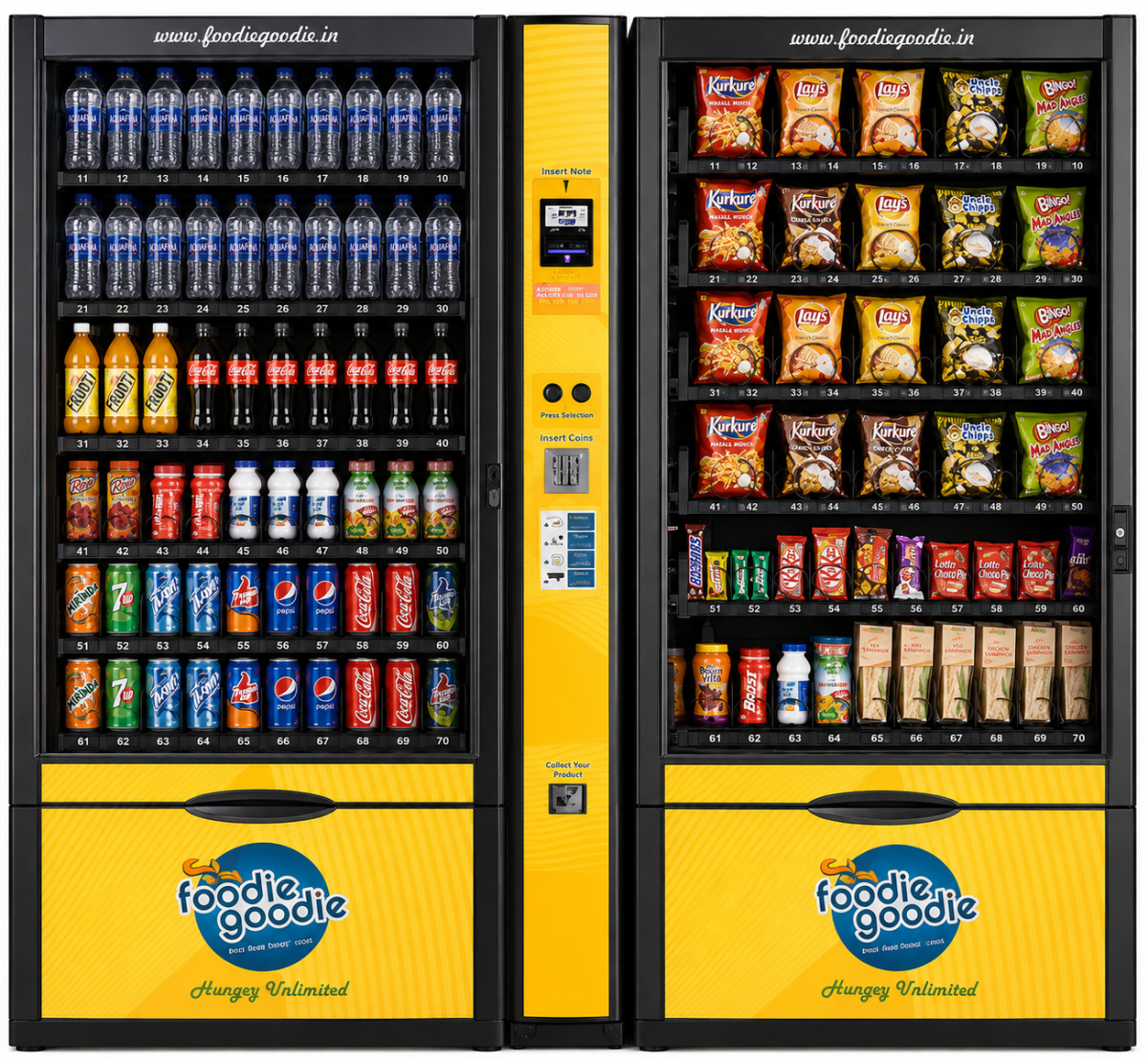
Answer
The picture shown is of an Automatic Vending Machine — a non-traditional market.
Features of Automatic Vending Machines:
Self-Service: The customer himself operates the machine to buy the product. There is no need for a salesperson to be present.
Coin/Cash/Card Operated: Customers insert coupons, coins, cash or use a card to receive the product. Payment is made before the product is dispensed.
Convenient Location: Vending machines are installed at high-traffic public places like workplaces, metro stations, airports, schools and shopping malls so that products are easily accessible.
Daily-use Branded Products: Well-known brands of daily-use items are sold through these machines. Common items include cold drinks, tea, coffee, candy, snacks and milk. In Delhi, Mother Dairy sells milk through vending machines.
24×7 Availability: Vending machines provide round-the-clock service without requiring shop staff or fixed shop hours.
Quick and Cashless Transaction: With modern machines accepting digital payments, transactions are quick and cashless, saving time for the customer.
Low Operating Cost: Once installed, vending machines run with minimal supervision, reducing labour and overhead costs for the seller.
CASE STUDY
With the advancement in technology and the goal to scale its business, JK Tyre & Industries has been working on a two-pronged strategy to add 'significant relevance' to its overall business. Along with the mainstream tyres, the Delhi based company is also running a fleet operating management business and a mobility business vertical.
"In the fleet management business, from selling a tyre as a commodity, it becomes a kind of service. We have tied up with 1300 of the 1800 large fleets across India. We provide all the services and the customer pays for the tyre's upfront cost." Anuj Kathuria, India President, JK Tyres, said. Any fleet of 100 trucks/buses, or more, is considered a 'large fleet'.
An initiative like the fleet management service also contributes to sustained relationship with customers, leading to repeat purchases of tyres by them. The customer base of 1300 fleet operators hasn't come easily for JK Tyres, an early mover with such a business intervention in the industry. The customer base has been built over the past two decades.
Under the fleet management business, JK Tyres is also offering tyre-as-a-service. It has about 250 pit stops, and close to 100 truck wheel centres, where its services are provided.
The company, which has also developed a tyre with 80% biodegradable materials, says that the 'green tyre' is close to a market launch. The tyre major has a target to achieve net zero emissions by 2050.
Source: auto.economictimes.indiatimes.com, February 9, 2024.
With reference to the above case study answer the following question:
Analyse the above case study and give any five differences between Product and Service.
Answer
JK Tyre & Industries provides both a product (tyres) and a service (fleet management and tyre-as-a-service). Based on this case, the five differences between a product and a service are:
| S.No. | Basis of Distinction | Product (Tyre) | Service (Fleet Management / Tyre-as-a-service) |
|---|---|---|---|
| 1. | Tangibility | A tyre is tangible — it can be seen, touched and physically possessed. | The fleet management service is intangible — it cannot be seen or touched, only experienced. |
| 2. | Perishability / Inventory | Tyres can be stored in warehouses or outlets for future sale. | Services like fleet management are perishable — they cannot be stored; they are produced and consumed simultaneously. |
| 3. | Ownership | When a fleet operator buys a tyre, ownership is transferred to the operator. | In tyre-as-a-service, the customer pays only for the service; ownership of the service-related assets is not transferred. |
| 4. | Inseparability | Tyres can be manufactured at a factory and sold elsewhere — production and sale are separable. | Fleet management services need JK Tyre's pit stops, wheel centres and personnel to be present at the time of delivery — service is inseparable from the provider. |
| 5. | Standardisation / Homogeneity | Tyres of a particular model are standardised — every unit is identical in quality. | Services may vary from one fleet/customer to another and from one pit stop to another — they are heterogeneous and depend on the staff providing them. |
| 6. | Customer Relationship | Selling a tyre is largely a one-time transaction. | Fleet management builds a sustained, long-term relationship leading to repeat purchases (as JK Tyres has built over the past two decades). |