
It is also known as 'going rate pricing' or competition based pricing.
- Skimming
- Parity pricing
- Penetration pricing
- Cost plus pricing
Answer
Parity pricing
Reason — Under parity pricing, a business firm adjusts its own price policy to the general pricing structure in the industry. It involves charging according to what competitors are charging. Therefore, it is also known as 'going rate pricing' or competition based pricing.
Berrylicious is a very famous wafer brand among children, currently in its growth stage. Which of the following statements is/are correct about this stage?
(1) Competition is virtually absent.
(2) Marginal producers are forced to go out of the market.
(3) Promotional expenditure remains high.
(4) Sales may decline rapidly.
- Only 2
- Only 2 and 3
- Only 1 and 4
- Only 1
Answer
No correct option is given.
Reason — During the growth stage, demand and sales grow rapidly, distribution is widened, competition increases and prices fall. Promotional expenditure remains high, though it falls as a percentage of sales turnover. Therefore, statement 3 is correct. Statement 1 is a feature of the introduction stage, statement 2 belongs to the maturity stage, and statement 4 is a feature of the decline stage. Since the given options do not include "Only 3", none of the options is fully correct.
How do customers know about the new product in the market?
- Branding
- Pricing
- Promotion
- Labelling
Answer
Promotion
Reason — Promotion is the process of communication with potential buyers involving information, persuasion and influence. It includes all activities aimed at informing customers about a product's availability and persuading them to buy it. Therefore, customers come to know about new products in the market through promotion.
Direct selling eliminates the need for intermediaries and can result in higher profit margins for the manufacturer.
- True
- False
Answer
True
Reason — In direct selling, the producer directly sells goods to ultimate consumers and there is no middleman or intermediary. By eliminating middlemen, the manufacturer saves the commission and margins paid to them, which can result in higher profit margins. The producer also has direct contact with customers and full control over distribution.
This marketing component is most likely to be standardized ...............
- Brand
- Price
- Advertising
- Distribution
Answer
Brand
Reason — Brand is the most likely component to be standardized as it provides identity and uniformity to the product across all markets. Price, advertising and distribution often vary based on local market conditions, customer preferences and regional factors, but the brand remains consistent to maintain its identity and recognition.
Which stage of the product life cycle is marked by falling costs and rising revenues?
- Introduction stage
- Growth stage
- Maturity stage
- Saturation stage
Answer
Growth stage
Reason — In the growth stage, demand and sales grow rapidly leading to rising revenues. Promotional expenses remain high but fall as a percentage of sales turnover and economies of scale lead to falling costs per unit. Therefore, profits rise during this stage.
The usual source for new products is ...............
- Marketing research
- R&D
- Accidental discoveries
- A variety of sources including customers, competitors
Answer
A variety of sources including customers, competitors
Reason — New products usually come from a variety of sources including customers' needs and feedback, competitors' products, marketing research, R&D departments and even accidental discoveries. Hence, the usual source for new products is not limited to one source but a combination of various sources.
A company launches a new product in the market with the following conditions:
(i) The product is priced significantly higher than competitors.
(ii) The target market is affluent consumers who value exclusivity.
(iii) The product is heavily promoted as a luxury item.
Which pricing strategy is the company likely using?
- Penetration Pricing
- Cost-Plus Pricing
- Skimming Pricing
- Parity Pricing
Answer
Skimming Pricing
Reason — Under skimming pricing, a very high price is set so that in the initial stages the cream of demand may be skimmed. The aim is to 'sell to classes' who don't care how much they pay for a novel product. Since the company is targeting affluent consumers, charging a higher price than competitors and promoting the product as a luxury item, this matches the skimming pricing strategy.
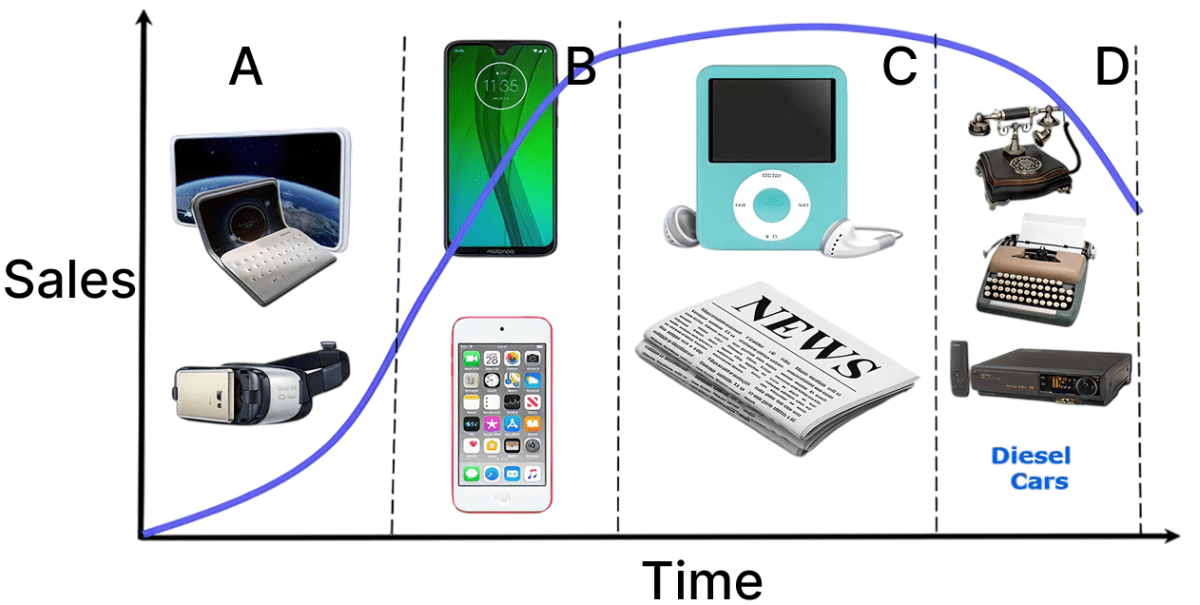
Which stage of the product life cycle is most likely represented by the products in "D category" in the image below?
- Introduction
- Growth
- Maturity
- Decline
Answer
Decline
Reason — In the product life cycle, the stages occur in the sequence: Introduction (A), Growth (B), Maturity (C), Decline (D), and Abandonment (E). The products shown in category D (such as obsolete items) are characterised by sharply falling sales and gradual displacement by new and superior products, which indicates the decline stage.
Assertion (A): The decline stage of the product life cycle is characterized by a decrease in sales and market share.
Reason (R): Companies should invest heavily in marketing and innovation during the decline stage to revive the product's growth.
- A is true but R is false
- A is false but R is true
- Both A and R are true and R explains A.
- Both A and R are true but R does not explain A.
Answer
A is true but R is false
Reason — Assertion (A) is true because the decline stage is characterised by sharp fall in sales and market share due to displacement by superior products or change in consumer preferences. However, Reason (R) is false because during the decline stage, promotional expenditure has to be reduced drastically to minimise loss, and most firms shift their attention to other products rather than investing heavily.
In which stage of product life cycle, the company takes decision whether to maintain, harvest or drop the product?
- Introduction
- Growth
- Maturity
- Decline
Answer
Decline
Reason — In the decline stage, sales fall down sharply and the product faces gradual displacement by new and superior products. At this stage, the company must take a critical decision on whether to maintain the product (with new features), harvest it (reduce expenditure to maximise short-term profit), or drop the product altogether.
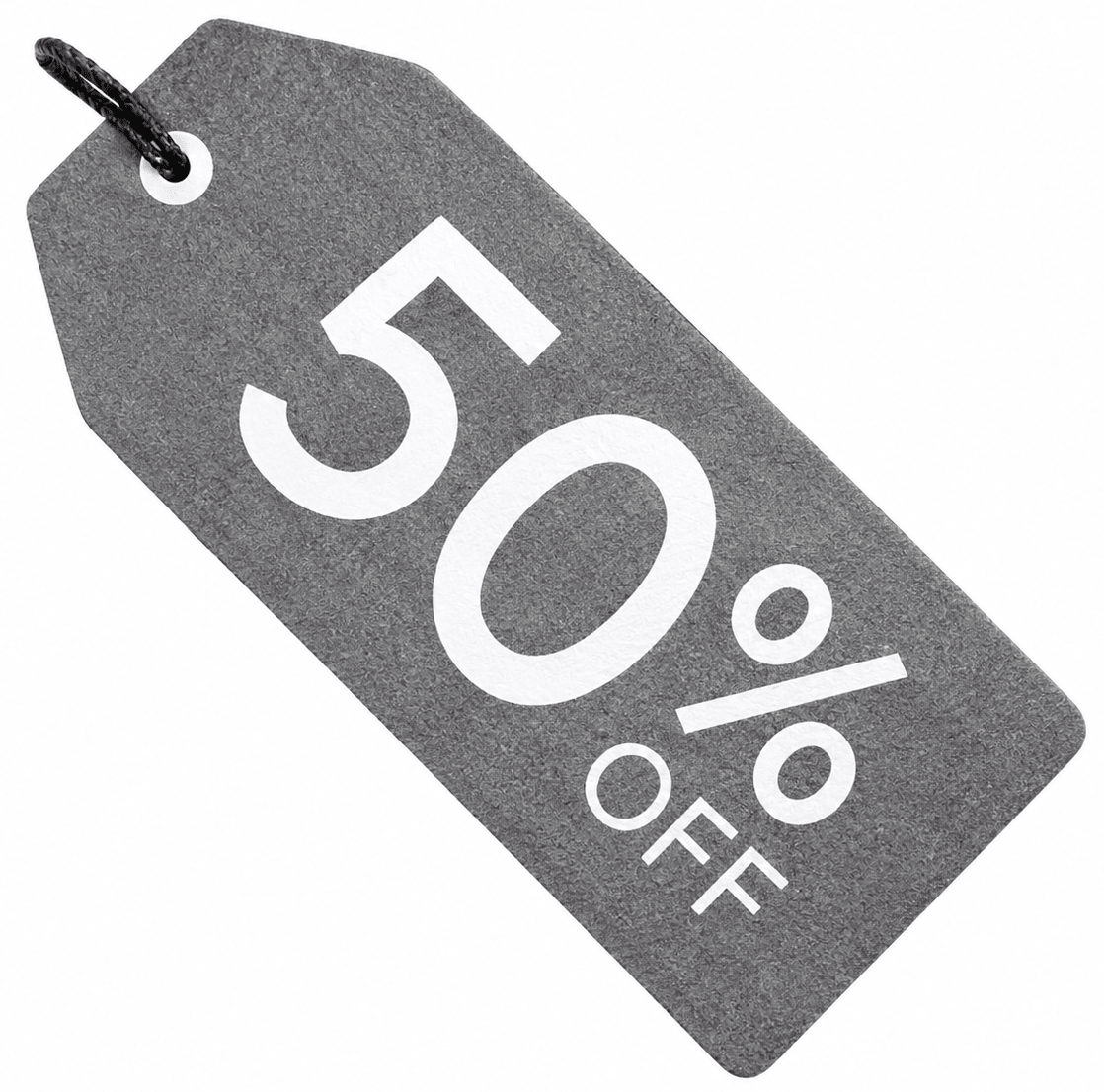
Which element of the marketing mix is most directly affected by the change illustrated in the image below?
- Product
- Promotion
- Place
- Price
Answer
Price
Reason — The image shows a "50% off" discount tag. Discounts are a component of the price mix, as price mix involves decisions regarding the basic price of the product, discounts, allowances, credit and terms of payment. Hence, the change shown most directly affects the price element of the marketing mix.
In declining stage of PLC, which tool would be more preferred?
- Sales promotion
- Personal selling
- Advertising
- Publicity
Answer
Sales promotion
Reason — During the decline stage, the emphasis is on reducing promotional expenses to minimise loss. Sales promotion tools such as discounts, attractive packaging, and economy packs are preferred since they are short-term and cost-effective measures to revive the market and clear stocks.
The strategy of introducing new product in existing market is classified as
- Market development
- Market Penetration
- Product development
- Diversification
Answer
Product development
Reason — Product development refers to the strategy of introducing a new product in an existing market. Market penetration involves selling existing products to existing markets, market development involves selling existing products in new markets, and diversification involves new products in new markets.
Statement 1: A product in the growth stage of its life cycle typically has low competition and high prices.
Statement 2: The maturity stage is characterized by intense competition and product differentiation.
Which of the following is correct?
- Only Statement 1 is correct.
- Only Statement 2 is correct.
- Both statements are correct.
- Both statements are incorrect.
Answer
Only Statement 2 is correct.
Reason — Statement 1 is incorrect because in the growth stage, competition increases and prices fall. Low competition and high prices are characteristics of the introduction stage. Statement 2 is correct because the maturity stage is characterised by intense competition, product differentiation and product improvement.
Markup pricing is also called as
- Cost pricing
- Marginal priced
- Cost plus pricing
- Cost based pricing
Answer
Cost plus pricing
Reason — In cost plus pricing, the selling price covers the full cost plus a margin of profit. This margin is known as 'mark up' and therefore cost plus pricing is also known as 'mark up pricing'.
Assertion (A): The concept of the product life cycle suggests that all products follow a predictable pattern of stages from introduction to decline.
Reason (R): The length of each stage in the product life cycle is not fixed and vary based on industry or product type.
- A is true but R is false
- A is false but R is true
- Both A and R are true and R explains A.
- Both A and R are true but R does not explain A.
Answer
A is false but R is true
Reason — Assertion (A) is false because the product life cycle is not a universal law. Not all products pass through all stages; some fail in the initial stage, while others may reach maturity after a long time. Reason (R) is true because the length of each stage in the product life cycle is not fixed and varies according to the industry, product type and market conditions.
Which of the following is not included in the function of physical supply?
- Standardization
- Storage
- Packaging
- Transportation
Answer
Standardization
Reason — Physical supply (or physical distribution) includes all activities involved in moving products or services from manufacturers to consumers, mainly transportation, storage and packaging. Standardization, on the other hand, is a part of product mix and is not a function of physical supply.
A company decides to change the packaging of its product to make it more eco-friendly. Which elements of the marketing mix does this decision impact?
- Product and Price
- Place and Promotion
- Product and Promotion
- Price and Place
Answer
Product and Promotion
Reason — Packaging is a component of the product mix as it is part of product features. At the same time, eco-friendly packaging can be highlighted in advertisements and used as a promotional tool to attract environmentally conscious customers, thus impacting the promotion mix as well.
............... refers to the pathway, path or route taken by goods as they flow or move from the point of production to the point of consumption or use.
- Channel of distribution
- Direct marketing
- Intensive distribution
- None of these
Answer
Channel of distribution
Reason — A channel of distribution or trade channel is the route or path along which products flow from the point of production to the point of ultimate consumption or use. It starts with the producer and ends with the consumer.
Which of the following is/are correct statement(s)?
Statement 1: Parity pricing is an appropriate strategy when there is little competition and product differentiation.
Statement 2: Cost-plus pricing is used when a firm wants to cover its costs and achieve a reasonable profit margin.
- Only Statement 1 is correct.
- Only Statement 2 is correct.
- Both statements are correct.
- Both statements are incorrect.
Answer
Only Statement 2 is correct.
Reason — Statement 1 is incorrect because parity pricing is appropriate where competition is very severe and competitive products are homogeneous (not where there is little competition and differentiation). Statement 2 is correct because cost-plus pricing ensures full coverage of costs and helps in achieving a reasonable return on capital employed.
The term marketing mix refers to ...............
- An analysis of micro and macro environment of the organization
- A mixture of various decisions to sell more products at any cost
- A customer relationship for long term profit and gain
- A combination of strategic elements to satisfy market needs
Answer
A combination of strategic elements to satisfy market needs
Reason — Marketing mix refers to the combination of four basic elements (product, price, place and promotion) which constitute the core of a company's marketing system. The basic purpose of marketing mix is to satisfy the needs and wants of customers in the most effective manner.
The skimming, penetration, parity are decided in which of the marketing mix strategy?
- Price Decisions
- Place Decisions
- Product Decisions
- Promotion Decisions
Answer
Price Decisions
Reason — Skimming, penetration, parity and cost-plus pricing are all pricing strategies used to fix the price of a product. Therefore, they fall under the price decisions of the marketing mix.
Typically profit is negative in which stage of the product life cycle?
- Growth
- Maturity
- Introduction
- Decline
Answer
Introduction
Reason — During the introduction stage, the product is newly launched. This stage is characterised by high costs, low sales volume, limited distribution and high promotional expenditure. As a result, profits are typically negative during this stage.
Packaging is solely concerned with the protection of the product during transportation and has no impact on consumer purchasing decisions.
- True
- False
Answer
False
Reason — Packaging is much more than just protection. A package acts as a silent but forceful salesman at the point of purchase and stimulates impulsive buying. It differentiates a product from its substitutes, helps in branding, and significantly influences consumer purchasing decisions, especially in the era of self-service.
An element of marketing mix, which creates utilities of time, place and possession:
- Place
- Product
- Promotion
- Price
Answer
Place
Reason — A distribution channel (place) serves as the connecting link between the producer and consumers. It creates utilities of time, place and possession by bridging the gap between the point of production and the point of consumption.
The strategy of selective distribution may be employed during ............... stage of product life cycle.
- Growth
- Maturity
- Introduction
- Decline
Answer
Introduction
Reason — During the introduction stage, since the product is new and the market is limited, selective distribution along with attractive discounts to dealers is one of the strategies employed to introduce the product successfully.
Which of the following is not an element of Distribution mix?
- Discount
- Transportation
- Channel
- Storage
Answer
Discount
Reason — Distribution mix (place mix) includes channels of distribution, distribution policy, transportation, warehousing (storage) and inventory control. Discount is an element of price mix, not distribution mix.
Under this Pricing Strategy, a business firm adjusts its own price policy in accordance with general pricing structure in the industry.
- Skimming pricing
- Parity pricing
- Cost plus pricing
- Penetrating pricing
Answer
Parity pricing
Reason — Under parity pricing strategy, a business firm adjusts its own price policy to the general pricing structure in the industry. It involves charging according to what competitors are charging.
The traditional channel employed in the distribution of consumer good is:
- Manufacturer-Agent-Wholesaler-Retailer-Consumer
- Manufacture-Agent-Retailer-Consumer
- Manufacture-Wholesaler-Retailer-Consumer
- Manufacture-Retailer-Consumer
Answer
Manufacturer-Wholesaler-Retailer-Consumer
Reason — The 'traditional' or normal channel for the distribution of consumer goods is Manufacturer-Wholesaler-Retailer-Consumer. This channel is suitable where the producer has limited finance and a narrow product line, or where wholesalers provide strong promotional support.
Which stage of the Product Life Cycle is characterised by saturation in the market?
- Introduction
- Growth
- Maturity
- Decline
Answer
Maturity
Reason — During the maturity stage, after some time there is saturation in the market. Supply exceeds demand for the first time and there is no possibility of further increase in sales as the sales curve levels off.
Selling price = Total cost per unit + Desired profit per unit is the formula to fix prices under which Pricing Strategy?
- Skimming pricing
- Penetrating pricing
- Cost plus pricing
- Parity pricing
Answer
Cost plus pricing
Reason — Under cost plus pricing, the selling price of a product must cover its full cost and yield a reasonable margin of profit. The formula used is: Selling price = Total cost per unit + Desired profit per unit.
............... represents an integrated approach to marketing.
- Price mix
- Place mix
- Marketing mix
- Promotion mix
Answer
Marketing mix
Reason — Marketing mix maintains a balance between the four interrelated elements (product, price, place and promotion). Therefore, marketing mix represents an integrated approach to marketing.
A high percentage of new products fail during this period of Product Life cycle:
- Growth stage
- Decline stage
- Introduction stage
- Maturity stage
Answer
Introduction stage
Reason — The introduction stage is very risky because a high percentage of new products fail during this period. This is due to high costs, low sales volume, limited distribution, lack of consumer awareness and high prices.
Factors which do not influence price determination is ...............
- Risk
- Goodwill
- Government control
- Buying motive
Answer
Goodwill
Reason — Factors that influence price determination include cost, demand, competition, quality and service, buying motives, promotional strategy, risks and government control. Goodwill is not directly listed as a factor influencing price determination.
The main aim of penetrating pricing is to:
- Provide funds for expansion
- Maximize the market share
- Provide a reasonable return on capital
- Avoid price wars
Answer
Maximize the market share
Reason — Penetrating pricing involves setting a low price in the initial stage to make the brand quickly popular and to maximise the market share. The manufacturer seeks to sell to the masses and capture a large share of the market.
One of the additional elements of marketing mix of services is ...............
- Price
- Place
- People
- Promotion
Answer
People
Reason — While the traditional 4 P's (Price, Place, Product, Promotion) apply to goods, the marketing mix of services includes additional elements like People, Process and Physical evidence. People is one of the key additional elements as services involve human interaction.
............... determines the sales volume and the profit margins.
- Price
- Place
- People
- Promotion
Answer
Price
Reason — Price determines largely the sales volume and profit margins. Price structure affects the competitive position and market share of the firm. A firm cannot succeed if its prices are too low or too high.
Marketing Mix represents the ............... of an enterprise.
- Total marketing program
- Total selling program
- Promotion techniques
- Total distribution plan
Answer
Total marketing program
Reason — Marketing mix represents the total marketing programme of an enterprise. It is a systematic combination of four elements — product, price, place and promotion — which constitute the core of a company's marketing system.
Choose the correct sequence of the product Life Cycle.
- Introduction > Growth > Maturity > Decline > Abandonment
- Introduction > Maturity > Growth > Decline > Abandonment
- Introduction > Growth > Maturity > Abandonment > Decline
- Introduction > Maturity > Growth > Abandonment > Decline
Answer
Introduction > Growth > Maturity > Decline > Abandonment
Reason — A product moves through five different stages of its life cycle in the sequence: Introduction (product is launched), Growth (sales rise rapidly), Maturity (sales reach peak and stabilise), Decline (sales fall sharply), and finally Abandonment (product is dropped).
The pricing strategy involves charging according to what competitors are charging:
- Going rate pricing
- Cost plus pricing
- Penetrating pricing
- Skimming pricing
Answer
Going rate pricing
Reason — Parity pricing, also known as 'going rate pricing' or competition based pricing, involves charging according to what competitors are charging. Many companies in an industry follow the price level set by the market leader.
In which stage of the product life cycle, sales continue to grow but at a decreasing rate?
- Maturity stage
- Decline stage
- Growth stage
- Introduction stage
Answer
Maturity stage
Reason — During the maturity stage, sales continue to grow but at a decreasing rate. Competition increases further and markets get stabilised, eventually reaching saturation point.
Which pricing strategy will be used to launch a high end auto motors?
- Parity Pricing
- Skimming Pricing
- Cost Plus pricing
- Penetrating pricing
Answer
Skimming Pricing
Reason — High-end auto motors are distinctive, premium products targeted at affluent consumers. Skimming pricing is appropriate for such highly distinctive products, where a high price is set initially to recover heavy investment costs and 'sell to the classes' who don't mind paying a premium.
Which feature is pertaining to Introduction stage of PLC?
- Competition is very severe
- Product is known all over the market
- It is a risky stage
- New versions of the product must be made available
Answer
It is a risky stage
Reason — The introduction stage is very risky because a high percentage of new products fail during this period. The other options (severe competition, product known all over, new versions) describe the maturity stage.
Which of the following is not an element of Marketing Mix?
- Price Mix
- Place Mix
- Promotion Mix
- Process Mix
Answer
Process Mix
Reason — The four traditional elements of the Marketing Mix are Product Mix, Price Mix, Place Mix and Promotion Mix (4 P's). Process Mix is not part of the traditional marketing mix for goods (though it is included in the extended marketing mix for services).
One of the methods of Direct Selling is ............... .
- Catalogue Selling
- Parity Selling
- Penetrating Selling
- Cost plus Selling
Answer
Catalogue Selling
Reason — Methods of direct selling include door-to-door salespersons, retail outlets, catalogue selling, telemarketing, and online/internet marketing. Parity, Penetrating and Cost-plus are pricing strategies, not methods of direct selling.
In the introduction stage of a product life cycle ............... is absent.
- Production
- Competition
- Sales
- Distribution
Answer
Competition
Reason — During the introduction stage, the product is new in the market. Competition is virtually absent during this stage as imitation has not yet taken effect, and the firm is the first or among the first to offer such a product.
Inventory control is a part of ............... .
- Place mix
- Product Mix
- Promotion Mix
- Price Mix
Answer
Place mix
Reason — Place mix (Distribution mix) includes channels of distribution, distribution policy, transportation, warehousing and inventory control. Therefore, inventory control is a part of place mix.
Which stage of Product Life Cycle has a greater emphasis on customer service?
- Introduction stage
- Maturity stage
- Growth stage
- Decline stage
Answer
Growth stage
Reason — During the growth stage, one of the strategies adopted is greater emphasis on customer service. This is because during this stage, the firm aims to retain customers, build brand image, and stand out among the increasing number of competitors.
In ............... stage, the business marketing focus is changed from buy my product to buy my brand.
- Maturity Stage
- Decline Stage
- Introduction Stage
- Growth Stage
Answer
Growth Stage
Reason — During the growth stage, demand and sales grow rapidly and competition increases. The promotional focus shifts from "buy my product" to "buy my brand" because now multiple competitors offer similar products, and the firm wants to build brand loyalty.
Which pricing strategy involves charging according to their competitors?
- Penetrating pricing
- Cost Plus pricing
- Skimming pricing
- Parity pricing
Answer
Parity pricing
Reason — Parity pricing involves charging according to what competitors are charging. The firm adjusts its own price policy to the general pricing structure in the industry.
Assertion (A): Parity Pricing is the most logical strategy when it is very difficult to calculate the cost of the products.
Reason (R): When price leadership is well established, setting price according to the competitors is the safest policy.
- (A) is true and (R) is false.
- Both (A) and (R) are true and (R) is the correct explanation of (A).
- Both (A) and (R) are true but (R) is not the correct explanation of (A).
- Both (A) and (R) are false.
Answer
Both (A) and (R) are true but (R) is not the correct explanation of (A).
Reason — Both Assertion and Reason are true. Parity pricing is indeed appropriate when costs are difficult to measure, and it is also the safest policy when price leadership is well established. However, R does not directly explain A — the difficulty in cost calculation and the well-established price leadership are two separate situations under which parity pricing is appropriate.
In which distribution channel is a producer relieved from the problem of distribution?
- Manufacturer - Wholesaler - Retailer
- Manufacturer - Agent - Retailer - Consumer
- Manufacturer - Consumer
- Manufacturer - Agent - Wholesaler - Retailer - Consumer
Answer
Manufacturer - Agent - Wholesaler - Retailer - Consumer
Reason — The Manufacturer - Agent - Wholesaler - Retailer - Consumer is the longest channel of distribution. It is used when the manufacturer wants to be fully relieved of the problem of distribution. The producer hands over the entire output to the selling agent who handles further distribution.
Direct selling, as a channel of distribution, has become popular due to the ...............
- availability of expert services of middlemen
- concentrated markets
- relief from the problem of distribution
- increasing cost of distribution
Answer
increasing cost of distribution
Reason — Direct selling has become increasingly popular due to increasing costs of distribution, scattered markets, cut-throat competition, the desire to maintain control over distribution, and modern means of communication.
With reference to growth stage of Product life cycle, which statement is/are NOT correct?
(1) New models of products are introduced.
(2) Sales fall down sharply.
(3) Distribution is widened.
(4) Prices are at competitive levels.
- 1 and 3
- 2 and 3
- 3 and 4
- Only 2
Answer
Only 2
Reason — During the growth stage, sales grow rapidly (not fall sharply). Sales falling sharply is a characteristic of the decline stage. The other statements — introduction of new models, widened distribution, and competitive pricing — are all correct features of the growth stage.
Enumerate the elements of marketing mix.
OR
Mention the four elements of marketing mix.
OR
Mention the elements of the Marketing mix.
Answer
The four elements of the marketing mix (popularly known as the 4 P's) are:
- Product Mix — refers to the combination of various features relating to the product or service offered for sale, including quality, brand, packaging, labelling and after-sale service.
- Price Mix — involves decisions regarding the basic price, discounts, allowances, credit and terms of payment.
- Place Mix (Distribution Mix) — consists of all activities involved in transferring ownership and physical possession of the product to consumers.
- Promotion Mix — consists of all activities aimed at persuading customers to buy the product, including advertising, personal selling, sales promotion and publicity.
What are the components of 'price mix'?
Answer
The components of price mix are:
- Price to be charged — the basic price of the product.
- Discounts and allowances — to be offered to dealers and customers as incentives.
- Terms of credit — credit facilities and payment terms offered to customers.
"Parity pricing is not relevant under the present marketing conditions." Justify either for or against by giving two reasons.
Answer
Against the statement — Parity pricing is highly relevant under present marketing conditions due to the following reasons:
- Severe competition — In today's highly competitive markets where competitive products are largely homogeneous, charging the same price as competitors is the safest strategy to avoid price wars.
- Difficulty in measuring costs — In modern business, it is often difficult to accurately determine the cost of a product due to common overheads and joint products. In such cases, parity pricing is a logical first step in a rational pricing strategy.
What is parity pricing?
Answer
Parity pricing is a pricing strategy under which a business firm adjusts its own price policy to the general pricing structure in the industry. It involves charging according to what competitors are charging. It is also known as 'going rate pricing' or 'competition based pricing'. Many companies follow the price level set by the market leader under this strategy.
Give two conditions under which parity pricing is desirable.
Answer
Two conditions under which parity pricing is desirable:
- When it is difficult to measure costs — Parity pricing may be the logical first step in a rational pricing strategy when accurately determining the cost of the product is difficult.
- When competitive products are homogeneous — Where competition is very severe and the products in the industry are similar in nature, parity pricing helps avoid price wars.
"An appropriate marketing mix is necessary to enable an enterprise to meet its goals." Justify for or against, giving reasons.
Answer
For the statement — An appropriate marketing mix is indeed necessary to enable an enterprise to meet its goals. Reasons:
- Customer satisfaction and increased sales — Marketing mix is decided keeping in view the needs and desires of a target group of customers. Therefore, an appropriate mix helps the firm in increasing sales and profits.
- Integrated approach to marketing — It maintains a balance between the four interrelated elements (product, price, place and promotion), representing an integrated approach to marketing.
- Link between firm and customers — It serves as a connecting link between the business firm and its customers, helping in pursuing customer-oriented marketing.
- Adaptability to environment — Marketing mix is changed with changes in the requirements of customers, helping maintain equilibrium between the firm and its marketing environment.
Hence, an appropriate marketing mix helps an enterprise position itself firmly in the market and achieve its profit goals.
Mention the advantages of cost plus pricing.
Answer
The advantages of cost plus pricing are:
- Most widely used technique — It is a safe and simple approach to pricing, easy to understand and apply.
- Full coverage of costs — It ensures full coverage of all costs (production and marketing) involved in offering the product.
- Reasonable return — It helps in achieving a reasonable return on capital employed by adding a fixed profit margin.
- Logical and defensible — The method is logical and can be defended on moral grounds, as it is based on covering legitimate costs.
- Discourages cut-throat competition — It discourages cut-throat competition in the market by maintaining stable prices.
Give one difference between product mix and promotion mix.
Answer
| Basis | Product Mix | Promotion Mix |
|---|---|---|
| Meaning | Product mix refers to the combination of features relating to the product offered for sale, including quality, brand, package, label and warranty. | Promotion mix consists of all activities aimed at persuading customers to buy the product, including advertising, personal selling, sales promotion and publicity. |
Give one difference between skimming pricing and penetrating pricing.
Answer
| Basis | Skimming Pricing | Penetrating Pricing |
|---|---|---|
| Initial Price | A very high price is set initially to skim the cream of demand. | A low price is set initially to capture as large a market as possible. |
| Target Market | Aims to 'sell to the classes' (affluent consumers). | Aims to 'sell to the masses' (price-sensitive consumers). |
Mention the elements of promotion mix.
OR
List any four elements of promotion mix.
Answer
The elements of promotion mix are:
- Advertising — providing product information through non-personal media like newspapers, radio and television.
- Personal Selling — face-to-face communication between a seller and the buyer.
- Sales Promotion — short-term promotional activities like displays, demonstrations and coupons.
- Publicity — favourable mention of a company or product in news media that is not paid for by the seller.
- Direct Selling — producer directly sells goods to ultimate consumers without any intermediary.
- Public Relations — activities aimed at creating a favourable image of the company among customers.
Explain promotion mix.
Answer
Promotion mix consists of all the activities aimed at persuading customers to buy the product. It is a vital element of the marketing mix. The various elements of promotion mix are:
- Advertising — provides information to present and prospective customers about the firm and its products through non-personal media. It turns the attention of people to a product.
- Personal Selling — refers to face-to-face communication between a seller (or his representative) and the buyer. Salespersons assist and persuade prospective buyers to buy the product.
- Sales Promotion — increasing sales through short-term promotional activities such as displays, demonstrations, fashion shows, exhibitions, prize contests and coupons.
- Publicity — favourable mention of a company, brand or product in newspapers, journals or radio that is not paid for by the seller.
- Direct Selling — direct sales by producer to ultimate consumers without any intermediary.
- Public Relations — activities to create a favourable image of the company, its products and policies.
State any two advantages of cost-plus pricing strategy.
Answer
Two advantages of cost-plus pricing strategy:
- Full coverage of costs — It ensures that all costs of production and marketing are fully recovered, with a reasonable margin of profit added on top.
- Simple and logical — It is the most widely used and a safe approach to pricing. The method is logical, easy to apply, and can be defended on moral grounds.
"Skimming pricing policy is ideal for introducing a product in the FMCG sector." Justify for or against.
Answer
Against the statement — Skimming pricing policy is NOT ideal for introducing a product in the FMCG (Fast Moving Consumer Goods) sector. Reasons:
- FMCG products are aimed at the masses and have highly elastic demand, meaning that the quantity sold is highly sensitive to price. A high initial price would discourage mass adoption.
- The FMCG sector has strong potential competition with many substitute products available, so a high price would drive customers towards competitors.
- Penetrating pricing is more suitable for FMCG products because it sets a low initial price to make the brand quickly popular and maximise market share. For example, 'Nirma' detergent powder used penetrating pricing to displace the higher-priced 'Surf' in India.
Write a short note on importance of packaging?
Answer
Packaging plays an important role in the marketing of goods. Its importance can be highlighted as follows:
- Protection — A good package protects the product from damage and deterioration during transportation and storage.
- Identification — The package helps to identify the product by indicating its nature and contents and protects against spurious products.
- Facilitates branding — The brand name and mark can be easily printed on the package, lending individuality and prestige to the product.
- Reduces cost — Good packaging reduces costs of transportation and storage and widens the market.
- Reuse value — Packages often have reuse and resale value (e.g., tins of Dalda are used by housewives for storing provisions).
- Silent salesman — A package acts as a silent but forceful salesman at the point of purchase, differentiating the product from substitutes and stimulating impulsive buying.
"In a competitive market, parity pricing is the appropriate strategy." Justify either for or against.
Answer
For the statement — In a competitive market, parity pricing is indeed the appropriate strategy. Reasons:
- Avoids price war — When price leadership is well established (especially in oligopolistic markets), charging according to what competitors are charging is the only safe policy. Charging lower than the leader may lead to a price war.
- Suitable for homogeneous products — Where competition is very severe and competitive products are homogeneous (similar in nature), parity pricing avoids the risk of losing customers to competitors.
- Less troublesome and less costly — It is less troublesome and less costly than an individualistic pricing strategy that requires extensive market research.
"Branded goods are normally sold by inspection." Justify a reason either for or against.
Answer
Against the statement — Branded goods are NOT normally sold by inspection. Reason:
Branded goods are sold based on trust and brand reputation rather than physical inspection. The brand name and packaging assure customers about the quality, contents and consistency of the product. Customers buy branded goods like Maggi, Colgate or Surf without inspecting each unit because they trust the brand. Inspection is more relevant for unbranded or generic goods like fruits, vegetables and grains, where each item may differ in quality.
"A distribution channel serves as a link between producers and consumers." Give a reason either for or against.
Answer
For the statement — A distribution channel indeed serves as a link between producers and consumers. Reason:
A distribution channel creates utilities of time, place and possession by bridging the gap between the point of production and the point of consumption. It represents three types of flows — products flow downwards from producer to consumers, cash flows upwards from consumers to producer, and marketing information flows in both directions. Therefore, it serves as the connecting link between the producer and consumers.
Mention any two components of product mix.
Answer
Two components of product mix are:
- Product range — the variety of products and product lines offered for sale by the firm (e.g., bulbs, tubes, mixer-grinders).
- Brand name — the unique name given to the product to distinguish it from competitors' products and lend it identity.
(Other components include packaging and labelling, quality, after-sale service, and warranty against defects.)
"Penetration pricing leads to setting a high initial price." Justify the statement for or against and give a reason.
Answer
Against the statement — Penetration pricing does NOT lead to setting a high initial price. Reason:
Penetration pricing involves setting a low initial price in the early stage so as to make the brand quickly popular and to maximise the market share. The manufacturer aims to sell to the masses by offering an attractive low price. The strategy of setting a high initial price is called skimming pricing, not penetration pricing. For example, 'Nirma' detergent powder used penetrating pricing (low initial price) to capture the mass market.
What do you mean by the term labelling?
Answer
Labelling is the process of attaching information to a product, providing essential details like name, ingredients, usage instructions and safety warnings. It implies putting identification marks or labels on the package. A label is an important feature of a product as it provides useful information about the product and its producer. A good label provides information about the name and address of the producer, weight and measurement, directions for use, date of packing, and maximum retail price.
Discuss any two important characteristics of product life cycle when the product is introduced in the market.
Answer
Two important characteristics of product life cycle when the product is introduced in the market (Introduction Stage):
- High costs and low sales volume — During this stage, prices are usually high because of small scale of production and heavy promotional expenditure. Sales grow at a low rate due to lack of consumer awareness and limited distribution. As a result, profits are typically negative.
- Limited competition and risky stage — Competition is virtually absent as the product is new and imitation has not yet taken effect. However, this stage is very risky because a high percentage of new products fail during this period due to consumer resistance and high costs.
Distinguish between skimming pricing and penetrating pricing.
Answer
| Basis | Skimming Pricing | Penetrating Pricing |
|---|---|---|
| Initial Price | A very high price is set initially. | A low price is set initially. |
| Aim | To skim the cream of demand and recover investment quickly. | To make the brand quickly popular and maximise market share. |
| Target Customers | Aims to sell to the 'classes' (affluent consumers). | Aims to sell to the 'masses' (price-sensitive customers). |
| Demand Type | Suitable when demand is inelastic. | Suitable when demand is highly elastic. |
| Competition | Used when imitation has not taken effect (low competition). | Used when there is strong potential competition. |
| Example | High-end smartphones, luxury cars. | FMCG products like Nirma detergent. |
"Marketing mix represents an integrated approach to marketing." How?
Answer
Marketing mix represents an integrated approach to marketing because it maintains a balance between four interrelated elements — Product, Price, Place and Promotion (4 P's).
The integrated approach can be explained as follows:
- Product Mix — The starting point. It involves decisions about quality, brand, packaging, labelling, after-sale service and warranty. The nature of the product influences pricing, distribution and promotion decisions.
- Price Mix — Decisions about price, discounts and credit terms must align with the product's quality and target market. A high-quality product may justify a higher price.
- Place Mix — Distribution channels chosen depend on the nature of the product and the target market. The place must complement the product and price strategies.
- Promotion Mix — Advertising, personal selling, sales promotion and publicity must be designed to communicate the product's features, justify its price, and inform customers about its availability.
All four elements work together as a unified system to satisfy the needs and wants of customers in the most effective manner.
What is Cost Plus pricing policy? State two advantages and two disadvantages of it.
Answer
Cost Plus Pricing Policy — The basic idea underlying this approach is that the selling price of a product must cover its full cost and yield a reasonable margin of profit. The margin (called 'mark up') may be a fixed amount per unit or a percentage of cost. Therefore, cost plus pricing is also known as 'mark up pricing'.
The formula used is:
Selling Price = Total Cost per Unit + Desired Profit per Unit
Two Advantages:
- Full coverage of costs — It ensures that all costs (production and marketing) are fully recovered, with a reasonable margin of profit added on top.
- Simple, logical and safe — It is the most widely used and safest approach to pricing. The method is easy to apply and can be defended on moral grounds.
Two Disadvantages:
- Ignores demand and competition — The method ignores the nature and level of demand in the market, and fails to reflect competition. The resulting price may be out of line with market conditions.
- Difficulty in cost determination — It is often difficult to accurately determine the cost per unit due to common overheads and joint products. The method involves arbitrary allocation of costs.
What is direct selling? Explain any two methods of direct selling.
Answer
Direct Selling — Direct selling means the producer directly sells goods to ultimate consumers, and there is no middleman or intermediary involved between the producer and the consumer.
Two methods of direct selling:
- Door-to-Door Salespersons — Under this method, the producer employs a sales force who approach customers at their residences or offices, book orders and deliver the goods. For example, Eureka Forbes Ltd. has been selling its 'Aquaguard' brand of water purifiers and vacuum cleaners through this method.
- Catalogue Selling — In this method, the seller mails one or more product catalogues to selected persons who are likely to place an order. The prospective customers read the catalogues and send orders by mail, telephone or fax. The producer delivers the products through Value Payable Post (VPP) or courier. For example, Avon sells cosmetics through this method.
What is penetrating pricing? Identify two conditions under which it is desirable.
Answer
Penetrating Pricing — This pricing strategy involves setting a low price in the initial stage so as to make the brand quickly popular and to maximise the market share. The manufacturer seeks to sell to the masses. Many firms use this strategy while launching fast moving consumer products. The policy results in high sales volume during the initial stages of a product's life cycle. For example, 'Nirma' detergent powder quickly penetrated the mass market by providing value for money and displaced the higher-priced 'Surf' in India.
Two conditions under which penetrating pricing is desirable:
- Highly elastic demand — When the demand for the product is highly elastic, i.e., the quantity sold is highly sensitive to price. By reducing price, demand can be increased to a large extent.
- Strong potential competition — When there is strong potential competition in the market, a low initial price helps restrict the entry of new firms and capture a larger market share before competitors enter.
Evergreen Cosmetics is planning to launch a new range of 'anti-wrinkle creams' in the Indian market. They conducted a market survey and found potential competition from Remain Young. Since they are targeting the higher strata of society, the cream is being priced much higher than their competitors. They plan to use the television as a media to advertise this anti-wrinkle cream as opposed to print media which is largely used by them for their other products. Officials at Evergreen Cosmetics feel that with the correct style of promotion they could easily be successful in the market.
(a) Identify and explain the pricing strategy that is being used by Evergreen Cosmetics.
(b) Describe any two qualities that a salesman selling this product should possess.
(c) Explain any two tools of sales promotion that can be used here.
Answer
(a) Pricing Strategy — Skimming Pricing
Evergreen Cosmetics is using Skimming Pricing. Under this strategy, a very high price is set so that in the initial stages the cream of demand may be skimmed and the investment made in the product is quickly realised. The aim is to 'sell to the classes'. Since the company is targeting the higher strata of society and pricing the product much higher than its competitors, this matches skimming pricing.
(b) Two qualities a salesman should possess:
- Good communication skills — The salesman should be able to clearly explain the unique features and benefits of the anti-wrinkle cream to convince the affluent target customer of its value and exclusivity.
- Product knowledge — The salesman should have thorough knowledge of the product's ingredients, benefits, and how it compares with competitors like Remain Young, so that customer queries can be confidently answered.
(c) Two tools of sales promotion that can be used:
- Free samples — Small sample packs of the anti-wrinkle cream can be distributed to potential customers (especially women in the higher income group) to allow them to try the product before purchase. This builds trust and encourages future purchases.
- Demonstrations — Demonstrations can be organised at premium beauty salons, malls and exclusive stores where beauty experts apply and demonstrate the cream on customers.
What happens to a product in the decline stage of its life cycle?
Answer
The decline stage of the product life cycle is characterised by the following:
- Sharp fall in sales — The product faces gradual displacement by new and superior products or due to changes in consumer's buying behaviour. As a result, sales fall down sharply.
- Reduction in promotional expenditure — Promotional expenditure has to be reduced drastically to minimise loss. The emphasis shifts to efficient distribution at the lowest cost.
- Loss of market share — The product loses its market share to newer alternatives, and many firms shift their attention to other products.
- Strategies to revive sales — To avoid sharp decline, firms may add new features to the product, introduce economy models or attractive packaging, and adopt selective promotion to reduce distribution costs.
- Eventual abandonment — Unless new uses of the product are found, the sales may decline rapidly and the product may soon go out of the market, eventually leading to abandonment. For example, the market for keypad mobile phones has declined drastically in our country.
"Pricing is fundamental to all marketing efforts." Give two reasons either for or against.
Answer
For the statement — Pricing is indeed fundamental to all marketing efforts. Two reasons:
- Determines sales volume and profit margins — Price determines largely the sales volume and profit margins. Price structure affects the competitive position and market share of the firm. A firm cannot succeed if its prices are too low or too high. Without pricing there can be no marketing as a sale takes place only when the buyer and the seller agree on price.
- Regulates the entire marketing system — Price is the regulatory mechanism by means of which the seller and the buyer come to a mutually satisfactory understanding. The quality of a product, services supplied, channel of distribution and promotional effort all depend greatly upon the price. Therefore, pricing influences all other elements of the marketing mix.
Mention two advantages and two disadvantages of cost plus pricing strategy.
Answer
Two Advantages of Cost Plus Pricing:
- Full coverage of costs — It ensures full coverage of all costs and helps in achieving a reasonable return on capital employed by adding a fixed mark-up.
- Simple, safe and logical — It is the most widely used and safe approach to pricing. The method is logical, easy to apply, and can be defended on moral grounds. It also discourages cut-throat competition.
Two Disadvantages of Cost Plus Pricing:
- Ignores demand and competition — The method ignores the nature and level of demand and fails to reflect competition in the market. The resulting price may be out of line with market conditions.
- Difficulty in cost determination — It is very often difficult to determine accurately the cost per unit due to common overheads and joint products. The method involves arbitrary allocation of costs.
Soon, you could get a touch screen smartphone that offers a high-definition camera, AI-powered voice assistant, 5G connectivity, and a built-in expandable storage option for around ₹8,000. A Netherlands-based semiconductor firm has launched a new, advanced chipset that promises to make this possible. The company is targeting the growing rural market in India. During the next phase of rapid expansion of mobile communication in rural and semi-urban areas of India, the firm aims to meet the aspirations of first-time smartphone users by providing an enhanced multimedia experience.
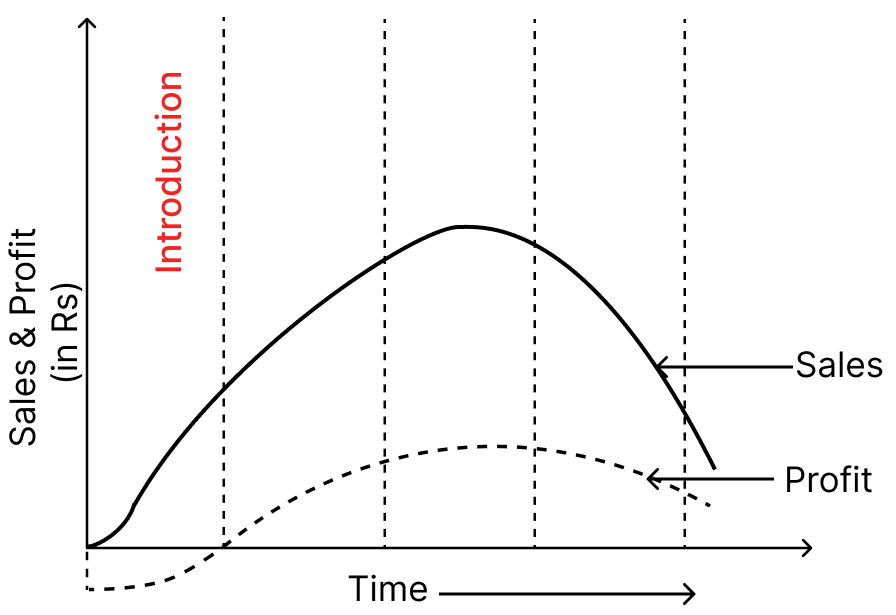
(a) Explain the stage of the Company's Product Life Cycle mentioned in the paragraph with the help of a diagram.
(b) Name the service to be offered by the Company in the next phase. Explain any two characteristics of Services.
(c) Suggest any two modern ways of marketing the concept of a product. Explain.
Answer
(a) Stage of Product Life Cycle — Introduction Stage
The chipset has just been launched, and the company aims to target first-time smartphone users in rural areas. This indicates the Introduction Stage of the product life cycle.
During this stage, the product is born — either entirely new or a new version of a basic product. Competition is virtually absent, the market is limited, prices are relatively high and little is known about the product. Growth in sales volume is at a low rate due to lack of awareness and limited distribution. This stage is risky as a high percentage of new products fail during this period.
(b) Service offered — Mobile communication / Telecommunication services (5G connectivity).
Two characteristics of Services:
- Intangibility — Services cannot be seen, touched or stored before purchase, unlike physical products. For example, mobile communication services are intangible — the customer experiences the service but cannot hold it physically.
- Inseparability — Services are produced and consumed simultaneously. The service provider and the customer must interact at the time of service delivery. For example, a phone call is delivered and consumed at the same time.
(c) Two modern ways of marketing a product:
- Online Marketing / Internet Marketing — This is the latest method of direct selling. Customers can order products 24 hours a day through the seller's website. It is convenient and hassle-free, less expensive for the seller, and helps build customer relationships. Sellers can quickly add products and change prices and descriptions.
- Telemarketing — The product is heavily advertised on TV. Interested customers place orders by telephone, mail or fax. Products are delivered through courier or VPP. For example, Asian Sky Shop uses this method in India. Some telemarketing systems are fully automated using Automatic Dialing and Recorded Message Players (ADRMPs).
Mention the various stages of 'Product Life Cycle'. How is product life cycle advantageous?
Answer
Stages of Product Life Cycle:
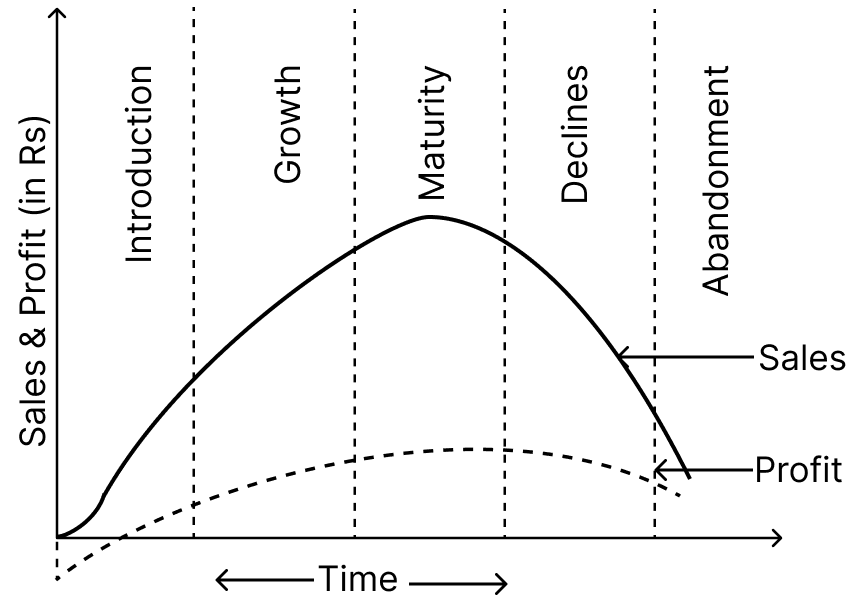
A product moves through five different stages of its life cycle:
- Introduction Stage — The product is launched in the market. Costs are high, sales are low, competition is virtually absent and prices are high.
- Growth Stage — Demand and sales grow rapidly, distribution widens, competition increases and prices fall. Profits rise.
- Maturity Stage — Sales continue to grow but at a decreasing rate. Markets get stabilised and saturation occurs. Profits start declining.
- Decline Stage — Sales fall sharply due to displacement by new products or change in consumer behaviour. Promotional expenses are reduced.
- Abandonment Stage — The product is dropped from the market and firms shift attention to other products.
Advantages of Product Life Cycle:
- Effective product planning — When the product life cycle is known, the firm can prepare an effective product plan and forecast sales and profits at each stage.
- Advance steps before decline — Management can take advance steps before the decline of the product, such as introducing new variants or finding new uses.
- Extending maturity stage — The maturity stage can be extended by finding new uses of the product, differentiating it, or developing new markets.
- Technological innovation — Technological innovations can be adopted to improve the quality, features and design of the product.
- Marketing decisions — It serves as a framework for taking sound marketing decisions at each stage of the life cycle, with appropriate emphasis on different elements of the marketing mix.
What pricing strategy will be used to launch
(i) a high end smart phone
(ii) shampoo
Answer
(i) High-end smartphone — Skimming Pricing
A high-end smartphone is a distinctive premium product targeted at affluent consumers who value exclusivity and innovation. Skimming pricing is appropriate for such a product.
Under this strategy, a very high price is set initially to skim the cream of demand. The high price helps recover the heavy investment in research and development quickly. Since the demand is relatively inelastic in the early stages (for status-seeking and tech-enthusiast customers), high prices do not significantly affect sales. Later, as competition enters, the price may be reduced to tap other market segments.
(ii) Shampoo — Penetrating Pricing
Shampoo is a Fast Moving Consumer Good (FMCG) used by the masses. Penetrating pricing is appropriate for such a product.
Under this strategy, a low price is set initially so that the brand quickly becomes popular and maximises market share. Demand for shampoo is highly elastic — by reducing price, demand can be greatly increased. There is also strong competition in the shampoo market, so a low initial price helps restrict the entry of new firms and gain mass acceptance. For example, sachets of shampoo are sold at very low prices to capture the rural and middle-class market.
Explain the first two stages of product life cycle.
Answer
The first two stages of product life cycle are:
1. Introduction Stage — During this stage, the product is born.
Characteristics:
- Competition is virtually absent.
- Market is limited and prices are relatively high.
- Sales grow at a low rate due to lack of consumer awareness.
- Heavy promotional expenditure leads to high costs and negative profits.
- This stage is very risky because a high percentage of new products fail during this period.
Strategies adopted:
- Proper advertisement and publicity (e.g., money-back guarantee).
- Attractive gifts as 'introductory offer'.
- Selective distribution and attractive discount to dealers.
- Skimming pricing policy to recover heavy promotional costs.
2. Growth Stage — In this stage, demand and sales grow rapidly, distribution is widened, competition increases and prices fall. Promotional focus shifts from "buy my product" to "buy my brand".
Characteristics:
- Sales and profits grow rapidly.
- Distribution channels expand.
- Promotional expenses remain high but fall as a percentage of sales.
- Major improvements may take place in the product.
Strategies adopted:
- Heavy advertising to create brand image.
- Expanding distribution channels.
- Introducing new versions to cater to different customer types.
- Keeping prices at competitive levels.
- Greater emphasis on customer service.
Explain the maturity stage and decline stage of product life cycle.
Answer
Maturity Stage:
During this stage, sales continue to grow but at a decreasing rate. Competition increases further, and markets get stabilised.
Characteristics:
- The product is known all over the market.
- A third level market (low income group) may emerge.
- Prices are reduced due to competition, but promotional expenditure remains high.
- Profits decline and marginal producers are forced to leave the market.
- Manufacturers introduce new models and broaden their lines.
- Supply exceeds demand for the first time, leading to saturation.
Strategies to lengthen this stage:
- Differentiating the product from competitors.
- Focussing on brand image.
- Extending warranty period.
- Introducing reusable packaging.
- Developing new markets and finding new uses.
Decline Stage:
This stage is characterised by either the product's gradual displacement by new and superior products or by changes in consumer's buying behaviour.
Characteristics:
- Sales fall down sharply.
- Promotional expenditure has to be reduced drastically to minimise loss.
- The emphasis is on efficient distribution at the lowest cost.
- Unless new uses are found, the product may soon go out of the market.
Strategies to avoid sharp decline:
- Adding new features to the product.
- Introducing economy models or packs to revive the market.
- Using new and attractive packaging to attract customers.
- Adopting selective promotion to reduce distribution costs.
Explain the maturity stage and abandonment stage of product life cycle.
Answer
Maturity Stage:
During this stage, sales continue to grow but at a decreasing rate. Competition increases further and markets get stabilised.
Characteristics:
- The product is known all over the market and a low-income group market may emerge.
- Prices are reduced due to competition, but promotional expenditure remains high.
- Profits decline and marginal producers are forced to leave.
- Supply exceeds demand for the first time, leading to saturation.
- New models are introduced and product lines are broadened.
Abandonment Stage:
This is the final stage of the product life cycle. Most firms shift their attention to other products and gradually phase out the declining product.
Characteristics:
- The product is removed from the market to make better use of resources.
- Preferences of consumers change, and new innovations enter the market to take the place of abandoned products.
- Firms try to postpone abandonment by introducing new models with unique features.
- In case of heavy losses and no future, the firm may sell out and merge with a stronger enterprise.
For example, the typewriter was abandoned with the introduction of computers, and keypad phones are gradually being abandoned in favour of touchscreen smartphones.
Explain the strategies to be adopted during the introduction stage and growth stage of Product Life Cycle.
Answer
Strategies during Introduction Stage:
The introduction stage is characterised by high costs, low sales, limited distribution and high prices. The following strategies may be employed to introduce the product successfully:
- Advertising and publicity — Proper advertisement and publicity of the product. For example, money-back guarantee may be offered to persuade people to try the product.
- Introductory offers — Attractive gifts to customers as an 'introductory offer' to encourage trial.
- Selective distribution — Selective distribution and attractive discount to dealers.
- Removing deficiencies — Removing technical and other deficiencies in the product based on customer feedback.
- Skimming pricing — Higher initial price to recover heavy promotional costs and investment.
Strategies during Growth Stage:
The following strategies may be adopted:
- Heavy advertising — To create a strong brand image and stimulate sales.
- Expanding distribution — Widening distribution channels to make the product available wherever demanded.
- New versions — Introducing new versions of the product to cater to the needs of different types of customers.
- Competitive pricing — Keeping the price at competitive levels to attract more customers.
- Customer service — Greater emphasis on customer service to retain customers and build loyalty.
What is direct selling? Mention four cases where direct selling is more suitable than indirect channels of distribution.
Answer
Direct Selling — Direct selling means the producer directly sells goods to ultimate consumers, and there is no middleman or intermediary involved. The producer has direct contact with customers and full control over distribution. Direct selling has become popular due to increasing costs of distribution, scattered markets, cut-throat competition. Four cases where direct selling is more suitable than indirect channels:
- Industrial and heavy products — For products like industrial machinery, power transformers, and heavy equipment, direct selling is most suitable as buyers are limited in number and require technical demonstration, installation and after-sales service.
- Perishable goods — Producers of perishable commodities like fruits, vegetables and bakery items prefer direct selling to local customers to avoid spoilage during transit through middlemen.
- Custom-made products — When products are made according to specific customer requirements (e.g., tailored garments or specialised electronics), direct contact between producer and consumer is essential.
- Limited or concentrated markets — When the number of prospective buyers is small or the market is geographically concentrated in a limited area, direct selling is easy and economical (e.g., specialised software sold to specific industries).
Explain any two types of consumer products with examples.
Answer
Two types of consumer products are:
Convenience Products — These are products that consumers buy frequently, with minimum effort and comparison. They are typically low-priced, widely available, and require quick purchase decisions. Consumers do not spend much time evaluating them. Examples include groceries, soaps, toothpaste, newspapers, milk, bread and biscuits. These are sold through long distribution channels involving wholesalers and retailers.
Shopping Products — These are products that consumers compare carefully on the basis of price, quality, style and suitability before purchase. They are usually higher-priced, durable, and bought less frequently. Consumers visit multiple stores and compare alternatives. Examples include clothing, furniture, footwear, home appliances and electronics. These are typically sold through retail stores where customers can examine and compare options.
(A third type — Speciality Products — includes unique high-end products like luxury cars, jewellery and designer brands for which consumers are willing to make a special effort to purchase.)
Explain the second and third stage of product life cycle.
Answer
Second Stage — Growth Stage:
In this stage, demand and sales grow rapidly, distribution is widened, competition increases and prices fall. The promotional focus shifts from "buy my product" to "buy my brand".
Characteristics:
- The firm expands sales by increasing market share in existing markets and by entering new markets.
- Promotional expenses remain high but fall as a percentage of sales turnover, leading to rising profits.
- Major improvements may take place in the product.
Strategies adopted:
- Heavy advertising to create a brand image and stimulate sales.
- Expanding distribution channels.
- Introducing new versions of the product.
- Keeping the price at competitive levels.
- Greater emphasis on customer service.
Third Stage — Maturity Stage:
During this stage, sales continue to grow but at a decreasing rate. Competition increases further, and markets get stabilised.
Characteristics:
- The product is known all over the market, and a low-income group market may emerge.
- Prices are reduced due to competition, while promotional expenditure remains high.
- Profits decline and marginal producers are forced out of the market.
- Supply exceeds demand for the first time, leading to saturation.
- Manufacturers broaden their product lines and introduce new models.
Strategies to lengthen this stage:
- Differentiating the product from competitors.
- Focussing on brand image.
- Extending the warranty period.
- Introducing reusable packaging.
- Developing new markets and finding new uses for the product.
ABC company is introducing new soap in the market. Which pricing strategy would be more appropriate? Give any four reasons.
Answer
Pricing Strategy — Penetrating Pricing
For introducing a new soap in the market, Penetrating Pricing would be the most appropriate strategy. This involves setting a low initial price to capture as large a market as possible.
Four Reasons:
- Highly elastic demand — Soap is an FMCG product where demand is highly sensitive to price. By reducing price, demand can be increased to a large extent. A low initial price will encourage customers to try the new soap.
- Strong competition — The soap market is highly competitive with several established brands like Lux, Dove, Lifebuoy, etc. Penetrating pricing helps the new soap restrict the entry advantage of competitors and gain market share quickly.
- Mass market product — Soap is a product used by the masses across all income levels. Aiming to sell to the masses is more profitable than targeting niche segments. A low price ensures wide acceptance.
- Economies of scale — Soap manufacturing benefits from substantial economies in unit cost when produced and sold in large volumes. Low prices enable high sales volume, which reduces per-unit cost.
(Example: 'Nirma' detergent powder used penetrating pricing to capture the mass market and displace the higher-priced 'Surf' in India.)
"Packaging is a silent salesman." Give five reasons to justify.
Answer
For the statement — Packaging is rightly called a 'silent salesman' because it performs many functions of a salesperson without speaking. Five reasons:
- Attracts attention — A well-designed package with attractive colours, shapes and graphics catches the customer's eye at the point of purchase. It draws customers towards the product among many alternatives on the shelf, just as a salesman would attract attention.
- Provides information — A package displays vital information such as brand name, ingredients, weight, manufacturing date, expiry date, MRP and usage instructions. This helps customers make informed buying decisions, replacing the need for a salesman to explain the product.
- Stimulates impulsive buying — In the era of self-service stores and supermarkets, packaging acts as a forceful salesman that encourages impulsive buying decisions, especially for products like chocolates, snacks and cosmetics.
- Differentiates the product — Packaging gives the product a unique identity and distinguishes it from competitive products. It lends individuality and prestige to the product, helping customers recognise and choose it.
- Builds customer confidence — A good package, by sealing the product and displaying authentic information, builds customer confidence and protects them from spurious products. This trust is what a salesman would otherwise build through interaction.
Name the stage of Product Life Cycle, when the promotional focus shifts from 'buy my product' to 'buy my brand'. State four strategies adopted during this stage.
Answer
Stage — Growth Stage
During the Growth Stage of the product life cycle, the promotional focus shifts from "buy my product" to "buy my brand". This is because by this stage, multiple competitors have entered the market with similar products, and the firm needs to build brand loyalty rather than just creating product awareness.
Four strategies adopted during the Growth Stage:
- Heavy advertising — To create a strong brand image and stimulate sales. The aim is to differentiate the firm's brand from those of competitors.
- Expanding distribution channels — To make the product available wherever demanded. Wider distribution helps capture more markets and prevent competitors from gaining shelf space.
- Introducing new versions — New versions of the product are introduced to cater to the needs of different types of customers and segments, expanding the customer base.
- Keeping prices at competitive levels — Prices are kept competitive (not too high, not too low) to retain customers and prevent them from switching to competitors. Greater emphasis is also placed on customer service to build loyalty.
CASE STUDY
Innovation and brand consultant, Anisha Motwani, believes that free trials or sampling as a strategy is mostly prevalent and successful in categories that have deep seated habits and have high frequency of consumption. Brand switching in this category require attitude and behavior changes and free sampling influences customers to try new brands and thus increasing the probability of purchase. Such categories could include newspapers, food products, etc. Free trials can also be found in case of expensive offerings where consumers prefer sampling before making a final commitment……
Success of Reliance Jio in the intensely competitive Indian telecom market brings forth the strength of trial marketing strategy, even in the service industry. Reliance Jio Infocomm Ltd offered free sampling of Jio's voice calling, text messaging, and data services, and acquired stupendous 100 million subscribers, of which it continued to retain 72 million even after the free trial period ended.
Conventional wisdom suggests that brand that indulge in trials and discounts erode brand Value. Here's the reality though. People value brands. But people also seek value for money ……
Source: https://www.ascdegreecollege.ac.in/wp-content/uploads/2020/12/Marketing-Management-Indian-Cases.pdf
With reference to the case study answer the following question:
Identify and explain suitable element of marketing mix that has been discussed here.
Answer
Element identified — Promotion Mix (specifically, Sales Promotion)
The element of marketing mix discussed in the case study is Promotion Mix, more specifically, the tool of Sales Promotion through free trials and sampling.
Explanation:
Promotion mix consists of all activities aimed at persuading customers to buy the product. Its various tools include advertising, personal selling, sales promotion, publicity, direct selling and public relations.
Sales Promotion refers to short-term promotional activities used to increase sales. It includes tools like displays, demonstrations, free samples, fashion shows, exhibitions, prize contests, coupons, and 'buy one, get one free' offers. Sales promotion supports advertising and personal selling.
In this case study:
- Anisha Motwani highlights that free trials and sampling are effective sales promotion strategies in categories with deep-seated habits and high consumption frequency, such as newspapers and food products.
- Reliance Jio successfully used free sampling of its voice calling, text messaging and data services in the highly competitive Indian telecom market.
- Through this trial marketing strategy, Jio acquired 100 million subscribers, of which 72 million were retained even after the free trial period ended.
This demonstrates how sales promotion (a tool of promotion mix) can influence customers to try new brands, change buying habits and increase the probability of purchase, ultimately building a strong customer base even in service industries.
What is direct selling? Discuss its latest method.
Answer
Direct Selling — Direct selling means the producer directly sells goods to ultimate consumers without any middleman or intermediary. The manufacturer has direct contact with customers and full control over distribution. Direct selling has become popular due to increasing costs of distribution, scattered markets, cut-throat competition, the desire to maintain control over distribution, and modern means of communication.
Latest method — Online Marketing or Internet Marketing
Online Marketing (also called Internet Marketing) is the latest method of direct selling. It uses the internet as a medium to reach customers directly without any intermediary.
Features of Online Marketing:
- Convenience — Customers can order products 24 hours a day, wherever they are. They need not visit the store or face salespersons.
- Access to information — Customers can access information on the Internet about competing brands, prices, features, and reviews to make informed decisions.
- Cost-effective for sellers — This method is less expensive for the seller as it eliminates the need for physical stores and middlemen.
- Flexibility — Sellers can quickly add products, change prices and update descriptions in real time.
- Customer relationship — It helps sellers build relationships with customers through personalised offers, emails, and interactive feedback.
Examples include Amazon, Flipkart and Myntra, where producers sell directly to customers through their online platforms or company websites. Online marketing has revolutionised direct selling by making products globally accessible and improving customer experience.
Identify the highlighted 'C' stage of the Product Life Cycle given in the image below and specify its any four features.
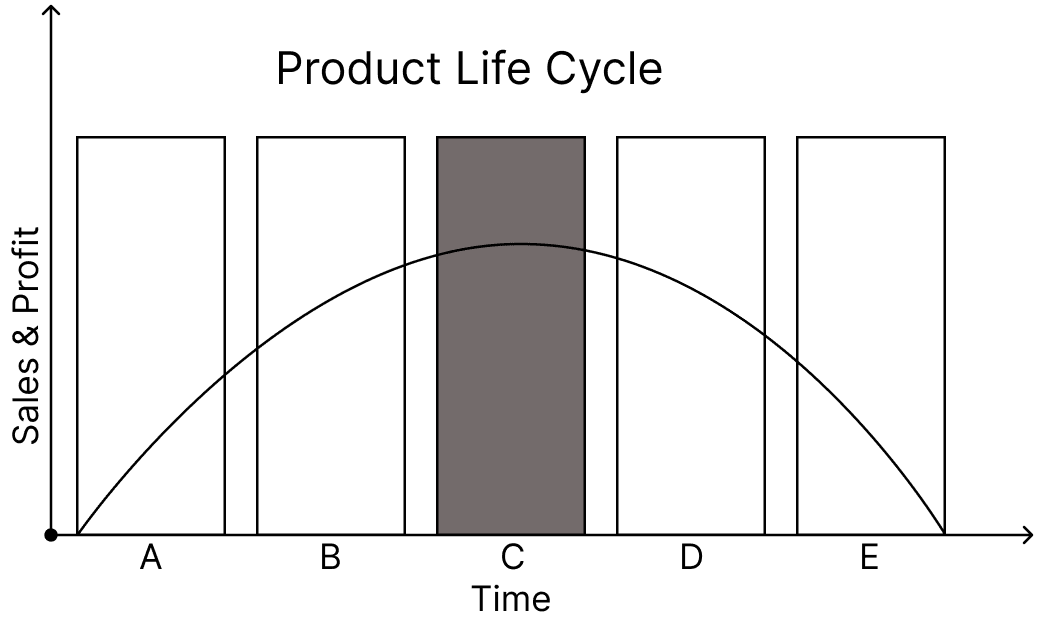
Answer
Stage 'C' — Maturity Stage
In the Product Life Cycle diagram, the sequence of stages is: Introduction (A), Growth (B), Maturity (C), Decline (D), and Abandonment (E). The 'C' stage represents the Maturity Stage, which is at the peak of the sales curve.
Four Features of the Maturity Stage:
- Sales grow at a decreasing rate — During this stage, sales continue to grow but at a decreasing rate. Eventually, the sales curve levels off as the market reaches saturation, with supply exceeding demand for the first time.
- Intense competition — Competition increases further during this stage, and the markets get stabilised. The product is known all over the market, and many competitors offer similar products.
- Falling profits — Due to intense competition, prices are reduced, but promotional expenditure remains high. As a result, profits decline, and marginal producers are forced out of the market.
- Product differentiation and improvement — Manufacturers attempt to differentiate their product from competitors by introducing new models, broadening product lines, focussing on brand image, extending warranty periods, introducing reusable packaging, and finding new uses for the product.