
Under which function of marketing, marketer gives special name to the product of his own company?
- Packaging
- Branding
- Warehousing
- Labelling
Answer
Branding
Reason — Branding is the process of assigning a distinctive name to the product by which it is to be known and remembered. It is the process by which a product is branded.
Which type of advertising focuses on a particular product or brand or service of an enterprise?
- Product advertisement
- Institutional advertisement
- Revenue advertisement
- None of these
Answer
Product advertisement
Reason — The main objective of product advertising is to promote the sale or reputation of a particular product, brand or service. It is sponsored by manufacturers, traders and other organisations to promote the uses, features, benefits and image of their products and services.
Which of the following statement(s) is/are correct?
Statement 1: Publicity is always a paid form of promotion that originates from the advertiser.
Statement 2: Advertising is a non-personal communication that requires payment to the media owner.
- Only Statement 1 is correct
- Only Statement 2 is correct
- Both statements are correct
- Both statements are incorrect
Answer
Only Statement 2 is correct
Reason — Statement 1 is incorrect because publicity is non-personal stimulation of demand which is NOT paid for by the sponsor; the message originates from the media, not the advertiser. Statement 2 is correct because advertising is a paid form of non-personal presentation in which the advertiser pays the media owner for space or time.
Free samples are given to consumers in case of:
- Personal selling
- Sales promotion
- Advertising
- Publicity
Answer
Sales promotion
Reason — Distribution of free samples is one of the main methods of sales promotion. It is used particularly to introduce new products to consumers and encourage them to try the product.
Which advertising medium is most likely depicted in the image below, considering its high cost and short life?

- Radio
- Films
- Newspapers
- Outdoor Advertising
Answer
Films
Reason — Film slides containing advertisements are shown in cinemas before the start of the feature film and during intermission. Although it is effective due to combined effect of spoken words and visuals, it suffers from high cost and lack of timeliness.
Which one of the following is not a sales promotion tool:
- Advertisement
- Discount
- Dealer contest
- Consumer contest
Answer
Advertisement
Reason — Advertisement is a separate element of the promotion mix and is a paid form of non-personal communication. The methods of sales promotion include discounts, dealer contests, consumer contests, free samples, coupons, etc.
Direct mail is an example of mass communication and has a broad reach across diverse audiences.
- True
- False
Answer
False
Reason — Direct mail is the most selective medium of advertising as the message is sent to selected persons directly. It has limited coverage and personal appeal, so it is not an example of mass communication.
All companies strive to build ............... strength.
- Brand
- Image
- Customer
- Employee
Answer
Brand
Reason — All companies strive to build brand strength, as a strong brand creates customer loyalty, helps differentiate products from competitors, and adds value to the product (brand equity).
Which of the following is not an advantage of branding?
- It helps consumer to identify and recognise the product.
- It differentiates the product from the rival products.
- It ensures standards of quality and design to consumers.
- It is not the basis of advertising and other techniques of mass selling.
Answer
It is not the basis of advertising and other techniques of mass selling.
Reason — Branding is the basis of advertising and other techniques of mass selling. Gradually, the brand itself becomes its own advertisement (e.g., Dalda, Coca-Cola, Lux). Therefore, statement 4 is the opposite of an advantage of branding.
Which of the following techniques of sales promotion can be used at the time of important festivals or other occasions?
- Merchandise aids
- Free offer
- Distribution of free samples
- Clearance sale
Answer
Free offer
Reason — During festivals or important occasions, free offers (premium or bonus offers like free gifts on purchase) are widely used to attract customers and boost sales. This sales promotion technique creates excitement and encourages festive buying.
Which of these best describes the objective of sales promotion?
- To generate a short-term sales increase
- To allow consumers permanent discounted pricing
- To reduce the amount of inventory on hand
- To encourage consumers to choose one retailer as a preferred distributor
Answer
To generate a short-term sales increase
Reason — Sales promotion means short-term incentives of non-recurring nature used to stimulate consumer purchasing and dealer effectiveness. The main purpose is to obtain spot buying by offering non-recurring and non-routine incentives, thereby generating short-term sales.
Money spent on advertisement is sheer wastage because:
- It does not add to the utility of products and services.
- Most of the advertisements are either ignored or escape the attention of consumers.
- Either (1) or (2)
- Both (1) and (2)
Answer
Both (1) and (2)
Reason — As per the criticism of advertising, money spent on advertising is sheer waste because it does not add to the utility of products and services, and most of the advertisements are either ignored or escape the attention of consumers. Both reasons are valid criticisms.
"To enhance the goodwill of the firm by promising better quality at fair prices" ............... .
- Is the objective of advertising
- Is the importance of advertising
- Is the disadvantage of advertising
- It is the effect of advertising
Answer
Is the objective of advertising
Reason — Building goodwill is one of the key objectives of advertising. Regular advertisements help create a good impression in the minds of customers about the enterprise.
Advertising is ............... than personal selling.
- Less flexible
- More flexible
- Very rigid
- All of these
Answer
Less flexible
Reason — Advertising is less flexible than personal selling because the message is standardised and non-personal, directed to a mass audience. Personal selling, on the other hand, allows the salesperson to adjust the message according to each customer's needs and reactions.
Which of the following is/are the criticism(s) of advertising?
- Unproductive
- Demand shift
- Monopoly creation
- All of these
Answer
All of these
Reason — Advertising has been criticised as being unproductive (wastage of resources), causing demand shift (only shifting demand from one product to another rather than creating new demand), and creating monopoly (big firms eliminate small firms with massive advertising budgets).
A company launches a new brand of detergent and decides to provide a free bucket with every purchase of the detergent. This strategy is best classified as:
- Advertising
- Publicity
- Sales Promotion
- Branding
Answer
Sales Promotion
Reason — Offering a free bucket with every purchase of detergent is a premium or bonus offer, which is one of the main methods of sales promotion. It provides a short-term incentive to encourage immediate purchase.
Which type of sales promotion is illustrated in the image below?
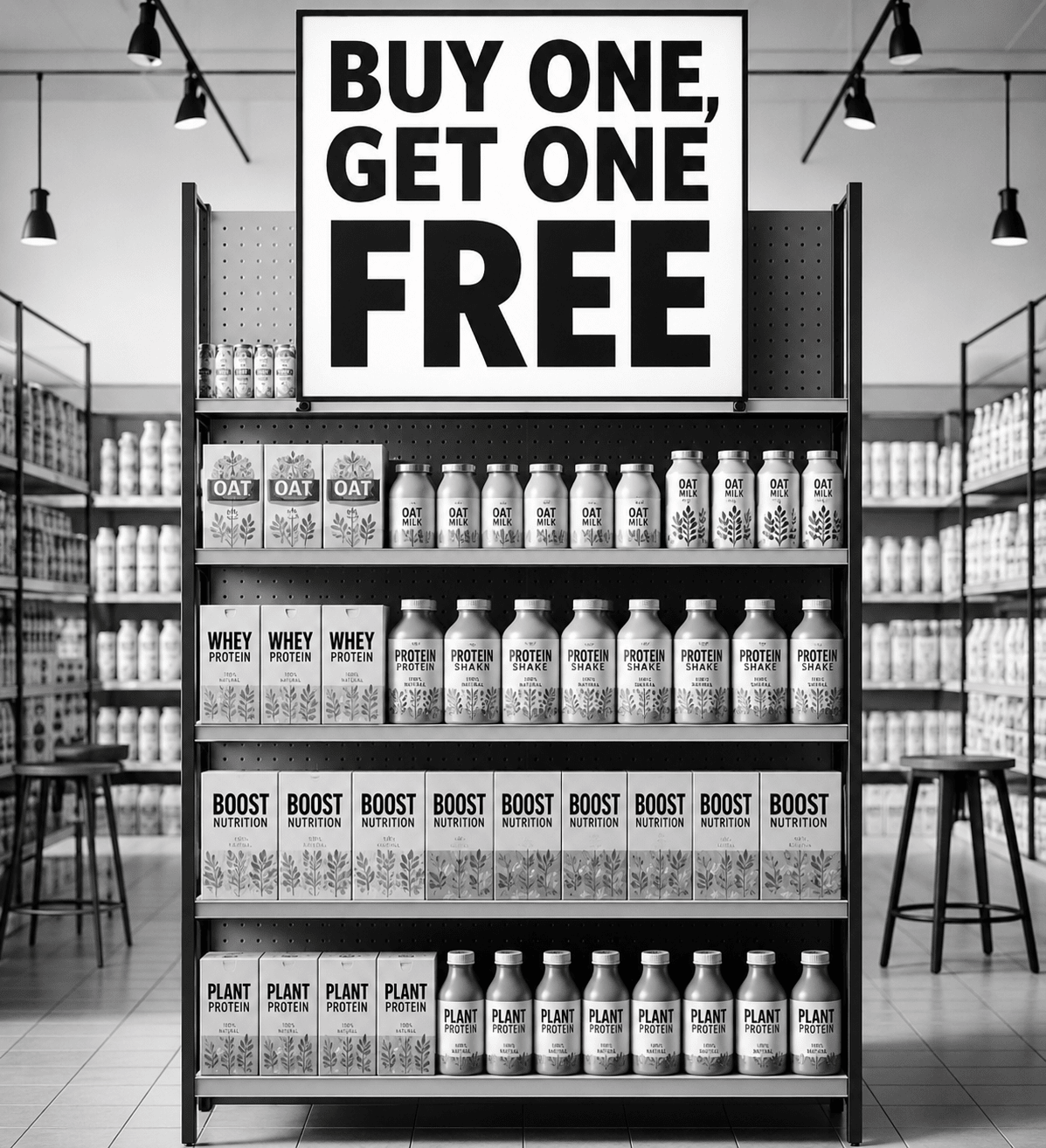
- Price-off Offer
- Premium Offer
- Prize Contest
- Exchange Offer
Answer
Premium Offer
Reason — A "Buy One Get One Free" offer is a premium or bonus offer where a free product is given along with the product purchased by the customer. It is one type of with-pack premium under sales promotion.
The primary purpose of reminder advertising is to introduce new products to the market.
- True
- False
Answer
False
Reason — Reminder advertising attempts to remind people about an existing product, service or idea. Introducing new products is the purpose of informative or concept (pioneering) advertising, not reminder advertising.
Trade fair, seminar, workshop, fair exhibitions, etc., are most closely associated with ............... .
- Promotion
- Price
- Product
- Place
Answer
Promotion
Reason — Trade fairs, seminars, workshops, and exhibitions are sales promotion methods used to display and popularise products of the firm. They form a part of the promotion element of the marketing mix.
Newsletters, catalogues, and invitations to organisation-sponsored events are most closely associated with ............... .
- Pricing
- Distribution
- Product development
- Promotion
Answer
Promotion
Reason — Newsletters, catalogues, and invitations to organisation-sponsored events are tools of promotion (advertising and publicity) used to communicate with customers and create awareness about the company and its products.
Which one of the following is not a sales promotion tool?
- Advertisement
- Discount
- Dealer contest
- Consumer contest
Answer
Advertisement
Reason — Advertisement is a separate component of the promotion mix and not a sales promotion tool. Discounts, dealer contests, and consumer contests are all techniques of sales promotion.
Which of the following statement(s) is/are correct?
Statement 1: Direct mail advertising is highly selective and allows for personal appeal.
Statement 2: Outdoor advertising has a long life and is effective in delivering detailed messages.
- Only Statement 1 is correct
- Only Statement 2 is correct
- Both statements are correct
- Both statements are incorrect
Answer
Only Statement 1 is correct
Reason — Statement 1 is correct because direct mail is the most selective medium and offers personal appeal as the message is sent to selected persons directly. Statement 2 is incorrect because although outdoor advertising has a long life, it cannot convey detailed messages — it has temporary appeal and low retention value.
"It is all marketing activities which stimulate consumer buying and dealer effectiveness. The aim of it is to increase immediate sales." What is it?
- Marketing
- Sales
- Sales promotion
- Social marketing
Answer
Sales promotion
Reason — Sales promotion refers to all those activities other than advertising and personal selling that stimulate consumer purchasing and dealer effectiveness, with the aim of increasing immediate sales.
All of the following are benefits of advertisements to customers except ............... .
- Employment generation
- Convenience
- Better quality
- Lower price
Answer
Employment generation
Reason — Employment generation is an advantage of advertising to society, not to consumers. The benefits to consumers include convenience (easier shopping), better quality (due to competition), and lower prices (due to large-scale production).
Which of the following is the sales promotion tool?
- Discount
- Fest
- High price
- Repeating same product
Answer
Discount
Reason — Discounts (price-off offers) are a popular method of sales promotion. They are short-term incentives that encourage immediate purchase by offering products at below the normal price.
"Sales promotion activities help to create interest in new products and ............... ."
- Stimulates demand
- Satisfies customers
- Time horizon
- Emphasis
Answer
Stimulates demand
Reason — Sales promotion activities help to create interest in new products and stimulate demand by offering attractive incentives to consumers, thereby encouraging them to purchase the product.
A brand of cooking oil runs an advertisement campaign highlighting its health benefits, supported by testimonials from nutritionists. This is an example of:
- Informative Advertising
- Concept Advertising
- Reminder Advertising
- Institutional Advertising
Answer
Informative Advertising
Reason — Informative advertising contains information about a product/service, including its features, uses, and benefits. By highlighting health benefits and providing testimonials from nutritionists, the brand is informing consumers about the product's benefits.
Promotion to marketing means ............... .
- Passing an examination
- Elevation from one grade to another
- Selling the products through various means
- Selling the products in specific area
Answer
Selling the products through various means
Reason — In marketing, promotion refers to all the personal or impersonal activities undertaken to inform, persuade, and assist prospects to buy a product or service. It includes advertising, sales promotion, personal selling, and publicity, i.e., selling products through various means.
Which of the following statement(s) is/are correct?
Statement 1: Institutional advertising focuses on promoting a product's features and benefits to consumers.
Statement 2: Product advertising aims to build a favourable image of the company rather than promoting specific products.
- Only Statement 1 is correct
- Only Statement 2 is correct
- Both statements are correct
- Both statements are incorrect
Answer
Both statements are incorrect
Reason — Both statements have been swapped. Product advertising focuses on a product's features and benefits, while institutional advertising aims to build a favourable image of the company/organisation rather than promoting specific products.
Media which has limited coverage:
- Newspapers
- Direct mail
- Television
- Radio
Answer
Direct mail
Reason — Direct mail is sent to selected persons only, so it has limited coverage compared to newspapers, radio, and television, which have wide coverage and reach a large number of people.
The value which is derived from the way the consumer perceives the brand name is:
- Brand promotion
- Brand loyalty
- Brand equity
- Quality control
Answer
Brand equity
Reason — Brand equity is the power and value which a brand adds to the product. It is derived from the consumer's perception of the brand name and reflects the additional value the brand brings to the product.
Advertisement designed to change a lifestyle of people is ............... .
- Persuasive advertising
- Concept advertising
- Institutional advertising
- Product advertising
Answer
Concept advertising
Reason — Concept advertising (also known as pioneering or primary demand advertising) aims to stimulate demand for a new type of product. Advertisements designed to change the lifestyle of people are concept advertising — for example, "A diamond is forever".
The main objective of this advertising is to persuade the customers to buy a product or service or to support an idea.
- Concept advertising
- Product advertising
- Persuasive advertising
- Informative advertising
Answer
Persuasive advertising
Reason — Persuasive advertising is specifically designed to persuade consumers to buy a product or service or to support an idea. Its objective is to influence the buying behaviour of consumers.
Advertising has been criticised because it ............... .
- Generates employment
- Increases prices of products to the consumers
- Establishes direct link between producer and consumer
- Provides wider choice
Answer
Increases prices of products to the consumers
Reason — Advertising is criticised because it increases the prices of products as the expenses incurred on advertisements are passed on to consumers. The other options (generating employment, direct link, wider choice) are advantages of advertising, not criticisms.
............... ensures uniform standards of quality and design of products to consumers.
- Selling
- Branding
- Advertising
- Publicity
Answer
Branding
Reason — Branding ensures uniform standards of quality and design to consumers. Branded products carry the manufacturer's reputation and are required to maintain consistent quality standards.
Sales promotion, advertising, personal selling and publicity are used for ............... .
- Place
- Product
- Promotion
- Price
Answer
Promotion
Reason — Sales promotion, advertising, personal selling, and publicity are the four elements of the promotion mix. They are all techniques used to promote products and communicate with customers.
Consumer's continuous preference of a particular brand due to faith in its superiority is termed as ............... .
- Brand Equity
- Brand promotion
- Brand loyalty
- Branding
Answer
Brand loyalty
Reason — Brand loyalty means that some consumers continue to prefer a particular brand due to faith in its superiority. It results in repeat sales over the long run.
In advertising, the ............... has control over the contents and the timing of the message.
- Media
- Customer
- Competitor
- Sponsor
Answer
Sponsor
Reason — In advertising, the sponsor (advertiser) has control over the contents and timing of the message because they pay for it. This is one of the main differences between advertising and publicity, where media controls the message.
Which one is the feature of the advertising?
- Direct communication
- Face to face communication
- Mass communication
- Verbal communication
Answer
Mass communication
Reason — Advertising is a method of mass communication where the message is directed to a large number of persons through various media. It is non-personal as no face-to-face contact is involved.
What is the advantage of advertising to the manufacturers?
- Helps in raising the living standard of people.
- Helps to maintain steady demand by smoothing out seasonal fluctuations in demand.
- They are the main sources of income for newspapers and magazines.
- Reduces possibility of cheating of consumers.
Answer
Helps to maintain steady demand by smoothing out seasonal fluctuations in demand.
Reason — Advertising helps manufacturers maintain steady demand by smoothing out seasonal fluctuations. Options 1 and 3 are advantages to society, and option 4 is an advantage to consumers.
The advertisement designed to change the lifestyle of people is:
- Persuasive
- Informative
- Pioneering advertising
- Reminder
Answer
Pioneering advertising
Reason — Pioneering advertising (also called concept advertising or primary demand advertising) aims to stimulate demand for a new type of product and is designed to change the lifestyle of people. For example, "A diamond is forever".
The power and value of a brand which adds to the product is called ............... .
- Brand loyalty
- Brand quality
- Brand equity
- Brand publicity
Answer
Brand equity
Reason — Brand equity is defined as the power and value which a brand adds to the product. A strong brand contributes additional value beyond the functional benefits of the product itself.
Which advertisement is designed to build a favourable image of the organisation rather than to promote product or service?
- Concept advertisement
- Institutional advertisement
- Product advertisement
- Reminder advertisement
Answer
Institutional advertisement
Reason — The aim of institutional advertising is to build a favourable image of the organisation rather than to promote the sale of a particular product or service.
Which of the following is not a method of Brand Promotion?
- Publicity
- Advertisements
- Public Relations
- Quality control
Answer
Public Relations
Reason — The methods of brand promotion mentioned in the chapter are advertisements, quality control, and publicity. Public relations is not listed as one of the main methods of brand promotion in the chapter.
Identify which of this is NOT the advantage of Advertising to the consumers:
- Advertisement creates a direct link between the Producer and Consumer
- It provides educational value
- It reduces the possibility of cheating of consumers
- It helps to meet the competition in the market
Answer
It helps to meet the competition in the market
Reason — "Helping to meet competition in the market" is an advantage of advertising to manufacturers, not to consumers. The other options (direct link, educational value, reducing cheating) are all advantages to consumers.
Which is a very old medium of advertising?
- Television
- Film
- Outdoor
- Newspaper
Answer
Outdoor
Reason — Outdoor advertising is described in the chapter as a very old medium. It consists of posters, billboards, neon signs, wall writings, and signboards on buses and other public vehicles.
Everyone loves the exclusive discounts and offers that come around during the holiday season. Your brand may already be running some discount offers.
Based on the information given above, which of the statement given below describes the term brand?
- Brand means the process of assigning a distinctive name to the product by which it is to be known and remembered.
- Brand means short term incentives of non-recurring nature used to stimulate consumer purchasing and dealer effectiveness.
- Brand means any identification mark used to identify the product of a seller and to differentiate it from the products of competitors.
- Brand means the exchange of goods and service for money.
Answer
Brand means any identification mark used to identify the product of a seller and to differentiate it from the products of competitors.
Reason — A brand is any identification mark (such as a trade name, mark, symbol, picture, design, colour, etc.) used to identify the product of a seller and to differentiate it from the products of competitors. Option 1 defines branding (the process), and option 2 defines sales promotion.
............... is commercially significant news which has no sponsor and is a credible method of promotion.
- Advertising
- Sales promotion
- Publicity
- Personal selling
Answer
Publicity
Reason — Publicity means any commercially significant news which has no sponsor, is non-personal, and is not paid for by the individual or organisation involved in it. It is an inexpensive, timely, and credible method of promotion.
Companies like Amul and Colgate have well established markets in India. Their advertisement is still a regular feature in multiple newspapers and television channels. Such advertisements can be classified as:
(1) Concept advertisement
(2) Reminder advertisement
(3) Institutional advertisement
(4) Product advertisement
- 1 and 2
- 2 and 3
- 3 and 4
- 2 and 4
Answer
2 and 4
Reason — Since Amul and Colgate are well-established brands, their advertisements are reminder advertisements (to remind consumers about their products) and product advertisements (focused on specific products like butter, milk, toothpaste). They are not introducing new concepts or building institutional images.
Advertising leads to a variety in consumption and use of better-quality products. The advantage of advertising is related to:
- Manufacturers
- Society
- Consumers
- Government
Answer
Society
Reason — Advertising leading to variety in consumption and use of better quality products is listed as an advantage of advertising to society. It helps raise the standard of living in society through widespread use of household appliances and improved products.
Enumerate any four methods of sales promotion.
Answer
The four main methods of sales promotion are:
Free Samples — Business firms distribute free samples of their products to selected consumers to make the products popular. This method is generally used for products of daily use like soaps, detergents, toothpaste, cosmetics, tea, etc.
Coupons — A coupon is a certificate that entitles its holder to a specified saving on the purchase of a specified product. Coupons are distributed through mail, newspapers, magazines, or retailers.
Premium or Bonus Offer — This implies an offer of a certain quantity of the product, free of cost, on the purchase of a specified quantity of the product. For example, one spoon free inside a 2 kg packet of Surf washing powder.
Price-off Offers — This means offering the product at below the normal price. For example, business firms may give 20% off on refrigerators, coolers, and fans during the off-season.
What is meant by 'premium offer'?
Answer
A premium or bonus offer implies an offer of a certain quantity of the product, free of cost, on the purchase of a specified quantity of the product. It also refers to a free gift on the purchase of specified products.
A premium offer can be of three types:
- With-pack premium — A free product given along with the product purchased (e.g., one spoon free with a packet of Surf).
- Reusable container — A container that has utility for the customer after the product is consumed (e.g., detergent powder offered in a plastic bucket).
- Free-in-the-mail premium — A free gift the customer can obtain after sending proof of purchase (e.g., a Bluetooth speaker free on purchase of a large refrigerator).
State any two objectives of advertising.
Answer
Two objectives of advertising are:
To Introduce New Products — Producers and traders advertise to inform customers about the availability of a new product and its salient features. They seek to develop a good image of the new product and persuade consumers to buy it, thereby creating demand for the new product.
To Build Brand Preference — Repeated advertisements are used to develop preference for a particular brand. Brand loyalty helps to yield repeat sales in the long run. Advertising continuously reminds consumers about the superiority of the brand so that customers do not switch to other brands.
Distinguish between sales promotion and publicity.
Answer
| S.No. | Basis | Sales Promotion | Publicity |
|---|---|---|---|
| 1. | Meaning | Marketing activities which stimulate consumer buying and dealer effectiveness. | Commercially significant news which has no sponsor and is non-personal. |
| 2. | Sponsor | Sales promotion is sponsored by the manufacturer/seller. | Publicity has no identified sponsor. |
| 3. | Payment | The seller pays for sales promotion activities. | The individual or firm involved does not pay for publicity. |
| 4. | Aim | To increase immediate sales or dispose of old stock. | To inform the public and build image. |
| 5. | Methods | Free samples, coupons, contests, premium offers, etc. | News releases, press conferences, feature articles, etc. |
Explain any two essentials of a good advertisement.
Answer
Two essentials of a good advertisement are:
Attention Value — The first requirement of a good advertisement is that it must be able to attract the attention of those to whom it is directed. Most people are busy and pay only cursory attention to advertisements. The attention can be attracted by using catchy headlines, pictures, bright colours, bold types, artistic borders, or by quoting an attractive low price.
Memorising Value — The design and layout of the copy should be such that it has a lasting impression on the minds of people. Repeated use of brand names and trademarks helps to make the advertisement memorable. Association of the product with a symbol or sketch (e.g., the smiling baby with Murphy radios) also helps to create a long-term impact on the mind.
Enumerate the various promotional techniques used by business firms to boost sales.
Answer
The various promotional techniques used by business firms to boost sales are:
Advertising — Any paid form of non-personal presentation and promotion of ideas, goods, or services through media like newspapers, TV, radio, internet, etc.
Sales Promotion — Short-term incentives of non-recurring nature like free samples, coupons, premium offers, price-off offers, prize contests, exchange offers, etc.
Personal Selling — Direct face-to-face communication with prospective buyers by salespersons to inform, persuade, and assist in purchase.
Publicity — Commercially significant news about the company in media that is not paid for by the company, like news releases, press conferences, and feature articles.
What is 'concept advertising'?
Answer
Concept advertising is also known as 'primary demand advertising' or 'pioneering advertising'. Its purpose is to stimulate demand for a new type of product. Advertisements designed to change the lifestyle of people are concept advertising. For example, the advertisement "A diamond is forever" seeks to promote diamond jewellery as a concept rather than as a specific brand.
What is brand loyalty?
Answer
Brand loyalty means that some consumers continue to prefer a particular brand due to faith in its superiority. It is the result of repeated advertising and consistent quality of the product. When a consumer is brand loyal, he/she does not switch to other brands even if competitor's products are available at lower prices. Brand loyalty helps to yield repeat sales in the long run and ensures a steady customer base for the company.
Distinguish between persuasive and informative advertising.
Answer
| S.No. | Basis | Persuasive Advertising | Informative Advertising |
|---|---|---|---|
| 1. | Meaning | This type of advertising is designed to persuade consumers to buy a product or service. | This type of advertising contains information about a product, service, or institution. |
| 2. | Purpose | To influence the buying behaviour of consumers. | To make consumers aware of the existence, features, and uses of goods and services. |
| 3. | Approach | Emotional and persuasive in nature. | Factual and educational in nature. |
| 4. | Example | Advertisements promoting the superiority of a brand. | Advertisements suggesting how to save petrol or avoid accidents. |
What is a brand? How is it different from branding?
Answer
Brand — A brand means any identification mark (such as trade name, mark, symbol, picture, design, colour, etc.) used to identify the product of a seller and to differentiate it from the products of competitors. Examples include Dalda ghee, Colgate toothpaste, Lux soap, and Titan watches.
Difference: A brand is the name, mark, or symbol itself, whereas branding is the process of creating and popularising that brand. In simple terms, branding is the activity, while the brand is the result of that activity.
Write a short note on institutional advertisement and persuasive advertising.
Answer
Institutional Advertising — The aim of institutional advertising is to build a favourable image of the organisation rather than to promote the sale of a product or service. The emphasis is on enhancing the goodwill and reputation of the company. Many corporates use institutional advertising to highlight their contributions to society, ethical practices, or corporate values.
Persuasive Advertising — Persuasive advertising is designed to persuade consumers to buy a product or service or to support an idea. The main objective is to influence the buying behaviour of consumers. It tries to convince consumers that the advertised product is better than competitors' products. It often uses emotional appeals, testimonials, and comparisons.
A branded product needs no sales promotion. Justify for or against.
Answer
Against the statement.
A branded product also needs sales promotion for the following reasons:
Competition — Even well-known brands face intense competition from rival brands. Sales promotion helps maintain market share against competitors.
New Product Launches — Even established brands launch new variants or extensions which require sales promotion to gain quick acceptance.
Boosting Sales During Slack Seasons — Sales promotion schemes like discounts and free offers help boost sales during off-seasons.
Clearing Old Stock — Sales promotion helps clear overdue stock and inventory.
Hence, sales promotion is necessary even for branded products.
What is meant by persuasive advertising?
Answer
Persuasive advertising is a type of advertising that is designed to persuade consumers to buy a product or service or to support an idea. Its main aim is to influence the buying decisions of consumers by convincing them about the superiority and necessity of the product. It often makes use of emotional appeals, testimonials, comparisons with competitors' products, and arguments highlighting the benefits of the product. The key purpose of persuasive advertising is to change consumer attitudes and motivate them to take action — usually purchasing the advertised product.
Advertisements eliminate middlemen. Justify either for or against.
Answer
For the statement.
Advertisements help to eliminate middlemen for the following reasons:
Direct Contact — Through advertisements, businesses can send their messages far and wide, enabling them to establish direct contact with customers.
Reduced Dependence on Dealers — When customers are well-informed about products through advertisements, they directly approach manufacturers or authorised retailers, reducing dependence on intermediate sellers.
Lower Distribution Costs — Direct contact with consumers helps reduce the cost of distribution as fewer middlemen are involved.
Lower Prices for Consumers — Elimination of middlemen helps to reduce prices for consumers since middleman margins are saved.
Thus, advertising helps reduce the role and number of middlemen in the distribution chain.
State one difference between advertising and publicity.
OR
Distinguish between Advertising and publicity. (any one point)
Answer
Sponsor — In advertising, the identity of the sponsor is clearly known and the advertiser pays the media to deliver the message. In publicity, the identity of the sponsor is not clear and the individual or firm involved does not pay for it; the message originates from the media.
State one difference between institutional advertising and product advertising.
Answer
The aim of institutional advertising is to build a favourable image of the organisation rather than to promote the sale of a particular product or service. In contrast, the main objective of product advertising is to promote the sale or reputation of a particular product, brand, or service.
Mention any two essentials of a brand.
Answer
Two essentials of a good brand are:
Brief and Simple — The brand name should be short, simple, easy to pronounce, spell, and remember. Long and complex words should be avoided as they create difficulty in reading and remembering. For example, Surf, Lux, Nirma.
Distinctive — The brand name should be distinctive and difficult to imitate. It should be unique and different from other brands in the same category, so that consumers can easily identify it.
Explain any two disadvantages of advertising.
Answer
Two disadvantages of advertising are:
Higher Prices — Advertising increases the prices of products to consumers because the expenses incurred on advertisements are passed on to them. Heavy spending on advertisement adds to the cost of the product, making it costlier for the end consumer.
Deceptive and Untruthful — In order to impress people, false statements and exaggerated claims are often made in advertisements. As a result, innocent people are misled into buying inferior or even worthless products. Advertising thus offers scope for fraud and deception.
"The objective of advertising is to support dealers." Justify this statement for or against and give a reason.
Answer
For the statement.
Yes, supporting dealers is an objective of advertising. Advertising assists dealers and salespersons in the following ways:
- Advertisements inform consumers about the product, paving the way for the salesman's visit and making selling easier.
- Advertisements carry details of dealers from where the product is available, helping to direct customers to the correct outlets.
- Advertising creates demand for products, which makes it easier for dealers to sell them.
- Pre-sold customers approach dealers ready to buy, reducing the dealer's selling effort.
Hence, advertising helps support dealers and is one of the key objectives of advertising.
Distinguish between Advertising and sales promotion.
Answer
| S.No. | Basis | Advertising | Sales Promotion |
|---|---|---|---|
| 1. | Meaning | Any paid form of non-personal presentation and promotion of a product, service, or idea by an identified sponsor. | Marketing activities which stimulate consumer buying and dealer effectiveness. |
| 2. | Time Horizon | Long-term perspective. | Short-term perspective. |
| 3. | Aim | To build the image of the producer and his product. | To increase immediate sales or dispose of old stock. |
| 4. | Media | Newspapers, magazines, TV, radio, posters, films, etc. | Free samples, coupons, contests, premium offers, displays, etc. |
| 5. | Nature | Regular and recurring. | Limited period, non-recurring. |
"Product differentiation is the main aim of branding." Justify this sentence for or against and give a reason.
Answer
For the statement.
Yes, product differentiation is the main aim of branding. Branding helps differentiate a product from competitors' products in the following ways:
- Unique Identity — A brand gives the product a unique identity through a distinctive name, mark, or symbol.
- Brand Loyalty — A producer can create a marked preference for his product (brand loyalty) by repeatedly promoting the brand to the public.
- Recognition — Consumers can easily identify and recognise the branded product, distinguishing it from rival products.
- Competitive Advantage — Branding helps the manufacturer establish a competitive advantage by creating a perception of uniqueness and superiority.
Hence, the primary aim of branding is to differentiate the product from competitors' products.
'The organisation has no control over publicity.' Justify this sentence for or against and give a reason.
Answer
For the statement.
Yes, the organisation has no control over publicity for the following reasons:
- Media Controls the Message — In publicity, the media decides what, when, and how to publish news about the organisation. The organisation cannot dictate the content or timing.
- No Payment Made — Since the organisation does not pay for publicity, it cannot demand favourable coverage.
- Risk of Bad Publicity — Just as good publicity can enhance the image of an organisation, bad publicity can spoil it. The organisation has no way to prevent negative news from being published.
- No Sponsor — Publicity has no identified sponsor, so the firm cannot influence the message originating from the media.
Hence, the statement is justified — the organisation has no control over publicity.
List any four channels of advertising media.
Answer
Four channels of advertising media are:
- Newspapers — A widely used print medium with wide circulation and continuity, allowing daily messages to be repeated.
- Television — An audio-visual medium that combines picture and sound for greater impact, reaching a large audience.
- Radio — An audio medium with wide coverage that can reach even illiterate people through voice, tone, and music.
- Outdoor Advertising — Includes posters, billboards, neon signs, wall writings, and signboards, having long life and wide appeal.
What is sales promotion? Describe the role of sales promotion.
Answer
Sales Promotion — Sales promotion means short-term incentives of non-recurring nature used to stimulate consumer purchasing and dealer effectiveness. The main purpose is to obtain spot buying by offering non-recurring and non-routine incentives. According to the American Marketing Association, sales promotion refers to those sales activities that supplement both personal selling and advertising, such as displays, shows, expositions, and demonstrations.
Role of Sales Promotion:
Low Unit Cost — The cost of sales promotion per unit is quite low, making it an economical way to boost sales.
Sales Support — Sales promotion provides strong support to personal selling and advertising. It serves as a bridge between them.
Faster Product Acceptance — Sales promotion makes a product acceptable to consumers faster than any other technique.
Effective Control — Management can have an effective check on the results achieved through sales promotion schemes. The costs and benefits can be analysed.
Best for New Products — Sales promotion efforts are best suited for new products as they provide access to a large market and personal contacts with customers and dealers.
Launching New Products — Helps quickly launch new products by creating immediate awareness and trial.
Clearing Stocks — Helps clear overdue and slow-moving inventory through discounts and special offers.
Meeting Competition — Allows firms to respond to competitive pressures effectively.
What is advertising? Describe its objectives.
Answer
Advertising — According to Philip Kotler, "Advertising is any form of non-personal presentation and promotion of ideas, goods, or services by an identified sponsor." It involves preparation of oral or visual messages and their dissemination through paid media for the purpose of making people aware and favourably inclined towards a product, service, idea, or organisation.
Objectives of Advertising:
To Introduce New Products — Producers advertise to inform customers about the availability of a new product and its salient features, creating demand for it.
To Sustain Demand for Existing Products — Advertising aims at maintaining demand for an existing product in the face of growing competition by informing consumers about new uses, improvements, and benefits.
To Build Brand Preference — Repeated advertisements are used to develop preference for a particular brand. Brand loyalty helps to yield repeat sales in the long run.
To Eliminate Middlemen — Businessmen use advertisements to send their messages far and wide, establishing direct contact with customers and reducing prices.
To Educate Consumers — Advertising educates consumers in better living and the proper use of products, helping increase the utility of products.
To Support Dealers — Advertising assists dealers and salespersons by informing consumers and paving the way for the salesman's visit.
To Build Goodwill — Regular advertisements help create a good impression in the minds of customers, building the reputation of the enterprise.
Explain the role of branding in the Indian industry.
Answer
Branding plays a vital role in the Indian industry. Its role can be explained as follows:
Product Identification — Branding helps Indian consumers identify and recognise products easily. With multiple options available in every category, brands like Tata Salt, Amul Butter, and Dabur Honey help consumers make quick choices.
Product Differentiation — In a highly competitive Indian market, branding helps differentiate products from rival products. Companies create marked preference (brand loyalty) for their products through consistent branding.
Basis for Advertising — Branding is the foundation of mass selling in India. Brands like Lux, Colgate, and Coca-Cola have become household names through repeated advertising.
Reduces Selling Costs — Branding minimises selling costs by reducing dependence on middlemen. Dealers handle branded products at lower margins.
Ensures Quality Standards — Branding ensures uniform standards of quality and design, which is important in the Indian market where adulteration and quality issues are common concerns.
Wider Market — Branding widens the market as goods can be sold by description without inspection. This helps Indian companies expand to rural and remote markets.
Protection from Imitation — A registered brand becomes the exclusive property of its owner, protecting Indian businesses from imitations and counterfeits.
Better Pricing — Branded products fetch better prices, contributing to higher revenues and growth of Indian industry.
Building National Identity — Indian brands like Tata, Reliance, and Bajaj have helped build national identity and contribute to the country's economic image globally.
How does advertising benefit the society? Why is advertising criticised?
Answer
Benefits of Advertising to Society:
Generates Employment — Advertising creates employment opportunities for a large number of persons including artists, copywriters, advertising agents and pressmen. It also generates indirect employment by increasing the scale of business operations.
Raises Standard of Living — Advertising leads to variety in consumption and use of better quality products. Growing use of household appliances like microwave ovens, air conditioners, refrigerators and washing machines has helped raise the standard of living.
Sustains the Press — Advertising is a great source of revenue for newspapers and magazines. As a result, the public can get newspapers and magazines at very low prices.
Adds to Art and Culture — Advertising provides new knowledge to the public and helps improve social customs and attitudes, thereby adding to culture.
Promotes Healthy Competition — Advertising promotes healthy competition and growth of business. It acts as a barometer of the country's economic growth.
Why Advertising is Criticised:
Higher Prices — Advertising increases the prices of products as the expenses are passed on to consumers.
Wastage of Resources — Money spent on advertising is sheer waste because it does not add to the utility of products. Advertisements only shift demand from one product to another rather than creating new demand.
Deceptive and Untruthful — False statements and exaggerated claims are made in advertisements, misleading customers into buying inferior products.
Vulgarity — Some advertisements exploit emotions and use vulgar, obscene or offensive content. Advertising may also be used to promote harmful products such as cigarettes and liquor.
Write short notes on : (a) Drawbacks of sales promotion, (b) Publicity
Answer
(a) Drawbacks of Sales Promotion:
Sub-standard Products — There is a feeling that sales promotion schemes are mainly intended to sell substandard products that are difficult to sell otherwise.
Wastage of Resources — Money spent on sales promotion could be used to lower prices instead.
Encourages Unnecessary Buying — Sales promotion can encourage consumers to buy products which they do not really need.
Cannot Create Brand Loyalty — Sales promotion creates only temporary interest, not lasting brand loyalty.
(b) Publicity:
Publicity means non-personal stimulation of demand for a product, service, or business unit by planting commercially significant news, that is not paid for by the sponsor. For example, when a Minister inaugurates a new factory, the news is reported by newspapers and television, improving the image of the company.
Publicity is an inexpensive, timely, and credible method of promotion. However, the organisation has no control over publicity. Just as good publicity can enhance the image of an organisation, bad publicity can spoil it.
Distinguish between promotion and advertising.
Answer
| S.No. | Basis | Promotion | Advertising |
|---|---|---|---|
| 1. | Meaning | Promotion is the personal or impersonal process of informing, persuading, and assisting prospects to buy a product or service. | Advertising is any paid form of non-personal presentation and promotion of ideas, goods, or services by an identified sponsor. |
| 2. | Scope | Broader concept that includes advertising, sales promotion, personal selling, and publicity. | A specific element or component of promotion. |
| 3. | Methods | Uses multiple methods like advertising, personal selling, sales promotion, and publicity. | Uses media like newspapers, TV, radio, internet. |
| 4. | Cost | May or may not be paid (publicity is unpaid). | Always paid form of communication. |
| 5. | Personal Contact | Can be personal (personal selling) or non-personal. | Always non-personal. |
Explain the features of newspapers and posters as media of advertising.
Answer
Newspapers as a Medium of Advertising:
Advantages:
- Newspapers have a wide circulation, providing wide coverage.
- Due to wide coverage, the cost per reader is low.
- There is continuity, as the message can be repeated daily.
- There is flexibility, as the message can be modified frequently.
- Regional newspapers can be used to focus on selected areas.
Disadvantages:
- It has a very short life — newspapers are usually discarded after a day.
- Most people do not pay much attention to advertisements while reading.
- There is limited scope for use of art and colour in newspapers.
- Illiterate people cannot be reached through newspapers.
Posters (Outdoor Advertising):
Advantages:
- Posters attract attention quickly due to their visual appeal.
- They have a long life as they remain visible for extended periods.
- They have wide appeal and can reach a large number of people.
- They are very selective in terms of geographical coverage.
- Posters are economical compared to other media.
Disadvantages:
- Posters cannot convey detailed messages.
- They have low retention value and only temporary appeal.
- They are considered harmful to the natural landscape and may cause road hazards by distracting drivers.
Describe any five factors influencing the choice of advertising media.
Answer
The five factors influencing the choice of advertising media are:
Nature of Product — Consumer products of daily use require a general and wide appeal, so newspapers, radio, and TV are useful. On the other hand, industrial products like machines are better advertised in trade and technical journals and direct mail.
Location and Size of Market — Local and small markets can be covered through films, outdoor media, and regional newspapers. Newspapers, radio, and TV are preferable when the market is large and geographically scattered.
Type of Message — Short advertisements can be given on radio, TV, and films. But lengthy advertisements with detailed information are better given in newspapers and direct mail.
Coverage of Media — When the message is to cover a large number of people, newspapers, radio, and TV are suitable. Magazines, direct mail, and outdoor media have limited coverage.
Cost of Media — Radio, TV, and films are costlier than direct mail, newspapers, and outdoor media. The choice depends on the advertiser's budget.
Other Factors — The objective of an advertisement (e.g., to launch a new product or remind buyers), the media used by competitors, and the type of buyers (literate or illiterate) also influence the choice of advertising media.
Write a short note on brand promotion.
Answer
Brand promotion means persuading customers to purchase a particular brand. The main purpose of brand promotion is to build a market for the product and to meet competition.
Methods of Brand Promotion:
Advertisements — Advertisements in newspapers, radio, TV, and other media are regularly given to make a brand well-known. Brands like Lux soap, Colgate toothpaste, and Titan watch have become popular through advertising.
Quality Control — Brands become popular and continue to enjoy buyer confidence only when the quality of the brand is maintained consistently.
Publicity — Mass media such as newspapers, radio, and television give news and views about an organisation in such a way that the image is enhanced. News releases, feature articles, and press conferences are key publicity techniques.
Sales Promotion — Short-term incentives like discount coupons, prize contests, and money refunds are used to promote brands.
The power and value which a brand adds to the product is known as 'brand equity'. Strong brand promotion builds brand loyalty over time.
"Intense competition in the corporate world has led to the emergence of advertising as a vital tool for corporate survival". Do you agree with this statement? Support your answer by citing reasons.
Answer
Yes, I agree with the statement that intense competition in the corporate world has made advertising a vital tool for corporate survival. The reasons are as follows:
Creation of Demand — In a competitive world, advertising is necessary to create demand for new products.
Maintaining Market Share — Companies must continually advertise to maintain demand for existing products.
Differentiation — With many similar products available, advertising helps differentiate one's product from competitors and build a unique identity.
Brand Loyalty — Intense competition makes it easy for customers to switch brands. Advertising builds brand preference and loyalty, ensuring repeat sales.
Counter Competitor Moves — When competitors launch promotional campaigns, a company must advertise to counter their impact and protect market share.
Reaching Wider Audience — In a global market, advertising helps reach a geographically scattered customer base efficiently.
Building Goodwill — Regular advertising builds goodwill and customer trust, which are critical assets in a competitive environment.
Hence, in today's corporate world, advertising is indeed a vital tool for survival.
List the advantages and disadvantages of using radio services as a form of advertising media.
Answer
Advantages of Radio Advertising:
- Wide Coverage — Radio has wide coverage and reaches a large audience across geographical areas.
- Reaches Illiterate People — Unlike print media, illiterate people can also be reached as radio uses spoken words.
- Repetition — The message can be repeated several times during the day, reinforcing the impact.
- Use of Voice and Music — Voice, tone, and music can be used to enhance the impact of the advertisement.
- Convenience — People can listen to the advertisement while at work, during travel, or doing other activities.
Disadvantages of Radio Advertising:
- Costlier than Newspapers — Radio advertising is costlier than newspaper advertising.
- Short Life — The message has a short life as it is heard only once and is over within seconds.
- Disturbances — People may fail to listen properly due to noise and other disturbances.
- Lack of Visual Appeal — Radio cannot show the product, which limits its effectiveness for visually appealing products.
- Lack of Flexibility and Selectivity — There is limited flexibility and selectivity in targeting specific audiences.
Explain newspapers as a media for advertising.
Answer
Newspapers are one of the most popular and widely used media of advertising. They have wide circulation and reach a large audience daily.
Advantages of Newspaper Advertising:
- Wide Circulation — Newspapers have wide circulation, providing extensive coverage of the message.
- Low Cost per Reader — Due to wide coverage, the cost per reader is low, making it economical.
- Continuity — The advertising message can be repeated daily, ensuring continuity.
- Flexibility — The message can be modified frequently as needed by the advertiser.
- Regional Focus — Regional newspapers can be used to focus on selected geographical areas.
Disadvantages of Newspaper Advertising:
- Short Life — Newspaper advertisements have a very short life, usually one day.
- Cursory Attention — Most people do not pay much attention to advertisements while reading newspapers.
- Limited Use of Colour — There is limited scope for the use of art and colour, especially in black-and-white print.
- Illiterate People Excluded — Illiterate people cannot be reached through newspapers.
Explain concept advertising and industrial advertising.
Answer
Concept Advertising — Concept advertising is also known as 'primary demand advertising' or 'pioneering advertising'. Its purpose is to stimulate demand for a new type of product. Advertisements designed to change the lifestyle of people are concept advertising. For example, "A diamond is forever" seeks to promote diamond jewellery as a concept rather than as a specific brand. Similarly, advertisements suggesting how to save petrol or avoid accidents are concept advertising aimed at influencing public attitudes and behaviour.
Industrial Advertising — Industrial advertising is directed at industrial buyers (businesses) rather than at end consumers. It is used to promote products that are used as inputs in production processes, such as machinery, equipment, raw materials, and components. Industrial advertising is generally placed in trade and technical journals, business publications, and through direct mail. The message focuses on technical specifications, quality, performance, and benefits to the buyer's business operations. Unlike consumer advertising, industrial advertising emphasises rational appeals and detailed product information rather than emotional appeals.
Describe the role of sales promotion and publicity in promoting a brand.
Answer
Role of Sales Promotion in Promoting a Brand:
- Quick Buyer Action — Sales promotion provides incentives like discounts, free samples, and bonus offers that motivate buyers to purchase the brand immediately.
- Trial Purchase — Free samples and coupons encourage consumers to try the brand for the first time.
- Inducing Brand Switching — Promotional offers attract customers from competing brands.
- Boosting Off-season Sales — Sales promotion helps maintain brand presence during slow seasons.
- Clearing Stocks — It helps clear old stock through clearance sales while keeping the brand visible.
- Building Excitement — Contests, lotteries, and exchange offers create excitement around the brand.
- Supporting Dealers — It encourages dealers to promote and stock the brand through dealer contests and incentives.
Role of Publicity in Promoting a Brand:
- Credibility — Publicity is more credible than advertising because the message comes from a third-party media source rather than the company itself.
- Cost Effectiveness — Publicity is inexpensive as the company does not pay for media coverage.
- Image Building — Positive news stories enhance the image of the brand and the company.
- Wide Reach — News stories about the brand reach a wide audience through mass media.
- Trust — Consumers trust news reports more than paid advertisements, leading to stronger brand acceptance.
- Special Events — Activities like opening of new showrooms, product launches, and corporate social responsibility activities generate publicity that enhances brand image.
Explain the advantages of branding to producers and consumers.
Answer
Advantages of Branding to Producers:
- Product Differentiation — Branding helps differentiate the product from rival products, creating a unique identity.
- Brand Loyalty — Producers can develop brand loyalty by consistently promoting the brand, ensuring repeat sales.
- Basis for Advertising — Branding becomes the foundation for advertising. Brands like Dalda and Lux become household names.
- Reduces Selling Costs — Branding reduces dependence on middlemen as dealers handle branded products at lower margins.
- Better Pricing — Branded products fetch higher prices and protect manufacturers from price competition.
- Legal Protection — A registered brand becomes the exclusive property of the owner, protecting against imitation.
- Goodwill Building — Strong brands build goodwill that becomes a valuable corporate asset.
Advantages of Branding to Consumers:
- Easy Identification — Branding helps consumers identify and recognise products easily, simplifying purchase decisions.
- Quality Assurance — Branding ensures uniform standards of quality and design.
- Prevents Exploitation — Prices of branded products are fixed and printed, preventing retailers from overcharging.
- Saves Time and Effort — Consumers can quickly select known brands without comparing products extensively.
- Prevents Adulteration — Branded products are invariably packed, preventing adulteration and preserving quality.
- Status and Satisfaction — Some brands provide a sense of status and personal satisfaction to consumers.
- Easy Selection — Consumers can choose between competing brands based on their preferences and experience.
Explain Product advertising and Informative advertising.
Answer
Product Advertising — The main objective of product advertising is to promote the sale or reputation of a particular product, brand or service. It is sponsored by manufacturers, traders and other organisations to promote the uses, features, benefits and image of their products and services.
Product advertising is further sub-divided into:
- Direct Action Advertising — It aims at seeking a quick response or action. For example, a departmental store may give an advertisement in a local newspaper stressing this month's special arrivals.
- Indirect Action Advertising — It is designed to create a favourable attitude towards the advertised product over a long period of time.
Informative Advertising — This type of advertising contains information about a product, service or institution. It makes consumers aware of the existence, features and uses of goods and services. Informative advertising is mostly used when consumers need to know what the product is, and how it can benefit them.
For example, advertisements suggesting how to save petrol or avoid accidents are informative advertising. Similarly, advertisements that explain the features and uses of new mobile phones or electronic gadgets to consumers are examples of informative advertising.
Discuss the advantages of sales promotion.
Answer
The advantages of sales promotion are as follows:
Low Unit Cost — The cost of sales promotion per unit is quite low, making it an affordable way to boost sales without large advertising budgets.
Sales Support — Sales promotion provides strong support to personal selling and advertising. It serves as a bridge between them and enhances the effectiveness of both.
Faster Product Acceptance — Sales promotion makes a product acceptable to consumers faster than many other techniques. Free samples, demonstrations and discounts encourage trial.
Effective Control — Management can have an effective check on the results achieved through sales promotion schemes. The costs incurred and the benefits derived can be analysed and measured.
Best for New Products — Sales promotion efforts are best suited for new products as they provide access to a large market and personal contact with customers and dealers.
Explain Institutional advertising and concept advertising by stating an example for each.
Answer
Institutional Advertising — The aim of institutional advertising is to build a favourable image of the organisation rather than to promote the sale of a specific product or service. The emphasis is on enhancing goodwill and public trust in the company.
Example: Tata Group's "Values Stronger Than Steel" campaign focuses on the company's commitment to integrity, excellence, and social responsibility rather than promoting any specific Tata product. Another example is LIC's advertisements emphasising trust and reliability of the institution.
Concept Advertising — Concept advertising is also known as 'primary demand advertising' or 'pioneering advertising'. Its purpose is to stimulate demand for a new type of product or to change the lifestyle of people.
Example: "A diamond is forever" — this advertisement promotes diamond jewellery as a concept of eternal love rather than promoting any specific brand. Another example is advertisements promoting the use of solar energy or electric vehicles, which seek to change consumer lifestyles.
Brands are used in business, marketing and advertising for recognition and to create a store value. Based on this statement list any five advantages of branding.
Answer
Five advantages of branding are:
Easy Identification and Recognition — Branding helps consumers identify and recognise the product. It reduces the time and effort involved in buying decisions.
Product Differentiation — Branding is a means of differentiating the product from competitors' products.
Basis of Mass Selling — Branding is the basis of advertising and other techniques of mass selling. Gradually, the brand itself becomes its own advertisement. Names like Coca-Cola and Lux have become household names because of brand advertising.
Uniform Quality Standards — Branding ensures uniform standards of quality and design to consumers.
Prevents Consumer Exploitation — Prices of branded and standardised products are fixed by the manufacturer and printed on the product, retailers cannot exploit consumers.
What are the various methods employed by manufacturers to promote the brand of their products?
Answer
Manufacturers employ the following methods to promote the brand of their products:
Advertisements — Advertisements in newspapers, radio, TV and other media are regularly given to make a particular brand well-known among consumers. It is due to repeated advertisements that brands like Lux soap, Colgate toothpaste, Titan watches and Honda cars have become popular in the market.
Quality Control — Brands become popular and continue to enjoy the confidence of buyers only when the quality of the brand is maintained. Consistent quality creates trust and helps build brand loyalty.
Publicity — Publicity means commercially significant news which has no sponsor, is non-personal and is not paid for by the individual or organisation involved in it. News releases, feature articles, letters to the editor, press conferences and audio-visual material help enhance the image of the organisation and promote the brand.
Thus, regular advertising, maintenance of quality and favourable publicity help manufacturers promote their brands and build brand loyalty.
CASE STUDY
Innovation and brand consultant, Anisha Motwani, believes that free trials or sampling as a strategy is mostly prevalent and successful in categories that have deep seated habits and have high frequency of consumption. Brand switching in this category require attitude and behavior changes and free sampling influences customers to try new brands and thus increasing the probability of purchase. Such categories could include newspapers, food products, etc. Free trials can also be found in case of expensive offerings where consumers prefer sampling before making a final commitment......
Success of Reliance Jio in the intensely competitive Indian telecom market brings forth the strength of trial marketing strategy, even in the service industry. Reliance Jio Infocomm Ltd offered free sampling of Jio’s voice calling, text messaging, and data services, and acquired stupendous 100 million subscribers, of which it continued to retain 72 million even after the free trial period ended.
Conventional wisdom suggests that brand that indulge in trials and discounts erode brand value. Here’s the reality though. People value brands. But people also seek value for money ......
Source: https://www.ascdegreecollege.ac.in/wp-content/uploads/2020/12/Marketing-Management-Indian-Cases.pdf
With reference to the case study answer the following question:
With reference to the case study, explain the term Brand and its types.
Answer
Brand — A brand means any identification mark (such as a trade name, mark, symbol, picture, design, colour, etc.) used to identify the product of a seller and to differentiate it from the products of competitors. In the case study, "Reliance Jio" is a brand that successfully identified its telecom service offerings and differentiated it from competitors. A registered brand is known as a 'trademark'. Examples of brands include Dalda ghee, Colgate toothpaste, Lux soap, and Titan watches.
A brand name consists of: (a) Words, numbers, or letters which can be pronounced. (b) Symbols, designs, marks, etc., which can only be seen but not pronounced.
Types of Brands:
Producer's Brand — A brand owned and used by the manufacturer of the product. For example, Reliance Jio is a producer's brand owned by Reliance Jio Infocomm Ltd.
Middlemen's Brand — A brand owned by wholesalers or retailers and used on products they distribute. For example, store brands of supermarkets.
Family Brand — A single brand name is used to sell a number of allied products. For example, Usha sells fans, sewing machines, and other appliances under the same Usha brand.
Multiple Brand — A company uses different brand names for different products in the same product line. For example, Hindustan Unilever uses Lux, Lifebuoy, and Dove for different soap variants.
Single Brand — A single brand name is used for all products of the company.
Three commonly used types of brands by business firms are: (a) Symbols and Marks — Like Rath vanaspati, Ship brand match-box. (b) Special Names — Like Pears soap, Mohan ghee. (c) Name of the Producer — Like Godrej refrigerator, Escorts tractor, Modi carpets.
In the case study, Reliance Jio is an example of a brand that uses the producer's name and has built strong brand equity through trial marketing.
Ms. Asha started a cosmetic business and tried to develop a positive image of her brand product towards her customers. With reference to this, explain any two methods of Brand Promotion implemented by Ms. Asha to increase brand loyalty among her customers.
Answer
The two methods of Brand Promotion that Ms. Asha can implement to increase brand loyalty among her customers are:
Advertising — Ms. Asha can use advertisements in newspapers, radio, TV, magazines, internet and social media platforms to promote her cosmetic brand. Through repeated advertisements, she can make her brand well-known among consumers. Attractive visuals, clear product benefits and regular reminders will help create a positive brand image and encourage repeat purchases.
Quality Control — Ms. Asha must focus on maintaining and continuously improving the quality of her cosmetic products. Brands continue to enjoy the confidence of buyers only when their quality is consistently maintained. By using safe ingredients and ensuring that her products deliver the promised benefits, she can satisfy customers and build long-term brand loyalty.
Other methods that Ms. Asha could also use include publicity (through news releases about new product launches), sales promotion (free samples, discounts, gift offers), and public relations (engaging with customers and resolving complaints quickly).
Write a short note on informative advertising.
Answer
Informative Advertising — Informative advertising is a type of advertising that contains information about a product, service, or institution.
Key Features of Informative Advertising:
- Provides Information — It informs consumers about the availability, features, and benefits of products.
- Educational in Nature — It educates consumers about new products, technologies, and proper use of products.
- Used at Introductory Stage — It is mostly used during the introductory stage of new products when consumers need to be made aware of what the product is and what it does.
- Builds Awareness — It helps create primary awareness about a product category before persuading customers to buy.
- Factual Approach — It uses a factual and rational approach rather than emotional appeals.
Examples of Informative Advertising:
- Advertisements suggesting how to save petrol or avoid accidents.
- Advertisements explaining the features of new mobile phones or electronic gadgets.
- Government advertisements about health awareness, vaccination campaigns, and tax filing procedures.
Informative advertising plays a vital role in helping consumers make informed choices and improving overall consumer awareness in the market.