
Which of the following is a Commercial Bank?
- SBI
- RBI
- EXIM
- None of these
Answer
SBI
Reason — State Bank of India (SBI) is the largest commercial bank of India. A commercial bank is an institution which accepts deposits of money from the public and provides loans and advances to businessmen and others. RBI is the central bank of India (not a commercial bank) and EXIM is an exchange bank set up for the promotion and development of foreign trade.
Concerning the functions of the Central Bank of India, which statement(s) is (are) accurate?
Statement 1: The Central Bank controls the issuance of currency and manages the country's monetary policy.
Statement 2: The Central Bank primarily focuses on maximizing its own profits.
Statement 3: The Central Bank advises the government to impose restrictions on imports and encourages exports.
Statement 4: The Central Bank's decisions have no impact on the country's economic stability.
- 1 & 3
- 2 & 4
- Only 1
- 3 & 4
Answer
1 & 3
Reason — Statement 1 is TRUE — the Central Bank has monopoly over issuing currency notes and carries out the country's monetary policy. Statement 3 is TRUE — the Central Bank advises the Government to impose restrictions on imports and encourage exports so as to keep the balance of payments in favour of the country. Statement 2 is FALSE — the aim of the central bank is to serve the country's interest, not to earn profit. Statement 4 is FALSE — the central bank's credit policy directly determines the level of economic activity in the country.
It carries out the country's monetary policy.
- Commercial Bank
- Central Bank
- Specialised Bank
- None of these
Answer
Central Bank
Reason — The Central Bank is a banking institution which controls the banking system in a country and carries out its monetary policy. Its main function is to control, regulate and stabilise the banking and monetary system of the country in the national interest. The Reserve Bank of India is the central bank of our country.
............... is the apex institution of the country's monetary and banking structure where as ............... is one of the organs of the money market.
- Commercial Bank, central bank
- Central Bank, commercial bank
- Specialised Bank, central bank
- Commercial bank, specialised bank
Answer
Central Bank, commercial bank
Reason — The Central Bank is the apex institution of a country's banking system — it occupies the central position and acts as the leader of the banking system (a banker's bank). Commercial banks operate as one of the organs of the money market, accepting deposits and providing loans to businessmen and the public. There is only one central bank in a country, but there are several commercial banks.
Which of the following is/are correct statement(s)?
Statement 1: The Central Bank can influence the country's economy by adjusting the Cash Reserve Ratio (CRR).
Statement 2: Commercial banks can issue currency notes as long as they meet the reserve requirements set by the Central Bank.
- Only Statement 1 is true
- Only Statement 2 is true
- Both statements are true
- Both statements are false
Answer
Only Statement 1 is true
Reason — Statement 1 is TRUE — CRR is a quantitative tool of credit control. An increase in CRR reduces the credit-granting capacity of commercial banks, while a decrease expands it; thereby influencing money supply in the economy. Statement 2 is FALSE — only the central bank has the monopoly over issue of currency notes. Commercial banks cannot issue notes under any circumstances.
A bank draft is always dishonoured if there are insufficient funds in the drawer's account at the time of encashment.
- True
- False
Answer
False
Reason — A bank draft cannot be dishonoured for insufficient funds because the draft amount along with commission is taken in advance by the bank from the sender at the time of issue. Since the bank itself has already received the money, the question of dishonour for insufficient funds does not arise. Dishonour for insufficient funds applies only to cheques, not to drafts.
If the central bank decides to promote economic growth by lowering the bank rate, which of the following is a likely consequence for commercial banks?
- They will increase interest rates on loans to maintain profitability.
- They will decrease their lending activity to reduce risks.
- They will expand their lending activities due to lower borrowing costs.
- They will raise the Cash Reserve Ratio to align with central bank policies.
Answer
They will expand their lending activities due to lower borrowing costs.
Reason — Bank rate is the rate at which the central bank rediscounts first class securities of commercial banks. When the central bank lowers the bank rate, central bank credit becomes cheaper for commercial banks. Commercial banks then reduce their market rate of interest, which encourages borrowers to borrow more, leading to expansion of credit and lending activities.
Central bank is owned by the __________ while commercial bank is owned by __________.
- Shareholders, shareholders
- Government, shareholders
- Shareholders, government
- None of these
Answer
Government, shareholders
Reason — As per the differences between a Central Bank and a Commercial Bank, the central bank is owned by the Government (its aim is to serve the country's interest, not to earn profit). A commercial bank, on the other hand, is generally owned by shareholders and its aim is to earn profit.
Assertion (A): Commercial banks primarily engage in profit-oriented activities.
Reason (R): Commercial banks have the authority to set monetary policies, establish reserve requirements, and conduct financial stability assessments to ensure the sound functioning of the banking system.
- A is true but R is false
- A is false but R is true
- Both A and R are true and R explains A
- Both A and R are true but R does not explain A
Answer
A is true but R is false
Reason — The Assertion is TRUE — commercial banks are profit-oriented institutions; their main aim is to earn profit by accepting deposits at lower rates and lending at higher rates. The Reason is FALSE — commercial banks do NOT have authority to set monetary policies, establish reserve requirements or conduct financial stability assessments. These are functions of the Central Bank (RBI). Commercial banks function under the control of the central bank.
Which of the following is/are the function(s) of central bank?
- Banker's bank
- Provides overdraft facility to the public.
- Receive deposits from the public and business firms
- Provide short-term and medium-term loans to customers
Answer
Banker's bank
Reason — The central bank acts as the bank for all commercial banks in the country — when a commercial bank needs funds it can obtain loans and rediscount its bills with the central bank. Therefore, the central bank is called 'banker's bank' and 'lender of last resort'. The other options (providing overdraft, accepting deposits from public, providing loans to customers) are functions of commercial banks; the central bank does not deal with the public directly.
It means signing on the back of the negotiable instrument with the objective of transferring its ownership.
- Endorsement
- Pay-in slip
- Crossing a cheque
- Bank draft
Answer
Endorsement
Reason — Endorsement means signing on the back of a negotiable instrument (such as a cheque, bill of exchange or promissory note) by the holder for the purpose of transferring its ownership to another person. A pay-in-slip is used to deposit money/cheques into a bank account, crossing a cheque means drawing two parallel lines across its face to ensure payment only through a bank account, and a bank draft is a banker's cheque.
The Statutory Liquidity Ratio (SLR) requires commercial banks to maintain a certain percentage of their liabilities in liquid assets, which can include government securities.
- True
- False
Answer
True
Reason — Under the Statutory Liquidity Ratio (SLR), commercial banks have to keep a certain percentage of their demand and time liabilities in liquid form, consisting of cash and government securities. When the central bank raises the SLR, banks have to keep more liquid assets, reducing their capacity to grant credit; lowering the SLR expands credit.
A commercial bank is considering increasing its lending to small businesses. Which of the following actions by the Central Bank would most likely constrain the bank's ability to do so?
- Reducing the Statutory Liquidity Ratio (SLR).
- Increasing the Cash Reserve Ratio (CRR).
- Lowering the Bank Rate.
- Conducting open market operations to purchase government securities.
Answer
Increasing the Cash Reserve Ratio (CRR).
Reason — An increase in CRR forces commercial banks to keep a larger portion of their cash reserves with the central bank, thereby reducing the amount of money available to lend. This directly constrains the bank's ability to extend more credit to small businesses. Reducing SLR, lowering bank rate and purchasing government securities (open market operations) would all expand credit, not constrain it.
A recurring deposit account allows the account holder to withdraw the entire deposited amount along with interest at any time before the maturity period.
- True
- False
Answer
False
Reason — A Recurring Deposit Account does NOT permit withdrawals before maturity. Under this scheme, the account holder is required to deposit a specific amount every month and gets back the entire amount together with interest only on the maturity date. The number of instalments may vary from 12 to 72.
An open cheque is safer than a crossed cheque because it can be cashed by anyone.
- True
- False
Answer
False
Reason — A crossed cheque is safer than an open cheque, not the other way around. An open cheque is payable across the counter of the bank to anyone who presents it, which makes it risky if lost or stolen. A crossed cheque (with two parallel lines drawn across its face) can be paid only through a bank account, so payment is made only into the payee's account, reducing the risk of fraud or wrongful encashment.
A country is facing economic instability, and the central bank decides to implement strict credit control measures. Which combination of actions is the central bank most likely to take to stabilize the economy?
- Increase the bank rate and sell government securities.
- Decrease the Cash Reserve Ratio (CRR) and lower the bank rate.
- Increase the Statutory Liquidity Ratio (SLR) and buy government securities.
- Lower the reserve requirement and reduce the statutory liquidity ratio.
Answer
Increase the bank rate and sell government securities.
Reason — When the central bank wants to reduce the volume of credit in the economy (to control inflation/instability), it raises the bank rate (making borrowing expensive for commercial banks) and sells government securities in the open market (which props up the cash reserves of commercial banks with the central bank). Both actions contract credit. The other options would expand credit, which is the opposite of what is needed during instability. Option 3 is contradictory — increasing SLR contracts credit, but buying securities expands it.
When considering the functions of commercial banks, which statement(s) is (are) correct?
(1) Commercial banks provide loans and advances to individuals and businesses.
(2) Commercial banks are solely responsible for issuing currency.
(3) Commercial banks have no involvement in government transactions.
(4) Commercial banks play a crucial role in the money creation process through lending.
- 1 & 3
- 2 & 4
- Only 1
- 1 & 4
Answer
1 & 4
Reason — Statement 1 is CORRECT — providing loans and advances (overdrafts, cash credit, discounting of bills, loans) is one of the primary functions of commercial banks. Statement 4 is CORRECT — commercial banks create credit through their lending activities. Statement 2 is INCORRECT — only the central bank issues currency notes. Statement 3 is INCORRECT — commercial banks do undertake government-related work such as collection and payment of taxes and handling of government accounts.
Assertion (A): One of the primary functions of a central bank is to act as the lender of last resort.
Reason (R): Central banks can influence interest rates through their monetary policy decisions, which include changes in the policy rate or reserve requirements.
- A is true but R is false
- A is false but R is true
- Both A and R are true and R explains A
- Both A and R are true but R does not explain A
Answer
Both A and R are true but R does not explain A
Reason — Both statements are factually TRUE. The Assertion is correct because the central bank acts as banker's bank — when commercial banks need funds, they can obtain loans and rediscount their bills with the central bank, which is why it is called the 'lender of last resort'. The Reason is also correct because the central bank does influence interest rates through monetary policy tools (bank rate, CRR, SLR). However, the Reason explains how the central bank conducts monetary policy, which is separate from its role as lender of last resort. Hence, R does not explain A.
Central bank regulates credit through
- Open market operations
- Bank rate
- Reserve requirements
- All of these
Answer
All of these
Reason — The central bank uses several methods to regulate credit. Quantitative methods include Bank Rate Policy, Open Market Operations, Cash Reserve Ratio (CRR) and Statutory Liquidity Ratio (SLR). Qualitative methods include margin requirements, credit rationing, moral suasion and publicity. All three options listed (open market operations, bank rate, reserve requirements) are used together by the central bank to regulate credit.
............... is/are the main types of bank accounts.
- Current
- Recurring
- Fixed deposit accounts
- All of these
Answer
All of these
Reason — Commercial banks accept deposits in four main types of accounts to meet the requirements of different people: (i) Fixed Deposit Account, (ii) Savings Deposit Account, (iii) Recurring Deposit Account, and (iv) Current Account. All the options listed (Current, Recurring, Fixed Deposit) are valid main types of bank accounts.
A bank offers the following options to its customers:
- Fixed Deposit Account: 7% interest, withdrawal only after maturity.
- Savings Account: 4% interest, withdrawal anytime.
- Recurring Deposit Account: 6% interest, regular monthly deposits.
Which account type should a customer choose if they need to withdraw money regularly and also want to maximize interest?
- Fixed Deposit Account
- Savings Account
- Recurring Deposit Account
- None of the above
Answer
Savings Account
Reason — The customer's first requirement is regular withdrawals, which automatically rules out Fixed Deposit (only on maturity) and Recurring Deposit (also on maturity date). Among the remaining options, only the Savings Account permits withdrawals at any time. Although it offers a lower 4% interest, it is the only type that meets the primary requirement of regular withdrawals — so it is the best fit available.
An ............... is a cheque which is payable across the counter of the bank.
- Open cheque
- Pay-in slip
- Crossed cheque
- Bank draft
Answer
Open cheque
Reason — An open cheque (also called a bearer or uncrossed cheque) is one which is payable in cash across the counter of the bank to the bearer or to the person named in it. A crossed cheque, in contrast, can only be paid into the payee's bank account. A pay-in-slip is used to deposit money, and a bank draft is a banker's cheque (always paid into a bank account).
In this account, the account holder is required to deposit a specific amount every month. After the expiry of the specified period, the depositor gets back his money together with interest thereon.
- Current account
- Recurring deposit account
- Saving account
- None of these
Answer
Recurring deposit account
Reason — A Recurring Deposit Account is a savings plan in which the account holder deposits a specific amount every month for a fixed period (12 to 72 months). On maturity, the depositor gets back the total amount together with interest. A pass book is issued but no cheque book.
Which of the following options is/are correct statement(s)?
Statement 1: The Reserve Bank of India (RBI) acts as the banker's bank and manages the country's monetary policy.
Statement 2: The Industrial Finance Corporation of India (IFCI) is responsible for controlling the country's monetary policy.
- Only Statement 1 is correct
- Only Statement 2 is correct
- Both statements are correct
- Both statements are incorrect
Answer
Only Statement 1 is correct
Reason — Statement 1 is CORRECT — the RBI is the central bank of India and acts as banker's bank, lender of last resort, and manager of the country's monetary policy. Statement 2 is INCORRECT — IFCI is an industrial bank which provides long-term finance, technical and managerial assistance to industries. It does NOT control monetary policy; that is exclusively the role of the RBI.
............... is a Banker's Bank.
- Commercial Bank
- Agricultural Bank
- Exchange Bank
- Central Bank
Answer
Central Bank
Reason — The Central Bank acts as the bank for all commercial banks in the country. Commercial banks keep cash reserves with the central bank and can obtain loans and rediscount bills with it when needed. Hence, the central bank is called 'banker's bank' and also 'lender of last resort'.
In this type of account, no cheque book is issued to the account holder:
- Fixed Deposit account
- Open account
- Saving Deposit account
- Current account
Answer
Fixed Deposit account
Reason — In a Fixed Deposit Account, money is locked in for a fixed period and cannot be withdrawn before maturity. Hence, no pass book or cheque book is issued. Instead, only a Fixed Deposit Receipt (FDR) is given to the depositor showing the name and address, amount and period of deposit. Cheque book facility is available on Savings and Current accounts. (Note: a pass book — but no cheque book — is issued in a Recurring Deposit account.)
A bank is a ............... which collects money from the public in the form of deposits and lends the same to the borrowers.
- company
- Reserve bank
- government organisation
- Lender of the last resort
Answer
company
Reason — As per the definition given in the chapter, a bank may be defined as a company which collects money from the public in the form of deposits and lends the same to borrowers. It is an institution that provides facilities for safekeeping, lending and transfer of money. In India, commercial banks are organised as joint stock companies.
ATM means:
- Any Time Money
- Amount Transaction Message
- Auto Transfer Money
- Automated Teller Machine
Answer
Automated Teller Machine
Reason — ATM stands for Automated Teller Machine. It is a self-service device that allows users to perform various banking transactions (cash withdrawal, balance inquiry, fund transfer, bill payment, deposit, mini statements, PIN change) without the need for direct interaction with bank personnel, round the clock.
The ............... is an extract or copy of the customer's account in the bank's ledger as on a particular date.
- Passbook
- Pay-in-slip book
- Cheque book
- Withdrawal form
Answer
Passbook
Reason — The Pass Book is an extract or copy of the customer's account in the bank's ledger as on a particular date. The bank clerk records all transactions made by the customer in the pass book — all deposits, withdrawals and the balance on the specific date. Its purpose is to acquaint the customer periodically with the details of his bank account.
Central bank is the sole ............... of the country's foreign currency reserve.
- Dealer
- Consumer
- Custodian
- User
Answer
Custodian
Reason — The central bank is the sole custodian of gold, foreign exchange and all other reserves of the country. It manages these reserves judiciously to overcome difficulties in balance of payments and to stabilise exchange rates. Commercial banks are merely authorised dealers in foreign exchange, not custodians.
............... is not a legal tender and the creditor may refuse to accept it.
- Bank Draft
- Cheque
- Overdraft
- Cash
Answer
Cheque
Reason — As stated in the chapter under disadvantages of payment by cheques: "Cheques are not legal tender and a creditor may refuse to accept a cheque in payment." Currency issued by the monetary authority is legal tender and must be accepted in settlement of a debt. A creditor has the right to refuse payment by cheque.
Identify an example of Nationalized Bank ...............
- Union Bank of India and State Bank of India
- Citi Bank and HDFC Bank
- ICICI Bank and Axis Bank
- American Express Bank and Yes Bank
Answer
Union Bank of India and State Bank of India
Reason — Nationalised banks are public sector banks that are owned and controlled by the Government. Union Bank of India and State Bank of India are both government-owned (public sector) banks, hence they are nationalised banks. Citi Bank and American Express Bank are foreign banks; HDFC, ICICI, Axis and Yes Bank are private sector banks owned by private businessmen.
Private Banks are the banks which are ...............
- owned and controlled by government
- owned and controlled by private businessmen
- owned and controlled by foreign banks
- owned by central Bank and managed by government
Answer
owned and controlled by private businessmen
Reason — Private sector banks in India are those banks which are owned and controlled by private businessmen, e.g., ICICI Bank, HDFC Bank, Axis Bank. Government-owned banks are called public sector banks (e.g., Union Bank of India), and banks owned by foreign entities are called foreign banks (e.g., Citi Bank, American Express Bank).
Time Deposit account is also known as ...............
- Recurring Deposit account
- Current account
- Saving Deposit account
- Fixed Deposit account
Answer
Fixed Deposit account
Reason — A Time Deposit refers to a lumpsum investment made for a fixed tenure, e.g., one year, three years, five years, etc. It is also known as a Fixed Deposit or long-term deposit. Money cannot be withdrawn before the expiry of the period. A higher rate of interest is paid on these deposits.
Assertion (A): Central Bank and Commercial Banks have distinct roles in economy.
Reason (R): Central Bank controls money supply and sets policy. Commercial Banks take deposits and make loans to customers.
- A is true but R is false
- A is false but R is true
- Both A and R are true and R explains A
- Both A and R are true but R does not explain A
Answer
Both A and R are true and R explains A
Reason — The Assertion is TRUE — central bank and commercial banks indeed perform distinct roles in the economy. The Reason is also TRUE and clearly explains the distinction: the central bank controls the money supply, issues currency, and sets monetary policy, while commercial banks take deposits from the public and make loans to customers. Hence, R correctly explains A.
The central bank settles the claims of commercial banks is called ...............
- Banking facility
- Ledger facility
- Clearing House Facility
- Accounts facility
Answer
Clearing House Facility
Reason — As a clearing house, the central bank settles the claims of commercial banks and enables them to clear their dues through book entries. It makes debit and credit entries in their accounts for convenient adjustment of their daily balances with one another. This avoids cash withdrawals during inter-bank settlements and helps stabilise the banking system.
Which account holder gets Overdraft facility?
- Saving Bank account
- Current account
- Recurring deposit
- Fixed deposit account
Answer
Current account
Reason — Current Account is generally opened by business firms. Pass book, cheque book and overdraft facility are available on a current account. Money can be deposited and withdrawn any number of times. The bank pays no interest, but charges a small fee. Overdraft facility is NOT available on Savings, Recurring or Fixed Deposit accounts.
Public Banks are the banks which are ...............
- owned and controlled by the Government
- owned and controlled by private businessmen
- owned and controlled by foreign banks
- owned by central bank
Answer
owned and controlled by the Government
Reason — Public sector banks in India are those banks which are owned and controlled by the Government, e.g., Union Bank of India, State Bank of India, Punjab National Bank, Bank of Baroda. Banks owned by private businessmen are called private sector banks, and banks owned by foreign entities are called foreign banks.
India's foreign exchange reserves climbed to a record of $651.5 billion by the end of last week demonstrating resilience despite uncertain geopolitics.
Source: The Economic Times, Kolkata, dated 6th June 2024
With reference to the above, name the institution that is authorised to monitor such reserves in our country.
- Central Bank of India
- State Bank of India
- Citi Bank
- Indian Bank
Answer
Central Bank of India
Reason — The Central Bank (RBI in India) is the sole custodian of gold, foreign exchange and all other reserves of the country. It manages these reserves judiciously to overcome difficulties in the balance of payments and to stabilise the exchange rates. State Bank of India is a commercial bank, Citi Bank is a foreign bank, and Indian Bank is a public sector commercial bank — none of them monitor the country's foreign exchange reserves.
With reference to Savings Deposit Account, which statement is correct?
- Depositors need to deposit a specific amount every month.
- There are restrictions on number of withdrawals in a week.
- Overdraft facility is available.
- There are restrictions on the number of deposits that can be made in a week.
Answer
There are restrictions on number of withdrawals in a week.
Reason — In a Savings Deposit Account, deposits can be made any number of times in a week, but there is a restriction on the number of withdrawals in a week. This is because the main purpose is to develop the habit of saving among the public. Option 1 describes a Recurring Deposit, Option 3 (overdraft) is available only on Current Account, and Option 4 is incorrect because there is no restriction on the number of deposits.
Which of these is NOT a function of Central bank?
- Controlling credit
- Credit creation
- Providing Clearing house facility
- Maintenance of Exchange rate
Answer
Credit creation
Reason — Credit creation is a function of commercial banks, NOT the central bank. As shown in the differences between Central Bank and Commercial Bank: "Central bank controls credit in the country" while "Commercial bank creates credit for customers." The central bank's job is to control credit through tools like CRR, SLR, bank rate and open market operations, not to create it. Controlling credit, providing clearing house facility and maintenance of exchange rate are all functions of the central bank.
Commercial banks act as trustees and executors for their customers. This is a/an ............... function of Commercial bank.
- General utility
- Agency
- Marketing
- Public Relations
Answer
Agency
Reason — As an agent of its customers, a commercial bank performs several functions including (a) collecting receipts, (b) making payments, (c) buying and selling securities, and (d) acting as trustees and executors and transferring funds. Hence, acting as trustees and executors is classified under Agency Functions of commercial banks. (General utility functions include issuing letters of credit, underwriting, safe custody of valuables and providing credit information.)
A demand draft is preferable to a cheque. Justify either for or against.
Answer
For the statement — A demand draft is indeed preferable to a cheque.
Justification:
No risk of dishonour — In case of a bank draft, the amount along with commission is paid in advance to the bank. Therefore, a draft cannot be dishonoured for insufficient funds, whereas a cheque can be dishonoured if the drawer's account does not have sufficient balance.
Cannot be easily stopped — The payment of a bank draft cannot be easily stopped, while the payment of a cheque can be stopped by giving a written notice to the bank.
Always payable on demand — A bank draft is always payable on demand and is therefore also called a 'demand draft'.
Drawn by a bank — A draft is always drawn by a bank, which lends it more credibility than a cheque drawn by a private person.
Convenient and safe — A bank draft is the most convenient and safe means of sending money from one place to another, especially over long distances.
Explain in brief moral suasion as a tool of credit control.
Answer
Moral Suasion — Moral suasion is a qualitative method of credit control used by the central bank. Under this method, the central bank requests and persuades commercial banks not to grant credit for speculative and non-essential activities. It may also persuade them to expand or contract credit in line with the prevailing monetary policy.
Key features:
- It is an informal and non-statutory method — there is no compulsion or punishment.
- It works on the basis of the moral influence and authority of the central bank, which commercial banks generally honour.
- The central bank may also issue directives to commercial banks to refrain from certain types of lending.
Explain industrial banks.
Answer
Industrial Banks — Industrial banks are banks which provide long-term finance, technical and managerial assistance to industries. Their main aim is to assist in the promotion of new industrial units and in the expansion and modernisation of existing units. Industrial banks are also known as development banks.
Examples: Industrial Finance Corporation of India (IFCI) and Industrial Development Bank of India (IDBI).
What are the two main functions of a commercial bank?
Answer
The two main (primary) functions of a commercial bank are:
Accepting Deposits — Commercial banks receive deposits from the public for the purpose of making investments and granting loans. People deposit their savings for safety and for earning interest. Deposits are accepted in different forms — Fixed deposits, Savings deposits, Recurring deposits and Current deposits.
Lending Money — Commercial banks lend money to businessmen, farmers, artisans and others through various means such as overdraft, cash credit, discounting of bills, and loans and advances.
How does the Central Bank control credit through SLR?
Answer
Statutory Liquidity Ratio (SLR) — Commercial banks are required to keep a certain percentage of their demand and time liabilities in liquid form, consisting of cash and government securities. This is known as the SLR.
How it controls credit:
To reduce credit — When the central bank wants to reduce the volume of credit in the economy, it raises the SLR. As a result, commercial banks have to keep more of their funds locked up in liquid assets like cash and government securities, which reduces their capacity to grant credit to borrowers.
To expand credit — Conversely, when the central bank wants to expand credit, it lowers the SLR. Commercial banks then have more funds available for lending, which increases their credit-granting capacity.
What is a current account?
Answer
Current Account is a type of bank account generally opened by business firms. Money can be deposited into and withdrawn from this account any number of times. Pass book, cheque book and overdraft facility are available on a current account. The bank pays no interest on the balance but makes a small charge on the account. The main purpose of this account is to facilitate frequent business dealings.
What are the advantages of 'Account Payee' crossing of a cheque?
Answer
The advantages of 'Account Payee' crossing of a cheque are:
Payment only to the named payee — The amount of the cheque is credited only to the bank account of the person named as the payee. It cannot be paid to anyone else.
Reduces fraud — Even if the cheque is lost or stolen, no one other than the payee can encash it, since the money will go directly into the payee's account.
Cannot be transferred — An 'Account Payee' cheque effectively cannot be endorsed or transferred to another person, providing additional security.
Safer mode of payment — It is a much safer way to make payments, especially over long distances or to unfamiliar parties.
Acts as a record — The collecting bank records the credit, providing a clear audit trail of who actually received the money.
What are open market operations of a Central Bank?
Answer
Open Market Operations mean the sale and purchase of government securities by the central bank in the open market. It is one of the quantitative methods of credit control.
To reduce credit — When the central bank wants to reduce the volume of credit, it sells securities in the open market. Sale of securities props up cash reserves of commercial banks towards the central bank, reducing their capacity to lend.
To expand credit — When the central bank wants to expand credit, it buys securities in the open market. This increases the money supply in the banking system, enabling banks to lend more.
In comparison with bank rate policy, open market operations are a more direct and effective method of credit control.
Distinguish between Fixed Deposit Account and Recurring Deposit Account.
Answer
Distinction between Fixed Deposit Account and Recurring Deposit Account
| S.No. | Basis of Distinction | Fixed Deposit Account | Recurring Deposit Account |
|---|---|---|---|
| 1. | Objective | To earn interest on lumpsum savings. | To save regularly and earn interest. |
| 2. | Frequency of deposits | Only one deposit at a time (lumpsum). | Fixed regular monthly deposits. |
| 3. | Period of deposit | Fixed period (e.g., 1, 3 or 5 years). | Fixed period (12 to 72 months). |
| 4. | Rate of interest | Higher rate of interest. | Moderate rate of interest. |
| 5. | Withdrawal | Only on maturity date. | Only on maturity date. |
| 6. | Document issued | Fixed Deposit Receipt is issued. | Pass book is issued. |
What is meant by Discounting of a Bill of Exchange?
Answer
Discounting of a Bill of Exchange is a form of bank lending. Businessmen receive bills of exchange from their customers who buy goods on credit. Instead of waiting until the maturity date to receive the payment, the businessman can present the bill to a commercial bank.
The bank pays the amount of the bill before its maturity date after deducting discount (interest) charges. On the date of maturity, the bank gets the full payment of the bill from its acceptor. If the bill is dishonoured on maturity, the bank receives the payment from the customer who originally discounted the bill.
This service helps businesses manage their cash flow more efficiently by providing immediate funds without waiting for the credit period to end.
Distinguish between cash credit and loan.
Answer
Distinction between Cash Credit and Loan
| S.No. | Basis of Distinction | Cash Credit | Loan |
|---|---|---|---|
| 1. | Nature | It is a revolving credit arrangement. | It is not a revolving arrangement. |
| 2. | Sum | The amount is credited to the bank account; the borrower withdraws as per his needs. | A lump sum amount is paid to the borrower at one time. |
| 3. | Interest | Interest is charged only on the amount actually withdrawn. | Interest is charged on the whole amount sanctioned. |
| 4. | Period | Generally for a longer period. | Granted for a fixed period (short-term or medium-term). |
What is a Recurring Deposit Account?
Answer
Recurring Deposit Account refers to a savings plan in which the account holder is required to deposit a specific amount every month. After the expiry of the specified period, the depositor gets back his money together with interest thereon. The number of monthly instalments may vary from 12 to 72. A pass book is issued to the depositor but no cheque book is issued. The main objective of this account is to encourage regular saving habits.
What is the term used for a cheque that can be encashed across the counter of the bank?
Answer
A cheque that can be encashed across the counter of the bank is called an Open Cheque (also known as a bearer or uncrossed cheque). It is payable in cash to the bearer or to the person named in it on presentation at the bank.
"A cheque is an inconvenient method of making payments". Justify for or against.
Answer
Against the statement — A cheque is in fact a very convenient method of making payments.
Justification:
Convenience — A cheque is a very convenient method of making payment. There is no need to count and check large numbers of currency notes.
Safety — The use of cheques ensures safety. A crossed cheque can ensure that payment is made only to the bank account of the payee.
Easy transfer of funds — Cheques facilitate transfer of funds from one place to another, even across countries, in a way that is easier and cheaper than carrying cash.
Acts as a receipt — Payment by cheque serves as valid proof of payment.
Saving in currency notes — Use of cheques reduces the need to print and circulate currency notes.
Hence, a cheque is a convenient method of payment.
List / Mention any two/three circumstances under which a bank can refuse payment or dishonour a cheque.
Answer
A bank can refuse payment or dishonour a cheque under the following circumstances:
- When the funds in the drawer's account are insufficient to make payment of the cheque.
- When the cheque is stale, i.e., more than three months old from the date written on it.
- When the drawer has stopped payment of the cheque by giving a written notice to the bank.
- When the signature of the drawer on the cheque does not tally with the specimen signatures on record.
- When the cheque is post-dated and is presented before the date it bears.
- When the amount in figures and words differ on the cheque.
- When the cheque has been altered and the alterations are not signed by the drawer.
Explain Bank Rate Policy as a tool of Credit Control.
Answer
Bank Rate Policy is a quantitative method of credit control used by the central bank.
Meaning — The bank rate is the rate at which the central bank rediscounts the first class securities of commercial banks. It determines the market rate of interest at which commercial banks grant loans to borrowers.
How it controls credit:
To reduce credit — When the central bank wants to reduce credit in the market, it raises the bank rate. Borrowing from the central bank becomes more expensive, so commercial banks raise their own market rate of interest. This discourages borrowers from borrowing, and the volume of credit is reduced.
To expand credit — When the central bank wants to expand credit, it lowers the bank rate. Commercial banks then reduce their lending rates, encouraging borrowing and increasing credit.
Thus, by adjusting the bank rate, the central bank can directly influence the cost of credit and thereby the level of borrowing in the economy.
"A crossed cheque is a safer mode of payment as compared to an open cheque." Justify.
Answer
For the statement — A crossed cheque is indeed a safer mode of payment than an open cheque.
Justification:
Payment only through bank account — A crossed cheque can only be paid into the bank account of the payee; it cannot be encashed across the counter. This ensures that payment goes only to the intended person.
Reduced risk of theft or loss — If a crossed cheque is lost or stolen, the finder cannot encash it directly at the counter, since it must be deposited into a bank account in the payee's name.
Audit trail — Since payment is made through banking channels, there is a clear record of the transaction, making fraud detection easier.
'A/c Payee' restriction — When a cheque is crossed 'Account Payee', the bank credits it only to the named payee's account, providing maximum safety.
How do exchange banks help in financing foreign trade?
Answer
Exchange banks are a type of commercial bank whose main function is financing of foreign trade. They provide the following services:
Discounting of foreign bills of exchange — They pay the amount of foreign bills of exchange before their maturity date after deducting discount, providing immediate funds to exporters.
Financing foreign trade — They provide finance to importers and exporters for purchase of goods, working capital and other trade-related needs.
Facilitating foreign remittances — They handle the transfer of funds from one country to another on behalf of customers engaged in foreign trade.
Buying and selling of gold and silver — They deal in foreign exchange, gold and silver, helping to settle international payments.
In India, exchange banks work under the direction and control of the Reserve Bank of India. The Export Import Bank (EXIM Bank) has been set up for the promotion and development of foreign trade.
Give one difference between savings account and current account.
Answer
| Basis | Savings Account | Current Account |
|---|---|---|
| Objective | It is opened to develop the habit of saving among the public. Interest is allowed (low rate), and there is a restriction on the number of withdrawals per week. | It is opened by business firms to carry on business dealings. Money can be deposited and withdrawn any number of times, no interest is paid, but overdraft facility is available. |
What does a pay-in-slip contain?
Answer
A pay-in-slip is filled in at the time of depositing cash and cheques into a bank account. It contains the following information:
- The date of deposit.
- The name of the depositor.
- The amount to be deposited (in figures and in words).
- The name and number of the bank account into which the amount is to be credited.
- The details of cash (denomination-wise) or details of the cheque (cheque number, bank, branch).
- Signature of the depositor.
- The counter-foil (which is stamped and returned to the depositor as evidence of deposit).
Why was EXIM Bank set up in India?
Answer
The Export Import Bank (EXIM Bank) was set up in India for the promotion and development of foreign trade in the country. It functions under the direction and control of the Reserve Bank of India and provides services such as discounting of foreign bills of exchange, financing of foreign trade, facilitating foreign remittances, and buying and selling of gold and silver to support exporters and importers.
Give one difference between central bank and commercial bank.
Answer
| Basis | Central Bank | Commercial Bank |
|---|---|---|
| Position/Status | It is the apex institution of a country's banking system, with only one in a country. Its aim is to serve the country's interest, and it has the monopoly over issue of currency notes. | It is one of many banks in a country whose aim is to earn profit. It cannot issue notes and functions under the control of the central bank. |
With the help of an example, explain the clearing house functions of RBI.
Answer
Clearing House Function of RBI — As a clearing house, the central bank settles the claims of commercial banks and enables them to clear their dues through book entries. It makes debit and credit entries in their respective accounts for convenient adjustment of their daily balances with one another.
Example — Suppose, the Bank of Baroda has to pay an amount of ₹20 lakhs to Punjab National Bank. To settle its dues, Bank of Baroda will issue a cheque of ₹20 lakhs to Punjab National Bank. The Reserve Bank of India will then debit the account of Bank of Baroda by ₹20 lakhs and credit the account of Punjab National Bank by the same amount. The settlement is thus completed without actual movement of cash.
Importance:
- Settlement between different commercial banks can be made conveniently through book entries.
- The possibilities of cash withdrawals during an economic crisis are reduced.
- It helps to stabilise the banking system in the country.
"Banking is a relationship-oriented industry." Give two reasons either for or against.
Answer
For the statement — Banking is indeed a relationship-oriented industry.
Reasons:
Based on mutual trust — Banking is based on mutual trust between a bank and its customers. Depositors entrust their savings to the bank with the confidence that the bank will keep their money safe and pay it back when demanded. Borrowers, on the other hand, are trusted by the bank to repay the loans on time.
Direct interaction with bank representatives — A borrower or depositor of a bank directly interacts with the representative or employee of the bank. The personal relationship and good service provided by bank staff play a major role in retaining customers and acquiring new ones.
State any difference between cash credit and overdraft.
OR
Distinguish between Overdraft and Cash Credit.
Answer
Distinction between Cash Credit and Overdraft
| S.No. | Basis of Distinction | Cash Credit | Overdraft |
|---|---|---|---|
| 1. | Meaning | Cash credit is a type of loan that allows the borrower to withdraw funds up to a certain limit. | Overdraft allows the borrower to withdraw more funds than they have in their account. |
| 2. | Period | Granted for a longer period. | Granted for a few days only. |
| 3. | Nature | It is a revolving credit arrangement. | It is not a revolving arrangement. |
Central Bank is the "lender of the last resort". Justify either for or against.
Answer
For the statement — The central bank is rightly called the 'lender of last resort'.
Justification:
Lends to commercial banks in need — When a commercial bank is in need of funds and cannot borrow from any other source, it can approach the central bank for loans. The central bank lends money by rediscounting their bills or by giving them direct loans.
Maintains stability of banking system — By acting as a last-resort lender, the central bank prevents bank failures and panic withdrawals during periods of financial stress, thereby maintaining stability in the banking system.
Banker's bank — Since commercial banks keep their cash reserves with the central bank and turn to it in difficult times, the central bank also acts as a banker's bank.
State one difference between fixed deposit account and recurring deposit account.
Answer
| Basis | Fixed Deposit Account | Recurring Deposit Account |
|---|---|---|
| Frequency of deposits | Only one lumpsum deposit is made at the time of opening, and the amount cannot be added later. | A specific amount is deposited regularly every month for the entire duration. |
What is a bank draft?
Answer
A bank draft is a type of cheque drawn by a bank either on its own branch or on another bank in favour of a third party. It is payable to the person named in it or to his order and is always payable on demand — hence it is also known as a 'demand draft'.
A bank draft is the most convenient and safe means of sending money from one place to another because the amount along with commission is paid in advance to the bank. The receiver gets the amount of the draft from the concerned bank against the draft.
Give two general utility functions of commercial banks.
Answer
Two general utility functions of commercial banks are:
Issuing Credit Instruments — Banks issue letters of credit, drafts and travellers' cheques to their customers. This enables people to transfer funds from one place to another without carrying currency notes with them.
Safe Custody of Valuables — Banks accept jewellery, important documents and other valuables for safekeeping. They provide safe deposit vaults (lockers) to customers for storing these valuables securely.
State one difference between cheque and bank draft.
Answer
| Basis | Cheque | Bank Draft |
|---|---|---|
| Drawer | A cheque is drawn by a person (account holder) on his bank. | A bank draft is always drawn by a bank, either on its own branch or on another bank. |
"Bank draft cannot get dishonoured." Justify for or against.
Answer
For the statement — A bank draft cannot get dishonoured.
Justification:
Amount taken in advance — When a person purchases a bank draft, he pays the full amount of the draft along with commission in advance to the bank. The bank receives the money before issuing the draft.
Bank itself is the drawer — A bank draft is drawn by the bank itself, not by a private individual whose account balance might be insufficient.
No question of insufficient funds — Since the bank already has the money in hand, the question of dishonour for insufficient funds does not arise.
In contrast, a cheque can be dishonoured if the drawer's account does not have sufficient funds.
"Commercial Banks are the lender of the last resort." Justify for or against.
Answer
Against the statement — Commercial banks are NOT the lender of the last resort.
Justification:
Central bank is lender of last resort — It is the central bank, not the commercial banks, that is called the lender of last resort. When a commercial bank is in need of funds, it can obtain loans and rediscount its bills with the central bank.
Commercial banks borrow from central bank — Commercial banks themselves borrow from the central bank in times of need, which clearly shows that they are not the last resort.
Function of central bank — The central bank acts as banker's bank, keeping cash reserves of commercial banks and providing them with finance whenever required.
Hence, the statement is incorrect — it is the central bank, not commercial banks, that is the lender of last resort.
List any two functions of central bank.
Answer
Two main functions of the central bank are:
Issue of Currency Notes — The central bank has monopoly over issuing currency notes in the country. It keeps reserves of gold, silver, etc., to back the notes and to inspire public confidence in paper currency. The monopoly ensures uniformity, avoids over-issue and lends prestige to the currency system.
Banker's Bank and Lender of Last Resort — The central bank acts as the bank for all commercial banks in the country. Commercial banks keep cash reserves with the central bank, and they can obtain loans and rediscount their bills with it whenever they need funds. Therefore, the central bank is also called the 'lender of last resort'.
An account holder of a Bank maintains a Passbook. Write any two features of it.
Answer
Two features of a Pass Book are:
Extract of customer's account — The pass book is an extract or copy of the customer's account in the bank's ledger as on a particular date. It is issued by the bank to the customer as a record.
Records all transactions and balance — The pass book shows all deposits and all withdrawals made by the customer along with the balance in the account on each specific date. The customer brings it to the bank from time to time to get it updated, or uses a passbook printing machine.
Write short note on informative advertising.
Answer
Informative Advertising — Informative advertising is a type of advertising whose primary purpose is to inform consumers about a product, service, brand or organisation. It focuses on providing factual information rather than emotional persuasion.
Key features:
It conveys details such as the features, price, uses, availability and benefits of the product or service.
It is widely used during the introduction stage of a new product, when consumers need to be made aware of its existence.
It is also used to inform customers about changes in price, special offers, new variants, or new services.
The aim is to build awareness and understanding, helping consumers make informed buying decisions.
Examples: Advertisements announcing the launch of a new mobile phone with its specifications, or a bank announcing a new fixed deposit scheme with its interest rate and tenure, are typical informative advertisements.
Write a short note on Automated Teller Machine.
Answer
Automated Teller Machine (ATM) — An ATM is a self-service banking device that allows customers to perform a variety of banking transactions without the need for direct interaction with bank personnel, 24 hours a day.
Key Features and Functions:
Cash Withdrawal — The primary function is to dispense cash to account holders any time, often without additional charges if the customer's own bank's ATM is used.
Balance Inquiry — Customers can check their account balance and get an instant snapshot of their financial status.
Fund Transfer — Many ATMs enable transfer of funds between accounts without visiting a branch.
Bill Payment — Some ATMs allow payment of utility bills, credit card dues, etc., directly from the account.
Deposit Functionality — Advanced ATMs allow users to insert cash or cheques into the machine for crediting to their accounts.
Mini Statements — Customers can request a brief statement of recent transactions.
PIN Change — Customers can change their ATM PIN (Personal Identification Number) to enhance security.
What is meant by the central bank of a country? Explain in brief four methods usually adopted by the central bank to control credit in the country.
Answer
Central Bank — A Central Bank is a banking institution which controls the banking system in a country and carries out its monetary policy. Its main function is to control, regulate and stabilise the banking and monetary system of the country in the national interest. It controls supply of money and credit and serves as the lender of last resort. The Reserve Bank of India is the central bank of India.
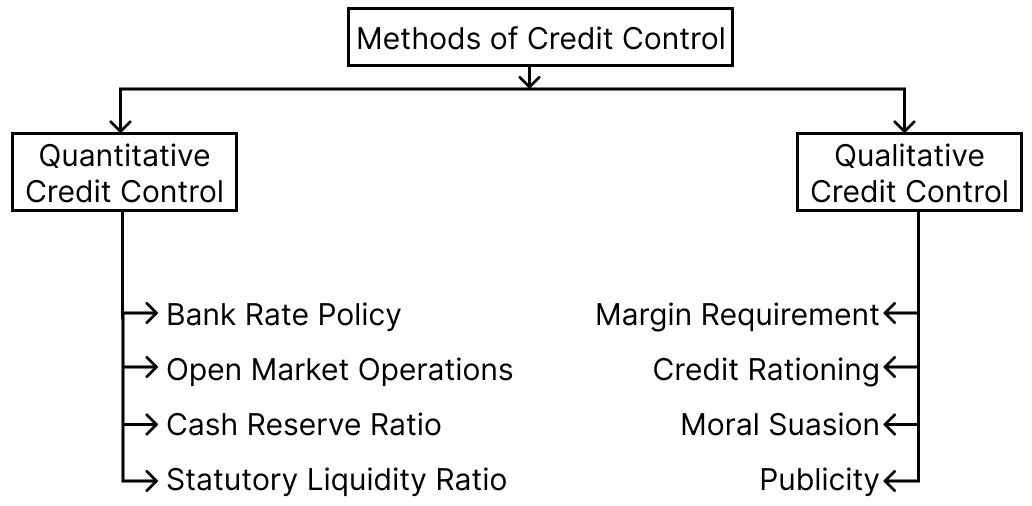
Four Methods of Credit Control:
Bank Rate Policy — The bank rate is the rate at which the central bank rediscounts the first class securities of commercial banks. When the central bank wants to reduce credit, it raises the bank rate — central bank credit becomes expensive, so commercial banks raise their lending rates, discouraging borrowing. When it wants to expand credit, it lowers the bank rate.
Open Market Operations — These mean the sale and purchase of government securities by the central bank in the open market. To reduce credit, the central bank sells securities, which absorbs cash from the banking system. To expand credit, the central bank buys securities, which injects more money into the system. This is a more direct and effective method than bank rate.
Cash Reserve Ratio (CRR) — Commercial banks are required to keep a specified percentage of their cash reserves with the central bank. An increase in CRR reduces the credit-granting capacity of commercial banks (less money available to lend), while a decrease in CRR expands it.
Statutory Liquidity Ratio (SLR) — Commercial banks have to keep a certain percentage of their demand and time liabilities in liquid form (cash and government securities). When the central bank raises SLR, banks have to keep more liquid assets, reducing credit capacity. Lowering SLR expands credit.
What is meant by the term commercial bank? Explain the functions of a commercial bank.
Answer
Commercial Bank — A commercial bank is an institution which accepts deposits of money from the public and provides loans and advances to businessmen and others. It also performs other related functions. In India, commercial banks are organised as joint stock companies. State Bank of India is the largest commercial bank of India.
Functions of a Commercial Bank — Commercial banks perform two types of functions: Primary Functions and Secondary Functions.
A. Primary Functions:
1. Accepting Deposits — Commercial banks accept deposits from the public to make investments and grant loans. The main forms of deposits are:
- Fixed Deposits — for a fixed time period; higher rate of interest.
- Savings Deposits — to develop habit of saving; restriction on withdrawals.
- Recurring Deposits — fixed amount deposited monthly for a fixed period.
- Current Deposits — for business firms; no interest paid; overdraft available.
2. Lending Money — Commercial banks lend money to businessmen, farmers, artisans and others through:
- Overdraft — allowing account holders to withdraw more than the balance up to a specified limit.
- Cash Credit — advancing cash loans up to a fixed limit against tangible security.
- Discounting of Bills — paying the amount of a bill of exchange before maturity after deducting discount.
- Loans and Advances — lump sum lending for short-term and medium-term needs.
B. Secondary Functions:
3. Agency Functions — Acting as an agent of customers, banks:
- Collect cheques, bills, interest, dividend, rent on behalf of customers.
- Make payments of loan instalments, interest, rent, insurance premium, taxes, etc.
- Buy and sell shares, debentures and securities.
- Act as trustees and executors and transfer funds.
4. General Utility Functions — Banks also perform:
- Issuing letters of credit, drafts and travellers' cheques.
- Underwriting shares and debentures issued by companies.
- Safe custody of valuables (lockers).
- Providing advice and credit information.
What is a central bank? Bring out the importance of a central bank by making special reference to the functions it performs.
Answer
Central Bank — A Central Bank is a banking institution which controls the banking system in a country and carries out its monetary policy. It is the apex institution of a country's banking system, owned by the Government, with the aim of serving the country's interest rather than earning profit.
Importance of a Central Bank — The importance of the central bank is reflected in the variety of crucial functions it performs:
Issue of Currency Notes — The central bank has the monopoly over issuing currency notes. It keeps reserves of gold, silver, etc., to inspire public confidence and to maintain uniformity in currency. This is essential for a stable monetary system.
Banker to the Government — The central bank acts as banker, agent and advisor to the Government. It receives and makes payments on behalf of the Government, manages the national debt and issue of government securities, and represents the Government in international monetary conferences.
Banker's Bank — It acts as the bank for all commercial banks. Commercial banks keep cash reserves with it and can obtain loans and rediscount bills with it. Hence, it is also called the 'lender of last resort'.
Credit Control — It exercises both quantitative (bank rate, open market operations, CRR, SLR) and qualitative (margin requirements, credit rationing, moral suasion, publicity) control over credit to maintain price and exchange rate stability.
Custodian of Foreign Currency Reserves — The central bank is the sole custodian of gold, foreign exchange and other reserves. It manages these reserves to overcome balance of payments difficulties and stabilise exchange rates.
Maintenance of Exchange Rate — It monitors and tries to maintain stability in the exchange rate of the home currency to promote foreign trade and encourage foreign investment.
Clearing House Facility — As a clearing house, it settles the claims of commercial banks through book entries, avoiding cash withdrawals and stabilising the banking system.
Developmental Functions — In a developing country like India, the central bank performs developmental functions such as creating special financial institutions for agriculture, industry and trade; ensuring balanced regional development; and controlling prices.
Collection and Publication of Data — It conducts surveys, publishes reports and bulletins, provides staff training to bank personnel, and maintains relations with international financial institutions like World Bank and IMF.
What are the methods adopted by the central bank to control credit?
Answer
The central bank uses two categories of methods to control credit: Quantitative methods (which affect the overall volume of credit) and Qualitative methods (which affect specific types of credit).
A. Quantitative Methods:
Bank Rate Policy — The rate at which the central bank rediscounts first class securities of commercial banks. Raising the bank rate makes credit costly and reduces lending; lowering it expands credit.
Open Market Operations — Sale and purchase of government securities by the central bank. Selling securities reduces credit (absorbs money); buying securities expands credit (injects money).
Cash Reserve Ratio (CRR) — Specified percentage of cash reserves that commercial banks must keep with the central bank. Raising CRR reduces lending capacity; lowering it expands lending capacity.
Statutory Liquidity Ratio (SLR) — Percentage of demand and time liabilities that banks must keep in liquid form (cash + government securities). Raising SLR contracts credit; lowering it expands credit.
B. Qualitative Methods:
Margin Requirements — The margin between the value of security and the loan granted against it. Raising margin requirements (e.g., from 70% to 60% of security value) reduces the volume of credit; lowering it expands credit. It is selective.
Credit Rationing — The central bank fixes a limit on the credit facilities available to commercial banks and rations the credit according to purpose. Used in exceptional situations of monetary stringency.
Moral Suasion — Informal, non-statutory method by which the central bank requests and persuades commercial banks not to grant credit for speculative or non-essential activities. Banks honour it out of respect for the central bank's authority.
Publicity — The central bank issues reports and review statements of assets and liabilities. These keep commercial banks aware of conditions in the money market, public finance, trade and industry, helping them adjust their credit activities accordingly.
What are the different types of deposit accounts that can be opened in a commercial bank? Briefly explain them.
Answer
A commercial bank offers four main types of deposit accounts to suit the needs of different customers:
1. Fixed Deposit Account — A fixed deposit (also known as time deposit or long-term deposit) is a lumpsum investment for a fixed tenure. The money cannot be withdrawn before the maturity date. A higher rate of interest is paid on fixed deposits. No pass book or cheque book is issued — only a Fixed Deposit Receipt (FDR). The depositor receives the deposit along with interest on the maturity date.
2. Savings Deposit Account — Any individual can open a savings account with a minimum specified balance. It is meant for middle and low-income people to deposit small savings. Deposits can be made any number of times in a week, but there is a restriction on the number of withdrawals. Interest is allowed on the minimum balance during a month (low rate). Both pass book and cheque book are issued. The main purpose is to develop the habit of saving among the public.
3. Recurring Deposit Account — Under a recurring deposit, the account holder is required to deposit a specific amount every month for a fixed period (12 to 72 months). On maturity, the depositor receives the entire amount with interest. The interest rate is moderate (between savings and FD rates). A pass book is issued but no cheque book. This account encourages regular saving.
4. Current Account — Generally opened by business firms, this account allows depositing and withdrawing money any number of times. Pass book, cheque book and overdraft facility are all available. No interest is paid, and the bank charges a small fee. It is suitable for business operations that require frequent transactions.
Differentiate between :
(a) Savings Deposit and Current Deposit.
(b) Fixed Deposit and Recurring Deposit.
Answer
(a) Distinction between Savings Deposit and Current Deposit
| S.No. | Basis of Distinction | Savings Deposit | Current Deposit |
|---|---|---|---|
| 1. | Objective | To develop habit of saving among the public. | To carry on day-to-day business dealings. |
| 2. | Account holders | Mainly individuals, especially middle and low-income people. | Mainly business firms and traders. |
| 3. | Number of withdrawals | Restriction on number of withdrawals in a week. | No restriction on number of withdrawals. |
| 4. | Interest | Low rate of interest is paid. | No interest is paid; bank charges a small fee. |
| 5. | Overdraft facility | Not available. | Available. |
| 6. | Cheque book | Issued. | Issued. |
(b) Distinction between Fixed Deposit and Recurring Deposit
| S.No. | Basis of Distinction | Fixed Deposit | Recurring Deposit |
|---|---|---|---|
| 1. | Objective | To earn higher interest on lumpsum savings. | To save regularly each month and earn interest. |
| 2. | Frequency of deposits | Only one lumpsum deposit. | Fixed regular monthly deposits. |
| 3. | Period | Fixed period (e.g., 1, 3, 5 years). | Fixed period (12 to 72 months). |
| 4. | Rate of interest | Higher rate. | Moderate rate. |
| 5. | Cheque book | Not issued. | Not issued. |
| 6. | Document issued | Fixed Deposit Receipt is issued. | Pass book is issued. |
| 7. | Withdrawal | Only on maturity date. | Only on maturity date. |
Explain the different types of accounts in which a bank may receive deposits. Also explain the different types of schemes through which a bank may receive time deposits.
Answer
Types of Accounts in which a Bank may receive Deposits:
A commercial bank receives deposits in four main types of accounts:
Fixed Deposit Account — Lumpsum deposit for a fixed period; higher rate of interest; cannot be withdrawn before maturity; no cheque book.
Savings Deposit Account — For small savings; low rate of interest; restriction on withdrawals; cheque book and pass book issued.
Recurring Deposit Account — Fixed amount deposited monthly for a fixed period (12 to 72 months); moderate rate of interest; no cheque book.
Current Account — For business firms; no interest paid; unlimited withdrawals; cheque book and overdraft facility available.
Types of Schemes for receiving Time Deposits:
A time deposit refers to a deposit kept for a fixed tenure. The main time-deposit schemes are:
Fixed Deposit Scheme — A lump sum amount is deposited for a fixed period, such as one year, three years or five years. The money is withdrawn along with interest on the maturity date. A higher rate of interest is paid on such deposits. No pass book or cheque book is issued; only a fixed deposit receipt is given.
Recurring Deposit Scheme — A fixed amount is deposited every month for a specified period, usually 12 to 72 months. On maturity, the depositor receives the total amount along with interest. A pass book is issued, but no cheque book is issued.
Explain the work of "banker's clearing house" and show its importance in modern banking.
Answer
Banker's Clearing House — As a clearing house, the central bank settles the claims of commercial banks against one another and enables them to clear their dues through book entries rather than actual cash movement. The central bank makes debit and credit entries in the accounts of commercial banks for convenient adjustment of their daily inter-bank balances.
Working with an example — Suppose Bank of Baroda has to pay ₹20 lakhs to Punjab National Bank. To settle the amount, Bank of Baroda issues a cheque of ₹20 lakhs to Punjab National Bank. The Reserve Bank of India then debits the account of Bank of Baroda by ₹20 lakhs and credits the account of Punjab National Bank by ₹20 lakhs. The settlement is completed without any actual movement of cash between the two banks.
Importance in Modern Banking:
Convenient settlement — Settlement between different commercial banks can be made conveniently through book entries.
Reduces cash withdrawals — During times of economic crisis, when banks may face heavy demands for cash, the clearing house mechanism reduces the need for cash withdrawals between banks and stabilises the banking system.
Saves time and cost — The use of book entries saves time and effort that would otherwise be spent in counting, transporting and securing cash.
Strengthens banking system — By providing a central place where all banks can settle their mutual claims, the clearing house promotes confidence in the banking system as a whole.
Promotes commerce — Faster clearing of cheques and bills helps in smooth conduct of trade and commerce by ensuring quick realisation of payments.
Differentiate between central bank and commercial bank.
Answer
Differences between Central Bank and Commercial Bank
| S.No. | Basis of Distinction | Central Bank | Commercial Bank |
|---|---|---|---|
| 1. | Position or status | It is the apex institution of a country's banking system. | It is one of the banks in a country. |
| 2. | Ownership | It is owned by the Government. | It is generally owned by the shareholders. |
| 3. | Aim | Its aim is to serve the country's interest. | Its aim is to earn profit. |
| 4. | Number | There is only one central bank in a country. | There are several commercial banks in a country. |
| 5. | Main client | It is a banker to the Government. | It is a banker to the general public. |
| 6. | Issue of notes | It has the monopoly over issue of notes. | It cannot issue notes. |
| 7. | Relationship with other banks | It controls all other banks. | It functions under the control of the central bank. |
| 8. | Competition | It does not compete with commercial banks. | It competes with other commercial banks. |
| 9. | Public dealings | It does not deal with the public directly. | It deals with the public directly. |
| 10. | Foreign exchange | It is the custodian of foreign exchange reserves of the country. | It is only an authorised dealer in foreign exchange. |
| 11. | Lender of last resort | It serves as a banker to other banks by keeping their reserves. | It does not serve as a banker to other banks. |
| 12. | Credit control | It controls credit in the country. | It creates credit for customers. |
| 13. | Chief executive | Its chief executive is called 'Governor'. | Its chief executive is called 'Chairman'. |
Describe the procedure to be followed to open a bank account.
Answer
The procedure for opening a bank account consists of the following steps:
1. Application in the Prescribed Form — The person or organisation wanting to open a bank account has to apply to the bank in the prescribed form. The form is available free of charge. Different forms are used for different types of accounts (savings, current, etc.). The application contains the name, occupation, full address and specimen signatures of the applicant.
2. Introduction of the Applicant — Opening a bank account creates a business relationship; the bank undertakes to honour the cheques drawn by the customer so long as there is credit balance. To reduce risk and fraud, the bank insists that the applicant be introduced by an existing account holder or a reputed businessman. The introducer signs on the application form and writes his full address.
3. Specimen Signatures — Once introduction and references are satisfactory, the applicant is asked to give two or three specimen signatures on a prescribed card. These are filed alphabetically and used by the bank to verify signatures on cheques. If the signatures do not match, the bank can refuse payment.
- For a partnership firm: a copy of the partnership deed must be submitted.
- For a joint stock company: certified copies of the Board resolution, Memorandum of Association, Articles of Association, Certificate of Incorporation, Certificate of Commencement of Business (for public companies), and specimen signatures of authorised persons must be submitted.
- For a cooperative society or club: copies of certificate of registration, list of managing committee, bye-laws, and specimen signatures of authorised persons.
4. Photographs — Banks now require photographs of applicants to prevent fraud. The photographs are affixed on the signature cards, helping to verify the customer's identity later.
5. Initial Deposit — When all formalities are completed, the applicant deposits the initial amount. The bank opens an account in the applicant's name. The minimum deposit varies between savings and current accounts and from one bank to another.
After opening the account, the bank provides a pass book, cheque book and pay-in-slip book to the account holder.
Differentiate between current deposit account and fixed deposit account.
Answer
Distinction between Current Deposit Account and Fixed Deposit Account
| S.No. | Basis of Distinction | Current Deposit Account | Fixed Deposit Account |
|---|---|---|---|
| 1. | Objective | To carry on day-to-day business dealings. | To earn higher interest on lumpsum savings. |
| 2. | Account holders | Mainly business firms. | Individuals, businesses or any depositor. |
| 3. | Period of deposit | No fixed period; can be operated continuously. | Fixed period (e.g., 1, 3, 5 years); cannot be withdrawn before maturity. |
| 4. | Frequency of deposit | Money can be deposited any number of times. | Only one lumpsum deposit at the time of opening. |
| 5. | Number of withdrawals | No restriction on number of withdrawals. | Withdrawal allowed only on maturity date. |
| 6. | Cheque book | Issued. | Not issued. |
| 7. | Pass book | Issued. | Not issued; only Fixed Deposit Receipt is issued. |
| 8. | Interest | No interest paid; bank charges a small fee. | Higher rate of interest paid. |
| 9. | Overdraft facility | Available. | Not available. |
How does the central bank use the SLR and credit rationing to exercise credit control in a country?
Answer
1. Statutory Liquidity Ratio (SLR) — SLR is a quantitative method of credit control. Commercial banks are required by law to keep a certain percentage of their demand and time liabilities in liquid form, consisting of cash and government securities.
How SLR controls credit:
To reduce credit — When the central bank wants to reduce the volume of credit, it raises the SLR. As a result, commercial banks have to keep a larger portion of their funds in liquid assets, leaving less money available for lending. Their credit-granting capacity is reduced, which controls inflation.
To expand credit — When the central bank wants to expand credit, it lowers the SLR. Banks can then keep a smaller portion in liquid form and have more funds available for lending, which boosts credit and economic activity.
2. Credit Rationing — Credit rationing is a qualitative (selective) method of credit control. Under this method, the central bank fixes a limit on the credit facilities available to commercial banks. The available credit is rationed among them according to the purpose of credit — priority sectors and essential industries get more, while non-essential and speculative purposes get less.
How Credit Rationing controls credit:
It ensures that available credit flows to the most productive and essential uses (e.g., agriculture, small industries, exports) rather than to speculative or non-essential activities.
It is used in exceptional situations of monetary stringency, such as during a serious shortage of credit or economic crisis.
It is generally used to contract credit (cannot ordinarily be used for credit expansion).
By combining SLR and credit rationing — quantitative and qualitative tools — the central bank can both control the volume of credit and direct it into the right channels, thereby achieving stability in prices, exchange rate and economic growth.
Write short notes on (a) The importance of a cheque (b) Primary functions of commercial banks.
Answer
(a) The Importance of a Cheque
A cheque is an unconditional order in writing, drawn upon a specified banker, directing the bank to pay a certain sum of money to the order of a person or to the bearer. It is one of the most important and widely used instruments of payment in modern banking.
Importance of a Cheque:
Convenient method of payment — There is no need to count and check large numbers of currency notes; a single cheque can settle large amounts.
Safety — Use of cheques (especially crossed cheques) ensures safety, as payment is made only into the payee's bank account.
Easy transfer of funds — Cheques facilitate the transfer of funds from one place to another and even from one country to another, easily and cheaply.
Acts as a receipt — A paid cheque serves as valid proof of payment, useful in case of disputes.
Supports credit — Cheques facilitate credit transactions, which support the growth of trade and commerce.
Saves currency notes — The use of cheques reduces the demand for currency notes, saving printing and handling costs.
(b) Primary Functions of Commercial Banks
The primary functions of a commercial bank are two:
1. Accepting Deposits — Commercial banks accept deposits from the public for safekeeping, earning interest, and to facilitate banking transactions. The four main types are:
- Fixed Deposits — for a fixed period; higher interest.
- Savings Deposits — for small savings; cheque book and pass book issued.
- Recurring Deposits — fixed monthly amount for a fixed period.
- Current Deposits — for business firms; no interest, but unlimited transactions and overdraft.
2. Lending Money — Commercial banks lend the deposited money to businessmen, farmers, artisans and others through:
- Overdraft — withdrawal beyond the credit balance up to a specified limit.
- Cash Credit — fixed credit limit against tangible security.
- Discounting of Bills — payment of bill amount before maturity after deducting discount.
- Loans and Advances — lump sum amount for a fixed period.
Explain Cash Reserve Ratio and Statutory Liquidity Ratio.
Answer
1. Cash Reserve Ratio (CRR)
Meaning — Cash Reserve Ratio (CRR) is the specified percentage of total cash deposits that commercial banks are required to keep with the central bank in the form of cash reserves.
How CRR controls credit:
Increase in CRR — When the central bank raises the CRR, commercial banks must keep a larger portion of their deposits with the central bank as cash reserves. This reduces the amount of money available to grant credit, thereby contracting the volume of credit in the economy. Used to control inflation.
Decrease in CRR — When the CRR is lowered, commercial banks have to keep a smaller portion as reserves and have more money available to lend. This expands credit and boosts economic activity.
2. Statutory Liquidity Ratio (SLR)
Meaning — Statutory Liquidity Ratio (SLR) is the specified percentage of demand and time liabilities of commercial banks that they must maintain in liquid form, consisting of cash and government securities (held with themselves, not with the central bank).
How SLR controls credit:
Increase in SLR — When the central bank raises the SLR, commercial banks have to keep a larger portion of their liabilities in liquid assets, reducing the funds available for lending and thereby contracting credit.
Decrease in SLR — When the SLR is lowered, banks have more funds available for lending, expanding credit in the economy.
Difference — The main difference is that CRR is kept as cash with the central bank, while SLR is kept by the commercial bank itself in cash and government securities. Both are quantitative tools used by the central bank to regulate the overall volume of credit.
Distinguish between a cheque and bill of exchange.
Answer
Distinction between Bill of Exchange and Cheque
| S.No. | Point of Distinction | Bill of Exchange | Cheque |
|---|---|---|---|
| 1. | Drawee | A bill may be drawn on any one including a banker. | A cheque is always drawn on a banker. |
| 2. | Acceptance | A bill has to be accepted by the drawee to make him liable. | A cheque does not require acceptance. |
| 3. | Payment and days of grace | A bill is not payable on demand; three days of grace are allowed. | A cheque is always payable on demand and no days of grace are allowed. |
| 4. | Copies | A foreign bill is prepared in three copies. | A single copy of cheque is used. |
| 5. | Crossing | A bill is not crossed. | A cheque can be crossed. |
| 6. | Stamping | A time bill must be stamped. | No stamps are required on a cheque. |
| 7. | Countermanding of payment | Payment of a bill cannot be countermanded. | Payment of a cheque can be countermanded (stopped). |
| 8. | Liability | A bill must be presented for payment on the due date; otherwise the drawee will be free from liability. | A cheque should be presented within reasonable period, but delay does not relieve the drawer of liability. |
| 9. | Notice of dishonour | If the bill is dishonoured, the holder must give notice to the drawer. | If the cheque is dishonoured, the holder need not give notice to the drawer. |
Describe the procedure to be followed to open a savings account in a bank.
Answer
The procedure for opening a savings account in a bank consists of the following steps:
1. Application in the Prescribed Form — The applicant collects the prescribed application form for a savings account from the bank (free of charge) and fills in details such as name, occupation, full address, telephone number, and specimen signatures. The bank may also ask for the names of references.
2. Introduction of the Applicant — The bank insists that the applicant be introduced by an existing account holder of the bank or a reputed person. The introducer signs on the application form and writes his full address. The purpose of introduction is to verify identity and reduce the scope for fraud.
3. Specimen Signatures — The applicant is asked to give two or three specimen signatures on a prescribed signature card. These are filed alphabetically and are used to verify signatures on cheques. If the signatures on a cheque do not tally, the bank can refuse payment.
4. Photographs and KYC Documents — The applicant has to submit photographs, which are affixed on the signature card. He also submits Know-Your-Customer (KYC) documents — proof of identity (PAN card, Aadhaar) and proof of address (Aadhaar, electricity bill, etc.). The bank verifies these documents.
5. Initial Deposit — The applicant deposits the minimum initial amount as required by the bank for opening a savings account (the minimum balance varies from bank to bank).
6. Issue of Pass Book, Cheque Book and Pay-in-Slip Book — Once the account is opened, the bank issues:
- A Pass Book showing the customer's account details.
- A Cheque Book for making payments and withdrawals.
- A Pay-in-Slip Book for depositing cash and cheques.
The customer can then operate the savings account by depositing money, withdrawing through cheques, and earning interest on the minimum balance during a month.
Explain any five functions of the Reserve Bank of India.
OR
Explain any two/five functions of central bank of a country.
Answer
The Reserve Bank of India (RBI), being the central bank of India, performs the following key functions:
1. Issue of Currency Notes — The RBI has the monopoly over issuing currency notes in India. It keeps reserves of gold, silver and foreign exchange to back the notes and to inspire public confidence. The monopoly ensures uniformity in currency, avoids over-issue and lends prestige to the currency system.
2. Banker to the Government — The RBI acts as banker, agent and advisor to the Central and State Governments. It receives and makes payments on behalf of the Government, manages the national debt, issues Government securities, and represents the Government in international monetary conferences.
3. Banker's Bank and Lender of Last Resort — The RBI acts as the bank for all commercial banks in the country. Commercial banks keep their cash reserves with it. When a commercial bank needs funds, it can obtain loans and rediscount bills with the RBI. Hence, the RBI is also called the 'lender of last resort'.
4. Credit Control — The RBI exercises both quantitative control (Bank Rate, Open Market Operations, CRR, SLR) and qualitative control (margin requirements, credit rationing, moral suasion, publicity) to regulate the volume and direction of credit in the country. This helps maintain stability in prices and the exchange rate.
5. Custodian of Foreign Currency Reserves — The RBI is the sole custodian of gold, foreign exchange and all other reserves of the country. It manages these reserves prudently to overcome difficulties in the balance of payments and to stabilise exchange rates.
Explain any two lending money functions of the commercial banks.
Answer
Commercial banks lend money to businessmen, farmers, artisans and others in various ways. Two important lending money functions are:
1. Cash Credit — Cash credit is a form of short-term loan in which the bank advances cash loans to the borrower against some tangible security or personal guarantee. The bank fixes a cash credit limit based on the borrower's creditworthiness and the value of the security. The borrower can withdraw money up to this limit according to his needs and can deposit back any surplus. Interest is charged only on the amount actually withdrawn and not on the full limit.
2. Discounting of Bills — Businessmen receive bills of exchange from customers who buy goods on credit. Instead of waiting until the maturity date, the businessman can present the bill to a commercial bank, which pays the amount of the bill before maturity after deducting discount (interest) charges. On the date of maturity, the bank gets the full payment from the acceptor of the bill. If the bill is dishonoured on maturity, the bank receives the payment from the customer who originally discounted the bill. This service helps businesses manage cash flow without waiting for the credit period to end.
What do you mean by Recurring Deposit Account. Explain any four agency functions of the commercial bank.
Answer
Recurring Deposit Account — A Recurring Deposit Account is a savings plan in which the account holder is required to deposit a specific amount every month for a fixed period, usually ranging from 12 to 72 months. After the expiry of the specified period, the depositor gets back the entire amount along with interest thereon. A pass book is issued to the depositor, but no cheque book is issued.
Four Agency Functions of a Commercial Bank:
As an agent of its customers, a commercial bank performs the following functions:
1. Collecting Receipts — Banks collect amounts of cheques, bills of exchange, promissory notes and hundies on behalf of their customers. They also collect interest, dividend and rent on the customer's instructions and credit them to the customer's account.
2. Making Payments — On the instructions of customers, banks make payments of loan instalments, interest, rent, insurance premium, taxes, electricity bills, telephone bills, etc., on behalf of account holders. This saves the customer's time and effort.
3. Buying and Selling of Securities — Banks buy and sell shares, debentures and other securities on behalf of their customers in the stock market. The bank acts as the customer's agent in such transactions.
4. Trustees and Executors — Commercial banks act as trustees and executors for their customers. They also act as representatives of their customers in dealings with other banks. Banks also transfer money from one place to another within the country and abroad as per the instructions of customers.
Write any three/five advantages of bank account.
OR
Explain two advantages of opening a bank account.
Answer
The main advantages of opening a bank account are as follows:
1. Safety of Money — Keeping cash at home involves the risk of theft, loss or fire. The savings deposited in a bank account remain safe and free from such risks, as banks have strong security arrangements.
2. Payment Facility — Payments can be made easily and safely by means of cheques, drafts, NEFT/RTGS, UPI, etc. There is no need to keep large amounts of cash at home or count notes when paying. Cheques and UPI also serve as evidence of payment in case of disputes.
3. Collection Facility — The bank collects cheques, drafts and bills of exchange deposited by the account holder. Businessmen having bank accounts can also get their bills of exchange discounted easily.
4. Habit of Savings — Bank accounts promote the habit of thrift and saving in the public. People are encouraged to save and deposit money because of the benefits of safety and earning interest.
5. Loans and Advances — Account holders can obtain various forms of credit from banks — loans, overdrafts and cash credits — for personal, business or emergency needs.
6. Safe Custody of Valuables — Banks offer lockers (safe deposit vaults) to their account holders on preferential basis. Customers can deposit their jewellery, important documents and other valuables for safe custody.
7. Credit Information — Banks provide information relating to the creditworthiness of their customers. A bank account holder can get better credit facilities in business, and banks issue letters of credit for those engaged in foreign trade.
8. Other Services — Account holders can avail of various other services such as purchase and sale of securities, payment of insurance premium, collection of interest and rent, remittance facility and travellers' cheques.
With reference to the secondary functions of a commercial bank, explain general utility function.
Answer
General Utility Functions form one of the two parts of the secondary functions of a commercial bank.
Main General Utility Functions:
1. Issuing Credit Instruments — Banks issue letters of credit, drafts and travellers' cheques to their customers. These instruments allow people to transfer funds from one place to another without carrying cash.
2. Underwriting Capital Issues — Banks underwrite shares and debentures issued by companies. By underwriting, the bank guarantees to subscribe to any unsold portion of the issue, helping companies raise capital from the public with confidence.
3. Safe Custody of Valuables — Banks accept jewellery, important documents and other valuables for safekeeping. They provide safe deposit vaults (lockers) in which customers can store their valuables.
4. Advice and Information — Banks offer advice on financial matters and provide information about creditworthiness of customers, helping them obtain credit facilities from suppliers. They also collect and provide information about trade and industry in the country and abroad.
What are the advantages of payment by cheque?
Answer
The advantages of payment by cheques are as follows:
1. Convenience — A cheque is a very convenient method of making payment. There is no need to count and check large numbers of currency notes; a single cheque can settle any amount.
2. Safety — The use of cheques for withdrawing money from a bank account ensures safety. A cheque can be crossed to ensure that payment is made only to the bank account of the payee, reducing the risk of theft or fraud.
3. Easy Transfer of Funds — Cheques facilitate transfer of funds from one place to another and from one country to another. Transfer of funds through cheques is easier, safer and cheaper than any other method.
4. Receipt — Payment by cheque also serves as a receipt. A paid cheque is valid proof of payment, useful in case of disputes or for tax purposes.
5. Credit — Cheques facilitate credit transactions in the economy, which help the growth of trade and commerce.
6. Money Saving — Use of cheques leads to a saving in the use of currency notes. The Government and the central bank do not have to print large numbers of notes for everyday transactions.
Distinguish between cheque and overdraft.
OR
Give any five differences between Cheque and Bank Draft.
Answer
Distinction between Cheque and Bank Draft
| S.No. | Basis of Distinction | Cheque | Bank Draft |
|---|---|---|---|
| 1. | Drawer | A cheque is drawn by a person (account holder). | A bank draft is always drawn by a bank. |
| 2. | Bearer | A cheque can be drawn payable to bearer. | A draft cannot be made payable to bearer. |
| 3. | Charges | The person who receives the payment has to pay collection charges. | Commission is paid in advance by the sender of money. |
| 4. | Dishonour | A cheque is dishonoured if the funds in the drawer's account are insufficient. | The draft amount is taken in advance by the bank, so there is no question of dishonour. |
| 5. | Stop payment | The payment of a cheque can be stopped by giving a written notice to the bank. | The payment of a bank draft cannot be so easily stopped. |
Discuss any two agency functions of Commercial Banks.
Answer
As an agent of its customers, a commercial bank performs several functions. Two important agency functions are:
1. Collecting Receipts — On behalf of customers, commercial banks collect amounts of cheques, bills of exchange, promissory notes and hundies. They also collect interest, dividend, rent and pension as per the instructions of customers and credit the amounts to their accounts. This saves customers the trouble of personally going to receive payments and ensures timely collection.
2. Making Payments — On the instructions of customers, banks make payments of various dues such as loan instalments, interest, rent, insurance premium, taxes, electricity bills, telephone bills, etc., on behalf of account holders. This is a great convenience for customers as bills are paid on time without their personal involvement, and the bank issues a record of payments made.
Study the image. Explain any five conditions for the refusal of the same by the bank.
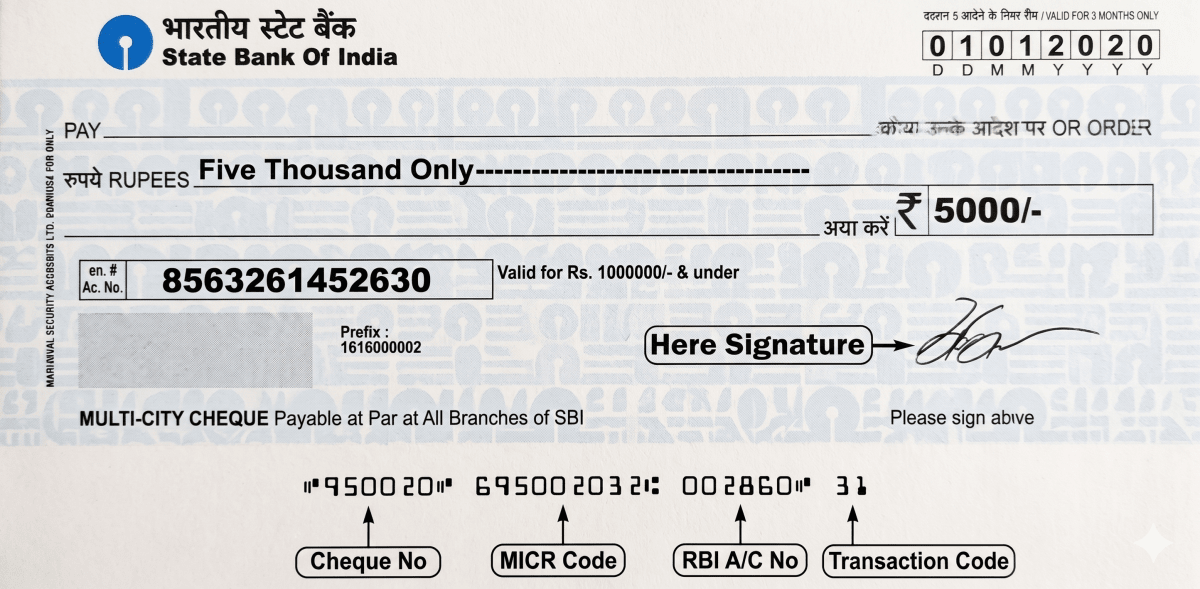
Answer
The image shows a cheque of State Bank of India for ₹5,000. A bank can refuse payment or dishonour such a cheque under the following circumstances:
1. Insufficient Funds — If the funds to the credit of the drawer are not sufficient to make payment of the cheque (i.e., the drawer's account does not have ₹5,000), the bank will dishonour the cheque.
2. Cheque is Stale — If the cheque is more than three months old from the date written on it. Such a cheque is called a 'stale cheque' and the bank will refuse to pay.
3. Stopped Payment — If the drawer has stopped payment of the cheque by giving a written notice to the bank, the bank will refuse to honour it.
4. Signature Mismatch — If the signature of the drawer on the cheque does not tally with the specimen signature kept in the bank's records, the bank can refuse payment.
5. Difference in Amount — If the amount written in figures (₹5,000) and the amount written in words ('Five Thousand Only') differ, the bank will dishonour the cheque.