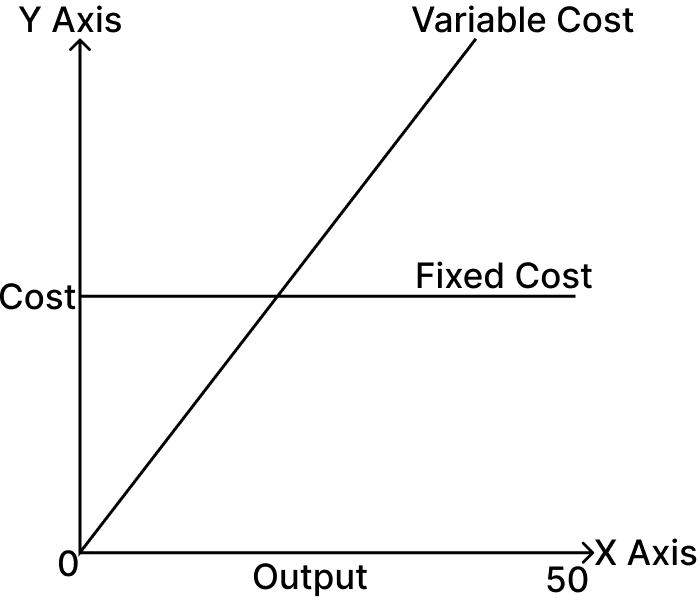
The term "variable costs" refers to ...............
- All costs that are likely to respond to the amount of attention devoted to them by a specific manager.
- All costs associated with marketing, shipping, warehousing, and billing activities.
- All costs that do not change in total for a given period of time and relevant range but become progressively smaller on a per unit basis as volume increases.
- All manufacturing costs incurred to produce units of output.
Answer
All manufacturing costs incurred to produce units of output.
Reason — Variable costs are those costs which vary in amount with changes in the level of output or activity. They increase or decrease in the same proportion as the volume of production. Among the given options, only option 4 relates to costs incurred for producing units of output (which inherently vary with the units produced). Option 1 describes controllable costs, option 2 describes selling and distribution costs, and option 3 describes fixed costs (which remain unchanged in total but become smaller per unit as volume rises).
Variable costs per unit decrease as the level of production increases.
- True
- False
Answer
False
Reason — Variable cost per unit remains constant irrespective of the level of production. It is the total variable cost which changes proportionately with the level of output. For example, if the level of output increases from 5,000 to 6,000 units and total variable cost rises from ₹25,000 to ₹30,000, the variable cost per unit remains unchanged at ₹5. (It is the fixed cost per unit which decreases as production increases.)
Assertion (A): Indirect costs are always fixed costs.
Reason (R): Indirect costs are expenses that cannot be directly attributed to a specific cost object.
- A is true but R is false
- A is false but R is true
- Both A and R are true and R explains A.
- Both A and R are true but R does not explain A.
Answer
A is false but R is true
Reason — The Assertion is FALSE because indirect costs are NOT always fixed. Indirect costs can be variable too — for example, indirect materials like grease, oil and consumable stores tend to vary with the level of production. The classification of cost as "direct/indirect" is based on traceability, while "fixed/variable" is based on behaviour; these are two independent classifications. The Reason is TRUE because indirect costs are indeed expenses which cannot be directly identified with a specific cost object (product, job or department).
Assertion (A): Indirect costs can be traced directly to a specific product or service.
Reason (R): Indirect costs are typically overheads that benefit multiple products or services.
Which of the following is correct?
- Both A and R are true, and R explains A.
- Both A and R are true, but R does not explain A.
- A is true, but R is false.
- A is false, but R is true.
Answer
A is false, but R is true.
Reason — The Assertion is FALSE because indirect costs, by definition, cannot be traced directly to a specific product or service. They are common costs that benefit several products or departments and therefore have to be apportioned. The Reason is TRUE because indirect costs are typically overheads (factory, office, selling) which jointly benefit multiple products or services rather than being chargeable to any one of them.
Total variable cost per unit increases ...............
- When production grows
- When demand decreases
- Change in government rules
- Change in availability of raw material
Answer
When production grows
Reason — Total variable cost increases when the volume of production grows because variable cost is incurred on every additional unit produced — more units produced means more raw materials, more direct labour and more variable expenses. There is a linear relationship between volume of production and total variable cost. (Variable cost per unit, however, remains constant.)
'The product has some value which can be measured in terms of money' it is called ...............
- Historical value
- Exchange value
- Zero value
- Positive value
Answer
Exchange value
Reason — Exchange value is the value of a product expressed in terms of money — that is, the price at which the product can be exchanged in the market. Cost is closely linked to exchange value because cost reflects the money paid or sacrifice made to acquire goods or services. Historical value refers to the original price paid in the past, while zero/positive values are not standard cost concepts.
A typical factory overhead cost is ...............
- Audit
- Compensation of plant manager
- Design distribution
- Internal
Answer
Compensation of plant manager
Reason — Factory (manufacturing) overheads include indirect materials, indirect labour and indirect expenses incurred in connection with the production of goods. The salary/compensation of a plant manager is indirect labour incurred in running the factory, hence it is a typical factory overhead. Audit fees are office and administrative overhead, design distribution is a selling overhead, and "internal" is not a recognised overhead category.
The cost of raw materials used in production is considered an indirect cost.
- True
- False
Answer
False
Reason — Raw materials that become an integral part of the finished product and can be easily measured and directly charged to the product are direct materials (a direct cost), not indirect. For example, cloth in dress making and timber in furniture are direct materials. Only items like grease, oil, nails and consumable stores — which cannot be specifically charged to a product — are treated as indirect materials.
In element-wise classification of overheads, which one of the following is not included in?
- Fixed overheads
- Indirect labour
- Indirect materials
- Indirect expenditure
Answer
Fixed overheads
Reason — Element-wise classification of overheads includes (a) indirect material, (b) indirect labour, and (c) indirect expenses. "Fixed overheads" is a classification on the basis of behaviour (along with variable overheads and semi-variable overheads), not on the basis of element. Therefore, fixed overheads do not belong to the element-wise classification.
Match the following types of costs with their correct examples:
| Types of Cost | Examples |
|---|---|
| (a) Direct Material | 1. Wages paid to quality inspectors |
| (b) Indirect Labour | 2. Cloth used in dress making |
| (c) Indirect Material | 3. Nails used in carpentry work |
| (d) Direct Labour | 4. Salary of a factory manager |
- a-2, b-4, c-3, d-1
- a-3, b-1, c-2, d-4
- a-4, b-3, c-2, d-1
- a-1, b-2, c-3, d-4
Answer
a-2, b-4, c-3, d-1
Reason —
- (a) Direct Material → 2. Cloth used in dress making — cloth becomes an integral part of the finished dress and can be directly charged to it.
- (b) Indirect Labour → 4. Salary of a factory manager — the factory manager supervises overall production, so his/her salary cannot be directly identified with a specific product.
- (c) Indirect Material → 3. Nails used in carpentry work — nails are consumable items of small value that cannot be conveniently traced to each individual product.
- (d) Direct Labour → 1. Wages paid to quality inspectors — inspectors specially required for production of a particular item are treated as direct labour (per textbook).
Fixed cost per unit decreases when ...............
- Production volume increases
- Production volume decreases
- Variable cost per unit decreases
- Variable cost per unit increases
Answer
Production volume increases
Reason — Total fixed cost remains constant in amount irrespective of changes in output (within the relevant range). When production volume increases, this constant fixed cost is spread over a larger number of units, so the fixed cost per unit decreases. For example, if total fixed cost is ₹1,50,000, then at 30,000 units the fixed cost per unit is ₹5, but at 60,000 units it falls to ₹2.50.
............... means amount spent on production or to provide services.
- Cost
- Profit
- Revenue
- Expenditure
Answer
Cost
Reason — Cost is the money spent or liability incurred for acquiring goods or services. In management terminology, cost is the expenditure incurred to generate revenue — i.e., the money value of resources used to produce a product or provide a service. Profit is the excess of revenue over cost, revenue is income earned, and expenditure is a broader term that may include capital outlays unrelated to current production.
Assertion (A): Fixed costs per unit remain constant as production volume increases.
Reason (R): Fixed costs are not dependent on the level of production.
Which of the following is correct?
- Both A and R are true, and R explains A.
- Both A and R are true, but R does not explain A.
- A is true, but R is false.
- A is false, but R is true.
Answer
A is false, but R is true.
Reason — The Assertion is FALSE because fixed costs per unit do not remain constant — they actually decrease as production volume increases (because the same total fixed cost is spread over more units). Fixed costs are constant in total, but vary per unit. The Reason is TRUE because total fixed costs are not dependent on the level of production within the relevant range; they remain unchanged whether output is 1 unit or 1,00,000 units.
Indirect costs can be directly traced to a specific cost object, such as a product or department.
- True
- False
Answer
False
Reason — Indirect costs, by definition, cannot be easily, directly and wholly traced to a specific cost object such as a product, job or department. They are common costs (overheads) that benefit several cost objects and therefore have to be apportioned/allocated using a suitable basis. Costs which can be directly traced to a cost object are called direct costs.
What describes variable costs in terms of cost behaviour?
(1) They stay constant regardless of changes in activity. (2) They change proportionally with changes in activity levels. (3) They include both direct and indirect components. (4) They are fixed in nature.
- 1 & 2
- 3 & 4
- Only 1
- 2 & 3
Answer
2 & 3
Reason — Statement 2 is correct because variable costs change in the same proportion as the level of output — they vary directly with activity. Statement 3 is also correct because variable costs can include both direct components (like direct materials, direct labour) and indirect components (like power, fuel and other variable overheads). Statement 1 (constant regardless of activity) describes fixed costs, and Statement 4 (fixed in nature) is the opposite of variable.
Assertion (A): Opportunity costs are relevant in business decision making.
Reason (R): Opportunity cost reflects the value of the next best alternative foregone when a decision is made.
- A is true but R is false
- A is false but R is true
- Both A and R are true and R explains A.
- Both A and R are true but R does not explain A.
Answer
Both A and R are true and R explains A.
Reason — Both statements are true. Opportunity cost is highly relevant to business decision making because every decision involves choosing one alternative over others, and managers must consider what is being sacrificed. The Reason correctly explains the Assertion: it is precisely because opportunity cost measures the value of the next best alternative foregone that it becomes a key consideration in decisions about pricing, make-or-buy, accepting/rejecting orders and resource allocation.
It refers to the expenses incurred on those items which are not directly chargeable to production. Salaries of timekeeper, foremen and watchmen are examples of this cost. This cost is incurred for the concern as a whole rather than a particular product.
- Direct cost
- Indirect cost
- Selling cost
- Advertising cost
Answer
Indirect cost
Reason — Indirect costs (also called overheads or common costs) are expenses incurred for the organisation as a whole, which cannot be directly charged to a particular product. Salaries of timekeepers, foremen, watchmen, storekeepers, etc., are typical examples of indirect labour cost — they support the production process but cannot be wholly identified with any specific product. Selling and advertising costs are specific subsets used in selling the product, not the general descriptor sought here.
Which definition best describes indirect costs?
- Indirect costs are those costs which are not controlled directly by a manager.
- Indirect costs are those costs which cannot be directly associated with a product or service.
- Indirect costs are always fixed.
- Indirect costs are always manufacturing overhead cost.
Answer
Indirect costs are those costs which cannot be directly associated with a product or service.
Reason — The defining feature of indirect costs is lack of traceability — they cannot be easily, directly and wholly identified with a particular cost unit or cost centre. Option 1 describes uncontrollable costs, not indirect costs. Option 3 is incorrect because indirect costs may be fixed or variable. Option 4 is too narrow because indirect costs include not only manufacturing overhead but also office, administrative, selling and distribution overheads.
To control costs, it is essential to keep control on:
- Prime cost
- Overheads
- Indirect materials and tools cost
- All of these
Answer
All of these
Reason — Effective cost control requires managing every component of total cost. Prime cost (direct materials + direct labour + direct expenses) is the largest controllable element of production. Overheads (factory, office, selling) form a significant portion of cost and need control to avoid wastage. Indirect materials and tools also add up over time and need to be carefully monitored. Hence all three must be controlled together for overall cost control.
Wages paid to a labour who was engaged in the production activities can be termed as ...............
- Direct cost
- Indirect cost
- Sunk cost
- Implicit cost
Answer
Direct cost
Reason — Wages paid to labour directly engaged in the production of a particular product (e.g., a machine operator or carpenter) are direct labour cost, which is a component of direct cost. Such wages can be wholly and directly identified with the specific product being made. Sunk costs are past costs that cannot be recovered, and implicit costs are notional costs (like opportunity cost) — neither describes production wages.
Which of the following best describes a fixed cost?
- A cost that remains at the same level up to a particular level of output.
- The cost changes with levels of output.
- A cost that remains at the same level when output increases.
- None of these
Answer
A cost that remains at the same level up to a particular level of output.
Reason — Fixed costs remain constant in total amount irrespective of changes in volume of output, but only upto a certain limit (the relevant range). Beyond this limit, additional capacity/facilities may be required and fixed cost may step up. Option 3 is incomplete because it only mentions "when output increases" without the relevant-range qualifier; option 1 is more precise.
Which of the following is best suited meaning of overhead?
- Overhead is the cost incurred in the course of buying a product, providing a service or running a department, but which cannot be traced directly and in full to the product, service or department.
- Overhead is the cost incurred in the course of making a product, providing a service or running a department, but which cannot be traced directly and in full to the product, service or department.
- Overhead is the cost incurred in the course of selling a product, providing a service or running a department, but which cannot be traced directly and in full to the product, service or department.
- Overhead is the cost incurred in the course of advertising a product, providing a service or running a department, but which cannot be traced directly and in full to the product, service or department.
Answer
Overhead is the cost incurred in the course of making a product, providing a service or running a department, but which cannot be traced directly and in full to the product, service or department.
Reason — The standard definition of overhead refers to indirect costs incurred while making a product, providing a service or running a department which cannot be traced directly. Buying, selling and advertising are too narrow — they cover only one aspect (purchase or selling overheads). The "making" version is the comprehensive textbook definition that captures the essence of overhead as indirect costs of operations.
Amount spent to purchase a machinery is the example of ............... cost.
- Variable
- Fixed
- Prime
- None of these
Answer
Fixed
Reason — The cost of purchasing machinery is a one-time capital outlay that does not change with the level of output. The depreciation on this machinery, which is the cost-recognition spread over the asset's useful life, is treated as a fixed cost because it remains the same regardless of how many units are produced. Variable cost changes with output, prime cost is direct material + direct labour + direct expenses — neither describes machinery cost.
Which of the following is overhead cost?
- Amount spent on raw material
- Salary of the finishing cost centre supervisor
- Wages paid to labour
- None of these
Answer
Salary of the finishing cost centre supervisor
Reason — Overhead/indirect cost cannot be wholly and directly identified with a particular product. The supervisor of a finishing cost centre oversees production but does not directly produce any item, so his/her salary is indirect labour and forms part of factory overhead. Raw material is direct material (direct cost), and wages paid to labour engaged in actual production are direct labour (direct cost) — neither is an overhead.
Variable cost per unit increases when ...............
- Volume of production decreases
- Volume of production increases
- Cost of raw material decreases
- Tax decreases
Answer
Volume of production decreases
Reason — Theoretically, variable cost per unit remains constant. However, in practice, when the volume of production decreases significantly, the firm may lose the benefits of bulk purchase discounts, economies of scale and efficient labour utilisation, which can cause the variable cost per unit to increase. The other options (volume increase, raw material cost decrease, tax decrease) would all tend to decrease variable cost per unit, not increase it.
An example of a production overhead would be ...............
- Material
- Rent
- Labour cost
- Supervisory cost
Answer
Supervisory cost
Reason — Production overhead consists of indirect materials, indirect labour and indirect expenses related to the production process. Supervisory cost (salary of foremen, supervisors) is indirect labour and forms part of factory/production overhead. Material and labour cost (when direct) are part of prime cost, not overhead. Plain "rent" is generic — without specifying it as factory rent it cannot be classified as production overhead.
A cost that is easily traceable to a cost object is known as ...............
- Direct cost
- Indirect cost
- Variable cost
- Fixed cost
Answer
Direct cost
Reason — A direct cost is one which can be easily, directly and wholly related to a particular cost unit or cost centre — that is, it is directly traceable. Examples include direct materials (cloth in dress making), direct labour (wages of machine operator) and direct expenses (hire charges for a specific job). Indirect costs lack this traceability, while fixed/variable classify costs by behaviour, not by traceability.
What is a defining feature of semi-variable (mixed) costs?
(1) They remain constant across various activity levels.
(2) They solely consist of variable components.
(3) They only apply to service industries.
(4) They include both fixed and variable elements.
- 1 & 2
- Only 4
- Only 1
- 3 & 4
Answer
Only 4
Reason — Semi-variable (mixed) costs are partly fixed and partly variable — that is, they contain both a fixed component (for providing capacity) and a variable component (for using the capacity). For example, a telephone bill has a fixed monthly rent plus variable call charges. Statement 1 describes purely fixed costs, statement 2 contradicts the very meaning of "semi-", and statement 3 is incorrect because semi-variable costs occur in all industries.
Fixed cost is a cost which remains same at ...............
- All levels of output
- Even zero level of output
- Both (A) and (B)
- Neither (A) nor (B)
Answer
Both (A) and (B)
Reason — Fixed costs remain unchanged in total amount irrespective of the volume of output — at all levels of output and even at zero level of output, the firm continues to incur fixed costs like rent, insurance, salaries of permanent staff and depreciation of plant. This is what makes them "fixed" — they exist as long as the business exists, regardless of whether anything is being produced.
Direct cost increases when ...............
- Sales price of product increases
- Cost of raw material increases
- Tax increases
- Subsidy increases
Answer
Cost of raw material increases
Reason — Direct cost includes direct material, direct labour and direct expenses. Raw material is direct material, so when the price/cost of raw material rises, the direct material cost — and consequently the direct cost — increases proportionately. Sales price affects revenue, not cost; tax affects total cost only if it is a direct levy on the product; and subsidies usually reduce cost rather than increase it.
Cost means:
- Revenue paid for something
- Price paid for something
- To generate expenses
- Depreciation earned
Answer
Price paid for something
Reason — The textbook explicitly defines cost as "the price paid for something or the sacrifice made to acquire something." For example, if a book is purchased for ₹100, the cost of the book is ₹100. "Revenue paid" is contradictory (revenue is received, not paid), "to generate expenses" is the purpose of cost, not its meaning, and "depreciation earned" is meaningless (depreciation is incurred, not earned).
Rent of an office premises is an example of ...............
- Semi-variable Cost
- Semi-fixed Cost
- Fixed Cost
- Variable Cost
Answer
Fixed Cost
Reason — Rent of office premises is paid at a fixed amount per month (or per year) regardless of the level of business activity, sales or production. It does not change with the volume of output and remains the same even if production is zero. Hence it is a fixed cost. (Other classic examples of fixed cost include insurance premium, depreciation of plant and managerial salaries.)
Sacrifice made to acquire something is called as ...............
- Cost
- Price
- Revenue
- Expense
Answer
Cost
Reason — As per the textbook, cost in common usage means the "price paid for something" or the "sacrifice made to acquire something." It is the money spent or the liability incurred for acquiring goods or services. Price is the amount asked for a product, revenue is the income earned from sales, and expense is a cost expired in earning revenue — none captures "sacrifice made to acquire" as precisely as cost.
Costs incurred other than on material and labour for production and distribution are called ...............
- Labour cost
- Material cost
- Expense
- Variable cost
Answer
Expense
Reason — As per the textbook: "Costs incurred other than on material and labour for production and distribution and for management of the organisation are called expenses." Expenses form the third basic element of cost (along with material and labour) and may be direct (e.g., hire charges of a specific machine) or indirect (e.g., factory rent, office expenses, selling expenses). Labour and material are themselves the other two elements; variable cost is a behavioural classification.
A firm has to pay a fixed rent of ₹500 for the post-paid mobile bill and further pay extra charges for the calls made in a month. Identify the type of cost mentioned here.
- Fixed cost
- Variable cost
- Semi-Fixed cost
- Unit cost
Answer
Semi-Fixed cost
Reason — This is a classic example of a semi-fixed (semi-variable) cost because it has both a fixed component and a variable component. The ₹500 monthly rent has to be paid even if no calls are made (fixed component – cost of providing capacity), while the extra charges depend on the number/duration of calls made (variable component – cost of using the capacity). The textbook itself uses the example of telephone rent + call charges to illustrate semi-fixed costs.
Identify which of the following is NOT a direct cost in a cotton textile unit.
- Rent of the factory where production is being carried out.
- Expense incurred on advertisement to promote the sale of the finished product.
- Colours used for dyeing the cotton fabric.
- Wages paid to the operators of sewing and spinning machines.
Answer
Expense incurred on advertisement to promote the sale of the finished product.
Reason — Advertisement expense is a selling and distribution overhead — it is incurred to promote sales after the product is made and cannot be traced directly to any specific unit of cotton textile produced. Hence it is an indirect cost, not a direct cost. Colours used for dyeing (direct material), wages of machine operators (direct labour), and rent of the room/factory specifically used for producing the textile (treated as direct expense per textbook) are all directly chargeable to the product.
An example of manufacturing overhead is ...............
- Fuel
- Office Rent
- Advertising
- Stationery
Answer
Fuel
Reason — Manufacturing (factory) overheads are indirect costs incurred in the production process, which include indirect materials (grease, oil), indirect labour (storekeeper's salary) and indirect expenses such as power and fuel. Fuel used in operating machinery in the factory is a typical example. Office rent and stationery are office and administrative overheads, while advertising is a selling and distribution overhead.
"Abnormal costs are not recorded as part of production cost." Justify for or against.
Answer
FOR — The statement is correct. Abnormal costs are NOT recorded as part of production cost.
Reasons:
Meaning of abnormal costs — Abnormal costs are those costs which arise due to unusual, unexpected or non-recurring circumstances that are not part of the normal production process. Examples include cost of idle time due to a strike or major machine breakdown.
Distort cost of production — If abnormal costs are included in production cost, they will distort the true cost of producing the goods and make cost comparison across periods misleading.
Treatment — Abnormal costs are charged directly to the Profit and Loss Account as abnormal losses, rather than being included in product cost or cost sheet. This ensures that the cost of production reflects only the normal expected cost of producing units.
Give two differences between direct labour cost and indirect labour cost.
Answer
| S.No. | Basis of Distinction | Direct Labour Cost | Indirect Labour Cost |
|---|---|---|---|
| 1. | Identification | Can be wholly and directly identified with a particular product or job. | Cannot be wholly and directly identified with a particular product or job. |
| 2. | Examples | Wages paid to a machine operator, wages paid to a carpenter in a furniture factory. | Wages paid to storekeeper, foreman, timekeeper, watchman. |
| 3. | Nature of work | Engaged in actual production of the product. | Engaged in tasks incidental to manufacture (supervision, support, maintenance of records). |
| 4. | Treatment in costing | Charged directly to the cost of the product (part of prime cost). | Treated as part of factory overhead and apportioned to products. |
Give difference between Direct Cost and Indirect Cost.
Answer
| S.No. | Basis of Distinction | Direct Cost | Indirect Cost |
|---|---|---|---|
| 1. | Relationship | Directly and wholly related to a particular unit or centre of cost. | Not directly and wholly related to a particular unit or centre of cost. |
| 2. | Components | Direct materials, direct labour, direct expenses. | Indirect materials, indirect labour, indirect expenses. |
| 3. | Examples | Sugarcane used in a sugar mill, wages of sugar workers. | Fuel, wages of storekeeper, rent. |
| 4. | Other name | Also known as prime cost (when totalled). | Also known as overheads or common costs. |
| 5. | Traceability | Can be easily traced to a specific cost object. | Cannot be easily traced; has to be apportioned. |
Give one/two differences between Fixed Cost and Variable Cost.
OR
Distinguish between fixed cost and variable cost. (any one point)
Answer
| S.No. | Basis of Distinction | Fixed Cost | Variable Cost |
|---|---|---|---|
| 1. | Behaviour | Fixed costs remain constant within a given range of activity and a given time period. | Variable costs vary in proportion to changes in the volume of output. |
| 2. | Basis | Fixed costs are time-based. | Variable costs are activity-based. |
| 3. | Total and per unit cost | Fixed in total but vary per unit. They decrease per unit with increase in the volume of output. | Fixed per unit but vary in total. They increase in total with increase in the volume of output. |
| 4. | Control | Fixed costs are not controllable in the short run. | Variable costs are controllable in the short run. |
| 5. | Examples | Rent, insurance, depreciation of plant. | Cost of raw material, power, fuel. |
What is meant by variable cost?
Answer
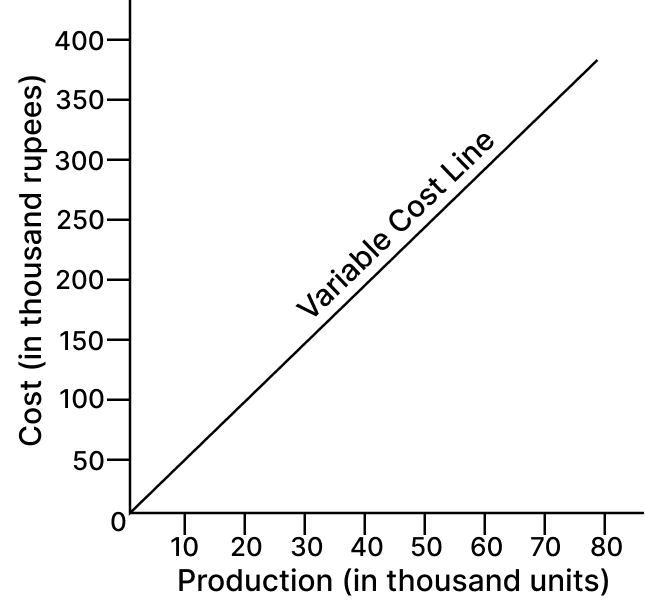
Variable cost refers to those costs which vary in amount with changes in the level of output or activity. Such costs increase and decrease in the same proportion in which the level of output increases or decreases.
Key characteristics:
- Variable costs vary in total amount but remain constant per unit of production.
- There is a linear relationship between volume of production and total variable cost.
- They are activity-based and are controllable in the short run.
For example, when the level of output rises from 5,000 to 6,000 units, the variable cost may rise from ₹25,000 to ₹30,000, but the variable cost per unit remains the same at ₹5. Sugarcane used to produce sugar, raw materials, power and fuel are common examples of variable costs.
"The cost of sugarcane is an avoidable cost." Justify for or against and give a reason.
Answer
FOR — The statement is correct. The cost of sugarcane IS an avoidable cost.
Reason:
Avoidable costs are those costs which can be eliminated by ceasing or reducing a particular activity. Sugarcane is the direct (variable) raw material used in the production of sugar. If a sugar mill decides not to produce sugar (or produces less sugar), the corresponding cost of sugarcane is automatically avoided/reduced because no sugarcane needs to be purchased for the production not undertaken.
In contrast, fixed costs like the rent of the factory, depreciation of plant or salaries of permanent staff would still have to be incurred even if production is stopped — these are unavoidable costs in the short run.
What is Indirect Labour Cost?
Answer
Indirect Labour Cost refers to the cost of labour which cannot be wholly and directly identified with a particular product or job. It is the cost of labour employed for performing tasks incidental to manufacture rather than directly producing the goods.
Indirect labour supports the production process but does not physically convert raw materials into finished goods. Wages and salaries paid to storekeeper, foreman, timekeeper, watchman, factory clerk and inspectors (in some cases) are common examples of indirect labour cost.
What are indirect expenses? Give an example.
Answer
Indirect expenses are those expenses which cannot be wholly and directly identified with a specific product, job or cost centre. They are incurred for the general operation, organisation and control of the business as a whole rather than for a specific product. Indirect expenses, together with indirect material and indirect labour, form the overheads of the organisation.
Indirect expenses are of three types:
- Factory expenses — e.g., factory rent, power and fuel, depreciation of plant.
- Office and administrative expenses — e.g., office rent, printing and stationery, audit fees.
- Selling and distribution expenses — e.g., advertising, sales commission, packing charges.
Example: Factory rent — it is paid for the entire factory premises and cannot be charged directly to any single product made in the factory.
Some costs are semi-variable in nature. Justify either for or against and give a reason.
Answer
FOR — The statement is correct. Some costs are indeed semi-variable in nature.
Reason:
Semi-variable (semi-fixed) costs are those costs which vary but not in direct proportion to the changes in the volume of production. They are a combination of fixed and variable components — partly fixed and partly variable. The fixed component represents the cost of providing the capacity, while the variable component is caused by using that capacity.
A common example is the telephone bill:
- A fixed monthly rental of, say, ₹500 must be paid regardless of usage (the fixed component).
- Additional charges are paid based on the number of calls made (the variable component).
Hence the classification of semi-variable cost is justified.
What do you mean by office and administrative overhead?
Answer
Office and administrative overheads are the indirect costs that are incurred in connection with the general management and administration of the organisation. These costs are essential for the day-to-day functioning of the office but are not directly related to the manufacture or sale of any specific product.
Office and administrative overheads include:
- Indirect materials — e.g., printing and stationery used in the office.
- Indirect labour — e.g., salary of office manager, salaries of administrative staff.
- Indirect expenses — e.g., office rent, audit fees, telephone bills, depreciation of office equipment, postage and telegrams, legal and professional fees.
What do you mean by Semi-Fixed cost? Give an example?
Answer
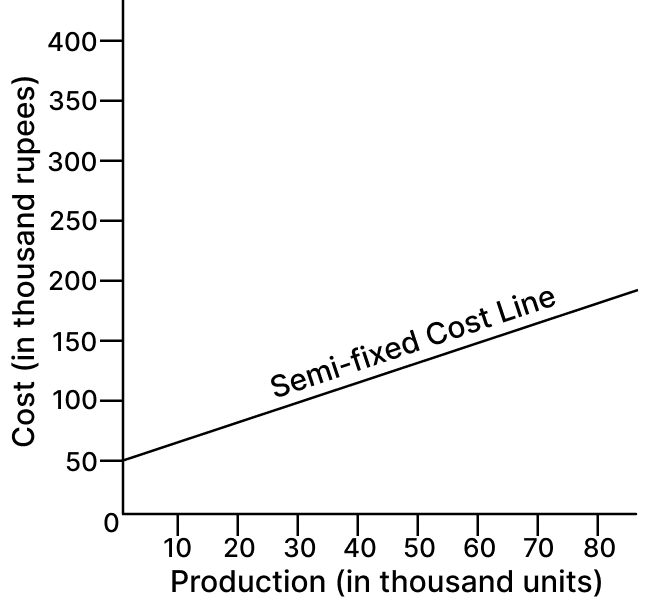
Semi-fixed cost (also called semi-variable cost or mixed cost) is a cost which varies but not in direct proportion to changes in the volume of production. It is a combination of fixed and variable components — partly fixed and partly variable.
The fixed component represents the cost of providing capacity, and the variable component is caused by the actual use of that capacity. Semi-fixed costs are neither perfectly fixed nor absolutely variable.
Example: Telephone bill — the monthly rent of the telephone connection is a fixed cost whereas the charges for the calls actually made during the month are a variable cost. The total bill thus has both a fixed and a variable element, making it semi-fixed.
Name and explain any two types of overheads.
Answer
The two main types of overheads are:
1. Factory (Manufacturing) Overheads — These are the indirect costs associated with the production process. They are necessary to operate the manufacturing facility but do not directly contribute to producing any specific unit. Factory overheads include:
- Indirect materials such as grease, oil and consumable stores.
- Indirect labour such as wages of the storekeeper, foreman and supervisors.
- Indirect expenses such as factory rent, power and fuel, depreciation of plant and machinery.
2. Office and Administrative Overheads — These are the indirect costs related to the general management and administration of the business. They are necessary for the day-to-day administrative functioning that supports production and sales. They include:
- Indirect materials such as printing and stationery.
- Indirect labour such as salary of the office manager and administrative staff.
- Indirect expenses such as office rent, audit fees, legal fees and depreciation of office equipment.
(A third type — Selling and Distribution Overheads — relates to costs of marketing, selling and distributing the product, e.g., advertising, sales commission, packing and warehousing charges.)
There are certain costs which are neither totally fixed nor fully variable. Justify for or against and give a reason.
Answer
FOR — The statement is correct. There are indeed certain costs which are neither totally fixed nor fully variable; these are called semi-fixed (semi-variable or mixed) costs.
Reason:
Semi-fixed costs are a combination of fixed and variable components. They have:
- A fixed component that represents the cost of providing capacity.
- A variable component that depends on the actual usage or level of activity.
Such costs vary with the volume of production but not in direct proportion to it. Hence they cannot be classified as purely fixed or purely variable.
Examples:
- Telephone bill — Fixed monthly rental + Variable call charges.
- Electricity bill — Fixed minimum charge + Variable consumption charges.
Therefore, the statement is justified — semi-fixed/semi-variable costs occupy the middle ground between fixed and variable costs.
Explain the following: (a) Material Cost (b) Semi-fixed costs.
Answer
(a) Material Cost
Material cost refers to the cost of substances from which the product is made. Materials enter the production process and form part of the finished product. For example, paper used in a book, plastic used in a ball pen and timber used in furniture are materials.
Material cost is divided into two categories:
(i) Direct Material — Materials which become an integral part of the finished product and which can be easily measured and directly charged to the product. Examples include:
- Any raw material, semi-finished item or component used for manufacturing a particular item — e.g., cloth in dress making.
- Any material specifically purchased for manufacturing a particular product — e.g., colours for dyeing cloth.
- Primary packing materials — e.g., bottles used in Coke or Pepsi.
(ii) Indirect Material — Materials which cannot be directly assigned to a specific product but can be apportioned across several products. They do not form an integral part of the finished product. Examples include consumable stores, oil and waste, nails, grease, lubricants and cleaning supplies.
(b) Semi-fixed Costs
Semi-fixed costs (also called semi-variable or mixed costs) are those costs which vary but not in direct proportion to changes in the volume of production. They are a combination of fixed and variable costs — partly fixed and partly variable.
Such costs are neither perfectly fixed nor absolutely variable. The fixed component represents the cost of providing capacity, while the variable component is caused by using the capacity.
Example: The rent of a telephone is a fixed cost, whereas the charges for the calls made during a month are a variable cost (depend on how much the telephone is used). Together, the total telephone bill is a semi-fixed cost.
"The term 'cost' must be qualified according to its context". Discuss this statement.
Answer
The statement is correct. The term 'cost' has different meanings in different contexts, and therefore it must always be qualified to convey precisely what is meant.
1. Common usage — In ordinary conversation, cost simply means the price paid for something or the sacrifice made to acquire something. For example, if a book is purchased for ₹100, the cost of the book to the buyer is ₹100.
2. Management terminology — In management accounting, cost means the expenditure incurred to generate revenue — that is, the money value of resources used to produce a product or provide a service. For example, if a publisher spends ₹80 to produce one copy of a book, the cost to the publisher is ₹80 (not ₹100, the price the customer pays).
3. Cost vs Loss vs Revenue — These three terms are often confused.
- Suppose a firm purchases a machine for ₹10,000 (asset value).
- It earns ₹1,000 with the help of the machine — this is revenue.
- The machine depreciates by ₹750 — this is cost.
- At year-end, the machine's book value is ₹9,250 (₹10,000 − ₹750), but if it is sold for only ₹9,000, the difference of ₹250 is loss.
4. Different cost classifications — Cost can be classified in multiple ways:
- By element: material, labour, expenses
- By nature: direct cost, indirect cost
- By behaviour: fixed, variable, semi-variable
Classify cost according to its nature.
Answer
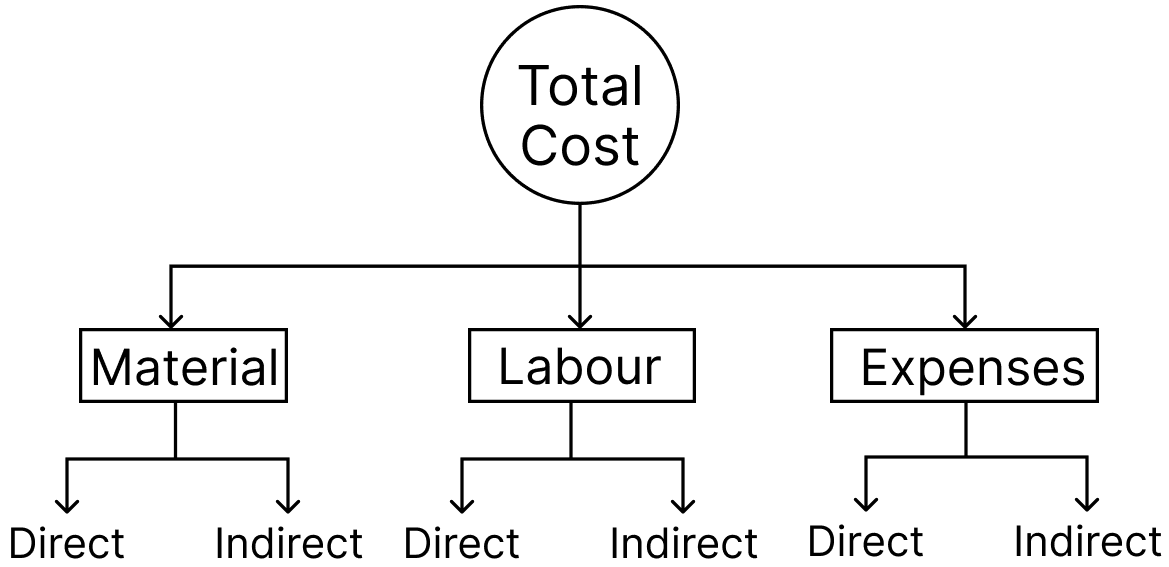
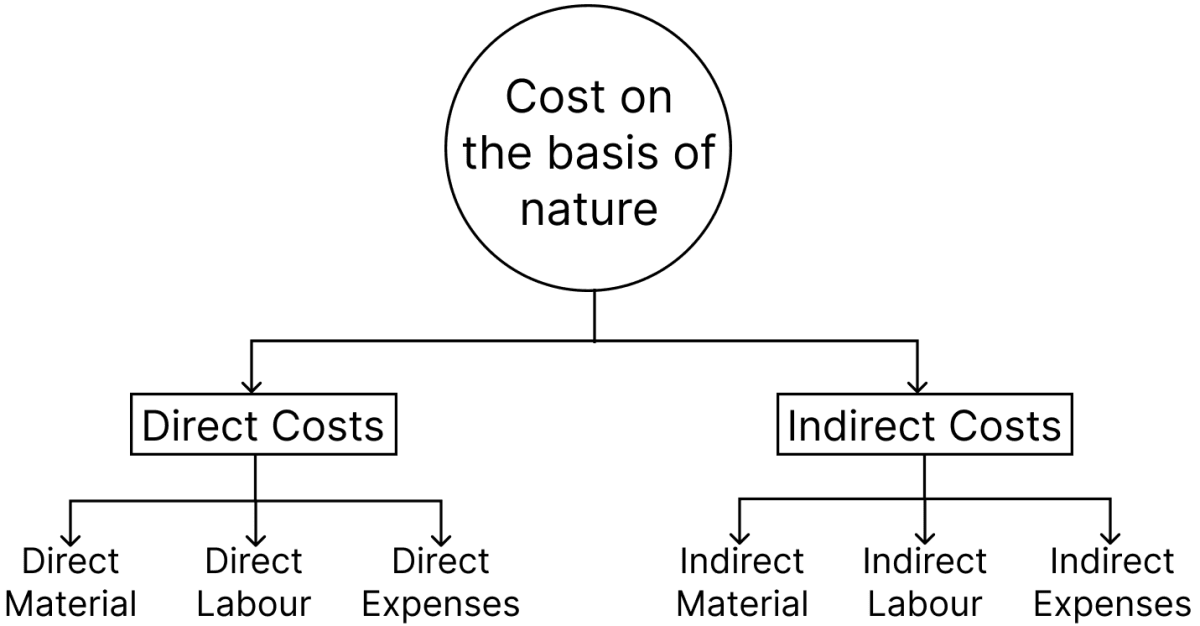
On the basis of nature, costs are classified into two broad categories — Direct Cost and Indirect Cost.
1. Direct Cost — These are those costs which can be easily, directly and wholly related to a particular cost unit or cost centre. Direct costs are also called the prime cost when totalled. They consist of three components:
- Direct Material — All materials which become an integral part of the finished product and can be easily measured and directly charged. Example: cloth used in dress making.
- Direct Labour — Wages of labour which can be wholly and directly identified with a particular product. Example: wages paid to a machine operator or carpenter.
- Direct Expenses — Expenses which can be wholly and directly identified with a particular product. Example: hire charges of a machine used for a specific job.
2. Indirect Cost — These are those costs which cannot be identified easily, directly and wholly with a particular cost unit or cost centre. They are also known as overheads or common costs. They consist of three components:
- Indirect Material — Materials that cannot be directly assigned to a specific product. Example: oil, grease, consumable stores.
- Indirect Labour — Labour that cannot be wholly identified with a particular product. Example: wages of storekeeper, foreman, timekeeper.
- Indirect Expenses — Expenses that cannot be directly identified with a specific product. Example: factory rent, office rent, advertising.
Name any two basic elements of cost. Give an example of each.
Answer
The three basic elements of cost are material, labour and expenses. Any two are explained below:
1. Material Cost — Material cost is the cost of substances from which the product is made. Materials enter the production process and form part of the finished product.
Example: The cost of sugarcane in the production of sugar in a sugar mill, or the cost of cloth used in dress making.
2. Labour Cost — Labour cost is the cost of human effort required for converting the material into the finished product. It is the aggregate amount of remuneration paid to workers, supervisors and managers.
Example: The wages paid to the workers employed in a sugar mill, or wages paid to a machine operator in a furniture factory.
What are Overheads or Indirect expenses? Mention any three types of overheads with an example of each.
Answer
Overheads or Indirect Expenses are those expenses which are not directly attributable to a specific job, product or cost centre. They include all expenses other than direct expenses and are incurred for the general organisation and control of the business as a whole.
Overheads include indirect materials, indirect labour and indirect expenses combined. They cannot be traced directly and in full to a specific product or department, and hence have to be apportioned on a suitable basis.
Three types of overheads:
1. Factory or Manufacturing Overheads — Indirect costs incurred in connection with the production of goods and services. They are necessary to operate the manufacturing facility.
- Indirect materials — e.g., grease, oil, consumable stores.
- Indirect labour — e.g., salary of storekeeper.
- Indirect expenses — e.g., power and fuel, depreciation of factory plant.
Example: Factory rent.
2. Office and Administrative Overheads — Indirect costs incurred in connection with the general management and administration of the organisation.
- Indirect materials — e.g., printing and stationery.
- Indirect labour — e.g., salary of office manager.
- Indirect expenses — e.g., office rent, audit fees.
Example: Salary of office staff.
3. Selling and Distribution Overheads — Indirect costs incurred in selling and distributing goods and services to customers.
- Indirect materials — e.g., price lists, packaging materials.
- Indirect labour — e.g., sales commission, salaries of sales staff.
- Indirect expenses — e.g., advertising, warehousing charges, freight outward.
Example: Advertisement expenses.
Explain fixed cost with suitable examples.
Answer
Fixed Cost refers to those costs which remain fixed in amount irrespective of changes in the volume of output during a given period of time. Such costs do not change with increase or decrease in the level of activity, upto a certain limit (called the relevant range).
Key features of fixed cost:
- Total fixed cost remains constant at all levels of output within the relevant range.
- Fixed cost per unit changes with the level of output. This is shown in the graph.
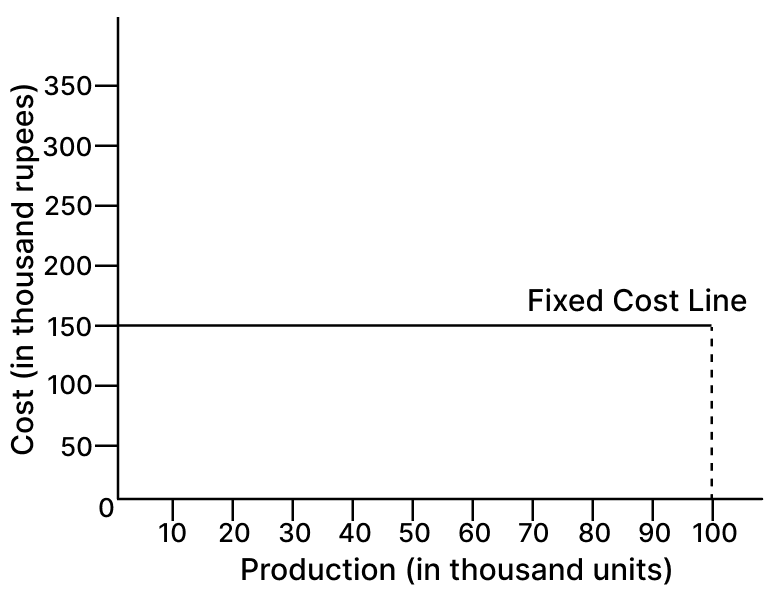
- For example, if total fixed cost is ₹1,50,000 and output is 30,000 units, fixed cost per unit is ₹5. If output rises to 60,000 units, fixed cost per unit falls to ₹2.50.
- Time-based — Fixed costs are related to the passage of time, not to activity.
- Incurred even at zero output — Fixed costs continue to be incurred even when production is nil.
Examples of fixed cost:
- Rent of the factory or office building
- Salary of the factory manager / managerial staff
- Insurance premium
- Depreciation of plant and machinery (on time basis)
Explain variable cost and semi-variable cost with suitable examples.
Answer
Variable Cost
Variable costs are those costs which vary in amount with changes in the level of output or activity. They increase or decrease in the same proportion in which the level of output rises or falls.
Key features:
- Variable costs vary in total but remain constant per unit of production.
- There is a linear relationship between volume of output and total variable cost.
- They are activity-based and controllable in the short run.
Examples: Cost of raw material (e.g., sugarcane in a sugar mill), power and fuel consumed in production, wages paid to direct labour on piece-rate basis, wear and tear of machines.
For instance, when output rises from 5,000 to 6,000 units, total variable cost may rise from ₹25,000 to ₹30,000, but variable cost per unit remains ₹5.
Semi-Variable Cost (Semi-fixed Cost)
Semi-variable costs are costs which vary, but not in direct proportion, with changes in the volume of production. They are a combination of fixed and variable components — partly fixed and partly variable.
Key features:
- The fixed component represents the cost of providing capacity (must be incurred even if there is no activity).
- The variable component represents the cost of using the capacity (varies with usage).
- They are neither perfectly fixed nor absolutely variable.
Examples:
- Telephone bill — Fixed monthly rent (e.g., ₹500) + Variable call charges.
- Electricity bill — Fixed minimum charge + Variable consumption charge.
- Salary with commission — Fixed basic salary + Variable commission/incentive.
Explain briefly the various elements of cost.
OR
Explain the elements of total cost.
Answer
There are three basic elements of cost — Material, Labour and Expenses. Each of these can be further sub-classified into direct and indirect.
1. Material Cost
Material cost is the cost of substances from which the product is made. Examples: paper in a book, plastic in a ball pen, timber in furniture.
- Direct Material — Materials that become an integral part of the finished product and can be directly charged to it. Example: cloth in dress making.
- Indirect Material — Materials that cannot be directly assigned to a specific product. Example: oil, grease, consumable stores.
2. Labour Cost
Labour cost is the cost of human effort. It is the total remuneration paid to workers, supervisors and managers.
- Direct Labour — Labour wholly and directly identified with a particular product. Example: wages paid to a machine operator, wages of a carpenter in a furniture factory.
- Indirect Labour — Labour that cannot be directly identified with a particular product. Example: wages of storekeeper, foreman, timekeeper.
3. Expenses
Expenses are costs incurred other than on material and labour, for production, distribution and management of the organisation.
- Direct Expenses — Expenses directly identifiable with a specific product. Example: hire charges of a machine for a specific job, rent of a room used to produce a specific product.
- Indirect Expenses — Expenses that cannot be directly identified with a specific product. These together with indirect material and indirect labour form overheads, of which there are three types — Factory, Office & Administrative, and Selling & Distribution.
The total of direct material + direct labour + direct expenses is called prime cost, while indirect costs together form overheads. Together they make up total cost.
Write a short note on direct and indirect labour cost.
Answer
Direct Labour Cost
Direct labour cost is the cost of labour which can be wholly and directly identified with a particular product.
Direct labour includes:
- Labour engaged in the actual production of the product.
- Labour engaged in aiding production by way of supervision, maintenance, etc.
- Inspectors, analysts, etc., specially required for production.
Examples: Wages paid to a machine operator, wages paid to a carpenter in a furniture factory, or wages paid to workers directly engaged in manufacturing.
Direct labour cost forms part of prime cost and is directly charged to the product.
Indirect Labour Cost
Indirect labour cost is the cost of labour which cannot be wholly and directly identified with a particular product. It is the labour employed for performing tasks that are incidental to the manufacturing process rather than directly producing the goods.
Examples: Wages paid to the storekeeper, foreman, timekeeper and watchman.
Indirect labour cost is treated as part of factory overhead.
Write short notes on: (a) Direct Labour Cost (b) Indirect Labour Cost
Answer
(a) Direct Labour Cost
Direct labour cost is the cost of labour which can be wholly and directly identified with a particular product or job. It is the remuneration paid to workers.
It includes:
- Labour engaged in the actual production of the product.
- Labour engaged in aiding production through supervision and maintenance.
- Inspectors, analysts and other specialists required specifically for the production.
Examples:
- Wages paid to a machine operator.
- Wages paid to a carpenter in a furniture factory.
- Wages paid to weavers in a textile factory.
Direct labour cost is part of the prime cost and is directly charged to the cost of the product.
(b) Indirect Labour Cost
Indirect labour cost is the cost of labour which cannot be wholly and directly identified with a particular product. It is the cost of labour employed for performing tasks incidental to manufacture — i.e., supporting the production process rather than directly producing the goods.
Examples:
- Wages paid to storekeeper.
- Wages paid to foreman.
- Wages paid to timekeeper, watchman.
- Salary of factory supervisor / factory clerk.
Indirect labour cost forms part of factory (manufacturing) overhead.
With reference to cost, on the basis of behaviour explain:
(a) Variable Cost
(b) Semi-variable Cost
Answer
(a) Variable Cost
Variable costs are those costs which vary in amount with changes in the level of output or activity. They increase or decrease in the same proportion as the volume of production rises or falls.
Key features:
- They vary in total but remain constant per unit of output.
- There is a linear relationship between total variable cost and the volume of production.
- They are activity-based.
- They are controllable in the short run.
Examples: Cost of raw material, power and fuel consumed in production, direct wages on piece-rate basis, wear and tear on machines.
For instance, if total variable cost is ₹25,000 at 5,000 units (₹5 per unit), then at 6,000 units it becomes ₹30,000 — total has increased proportionately while per-unit cost remains ₹5.
(b) Semi-variable Cost
Semi-variable costs (also called semi-fixed or mixed costs) are those costs which vary, but not in direct proportion, with changes in the volume of production. They are a combination of fixed and variable elements — partly fixed and partly variable.
Key features:
- The fixed component represents the cost of providing capacity (must be incurred even at zero activity).
- The variable component represents the cost of using capacity.
- They are neither perfectly fixed nor purely variable.
Examples:
- Telephone bill — Fixed monthly rent + Variable call charges.
- Electricity bill — Fixed minimum charge + Variable consumption charges.
On what basis are Fixed Cost differentiated from Variable Cost?
Answer
Fixed Cost and Variable Cost are differentiated on the following bases:
| S.No. | Basis of Distinction | Fixed Cost | Variable Cost |
|---|---|---|---|
| 1. | Behaviour | Fixed costs remain constant within a given range of activity and a given time period, irrespective of changes in volume of output. | Variable costs vary in proportion to changes in the volume of output. |
| 2. | Basis | Fixed costs are time-based — they relate to the passage of time. | Variable costs are activity-based — they relate to the level of activity. |
| 3. | Total cost | Fixed in total. | Vary in total — increase with increase in volume of output, decrease with decrease in output. |
| 4. | Per unit cost | Vary per unit — decrease with increase in the volume of output. | Constant per unit — remain the same regardless of the volume of output. |
| 5. | Control | Not controllable in the short run. | Controllable in the short run. |
| 6. | Behaviour at zero output | Continue to be incurred even at zero level of output. | Become zero when there is no output. |
| 7. | Examples | Rent of factory, salary of factory manager, insurance, depreciation of plant. | Cost of raw material, power and fuel, direct wages on piece-rate basis. |