
Human resources are the most valuable resource of an organisation as the ............... of all other resources depends upon people.
- Efficiency
- Alertness
- Productivity
- None of these
Answer
Productivity
Reason — Human resources (people) are the most valuable resource of an organisation as the productivity of all other resources (physical and financial) depends upon people. Without people, organisations cannot exist as it is the people who make use of physical and financial resources.
............... are the number of people working in an organisation together with their knowledge, skills, experience, attitudes, motivation and potential.
- Natural resources
- Human resources
- Financial resources
- None of these
Answer
Human resources
Reason — Human resources may be defined as the number of persons working in an organisation together with their knowledge, skills, experience, attitudes, motivation and potential. They are the most valuable and active resource of any organisation.
Read the two statements below and choose the correct option:
Statement 1: Human Resource Management focuses exclusively on achieving organizational objectives without considering employee satisfaction.
Statement 2: Human Resource Development is solely concerned with compliance with legal requirements in the workplace.
- Only 1 is correct
- Only 2 is correct
- Both statements are false
- Both statements are true
Answer
Both statements are false
Reason — Statement 1 is false because HRM seeks to achieve organisational, personal as well as social objectives — not only organisational goals. Statement 2 is false because HRD is concerned with improving the knowledge, skills, aptitudes and values of employees so that they can perform present and future jobs more effectively, not merely legal compliance.
A company is facing high turnover rates and low employee morale. Which HRM strategy would be most effective in addressing these issues?
- Implementing a rigorous training program for new hires
- Introducing a competitive bonus structure
- Conducting a comprehensive job analysis and redesign
- Enhancing employee participation in decision-making
Answer
Enhancing employee participation in decision-making
Reason — High turnover and low morale are problems related to employee motivation and integration. Enhancing employee participation in decision-making is part of the integration function of HRM, which reconciles the goals of the organisation with those of its members and helps in motivating employees, building sound human relations and improving quality of work life — directly addressing morale and retention.
Human resource management seeks to achieve ............... goals.
- Social
- Personal
- Both (A) and (B)
- None of these
Answer
Both (A) and (B)
Reason — According to Flippo, HRM aims at the accomplishment of individual, organisational and societal objectives. Hence it seeks to achieve both personal goals (of employees) and social goals (of society), along with organisational goals.
It is the field of management which is concerned with the acquisition, development, compensation, maintenance and integration of human resources so as to achieve organisational, personal and social objectives.
- Financial management
- Selection
- Recruitment
- Human resource management
Answer
Human resource management
Reason — As per Flippo's definition, Human Resource Management is the planning, organising, directing and controlling of the procurement, development, compensation, integration, maintenance and reproduction of human resources to the end that individual, organisational and societal objectives are accomplished.
The integration function in HRM focuses on resolving employee grievances and fostering positive labour relations.
- True
- False
Answer
True
Reason — The integration function is the process of reconciling the goals of the organisation with those of its members. It involves motivating employees, providing job satisfaction, handling employee grievances through formal grievance procedures, collective bargaining, workers' participation in management, conflict resolution and developing sound human relations.
Evaluate the following statements:
Statement 1: Performance appraisal is solely a tool for identifying underperforming employees.
Statement 2: Career planning is integral to employee motivation and organizational growth.
- Only 1 is correct
- Only 2 is correct
- Both statements are true
- Both statements are false
Answer
Only 2 is correct
Reason — Statement 1 is false because performance appraisal implies systematic evaluation of employees with respect to their performance on the job and their potential for development — it is not solely for identifying underperformers. Statement 2 is true as career planning fulfils career aspirations of employees through promotions and transfers, motivating them and supporting organisational growth.
Assess the following statements:
Statement 1: Human Resource Planning is only concerned with filling current job vacancies.
Statement 2: Human Resource Planning involves forecasting future workforce needs and preparing for potential challenges.
- Only 1 is correct
- Only 2 is correct
- Both statements are true
- Both statements are false
Answer
Only 2 is correct
Reason — Statement 1 is false because HR Planning is not limited to current vacancies. Statement 2 is true — Human Resource Planning is the process of estimating the present and future manpower requirements of the organisation, preparing inventory of present manpower and formulating action programmes to bridge the gaps in manpower.
Human Resource Development (HRD) only focuses on employee training and does not include career planning.
- True
- False
Answer
False
Reason — Human Resource Development is the process of improving the knowledge, skills, aptitudes and values of employees. It comprises performance and potential appraisal, training, executive development, and career planning & development. Hence career planning is very much a part of HRD.
Which function of HRM involves attracting, selecting, and hiring suitable candidates for job positions?
(1) Compensation function
(2) Development function
(3) Procurement function
(4) Maintenance function
- 1 & 2
- 3 & 4
- Only 1
- Only 3
Answer
Only 3
Reason — The procurement function is concerned with securing and employing the right kind and proper number of people required to accomplish the organisational objectives. It includes job analysis, human resource planning, recruitment, selection, placement and induction — i.e., attracting, selecting and hiring suitable candidates.
Assertion (A): The HR department's Compensation function includes managing employee training programs.
Reason (R): Compensation function involves structuring employee salaries, bonuses, and incentives.
- A is true but R is false
- A is false but R is true
- Both A and R are true and R explains A.
- Both A and R are true but R does not explain A.
Answer
A is false but R is true
Reason — Assertion (A) is false because managing employee training programs falls under the development function, not the compensation function. Reason (R) is true because the compensation function refers to providing equitable and fair remuneration through job evaluation, wage and salary administration and bonus.
What is the role of HRM in employee development?
(1) Providing monetary incentives.
(2) Offering flexible work hours.
(3) Enhancing employee skills and knowledge through training and education.
(4) Mobility of personnel through promotions and transfers.
- 1 & 2
- 3 & 4
- Only 1
- Only 3
Answer
3 & 4
Reason — The development function of HRM aims at improving the knowledge, skills, aptitudes and values of employees through training and executive development (option 3) and career planning & development which involves mobility of personnel through promotions and transfers (option 4). Monetary incentives belong to the compensation function and flexible hours fall under the integration/maintenance area.
Which of the following is a procurement function of human resource management?
- Human Resource Planning
- Recruitment
- Selection
- All of these
Answer
All of these
Reason — The procurement function consists of job analysis, human resource planning, recruitment, selection, placement and induction or orientation. Hence Human Resource Planning, Recruitment and Selection are all procurement functions.
Which of the following is not the development function of human resource management?
- Training
- Collective Bargaining
- Executive development
- Career Planning & Development
Answer
Collective Bargaining
Reason — Training, Executive Development and Career Planning & Development are all activities of the development function. Collective Bargaining is an activity of the integration function as it deals with reconciling the interests of employers and employees.
Which of the following is the development function of human resource management?
- Job evaluation
- Collective Bargaining
- Improving quality of work life
- Career Planning & Development
Answer
Career Planning & Development
Reason — Career Planning and Development is part of the development function. Job evaluation is a compensation activity, while Collective Bargaining and Improving quality of work life fall under the integration function.
Which of the following is the compensation function of human resource management?
- Job evaluation
- Collective Bargaining
- Improving quality of work life
- Career Planning & Development
Answer
Job evaluation
Reason — The compensation function refers to providing equitable and fair remuneration to employees. Its activities include job evaluation, wage and salary administration and bonus. Collective Bargaining and Improving quality of work life belong to the integration function, while Career Planning & Development is part of the development function.
A multinational corporation is planning to enter a new market with a diverse cultural landscape. Which HRM function will be most critical in ensuring smooth operations?
- Recruitment
- Cross-cultural training
- Performance appraisal
- Compensation
Answer
Cross-cultural training
Reason — When a multinational corporation enters a market with a diverse cultural landscape, employees must understand and adapt to local customs, values and communication styles. Cross-cultural training (a part of the development function) equips employees to work effectively across cultures, ensuring smooth operations in the new market.
Which of the following is a procurement function of human resource management?
- Job analysis
- Collective Bargaining
- Improving quality of work life
- Career Planning & Development
Answer
Job analysis
Reason — Job analysis is a procurement activity — it is the process of studying in detail the operations and responsibilities involved in a job to identify the nature and level of human resources required. Collective Bargaining and Improving quality of work life are integration activities; Career Planning & Development is a development activity.
It is the process of determining the relative worth of a job.
- Job assessment
- Job evaluation
- Selection
- Job rotation
Answer
Job evaluation
Reason — Job evaluation is the process of determining the relative worth of a job. It is an activity of the compensation function and helps in developing an equitable wage and salary structure for various jobs in the organisation.
It is the process of studying in detail the operations and responsibilities involved in a job so as to identify the nature and level of human resources required to perform the job effectively.
- Job assessment
- Job evaluation
- Job analysis
- Job rotation
Answer
Job analysis
Reason — Job analysis is the process of studying in detail the operations and responsibilities involved in a job so as to identify the nature and level of human resources required to perform the job effectively. Job descriptions and job specifications are prepared with the help of information provided by job analysis.
It is the process of estimating the present and future manpower requirements of the organisation, preparing inventory of present manpower and formulating action programmes to bridge the gaps in manpower.
- Job assessment
- Job evaluation
- Human resource management
- Human resource planning
Answer
Human resource planning
Reason — Human Resource Planning is the process of estimating the present and future manpower requirements of the organisation, preparing inventory of present manpower and formulating action programmes to bridge the gaps in manpower. It is one of the activities of the procurement function.
It is concerned with protecting and promoting the physical and mental health of employees.
- Development function
- Procurement function
- Maintenance function
- Integration function
Answer
Maintenance function
Reason — The maintenance function is concerned with protecting and promoting the physical and mental health of employees. For this purpose, fringe benefits like housing, medical aid, conveyance facilities and social security measures like provident fund, pension, gratuity, group insurance and welfare measures are arranged.
Human Resource Management is a ............... oriented function.
- Job
- People
- Money
- Profit
Answer
People
Reason — Human Resource Management is a people-oriented function. It is concerned with employees as individuals as well as groups. It is the task of dealing with human relationships within an organisation and the process of bringing people and organisations together so that the goals of each are met.
............... is concerned with managing people at work.
- Human resource management
- Public Relations management
- Human resource manager
- Public relations manager
Answer
Human resource management
Reason — Human Resource Management is concerned with managing people at work. It is a comprehensive function which covers all types of people at all levels in the organisation — workers, supervisors, officers, managers and other types of personnel.
One of the Maintenance functions of Human Resource Management is ............... .
- Training
- Selection
- Bonus
- Social measure
Answer
Social measure
Reason — The maintenance function includes fringe benefits, social security measures (social measure), personnel records and research. Training is a development activity, Selection is a procurement activity, and Bonus is a compensation activity.
Which function of Human Resource Management deals with handling employee grievances, conflict resolution and employee counselling?
- Procurement function
- Development function
- Integration function
- Compensation function
Answer
Integration function
Reason — The integration function is the process of reconciling the goals of the organisation with those of its members. It involves handling employee grievances through formal grievance procedures, collective bargaining, workers' participation in management, conflict resolution, developing sound human relations and employee counselling.
Which function of Human Resource Management specifies that improvement in personality and interest is required to get maximum satisfaction from their work?
- Action-Oriented function
- Pervasive function
- Development-Oriented function
- Comprehensive function
Answer
Development-Oriented function
Reason — Development-oriented function of HRM is concerned with developing the potential of employees so that they get maximum satisfaction from their work and give their best efforts to the organisation. It takes into account the personality, interests, opportunities and capacities of employees and seeks to help them realise their full potential.
The process of determining the relative worth of a job is known as:
- Performance and potential appraisal
- Job evaluation
- Job analysis
- Executive development
Answer
Job evaluation
Reason — Job evaluation is the process of determining the relative worth of a job. It is an activity of the compensation function used to develop a suitable wage and salary structure for various jobs in the organisation.
Comprehensive function of Human Resource Management is not concerned with managing all types of people at each level.
- True
- False
Answer
False
Reason — The comprehensive function of HRM is concerned with managing all types of people at all levels in the organisation. It applies to workers, supervisors, officers, managers and other types of personnel. Hence the statement is false.
According to ............... function of Human Resource Management, Personnel management is inherent in all organisations and at all levels.
- Pervasive
- Challenging
- Staff
- Comprehensive
Answer
Pervasive
Reason — According to the pervasive function of HRM, personnel management is inherent in all organisations and at all levels. It is not confined to industry alone — it is equally useful and necessary in government, armed forces, sports organisations and the like, permeating all functional areas like production, marketing, finance and research.
What is meant by Human Resource Management?
Answer
Human Resource Management may be defined as a set of policies, programmes and practices designed to maximise both personal and organisational objectives. It is the process of binding people and organisations together so that the objectives of each are achieved.
According to Flippo, "Personnel management or human resource management is the planning, organising, directing and controlling of the procurement, development, compensation, integration, maintenance and reproduction of human resources to the end that individual, organisational and societal objectives are accomplished."
State the national significance of human resource management.
Answer
Human resources and their management play a vital role in the development of the nation. The national significance of HRM is as follows:
Effective Utilisation of National Resources — The effective exploitation and utilisation of a nation's natural, physical and financial resources require an efficient and committed manpower.
Quality of Human Resources — There are wide differences in development between countries with similar resources due to differences in the quality of their people.
Foundation of Development — The level of development in a country depends primarily on the skills, attitudes and values of its human resources.
Economic Growth — Effective management of human resources helps to speed up the process of economic growth which in turn leads to higher standards of living and fuller employment.
"Human resource management is a challenging function." Comment.
Answer
Human Resource Management is indeed a challenging function due to the following reasons:
Dynamic Nature of People — Managing human resources is challenging because of the dynamic nature of people. Unlike machines, people have sentiments, emotions and feelings that change over time.
People Cannot Be Treated Like Machines — Since people are emotional and rational beings, they cannot be treated like machines.
Administering a Social System — HRM is not simply managing people; it is administering a social system involving complex inter-personal and inter-group relationships.
Diverse Needs and Expectations — Different employees have different needs, expectations, attitudes and aspirations, which makes it challenging to satisfy everyone.
Constant Alertness Required — Personnel management requires a constant alertness and awareness of human relations and their importance in everyday operations.
Describe any one/two function of human resource management.
Answer
Two important functions of Human Resource Management are:
Procurement Function — It is concerned with securing and employing the right kind and proper number of people required to accomplish the organisational objectives. Its activities include:
- Job Analysis — Studying the operations and responsibilities involved in a job.
- Human Resource Planning — Estimating present and future manpower requirements.
- Recruitment — Searching for required personnel and stimulating them to apply.
- Selection — Judging the suitability of candidates and choosing the most appropriate ones.
- Placement — Assigning suitable jobs to selected candidates.
- Induction or Orientation — Familiarising new employees with the company.
Development Function — It is the process of improving the knowledge, skills, aptitudes and values of employees so that they can perform present and future jobs more effectively. Its activities include:
- Performance and Potential Appraisal — Systematic evaluation of employees with respect to their performance and potential.
- Training — Process by which employees learn knowledge, skills and attitudes.
- Executive Development — Developing managerial talent through appropriate programmes.
- Career Planning & Development — Planning the career of employees through promotions and transfers.
Human resource is the most valuable asset to business enterprises. Justify either for or against.
Answer
For the statement.
Human resource is indeed the most valuable asset to business enterprises for the following reasons:
Productivity Depends on People — The productivity of all other resources (physical and financial) depends upon people. Without people, organisations cannot exist.
Active Resource — Human resource is the most valuable and active resource of any organisation. It is the people who make use of physical and financial resources.
Knowledge, Skills and Potential — Human resources possess knowledge, skills, experience, attitudes, motivation and potential, which give a competitive edge to the organisation.
Source of Innovation — Innovation, creativity and decision-making come from people, not machines. New ideas and improvements are products of human thinking.
Achieving Goals — Effective human resources help an enterprise achieve its goals more efficiently and effectively through their willing cooperation and dedication.
Cannot Be Replicated — While machines and money can be acquired by competitors, the unique skills, talent and culture of an organisation's human resources cannot be easily duplicated.
Hence, human resource is justly called the most valuable asset of any business enterprise.
"The function of Human Resource Management is advisory in nature." Justify for or against and give a reason.
Answer
For the statement.
The function of Human Resource Management is advisory (staff) in nature for the following reasons:
Staff Function — Human resource managers do not manufacture or sell goods, but they contribute to the success and growth of an organisation by advising the operating departments on personnel matters.
Provides Expert Advice — In big organisations, the human resource department provides expert advice and assistance concerning personnel matters.
Line Responsibility — Personnel management is a responsibility of all those who manage people. When a personnel department is created, other managers are not relieved of this responsibility — the department only advises and assists line managers.
Director-like Role — Like the director of a movie, the performance of HR managers can be judged from the success of the total organisation.
Hence, HRM is rightly described as a staff function but a line responsibility.
"Human resource management is only action oriented rather than being people oriented." Justify.
Answer
Against the statement.
Human resource management is BOTH action-oriented AND people-oriented; it is wrong to say it is "only" action-oriented. The reasons are:
People-Oriented Function — HRM is concerned with employees as individuals as well as groups. It is the task of dealing with human relationships within an organisation.
Bringing People and Organisation Together — HRM is the process of bringing people and organisations together so that the goals of each are met.
Individual-Oriented — Under HRM, every employee is considered as an individual so as to provide services and programmes to facilitate employee satisfaction and growth.
Action-Oriented Too — At the same time, HRM is also action-oriented, focusing on action rather than on record-keeping or procedures. It stresses the solution of personnel problems to achieve both organisational objectives and employees' personal goals.
Hence, the statement is incorrect — HRM is both people-oriented and action-oriented; one feature does not exclude the other.
With reference to the functions of Human Resource Management, explain:
(A) Any three Development functions
(B) Any two maintenance functions
Answer
(A) Three Development Functions
The development function is the process of improving the knowledge, skills, aptitudes and values of employees. Three of its activities are:
Performance and Potential Appraisal — It implies systematic evaluation of employees with respect to their performance on the job and their potential for development.
Training — It is the process by which employees learn knowledge, skills and attitudes to further organisational and personal goals.
Executive Development — It is the process of developing managerial talent through appropriate programmes so that managers can take up higher responsibilities.
(B) Two Maintenance Functions
The maintenance function is concerned with protecting and promoting the physical and mental health of employees. Two of its activities are:
Fringe Benefits — Several types of fringe benefits such as housing, medical aid, educational facilities and conveyance facilities are provided to employees to enhance their welfare.
Social Security Measures — Social security measures like provident fund, pension, gratuity, maternity benefits, injury/disablement allowance and group insurance are arranged for the well-being of employees and their families.
What do you understand by the term 'human resources'? Describe the nature of human resources.
Answer
Meaning of Human Resources — Human resources may be defined as the number of persons working in an organisation together with their knowledge, skills, experience, attitudes, motivation and potential. Organisations are made up of people and function through people. Without people, organisations cannot exist. Therefore, human resource is the most valuable and active resource of any organisation.
Nature/Features of Human Resources:
Most Valuable Resource — Human resources are the most valuable resource as the productivity of all other resources depends upon people.
Heterogeneous — Human resources are heterogeneous as they consist of different individuals with different backgrounds, skills, knowledge, attitudes and personalities.
Dynamic — Human resources are dynamic in nature. People have sentiments and emotions and their behaviour, expectations and aspirations change over time.
Possess Immense Potential — Human resources have immense potential which can be developed through proper training and motivation.
Active Resource — Unlike physical and financial resources, human resources are active. They make decisions and take actions, while other resources are passive.
Source of Innovation — Human resources are the source of new ideas, creativity and innovation, which give a competitive advantage to the organisation.
Cannot Be Stored — Unlike physical resources, human resources cannot be stored. The skills and time of employees not used today are lost forever.
Need Continuous Development — Human resources need continuous development through training, education and experience.
"Effective management of human resources is essential for the prosperity and welfare of an organisation, a society and a nation." In the light of this statement, describe the role of human resource management.
Answer
The role of human resource management can be discussed at four levels — corporate, professional, social and national:
1. Significance for an Enterprise — HRM helps an enterprise achieve its goals more efficiently and effectively in the following ways:
(a) Attracting and retaining the required talent through effective human resource planning, recruitment, selection, placement, orientation, compensation and promotional policies.
(b) Developing the necessary skills and right attitudes among the employees through training, development and performance appraisal.
(c) Securing willing cooperation of employees through motivation, participation and grievance handling.
(d) Utilising effectively the available human resources.
(e) Ensuring that the enterprise will have in future a team of competent and dedicated employees.
2. Professional Significance — Effective management of human resources helps to improve the quality of work life. It contributes to professional growth in the following ways:
(a) Providing maximum opportunities for personal development of each employee.
(b) Maintaining healthy relationships between individuals and different work groups.
(c) Allocating work properly.
3. Social Significance — Sound human resource management has a great significance for the society. It helps to enhance the dignity of labour in the following ways:
(a) Providing suitable employment that provides social and psychological satisfaction to people.
(b) Maintaining a balance between the jobs available and the job-seekers in terms of numbers, qualifications, needs and aptitudes.
(c) Eliminating waste of human resources through conservation of physical and mental health.
4. National Significance — Human resources play a vital role in the development of the nation. The effective exploitation and utilisation of a nation's natural, physical and financial resources require an efficient and committed manpower. Countries with similar resources differ in development due to differences in the quality of their people. Effective management of human resources helps to speed up the process of economic growth which in turn leads to higher standards of living and fuller employment.
"Human resource management seeks to achieve personal and social goals." Explain. Outline the major functions of human resource management.
Answer
HRM Seeks to Achieve Personal and Social Goals
Human resource management is concerned not merely with achieving the objectives of an organisation. It also seeks to achieve the goals of its employees and those of the society. According to Flippo, HRM is the planning, organising, directing and controlling of human resources to the end that individual, organisational and societal objectives are accomplished. Hence HRM is a triple-objective function:
- Personal Goals — Includes job satisfaction, fair compensation, opportunities for growth, recognition and personal development of employees.
- Social Goals — Includes providing suitable employment, maintaining a balance between jobs and job-seekers, eliminating waste of human resources and enhancing dignity of labour.
Major Functions of HRM
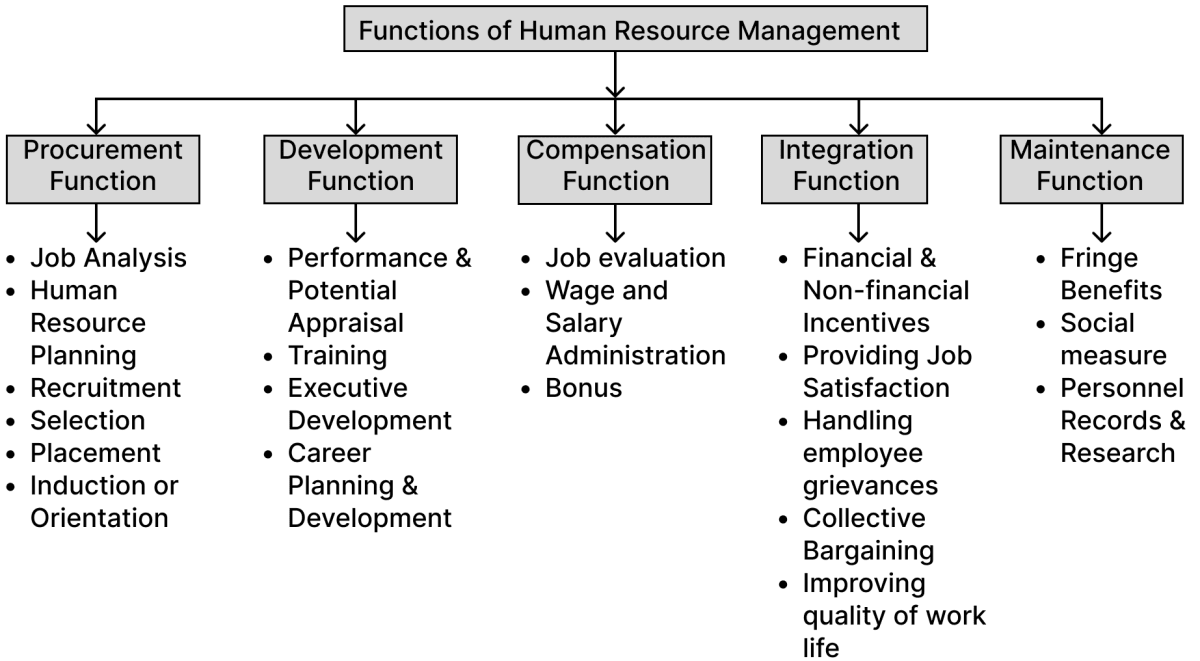
Procurement Function — Securing and employing the right kind and proper number of people. Activities: Job analysis, HR planning, recruitment, selection, placement, induction.
Development Function — Improving knowledge, skills, aptitudes and values of employees. Activities: Performance and potential appraisal, training, executive development, career planning & development.
Compensation Function — Providing equitable and fair remuneration. Activities: Job evaluation, wage and salary administration, bonus.
Integration Function — Reconciling the goals of the organisation with those of members. Activities: Motivation, financial and non-financial incentives, providing job satisfaction, handling grievances, collective bargaining, improving quality of work life.
Maintenance Function — Protecting and promoting the physical and mental health of employees. Activities: Fringe benefits, social security measures, personnel records and research.
Human Resource Management is the management of people at work. With reference to the above statement explain the role of Human Resource Management in an organisation.
Answer
Human Resource Management is the management of people at work. It is concerned with managing all types of people at all levels — workers, supervisors, officers, managers and other personnel. The role of HRM in an organisation is highly significant and is explained below:
Attracting and Retaining Talent — HRM helps in attracting and retaining the required talent through effective human resource planning, recruitment, selection, placement, orientation, compensation and promotional policies.
Developing Skills and Attitudes — HRM develops the necessary skills and right attitudes among employees through training, executive development and performance appraisal.
Securing Willing Cooperation — HRM secures willing cooperation of employees through motivation, participation in decision-making, grievance handling and effective communication.
Effective Utilisation of Human Resources — HRM ensures that the available human resources are utilised effectively to maximise productivity.
Ensuring Future Talent — HRM ensures that the enterprise will have in future a team of competent and dedicated employees by planning succession and conducting career development programmes.
Improving Quality of Work Life — Through fair compensation, sound grievance handling and welfare measures, HRM improves the quality of work life.
Building Sound Human Relations — HRM helps build healthy relationships between individuals and different work groups, fostering team work and harmony.
What is the professional and social significance of Human Resource Management?
OR
Explain three professional and two social significance of Human Resource Management.
Answer
Professional Significance of HRM
Effective management of human resources helps to improve the quality of work life. It permits team work among employees by providing a healthy, working environment. Three points of professional significance are:
Maximum Opportunities for Personal Development — HRM provides maximum opportunities for personal development of each employee through training, executive development and career planning.
Healthy Relationships Between Individuals and Work Groups — HRM helps in maintaining healthy relationships between individuals and different work groups, ensuring teamwork and harmonious functioning.
Proper Allocation of Work — HRM ensures proper allocation of work to employees based on their qualifications, skills and interests. This results in better productivity and job satisfaction.
Social Significance of HRM
Sound human resource management has great significance for society as it helps enhance the dignity of labour. Two points of social significance are:
Providing Suitable Employment — HRM provides suitable employment that gives social and psychological satisfaction to people. Employment is essential for self-respect and standard of living.
Maintaining Balance Between Jobs and Job-Seekers — HRM helps maintain a balance between the jobs available and the job-seekers in terms of numbers, qualifications, needs and aptitudes. It also eliminates waste of human resources through conservation of physical and mental health.
What do you mean by development function of Human Resource Management? Discuss its various activities?
Answer
Meaning — The development function of HRM is the process of improving the knowledge, skills, aptitudes and values of employees so that they can perform the present and future jobs more effectively.
Activities of the Development Function:
Performance and Potential Appraisal — It implies systematic evaluation of employees with respect to their performance on the job and their potential for development.
Training — It is the process by which employees learn knowledge, skills and attitudes to further organisational and personal goals. Training programmes equip employees to handle current responsibilities effectively.
Executive Development — It is the process of developing managerial talent through appropriate programmes. Executive development programmes enhance the conceptual, human and technical skills of managers.
Career Planning and Development — It involves planning the career of employees and implementing career plans so as to fulfil the career aspirations of people. It includes mobility of personnel through promotions and transfers.
Write in brief any three features of Human Resource Management.
Answer
Three features of Human Resource Management are:
Comprehensive Function — Human resource management is concerned with managing people at work. It covers all types of people at all levels in the organisation. It applies to workers, supervisors, officers, managers and other types of personnel — making it a comprehensive function.
People-Oriented — Human resource management is concerned with employees as individuals as well as groups. It is the task of dealing with human relationships within an organisation. It is the process of achieving the best fit between individuals, jobs, organisations and the environment, and bringing people and organisations together so that the goals of each are met.
Pervasive Function — Personnel management is inherent in all organisations and at all levels. It is not confined to industry alone — it is equally useful and necessary in government, armed forces, sports organisations and the like. It permeates all functional areas like production, marketing, finance and research. Each and every manager is involved with the human resource function.
Explain procurement function of Human Resource Management?
OR
With reference to functions of Human Resource Management, explain procurement.
Answer
Meaning — The procurement function is concerned with securing and employing the right kind and proper number of people required to accomplish the organisational objectives.
Activities of the Procurement Function:
Job Analysis — It is the process of studying in detail the operations and responsibilities involved in a job so as to identify the nature and level of human resources required to perform the job effectively. Job descriptions and job specifications are prepared with the help of information provided by job analysis.
Human Resource Planning — It is the process of estimating the present and future manpower requirements of the organisation, preparing inventory of present manpower and formulating action programmes to bridge the gaps in manpower.
Recruitment — It is the process of searching for required personnel and stimulating them to apply for jobs in the organisation. A proper balance should be maintained between the internal and external sources of recruitment.
Selection — It implies judging the suitability of different candidates for jobs in the organisation and choosing the most appropriate people.
Placement — It means assigning suitable jobs to the selected candidates so as to match employee qualifications with job requirements.
Induction or Orientation — It involves familiarising the new employees with the company, the work environment and the existing employees so that the new people feel at home and can start work confidently.
Explain the compensation function of Human Resource Management.
Answer
Meaning — The compensation function refers to providing equitable and fair remuneration to employees for their contribution to the attainment of organisational objectives.
Activities of the Compensation Function:
Job Evaluation — It is the process of determining the relative worth of a job. Through job evaluation, the value of each job in the organisation is assessed in relation to other jobs, providing a rational basis for setting wage differentials.
Wage and Salary Administration — It implies developing and operating a suitable wage and salary programme. Wage and salary surveys are conducted to determine the wage and salary structure for various jobs in the organisation.
Bonus — It involves payment of bonus under the Payment of Bonus Act, 1965, as well as non-statutory bonus and other incentives.
A well-designed compensation system attracts competent employees, motivates them to perform well, retains valuable personnel and ensures legal compliance.
With reference to role of Human Resource Management, discuss the significance for an enterprise.
Answer
Human resource management plays a critical role in helping an enterprise achieve its goals more efficiently and effectively. The significance of HRM for an enterprise is as follows:
Attracting and Retaining Talent — HRM helps the enterprise in attracting and retaining the required talent through effective human resource planning, recruitment, selection, placement, orientation, compensation and promotional policies. Without competent people, no enterprise can succeed.
Developing Skills and Right Attitudes — HRM develops the necessary skills and right attitudes among the employees through training, development and performance appraisal. Continuous development helps employees adapt to changing technology and methods.
Securing Willing Cooperation — HRM secures the willing cooperation of employees through motivation, participation in decision-making, grievance handling and effective communication. Cooperative employees produce better results.
Effective Utilisation of Human Resources — HRM ensures effective utilisation of the available human resources by allocating work properly, matching skills with jobs and avoiding wastage of human effort.
Future Talent Pool — HRM ensures that the enterprise will have in future a team of competent and dedicated employees by planning succession, identifying future talent needs and conducting career development programmes.
Industrial Peace — Through collective bargaining, employee participation and conflict resolution, HRM helps maintain industrial peace and harmonious labour relations.
Improved Productivity — Through training, motivation and a healthy work environment, HRM directly contributes to improved employee productivity and overall organisational performance.
Hence, HRM is the backbone of every modern enterprise and crucial to its long-term success.
Name and explain how Human Resource Management helps to improve the quality of work life of its employees.
Answer
Human Resource Management helps to improve the quality of work life of employees through its professional significance. Effective management of human resources permits teamwork among employees by providing a healthy working environment. It contributes to professional growth in the following ways:
Providing Opportunities for Personal Development — HRM provides maximum opportunities for the personal development of each employee through training, development, performance appraisal and career planning. This helps employees improve their skills and realise their potential.
Maintaining Healthy Relationships — HRM helps in maintaining healthy relationships between individuals and different work groups. Such relationships create cooperation, teamwork and a better working atmosphere.
Proper Allocation of Work — HRM ensures that work is allocated properly according to the abilities, qualifications and interests of employees. This improves efficiency and gives employees greater satisfaction in their work.
Providing a Healthy Working Environment — Through welfare measures, grievance handling, motivation and employee participation, HRM creates a favourable work environment where employees can work with dignity and confidence.
Thus, HRM improves the quality of work life by promoting personal development, teamwork, proper work allocation and healthy human relations.
What is meant by compensation function of Human Resource Management? Explain its activities.
Answer
Meaning of Compensation Function — The compensation function of Human Resource Management refers to providing equitable and fair remuneration to employees for their contribution to the attainment of organisational objectives.
Activities of the Compensation Function:
Job Evaluation — Job evaluation is the process of determining the relative worth of a job. Through systematic methods such as ranking, classification, point method and factor comparison, the value of each job in the organisation is assessed in relation to others.
Wage and Salary Administration — It implies developing and operating a suitable wage and salary programme. Wage and salary surveys are conducted to determine the prevailing wage and salary structure for various jobs in the organisation, both internally and in comparison with other companies. It includes setting basic pay, allowances, deductions and revisions.
Bonus — Bonus involves payment of bonus under the Payment of Bonus Act, 1965, as well as non-statutory bonus and other incentives. Bonus is an additional payment given to employees over and above their wages and salaries. Statutory bonus is a legal requirement, while non-statutory bonus and other incentives reward employee performance.