
The process of searching the prospective employees is known as:
- Recruitment
- Selection
- Staffing
- Training
Answer
Recruitment
Reason — Recruitment is the process of searching for and identifying the prospective employees and encouraging them to apply for jobs in the enterprise. It involves seeking and attracting adequately qualified people from which suitable candidates can be selected.
The process of eliminating unqualified and unfit job seekers based on the information supplied by them in their application is called ............... .
- Reference checks
- Selection decision
- Preliminary screening
- Training
Answer
Preliminary screening
Reason — Preliminary screening (or preliminary interview) is the first stage of selection where job-seekers are received by an official who conducts a brief interview to ascertain the minimum qualification, experience, age, etc., of candidates. Candidates who are obviously unfit for the job are rejected at this stage.
ABC Business house approached Juveriya's educational institute for recruitment. Juveriya got job even before she left the institution. Identify the type of Recruitment:
(i) Campus Interviews
(ii) Recommendations
(iii) Internal
(iv) External
- i & iii
- ii & iii
- i & iv
- ii & iv
Answer
i & iv
Reason — When companies visit educational institutions and select students for jobs before they pass out, it is known as Campus Recruitment/Campus Interviews. Campus recruitment is an external source of recruitment as the candidates are recruited from outside the organisation.
It is said that Selection is a negative process whereas Recruitment is a positive process.
- True
- False
Answer
True
Reason — Recruitment is a positive process because it aims at creating a large pool of candidates from which appropriate employees can be selected. Selection is a negative process because the number of candidates rejected is much higher than that of selected persons; it is essentially an elimination process.
As the HR of Zoya Garments, how would you articulate the benefits of external recruitment in terms of bringing fresh perspectives, diverse skill sets, and driving innovation within the company?
- The injection of new perspectives can foster creativity and lead to better problem-solving and decision-making processes
- External recruitment can be a time-consuming process as it involves various stages
- Leading to decreased morale and employee retention challenges
- There is always an element of uncertainty
Answer
The injection of new perspectives can foster creativity and lead to better problem-solving and decision-making processes
Reason — External recruitment brings in new ideas and fresh thinking (fresh outlook), which helps the organisation to remain competitive. The other options are demerits of external recruitment, not benefits.
............... is not an internal source of recruitment.
- Promotion
- Transfer
- Job rotation
- Departmental exam
Answer
Job rotation
Reason — The internal sources of recruitment are Transfers, Promotions, Demotions and Ex-employees. Job rotation is a method of on-the-job training where the trainee is periodically rotated from job to job — it is not a source of recruitment.
The main advantage of advertising job vacancies is that it brings in a flood of applications, many of which may be from unqualified candidates.
- True
- False
Answer
False
Reason — A flood of applications including those from unqualified candidates is actually a disadvantage of advertising vacancies, not an advantage. The real advantage of advertisement is that it brings in a large number of applications due to wide circulation of newspapers, and it is convenient and economical.
Observe the image and identify the external source of recruitment.

- Advertisements
- Campus Interviews
- Employment Exchanges
- Placement Agencies
Answer
Advertisements
Reason — The image displays a newspaper advertisement showing "1000's of abroad jobs from all industries", which is a typical example of recruitment advertisement in newspapers. Advertisements in newspapers and journals are the most widely used method of attracting candidates for all types of jobs.
It refers to assigning specific jobs to the selected candidates.
- Placement
- Induction
- Training
- Development
Answer
Placement
Reason — After the candidates are selected for the job, they are assigned specific jobs and work places. This process of assigning specific work/jobs to new employees is called placement. Fitting the right men on the right job is the purpose of placement.
............... is a horizontal shifting of employees.
- Promotion
- Transfer
- Casual callers
- None of these
Answer
Transfer
Reason — A transfer means shifting of an employee from one place to another without any change in rank, responsibility and remuneration. It is a horizontal movement of the employee. Promotion, on the other hand, is a vertical movement.
Assertion (A): Recruitment is the process of attracting a pool of potential candidates for a job vacancy.
Reason (R): It is important for organizations to have a wide range of qualified candidates to choose from during the selection process.
- A is true but R is false
- A is false but R is true
- Both A and R are true and R explains A.
- Both A and R are true but R does not explain A.
Answer
Both A and R are true and R explains A.
Reason — Assertion is true as recruitment indeed aims at creating a pool of potential candidates. Reasoning is also true and it correctly explains the assertion — recruitment attracts a wide pool because organisations need a range of qualified candidates from which the most suitable can be selected.
Promotion motivates the employees if it is ............... based.
- Time
- Function
- Performance
- Training
Answer
Performance
Reason — Promotion motivates employees most effectively when it is based on performance/merit because it rewards capable employees and encourages them to work harder. Performance-based promotion ensures fairness and recognises actual contribution rather than just seniority.
Industrial and factory workers are recruited through ............... .
- Campus recruitment
- Placement agencies
- Labour contractors
- None of these
Answer
Labour contractors
Reason — Jobbers and labour contractors are commonly engaged for the supply of labour, especially when workers are required at short notice. They maintain close links with small towns and villages and are a good source of unskilled labour for industrial and factory work.
Assertion (A): Tests are more useful in identifying and eliminating unsuitable candidates.
Reason (R): Tests are fully reliable and they do not involve time and money.
- A is true and R is the correct explanation for A.
- A is true and R is not the correct explanation for A.
- A is true, but R is false.
- A is false, but R is true.
Answer
A is true, but R is false.
Reason — Assertion is true because tests are more useful for identifying unsuitable candidates than for selecting appropriate candidates. However, Reasoning is false because tests are not fully reliable (only a sample of skills/behaviour is tested) and they do involve time and money.
These tests are designed to measure the applicant's level of knowledge and skill already achieved in a particular trade or occupation.
- Personality test
- Trade test
- Dexterity test
- Intelligence test
Answer
Trade test
Reason — Trade tests (also known as Achievement tests, Performance tests or Proficiency tests) measure the skills and knowledge which the candidate already possesses at the time of testing. For example, a candidate for the post of typist may be asked to type a page to judge his speed and accuracy.
Assertion (A): Internal recruitment refers to the process of hiring candidates from inside the organization to fill specific job positions.
Reason (R): Internal recruitment is usually a faster and more cost-effective method compared to external recruitment.
- A is true but R is false
- A is false but R is true
- Both A and R are true and R explains A.
- Both A and R are true but R does not explain A.
Answer
Both A and R are true but R does not explain A.
Reason — Both statements are true. Assertion correctly defines internal recruitment, and Reasoning correctly states a benefit (it is economical and time-saving). However, R does not explain A — R describes an advantage of internal recruitment, but does not explain what internal recruitment is.
Which is not an advantage of internal Source of recruitment?
- Time saving
- New blood
- Less expensive
- Increased Cost
Answer
New blood
Reason — Internal recruitment does not bring in 'new blood' or fresh ideas — this is actually a benefit of external recruitment. In fact, inbreeding (lack of new ideas and fresh thinking) is a demerit of internal recruitment. Time saving and less expensive are genuine advantages of internal recruitment.
Campus selection is a ............... source of recruitment.
- Fresh
- Modern
- Internal
- External
Answer
External
Reason — Campus recruitment involves companies maintaining liaison with educational institutions and recruiting students from there. Since these candidates come from outside the organisation, campus selection is classified as an external source of recruitment.
When the Principal of a school retires the vice-principal is given her place. Identify which of the following will be true in this context.
I. The vice-principal is being transferred
II. The vice-principal will be getting a higher salary
III. The vice-principal is getting promoted
IV. The vice-principal will be getting the same salary but her designation will change
- I & II are true
- III & IV are true
- II & III are true
- I & IV are true
Answer
II & III are true
Reason — When the vice-principal is given the place of the retired principal, it is a vertical movement (promotion), not a transfer (which would be horizontal). Promotion leads to increase in pay, status and responsibility — so the vice-principal will be promoted (III true) and will get a higher salary (II true).
Identifying the ............... candidates and ............... them to apply for the job is called Recruitment.
- Available, insisting
- Available, making
- Potential, Attracting
- Potential, insisting
Answer
Potential, Attracting
Reason — Recruitment is the process of identifying the potential (prospective) employees and attracting (encouraging) them to apply for jobs in the enterprise. The aim is to attract a pool of qualified candidates, not to insist or force them.
Observe the given image and identify the type of training shown ............... .

- Vestibule Training
- Apprenticeship Training
- Job Rotation
- Simulation Exercises
Answer
Job Rotation
Reason — The image shows employees moving between different departments (Marketing, Purchase, HR, Sales). In job rotation, the trainee is periodically rotated from one job/department to another to broaden their outlook and give a general background of different jobs.
While choosing the right source of recruitment, the following factors should be considered:
- Number of persons to be recruited.
- Type of staff to be recruited and the nature of the job to be filled in.
- Time available for recruitment
- All of these
Answer
All of these
Reason — The choice of source of recruitment is influenced by several factors including the number and type of personnel to be recruited, cost involved in different sources, time available, ratio between applicants and vacancies, effect on existing employees, and government policy.
Which of the following are the advantages of internal sources of recruitment?
- Internal recruitment helps to minimise labour turnover and absenteeism. People wait for promotion and the work-force is more satisfied.
- It is an expensive source of recruitment.
- Internal candidates may not give a new outlook and fresh ideas to business.
- Unsuitable candidates may be promoted to positions of higher responsibility.
Answer
Internal recruitment helps to minimise labour turnover and absenteeism. People wait for promotion and the work-force is more satisfied.
Reason — Internal recruitment boosts employee morale, motivation and loyalty, as employees are assured of promotion opportunities. This reduces labour turnover and absenteeism. The other three options are demerits of internal recruitment, not advantages.
Arrange the following steps of staffing in correct sequence.
(i) Preliminary interview
(ii) Application form
(iii) Tests
(iv) Interview
- i, ii, iii, iv
- iv, iii, i, ii
- i, iv, ii, iii
- iii, ii, i, iv
Answer
i, ii, iii, iv
Reason — The standard selection procedure follows this sequence: Preliminary Interview → Application Form → Employment Tests → Selection Interview → Checking References → Medical Examination → Final Approval.
Mr. 'P' has been selected for a mission to go to the moon. Before he goes into space he is trained to survive in 'Zero Gravity'. Identify the training used.
- Job rotation
- Apprenticeship
- Classroom
- Vestibule
Answer
Vestibule
Reason — Vestibule training is conducted in a special simulated environment using machines and equipment similar to those at the actual workplace. Training astronauts to survive in zero gravity requires simulating space conditions, which matches vestibule training where work environment is artificially created for the trainees.
Observe the image and identify the step of selection.

- Group Discussion
- Checking References
- Medical or Physical Examination
- Selection or Final Interview
Answer
Group Discussion
Reason — The image shows a group of candidates seated together discussing a topic. In a group interview/discussion, a group of candidates are interviewed at the same time and given a problem for discussion to judge their views, communication skills and initiative.
This method is used in technical trades and crafts in which a long period (ranging from two to seven years) is required to become proficient. The worker is attached to an experienced or senior employee.
- Apprenticeship
- Vestibule training
- Induction training
- None of these
Answer
Apprenticeship
Reason — Apprenticeship training is used in technical trades and crafts (like plumbing, electrician, carpentry) where a long period of two to seven years is required to become proficient. The worker is attached to an experienced senior employee and learns by observing and assisting. In India, it is regulated under the Apprenticeship Act, 1961.
............... is one of the internal sources of recruitment.
- Advertisements
- Transfers
- Gate hirings
- Education institutes
Answer
Transfers
Reason — Transfers are an internal source of recruitment, where employees are shifted from one place/post to another within the organisation. Advertisements, gate hirings and educational institutes are all external sources of recruitment.
............... is an elimination process.
- Recruitment
- Selection
- Training
- Education
Answer
Selection
Reason — Selection is an elimination process. There are many stages of selection, and at every stage some unsuitable candidates are rejected/eliminated so that the most suitable candidates may be identified. The number of candidates rejected is much higher than the number of selected persons.
An example of Direct method of recruitment is:
- Advertisements
- Tele Recruitment
- Placement agencies
- Jobbers and contractors
Answer
Tele Recruitment
Reason — Tele recruitment is a direct method of recruitment in which the company directly contacts potential candidates through phone calls. Advertisements, placement agencies, and jobbers/contractors are all indirect methods which involve a third party between job-seekers and employers.
............... training is also called as 'process of socializing'.
- Induction
- Refresher
- Safety
- Job
Answer
Induction
Reason — Orientation or induction training is the training given to new employees to familiarise them with the policies, rules and regulations of the organisation. It is a process of socialisation wherein new employees get acquainted with their superiors, subordinates and colleagues.
Off-the-job training method is ............... .
- Role play
- Job rotation
- Mentoring
- Under study
Answer
Role play
Reason — Role play is an off-the-job training method where the trainee is assigned a role and learns to deal with interactions and complexities involved in various roles. Job rotation, mentoring/coaching, and under study are all on-the-job training methods.
............... are also known as 'casual callers'.
- Gate Hiring
- Advertisement
- Placement Agencies
- Unsolicited Applicants
Answer
Unsolicited Applicants
Reason — Unsolicited applicants are persons who visit company offices in search of employment carrying their resume and certificates. They are also known as 'casual callers' as they call upon the company without being formally invited or notified about a vacancy.
Which of the following is set up by the Government to recruit semi-skilled and unskilled personnel?
- Placement agencies
- Educational institutions
- Employment exchanges
- Advertising agencies
Answer
Employment exchanges
Reason — Employment exchanges are run by the Government and are a useful source of recruitment for semi-skilled and unskilled personnel. Anyone seeking employment can register with the employment exchange, and employers notify their job vacancies to the exchange. No cost is involved in this source of recruitment.
The following passage is excerpted from the "High-Tech High-Touch Recruiting" written by Barbara Bruno, president of Good as Gold Training and HR Search. In her latest book, Bruno provides recruiters with an end-to-end process for recruiting in-demand talent, selecting the right candidates and engaging them to become long-term employees.
Based on the information provided in the passage, which of the following statements best describes the difference between Recruitment and Selection?
- Recruitment is the second stage of hiring and selection is the first stage of hiring.
- Recruitment is the first stage of hiring and selection is the second stage of hiring.
- Both Recruitment and Selection start and end together.
- Both Recruitment and Selection are involved in choosing the right candidates for the job.
Answer
Recruitment is the first stage of hiring and selection is the second stage of hiring.
Reason — Recruitment is the first stage of hiring as it involves attracting a pool of candidates. Selection follows recruitment and is the second stage, where the most suitable candidate is chosen from the recruited pool. Selection begins when recruitment ends.
............... means assigning suitable jobs to the selected candidates in the organisation and choosing the most appropriate people.
- Selection
- Recruitment
- Placement
- Orientation
Answer
Placement
Reason — Placement means assigning specific suitable jobs to the selected candidates in the organisation. Fitting the right men on the right job is the purpose of placement, which takes place after selection is complete.
The vertical movement or advancement of an employee is known as:
- Promotion
- Demotion
- Transfer
- Inbreeding
Answer
Promotion
Reason — Promotion means shifting an employee from a lower post to a higher post. It leads to increase in pay, status and responsibility of the employee. Therefore, promotion involves a vertical movement or advancement of an employee.
The process of assigning specific work to new employees is called ............... .
- Recruitment
- Selections
- Interview
- Placement
Answer
Placement
Reason — After candidates are selected, they are assigned specific jobs and work places. This process of assigning specific work/jobs to new employees is called placement. The purpose of placement is to fit the right men on the right job.
With reference to methods of training, identify the correct statement:
(1) On-the-Job training is also known as 'learning by doing'.
(2) On-the-Job training is given to an employee who is trained outside the job.
(3) On-the-Job training is the process of judging the suitability of applicants in the light of job requirements.
(4) On-the-Job training is the process of searching for and identifying the prospective employees.
- 2 and 3
- 1 and 4
- Only 1
- Only 2
Answer
Only 1
Reason — On-the-Job training is also known as 'learning by doing' as employees learn by performing the job in the actual work situation. Statement 2 describes off-the-job training; Statement 3 defines selection; Statement 4 defines recruitment — all are incorrect for on-the-job training.
Which of the following can be best identified as a demerit to Internal source of recruitment?
- It has limited choice of candidates.
- It is easy to evaluate the employees since they are from the same organisation.
- It is very economical.
- The organisation does not have to provide training to the employees.
Answer
It has limited choice of candidates.
Reason — Limited choice is a clear demerit of internal recruitment because the choice is restricted to existing employees who may not be suitable for higher positions, and competent outsiders do not get the opportunity to be considered. The other three options (easy evaluation, economical, no need for training) are merits of internal recruitment.
With reference to 'On-the-job training', which statement is/are correct?
(1) It is also known as 'learning by doing'.
(2) It focuses on learning only.
(3) It is step-by-step learning, and the worker contributes towards production in the course of learning.
(4) It imparts theoretical knowledge about the job.
- Only 1 is correct
- 1 & 3 are correct
- 2 & 4 are correct
- 3 & 4 are correct
Answer
1 & 3 are correct
Reason — On-the-job training is correctly known as 'learning by doing' (Statement 1) and it is step-by-step learning where the worker contributes towards production in the course of learning (Statement 3). Statement 2 is wrong because in on-the-job training, learning and earning go together (it is not learning only). Statement 4 is wrong because on-the-job training imparts practical (not theoretical) knowledge.
Selection means assigning suitable jobs to the selected candidates in the organisation and choosing the most appropriate candidates.
- True
- False
Answer
False
Reason — Assigning suitable jobs to the selected candidates is called Placement, not Selection. Selection means the process of judging the suitability of applicants in the light of job requirements to decide which recruits should be hired or employed.
Which of the following statement best describes Selection?
- It is a positive process.
- It is the first stage of hiring.
- It succeeds recruitment.
- It encourages people to apply for the job.
Answer
It succeeds recruitment.
Reason — Selection succeeds (follows) recruitment — it is the second stage of hiring, beginning when recruitment ends. Selection is a negative process (not positive), it is the second stage of hiring (not the first), and encouraging people to apply describes recruitment, not selection.
............... is a method of training, used in technical trades and crafts, in which a long period is required to become proficient.
- Under study
- Job rotation
- Mentoring
- Apprenticeship
Answer
Apprenticeship
Reason — Apprenticeship training is used in technical trades and crafts in which a long period (ranging from two to seven years) is required to become proficient. The worker is attached to an experienced or senior employee and learns while observing and assisting his senior. It is suitable for skilled occupations like plumbing, electrician, carpentry, etc.
'T-Group Training' is also known as ............... .
- Internship Training
- Vestibule Training
- Sensitivity Training
- Refresher Training
Answer
Sensitivity Training
Reason — Sensitivity training is also known as 'T-Group Training'. It was developed by the National Training Laboratories, USA to promote better human relations. Small groups are constituted and trainees interact closely without any formal agenda, with the basic purpose of making them aware of self and others and learning interpersonal skills.
............... training makes employees proficient in handling machines and equipment.
- Safety
- Job
- Refresher
- Promotional
Answer
Job
Reason — Job training is given to make employees proficient in performing job operations. They learn how to handle machines and equipment efficiently. Job training is particularly essential for employees who have no work experience.
Mr. Ajay, an executive of an organisation, should undergo which of the following methods of training to learn from the board of directors, how they take decisions, interact with each other and develop problem solving skills?
- Job rotation
- Under study
- Committee Membership
- Apprenticeship Training
Answer
Committee Membership
Reason — In the Committee Membership method of training, the trainee is made a member of a committee or a board. He interacts with other persons and learns problem solving and decision making skills. This method is generally used for training executives at various levels of management.
Mr. John wanted to apply for an Accountant post in a Government office. Which external source of recruitment should he choose?
- Gate Hiring
- Jobbers
- Contractors
- Employment Exchange
Answer
Employment Exchange
Reason — Employment exchanges are run by the Government and are an external source of recruitment. Anyone seeking employment, including those applying for posts in Government offices, can register with the employment exchange. Employers notify job vacancies to employment exchanges, which then supply a list of candidates fulfilling the required qualifications.
How is recruitment different from selection?
OR
State one difference between recruitment and selection.
Answer
| S.No. | Basis | Recruitment | Selection |
|---|---|---|---|
| 1. | Meaning | It involves searching for prospective employees and stimulating them to apply. | It involves comparing and choosing suitable candidates. |
| 2. | Nature of process | It is a positive process because it seeks to attract a large number of candidates from which choice can be made. | It is a negative process because it seeks to eliminate less qualified candidates to select the most suitable ones. |
| 3. | Stage | It is the first stage in hiring. | It is the second stage in hiring. |
| 4. | Objective | To create a pool of candidates. | To choose the right person for every job. |
Why are interviews an essential part of the selection procedure?
Answer
Interviews are an essential part of the selection procedure due to the following reasons:
Verification of Information — Interview serves as a means of checking the information obtained through application form and tests. It helps verify the genuineness of the candidate's claims.
Two-Way Communication — Interview provides an opportunity to the candidate to get information about the job and the company, while also allowing the employer to assess the candidate.
Personality Assessment — Through face-to-face contact, managers can judge the personality, communication skills, facial expressions, postures, gestures and overall suitability of the candidate, which cannot be assessed through written tests alone.
Direct Evaluation — It provides the most direct method of evaluating a candidate's confidence, attitude, and behavioural traits relevant to the job.
State any two merits/advantages of external recruitment.
OR
Mention any two merits of external sources of recruitment.
Answer
Two merits of external sources of recruitment are:
Wide Choice — External sources offer a wider choice in the selection of candidates because a large number of persons apply for jobs.
Fresh Outlook — Recruitment of personnel from outside brings in new ideas and fresh thinking. This helps the organisation to remain competitive as new entrants may introduce innovative methods and approaches to work.
"Vestibule training is better than on-the-job training." Justify for or against.
Answer
For the statement.
Vestibule training is better than on-the-job training for the following reasons:
Greater Emphasis on Learning — Vestibule method permits greater emphasis on teaching the best method of work. Trainees can fully concentrate on learning since they are not under pressure to produce.
No Interruption to Production — Training does not hamper actual work of production, unlike on-the-job training where trainees may slow down work or damage equipment.
Expert Trainers — A large number of workers are trained under the guidance of expert trainers who teach both theoretical and practical aspects of the job.
Overcomes Initial Nervousness — Trainees get accustomed to the work routine and can overcome initial nervousness before working on the actual job.
What is meant by gate hiring in recruitment?
Answer
Gate hiring is an external source of recruitment generally used by small firms. Under this method, recruitment is done at the factory gate. Workers gather at the factory gate after reading the notice of vacancies displayed there, and the suitable candidates are selected on the spot. This method is mainly used to fill temporary and casual vacancies, especially for unskilled or semi-skilled labour.
Write a note on guidelines for conducting effective interviews.
Answer
The guidelines for conducting effective interviews are as follows:
Select Expert Interviewers — Select expert and unbiased interviewers who have adequate experience and can devote sufficient time to the interview process.
Get Detailed Information about Candidates — Before the interview, the interviewer should study the application form and other details of the candidate to formulate appropriate questions.
Make Proper Preparation — Make proper preparation for the interview by deciding the questions to be asked, time to be allowed, and assessment criteria in advance.
Comfortable Environment — Create a comfortable and stress-free environment during the interview so that the candidate can express himself freely.
Take Decision Promptly — Take selection decision immediately after the interview while the impressions are still fresh in the mind.
Avoid Bias — Interviewers should avoid personal bias or prejudice and judge candidates objectively on the basis of job requirements.
"Recruitment is a positive process." Justify for or against by giving two reasons.
Answer
For the statement.
Recruitment is a positive process for the following reasons:
Aims at Attracting Candidates — Recruitment aims at creating a large pool of candidates from which appropriate employees can be selected. It encourages and invites people to apply for jobs rather than eliminating them.
More Candidates than Selected — The number of recruited candidates is much more than the number of selected candidates. The objective is to widen the field of choice and not to reject candidates.
Explain two main differences between Apprenticeship and Internship.
Answer
| S.No. | Basis of Distinction | Apprenticeship Training | Internship Training |
|---|---|---|---|
| 1. | Meaning | A training system wherein classroom instruction and practical learning are combined to develop all-round craftsmen. | A training programme under which training institute and business house collaborate for training. |
| 2. | Example | Training of electricians, carpenters, plumbers, mechanics, etc. in Industrial Training Institutes (ITIs). | Training of articled clerks under the Chartered Accountancy course. |
Explain two main methods of training.
Answer
The two main methods of training are:
On-the-Job Training (OJT) — Under this method, employees are assigned a specific job and they learn by performing the job in the actual work situation. Therefore, it is also known as 'learning by doing'. The employee learns work methods and job operations under the supervision of a senior employee. It is step-by-step learning, and the worker contributes towards production in the course of learning. Examples include coaching, under study, job rotation, and apprenticeship training.
Off-the-Job Training — When an employee is trained outside the job, it is called off-the-job training. Trainees focus only on learning and there is no pressure of production. Theoretical knowledge about the job is imparted along with practical aspects in a specially designed environment. Examples include vestibule training, internship training, role playing, lectures, and sensitivity training.
"Selection is a negative process." Give two reasons for or against.
Answer
For the statement.
Selection is a negative process for the following reasons:
Elimination Process — Selection seeks to eliminate less qualified or unsuitable candidates at every stage so that only the most suitable candidates are identified. The number of candidates rejected is much higher than that of selected persons.
Multiple Stages of Rejection — Selection involves several stages such as preliminary interview, application form, employment tests, selection interview, reference checks, and medical examination. At every stage, some candidates are rejected, making it an elimination-based process.
Give one difference between promotion and transfer.
Answer
| S.No. | Basis | Transfer | Promotion |
|---|---|---|---|
| 1. | Nature of movement | It is a horizontal movement of an employee from one place to another without any change in rank, responsibility, and remuneration. | It is a vertical movement or advancement of an employee from a lower post to a higher post. |
| 2. | Effect | It does not increase pay, status, authority, and responsibility of the employee. | It increases pay, status, authority, and responsibility of the employee. |
Give two differences between recruitment and training.
Answer
| S.No. | Basis of Distinction | Recruitment | Training |
|---|---|---|---|
| 1. | Purpose | To locate and contact the sources of required employees. | To improve knowledge and skills for doing a job. |
| 2. | Stage | First stage — done before selection of employees. | Second stage — done after selection of employees. |
| 3. | Element | Element of procurement function of human resource management. | Element of development function of human resource management. |
"Selection is a process of elimination." Justify.
Answer
For the statement.
Selection is a process of elimination for the following reasons:
Multiple Stages — Selection involves many stages such as preliminary interview, application form, employment tests, selection interview, reference checks, medical examination, and final approval. At every stage, some candidates are rejected.
Number of Rejections — The number of candidates rejected during the selection process is much higher than the number of candidates finally selected.
Step-by-Step Filtering — Unsuitable candidates are eliminated at every stage so that the most suitable candidates may be identified for the job.
Hence, selection is rightly called a process of elimination.
"There is no difference between Training and Development." Justify either for or against.
Answer
Against the statement.
There is a clear difference between training and development as explained below:
Use — The word training is generally used in relation to non-managers, whereas the word development is used in relation to managers.
Contents — Training involves increasing the knowledge and abilities of workers for performing specific jobs, while development involves improving the capacity of managers to take up more difficult and challenging jobs. In other words, training is job-oriented whereas development is career-bound.
Period — Training is time-bound, whereas development is life-long.
Hence, training and development are not the same and have distinct meanings and purposes.
"On the job training includes practical and theoretical learning." Justify either for or against.
Answer
Against the statement.
On-the-job training does not include theoretical learning. The reasons are:
Practical Knowledge Only — On-the-job training is also known as 'learning by doing'. It imparts practical knowledge of the job and not theoretical knowledge.
Earning and Learning Together — In on-the-job training, learning and earning go together. The trainee contributes to production in the course of learning.
Theoretical Learning is Off-the-Job — Theoretical learning is given through off-the-job training methods like internship, vestibule training, lectures, and seminars, where the focus is purely on learning.
"Training is related to improving skills for performing a job." Justify either for or against.
Answer
For the statement.
Training is indeed related to improving skills for performing a job because of the following reasons:
Job-Oriented Process — Training is an organised process for increasing the knowledge and skill of an employee for doing a particular job.
Skill Acquisition — Through training, employees acquire knowledge, skills, and aptitudes for performing a specific job.
Change in Behaviour — As an organised procedure, training is designed to create a change in the thinking and behaviour of employees in relation to job performance.
Hence, training is rightly related to improving the skills required for performing a job.
Give one difference between:
(a) Orientation training and Refresher training.
(b) Transfer and promotion
Answer
(a) Orientation training and Refresher training:
| S.No. | Basis of Distinction | Orientation Training | Refresher Training |
|---|---|---|---|
| 1. | Participants | New employees. | Existing employees. |
| 2. | Purpose | To make new recruits familiar with the total work environment, policies, rules, and people of the organisation. | To update knowledge and skills of employees and teach them latest developments in work methods and procedures. |
(b) Transfer and Promotion:
| S.No. | Basis | Transfer | Promotion |
|---|---|---|---|
| 1. | Nature of movement | It is a horizontal movement of an employee. | It is a vertical movement of an employee. |
| 2. | Effect | It does not increase pay, status, authority and responsibility of the employee. | It increases pay, status, authority and responsibility of the employee. |
Mention any two merits of internal sources of recruitment.
Answer
Two merits of internal sources of recruitment are:
Employee Morale — Internal recruitment, like promotion of employees from within the organisation, helps to boost the motivation and morale of employees. When employees are assured of higher positions, their loyalty and commitment to the organisation increases.
Economical — Internal recruitment is economical as the cost incurred in advertising and screening candidates is avoided. No outside references are required, and employees are already familiar with the organisation, saving time and money.
Justify a reason either for or against each of the following:
(a) Recruitment is a process of elimination.
(b) Training reduces employee absenteeism.
Answer
(a) Recruitment is a process of elimination — Against the statement.
Recruitment is not a process of elimination but a positive process. The reason is that recruitment aims at creating a large pool of candidates from which appropriate employees can be selected. It involves searching for prospective employees and stimulating them to apply, thereby attracting candidates rather than eliminating them. The process of elimination is selection, not recruitment.
(b) Training reduces employee absenteeism — For the statement.
Yes, training reduces employee absenteeism. The reason is that effective training improves the self-confidence and job satisfaction of employees. Trained employees feel a sense of security, take greater interest in their work, and are more motivated. As trained employees are more satisfied and interested in their jobs, both labour turnover and absenteeism are reduced.
State one difference between employment exchanges and placement agencies.
Answer
| S.No. | Basis | Employment Exchanges | Placement Agencies |
|---|---|---|---|
| 1. | Operated by | Run by the Government. | Run by private parties or firms. |
| 2. | Cost | No cost is involved in this source of recruitment. | They charge a fee for their services. |
| 3. | Suitability | Useful for recruitment of semi-skilled and unskilled personnel. | Popular source for recruiting managerial and technical personnel. |
What do you mean by walk-In-Interviews?
Answer
Walk-In-Interview is a direct method of recruitment in which candidates seeking jobs are informed of the time and place where interviews are to be held. The interviews may be held in the office of the company or in a hotel. Candidates come to the place of interview along with their resume and certificates. On-the-spot interviews are held and selection is made. This method is conveniently used by call centres and other organisations to recruit a large number of employees quickly.
Write about any two direct methods of Recruitment.
Answer
Two direct methods of recruitment are:
Field Recruitment — In this method, representatives of a company visit management and technical institutes. They take on-the-spot tests and interviews and short-list candidates for appointment.
Walk-in Interviews — Candidates seeking jobs are informed of the time and place where interviews are to be held. The interviews may be held in the office of the company or in a hotel. Candidates come along with their resume and certificates, on-the-spot interviews are held, and selection is made.
Internal Source is an incomplete source of recruitment. Justify.
Answer
For the statement.
Internal source is an incomplete source of recruitment for the following reasons:
Cannot Fill All Vacancies — Internal recruitment cannot meet all job vacancies in the organisation. When a person is promoted, vacancy arises at the lower level.
Limited Choice — Internal recruitment restricts the choice of management. The existing employees may not be suitable for higher positions, and competent candidates from outside do not get the opportunity to be considered.
No Fresh Talent — When all higher level vacancies are filled by promoting present employees, new ideas and fresh thinking may not enter the organisation, leading to inbreeding.
Hence, internal source is rightly called an incomplete source of recruitment.
"Training reduces employee turnover". Justify for or against and give a reason.
Answer
For the statement.
Yes, training reduces employee turnover. The reason is that effective training improves the self-confidence, job satisfaction, and morale of employees. Trained employees feel more secure in their jobs and develop a sense of belonging to the organisation. Their chances of promotion also increase, motivating them to make faster progress in their career. As trained employees feel more satisfied and interested in their jobs, both labour turnover and absenteeism are reduced.
Define the term recruitment.
Answer
Recruitment is the process of searching for and identifying the prospective employees and encouraging them to apply for jobs in the enterprise. It is the process of discovering and attracting capable applicants for vacant jobs lying in an organisation. It involves seeking and attracting adequately qualified people from which suitable candidates can be selected. The basic purpose of recruitment is to create a pool of qualified persons from which selection may be made.
According to Dale Yoder, "Recruitment is a process to discover the sources of manpower to meet the requirements of the staffing schedule and to employ effective measures for attracting that manpower in adequate numbers to facilitate effective selection of an efficient work force."
"Internal source of recruitment is not economical". Justify for or against and give a reason.
Answer
Against the statement.
Internal source of recruitment is economical. The reason is that the cost incurred in advertising vacancies, engaging placement agencies, and screening external candidates is completely avoided. No outside references are required to be checked, and the existing employees are already familiar with the policies, rules, and working conditions of the enterprise. There is no need to provide extensive training as the transferred or promoted employees are already experienced. Hence, internal recruitment is rightly considered economical.
"Selection is a positive process." Justify.
Answer
Against the statement.
Selection is not a positive process; it is a negative process. The reasons are:
Elimination Process — Selection seeks to eliminate less qualified or unsuitable candidates to select the most suitable ones. The number of candidates rejected is much higher than the number selected.
Multiple Stages of Rejection — Selection involves several stages, and at every stage some candidates are rejected. Hence, the focus is on rejecting unsuitable candidates rather than attracting them.
"Interview provides an opportunity to improve, a potential employee's experience and skills." Justify either for or against.
Answer
Against the statement.
The interview does not improve a potential employee's experience and skills. Its purpose is different. The reasons are:
Purpose of Interview — Interview is a face-to-face encounter conducted to judge the candidate's suitability for a job. It is used to assess the personality, communication skills, facial expressions, postures, gestures, and speaking skills of candidates, not to enhance them.
Means of Verification — Interview serves as a means of checking the information obtained through the application form and tests. It is an evaluation tool, not a development tool.
Skills Improved through Training — A potential employee's experience and skills are improved through training programmes.
Hence, interview is a method of selection, not a method of skill enhancement.
'Internal recruitment is a complete source.' Justify for or against and give reason.
Answer
Against the statement.
Internal recruitment is not a complete source of recruitment. The reason is that internal recruitment cannot meet all job vacancies in the organisation. When a person is promoted to a higher post, a vacancy arises at the lower level which has to be filled through external recruitment. Moreover, the existing employees may not always be suitable for higher positions, and external sources are needed to bring in fresh ideas, new talent, and specialised skills that may not be available within the organisation. Hence, internal recruitment is rightly called an incomplete source.
'Walk-in-interview is a direct method of recruitment.' Justify for or against and give a reason.
Answer
For the statement.
Walk-in-interview is indeed a direct method of recruitment. The reason is that in this method, the company directly invites candidates to a specified place at a specified time without involving any third party such as a placement agency or employment exchange. Candidates come to the place of interview along with their resume and certificates, on-the-spot interviews are held, and selection is made. As there is no intermediary between the employer and the job-seeker, walk-in-interview is correctly classified as a direct method of recruitment.
An organisation has decided to follow a three-tier selection process of appointing Executive Trainees: Aptitude Test (A.T.), Group Discussion (G.D.), and Final Interview (F.I.). Outline the details of this process stating clearly the tasks involved at each stage.
Answer
The three-tier selection process for appointing Executive Trainees involves the following stages:
1. Aptitude Test (A.T.) — This is the first stage of the selection process. Aptitude means an individual's potential for learning the skills required for a job. The aptitude test measures a candidate's capacity and his potential for development. The test typically consists of questions on quantitative ability, logical reasoning, verbal ability, and general awareness. The performance of the candidates is measured against pre-determined standards, and only those who clear the cut-off marks proceed to the next stage.
2. Group Discussion (G.D.) — Candidates who qualify the aptitude test are called for a group discussion. In this stage, a group of candidates is given a specific topic or case for discussion. The candidates are required to express their views and engage in a constructive discussion within a limited time frame. The selectors observe the candidates and assess their:
- Communication and presentation skills
- Leadership qualities
- Initiative and problem-solving ability
- Ability to work in a team
- Confidence and clarity of thought
Only those candidates who perform well in the group discussion are short-listed for the final interview.
3. Final Interview (F.I.) — This is the last and most decisive stage of the selection process. The short-listed candidates appear before a panel of senior executives or members of the selection committee. The interview involves a face-to-face conversation where:
- The candidate's personality, attitude, and suitability for the executive trainee role are assessed.
- Job-related and general questions are asked to evaluate technical knowledge and personal traits.
- The candidate also gets an opportunity to learn about the job and the organisation.
Based on the combined performance in all three stages, the selection committee makes the final decision and appoints the successful candidates as Executive Trainees.
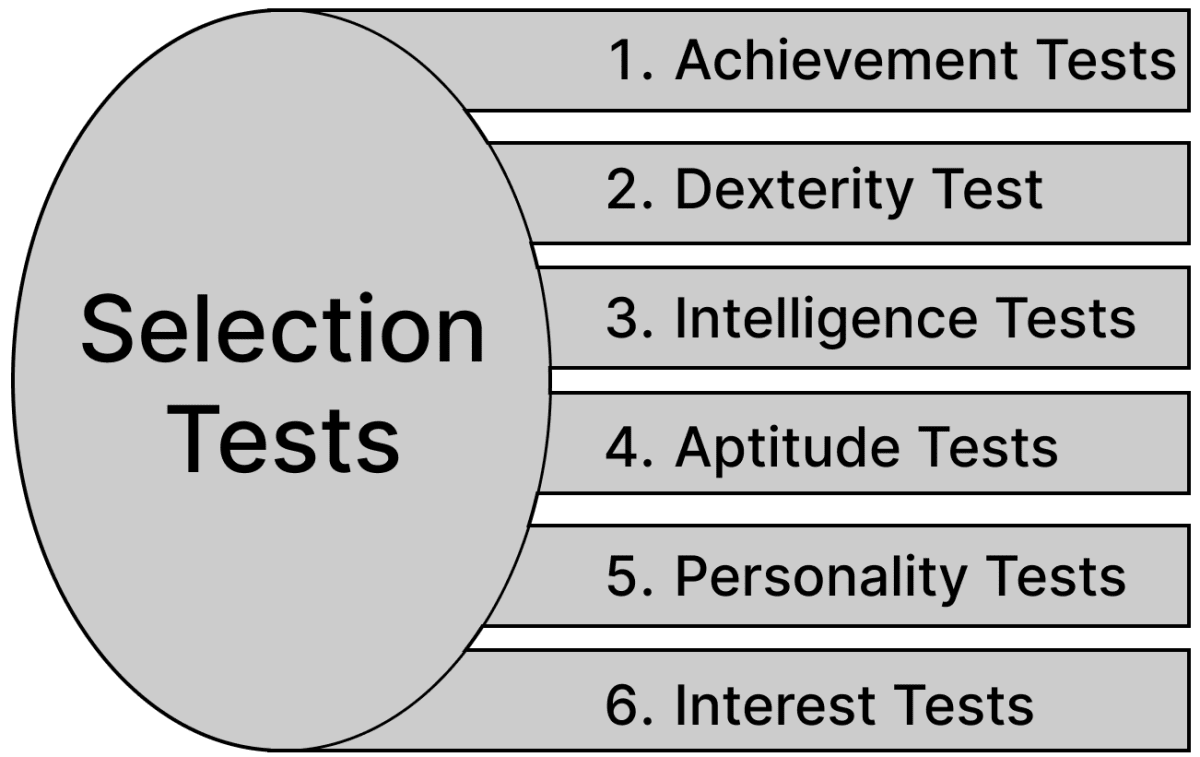
Explain any two types of employment tests conducted to select employees.
Answer
Two types of employment tests conducted to select employees are:
Achievement Tests — Achievement tests measure the skills and knowledge which the candidate already possesses at the time of testing. These tests help to determine whether the claims made by the candidate about his knowledge and skills are correct or not. The candidate is asked to perform the job, and his actual test performance indicates his proficiency. These tests are also known as trade tests, performance tests, or proficiency tests. Example: A candidate for the post of a typist may be asked to type a page so as to judge his speed and accuracy.
Intelligence Tests — These tests measure a person's capacity for listening and comprehension in terms of his vocabulary, mental alertness, memory, and reasoning. An applicant's intelligence quotient (IQ) can be judged through intelligence tests.
"Training is beneficial to both employers and employees." Explain.
Answer
Training is beneficial to both employers and employees in the following ways:
Benefits to Employers:
Increased Productivity — Training helps to improve the quantity and quality of work performance. Well-trained employees produce more and better quality goods.
Better Utilisation of Resources — By training, employees learn new and better methods of doing jobs. They make better use of materials and machinery, reducing wastage and cost of production.
Better Safety — Training helps to improve the job knowledge and skills of employees. Trained employees operate machines and equipment more carefully and cause fewer accidents.
Less Supervision — Well-trained employees are less dependent on supervision. They are more disciplined, self-dependent, and responsible. Therefore, the need and cost of supervision are reduced.
Reduced Turnover and Absenteeism — Trained employees feel more satisfied and interested in jobs, leading to reduced labour turnover and absenteeism.
Expansion and Growth — With the help of trained staff, an enterprise can expand and grow easily and rapidly.
Benefits to Employees:
Easy Employment — Trained employees can get employment more easily and quickly.
Higher Earnings — Training helps employees do their jobs more efficiently, allowing them to earn more through higher productivity.
Adaptability — Training increases adaptability of employees to new methods and new technology.
Improved Motivation and Morale — Training helps to improve the motivation and morale of employees.
Career Growth — Training increases the chances of promotion and career growth for employees.
Mobility — Training improves the mobility of employees from one organisation and place to another.
Hence, training brings mutual benefits to both employers and employees.
"A test is a method used for selection of employees by an organisation." In the light of this statement, explain any two types of tests.
Answer
A test is a systematic comparison of the work behaviour of candidates on a sample basis, used as a method for selecting employees. Two types of tests are:
Aptitude Tests — Aptitude means an individual's potential for learning the skills required for a job. Aptitude tests measure a candidate's capacity and his potential for development. These tests are useful for selecting candidates for jobs where natural ability and trainability are more important than current skills. For example, an aptitude test for a programming job assesses logical thinking and problem-solving ability rather than current programming knowledge.
Personality Tests — Personality tests are designed to judge the emotional balance, temperament, and maturity of a candidate. They reveal the ability of an applicant to adjust to new situations and new persons. They are particularly helpful for selecting persons for managerial jobs. For example, a personality test may assess whether a candidate is introverted or extroverted or calm.
All vacancies at various levels in an organisation cannot be filled through internal sources of recruitment. Explain any five other sources of recruitment.
Answer
When internal sources are insufficient, organisations rely on external sources of recruitment. Five external sources of recruitment are:
Advertisements — Advertisements in newspapers and journals are the most widely used method of attracting candidates for all types of jobs. The requirement of the job and terms and conditions of employment are given in the advertisement. Candidates evaluate themselves against job requirements and send applications. This method is convenient and economical, and brings in a large number of applications due to wide circulation.
Employment Exchanges — Employment exchanges run by the Government are an external source of recruitment. Anyone seeking employment can register with the employment exchange. Employers notify job vacancies, and the exchange supplies a list of candidates fulfilling the required qualifications. Employment exchanges are useful for recruitment of semi-skilled and unskilled personnel, and no cost is involved.
Placement Agencies — Private employment agencies can be engaged for recruiting staff. These agencies advertise vacancies, receive applications, conduct interviews, and short-list candidates on behalf of employers. They charge a fee for their services and have become a popular source for recruiting managerial and technical personnel.
Educational Institutions — Companies maintain a close liaison with management and technical institutes and universities. Brilliant students are spotted during the course of their studies and are offered jobs on completion of their studies. This method, known as campus recruitment, is suitable for recruiting engineers, computer experts, and managers. Examples include recruitment from IITs and IIMs.
Recommendations — Applicants introduced by friends, relatives, or existing employees can be a source of recruitment. When an existing employee or business friend recommends a person, a sort of preliminary screening takes place. In some firms, candidates recommended by trade unions are given preference.
Explain the benefits of training to a business enterprise.
Answer
The benefits of training to a business enterprise are as follows:
Increased Productivity — Training helps to improve the quantity and quality of work performance. Well-trained employees produce more and better quality goods, leading to higher overall productivity of the enterprise.
Better Utilisation of Resources — Through training, employees learn new and better methods of doing jobs. They make better use of materials, machinery, and equipment, resulting in reduced wastage of resources and lower cost of production.
Better Safety — Training improves the job knowledge and skills of employees. Trained employees operate machines and equipment more carefully and cause fewer accidents at the workplace, ensuring a safer work environment.
Less Supervision — Well-trained employees are less dependent on supervision. They are more disciplined, self-dependent, and responsible. Therefore, the need and cost of supervision are reduced.
Higher Morale — Effective training improves the self-confidence and job satisfaction of employees. They take greater interest in their work and feel a sense of security, which boosts their morale.
Reduced Turnover and Absenteeism — Trained employees feel more satisfied and interested in their jobs. As a result, labour turnover and absenteeism are reduced, ensuring stability of the workforce.
Expansion and Growth — With the help of trained staff, an enterprise can expand and grow easily and rapidly. Loss of a few employees does not threaten its survival. Trained employees can adapt more easily to technological advancements and competitive environment, improving the flexibility of the enterprise.
The system of Teacher Education holds the key responsibility in the making of professionally qualified and competent teachers. An effective teacher must have a positive attitude towards teaching as a profession, commitment and dedication towards teaching as a function. A profession is a specialized occupation involves specific orientation and training.
The purpose of a code of professional ethics for academic staff is to provide guidance in exercising the ethical responsibilities inherent in a profession.
(a) State and explain any two external sources of recruitment for academic staff.
(b) Suggest any two types of training to enhance teacher's proficiency.
(c) Suggest any two primary professional obligations of school teachers towards students.
Answer
(a) Two external sources of recruitment for academic staff:
Advertisements — Vacancies for teaching staff can be advertised in leading newspapers, education journals, and online job portals. The advertisement specifies the qualifications, experience, and other requirements. Interested candidates evaluate themselves against the requirements and send their applications. This method ensures wide circulation and attracts qualified candidates from across the country.
Educational Institutions — Schools and colleges maintain close links with universities and teacher training institutes (such as B.Ed. and M.Ed. colleges). Bright students are spotted during their studies and offered teaching positions upon completion of their courses. This source, known as campus recruitment, is excellent for recruiting fresh and well-trained teachers.
(b) Two types of training to enhance teacher's proficiency:
Refresher Training — Refresher training is designed to teach teachers the latest developments in teaching methods, curriculum, and educational technology. Short-term refresher courses are organised to update their knowledge and avoid obsolescence. This type of training keeps teachers current with modern pedagogy and changing student needs.
Orientation Training — Orientation or induction training is given to newly recruited teachers to familiarise them with the school's policies, rules, regulations, curriculum, students, and colleagues. It helps new teachers adjust quickly to the work environment and become aware of the institution's values and expectations.
(c) Two primary professional obligations of school teachers towards students:
Imparting Quality Education — Teachers have a primary obligation to provide students with quality education by teaching with dedication, using effective methods, and ensuring that students understand the subject thoroughly.
Holistic Development — Teachers must contribute to the overall development of students — intellectual, emotional, social, and moral. They should encourage students, build their confidence, and guide them to become responsible citizens.
Explain in brief the external sources of recruitment.
OR
Discuss any two external sources of recruitment.
Answer
External sources of recruitment refer to recruiting employees from outside the organisation. The main external sources are:
Advertisements — Advertisements in newspapers and journals are the most widely used method of attracting candidates for all types of jobs. The job requirements and terms of employment are given in the advertisement. This method is convenient, economical, and brings in a large number of applications due to wide circulation.
Employment Exchanges — Employment exchanges run by the Government allow job-seekers to register and employers to notify vacancies. The exchange brings job-seekers and job-givers into contact. This source is useful for recruiting semi-skilled and unskilled personnel without any cost.
Placement Agencies — Private placement agencies advertise vacancies, receive applications, conduct interviews, and short-list candidates on behalf of employers. They charge a fee but are popular for recruiting managerial and technical personnel.
Educational Institutions — Companies maintain liaison with management and technical institutes. Bright students are spotted and offered jobs on completion of their studies. This is also known as campus recruitment and is suitable for engineers, computer experts, and managers.
Gate Hiring — Small firms make recruitment at the factory gate. Workers gather at the gate after reading vacancy notices, and suitable candidates are selected. This method is used for temporary and casual vacancies.
Unsolicited Applicants — Persons in search of employment visit company offices with their resumes. They are also known as casual callers and may be considered when suitable vacancies arise.
Recommendations — Applicants introduced by friends, relatives, or existing employees can be a source of recruitment. Preliminary screening takes place through recommendation.
Jobbers and Contractors — Contractors are engaged for the supply of unskilled labour at short notice. They maintain links with small towns and villages and serve as a useful source for unskilled workers.
Elucidate the selection procedure for a vacancy in an organisation.
Answer
The selection procedure for a vacancy in an organisation generally involves the following steps:
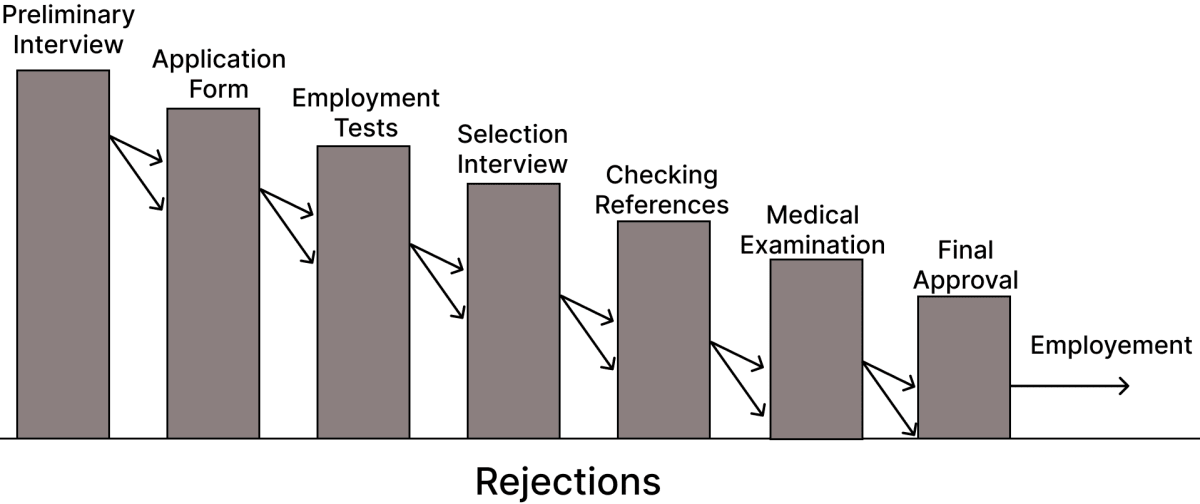
Preliminary Interview — This is the first occasion when candidates come into contact with the company's officials. A brief interview is conducted by the receptionist or some other official to ascertain the minimum qualifications, experience, age, etc., of candidates. Candidates who are obviously unfit are rejected at this stage.
Application Form — Candidates who succeed in the preliminary interview are asked to fill in the prescribed application form. The form provides a written record of the name, address, age, qualifications, work experience, etc., of a candidate. It serves as the basis for further interview.
Employment Tests — Tests are conducted to assess the work behaviour and capabilities of candidates. Various tests like achievement tests, intelligence tests, aptitude tests, personality tests, and interest tests may be used to identify suitable candidates.
Selection Interview — A purposeful exchange of ideas and information between the candidate and the employer takes place. The interview helps in checking the information obtained through application form and tests, and assessing the personality, communication skills, and suitability of the candidate.
Checking References — Candidates are required to give names and addresses of two or three persons (called 'references') from whom information about the candidate may be obtained. References may be heads of educational institutions or previous employers, who provide information in confidence about the candidate's competence and character.
Medical Examination — A physical examination of the candidates is conducted to ensure they are physically fit for the job. It also protects the employer against future claims for compensation. Medical examination records complete medical history, current physical capabilities, and nature of disabilities, if any.
Final Approval — Candidates short-listed after the medical examination are finally approved by the head of the department. They are issued appointment letters and/or service agreements. They are usually appointed on probation of one or two years and made permanent after satisfactory performance.
After selection, the candidates are assigned specific jobs and workplaces, which is called placement.
Explain any two types of interviews conducted by an enterprise in the selection of its employees.
OR
Discuss any two types of interviews.
Answer
Two types of interviews conducted by an enterprise in the selection of its employees are:
Structured or Patterned Interview — This interview is systematically planned in advance and is conducted in a pre-planned manner. The questions to be asked, the time to be allowed, and the criteria for evaluation are decided in advance. This is the most common type of selection interview. It ensures uniformity in evaluation as the same questions are asked to all candidates, allowing fair comparison. It is suitable when a large number of candidates are to be assessed for the same job.
Stress Interview — The purpose of this interview is to see how candidates react to awkward questions and difficult situations. The interviewer deliberately adopts a hostile attitude by asking questions rapidly, by criticising the candidate, or by interrupting frequently. The reactions of the candidate to stressful conditions are judged. If the candidate keeps his cool and responds calmly, he is selected. This type of interview is useful for jobs that involve high pressure and require emotional stability.
Explain any five steps generally involved in the selection of employees.
Answer
The five main steps generally involved in the selection of employees are:
Preliminary Interview — This is the first occasion when candidates come into contact with the company's officials. The job-seekers are received by the receptionist or some other official who conducts a brief interview to determine whether it is worthwhile for the candidate to fill up the application form. The purpose is to ascertain the minimum qualifications, experience, and age of candidates. Candidates who are obviously unfit for the job are rejected at this stage.
Application Form — Candidates who succeed in the preliminary interview are asked to fill in the prescribed application form. The application form provides a written record of the name, address, age, qualifications, work experience, etc., of a candidate. It reflects the handwriting and expression of the candidate and serves as the basis for the interview.
Employment Tests — Tests are conducted to predict the work behaviour of candidates by sampling it. Various types of tests like achievement tests, intelligence tests, aptitude tests, personality tests, and interest tests may be used. Tests are particularly useful for identifying unsuitable candidates.
Selection Interview — An interview is a purposeful exchange of ideas and information between two or more persons. It serves as a means of checking the information obtained through the application form and tests. Through face-to-face contact, managers can judge the personality, communication skills, and suitability of the candidate.
Medical Examination — A physical examination of the candidates is necessary to ensure that they are physically fit for the job. Such examination also helps protect the employer against the risk of claims for compensation from individuals who already suffer from disabilities and diseases.
All vacancies at various levels in an organization cannot be filled through internal sources of recruitment. Explain any five external sources of recruitment.
Answer
Five external sources of recruitment are:
Advertisements — Advertisements in newspapers and journals are the most widely used method of attracting candidates. The job requirement and terms of employment are given in the advertisement. Candidates evaluate themselves against the job requirements and send applications. Advertisements bring a large number of applications due to wide circulation. This method is convenient and economical.
Employment Exchanges — Employment exchanges run by the Government register job-seekers and notify vacancies. The exchange supplies a list of candidates fulfilling the required qualifications. This source is useful for semi-skilled and unskilled personnel, and no cost is involved.
Placement Agencies — Private employment agencies advertise vacancies, receive applications, conduct interviews, and short-list candidates on behalf of employers. They charge a fee but are popular for recruiting managerial and technical personnel.
Educational Institutions (Campus Recruitment) — Companies maintain liaison with management and technical institutes. Brilliant students are spotted during their studies and offered jobs on completion. Examples include recruitment from IITs and IIMs. It is suitable for recruiting engineers, computer experts, and managers.
Gate Hiring — Small firms make recruitment at the factory gate. Workers gather at the gate after reading the notice of vacancies, and suitable candidates are selected. This method is used to fill temporary and casual vacancies.
Explain Selection interview and Checking References as steps in the selection procedure.
Answer
Selection Interview:
A selection or employment interview is a purposeful, formal conversation between a candidate and the employer to judge the candidate's suitability for the job. It is a face-to-face encounter that serves as a means of checking the information obtained through the application form and tests.
Through the interview, managers can judge the personality, communication skills, facial expressions, postures, gestures, and overall suitability of the candidate. Various types of interviews used include structured, unstructured, group, panel, and stress interviews.
Checking References:
Candidates are generally required to give names and addresses of two or three persons from whom information about the candidate may be obtained. These persons are called 'references'. References may be heads of educational institutions attended by the candidate or his previous employers.
These references are requested to provide information in confidence about the candidate's competence and character. However, reference checks may not always provide reliable information because:
- No candidate will enter the name of a referee who might speak unfavourably about him.
- The referee may deliberately speak against the candidate due to prejudice.
- The referee may not always respond to inquiries.
Despite these limitations, checking references is an important step that helps verify the genuineness of the candidate's claims and gives additional information about his past performance and character.
Explain any two methods of on-the-job training.
Answer
Two methods of on-the-job training are:
Coaching or Mentoring — In this method, the supervisor instructs and guides the trainee. The new employee learns the ins and outs of the job under the guidance of his supervisor. This method improves the relationship between the worker and his supervisor. The supervisor identifies weaknesses of the trainee and helps him overcome them through continuous guidance. However, this method can be effective only when the supervisor is competent and takes a genuine interest in training.
Job Rotation — In this method, the trainee is periodically rotated from job to job. The purpose is to broaden his outlook and give a general background of different jobs. The trainee learns a variety of tasks and develops a better view of the organisation. This method is especially useful for training future managers who must understand all functional areas. However, it may cause disruption in work routine, and few persons have the capacity to move from one job to another. Therefore, the persons to be trained and the jobs to which they are to be rotated should be selected carefully.
Explain (i) Campus recruitment (ii) Placement agencies as external sources of recruitment.
Answer
(i) Campus Recruitment:
Campus recruitment is an external source of recruitment in which companies maintain a close liaison with management and technical institutes and universities. Representatives of companies hold tests, group discussions, and interviews in the educational institutions and select qualified students. Selected students are offered jobs on completion of their studies.
For example, students passing out from Indian Institutes of Technology (IITs) and Indian Institutes of Management (IIMs) are selected every year for jobs in industry. This source is suitable for recruiting engineers, computer experts, and managers. It is convenient because a large number of qualified candidates are available at one place, saving time and effort.
(ii) Placement Agencies:
Placement agencies are private employment agencies that can be engaged for recruiting staff. These agencies advertise the vacancies, receive applications, conduct preliminary interviews, and short-list candidates on behalf of employers.
The employer pays a fee to these agencies for their services, but the burden of advertising and initial screening is reduced for the company. These agencies have become a popular source for recruiting managerial and technical personnel.
A leading Human Resource Consultancy group has received a number of applications for the post of an analyst for its Hyderabad office. But the person finally selected had no prior experience for work in the same industry. The administrative manager feels that with proper training the selected person will turn out to be an asset to the organisation. Although he feels that on-the-job training will be the most appropriate, other members of the selection committee recommended Internship training and Role Playing methods of training.
(a) What is employee selection? Mention any three benefits of employee selection.
(b) Explain Internship training and Role Playing methods of training.
(c) Explain any two internal sources of recruitment.
Answer
(a) Employee Selection:
Selection means the process of judging the suitability of applicants in the light of job requirements to decide which recruits should be hired or employed. Selection is said to be a negative process because the number of candidates rejected is much higher than that of selected persons. It is an elimination process where unsuitable candidates are eliminated at every stage so that the most suitable candidates may be identified.
Three benefits of employee selection:
- Improved Work Performance — Careful selection helps to match the employees and job requirements, which improves their work performance and productivity.
- Job Satisfaction — Properly selected employees experience higher job satisfaction as the job matches their skills, abilities, and interests.
- Reduced Labour Turnover and Absenteeism — Suitable selection helps to minimise labour absenteeism and labour turnover, ensuring workforce stability.
(b) Internship Training and Role Playing methods of training:
Internship Training — This is a joint programme of training in which business houses collaborate with technical institutions. Internship training involves a balance between theory and practice. The trainees are given theoretical instructions in technical institutions, and after completing theoretical learning, they receive practical training in factories and offices. This method is used in medical, accountancy, and legal professions.
Role Playing — Under this method, the trainee is assigned a role. He learns to deal with the interactions and complexities involved in various roles. For example, an employee may be asked to play the role of a labour officer and negotiate with another trainee who plays the role of a union leader. This method develops interpersonal skills, problem-solving ability, and confidence.
(c) Two internal sources of recruitment:
Transfers — A transfer means shifting of an employee from one place to another without any change in rank, responsibility, and remuneration. It is a horizontal movement of the employee. Job vacancies in one factory, branch, or office of the organisation may be filled by transferring surplus staff from another location.
Promotions — A promotion means shifting an employee from a lower post to a higher post. It leads to an increase in pay, status, and responsibility of the employee. Therefore, promotions are considered as rewards. Promotions may be made on the basis of merit or seniority of employees. A promotion involves a vertical movement or advancement of an employee.
Explain vestibule training and the lecture method of training.
Answer
Vestibule Training:
Vestibule training is the most common off-the-job training method. The word 'vestibule' means a room between the outer door and the interior of a building. In this method, workers are trained in a classroom or hall within the plant. A large number of workers are trained under the guidance of expert trainers. The same machines and equipment as used at the workplace are used in the vestibule training room.
Advantages:
- Permits greater emphasis on teaching the best method of work.
- Trainees get accustomed to the work routine and overcome initial nervousness.
- Training does not hamper actual work of production.
- Trainees can better concentrate on learning.
Disadvantage: Vestibule training is very expensive.
Lecture Method:
Under the lecture method, managers and employees attend lectures, seminars, and conferences to learn new ideas and latest developments in their field. Sometimes, executives attend courses and classes in management institutes and universities to refresh their knowledge and learn new concepts.
The lecture method is suitable for imparting theoretical knowledge to a large group of trainees in a short time. It is used to explain concepts, principles, theories, and the latest developments in the field. The method is economical and allows for quick coverage of a large amount of information. However, it is mostly one-way communication and may not give trainees enough opportunity for active learning.
Explain the following:
(a) Structured Interview
(b) Group Interview
(c) Stress Interview
Answer
(a) Structured Interview — A structured or patterned interview is systematically planned in advance and is conducted in a pre-planned manner. The questions to be asked and the time to be allowed to a candidate are decided in advance. This is the most common type of selection interview.
(b) Group Interview — In this type of interview, a group of candidates is interviewed at the same time. They are given a problem or topic for discussion, and candidates express their views on the problem. The interviewers judge the views, communication skills, leadership qualities, and initiative taken by the candidates.
(c) Stress Interview — The purpose of a stress interview is to see how candidates react to awkward questions and difficult situations. The interviewer deliberately adopts a hostile attitude by asking questions rapidly, criticising the candidate, or interrupting frequently. The reactions of the candidate to stressful conditions are judged. If the candidate keeps his cool and responds calmly, he is selected. This type of interview is useful for jobs that involve high pressure and require emotional stability.
Urban Company is Asia's largest online home service platform. Launched in 2014, Urban Company today operates in India, Australia, Singapore, the UAE and the Kingdom of Saudi Arabia. The platform helps customers book reliable and high-quality services-beauty treatments, massages, haircut, home cleaning, handymen, appliance repair, painting, pest control and more-delivery by trained professionals conveniently at home. Urban Company's vision is to empower millions of professionals worldwide to deliver services at home like never experienced before. Urban Company provides a platform that allows skilled and experienced professionals to connect with users looking for specific services. All the professionals, though experienced and skilled, undergo intensive training modules before being allowed to list their services on the platform. Once on the platform, Urban Company's match-making algorithm identifies professionals who are closest to the users' requirements and available at the requested time and date. In reference to the above case, answer the following questions:
(a) What type of Bank account does Urban Company have? Why?
(b) Explain how, the professionals are recruited by Urban Company.
(c) Write about any three External sources of Recruitment.
(d) What services does the Urban Company offer?
Answer
(a) Type of Bank Account of Urban Company:
Urban Company would have a Current Account because it is a business enterprise that operates in multiple countries and handles a large number of transactions on a daily basis with customers and service professionals. A current account allows unlimited deposits and withdrawals, which is essential for a business with high transaction volumes. It also offers facilities like overdraft, which helps the company manage its cash flow effectively.
(b) How professionals are recruited by Urban Company:
Urban Company recruits professionals through external sources of recruitment. They attract skilled and experienced professionals (like beauticians, plumbers, electricians, painters, etc.) through advertisements, online platforms, and word-of-mouth recommendations. Even though the professionals are already skilled and experienced, they are required to undergo intensive training modules before being allowed to list their services on the platform. This ensures uniform quality and standardised service delivery to customers. After successful training, professionals are matched with customers through Urban Company's match-making algorithm based on customer requirements and the professional's location and availability.
(c) Three External Sources of Recruitment:
Advertisements — Advertisements in newspapers, journals, and online portals are the most widely used method. The job requirements and terms of employment are given, and candidates evaluate themselves and apply.
Placement Agencies — Private employment agencies advertise vacancies, receive applications, conduct interviews, and short-list candidates on behalf of employers. They charge a fee but are popular for recruiting managerial and technical personnel.
Educational Institutions (Campus Recruitment) — Companies maintain liaison with management and technical institutes. Brilliant students are spotted during their studies and offered jobs on completion of their courses. This is suitable for recruiting engineers, managers, and computer experts.
(d) Services offered by Urban Company:
Urban Company offers a wide range of home services delivered by trained professionals at the customer's doorstep. These services include:
- Beauty treatments and massages
- Haircuts and salon services
- Home cleaning
- Handyman services
- Appliance repair
- Painting services
- Pest control
- Plumbing and electrical work
The services are booked through the platform, and Urban Company's algorithm matches customers with the most suitable professionals available at the requested time and date.
Discuss the merits of internal sources of recruitment.
Answer
The merits of internal sources of recruitment are:
Employee Morale — Internal recruitment, like promotion of employees from within the organisation, helps to boost the motivation and morale of employees. When employees are assured of higher positions, their loyalty and commitment to the organisation increase.
Economical — Internal recruitment is economical. The cost incurred in advertising, engaging placement agencies, and screening external candidates is avoided. No outside references are required.
Familiarity — The employees are already aware of the policies, rules, and working conditions of the enterprise. They need not waste their time and energy in learning these basic aspects.
Experienced Staff — Employees who are transferred and promoted are already experienced. The organisation does not have to provide extensive training to them.
Easy Evaluation — The management can easily evaluate the performance of existing employees from their service records, making fair and informed decisions about promotions and transfers.
Upgrading — When an employee is promoted, several other persons below his rank are automatically upgraded. In this way, one vacancy filled from within results in upgrading of several employees and a chain of opportunities for growth.
Reduced Turnover and Absenteeism — Internal recruitment helps minimise labour turnover and absenteeism. People wait for promotion, and the workforce remains satisfied and committed to the organisation.
A new company wants to train its employees on latest development in work method and procedures. Explain any two types of training suitable for existing employees.
Answer
Two types of training suitable for existing employees of a new company are:
Refresher Training — Refresher training is designed to teach employees the latest developments in work methods and procedures. Technological advancements and the introduction of new tools and equipment have increased the need for such training. Short-term refresher courses are organised for this purpose. Refresher training helps to avoid employee obsolescence and to refresh the memory of employees, ensuring they stay updated with the latest practices in their field.
Promotional Training — Promotional training is given to employees who are chosen to perform higher level jobs. As employees move up in the organisation, their responsibilities increase, and it becomes necessary to prepare them by providing training in the new job. This includes training in leadership, decision-making, and managerial skills required at the higher level. It ensures a smooth transition for the promoted employee.
CASE STUDY
Julian Richer (born 1959) is the Managing Director and founder of Richer Sounds, a hi-fi and home cinema retailer specialising in audio equipment such as LCD televisions, DVD players and amplifiers.
In 1978, aged just nineteen, Richer opened his first store in London Bridge. The company has 53 retail outlets throughout the UK. In 1994, his flagship store in London Bridge set a new Guinness World Record for the highest sales per square meter of any retail outlets in the world- a staggering £195426 ($322450) per square meter- a record held for over two decades. Richer Sounds has also won many awards, including Which? magazine's Best Retailer Award and Sunday Times award for Britain's Best Employer. The company is also one of the UK's most generous donors, allocating 15% of its annual profits to charitable organisations.
Richer believes it is vital that his staff have fun and enjoy their work. He is renowned for empowering staff to make a difference to the company. Each week, he looks at employee suggestions and awards up to £20,000 ($33,000) for an idea. Each month, the top three salespeople get to use his personal Bentley or Rolls-Royce for a weekend. He only promotes people internally. Richer argues that businesses with demotivated staff face lower productivity due to higher absenteeism, labour turnover, theft and customer complaints.
[Sources: www.richersounds.co.uk, www.richerstudentszone.co.uk and The Richer Way, By Julian Richer]
With reference to the above case study answer the following questions:
(i) Examine how motivation can lead to improved productivity of his Organisation.
(ii) With reference to features of Human Resource Management, explain:
(a) Staff function
(b) Pervasive function
(iii) What are the advantages of internal sources of recruitment?
Answer
(i) How motivation can lead to improved productivity:
Motivation can significantly lead to improved productivity in Richer Sounds in the following ways:
Increased Effort and Performance — Motivated employees put in more effort and perform their tasks with dedication. Awards of up to £20,000 for employee suggestions and use of luxury cars by top salespeople inspire them to perform better.
Reduced Absenteeism and Turnover — Demotivated staff face higher absenteeism and labour turnover. By keeping employees motivated through rewards and recognition, Richer Sounds ensures stability of its workforce.
Improved Quality of Work — Motivated employees are committed to delivering quality service, leading to satisfied customers and fewer complaints.
Encouragement of Innovation — Recognising employee suggestions encourages a culture of innovation and continuous improvement, which directly enhances productivity.
Reduced Theft and Wastage — Motivated employees who feel valued are less likely to engage in theft or careless wastage of resources, ensuring efficient use of company assets.
(ii) Features of Human Resource Management:
(a) Staff Function — Human Resource Management is a staff function, which means it is an advisory function that supports and assists the line departments (production, marketing, sales). The HR department does not directly produce goods or services or sell them but provides expertise on recruiting, training, and managing employees who carry out the line activities. In Richer Sounds, the HR function would advise managers on how to motivate staff, design reward systems, and handle employee suggestions.
(b) Pervasive Function — Human Resource Management is a pervasive function, meaning it is performed at every level of the organisation — from the top management to the lowest supervisory level. Every manager who supervises subordinates performs HR functions like assigning work, motivating, evaluating performance, and developing employees. In Richer Sounds, Julian Richer himself looks at employee suggestions every week, demonstrating that HRM permeates all levels of the organisation.
(iii) Advantages of Internal Sources of Recruitment:
Employee Morale — Promotion from within boosts the motivation and morale of employees. Their loyalty and commitment to the organisation increase. (Richer Sounds promotes people only internally, which keeps employees motivated.)
Economical — Internal recruitment is economical as the cost of advertising and screening external candidates is avoided.
Familiarity — Employees are already aware of the policies, rules, and working conditions of the enterprise.
Experienced Staff — Employees who are transferred or promoted are already experienced, so the organisation need not provide extensive training.
Easy Evaluation — The management can easily evaluate the performance of existing employees from their service records.
Upgrading — When one employee is promoted, several others below his rank are automatically upgraded.
Reduced Turnover — Internal recruitment minimises labour turnover and absenteeism, as employees see growth opportunities within the organisation.
Explain need and the importance of Training.
Answer
Training is necessary and useful for both employers and employees. A trained workforce is a very valuable asset to an organisation. Training enables employees to obtain security of job, higher earnings, and quick promotions. The need and importance of training are as under:
Increased Productivity — Training helps to improve the quantity and quality of work performance. Well-trained employees produce more and better quality goods, leading to higher organisational output.
Better Utilisation of Resources — Through training, employees learn new and better methods of doing jobs. They make better use of materials and machinery. As a result, wastage of resources and cost of production are reduced.
Better Safety — Training helps to improve the job knowledge and skills of employees. Trained employees operate machines and equipment more carefully and cause fewer accidents at the workplace.
Less Supervision — Well-trained employees are less dependent on supervision. They are more disciplined, self-dependent, and responsible. Therefore, the need and cost of supervision are reduced.
Higher Morale — Effective training improves the self-confidence and job satisfaction of employees. They take greater interest in their work and feel a sense of security. Their chances of promotion also increase, leading to faster career progress.
Reduced Turnover and Absenteeism — As trained employees feel more satisfied and interested in their jobs, labour turnover and absenteeism are reduced.
Expansion and Growth — With the help of trained staff, an enterprise can expand and grow easily and rapidly. Loss of a few employees does not threaten its survival.
Describe the five various internal sources of recruitment.
Answer
Internal sources of recruitment refer to filling vacancies from among employees already working in the organisation. The five internal sources of recruitment are:
Transfers — A transfer means shifting of an employee from one place to another without any change in rank, responsibility, and remuneration. It is a horizontal movement of the employee. Job vacancies in one factory, branch, or office of the organisation may be filled by transferring surplus staff from another factory, branch, or office.
Promotions — A promotion means shifting an employee from a lower post to a higher post. It leads to an increase in the pay, status, and responsibility of the employee. Therefore, promotions are considered rewards. Promotions may be made on the basis of merit or seniority. A promotion involves a vertical movement or advancement of an employee.
Demotions — An employee who is unable to perform his duties properly may be shifted to a lower post. Demotion involves a reduction in the pay and status of the employee. It is considered a serious penalty and is therefore used only in exceptional cases.
Ex-Employees — The retired employees of the organisation may be recruited for a temporary period to meet an abnormally high rush of work in the organisation. Their experience and familiarity with the organisation make them useful in handling sudden workload increases.
CASE STUDY
British carmaker MG has confirmed the launch of a new affordable Electric Vehicle (EV) in India in the first half of 2023. The brand also revealed that this newly developed EV will come with an affordable price tag of around Rs 7-8 lakh.
Although the firm has not yet disclosed the details of the EV's body style, this new pure-electric offering will most probably compete against the Tata Nexon EV. Besides this, the MG's upcoming EV will utilise a new platform and could offer a sub-300 km of travel range on a single charge.
MG Motor has also announced that it will invest in nurturing young talents through its initiatives like the MG Nurture program. The carmaker plans to collaborate with 50 institutes through the program to train one lakh students on the latest technologies regarding EVs.
Electric cars produce zero exhaust emissions, which means they do not emit any harmful exhaust gases into the air. This can benefit the environment as exhaust gases can negatively impact various health conditions and also have an impact on climate change. EVs are more efficient, and that combined with the electricity cost is cheaper than filling petrol or diesel for your travel requirements. Using renewable energy sources can make the use of EVs more eco-friendly. They mainly reduce noise levels which are hazardous to human health.
Source: auto.hindustantimes.com
With reference to the case study answer the following question:
Which type of training can be undertaken by MG Motors to train its employees? Briefly explain.
Answer
MG Motors can undertake Internship Training to train its employees, particularly the young talents collaborating with the 50 institutes through the MG Nurture program.
Internship Training — This is a joint programme of training in which business houses collaborate with technical institutions. Internship training involves a balance between theory and practice. The trainees are given theoretical instructions in technical institutions, and after completing theoretical learning, they receive practical training in factories and offices.
In MG Motors' case, the MG Nurture program collaborates with 50 institutes to train one lakh students on the latest technologies regarding Electric Vehicles. The students would receive theoretical training on EV technologies at the institutes and practical hands-on experience at MG Motor's facilities. This dual approach ensures that students develop both the conceptual understanding and practical skills required to work on cutting-edge EV technology.
Other types of training suitable for MG Motors include:
- Refresher Training — To update existing employees on the latest EV technologies.
- Job Training — To make employees proficient in handling EV manufacturing equipment.
Dr. Seema is a reputed senior surgeon who believes in training her junior doctors in the actual operation theatre itself. Identify and explain the method of training undertaken by Dr. Seema. Discuss any two methods of training.
Answer
The method of training undertaken by Dr. Seema is On-the-Job Training (OJT).
On-the-Job Training (OJT) — Under this method, employees are assigned a specific job and they learn by performing the job in the actual work situation. Therefore, it is also known as 'learning by doing'. The employee learns work methods and job operations under the supervision of a senior employee. It is step-by-step learning, and the worker contributes towards production in the course of learning. Dr. Seema trains her junior doctors directly in the operation theatre — they learn surgical techniques while assisting and observing the actual operations she performs.
Two methods of training:
Coaching or Mentoring (On-the-Job) — In this method, the supervisor instructs and guides the trainee. The new employee learns the ins and outs of the job under the guidance of his supervisor. This method improves the relationship between the worker and his supervisor. It is effective when the supervisor is competent and takes a genuine interest in training. Dr. Seema's method of training her junior doctors directly is essentially coaching/mentoring within on-the-job training.
Vestibule Training (Off-the-Job) — Vestibule training is the most common off-the-job training method. Workers are trained in a classroom or hall within the plant. A large number of workers are trained under the guidance of expert trainers. Special instructors teach the theoretical and practical aspects of the job. The same machines and equipment which are employed at the workplace are used in the vestibule. This method permits greater emphasis on teaching the best method of work, and trainees can concentrate on learning without disrupting actual production. However, it is very expensive.
Write short notes on:
(a) Refresher training
(b) Apprenticeship training
Answer
(a) Refresher Training:
Refresher training is designed to teach employees the latest developments in work methods and procedures. Technological advancements and the introduction of new tools and equipment have increased the need for such training.
Key features of refresher training:
- It is given to existing employees, not new recruits.
- Short-term refresher courses are organised for this purpose.
- It helps to avoid employee obsolescence and to refresh the memory of employees.
- It updates employees on the latest tools, technologies, and best practices.
- It is essential in industries where technology and procedures change frequently.
For example, computer professionals attending courses on new software, or doctors attending workshops on new medical procedures, are examples of refresher training.
(b) Apprenticeship Training:
Apprenticeship training is used in technical trades and crafts in which a long period (ranging from two to seven years) is required to become proficient. The worker is attached to an experienced or senior employee. He learns while observing and assisting his senior.
Key features of apprenticeship training:
- The purpose is to prepare employees for skilled occupations like plumbing, electrician, carpentry, mechanics, etc.
- It combines classroom instruction and on-the-job training.
- The trainee learns the intricacies of the job under the direct supervision of his master.
- During the period of apprenticeship, a stipend may be paid to the trainees.
- In India, apprenticeship training is regulated under the Apprenticeship Act, 1961.
This method ensures that the trainee acquires both theoretical knowledge and practical expertise needed for skilled trades.
What is indirect method of recruitment? Explain any three such methods.
Answer
Indirect Method of Recruitment:
Indirect methods of recruitment involve the use of a third party which serves as a link between job-seekers and employers. The organisation does not directly contact the candidates; instead, it uses external agencies, media, or institutions to connect with potential employees.
Three indirect methods of recruitment:
Advertisements in Newspapers, Magazines, and Journals — Advertisements are placed in newspapers, magazines, professional journals, and on TV. The job requirements and terms of employment are given in the advertisement, and candidates send applications based on this information. The newspaper or magazine acts as the third party between the employer and the job-seeker.
Public Employment Exchanges — Employment exchanges run by the Government act as a third party connecting job-seekers with employers. Job-seekers register themselves with the exchange, and employers notify their vacancies. The exchange supplies a list of suitable candidates fulfilling the required qualifications.
Professional Search Firms or Placement Agencies — Private placement agencies act as intermediaries between employers and job-seekers. These agencies advertise the vacancies, receive applications, conduct preliminary interviews, and short-list candidates on behalf of employers. Employers pay a fee for these services.
(A fourth indirect method is Professional Associations and Trade Unions, which also serve as a link between job-seekers and employers in their respective fields.)