
............... is the process of gaining public support for an activity, cause or organisation through information and persuasion.
- Public relations
- Public applications
- Personal selling
- Advertisement
Answer
Public relations
Reason — According to Edward L. Bernays, "Public relations is the attempt by information, persuasion and adjustment to engineer public support for an activity, cause, movement or institution." Hence, public relations is the process of gaining public support through information and persuasion.
Public relations is a ............... and sustained effort to develop and maintain mutual understanding between an organisation and its various publics.
- Planned
- Unplanned
- Prepared
- None of these
Answer
Planned
Reason — As per the Institute of Public Relations, U.K., "Public relations is the deliberate, planned and sustained effort to establish and maintain mutual understanding between an organisation and its public." Therefore, public relations is a planned and sustained effort, not unplanned or merely prepared.
Public relations primarily aims to manage the internal relationships within an organization, with external relationships being a secondary focus.
- True
- False
Answer
False
Reason — Public relations is concerned with the relationship between an organisation and all its publics — both internal (employees) and external (consumers, shareholders, distributors, suppliers, government, community, media). External relationships are not secondary; they are equally important for building goodwill and securing public support.
Statement 1: Public relations is primarily concerned with managing a company's internal communications.
Statement 2: Public relations involves anticipating, analysing, and interpreting public opinion to benefit the organization.
Which of the following is/are correct statement(s)?
- Only Statement 1 is correct
- Only Statement 2 is correct
- Both statements are correct
- Both statements are incorrect
Answer
Only Statement 2 is correct
Reason — Statement 1 is incorrect because public relations is not limited to internal communications; it covers relations with both internal and external publics. Statement 2 is correct because public relations involves evaluation of public opinion and attitudes about the policies, procedures and actions of an organisation in order to benefit the organisation.
Good public relations help in
- Building goodwill and positive image
- Attracting and attrition of talent
- Building goodwill and negative image
- Decreasing sales and revenue
Answer
Building goodwill and positive image
Reason — Good public relations help in building goodwill and a positive image, attracting and retaining talent, increasing sales and revenue, communicating strategy and policy, gaining community acceptance, collecting funds, and supporting growth and diversification.
Good consumer relations depend heavily upon the nature of the ............... provided to consumers.
- Products
- Services
- Both 1 and 2
- None of these
Answer
Both 1 and 2
Reason — Good consumer relations depend heavily upon the nature of the products and services provided to consumers. Corporations seek to retain the goodwill of consumers through quality products and services, regular communication, sales representatives, meetings, surveys, mailings, magazines, and literature.
A public relations manager is trying to convince a community to support a new company policy. The manager carefully listens to the community's concerns and adjusts the policy accordingly.
Which element of public relations is being demonstrated in this scenario?
- Persuasion
- Empathy
- Human Relations
- Dialogue
Answer
Dialogue
Reason — Dialogue means a two-way conversation with a purpose, involving impartial listening, understanding and respect for others' opinions. By listening to the community's concerns and adjusting the policy accordingly, the manager is engaging in dialogue — open and two-way communication that builds mutual confidence.
Assertion (A): Dialogue is an essential part of public relations because it facilitates two-way communication.
Reason (R): Dialogue in public relations is used to impose the organization's views on the public.
- Both Assertion (A) and Reason (R) are true, and Reason (R) is the correct explanation of Assertion (A).
- Both Assertion (A) and Reason (R) are true, but Reason (R) is not the correct explanation of Assertion (A).
- Assertion (A) is true, but Reason (R) is false.
- Assertion (A) is false, but Reason (R) is true.
Answer
Assertion (A) is true, but Reason (R) is false.
Reason — Assertion (A) is true because dialogue is a two-way communication between the organisation and its public, which helps reduce prejudice and build mutual confidence. Reason (R) is false because dialogue does not impose views; rather, it requires respect for each other's opinions, impartial listening, and a measure of generosity. If a person goes on talking without allowing others to participate, it becomes a monologue, not a dialogue.
It means to convince another person of some idea, product, service or institution, to induce a person or group or to do something.
- Human relations
- Empathy
- Persuasion
- Dialogue
Answer
Persuasion
Reason — Persuasion means to convince another person of some idea, product, service or institution, to induce a person or group or to do something. It is a civilised form of interaction, as opposed to force which involves compelling another person to do something.
Look at the image below showing a company's event:

Which of the following public relations benefits is most likely to be achieved through this event?
- Improved government relations
- Enhanced employee satisfaction
- Positive media coverage and public image
- Increased sales revenue
Answer
Positive media coverage and public image
Reason — The image depicts a charity event hosted by the company with media present. Such community-oriented events generate positive media coverage and enhance the company's public image, as the public sees the company taking part in community life and discharging its social responsibility.
A company is deciding between two public relations strategies:
Strategy 1: Focuses on aggressive media campaigns to boost short-term sales.
Strategy 2: Emphasizes long-term community engagement and transparent communication with stakeholders.
Which strategy aligns more with the principles of ethical public relations, and why?
- Strategy 1, because it generates immediate results
- Strategy 1, because media campaigns reach a wider audience
- Strategy 2, because it builds sustainable relationships based on trust
- Strategy 2, because it is more cost-effective in the long run
Answer
Strategy 2, because it builds sustainable relationships based on trust
Reason — Ethical public relations focuses on long-term reputation management rather than short-term gains. Transparency in communication, social responsibility, and balancing stakeholder interests help build trust and credibility with stakeholders. Exaggerated and untrue propaganda for short-term image causes irreparable damage to the reputation of a business in the long run.
Empathy is a critical element in public relations, as it helps organizations understand and align with the public's perspective.
- True
- False
Answer
True
Reason — Empathy means looking at things and events from the other's point of view. It enables a public relations executive to be sensitive and sympathetic to the attitudes, expectations, and problems of workers and clients. Empathy fosters greater understanding and improves relationships with stakeholders.
The Main Reasons for the Rapid Growth of Public Relations is/are
- Communication Gap
- Population decline
- Recognition of social responsibility
- Rapid decline in Communication Media
Answer
Communication Gap and Recognition of social responsibility
Reason — The main reasons for the rapid growth of public relations include communication gap, population growth (not decline), recognition of social responsibility, big government, development (not decline) of communication media, new ethical standards, consumerism, and education in public relations. Hence, only options 1 and 3 are correct.
............... of an organisation is its picture in the minds of public. It indicates what people think the organisation stands for.
- Planning
- Image
- Relation
- Customer
Answer
Image
Reason — The image of an organisation is its picture in the minds of the public — what people think the organisation stands for. Public relations works to build and maintain a favourable image through truthful communication and responsible performance.
An effective public relations strategy can involve the use of exaggerated claims if it ultimately benefits the organization's image.
- True
- False
Answer
False
Reason — Exaggerated and untrue propaganda to boost image causes irreparable damage to the reputation of business in the long run. Publicity not backed by good action is unethical. Honesty is the best business policy for long-lasting business in public relations.
............... function ensures that the policies, procedures and actions of the organization are in public interest.
- Financial Management
- Public Relations
- Skill Development
- Performance Appraisal
Answer
Public Relations
Reason — The public relations function seeks to ensure that the policies, procedures and actions of the organisation are in the public interest and socially responsible. The other functions like financial management, skill development, and performance appraisal serve different purposes within the organisation.
A planned and sustained effort and management function is:
- Public relations
- Public applications
- Promotion
- Propaganda
Answer
Public relations
Reason — Public relations is a planned and sustained effort and a management function aimed at developing and maintaining mutual understanding between an organisation and its publics. Propaganda is different — it is one-way, guided by self-interest, and is an instrument of politics and power for social control.
............... is defined as 'science of morality'.
- Sympathy
- Ethics
- Empathy
- Dialogue
Answer
Ethics
Reason — The term 'ethics' is derived from the Greek word 'ethos' which means character. Ethics is defined as the science of morality. It is concerned with the study of what is right conduct or behaviour in a society.
............... fosters greater understanding and improves relationship with the client.
- Dialogue
- Persuasion
- Human Relations
- Empathy
Answer
Empathy
Reason — Empathy fosters greater understanding and improves relationship with the client. It tells an executive when to talk and when to remain silent, when to be firm and when to be restrained. An empathetic executive is more accurate in interpreting what a client says or does.
Which of the following helps to reduce prejudice and builds up mutual confidence between two persons?
- Empathy
- Persuasion
- Dialogue
- Ethics
Answer
Dialogue
Reason — Open and two-way communication (dialogue) helps to reduce prejudice and builds up mutual confidence. Effective dialogue requires impartial listening, understanding, faith, goodwill, and respect for each other's opinions.
Public Relations executives must practice the art of ............... because it involves them to convince other person about some idea, product, service or institution.
- Dialogue
- Persuasion
- Human Relations
- Empathy
Answer
Persuasion
Reason — Persuasion means to convince another person of some idea, product, service or institution, to induce a person or group to do something. Public relations executives must practice the art of persuasion as it is a civilised and well-accepted means of building good relations with others.
Force and persuasion have accelerated the rise of Public Relations.
- True
- False
Answer
False
Reason — Force is considered improper conduct in a civilised society. The rise of public relations was accelerated by the Industrial Revolution and the advent of mass communication media, not by force. Persuasion (and not force) is the right conduct in a civilised society.
Which function of Human Resource Management specifies that improvement in personality and interest is required to get maximum satisfaction from their work?
- Action-Oriented function
- Pervasive function
- Development-Oriented function
- Comprehensive function
Answer
Development-Oriented function
Reason — The development-oriented function of Human Resource Management focuses on the improvement of personality and interest of employees so that they get maximum satisfaction from their work. It aims at developing employees through training, education and growth opportunities.
Which element of Public Relations can motivate employee's loyalty and dignity?
- Human Relations
- Empathy
- Persuasion
- Dialogue
Answer
Human Relations
Reason — Human relations means relations between human beings on the basis of human dignity and respect for each other. Employer or management can buy a person's time and actions, but enthusiasm, loyalty and initiative cannot be bought — they have to be earned through good human relations.
............... is the only weapon of reasoning and understanding in a civilised society.
- Dialogue
- Human Relation
- Persuasion
- Empathy
Answer
Dialogue
Reason — In a civilised society, dialogue is the only weapon of reasoning and understanding. It requires impartial listening, faith, goodwill, respect for each other's opinions, and original thinking, helping to create awareness and build mutual confidence.
Mention any two characteristics of public relations.
Answer
Two characteristics of public relations are:
Planned and Sustained Effort — Public relations is a planned and sustained effort. It is a management function that requires careful planning and continuous implementation, not a one-time activity.
Two-Way Communication — Public relations involves both action and communication programmes. It requires a two-way flow of mutual understanding between the organisation and its publics, based on truth, knowledge and full information.
State the importance of 'persuasion' as an element.
Answer
Persuasion is an important element of public relations because of the following reasons:
Civilised Form of Interaction — Persuasion is the civilised and well-accepted means of convincing others, as opposed to force which is considered improper conduct in a civilised society.
Building Public Support — Through persuasion, public relations executives convince stakeholders about the company's ideas, products, services, or policies, which helps gain public support.
Image Building — By employing compelling messages and transparent communication, organisations can build a good public image through persuasion.
Influencing Attitudes — Persuasion helps in changing attitudes of people in favour of the organisation when messages are presented attractively from credible sources.
Mention the elements of public relations.
Answer
The four main elements of public relations are:
- Human Relations — Relations between human beings based on dignity and respect.
- Empathy — Looking at things and events from the other person's point of view.
- Persuasion — Convincing another person of some idea, product, service or institution.
- Dialogue — A two-way conversation between two persons with a purpose.
Name the main elements of public relations.
Answer
The four main elements of public relations are:
- Human Relations
- Empathy
- Persuasion
- Dialogue
Give two reasons either for or against: "Public relations is a gimmick."
Answer
Against the statement. Public relations is NOT a gimmick.
Planned and Sustained Effort — Public relations is a deliberate, planned and sustained management function, not a temporary trick or gimmick. It involves long-term commitment to building relationships.
Based on Ethical Conduct — Public relations is based on truth, knowledge, full information and ethical conduct. It seeks to achieve mutual understanding by securing willing acceptance of attitudes and ideas, which is the opposite of a gimmick.
Public relations is a propaganda. Give two reasons for or against.
Answer
Against the statement. Public relations is NOT propaganda.
Two-way Communication vs One-way Propaganda — Public relations involves a two-way flow of mutual understanding between an organisation and its publics, whereas propaganda is one-way and is an instrument of politics and power for social control.
Ethical Conduct vs Self-Interest — Public relations recognises ethical conduct and seeks willing acceptance of attitudes and ideas. In contrast, propaganda does not necessarily require ethical content and is guided solely by self-interest. In public relations, the ends can never justify the use of false, harmful or questionable means.
Describe the importance of public relations to a business enterprise.
Answer
Public relations is important to a business enterprise for the following reasons:
Building Goodwill and Positive Image — Good public relations helps build goodwill and a positive image of the organisation in the minds of the public.
Attracting and Retaining Talent — A favourable public image helps attract talented employees and retain them in the organisation.
Increasing Sales and Revenue — Public relations helps create consumer awareness and trust, leading to increased sales and revenue.
Communicating Strategy and Policy — It helps communicate the organisation's strategy and policies effectively to stakeholders.
Gaining Community Acceptance — Good public relations earns the cooperation and goodwill of the local community in which the business operates.
Collecting Funds — Companies with strong public relations find it easier to raise funds from investors and financial institutions.
Growth and Diversification — Public relations supports the long-term growth and diversification of the business by maintaining stakeholder confidence.
"Scope of public relations is narrow." Justify either for or against.
Answer
Against the statement. The scope of public relations is wide, not narrow.
The scope of public relations covers relations with all the publics of a business organisation, including:
- Employees — Maintaining good employee relations through sound personnel policies and two-way communication.
- Stockholders and Financial Institutions — Keeping shareholders informed about financial position and future prospects.
- Consumers — Retaining consumer goodwill through quality products and services.
- Distributors and Suppliers — Ensuring mutual cooperation through meetings, visits, and correspondence.
- Government — Building effective partnerships with government for mutual advantage.
- Community — Serving the local community by being a good corporate citizen.
- Media — Maintaining good working relationships with the press and electronic media for favourable publicity.
Thus, the scope of public relations is very wide and not narrow.
Why is dialogue an important element in public relations?
Answer
Dialogue is an important element in public relations for the following reasons:
Two-way Communication — Dialogue ensures open and two-way communication between the organisation and its publics, which is essential for mutual understanding.
Reduces Prejudice — Effective dialogue helps reduce prejudice and builds up mutual confidence between the organisation and its stakeholders.
Weapon of Reasoning — In a civilised society, dialogue is the only weapon of reasoning and understanding. It helps create awareness and appreciation of the organisation's policies, programmes and performance.
Respect for Opinions — Dialogue requires impartial listening, understanding and respect for each other's opinions, which strengthens relationships.
Encourages Original Thinking — It enables informed participants to contribute through original thinking and meaningful discussion.
Explain briefly employee relations as a scope of public relations.
Answer
Employee Relations — Employee relations is an important scope of public relations dealing with maintaining good relations between management and employees of the organisation.
Communication Gap — The expansion in the industrial workforce has created serious problems in communication and relations with employees. Poor communication creates misunderstanding.
Sound Personnel Policies — The foundation of good employee relations is sound personnel policies and their impartial implementation. Employees judge a company by its personnel policies and the practices of management.
Two-way Communication — Two-way channels of communication between management and workers are required. Management should do more listening and less talking, allowing employees to express their views on matters affecting their interests.
Informing Employees — Failure to inform employees about corporate policy and developments affecting their interests leads to misunderstanding and criticism.
"A company needs to pay for its publicity to the media owners." Justify a reason either for or against.
Answer
Against the statement. A company does not need to pay for publicity to media owners.
Publicity is different from advertising. While advertising is a paid form of non-personal communication where the advertiser pays the media owner for space or time, publicity is non-personal stimulation of demand which is NOT paid for by the sponsor. The message originates from the media itself, often in the form of news releases, press conferences, and news stories.
Good working relationships with editors, reporters, columnists and broadcasters are essential for securing good publicity coverage, but the company does not pay the media owners for this coverage. Hence, the statement is incorrect.
What do you mean by business ethics?
Answer
The term 'ethics' has been derived from the Greek word 'ethos' which means character. Ethics may be defined as the science of morality. It is concerned with the study of what is right conduct or behaviour in a society.
Business ethics means a set of moral standards which businessmen are supposed to follow in their business activities. It involves principles like honesty, fairness, transparency, accountability, and respect for stakeholders. Business ethics requires that management speak truthfully, act fairly, and deal honourably with the public.
"Ethics has no role in Public Relations." Give a reason either for or against.
Answer
Against the statement. Ethics has a significant role in public relations.
In the field of public relations, ethics has a central place. Publicity not backed by good action is unethical and will damage rather than improve the image of the organisation. Accurate and timely communication with the public is essential for good public relations. Exaggerated and untrue propaganda to boost image causes irreparable damage to the reputation of business in the long run.
Several well-known corporations which relied on unethical practices to survive and succeed had to go into liquidation. Honesty is the best business policy for long-lasting business in public relations. Therefore, ethics plays a crucial role in public relations.
Why is Human relation an important element in public relations?
Answer
Human relations is an important element in public relations for the following reasons:
Based on Dignity and Respect — Human relations means relations between human beings on the basis of human dignity and respect for each other, which is essential for harmonious relationships.
Earns Loyalty and Enthusiasm — Employer or management can buy a person's time and actions, but enthusiasm, loyalty and initiative cannot be bought. These qualities have to be earned through good human relations.
Internal and External Publics — Good human relations ensure that people get along well with both 'internal' publics (employees) and 'external' publics (consumers, suppliers, community, etc.).
Sincere Interest in People — Every person in an organisation is a human being and should show sincere interest in others' official and personal progress, which strengthens organisational bonds.
Write a short note on empathy as an element of public relations.
Answer
Empathy is one of the four main elements of public relations. It means looking at things and events from the other person's point of view. It requires that the communicator be in tune with the communicatee.
Key Features:
Understanding Others' Perspective — A good speaker should know the emotions and sentiments of his audience. One should put themselves in the shoes of the listener before speaking.
Sensitivity — Empathy enables an executive to be sensitive and sympathetic to the attitudes, expectations and problems of workers and clients.
Different from Sympathy — Empathy is feeling with the other person, whereas sympathy means feeling sorry for the other person.
You Attitude — Empathy can be created in communications by adopting the 'you attitude'. For example, in writing letters, one should avoid 'I' and 'We' and instead use 'You'.
Improves Relationships — Empathy fosters greater understanding and improves relationship with clients. It tells an executive when to talk and when to remain silent.
"Good public relations do not help in building goodwill and positive image." Justify for or against and give a reason.
Answer
Against the statement. Good public relations do help in building goodwill and positive image.
Builds Goodwill — Good public relations help in building goodwill among various stakeholder groups including customers, employees, shareholders, suppliers, government, and the community.
Creates Positive Image — Through truthful communication and responsible performance, public relations creates a favourable picture of the organisation in the minds of the public.
Long-term Reputation — Ethical public relations focuses on building a positive, long-term reputation for the organisation, which contributes to overall success and sustainability.
Mutual Understanding — Good public relations establish a two-way flow of mutual understanding based on truth, knowledge and full information, which strengthens goodwill.
Hence, good public relations are essential for building goodwill and a positive image of an organisation.
What are public relations? Explain the nature of public relations.
Answer
Public Relations — Public relations is the deliberate, planned and sustained effort to establish and maintain mutual understanding between an organisation and its publics. According to Edward L. Bernays, "Public relations is the attempt by information, persuasion and adjustment to engineer public support for an activity, cause, movement or institution."
Nature/Characteristics of Public Relations:
Planned and Sustained Effort — Public relations is a planned and sustained effort. It is a management function that requires careful planning and continuous implementation.
Relationship between Organisation and Public — It is concerned with the relationship between an organisation and its various publics including employees, shareholders, consumers, government, media, and community.
Evaluation of Public Opinion — It involves evaluation of public opinion and attitudes about the policies, procedures and actions of an organisation in so far as they relate to the public.
Public Interest — The public relations function seeks to ensure that the policies, procedures and actions of the organisation are in the public interest and socially responsible.
Action and Communication — Public relations requires both action and communication programmes. Mere communication without action is unethical.
Harmonious Relations — The basic purpose of public relations is to create and maintain harmonious relations between an organisation and its public.
Not Propaganda — Public relations is not propaganda. Propaganda is one-way, guided by self-interest, and is an instrument of politics and power. Public relations, on the other hand, recognises ethical conduct and seeks mutual understanding through willing acceptance of attitudes and ideas.
Explain the elements of public relations.
OR
What are the four elements of public relations? Briefly explain any two of them.
Answer
There are four main elements of good public relations:
Human Relations — Human relations means relations between human beings on the basis of human dignity and respect for each other. Good human relations require that people get along well together with both 'internal' publics (employees) and 'external' publics (consumers, community, etc.). Every person in an organisation is a human being and should show sincere interest in others. Employer or management can buy a person's time and actions, but their enthusiasm, loyalty and initiative cannot be bought — these have to be earned through good human relations.
Empathy — Empathy means looking at things and events from the other person's point of view. It requires that the communicator be in tune with the communicatee. Empathy enables an executive to be sensitive and sympathetic to the attitudes, expectations and problems of workers and clients. Empathy is different from sympathy — empathy is feeling with the other person, whereas sympathy means feeling sorry for the other person. Empathy fosters greater understanding and improves relationships with clients.
Persuasion — Persuasion is an important element of public relations. To persuade means to convince another person of some idea, product, service or institution, or to induce a person or group to do something. There are two forms of interaction between individuals and groups — force and persuasion. Force is considered improper conduct in a civilised society, while persuasion is the right conduct as it involves convincing the other person. A message becomes persuasive when people believe in the source of the message.
Dialogue — Dialogue means a conversation between two persons with a purpose. If a person goes on talking without allowing others to participate, it becomes a monologue. In a civilised society, dialogue is the only weapon of reasoning and understanding. Effective dialogue requires impartial listening, understanding and respect for each other's opinions. A good way to start a dialogue is by asking questions and listening to the answers. Dialogue helps reduce prejudice and builds up mutual confidence.
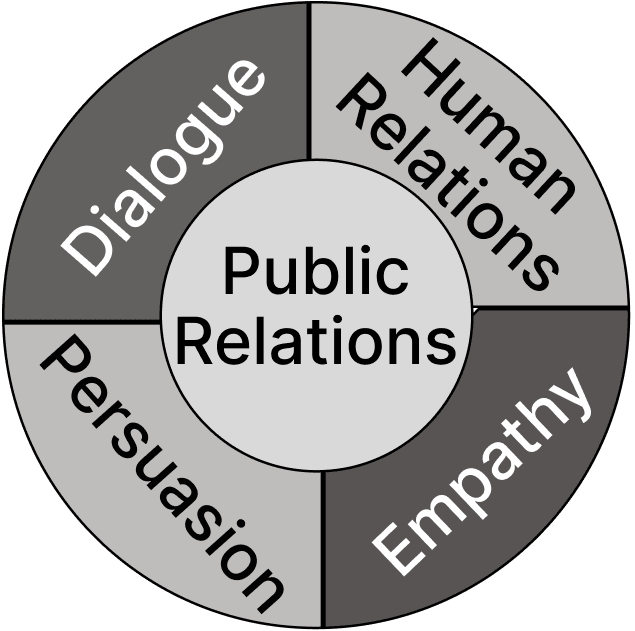
Trace out the history of public relations.
Answer
Public relations have been practised sporadically since the earliest times. However, the systematic study and use of public relations is of comparatively recent origin. The history of public relations may be traced through the following stages:
Public Relations in Ancient Times — There is enough evidence in the records of early Greek and Roman empires to show that great care and attention was devoted to influencing public opinion. The Romans dramatised the importance of public opinion in the slogan vox populi, vox dei — the voice of people is the voice of God. In ancient Egypt, priests were experts in public relations and persuasion.
American Revolution — A small group of persons including Samuel Adams, Thomas Paine, Benjamin Franklin, Alexander Hamilton and Thomas Jefferson started the American Revolution. They used voice and pen to make a profound impact on public opinion of their day. They circulated pamphlets, wrote in newspapers, and spread their ideas of revolt by word of mouth.
Eighteenth Century England — Jonathan Swift, Daniel Defoe and others used public relations methods to propagate their ideas. Huxley promoted the ideas of Darwin, and the writings of Charles Dickens tried to expose the social evils of his time. The phrase 'public relations' is believed to have first been used in 1807 when President Thomas Jefferson used it while drafting his 'Seventh Address to the Congress'. Ivy L. Lee, personal advisor to John D. Rockefeller, used the term 'public relations' in 1919.
Public Relationsss in the Twentieth Century — Public relations as practised today is largely a 20th century phenomenon. The First World War gave a great boost to public relations. President Wilson set up a Committee on Public Information. Edward L. Bernays published his book 'Crystallising Public Opinion' in 1923 — the first full-length book on public relations. The Second World War further accelerated the development of public relations. The Industrial Revolution and the advent of mass communication media accelerated the rise of public relations.
Explain Empathy and Dialogues as elements of Public Relations.
Answer
Empathy — Empathy means looking at things and events from the other person's point of view. It requires that the communicator be in tune with the communicatee.
Understanding Others — A good speaker should know the emotions and sentiments of his audience.
Sensitive and Sympathetic — Empathy enables an executive to be sensitive and sympathetic to the attitudes, expectations and problems of workers and clients.
Different from Sympathy — Empathy is feeling with the other person, whereas sympathy means feeling sorry for the other person.
Improves Relationships — Empathy fosters greater understanding and improves relationship with the client.
You Attitude — Empathy can be created in communications by adopting the 'you attitude' — using 'You' instead of 'I' and 'We' in written and spoken communication.
Dialogue — Dialogue means a conversation between two persons with a purpose. If a person goes on talking without allowing others to participate in the discussion, it becomes a monologue.
Weapon of Reasoning — In a civilised society, dialogue is the only weapon of reasoning and understanding.
Open and Two-way Communication — To create awareness and appreciation of the policies, programmes and performance of a company, one must maintain open and two-way communication with the public.
Reduces Prejudice — Dialogue helps reduce prejudice and builds up mutual confidence between the organisation and its publics.
Requires Respect — Effective dialogue requires impartial listening, understanding, respect for each other's opinions, faith, goodwill and a measure of generosity.
Asking Questions — A good way to start a dialogue is by asking questions and listening to the answers. It requires a topic about which the participants are informed.
Explain the nature of ethics in public relations.
Answer
The term 'ethics' has been derived from the Greek word 'ethos' which means character. Ethics may be defined as the science of morality. Business ethics means a set of moral standards which businessmen are supposed to follow in their business activities.
In the field of public relations, ethics has a significant place:
Publicity with Good Action — Publicity not backed by good action is unethical. It will damage rather than improve the image of the organisation.
Accurate and Timely Communication — Accurate and timely communication with the public is essential for good public relations.
Damage from Exaggeration — Exaggerated and untrue propaganda to boost image causes irreparable damage to the reputation of business in the long run.
Honesty as Best Policy — Honesty is the best business policy for long-lasting business in public relations.
Golden Rule — Ethics in public relations embodies the practice of the golden rule "Do unto others what you want others to do to you."
Transparency and Trust — Ethical practices like transparency in communication help build trust and credibility with stakeholders.
Social Responsibility — Ethical public relations involves aligning the organisation's communication efforts with its commitment to social and environmental issues.
Avoiding Misinformation — Public relations professionals have a responsibility to ensure the accuracy of the information they disseminate and avoid fake news.
Long-Term Reputation — Ethical public relations goes beyond short-term gains and focuses on building a positive, long-term reputation for the organisation.
Mention any five ways as to how 'Good Public Relations' help business enterprises.
Answer
Good public relations help business enterprises in the following five ways:
Building Goodwill and Positive Image — Good public relations help build goodwill and a positive image of the organisation in the minds of various stakeholder groups.
Attracting and Retaining Talent — A favourable public image makes the organisation attractive to talented professionals. Good employees prefer to work with organisations that have a strong public reputation.
Increasing Sales and Revenue — Good public relations create consumer awareness and trust in the brand, leading to increased sales and revenue.
Communicating Strategy and Policy — Public relations helps communicate the organisation's strategy and policies effectively to all stakeholders, ensuring everyone is aligned with the business objectives.
Gaining Community Acceptance — Good public relations earn the cooperation and goodwill of the local community in which the business operates. The community supplies labour, capital and demand to the business.
Collecting Funds — Companies with strong public relations find it easier to raise funds from investors and financial institutions, as they enjoy the confidence of these stakeholders.
Growth and Diversification — Public relations support long-term growth and diversification by maintaining stakeholder confidence and creating a favourable environment for business expansion.
Explain the following elements of Public Relations : (i) Dialogue (ii) Persuasion.
Answer
(i) Dialogue — Dialogue means a conversation between two persons with a purpose. If a person goes on talking without allowing others to participate in the discussion, it becomes a monologue.
Two-way Communication — In order to create awareness and appreciation of the policies, programmes and performance of a company, one must maintain open and two-way communication with the public.
Only Weapon in Civilised Society — In a civilised society, dialogue is the only weapon of reasoning and understanding.
Reduces Prejudice — Dialogue helps reduce prejudice and builds up mutual confidence between the organisation and its stakeholders.
Requirements — Effective dialogue requires impartial listening, understanding, respect for each other's opinions, faith, goodwill and a measure of generosity.
Asking Questions — A good way to start a dialogue is by asking questions and listening to the answers. It requires a topic about which the participants are informed.
(ii) Persuasion — Persuasion is an important element of public relations. To persuade means to convince another person of some idea, product, service or institution, or to induce a person or group to do something.
Forms of Interaction — There are two forms of interaction — force and persuasion. Force is improper conduct in a civilised society; persuasion is the right conduct.
Universal Practice — We are all engaged in persuasion in everyday life — a young man persuading his beloved, a teacher persuading his students, a politician persuading the voters.
Credibility — A message becomes persuasive when people believe in the source of the message. Messages from credible sources are generally accepted.
Attractive Presentation — Reasonable messages presented in an attractive manner tend to be more persuasive.
Self-Conviction — One can be persuasive only when convinced oneself and looking at the situation from the other person's angle.
Write short notes on persuasion and empathy as elements of public relations.
Answer
Persuasion — Persuasion is an important element of public relations. To persuade means to convince another person of some idea, product, service or institution, or to induce a person or group to do something.
Right Conduct — There are two forms of interaction — force and persuasion. Force is improper conduct in a civilised society; persuasion is the right conduct.
Communication Based — It is through some kind of communication that persuasion takes place. By employing compelling messages and transparent communication, public relations professionals can build good relationships with stakeholders.
Credibility Matters — A message becomes persuasive when people believe in the source. Messages from credible sources are accepted without questions.
Builds Public Image — An organisation can build a good public image through persuasion. Public relations executives must practice the art of persuasion.
Empathy — Empathy means looking at things and events from the other person's point of view. It requires that the communicator be in tune with the communicatee.
Sensitivity — Empathy enables an executive to be sensitive and sympathetic to the attitudes, expectations and problems of workers and clients.
Improves Relationships — Empathy fosters greater understanding and improves relationship with the client. It tells an executive when to talk and when to remain silent, when to be firm and when to be restrained.
Different from Sympathy — Empathy is feeling with the other person, whereas sympathy means feeling sorry for the other person.
You Attitude — Empathy can be created in communications by adopting the 'you attitude' — using 'You' instead of 'I' and 'We' in communication.
Explain persuasion as an element of public relations and mention any two principles of persuasion.
Answer
Persuasion — Persuasion is an important element of public relations. To persuade means to convince another person of some idea, product, service or institution, or to induce a person or group to do something. It is through some kind of communication that persuasion takes place.
There are two forms of interaction between individuals and groups — force and persuasion. When one person compels another to do something, it is interaction through force, which is considered improper conduct in a civilised society. Interaction through persuasion involves convincing the other person and is considered the right conduct.
A message becomes persuasive when people believe in the source of the message. Messages from credible sources are generally accepted without question. Reasonable messages presented in an attractive manner tend to be more persuasive.
Two Principles of Persuasion:
Acceptance of the Message — Acceptance of the message is a critical factor in persuasive communication. To change the attitudes of people, the suggestion for change must first be received and accepted by them.
Conformity with Needs and Desires — A suggestion is more likely to be accepted if it is in conformity with the needs and desires of people. When the message aligns with what people want, they are more receptive to it.
Harmony with Group Norms — A suggestion is more likely to be accepted when it is in harmony with group norms and loyalties.
Reliable Source — A suggestion is more likely to be accepted when the source is perceived as reliable or expert.
Discuss employee relation and government relations on the basis of scope of public relations.
Answer
Employee Relations — Employee relations is an important scope of public relations dealing with maintaining good relations between management and employees.
Communication Gap — The expansion in the industrial workforce has created serious problems in communication and relations with employees. Poor communication creates misunderstanding.
Sound Personnel Policies — The foundation of good employee relations is sound personnel policies and their impartial implementation. Employees judge a company by its personnel policies and the practices of management in carrying out these policies.
Two-way Communication — Two-way channels of communication between management and workers are required. Management should do more listening and less talking.
Express Opinions — Employees want to express their opinions about matters affecting their interests. Failure to inform employees about corporate policy and developments leads to misunderstanding and criticism.
Government Relations — Government relations involve building close relationships between corporations and the government.
Synthesis of Interests — The interests of business and government are becoming synthesised to the common advantage of both.
Effective Partnership — There is an increasing recognition on the part of business executives of the importance of developing an effective partnership with government.
Active Participation — Business is taking an increasingly active part in government affairs.
Mutual Consultation — Government is also increasingly consulting businessmen in formulating policies and programmes for economic and social development of people.
What are the characteristics of public relations?
Answer
The characteristics of public relations are as follows:
Planned and Sustained Effort — Public relations is a planned and sustained effort. It is a management function that requires careful planning and continuous implementation.
Relationship between Organisation and Public — It is concerned with the relationship between an organisation and its various publics — employees, shareholders, consumers, government, media, and community.
Evaluation of Public Opinion — It involves evaluation of public opinion and attitudes about the policies, procedures and actions of an organisation insofar as they relate to the public.
Public Interest — The public relations function seeks to ensure that the policies, procedures and actions of the organisation are in the public interest and socially responsible.
Action and Communication — Public relations requires both action and communication programmes. Communication without good action is unethical.
Harmonious Relations — The basic purpose of public relations is to create and maintain harmonious relations between an organisation and its public.
Not Propaganda — Public relations is not propaganda. Propaganda is one-way, guided by self-interest, and is an instrument of politics. Public relations recognises ethical conduct and seeks willing acceptance of attitudes and ideas.
Ethical Conduct — In public relations, the ends can never justify the use of false, harmful or questionable means.
Mention any five ways as to how good public relations help to maintain good relationship with employees of an organisation.
Answer
Good public relations help maintain good relationship with employees in the following five ways:
Sound Personnel Policies — Good public relations ensures the development of sound personnel policies and their impartial implementation.
Two-Way Communication — Good public relations establishes two-way channels of communication between management and workers. Management does more listening and less talking, allowing employees to express their views.
Informing Employees — Good public relations ensures employees are kept informed about corporate policy and developments affecting their interests.
Human Dignity and Respect — Good public relations are based on human relations — relations between human beings on the basis of human dignity and respect for each other.
Building Loyalty — Employer or management can buy a person's time and actions, but their enthusiasm, loyalty and initiative have to be earned through good human relations and public relations efforts.
Resolving Grievances — Good public relations provides avenues for resolving employee grievances through open dialogue, reducing prejudice and building mutual confidence.
Career Development — Good public relations involves showing sincere interest in employees' official and personal progress, supporting their career development.
With reference to Public Relations, write a short note on Role of ethics in business.
Answer
Role of Ethics in Business (in Public Relations):
The term 'ethics' is derived from the Greek word 'ethos' meaning character. Ethics is the science of morality, concerned with right conduct in society. Business ethics is a set of moral standards which businessmen are supposed to follow in their business activities.
The role of ethics in business with reference to public relations is as follows:
Transparency and Trust — Ethical practices such as transparency in communication help build trust and credibility with stakeholders. Public relations professionals are responsible for conveying accurate information.
Social Responsibility — Modern organisations are expected to demonstrate social responsibility by considering the broader impacts of their actions, including sustainability, diversity and community engagement.
Avoiding Misinformation — Public relations professionals have a responsibility to ensure accuracy of information they disseminate. The prevalence of fake news highlights the need for truthfulness.
Balancing Stakeholder Interests — Organisations have multiple stakeholders. Ethical public relations involves balancing their interests and ensuring fair, respectful communication.
Crisis Communication — During crises, public relations professionals must handle situations transparently, provide accurate information, and demonstrate empathy.
Privacy and Data Protection — With increasing reliance on data-driven communication, ethical standards regarding data privacy and protection must be upheld.
Ethical Decision-Making — Public relations professionals often face ethical dilemmas. Upholding ethical standards involves considering consequences and choosing fair, honest, respectful actions.
Long-Term Reputation — Ethical public relations focuses on building a positive, long-term reputation for the organisation, which contributes to overall success and sustainability.
Honesty is Best Policy — Exaggerated and untrue propaganda causes irreparable damage to business reputation.
Name and explain the scope of Public Relations with reference to any two stakeholders who create an impact on the business organisation.
Answer
The scope of public relations covers various stakeholders. Two important stakeholders that create an impact on the business organisation are:
1. Consumer Relations — Consumers determine the success or failure of a business enterprise. Therefore, a sincere concern for consumers is essential.
Increasing Demands — Consumers and consumer groups are increasingly demanding their rights. Developing better relations with consumers is a challenging task.
Communication Channels — Corporations seek to retain the goodwill of consumers by regularly communicating with them through sales representatives, meetings, surveys, mailings, magazines, and literature.
Quality Products and Services — Good consumer relations depend heavily upon the nature of the products and services provided to consumers. Quality is the key to consumer satisfaction.
Impact on Business — Satisfied consumers become loyal customers, leading to repeat purchases, positive word-of-mouth publicity, and long-term success of the business.
2. Government Relations — There has been a closer relationship between corporations and government in modern times.
Synthesised Interests — The interests of business and government are becoming synthesised to the common advantage of both.
Effective Partnership — Business executives recognise the importance of developing an effective partnership with government.
Active Participation — Business takes an increasingly active part in government affairs through industry associations and policy advocacy.
Mutual Consultation — Government also consults businessmen in formulating policies and programmes for economic and social development.
Impact on Business — Good government relations help businesses navigate regulations, taxation, and policy changes, ensuring smooth operations and growth opportunities.
Public Relations help to inform, educate and persuade media. Write any five points to explain the scope of Public Relations.
Answer
The scope of public relations covers relations with all the publics of a business organisation. Five important points to explain the scope are:
Employee Relations — Employee relations involve maintaining good relations between management and employees through sound personnel policies, two-way communication, and impartial implementation of policies. Failure to inform employees leads to misunderstanding and criticism.
Consumer Relations — Consumers determine the success of a business. Corporations communicate with consumers through sales representatives, meetings, surveys, mailings, magazines, and literature. Good consumer relations depend heavily upon the nature of products and services provided.
Stockholder Relations — Many shareholders suspect corporate management. Management should provide shareholders with current information about financial position and future prospects through reports, shareholders' meetings, films and lectures, treating them as actual owners.
Government Relations — Business and government interests are becoming synthesised. Business takes active part in government affairs, while government consults businessmen in formulating policies for economic and social development.
Community Relations — The local community and business firms are mutually dependent. Business serves the community by providing employment, wages, and taxes; community supplies labour and demand. Business must accept its responsibility to the community by being a good citizen.
Media Relations — Good working relationships with editors, reporters, columnists and broadcasters are essential for securing good publicity coverage. Newspapers, business magazines, radio and television are the main media for publicity.
Distributor and Supplier Relations — Manufacturers must maintain close contact with distributors through literature, personal visits, meetings, telephone calls, dealer contests, and marketing aids. Suppliers provide materials and services worth approximately one-half of sales income.
Describe the present status of Public Relations.
Answer
The present status of public relations is as follows:
Management Function — Public relations has now developed as a management function. It has acquired a professional status.
Professional Approach — Like any profession, public relations is concerned with gathering information about particular interests, understanding the policies of specialised agencies, and determining the abilities of these agencies to meet these interests.
Two-way Function — It seeks not only to inform the public but also to secure better understanding of public attitudes towards business and take positive steps to gain public understanding and goodwill.
Art and Science — Public relations has become a serious business. It is an art as well as a science that deals with difficult problems of how an institution or organisation can get along satisfactorily with other institutions and groups.
Broad Concept — Public relations is not a narrow set of rules; it is a broad concept. It is an entire body of relationships that creates and sustains impressions.
Organised Activity — In today's business, public relations is an organised activity. Large and progressive companies have public relations departments and officers to establish and maintain their goodwill.
Two-way Communication — The fundamental purpose of public relations activities is to establish a two-way flow of mutual understanding based on truth, knowledge and full information.
Essential for All Organisations — No institution, industry or democratic government can operate successfully without the cooperation of the public.
Inward and Outward Activity — A public relations policy includes both inward activity (to assess company's policies and behaviour) and outward activity (to inform the public about the company and its achievements).
Recognition of Public Opinion — The philosophy underlying public relations today is the recognition of the ultimate authority of public opinion.
CASE STUDY
Innovation and brand consultant, Anisha Motwani, believes that free trials or sampling as a strategy is mostly prevalent and successful in categories that have deep seated habits and have high frequency of consumption. Brand switching in this category require attitude and behavior changes and free sampling influences customers to try new brands and thus increasing the probability of purchase. Such categories could include newspapers, food products, etc. Free trials can also be found in case of expensive offerings where consumers prefer sampling before making a final commitment……
Success of Reliance Jio in the intensely competitive Indian telecom market brings forth the strength of trial marketing strategy, even in the service industry. Reliance Jio Infocomm Ltd offered free sampling of Jio's voice calling, text messaging, and data services, and acquired stupendous 100 million subscribers, of which it continued to retain 72 million even after the free trial period ended.
Conventional wisdom suggests that brands that indulge in trials and discounts erode brand value. Here's the reality though. People value brands. But people also seek value for money ……
Source: https://www.ascdegreecollege.ac.in/wp-content/uploads/2020/12/Marketing-Management-Indian-Cases.pdf
With reference to the case study answer the following question:
Which scope of public relations has been emphasised in the case study? Explain its importance to business.
Answer
The scope of public relations emphasised in the case study is Consumer Relations.
Reliance Jio used the strategy of free trials to build relationships with consumers in the highly competitive Indian telecom market. By offering free sampling of voice calling, text messaging, and data services, Jio focused on consumer engagement and built consumer trust, which is the essence of consumer relations as a scope of public relations.
Importance of Consumer Relations to Business:
Success or Failure — Consumers determine the success or failure of a business enterprise. As shown in the case, Jio acquired 100 million subscribers and retained 72 million through effective consumer relations.
Sincere Concern for Consumers — Developing better relations with consumers requires sincere concern, as consumers and consumer groups are increasingly demanding their rights.
Retaining Goodwill — Corporations seek to retain the goodwill of consumers by regularly communicating with them through sales representatives, meetings, surveys, mailings, magazines, and literature.
Quality Products and Services — Good consumer relations depend heavily upon the nature of the products and services provided to consumers. Jio retained customers after the free trial because of the quality of services.
Brand Loyalty — Good consumer relations help build brand loyalty. Despite the perception that trials erode brand value, Jio created strong consumer connections, proving that consumers value both the brand and value-for-money.
Repeat Sales — Satisfied consumers lead to repeat purchases and long-term revenue for the business.
Positive Word-of-Mouth — Happy consumers spread positive word-of-mouth publicity, attracting more customers and building the company's reputation.
Competitive Advantage — Strong consumer relations give a business a competitive advantage in the market, as evidenced by Jio's success in the intensely competitive Indian telecom market.