
Ecosystem is being spoiled due to
- Transport
- Industrialisation
- Dwelling of business units
- All of these
Answer
All of these
Reason — Ecosystem is being spoiled due to several factors including industrialisation, dwelling of business units, transport, tourism and mining. All these activities clear forest land, alter natural habitats and cause loss of biodiversity, so all the options together are responsible for destruction of the ecosystem.
Which of the following actions would be most effective in reducing the negative impact of non-renewable resources on the environment?
- Switching all industrial processes to coal and oil for more reliable energy production.
- Encouraging consumers to use more solar-powered appliances in their homes.
- Increasing mining activities to ensure a steady supply of non-renewable resources.
- Developing more efficient ways to use fossil fuels in automobiles.
Answer
Encouraging consumers to use more solar-powered appliances in their homes.
Reason — Solar energy is a clean, renewable, pollution-free source of energy. Encouraging the use of solar-powered appliances reduces the dependence on non-renewable resources like coal and oil, thereby reducing pollution and conserving fossil fuels for the future.
There is excessive consumption of both renewable and non-renewable resources due to
- Industrial and technological development
- Population growth
- Non-equitable distribution
- All of these
Answer
All of these
Reason — Excessive consumption of natural resources is caused by the fast pace of industrial and technological development, the ever-increasing population which puts strain on land, electricity and forests, and the uneven (non-equitable) distribution of resources which leads to over-mining and depletion in certain regions.
Which of the following is/are correct statement(s)?
Statement 1: The greenhouse effect is necessary to maintain life on Earth, but an excess of it leads to global warming.
Statement 2: The greenhouse effect is entirely harmful and should be reduced as much as possible.
Which of the following is correct?
- Only Statement 1 is true.
- Only Statement 2 is true.
- Both Statements 1 and 2 are true.
- Both Statements 1 and 2 are false.
Answer
Only Statement 1 is true.
Reason — The greenhouse effect is a natural process that keeps the earth warm and habitable. Without it, the temperature of the earth's surface would be below the freezing point of water (–18°C). However, an excess of greenhouse gases like carbon dioxide leads to global warming and climate change. Hence Statement 2 is false as the greenhouse effect is essential and should not be eliminated.
Assertion (A): The right to redress enables consumers to seek compensation for faulty products or subpar services.
Reason (R): The right to redress does not apply to online purchases and transactions.
Read the statements and choose the correct option
- A is true but R is false
- A is false but R is true
- Both A and R are true and R explains A.
- Both A and R are true but R does not explain A.
Answer
A is true but R is false
Reason — The right to seek redressal indeed enables consumers to seek compensation against unfair trade practices and faulty products, so A is true. However, R is false because the right to redress applies equally to online purchases and transactions; consumers can seek redressal for any purchase, whether made online or offline.
If you were tasked with reducing the environmental impact of acid rain in an industrial area, which of the following strategies would you implement first, based on long-term benefits?
- Immediate reduction in industrial emissions using scrubbers and filters.
- Increase tree plantations to absorb CO2 and neutralize soil acidity.
- Promote the use of renewable energy sources over fossil fuels.
- Regulate the production of goods in industries to lower acid-producing emissions.
Answer
Promote the use of renewable energy sources over fossil fuels.
Reason — The main source of acid rain emission is the combustion of fossil fuels in automobiles, factories and power plants. Promoting the use of renewable energy sources like solar, wind and hydel energy in place of fossil fuels addresses the root cause of acid rain and provides the most sustainable long-term benefit.
The consumer has the right to get compensation against unfair trade practices under
- Right to choose
- Right to seek redressal
- Right to safety
- Right to inform
Answer
Right to seek redressal
Reason — Right to seek redressal means the right to seek redressal against unfair trade practices or unscrupulous exploitation of consumers. It also includes the right to fair settlement of the genuine grievances of consumers.
How does acid rain impact the environment?
(1) It leads to a decrease in carbon dioxide levels.
(2) It increases soil fertility and agricultural productivity.
(3) It damages aquatic ecosystems, forests, and buildings.
(4) It accelerates the process of desertification.
- 1 & 2
- 3 & 4
- Only 1
- Only 3
Answer
Only 3
Reason — Acid rain has a corrosive nature and damages buildings, monuments containing limestone or marble, corrodes metal structures, harms aquatic ecosystems by disrupting reproduction of aquatic animals, and damages forests by reducing soil fertility and damaging leaves. It does not decrease CO2 levels, increase soil fertility, or directly cause desertification.
Which of the following is most suited statement related to right to seek redressal?
- To get safety
- To get security
- Against the unfair trade practices or exploitation
- Unfair settlement
Answer
Against the unfair trade practices or exploitation
Reason — Right to seek redressal means the right to seek redressal against unfair trade practices or unscrupulous exploitation of consumers. It also includes the right to fair settlement of the genuine grievances of consumers.
Which of the following is not the responsibility of a consumer?
- Filing complaints for the redressal of grievances
- Consumer must be quality conscious
- Do not be carried away by advertisement
- To produce goods for social welfare
Answer
To produce goods for social welfare
Reason — Producing goods is the responsibility of the manufacturer, not the consumer. The responsibilities of a consumer include checking quality, asking for cash memo, filing complaints, forming consumer associations, and not being carried away by misleading advertisements.
To check quality mark, ask for full information, insist on cash memo are the responsibilities of:
- Seller
- Advertisers
- Consumer
- A teacher
Answer
Consumer
Reason — These are the duties of a consumer. While purchasing goods and services, consumers must check the quality, insist on warranty card, buy products marked with ISI, AGMARK and ask for the cash memo for the items purchased.
Protection of consumers is necessary because
- Consumers are weak and powerless against strong and powerful sellers
- Consumers are lucky and fully protected.
- Consumer is considered as king of market.
- None of the above
Answer
Consumers are weak and powerless against strong and powerful sellers
Reason — Consumers are often exploited by powerful sellers through unfair trade practices, adulteration, misleading advertisements and defective products. Therefore, consumer protection is necessary to safeguard consumers from such exploitation and ensure their rights.
When consumer has freedom to select a particular product out of many products, which "Right" is applicable according to Consumer Protection Act?
- Right to safety
- Right to choose
- Right to consumer education
- Right to be heard
Answer
Right to choose
Reason — Right to choose means the right to be assured, whenever possible, of access to a variety of goods and services at competitive prices. It gives the consumer freedom to select a product or service from a variety of options.
Industrialization has contributed to an increase in greenhouse gases, which in turn accelerates global warming and climate change.
- True
- False
Answer
True
Reason — Industrialisation has led to increased burning of fossil fuels in factories, power plants and automobiles, releasing huge quantities of carbon dioxide and other greenhouse gases into the atmosphere. This has accelerated global warming and caused climate change.
What was the primary gas leaked in the Bhopal gas tragedy?
- Hydrogen Peroxide
- Methyl Isocyanate (MIC)
- Carbon Monoxide
- Nitrogen Dioxide
Answer
Methyl Isocyanate (MIC)
Reason — The Bhopal Gas Tragedy on the night of December 2-3, 1984, involved a significant leak of methyl isocyanate (MIC), a highly toxic and volatile chemical, from a storage tank at the Union Carbide India Limited factory.
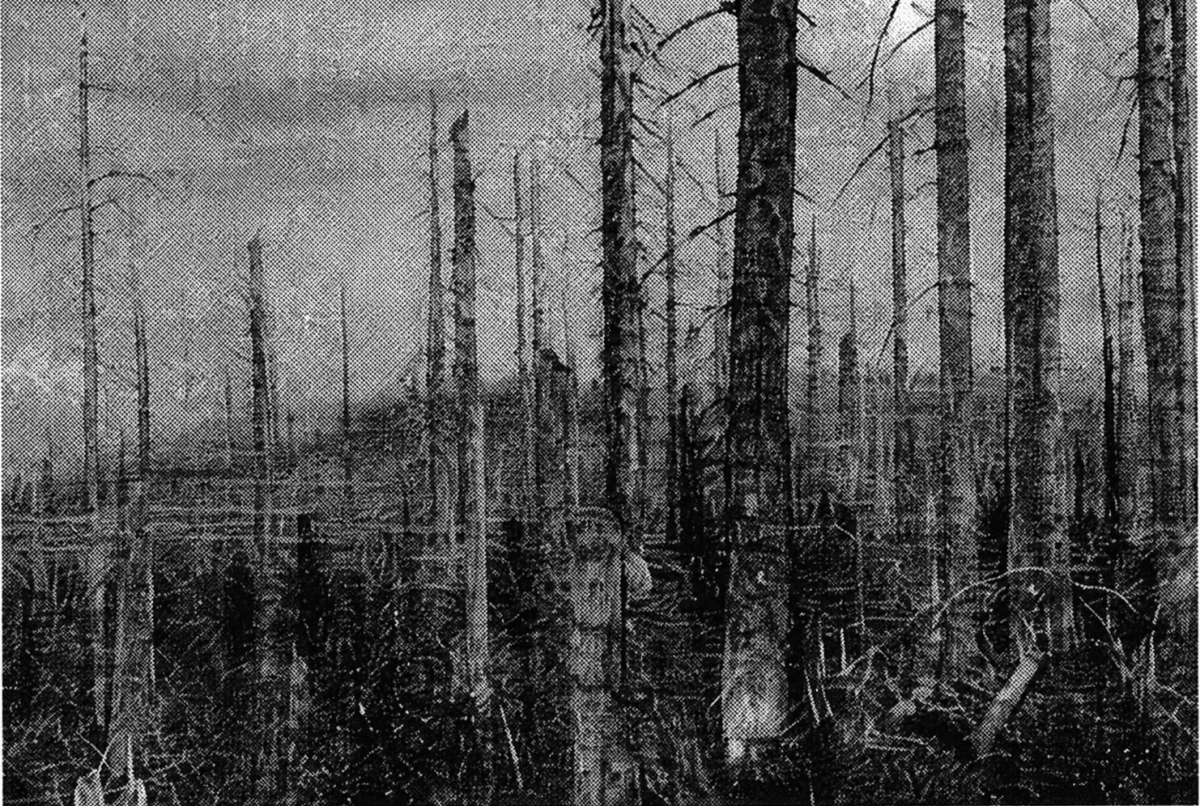
What is the primary long-term effect of acid rain on the ecosystem shown in the image?
- Increased soil fertility.
- Loss of biodiversity due to plant damage.
- Higher water retention in the soil.
- Faster growth of forest cover.
Answer
Loss of biodiversity due to plant damage.
Reason — Acid rain damages or destroys plants by reducing the fertility of soil. It damages leaves and causes loss of sensitive plants. It also disrupts the reproduction of aquatic animals and alters food and habitat for wildlife, leading to overall loss of biodiversity.
_________ is a set of moral standards that guide people how to interact with the environment.
- Value education
- Environmental ethics
- Fundamental duties
- Consumer responsibilities
Answer
Environmental ethics
Reason — Environmental ethics refers to the set of moral standards which guide us how to interact with our environment. These standards indicate what is the right conduct according to society, such as not polluting air, water and soil.
Assertion (A): The right to information empowers consumers to make informed decisions about products and services.
Reason (R): The right to information ensures that consumers have access to accurate and transparent information regarding the features, ingredients, prices, and risks of products.
- A is true but R is false
- A is false but R is true
- Both A and R are true and R explains A.
- Both A and R are true but R does not explain A.
Answer
Both A and R are true and R explains A.
Reason — The right to be informed gives consumers access to information about the quality, quantity, purity, potency, standard and price of goods. With this information, consumers can make the right choice and protect themselves from unfair trade practices. Hence, R correctly explains the assertion A.
Imagine you are part of a government committee tasked with addressing the effects of acid rain in a region. Which of the following solutions would be most sustainable for long-term ecological restoration?
- Immediate cleanup of rivers and lakes affected by acid rain.
- Implementing stronger regulations on industries that emit sulfur dioxide and nitrogen oxides.
- Encouraging citizens to use less water in order to reduce water pollution.
- Importing water from non-affected regions to balance the ecological damage.
Answer
Implementing stronger regulations on industries that emit sulfur dioxide and nitrogen oxides.
Reason — Acid rain is primarily caused by emissions of sulphur and nitrogen compounds from industries, automobiles and power plants. Implementing stronger regulations on these emissions tackles the root cause of acid rain and provides the most sustainable long-term solution for ecological restoration.
The greenhouse effect is entirely harmful and should be eliminated to stop global warming.
- True
- False
Answer
False
Reason — The greenhouse effect is a natural process that keeps the earth warm and habitable. Without it, the earth's temperature would fall below the freezing point of water (–18°C). It is only the excess of greenhouse gases that causes global warming; the natural greenhouse effect itself should not be eliminated.
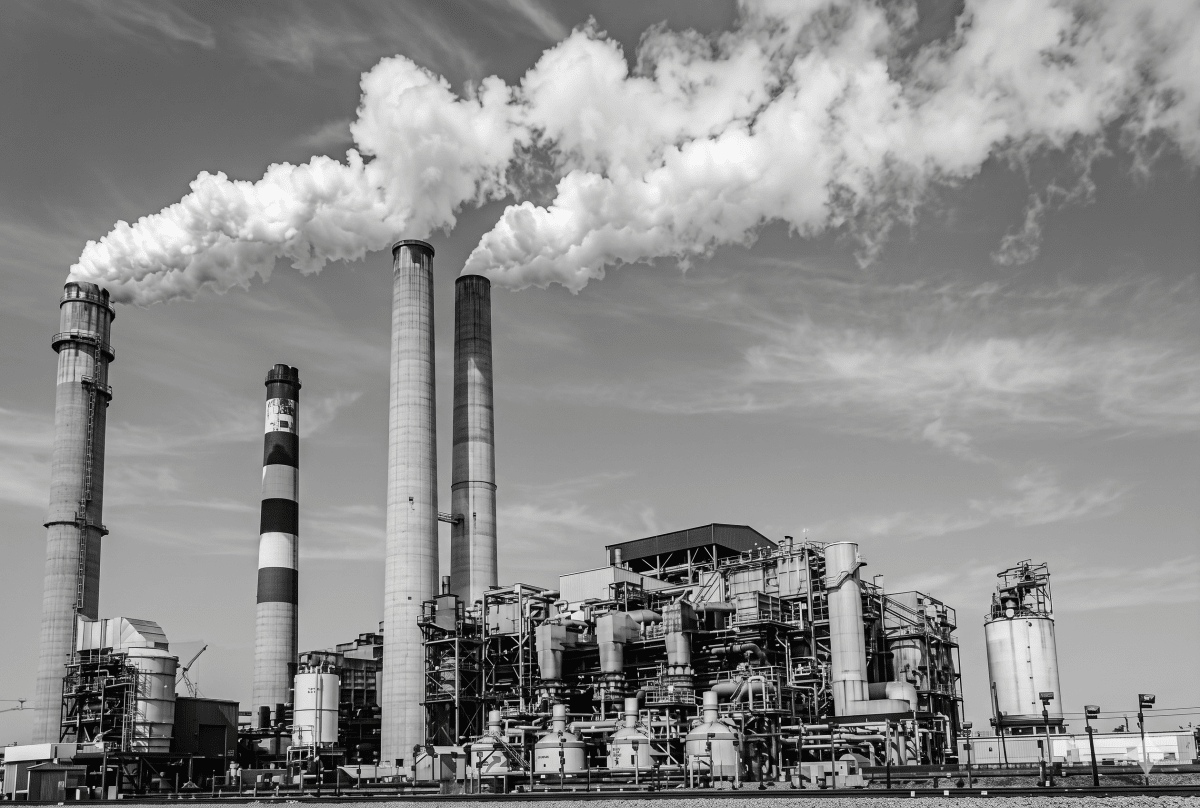
Which of the following would be the most effective solution to reduce the type of pollution visible in the image?
- Switching to electric vehicles for transportation.
- Switching to cleaner-burning fuel in factories to reduce emissions.
- Encouraging citizens to use bicycles instead of cars.
- Building more factories in rural areas to balance urban pollution.
Answer
Switching to cleaner-burning fuel in factories to reduce emissions.
Reason — The image shows industrial air pollution from factory smokestacks. Switching to cleaner-burning fuels in factories directly addresses this source of pollution by reducing emissions of harmful gases like sulphur dioxide and carbon dioxide, thereby reducing air pollution and its harmful effects.
Asthmatic attacks, accumulation of lead from traffic exhausts, etc. are examples of _________ health hazards.
- Short term
- Long term
- Transient
- None of these
Answer
Long term
Reason — Long-term health hazards result from continuous exposure to hazardous materials over a long period of time. They last for months and years and affect multiple organs. Asthmatic attacks and accumulation of lead from traffic exhausts are examples of such long-term hazards.
To protect and improve the natural environment including forests, lakes, rivers and wildlife, and have compassion for living creatures is _________?
- Value education
- Environmental ethics
- Fundamental duties
- Consumer responsibilities
Answer
Fundamental duties
Reason — Article 51A of the Constitution of India lists the fundamental duties of every citizen. One of these duties states that it shall be the duty of every citizen to protect and improve the natural environment including forests, lakes, rivers and wildlife, and have compassion for living creatures.
Making consumers aware of their rights and duties is _________.
- Consumer Education
- Value Education
- Industrial Relation
- People Relation
Answer
Consumer Education
Reason — Consumer education means making consumers aware of their rights and duties. Its aims are to reduce waste of natural resources, encourage reuse/recycling of materials, and create wise and eco-friendly consumers.
Asking for cash memo for the item purchased is _________.
- Consumer education
- Consumer awareness
- Consumer's duty
- Consumer's requirement
Answer
Consumer's duty
Reason — Asking for cash memo for items purchased is one of the duties of a consumer. The cash memo serves as proof of purchase and is essential to file complaints and seek redressal in case of defective goods or unfair trade practices.
Narmada Bachao Andolan was started by:
- Sundar Lal Bahuguna
- Medha Patkar
- Ghanshyam Raturi
- Chandi Prasad
Answer
Medha Patkar
Reason — Narmada Bachao Andolan was started in 1986 under the leadership of Medha Patkar. It aimed primarily to educate those directly affected about the social and environmental impact of large development projects, particularly the construction of dams in the Narmada Valley.
Mixing of jaggery (gur) in honey is an example of _________.
- Pollution
- Food Adulteration
- Degeneration
- Decomposition
Answer
Food Adulteration
Reason — Food adulteration means deliberate mixing of low quality, undesirable, inedible and even toxic materials in food items. Mixing of sugar or jaggery (gur) in honey is a common example of food adulteration.
Identify which of the following concept is NOT required to avoid excessive consumption?
- Reduce
- Reuse
- Refuse
- Remember
Answer
Remember
Reason — The 5 R's used to avoid excessive consumption are Reduce, Reuse, Recycle, Refuse and Repair. 'Remember' is not part of the 5 R's. Therefore, 'Remember' is not required to avoid excessive consumption.
Which one of these is a voluntary group promoting the participation of students in learning to improve their environment?
- Nature Club
- Van Mahotsav Club
- Eco-Club
- Interact Club
Answer
Eco-Club
Reason — Eco-Club is a voluntary group which promotes the participation of students in learning about and improving their environment. It has three main themes — people, nature and culture. Any group of concerned people can start an eco-club to increase awareness about the environment.
This is NOT an example of renewable energy:
- Nuclear Energy
- Natural Gas
- Solar energy
- Tidal Energy
Answer
Natural Gas
Reason — Natural gas is a fossil fuel found with petroleum in oil wells and is a non-renewable source of energy because it cannot be replenished once used. Solar energy, tidal energy and nuclear energy are classified as renewable sources of energy.
Assertion (A): Values are a set of standards of behaviour that are considered desirable and important by society.
Reason (R): These principles or standards of behaviour need not be inculcated in person through the right kind of education.
- A is false, but R is true.
- A is true, but R is false.
- Both A and R are true and R explains A.
- Both A and R are true but R does not explain A.
Answer
A is true, but R is false.
Reason — Values are indeed a set of standards of behaviour considered desirable and important by society, so A is true. However, R is false because these principles or standards of behaviour need to be inculcated in a person through the right kind of education — that is why value education is necessary.
There are two statements given below, marked as Assertion (A) and Reason (R). Read the statements and choose the correct option.
Assertion (A): Environmental education makes individuals aware of environmental issues and promotes environmental sustainability.
Reasoning (R): It is very essential to think and act creatively to become capable to approach environmental issues in a proactive manner.
- A is true but R is false
- A is false but R is true
- Both A and R are true, and R explains A
- Both A and R are true, but R does not explain A
Answer
Both A and R are true, and R explains A
Reason — Environmental education makes individuals aware of environmental issues and promotes sustainability, so A is true. It also develops the ability to think and act creatively so that environmental problems can be approached in a proactive and sustainable manner. Hence, R correctly explains A.
Ms. Emma, a working woman wants to purchase a laptop online. She came across an attractive offer on a popular e-commerce website. The website claimed to offer the latest model at a significantly discounted price with free shipping. Excited about the deal, Emma placed her order immediately. Emma received a damaged laptop. She tried contacting the website's customer support, but her calls and emails went unanswered.
Based on the case study, which of the following Consumer Right can be exercised by her.
- Right to be Heard
- Right to consumer education
- Right to choose
- Right to seek redressal
Answer
Right to seek redressal
Reason — Right to seek redressal means the right to seek redressal against unfair trade practices and the right to fair settlement of genuine grievances. Since Emma received a damaged laptop and the seller is not addressing her grievance, she can exercise her right to seek redressal to claim compensation or replacement.
An ecosystem may either be natural or artificial.
- True
- False
Answer
True
Reason — An ecosystem may either be natural or artificial. Natural ecosystems include terrestrial ecosystems (forest, desert, grassland) and aquatic ecosystems (fresh water, ocean, coastal, estuaries). Artificial ecosystems include cropland, aquarium, park, kitchen garden, etc.
Lata visited a grocery shop and purchased a packet of biscuit. The Maximum Retail Price (MRP) was not clearly printed on this packet. Which Right of the consumer was violated here?
- Right to Safety
- Right to Choose
- Right to Seek Redressal
- Right to be Informed
Answer
Right to be Informed
Reason — Right to be informed means the right to be informed about the quality, quantity, purity, potency, standard and price of goods. Since the MRP (price) was not clearly printed on the packet, Lata's right to be informed was violated.
Assertion (A): Renewable natural resources are being depleted due to overuse and misuse.
Reasoning (R): Growing demand for economic and industrial growth is a major cause for over exploitation of natural resources.
- A is true R is false.
- A is false but R is true.
- Both A and R are true and R explains A.
- Both A and R are true but R does not explain A.
Answer
Both A and R are true and R explains A.
Reason — Natural resources are indeed being depleted due to overuse and misuse (A is true). The growing demand for economic and industrial growth is a major cause of over-exploitation of natural resources (R is true), and this growing demand is exactly what drives the overuse and misuse. Hence R correctly explains A.
Which movement began as a protest against the construction of dams?
- Narmada Bachao Andolan
- Van Mahotsav
- Anandalya Movement
- National Awareness Movement
Answer
Narmada Bachao Andolan
Reason — Narmada Bachao Andolan, started in 1986 under the leadership of Medha Patkar, began as a protest against the construction of dams in the Narmada Valley. It mobilised residents of the Narmada Valley on human rights and environmental issues related to big dams.
Under which Right of Consumer Protection Act 1986, fair settlement and genuine grievances of customers were addressed?
- Right to Safety
- Right to be Heard
- Right to Seek Redressal
- Right to Consumer Education
Answer
Right to Seek Redressal
Reason — Right to seek redressal includes the right to fair settlement of the genuine grievances of consumers. It enables consumers to seek redressal against unfair trade practices or unscrupulous exploitation.
What is Ecology?
Answer
Ecology is the branch of science that deals with the study of the relationships between living organisms (plants, animals and microbes) and their environment, including both biotic (living) and abiotic (non-living) components. It studies how organisms interact with each other and with their physical and chemical surroundings.
Name the two components of Eco-system.
Answer
The two components of an ecosystem are:
Biotic or Living Components — These include all living organisms such as human beings, animals, birds, insects and plants. They are further divided into producers, consumers and decomposers.
Abiotic or Non-living Components — These include physical and chemical factors of the environment such as land, air, water, sunlight, rainfall, temperature, earth's atmosphere and gases. They include inorganic, organic and climatic components.
Distinguish between Renewable and Non-renewable resources.
Answer
| S.No. | Basis | Renewable Resources | Non-renewable Resources |
|---|---|---|---|
| 1. | Meaning | These are regularly replenished through natural process. | These exist on earth in fairly fixed quantities and can be depleted or exhausted. |
| 2. | Availability | Always available and have the potential to last indefinitely. | Limited supply and will eventually run out. |
| 3. | Replenishment | Naturally replenished. | Take millions of years to form. |
| 4. | Examples | Water, wind, sunlight, forests. | Coal, natural gas, petroleum, minerals. |
| 5. | Impact on Environment | Cleaner and better for the environment. | Cause more pollution and harm the environment. |
What is Greenhouse Effect?
Answer
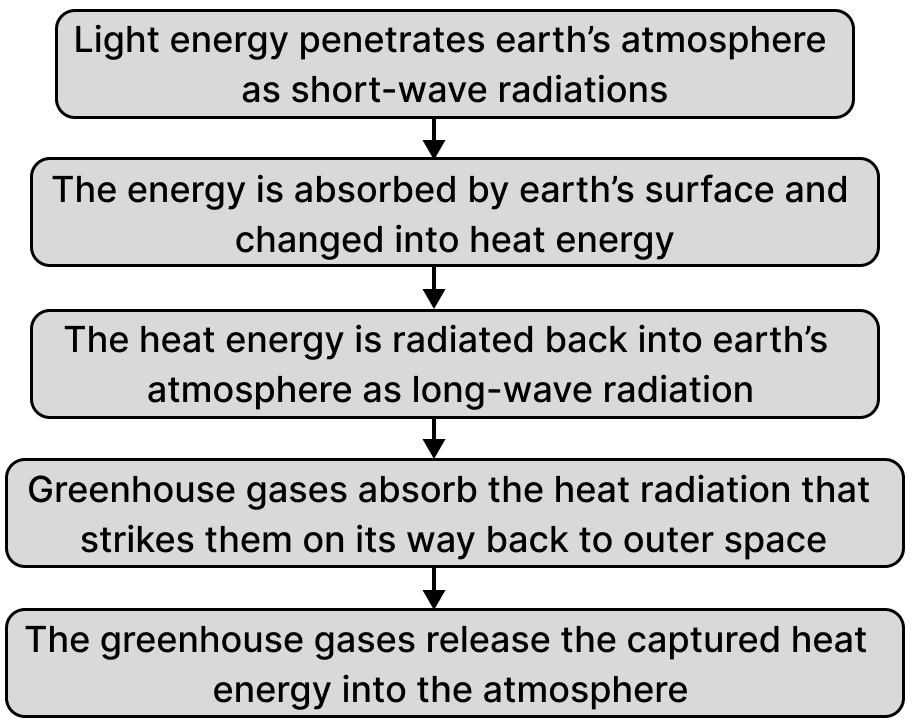
Greenhouse effect means the progressive warming up of the Earth's surface due to the blanketing effect of man-made carbon dioxide in the atmosphere. It is a natural process in which certain gases like carbon dioxide and water vapour (called greenhouse gases) trap heat that radiates from the earth's surface. These gases act like the glass panels of a greenhouse, allowing short-wave solar radiation to enter but preventing long-wave infrared radiation from escaping, thus keeping the earth warm and habitable. The term 'greenhouse effect' was coined by J. Furrier in 1827.
Mention any two harmful effects of Global Warming.
OR
State any two threats of global warming.
Answer
Two harmful effects/threats of global warming are:
Rise in Sea Level — Global warming causes melting of glaciers and ice-caps, resulting in a rise in sea level. This destroys beach nesting shelters of sea turtles, threatens coastal areas and damages the breeding of sea birds and sea animals.
Extinction of Animals and Birds — Global warming has caused extinction of many animals including migratory birds. Heat waves also lead to heat strokes, heart attacks and other heart-related ailments in humans, while glacier retreat affects water availability.
Explain any two impacts of Acid Rain.
Answer
Two impacts of acid rain are:
Impact on Buildings and Monuments — Acid rain is corrosive in nature. It corrodes buildings, monuments, metals and rock structures. Structures containing limestone or marble rocks are particularly damaged by acid rain. Famous monuments like the Taj Mahal have been affected by acid rain.
Impact on Wildlife and Trees — Acid buildup in lakes disrupts the reproduction of aquatic animals. It causes loss and alteration of food and habitat for wildlife. Acid rain also damages or destroys plants by reducing the fertility of soil, damaging leaves and causing loss of sensitive plants.
Mention any four causes of the Greenhouse effect.
Answer
Four causes of the greenhouse effect are:
Carbon Dioxide — Carbon dioxide is released into the environment every time fossil fuels are burnt for energy by factories, power plants and automobiles. Deforestation and burning of firewood also release carbon dioxide.
Chlorofluorocarbons (CFCs) — CFCs are used in industries that manufacture refrigerators, air conditioners, paints and other sprays. They have 15,000 times the impact of carbon dioxide and are responsible for about 25 percent of the overall greenhouse effect.
Methane — Methane is generated by hydroelectric reservoirs, and bacterial decomposition of flooded peat and forest biomass. Its heat-absorbing capacity is about 25 times more than that of carbon dioxide. It contributes about 12 percent of the greenhouse effect.
Nitrogen Oxides — Nitrogen oxides are released by excessive use of nitrogen fertilisers in agriculture and intensive vehicular traffic. Their heat-absorbing capacity is about 230 times more than that of carbon dioxide.
What is meant by environmental ethics?
Answer
Environmental ethics refers to the set of moral standards which guide us how to interact with our environment. These standards indicate what is the right conduct according to society regarding the environment. For example, we should not pollute air, water, soil, etc. in our everyday routine. A factory owner is expected to avoid polluting air and local water bodies. We have a moral duty to conserve limited natural resources because future generations have an equal right to these resources.
What is meant by consumer education?
Answer
Consumer education means making consumers aware of their rights and duties. A consumer is a person who pays a price for a product or service and uses it. The aims of consumer education are:
- To reduce waste of natural resources.
- To encourage reuse/recycling of materials.
- To create wise and eco-friendly consumers.
List two rights of a consumer.
OR
Write in short about any three consumer Rights.
Answer
Three rights of consumers as per the Consumer Protection Act, 1986 are:
Right to Safety — It means the right to be protected against the marketing of goods and services which are hazardous to life and property. Consumers should insist on the quality and guarantee of products and purchase products carrying quality marks like ISI, AGMARK, etc.
Right to be Informed — It means the right to be informed about the quality, quantity, purity, potency, standard and price of goods. By getting all such information, consumers can make the right choice and protect themselves from unfair trade practices.
Right to Choose — It means the right to be assured, whenever possible, of access to a variety of goods and services at competitive prices. It also includes the right to basic goods and services.
What is food adulteration? Give one/two example.
OR
What do you mean by the term food adulteration?
Answer
Food adulteration means deliberate mixing of low quality, undesirable, inedible and even toxic materials in food items. It is harmful to health and can cause serious diseases.
Examples:
- Mixing of argemone oil in mustard oil and other edible oils, which causes a serious disease called dropsy.
- Mixing of kesari dal in arhar dal, which can cause paralysis of the legs (lathyrism).
What is an eco-club?
Answer
An eco-club is a voluntary group which promotes the participation of students in learning about and improving their environment. Any group of concerned people can start an eco-club to increase awareness about the environment. Eco-club or green club has three main themes — people, nature and culture. Its purpose is to respect our planet, not disturb the balance of nature, leave the planet in a fit state for the future. The Anandalya Prithvipala Environmental Club is a famous eco-club.
With reference to the Bhopal Gas Tragedy :
(i) Name the company responsible for the tragedy.
(ii) Identify the poisonous gas that caused this ghastly man made disaster.
Answer
(i) Company responsible — Union Carbide India Limited (UCIL), a subsidiary of Union Carbide Corporation (UCC), was responsible for the Bhopal Gas Tragedy.
(ii) Poisonous gas — The gas that caused the disaster was Methyl Isocyanate (MIC), a highly toxic and volatile chemical that leaked from a storage tank at the factory on the night of December 2-3, 1984.
Briefly explain how tourism can also lead to destruction of the eco-system.
Answer
Tourism is a major factor responsible for destruction of the ecosystem in the following ways:
Development in Natural Areas — Tourism facilities are developed in areas which have rich natural resources, leading to clearing of forests and natural habitats.
Eco-tourism Impact — Eco-tourism promoted in India involves opening up of national parks and wildlife sanctuaries to tourists, causing disturbance to wildlife.
Littering and Pollution — Routes to pilgrim places like Amarnath Temple have been found littered with plastic and polythene bags thrown around by pilgrims. Mountaineers reaching Mount Everest have left behind hazardous refuse.
Boarding Facilities — Construction of hotels and boarding facilities for tourists and pilgrims causes deterioration of the ecosystem.
Loss of Freshwater Systems — Tourism and recreation facilities cause loss of freshwater systems and habitats.
State one advantage and one drawback each of using nuclear power as a form of energy.
Answer
Advantage — Nuclear energy is in some respects the most clean source of energy. Its generation and emission do not create carbon dioxide or other greenhouse gases, and it does not cause acid rain or smog. It can also generate huge amounts of energy from a small quantity of fuel.
Drawback — There is a risk of accidents in nuclear power plants, such as the Chernobyl power plant explosion in Ukraine (USSR). It also creates radioactive waste which is very harmful to human health and the environment, causing cancers and genetic disorders.
What is Tidal energy?
Answer
Tidal energy is the energy derived from the tides of the oceans. Tides are caused by the gravitational force of the sun and the moon, and they contain a tremendous amount of mechanical energy. This energy can be used to generate electricity. In India, three sites have been selected for generating tidal energy — Gulf of Kutch and Gulf of Cambay in Gujarat, and Sundarbans along the east-west of West Bengal.
Mention any two advantages of wind energy.
Answer
Two advantages of wind energy are:
Abundant and Pollution-free — Wind energy is available abundantly in nature and is inexpensive and pollution-free. It does not produce harmful emissions or contribute to climate change.
Useful in Remote Areas — Wind energy can be generated and supplied to remote areas where other energy resources are not available. This makes it especially valuable for areas not connected to the main electricity grid.
What is Acid Rain?
Answer
Acid rain means rainfall with a pH of less than 5.6. About 80% of the oxides of sulphur come from the burning of fossil fuels. Sulphur trioxide on reaction with water produces sulphuric acid (H2SO4), which is the principal (60-70 percent) cause of acid rain. Acid rain is essentially an outcome of aggressive industrialisation in developed countries and is caused by both natural processes (like lightning, volcanic activities, forest fires) and human activities (combustion of fossil fuels in automobiles, factories and power plants).
Distinguish between Geothermal energy and Ocean thermal energy.
Answer
| S.No. | Basis | Geothermal Energy | Ocean Thermal Energy |
|---|---|---|---|
| 1. | Meaning | Heat energy obtained from hot rocks present inside the earth. | Energy obtained from the heat contained in ocean water heated by the sun. |
| 2. | Source | Hot magma and hot springs deep inside the earth's crust. | Warm surface water of the ocean. |
| 3. | Process | Hot magma collects below the earth's surface, creating hot spots used as the source of energy. | Warm surface water is used to boil liquids like ammonia to form vapours, which drive a turbine to produce electricity. |
| 4. | Reliability | Reliable and stable source unaffected by changes in weather and seasons. | Depends on the temperature of ocean water. |
| 5. | Example | Hot water springs at Dehradun, Gurgaon and Manali. | Ocean-thermal power plants installed in coastal areas. |
"Consumer education encourages critical thinking so that the consumer can function more independently while buying goods." Justify the sentence for or against and give a reason.
Answer
For the statement.
Yes, consumer education encourages critical thinking and helps consumers function more independently while buying goods for the following reasons:
Better Decision Making — Consumer education makes consumers aware of their rights and duties. They learn to evaluate products carefully and compare options before making a purchase.
Promotes Self-confidence — Consumer education promotes self-confidence and independence in consumers, enabling them to take decisions without being influenced by misleading advertisements.
Imparts Life Skills — It imparts life skills needed for success in everyday living such as differentiating between needs and wants, planning budgets and paying bills.
Protection from Exploitation — Educated consumers can identify unfair trade practices, adulteration and false claims, protecting themselves from exploitation.
Give any two reasons to show how ethical environmental consciousness can be developed.
Answer
Two ways to develop ethical environmental consciousness are:
Refusing Use of Polybags and Styrofoam Containers — The act of refusing single-use polybags and Styrofoam containers prevents their contribution to pervasive plastic pollution. By abstaining from these materials, the demand for their production reduces, subsequently reducing the consumption of fossil fuels and minimizing resource exploitation.
Reusing Plastic and Glass Containers — Reusing plastic and glass containers diminishes the necessity for constant manufacturing, thereby conserving raw materials and energy required for production. Through reuse, fewer containers end up as waste, lessening the burden on landfills and promoting a circular economy.
Discuss any two R's with respect to environmental values and ethics.
Answer
Two R's with respect to environmental values and ethics are:
Reduce — The practice of minimizing consumption helps in conserving resources, curbing waste generation and lessening the environmental footprint. By reducing the use of materials, energy and water, individuals can significantly decrease their impact on the environment.
Recycle — Recycling converts waste materials into reusable resources, reducing landfill burden and conserving energy. For example, recycling paper curtails the demand for fresh wood pulp, minimizing deforestation and preserving habitats. Recycling also consumes less energy and water compared to producing items from raw materials.
Explain renewable and non-renewable sources of energy.
Answer
The various sources of energy are classified into two broad categories — renewable and non-renewable sources of energy.
Renewable Sources of Energy — Energy which can be replenished is known as renewable energy. Some examples include:
Solar Energy — Energy emanating from the sun. It is naturally and abundantly available, clean and pollution-free. It can be used directly in solar water heaters, solar cookers, solar furnaces or converted into electricity through solar cells.
Hydel/Hydro Energy — Energy created by running and falling water. It is used for generating electricity through dams like Bhakra Dam, Hirakud Dam, and Damodar Valley Project.
Wind Energy — Energy obtained from air in motion. It is harnessed using windmills installed in 'wind farms'. India has an estimated wind power potential of 20,000 MW.
Biogas Energy — Produced from decomposition of organic matter (animal dung, agricultural waste) in the absence of air. Used widely for cooking and lighting in rural India.
Tidal Energy — Energy derived from ocean tides caused by gravitational force of sun and moon. India has selected three sites — Gulf of Kutch, Gulf of Cambay and Sundarbans.
Geothermal Energy — Heat energy from hot rocks inside the earth, available at hot springs at places like Manali, Dehradun and Gurgaon.
Ocean-Thermal Energy — Heat contained in ocean water heated by the sun, converted into electricity by boiling liquids like ammonia.
Nuclear Energy — Energy released from atomic nuclei through fission or fusion. Generates huge amounts of energy without carbon emissions.
Non-renewable Sources of Energy — Sources of energy which once used are not available again are called non-renewable energy. Some examples include:
Coal — Formed by slow compression of forests 300 million years ago. Coal is a fossil fuel and was a major source of energy worldwide. India has substantial reserves of coal and Coal Bed Methane (CBM).
Petroleum Gas — Obtained as a by-product in petroleum refining. Liquified Petroleum Gas (LPG) is used in cooking gas cylinders. Mercaptan is mixed with LPG to detect leakage.
Natural Gas — Found with petroleum in oil wells, contains mainly methane. Compressed Natural Gas (CNG) is used as fuel in automobiles. India has only 0.4% of world's natural gas reserves.
In order to exercise their rights, consumers must make correct choices and fulfill certain duties. Enumerate five such responsibilities.
Answer
In order to exercise their rights, consumers must fulfill the following responsibilities:
Check Quality and Insist on Warranty — While purchasing goods and services, consumers must check their quality and insist on a warranty card. They should buy products marked with ISI, AGMARK.
Ask for Cash Memo — Consumers should always ask for a cash memo or receipt for items purchased.
Form Consumer Associations — Consumers should form consumer associations to create awareness about consumer rights.
Make Complaints for Genuine Grievances — Consumers must make complaints for their genuine grievances. Even if the value of goods or services involved is small.
Know and Exercise Their Rights — Consumers must know and exercise their rights such as right to safety, right to be informed, right to choose, etc.
Discuss the concept, causes and effects of green house effect.
Answer
Concept of Greenhouse Effect — Greenhouse effect means the progressive warming up of the Earth's surface due to the blanketing effect of man-made carbon dioxide in the atmosphere. It is a natural process in which certain gases like carbon dioxide and water vapour (called greenhouse gases) trap heat that radiates from the earth's surface. These gases act like the glass panels of a greenhouse, allowing short-wave solar radiation to enter but preventing long-wave infrared radiation from escaping. Without the greenhouse effect, the earth's temperature would be below the freezing point of water (–18°C).
Causes of Greenhouse Effect — The chief causes are:
Carbon Dioxide — Released by burning of fossil fuels in factories, power plants, automobiles, deforestation and burning of firewood.
Water Vapour — Increased water vapour and changes in atmospheric circulation create changes in cloud cover.
Chlorofluorocarbons (CFCs) — Used in refrigerators, air conditioners and sprays. They have 15,000 times the impact of carbon dioxide and account for 25% of greenhouse effect.
Nitrogen Oxides — Released by use of nitrogen fertilisers and vehicular traffic. They have 230 times the heat-absorbing capacity of carbon dioxide.
Methane — Generated by hydroelectric reservoirs and bacterial decomposition. Its capacity to absorb heat is 25 times more than CO2.
Ozone — Has a global warming potential about 2000 times that of carbon dioxide.
Effects of Greenhouse Effect — While the greenhouse effect makes the earth habitable, an excess of greenhouse gases leads to:
- Global warming and climate change.
- Extinction of many animals and migratory birds.
- Increase in storms damaging the breeding of sea birds and sea animals.
- Rise in sea level destroying beach nesting shelters of sea turtles.
- Growing water scarcity destroying wetland areas.
- Heat waves leading to heat strokes, heart attacks and other ailments.
- Glacier retreat around the world.
- Slowing down of thermohaline circulation, affecting ocean currents.
With the help of examples, explain how consumption can be reduced by using the 5 R's.
Answer
The 5 R's used to reduce consumption and protect the environment are:
Reduce — The practice of minimizing consumption helps in conserving resources, curbing waste generation and lessening the environmental footprint. Example — Using less water while bathing or washing dishes, switching off lights and fans when not in use, and using public transport instead of private vehicles.
Reuse — Reusing items whenever possible extends their lifespan and reduces the need for new production, thus minimizing resource depletion. Example — Reusing plastic and glass containers for storage, using cloth bags instead of plastic bags, refilling water bottles instead of buying new ones.
Recycle — Recycling converts waste materials into reusable resources, reducing landfill burden and conserving energy. Example — Recycling paper curtails the demand for fresh wood pulp and minimizes deforestation. Recycling plastic, glass and metals saves raw materials and energy.
Refuse — The act of refusing single-use items minimizes their detrimental impact on the environment. Example — Refusing plastic bags, Styrofoam containers, disposable cutlery and straws helps reduce plastic pollution and conserves fossil fuel-based resources.
Repair — Repairing items instead of discarding them promotes resourcefulness, reduces waste and extends the lifespan of products. Example — Repairing torn clothes, broken electronics or damaged furniture instead of buying new ones contributes to sustainable consumption and environmental preservation.
By practising the 5 R's, individuals can significantly reduce their consumption of natural resources and contribute to environmental sustainability.
What are the threats from Global Warming? How can these be mitigated?
Answer
Threats from Global Warming:
Extinction of Animals — Many animals including migratory birds are facing extinction due to climate change.
Increase in Storms — Rising temperatures cause increase in storms, damaging the breeding of sea birds and sea animals.
Rise in Sea Level — Melting of glaciers and ice caps causes a rise in sea level, destroying beach nesting shelters of sea turtles and threatening coastal areas.
Ecological Imbalance — Decline in number of male sea turtles is creating imbalance in the ecosystem.
Water Scarcity — Growing water scarcity in many regions could destroy the wetland areas on which migrating water fowl depend.
Health Issues — Heat waves lead to heat strokes, heart attacks and other heart-related ailments.
Glacier Retreat — Imbalance in glacier mean causes glacier retreat around the world, affecting freshwater availability.
Disruption of Ocean Currents — Global warming may shut down or slow down the thermohaline circulation, leading to changes in ocean currents.
Mitigation Measures:
Use of Renewable Energy — Promote use of solar, wind, hydel, biogas and other renewable energy sources in place of fossil fuels.
Afforestation — Plant more trees to absorb carbon dioxide from the atmosphere.
Reduce Deforestation — Prevent cutting of forests as forests are natural sinks of CO2.
Energy Conservation — Conserve electricity, use energy-efficient appliances and reduce energy consumption.
Public Transport — Encourage use of public transport, cycling and walking to reduce vehicular emissions.
Industrial Regulations — Implement strict regulations on industrial emissions of greenhouse gases.
International Cooperation — Countries must cooperate through agreements like the Paris Agreement to reduce global emissions.
Awareness — Create public awareness through media, eco-clubs and environmental campaigns.
Explain the causes and impact of acid rain. How can acid rain be controlled?
Answer
Causes of Acid Rain:
Acid rain means rainfall with a pH of less than 5.6. The main compounds that lead to acid rain are:
Oxides of Sulphur — About 80% of oxides of sulphur come from burning of fossil fuels in industries and power plants. Sulphur trioxide reacts with water to form sulphuric acid (H2SO4), which is the principal (60-70%) cause of acid rain.
Nitrogen Compounds — Nitrogen oxides are released by vehicles and industries, forming nitric acid in the atmosphere.
Chlorine and Hydrochloric Acid — Industrial emissions also release these acid-forming substances.
Natural Causes — Chemicals contributing to acid rain are also produced by lightning, volcanic activities and forest fires.
Impact of Acid Rain:
Impact on Buildings and Monuments — Acid rain is corrosive and corrodes buildings, monuments, metals and rock structures. Structures containing limestone or marble are particularly affected.
Impact on Human Health — Acid causes irritation in eyes and skin, reduces visibility and causes respiratory disorders. It may lead to bronchitis and lung cancer.
Impact on Wildlife — Acid buildup in lakes disrupts the reproduction of aquatic animals. It causes loss of food and habitat for wildlife.
Impact on Trees — Acids damage or destroy plants by reducing soil fertility, damaging leaves and causing loss of sensitive plants.
Impact on Microorganisms — Long-term acid rain causes shifts in microorganism communities. Useful microorganisms in soil may be replaced by disease-causing fungi.
Control of Acid Rain:
- Reduce burning of fossil fuels by promoting renewable energy sources.
- Use scrubbers and filters in industries to reduce sulphur dioxide and nitrogen oxide emissions.
- Use cleaner fuels like CNG in vehicles in place of petrol and diesel.
- Promote use of electric vehicles to reduce vehicular emissions.
- Implement strict government regulations on industrial emissions.
- Plant more trees to absorb pollutants and CO2.
Describe how value education can be provided to people.
Answer
Value education means planned educational programmes aimed at the development of the right values, proper attitudes and sound character in students. Value education can be provided to people in the following ways:
Formal Education — Schools and colleges should include value education as part of the curriculum. Teachers should teach students about moral values, social responsibility, environmental ethics and good citizenship.
Family Education — Parents and family elders play a crucial role in inculcating values in children from a young age through their own conduct, storytelling and discussion.
Religious and Spiritual Teachings — Religious institutions can provide value education through scriptures, sermons and moral teachings that promote ethical behaviour.
Role Models and Examples — Citing examples of great leaders, freedom fighters and social reformers who upheld values can inspire people to follow similar principles.
Co-curricular Activities — Schools should organize debates, essay competitions, dramas and cultural activities on themes related to values, ethics and the environment.
Mass Media — Television, radio, newspapers and social media should be used to spread positive values and discourage harmful practices.
Eco-Clubs and NGOs — Voluntary groups like eco-clubs and NGOs can conduct awareness programmes, workshops and community activities to promote environmental and social values.
Government Initiatives — Government can run campaigns like Swachh Bharat Abhiyan, Beti Bachao Beti Padhao to promote values of cleanliness, gender equality and social welfare.
Explain the concept and basis of environmental ethics.
Answer
Concept of Environmental Ethics — Environmental ethics refers to the set of moral standards which guide us how to interact with our environment. These standards indicate what is the right conduct according to society. For example, we should not pollute air, water and soil in our everyday routine.
Basis of Environmental Ethics — Environmental values and ethics are based on the following principles:
Upholding Responsibility — By cultivating the sense of responsibility towards the environment as a fundamental duty, individuals are encouraged to act as conscientious custodians of nature.
Promoting Civic Sense — Fostering an understanding of environmental responsibilities nurtures a culture of civic sense, where cleanliness, sustainability and respect for nature are prioritized.
Inculcating Respect — Value education instils respect for the environment and fellow beings, reinforcing the interconnectedness between human actions and the natural world.
Nurturing Empathy — Ethical values promote empathy towards the environment, fostering a deeper connection and appreciation for its intricate balance.
Justice for Future Generations — Justice requires that we hand over to our children and grandchildren a world that is not worse than the one we inherited from our parents and grandparents.
Briefly explain any five benefits of consumer education.
Answer
Five benefits of consumer education are:
Encourages Critical Thinking — Consumer education encourages critical thinking so that consumers can function more efficiently in the market place.
Promotes Self-confidence and Independence — Consumer education promotes self-confidence and independence in consumers. Educated consumers can take their own decisions without being influenced by misleading advertisements or sales tactics.
Imparts Life Skills — Consumer education imparts life skills needed for success in everyday living. It teaches consumers to differentiate between needs and wants, plan budgets and pay bills wisely.
Fosters Good Values — It fosters values such as saving money, planning budgets, paying bills on time and avoiding wasteful expenditure. These values lead to better financial management and a more secure life.
Improves Quality of Life and Environment — Consumer education improves the quality of life and of the environment. By becoming wise and eco-friendly consumers, people reduce waste of natural resources and encourage reuse and recycling of materials.
Explain the five consumer rights as per the Consumer Protection Act, 1986.
Answer
The Consumer Protection Act, 1986 provides the following rights to consumers:
Right to Safety — It means the right to be protected against the marketing of goods and services which are hazardous to life and property. Before purchasing, consumers should insist on the quality and guarantee of the product and service. They should purchase products carrying quality marks such as ISI, AGMARK, etc.
Right to be Informed — It means the right to be informed about the quality, quantity, purity, potency, standard and price of goods. By getting all such information, consumers can make the right choice and protect themselves from unfair trade practices.
Right to Choose — It means the right to be assured, whenever possible, of access to a variety of goods and services at competitive prices. It also includes the right to basic goods and services. This right ensures that consumers are not forced to buy any particular product.
Right to be Heard — It means consumer's interest must receive due consideration at appropriate forums. It also includes the right to be represented in various forums constituted to consider the welfare of consumers.
Right to Seek Redressal — It means the right to seek redressal against unfair trade practices or unscrupulous exploitation of consumers. It also includes the right to fair settlement of the genuine grievances of consumers.
Right to Consumer Education — It means the right to acquire the knowledge and skill to be an informed consumer. Consumers must not only know but also exercise their rights. Only then real consumer protection can be achieved.
Discuss the duties of a consumer.
Answer
In order to exercise their rights, consumers must fulfil the following duties:
Check Quality and Warranty — While purchasing goods and services, consumers must check their quality and insist on a warranty card. They should buy products marked with ISI, AGMARK and other quality certifications.
Ask for Cash Memo — Consumers must always ask for a cash memo for the items purchased. This serves as a proof of purchase and is essential for filing complaints or claiming warranty.
Form Consumer Associations — Consumers should form consumer associations to create awareness about consumer rights and represent consumers in various committees formed to deal with matters relating to consumers.
Make Complaints for Genuine Grievances — Consumers should make complaints for their genuine grievances. Even if the value of goods or services involved is small, its impact on society can be large. They should take help from consumer associations in seeking redressal.
Know and Exercise Rights — Consumers must know and exercise their rights such as right to safety, right to be informed, right to choose, right to be heard, right to seek redressal and right to consumer education.
Beware of Misleading Advertisements — Consumers should not be carried away by misleading advertisements. They should verify the claims made in advertisements before making purchases.
Be Quality Conscious — Consumers should always be quality conscious and avoid buying cheap, poor-quality products that may be hazardous to health and property.
What are the effects of pollution on environment?
Answer
Pollution has harmful effects on the environment as well as on human and animal health. Its effects may be short-term, long-term or temporary.
Air pollution mainly affects the respiratory system and may cause asthma, bronchitis, lung cancer, headache, chest pain, allergies, burning eyes, poor vision and damage to the kidneys, brain and nervous system. It may also affect unborn children.
Water pollution spreads infectious diseases such as cholera, diarrhoea, malaria and hepatitis. Harmful chemicals like arsenic, mercury, fluoride and cadmium may cause brain damage, bone disorders, dental fluorosis, vomiting, skin problems and even death.
Soil pollution reduces soil quality and harms living organisms. Toxic substances like lead, arsenic, chromium, molybdenum and pesticides may cause brain damage, skin diseases, anaemia, respiratory problems, blindness and cancer.
Noise pollution can cause deafness, high blood pressure, increased heartbeat, tiredness, speech disturbance, irritation, impatience and mental inefficiency.
Radiation pollution may cause cancers, genetic changes, damage to blood cells and weakening of muscles.
Thus, pollution disturbs ecological balance and creates serious health hazards for all living beings.
Write short notes on :
(i) Chipko Andolan
(ii) Bhopal Gas Tragedy
(iii) Chernobyl Disaster
Answer
(i) Chipko Andolan — In the 1970s, an organised resistance to the destruction of forests spread throughout India, known as Chipko Andolan. Chipko literally means "hug the trees". The movement was a grassroots effort aimed at raising awareness about deforestation, promoting sustainable forest management, and advocating for the rights of local communities. It was a response to rampant deforestation and commercial logging activities that were negatively impacting the livelihood of local villagers and the fragile Himalayan ecosystem. The movement was led by Sunderlal Bahuguna, who undertook a 5000-kilometre foot march and coined the slogan "Ecology is permanent economy". Chandi Prasad Bhatt went into the forest and formed circles around trees to prevent cutting. The Chipko movement drew worldwide attention, contributed to eco-feminism and deep ecology, and led to a ban on the felling of green trees in the Himalayan forests.
(ii) Bhopal Gas Tragedy — The Bhopal Gas Tragedy was one of the world's worst industrial disasters that occurred on the night of December 2-3, 1984, in Bhopal, Madhya Pradesh. A significant amount of methyl isocyanate (MIC), a highly toxic and volatile chemical, leaked from a storage tank at the Union Carbide India Limited (UCIL) factory due to inadequate safety measures, poor maintenance and lack of proper emergency protocols. The gas cloud enveloped surrounding neighbourhoods, exposing thousands to deadly gas. Thousands of people died within the first few days and tens of thousands suffered from respiratory problems, eye irritation and neurological disorders. Estimates of the death toll range from several thousand to over 15,000. Contaminated soil and water continued to affect residents and livestock for years. In 1989, Union Carbide Corporation settled with the Indian government for $470 million as compensation, though this was widely criticized as inadequate. The tragedy led to increased awareness about industrial safety regulations and corporate responsibility.
(iii) Chernobyl Disaster — The Chernobyl disaster was a catastrophic nuclear accident that occurred on April 26, 1986, at the Chernobyl Nuclear Power Plant in Pripyat, Ukraine. It is widely considered the worst nuclear disaster in history. The disaster was caused by a combination of flawed reactor design, operator errors and lack of proper safety measures during a safety test. An unexpected power surge led to a series of explosions in Reactor No. 4, releasing massive amounts of radioactive materials into the atmosphere. The radioactive plume spread across Europe, prompting large-scale evacuations. Plant workers, emergency responders and nearby residents suffered from acute radiation sickness, cancers and other illnesses. The disaster prompted a global reassessment of nuclear energy policies and led to improvements in safety regulations worldwide. The Chernobyl Exclusion Zone remains largely uninhabitable due to high levels of radiation.
Briefly explain Consumer Rights.
Answer
The Consumer Protection Act, 1986 provides the following six rights to consumers:
Right to Safety — The right to be protected against the marketing of goods and services which are hazardous to life and property. Consumers should buy products with quality marks like ISI and AGMARK.
Right to be Informed — The right to be informed about the quality, quantity, purity, potency, standard and price of goods. This protects consumers from unfair trade practices.
Right to Choose — The right to be assured of access to a variety of goods and services at competitive prices. Consumers have the freedom to choose from available options.
Right to be Heard — The right to have consumer interests considered at appropriate forums. Consumers can be represented in various committees set up for their welfare.
Right to Seek Redressal — The right to seek redressal against unfair trade practices or exploitation. It includes fair settlement of genuine grievances.
Right to Consumer Education — The right to acquire the knowledge and skill needed to be an informed consumer. Real consumer protection is achieved only when consumers know and exercise their rights.
These rights empower consumers to protect themselves from exploitation by unscrupulous traders and ensure fair dealings in the marketplace.
Briefly explain any five factors responsible for the destruction of the eco system.
Answer
Five factors responsible for the destruction of the ecosystem are:
Industrialisation — Setting up of more and more industries and expansion of existing industrial units leads to clearing of forest land and fertile agricultural land. Biological diversity is being lost forever. Industries produce chemicals, fertilisers, dyes and paints, and contribute to air and water pollution.
Dwelling of Business Units — In order to accommodate the migrating population to industries and commercial cities, more dwelling units are being developed. This causes clearing of natural habitats to construct buildings, leading to ecosystem destruction.
Transport — For transport facilities, new roads and railway lines are being constructed. Roads that were once croplands, forests and wetlands are being occupied. Shallow lakes, ponds and wetlands are being filled up, affecting migratory birds and other species.
Tourism — Development of facilities for tourism, pilgrimage, recreation and adventure leads to destruction of ecosystems in areas rich in natural resources. Eco-tourism causes loss of freshwater systems and habitats. Pilgrim routes like to Amarnath are littered with plastic waste. Mega projects like Sardar Sarovar Dam cause serious ecological damage.
Mining — Mining involves removal of minerals from the earth's crust. In India, over 80,000 hectares are under mining stress. Mining causes deforestation, disruption of surface and groundwater circulation, reshaping of topography, generation of waste, contamination of water, soil erosion, landslides and degradation of land.
Explain any two causes responsible for the destruction of the eco-system.
Answer
Two causes responsible for the destruction of the ecosystem are:
Industrialisation — Setting up of more and more industries and expansion of existing industrial units leads to clearing of forest land and fertile agricultural land. Biological diversity is being lost forever. Industrial wastes and manufacturing processes have a direct adverse effect on the environment. Industries produce chemicals, fertilisers, dyes and paints. Industrialisation is an important cause of air pollution and water pollution, contributing significantly to environmental degradation.
Mining — Mining involves removal of minerals and other materials from the earth's crust for use by people. In India, more than 80,000 hectares of land is under the stress of mining activities. These activities involve removal of plant cover (deforestation) along with the underlying soil mantle and excavating overlying rock masses. Mining leads to disruption of surface and groundwater circulation, reshaping of topography, generation of greater volumes of waste (debris), severe contamination of water by mine wastes, soil erosion, landslides and degradation of land.
Explain Narmada Bachao Andolan and the Chipko movement.
Answer
Narmada Bachao Andolan — The Narmada Bachao Andolan was started in 1986 under the leadership of Medha Patkar. It aimed primarily to educate those directly affected about the social and environmental impact of large development projects. It began as a protest against the construction of dams in the Narmada Valley. The Andolan mobilised and organised residents of the Narmada Valley on human rights and environmental issues related to big dams. The leaders of this movement have been fighting against displacement and disregard of the rights of the people affected by mega-projects like Sardar Sarovar Dam. The movement also raised concerns about submergence of agricultural lands, forests and villages, as well as the displacement of tribal communities.
Chipko Movement — In the 1970s, an organised resistance to the destruction of forests spread throughout India, known as Chipko Andolan. Chipko literally means "hug the trees". The movement was a grassroots effort aimed at raising awareness about deforestation, promoting sustainable forest management, and advocating for the rights of local communities. It was a response to rampant deforestation and commercial logging activities that were negatively impacting the livelihood of local villagers and the fragile Himalayan ecosystem. The movement was led by Sunderlal Bahuguna and several other civil society leaders. Ghanshyam Raturi, the Chipko poet, wrote a poem describing the method of embracing trees to save them from being felled. Sunderlal Bahuguna undertook a 5000-kilometre foot march and coined the slogan "Ecology is permanent economy". Chandi Prasad Bhatt formed a circle around trees preventing them from cutting. The movement contributed to eco-feminism, deep ecology and sustainable development, and led to a ban on the felling of green trees in the Himalayan forests.
What is energy crisis? Discuss any two renewable energy sources that would help meet this crisis.
Answer
Energy Crisis — Energy crisis is the situation where the supply of energy cannot keep pace with the demand for energy. Energy is a key input in the economic growth of a country and is consumed in various forms. With rapid industrialisation, urbanisation, mechanisation, population growth and changing lifestyles, the demand for energy is increasing rapidly. In India, distribution and consumption of energy are unequal in urban and rural areas. Urban areas use a lot of non-renewable energy like electricity, LPG, CNG and petroleum, while rural areas use both renewable and non-renewable energies.
Two Renewable Energy Sources to Meet the Crisis:
Solar Energy — Energy emanating from the sun is called solar energy. Amongst all forms of energy, solar energy has the greatest potential. India receives approximately 6000 billion MW of solar energy every year. If only 1% of this energy could be tapped at even 10% efficiency, it would be 30-35 times of India's current electricity generation. Solar energy is naturally available, clean, pollution-free and renewable. It can be used directly in solar water heaters, solar cookers and solar furnaces, or converted into electrical energy through solar photovoltaic cells. The drawback is that solar energy is not available at night and a large area is needed for collection.
Wind Energy — The energy obtained from air in motion is known as wind energy. It can be used to generate mechanical power for pumping water, grinding grains and driving sail boats. A large number of windmills are installed over a large area called a 'wind farm'. The wind power potential of India is estimated to be 20,000 MW, and there are about 100 sites in India where wind farms can be developed. Wind energy is abundant, inexpensive and pollution-free. It can be supplied to remote areas where other energy resources are not available. The drawback is that wind turbines create noise pollution and the generation depends on wind direction and velocity.
Write any three ways by which environmental values and ethics can be developed in people.
Answer
Three ways by which environmental values and ethics can be developed in people are:
Through Value Education — Value education in schools and colleges can inculcate environmental values in students. Planned educational programmes can develop right values, proper attitudes and sound character. Students should be taught about the importance of conserving natural resources, reducing pollution and respecting nature.
Through Practical Implementation of 5 R's — Practising the 5 R's (Reduce, Reuse, Recycle, Refuse, Repair) in daily life develops environmental ethics. For example, using cloth bags instead of plastic, reusing containers, recycling paper, refusing single-use items and repairing instead of discarding all build a sense of environmental responsibility.
Through Awareness Campaigns and Community Participation — Public awareness through mass media (TV, radio, newspapers), eco-clubs, Earth Day, World Environment Day, Van Mahotsava, exhibitions and NGO programmes helps develop ethical environmental consciousness. Participating in tree plantation drives, cleanliness campaigns and recycling activities instils environmental values. Movements like Chipko Andolan and Narmada Bachao Andolan inspire people to value and protect the environment.
Briefly explain any five reasons required for the increasing need of consumer education.
Answer
Five reasons for the increasing need of consumer education are:
Protection from Exploitation — Consumers are often exploited by unscrupulous traders through misleading advertisements, adulteration, defective products, overcharging and unfair trade practices. Consumer education makes consumers aware of their rights and helps them protect themselves from such exploitation.
Promotion of Critical Thinking — Consumer education encourages critical thinking so that consumers can function more efficiently in the marketplace. They can compare products, evaluate options and make informed buying decisions instead of being influenced by attractive advertisements.
Awareness of Rights and Duties — Consumer education makes consumers aware of their rights such as right to safety, right to be informed, right to choose, right to be heard, right to seek redressal and right to consumer education. It also teaches them their duties like checking quality, asking for cash memo and making complaints.
Environmental Protection — Consumer education plays a vital role in protecting the environment. It teaches consumers to reduce waste of natural resources, encourage reuse and recycling, and become eco-friendly. Educated consumers prefer environment-friendly products and packaging.
Improvement in Quality of Life — Consumer education improves the quality of life by fostering values like saving money, planning budgets, paying bills on time, and differentiating between needs and wants. It also imparts life skills needed for successful day-to-day living.
Case Study
The Central Consumer Protection Authority (CCPA) under the Department of Consumer Affairs has notified 'Guidelines for Prevention of Misleading Advertisements and Endorsements for Misleading Advertisements, 2022' with an objective to curb misleading advertisements and protect consumers, who may be exploited or affected by such advertisements.
Keeping in view the sensitiveness and vulnerability of children and severe impact advertisements make on the younger minds, several preemptive provisions have been laid down on advertisements targeting children. Guidelines say that advertisement targeting children shall not feature any personalities from the field of sports, music or cinema and products which under any law require a health warning for such advertisement or cannot be purchased by children.
(Courtesy: PIB, Delhi)
With reference to the case study answer the following question:
Explain the various Consumer Rights as mentioned in the Consumer Protection Act.
Answer
The Consumer Protection Act, 1986 provides the following rights to consumers, which are particularly relevant in protecting consumers from misleading advertisements as mentioned in the case study:
Right to Safety — It means the right to be protected against the marketing of goods and services which are hazardous to life and property. The CCPA guidelines protect children from advertisements of products requiring health warnings, ensuring their safety. Consumers should buy products carrying ISI, AGMARK and other quality marks.
Right to be Informed — It means the right to be informed about the quality, quantity, purity, potency, standard and price of goods. Misleading advertisements violate this right by giving false or exaggerated information. The CCPA guidelines aim to ensure that advertisements provide accurate and truthful information so consumers can make informed decisions.
Right to Choose — It means the right to be assured of access to a variety of goods and services at competitive prices. Misleading advertisements unfairly influence consumer choice. The guidelines protect consumers, especially children, from being unduly influenced by advertisements featuring celebrities from sports, music or cinema.
Right to be Heard — It means consumer's interest must receive consideration at appropriate forums. The CCPA itself is such a forum where consumer concerns about misleading advertisements can be heard and addressed.
Right to Seek Redressal — It means the right to seek redressal against unfair trade practices or unscrupulous exploitation. Consumers affected by misleading advertisements can seek compensation and redressal under this right.
Right to Consumer Education — It means the right to acquire knowledge and skill to be an informed consumer. The CCPA's guidelines and awareness campaigns help educate consumers, especially children and parents, about misleading advertising tactics.
Case Study
British carmaker MG has confirmed the launch of a new affordable Electric Vehicle (EV) in India in the first half of 2023. The brand also revealed that this newly developed EV will come with an affordable price tag of around Rs 7-8 lakh.
Although the firm has not yet disclosed the details of the EV's body style, this new pure-electric offering will most probably compete against the Tata Nexon EV. Besides this, the MG's upcoming EV will utilise a new platform and could offer a sub-300 km of travel range on a single charge.
MG Motor has also announced that it will invest in nurturing young talents through its initiatives like the MG Nurture program. The carmaker plans to collaborate with 50 institutes through the program to train one lakh students on the latest technologies regarding EVs.
Electric cars produce zero exhaust emissions, which means they do not emit any harmful exhaust gases into the air. This can benefit the environment as exhaust gases can negatively impact various health conditions and also have an impact on climate change. EVs are more efficient, and that combined with the electricity cost is cheaper than filling petrol or diesel for your travel requirements. Using renewable energy sources can make the use of EVs more eco-friendly. They mainly reduce noise levels which are hazardous to human health.
[Source - auto.hindustantimes.com]
With reference to the case study answer the following question:
Explain the effects of pollution on human health.
Answer
Exhaust gases released by conventional vehicles contain harmful pollutants that can cause respiratory problems such as asthma, bronchitis, irritation in the airways, coughing and difficulty in breathing. Long-term exposure to polluted air may also damage the lungs and increase the risk of serious diseases like lung cancer. Air pollution can cause burning sensation in the eyes, headache, chest pain and strain on the heart. It may also affect the nervous system, leading to reduced concentration, weak memory and poor reflexes.
Noise pollution from vehicles is also harmful to human health. Continuous exposure to high noise levels can cause hearing problems, headache, stress, irritability and lack of sleep. It may also increase blood pressure and heartbeat.
Thus, Electric Vehicles are beneficial because they produce zero exhaust emissions and reduce noise levels, helping to protect human health and the environment.
Write a short note on the five beliefs of environmental ethics.
Answer
Environmental ethics refers to the set of moral standards that guide us on how to interact with our environment. The five beliefs (basis) of environmental ethics are:
Upholding Responsibility — By cultivating a sense of responsibility towards the environment as a fundamental duty, individuals are encouraged to act as conscientious custodians of nature.
Promoting Civic Sense — Fostering an understanding of environmental responsibilities nurtures a culture of civic sense, where cleanliness, sustainability and respect for nature are prioritised.
Inculcating Respect — Value education instils respect for the environment and fellow beings, reinforcing the interconnectedness between human actions and the natural world.
Nurturing Empathy — Ethical values promote empathy towards the environment, fostering a deeper connection with nature and appreciation for its delicate balance.
Justice for Future Generations — Environmental ethics teaches that future generations also have an equal right to natural resources. Therefore, we must hand over to our children and grandchildren a world that is not worse than the one we inherited from our parents and grandparents.
Acid rain essentially an outcome of aggressive industrialisation in the developed countries. In view of the above statement explain any two impacts of Acid Rain on the environment.
Answer
Acid rain is essentially an outcome of aggressive industrialisation in developed countries, caused by emissions of sulphur dioxide and nitrogen oxides from factories, power plants and automobiles. Two impacts of acid rain on the environment are:
Impact on Buildings and Monuments — Acid rain is corrosive in nature. It corrodes buildings, monuments, metals and rock structures. Structures containing limestone or marble rocks are particularly corroded by acid rain because acid reacts with the calcium carbonate in these materials. Famous monuments like the Taj Mahal have been adversely affected by acid rain, causing irreversible damage to historical and cultural heritage.
Impact on Wildlife and Trees — Acid buildup in lakes disrupts the reproduction of aquatic animals. Fish populations decline as the acidity prevents their eggs from hatching. There is loss and alteration of food and habitat for wildlife. Acid rain also damages or destroys plants by reducing the fertility of soil. It causes damage to leaves and loss of sensitive plant species. Long-term acid rain leads to widespread forest decline and biodiversity loss.
Case Study
With the advancement in technology and the goal to scale its business, JK Tyre & Industries has been working on a two-pronged strategy to add 'significant relevance' to its overall business. Along with the mainstream tyres, the Delhi based company is also running a fleet operating management business and a mobility business vertical.
"In the fleet management business, from selling a tyre as a commodity, it becomes a kind of service. We have tied up with 1300 of the 1800 large fleets across India. We provide all the services and the customer pays for the tyre's upfront cost." Anuj Kathuria, India President, JK Tyres, said. Any fleet of 100 trucks/buses, or more, is considered a 'large fleet'.
An initiative like the fleet management service also contributes to sustained relationship with customers, leading to repeat purchases of tyres by them. The customer base of 1300 fleet operators hasn't come easily for JK Tyres, an early mover with such a business intervention in the industry. The customer base has been built over the past two decades.
Under the fleet management business, JK Tyres is also offering tyre-as-a-service. It has about 250 pit stops, and close to 100 truck wheel centres, where its services are provided.
The company, which has also developed a tyre with 80% biodegradable materials, says that the 'green tyre' is close to a market launch. The tyre major has a target to achieve net zero emissions by 2050.
Source: auto.economictimes.indiatimes.com, February 9, 2024.
With reference to the above case study answer the following question:
Explain how 'Industrialisation' and 'Transport' cause ecological damage.
Answer
As the case study mentions, JK Tyre & Industries is an industrial company linked to the transport sector, both of which contribute to ecological damage. The company's efforts towards developing 'green tyres' and achieving net zero emissions by 2050 reflect awareness of these damages.
1. Industrialisation as a Cause of Ecological Damage:
Setting up of more and more industries and expansion of existing industrial units is leading to ecological damage in the following ways:
(i) Clearing of Forest Land — Industries require large tracts of land, leading to clearing of forest land and fertile agricultural land. This results in deforestation and loss of natural habitats.
(ii) Loss of Biodiversity — Biological diversity is being lost forever as natural ecosystems are destroyed to set up industries.
(iii) Industrial Waste — Industries produce chemicals, fertilisers, dyes, paints and other waste products that have a direct adverse effect on the environment.
(iv) Air and Water Pollution — Industrialisation is an important cause of air pollution (through emissions of sulphur dioxide, nitrogen oxides and carbon dioxide) and water pollution (through discharge of effluents into rivers and water bodies).
(v) Greenhouse Gas Emissions — Industries are major contributors to greenhouse gases like carbon dioxide, leading to global warming and climate change.
2. Transport as a Cause of Ecological Damage:
For transport facilities, new roads and railway lines are constantly being constructed, causing ecological damage in the following ways:
(i) Encroachment on Natural Habitats — Roads that were once croplands, forests and even wetlands are being occupied. Even in villages, new roads and railways are being constructed.
(ii) Filling of Wetlands — Shallow lakes, ponds and other wetland areas are being filled up due to non-availability of land. This causes destruction of ecosystems and affects migratory birds.
(iii) Construction in Traditional Areas — Traditional ecosystems are being altered to build schools, hospitals, community centres, sports complexes and government offices.
(iv) Vehicular Pollution — Vehicles emit harmful gases like carbon monoxide, nitrogen oxides and particulate matter, causing severe air pollution. This is one of the major contributors to greenhouse effect, smog and acid rain.
(v) Disposal of Tyres and Vehicle Waste — Used tyres and vehicle parts contribute to solid waste pollution, which is why JK Tyres' initiative to develop biodegradable tyres is a positive step.
Study the pictures given below and describe the movement.
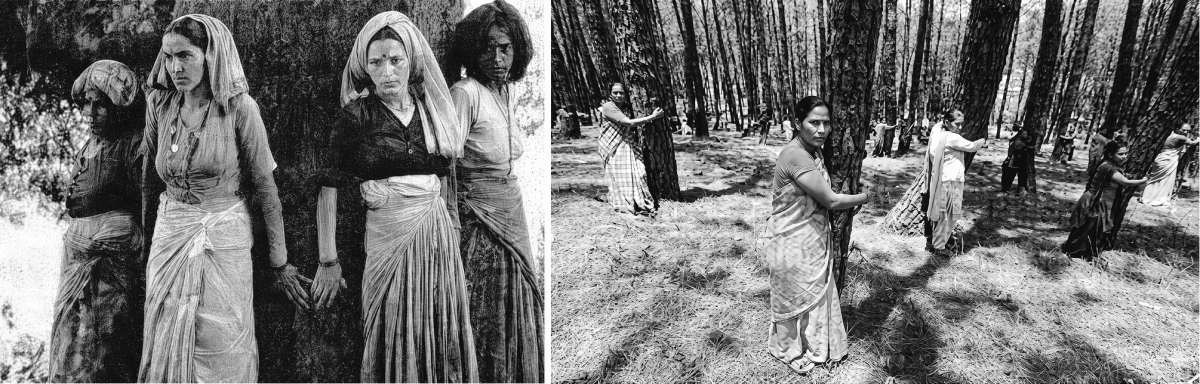
Answer
The pictures show women hugging trees, depicting the Chipko Andolan (Chipko Movement).
In the 1970s, an organised resistance to the destruction of forests spread throughout India, which came to be known as Chipko Andolan. Chipko literally means "hug the trees". The movement was a grassroots effort aimed at:
Raising Awareness about Deforestation — It highlighted the dangers of rampant deforestation in the Himalayan region.
Promoting Sustainable Forest Management — It advocated for the protection and sustainable use of forest resources.
Advocating Rights of Local Communities — It supported the rights of local villagers whose livelihood depended on the forests.
The movement was a response to rampant deforestation and commercial logging activities that were negatively impacting the livelihood of local villagers and the fragile Himalayan ecosystem.
Key Leaders:
- Sunderlal Bahuguna — Led the movement, undertook a 5000-kilometre foot march to spread the Chipko message, and coined the slogan "Ecology is permanent economy".
- Chandi Prasad Bhatt — An activist who went into the forests and formed circles around trees, preventing them from being cut.
- Ghanshyam Raturi — The Chipko poet who wrote the famous poem: "Embrace the trees and save them from being felled; The property of our hills, save them from being looted."
- Dhoom Singh Negi — Along with village women, coined the slogan: "What do the forests bear? Soil, water and pure air."
Impact of the Movement:
- The Chipko Andolan drew worldwide attention and inspired environmentalists in India and abroad.
- It made a substantial contribution to eco-feminism, deep ecology, community-based conservation and sustainable development.
- The Chipko movement led to a ban on the felling of green trees in the Himalayan forests.
Study the pictures below. Give the reason for the corrosion of these statues and state its causes created by nature and human activities.
Answer
The pictures show statues that have been corroded and damaged. The corrosion of these statues is caused by Acid Rain.
Reason for Corrosion:
Acid rain means rainfall with a pH of less than 5.6. Acid rain is corrosive in nature and corrodes buildings, monuments, metals and rock structures. Structures containing limestone or marble rocks are particularly corroded by acid rain because the acid (mainly sulphuric acid) reacts with the calcium carbonate in these stones, causing their gradual deterioration. The reaction can be represented as:
CaCO3 + H2SO4 → CaSO4 + H2O + CO2
The calcium sulphate formed is soluble in water and washes away, leading to loss of detail and ultimately the destruction of the statue's features.
Causes of Acid Rain by Nature:
Lightning — Lightning produces oxides of nitrogen, which combine with water to form nitric acid.
Volcanic Activities — Volcanic eruptions release sulphur dioxide and other gases into the atmosphere, contributing to acid rain.
Forest Fires — Natural forest fires release sulphur and nitrogen oxides into the air.
Causes of Acid Rain by Human Activities:
Burning of Fossil Fuels — About 80% of oxides of sulphur come from the burning of fossil fuels in industries, power plants and automobiles. Sulphur trioxide reacts with water to form sulphuric acid (H2SO4), which is the principal (60-70%) cause of acid rain.
Industrial Emissions — Factories release sulphur dioxide, nitrogen oxides, chlorine and hydrochloric acid into the atmosphere.
Vehicular Emissions — Automobiles release nitrogen oxides and other pollutants that form acid rain.
Power Plants — Thermal power plants burning coal release large quantities of sulphur dioxide.
Hence, acid rain is essentially an outcome of aggressive industrialisation in developed countries and is caused by a combination of natural processes and human activities.