KnowledgeBoat Logo
|
OPEN IN APP

Chapter 27

Mixed Practice

Class - 10 Concise Mathematics Selina


SET A

Question 1

A dealer in Calcutta supplied the following goods/services to another dealer in Banaras. Find the total amount of bill :

Cost (in ₹) in CalcuttaDiscount %GST %
1050 18
1750 18
11002518
14253018
17254018

Answer

We know that,

Discounted price = (100 - Discount)% × MRP

Cost (in ₹) in CalcuttaDiscount %GST %Discounted price
1050 181050
1750 181750
1100251875% of 1100 = 825
1425301870% of 1425 = 997.50
1725401860% of 1725 = 1035
Total5657.50

As this is a inter-state transaction, hence IGST will apply.

IGST = 18% of 5657.50 = 18100×5657.50\dfrac{18}{100} \times 5657.50 = 1018.35

Total amount = ₹ 5657.50 + ₹ 1018.35 = ₹ 6675.85

Hence, amount of bill = ₹ 6675.85

Question 2

Some goods/services are supplied for ₹ 20,000 from Mathura (U.P.) to Ratlam (M.P.) and then from Ratlam to Indore (M.P.). If at each stage, the rate of tax under G.S.T. system is 12% and the profit made by the dealer in Ratlam is ₹ 3,750; find the cost of the article (in Indore) under GST.

Answer

S.P. in Mathura = ₹ 20,000

GST = IGST = 12% of ₹ 20,000 = 12100×20000\dfrac{12}{100} \times 20000 = ₹ 2400 (Inter state transaction)

GST charged by the dealer in Mathura = Input GST for the dealer in Ratlam = ₹ 2400.

S.P. in Ratlam = ₹ 20000 + ₹ 3750 = ₹ 23750.

GST charged by the dealer in Ratlam = CGST + SGST (Intra-state transaction)

CGST = 6% of ₹ 23750 = 6100×23750\dfrac{6}{100} \times 23750 = ₹ 1425

SGST = CGST = ₹ 1425

GST = CGST + SGST = ₹ 1425 + ₹ 1425 = ₹ 2850

Cost of the article in Indore = S.P. for dealer in Ratlam + GST

= ₹ 23750 + ₹ 2850

= ₹ 26600.

Hence, cost of article in Indore = ₹ 26600.

Question 3

Mr. Kumar has a recurring deposit account in a bank for 4 years at 10% p.a. rate of interest. If he gets ₹ 21,560 as interest at the time of maturity, find :

(i) the monthly instalment paid by Mr. Kumar.

(ii) the amount of maturity of this recurring deposit account.

Answer

(i) Let monthly deposit be ₹ P.

Given,

Time = 4 years = 4 × 12 = 48 months.

By formula,

Interest (I) = P × n(n+1)2×12×r100\dfrac{n(n + 1)}{2 \times 12} \times \dfrac{r}{100}

Substituting values we get :

21560=P×48×(48+1)2×12×1010021560=P×48×4924×110P=21560×24×1048×49P=10780049=2,200.\Rightarrow 21560 = P \times \dfrac{48 \times (48 + 1)}{2 \times 12} \times \dfrac{10}{100} \\[1em] \Rightarrow 21560 = P \times \dfrac{48 \times 49}{24} \times \dfrac{1}{10} \\[1em] \Rightarrow P = \dfrac{21560 \times 24 \times 10}{48 \times 49} \\[1em] \Rightarrow P = \dfrac{107800}{49} = ₹ 2,200.

Hence, monthly installment = ₹ 2,200.

(ii) By formula,

Maturity value = P × n + Interest

= ₹ 2200 × 48 + ₹ 21560

= ₹ 105600 + ₹ 21560

= ₹ 1,27,160.

Hence, amount of maturity = ₹ 1,27,160.

Question 4

The maturity value of a cumulative deposit account is ₹ 1,20,400. If each monthly installment for this account is ₹ 1,600 and the rate of interest is 10% per year, find the time for which the account was held.

Answer

Let time be n months.

Given,

M.V. = ₹ 1,20,400

By formula,

M.V. = P × n + P × n(n+1)2×12×r100\dfrac{n(n + 1)}{2 \times 12} \times \dfrac{r}{100}

Substituting values we get :

120400=1600×n+1600×n(n+1)2×12×10100120400=1600(n+n(n+1)24×10100)1204001600=n+n(n+1)2403014=240n+n2+n240301×2404=240n+n2+n301×60=n2+241nn2+241n18060=0n2+301n60n18060=0n(n+301)60(n+301)=0(n60)(n+301)=0n=60 or n=301.\Rightarrow 120400 = 1600 × n + 1600 \times \dfrac{n(n + 1)}{2 \times 12} \times \dfrac{10}{100} \\[1em] \Rightarrow 120400 = 1600\Big(n + \dfrac{n(n + 1)}{24} \times \dfrac{10}{100}\Big) \\[1em] \Rightarrow \dfrac{120400}{1600} = n + \dfrac{n(n + 1)}{240} \\[1em] \Rightarrow \dfrac{301}{4} = \dfrac{240n + n^2 + n}{240} \\[1em] \Rightarrow \dfrac{301 \times 240}{4} = 240n + n^2 + n \\[1em] \Rightarrow 301 \times 60 = n^2 + 241n \\[1em] \Rightarrow n^2 + 241n - 18060 = 0 \\[1em] \Rightarrow n^2 + 301n - 60n - 18060 = 0 \\[1em] \Rightarrow n(n + 301) - 60(n + 301) = 0 \\[1em] \Rightarrow (n - 60)(n + 301) = 0 \\[1em] \Rightarrow n = 60 \text{ or } n = -301.

Since, time cannot be negative.

∴ n = 60 months or 6012\dfrac{60}{12} = 5 years.

Hence, time = 5 years.

Question 5

Rajat invested ₹ 24,000 in 7% hundred rupee shares at 20% discount. After one year, he sold these shares at ₹ 75 each and invested the proceeds (including dividend of first year) in 18% twenty five rupee shares at 64% premium. Find :

(i) his gain or loss after one year.

(ii) his annual income from the second investment.

(iii) the percentage of increase in return on his original investment.

Answer

Given, investment = ₹ 24000, div % = 7%, N.V. = ₹ 100,

⇒ M.V. = N.V. - discount

⇒ M.V. = ₹ 100 - 20100×100\dfrac{20}{100} \times 100 = ₹ 100 - ₹ 20 = ₹ 80.

(i) No. of shares = InvestmentM.V. of each share=2400080\dfrac{\text{Investment}}{\text{M.V. of each share}} = \dfrac{₹ 24000}{₹ 80} = 300.

∴ Dividend on 1 share = 7% of ₹ 100 = ₹ 7

∴ Rajat's dividend for the first year = ₹ 7 × 300 = ₹ 2100.

Hence, Rajat gained ₹ 2100 in first year.

(ii) Since, each share is sold for ₹ 75

∴ Proceeds (including dividend) = 300 × ₹ 75 + ₹ 2100 = ₹ 22500 + ₹ 2100 = ₹ 24600.

N.V. of each share = ₹ 25

M.V. of each share = N.V. + 64% of N.V.

= ₹ 25 + 64100×25\dfrac{64}{100} \times 25

= ₹ 25 + ₹ 16

= ₹ 41

Dividend = 18%

∴ No. of shares bought = InvestmentM.V. of each share=2460041\dfrac{\text{Investment}}{\text{M.V. of each share}} = \dfrac{₹ 24600}{₹ 41} = 600.

Dividend on 1 share = 18% of ₹ 25 = 18×25100\dfrac{18 \times 25}{100} = ₹ 4.50

Annual dividend (income) from second investment = 600 × ₹ 4.50 = ₹ 2700.

Hence, annual dividend (income) from second investment = ₹ 2700.

(iii) Increase in return = ₹ 2700 - ₹ 2100 = ₹ 600.

Percentage increase in return (on original investment) = 60024000×100=10040\dfrac{600}{24000} \times 100 = \dfrac{100}{40} = 2.5 %.

Hence, percentage increase in return = 2.5 %.

Question 6

A man sold some ₹ 20 shares, paying 8% dividend, at 10% discount and invested the proceeds in ₹ 10 shares, paying 12% dividend, at 50% premium. If the change in his annual income is ₹ 600, find the number of shares sold by the man.

Answer

N.V. of share = ₹ 20

M.V. of share = N.V. - Discount

= ₹ 20 - 10% of 20

= ₹ 20 - 10100×20\dfrac{10}{100} \times 20

= ₹ 20 - ₹ 2 = ₹ 18.

∴ Dividend on 1 share = 8% of ₹ 20 = 8100×20\dfrac{8}{100} \times 20 = ₹ 1.60

Let no. of shares purchased be x.

Dividend on x number of shares = 1.6x

S.P. of each share = ₹ 18

S.P. of x shares (Sum invested) = ₹ 18x

In 2nd investment

N.V. of share = ₹ 10

M.V. of share = N.V. + Premium

= ₹ 10 + 50% of 10

= ₹ 10 + ₹ 5

= ₹ 15

No. of shares purchased = InvestmentM.V. of share=18x15\dfrac{\text{Investment}}{\text{M.V. of share}} = \dfrac{18x}{15}

∴ Dividend on 1 share = 12% of ₹ 10 = 12100×10\dfrac{12}{100} \times 10 = ₹ 1.2.

Total income = 1.2 × 18x15=21.6x15\dfrac{18x}{15} = \dfrac{21.6x}{15} = 1.44x

Given,

Change in income = ₹ 600

⇒ 1.6x - 1.44x = 600

⇒ 0.16x = 600

⇒ x = 6000.16\dfrac{600}{0.16} = 3750.

Hence, no. of shares sold = 3750.

Question 7

Find the value of x which satisfies the inequation :

-2 ≤ 122x3156\dfrac{1}{2} - \dfrac{2x}{3} \le 1\dfrac{5}{6}, x ∈ W.

Also, graph the solution on a number line.

Answer

Solving L.H.S. of the above inequation :

2122x32x312+22x352x52×32x154 .........(1) \Rightarrow -2 \le \dfrac{1}{2} - \dfrac{2x}{3} \\[1em] \Rightarrow \dfrac{2x}{3} \le \dfrac{1}{2} + 2 \\[1em] \Rightarrow \dfrac{2x}{3} \le \dfrac{5}{2} \\[1em] \Rightarrow x \le \dfrac{5}{2} \times \dfrac{3}{2} \\[1em] \Rightarrow x \le \dfrac{15}{4} \text{ .........(1) }

Solving R.H.S. of the above inequation :

122x3156122x31162x3121162x33116x86×32x2 .......(2)\Rightarrow \dfrac{1}{2} - \dfrac{2x}{3} \le 1\dfrac{5}{6} \\[1em] \Rightarrow \dfrac{1}{2} - \dfrac{2x}{3} \le \dfrac{11}{6} \\[1em] \Rightarrow \dfrac{2x}{3} \ge \dfrac{1}{2} - \dfrac{11}{6}\\[1em] \Rightarrow \dfrac{2x}{3} \ge \dfrac{3 - 11}{6} \\[1em] \Rightarrow x \ge -\dfrac{8}{6} \times \dfrac{3}{2} \\[1em] \Rightarrow x \ge -2 \text{ .......(2)}

From (1) and (2), we get :

-2 ≤ x ≤ 154\dfrac{15}{4}

Since, x ∈ W.

x = {0, 1, 2, 3}

Find the value of x which satisfies the inequation. Also, graph the solution on a number line. Mixed Practice, Concise Mathematics Solutions ICSE Class 10.

Hence, x = {0, 1, 2, 3}.

Question 8

Solve (using formula) the equation :

xx+1+x+1x=2415\dfrac{x}{x + 1} + \dfrac{x + 1}{x} = 2\dfrac{4}{15}.

Answer

Given, equation :

xx+1+x+1x=2415x2+(x+1)2x(x+1)=341515[x2+(x+1)2]=34x(x+1)15x2+15(x+1)2=34x2+34x15x2+15(x2+1+2x)=34x2+34x15x2+15x2+15+30x=34x2+34x34x215x215x2+34x30x15=04x2+4x15=0.\Rightarrow \dfrac{x}{x + 1} + \dfrac{x + 1}{x} = 2\dfrac{4}{15} \\[1em] \Rightarrow \dfrac{x^2 + (x + 1)^2}{x(x + 1)} = \dfrac{34}{15} \\[1em] \Rightarrow 15[x^2 + (x + 1)^2] = 34x(x + 1) \\[1em] \Rightarrow 15x^2 + 15(x + 1)^2 = 34x^2 + 34x \\[1em] \Rightarrow 15x^2 + 15(x^2 + 1 + 2x) = 34x^2 + 34x \\[1em] \Rightarrow 15x^2 + 15x^2 + 15 + 30x = 34x^2 + 34x \\[1em] \Rightarrow 34x^2 - 15x^2 - 15x^2 + 34x - 30x - 15 = 0 \\[1em] \Rightarrow 4x^2 + 4x - 15 = 0.

Comparing above equation, with ax2 + bx + c = 0, we get :

a = 4, b = 4 and c = -15.

By formula,

x=b±b24ac2ax = \dfrac{-b \pm \sqrt{b^2 - 4ac}}{2a}

Substituting values we get :

x=4±424×4×(15)2×4=4±16+2408=4±2568=4±168=4+168,4168=128,208=32,52x = \dfrac{-4 \pm \sqrt{4^2 - 4 \times 4 \times (-15)}}{2 \times 4} \\[1em] = \dfrac{-4 \pm \sqrt{16 + 240}}{8} \\[1em] = \dfrac{-4 \pm \sqrt{256}}{8} \\[1em] = \dfrac{-4 \pm 16}{8} \\[1em] = \dfrac{-4 + 16}{8}, \dfrac{-4 - 16}{8} \\[1em] = \dfrac{12}{8}, -\dfrac{20}{8} \\[1em] = \dfrac{3}{2}, -\dfrac{5}{2}

Hence, x = 52-\dfrac{5}{2}, 32\dfrac{3}{2}

Question 9

By selling an article for ₹ 24, a man gains as much percent as its cost price. Find the cost price of the article.

Answer

Let cost price be ₹ x.

Profit = ₹ (24 - x)

According to question,

Profit percent = x%.

By formula,

Profit\Rightarrow \text{Profit} % = ProfitC.P.×100\dfrac{\text{Profit}}{\text{C.P.}} \times 100

x=24xx×100x2=100(24x)x2=2400100xx2+100x2400=0x2+120x20x2400=0x(x+120)20(x+120)=0(x20)(x+120)=0x20=0 or x+120=0x=20 or x=120.\Rightarrow x = \dfrac{24 - x}{x} \times 100 \\[1em] \Rightarrow x^2 = 100(24 - x) \\[1em] \Rightarrow x^2 = 2400 - 100x \\[1em] \Rightarrow x^2 + 100x - 2400 = 0 \\[1em] \Rightarrow x^2 + 120x - 20x - 2400 = 0 \\[1em] \Rightarrow x(x + 120) - 20(x + 120) = 0 \\[1em] \Rightarrow (x - 20)(x + 120) = 0 \\[1em] \Rightarrow x - 20 = 0 \text{ or } x + 120 = 0 \\[1em] \Rightarrow x = 20 \text{ or } x = -120.

Since, C.P. cannot be negative.

∴ x = ₹ 20.

Hence, cost price = ₹ 20.

Question 10

B takes 16 days less than A to do a certain piece of work. If both working together can complete the work in 15 days, in how many days will B alone complete the work ?

Answer

Let A take x days to complete the work so B will take (x - 16) days.

Work done by A alone in 1 day = 1x\dfrac{1}{x}

Work done by B alone in 1 day = 1x16\dfrac{1}{x - 16}

Work done by A and B together in 1 day is 1x+1x16\dfrac{1}{x} + \dfrac{1}{x - 16}

Given,

If both work together, they finish the work in 15 days.

15(1x+1x16)=1x16+xx(x16)=1152x16x216x=11515(2x16)=x216x30x240=x216xx216x30x+240=0x246x+240=0x240x6x+240=0x(x40)6(x40)=0(x6)(x40)=0x6=0 or x40=0x=6 or x=40.\therefore 15\Big(\dfrac{1}{x} + \dfrac{1}{x - 16}\Big) = 1 \\[1em] \Rightarrow \dfrac{x - 16 + x}{x(x - 16)} = \dfrac{1}{15} \\[1em] \Rightarrow \dfrac{2x - 16}{x^2 - 16x} = \dfrac{1}{15} \\[1em] \Rightarrow 15(2x - 16) = x^2 - 16x \\[1em] \Rightarrow 30x - 240 = x^2 - 16x \\[1em] \Rightarrow x^2 - 16x - 30x + 240 = 0 \\[1em] \Rightarrow x^2 - 46x + 240 = 0 \\[1em] \Rightarrow x^2 - 40x - 6x + 240 = 0 \\[1em] \Rightarrow x(x - 40) - 6(x - 40) = 0 \\[1em] \Rightarrow (x - 6)(x - 40) = 0 \\[1em] \Rightarrow x - 6 = 0 \text{ or } x - 40 = 0 \\[1em] \Rightarrow x = 6 \text{ or } x = 40.

Value of x will be greater than 16.

∴ x = 40 and x - 16 = 40 - 16 = 24.

Hence, B alone can finish the work in 24 days.

Question 11

Divide ₹ 1870 into three parts in such a way that half of the first part, one-third of the second part and one-sixth of the third part are all equal.

Answer

Let half of the first part, one-third of the second part and one-sixth of the third part be equal to x.

12\dfrac{1}{2} First part = x

⇒ First part = 2x

13\dfrac{1}{3} Second part = x

⇒ Second part = 3x

16\dfrac{1}{6} Third part = x

⇒ Third part = 6x.

We know that,

⇒ Total = ₹ 1870

⇒ 2x + 3x + 6x = ₹ 1870

⇒ 11x = ₹ 1870

⇒ x = 187011\dfrac{1870}{11} = ₹ 170.

First part = 2x = 2 × 170 = ₹ 340

Second part = 3x = 3 × 170 = ₹ 510

Third part = 6x = 6 × 170 = ₹ 1020

Hence, first part = ₹ 340, second part = ₹ 510 and third part = ₹ 1020.

Question 12

If a + c = be and 1b+1d=ec\dfrac{1}{b} + \dfrac{1}{d} = \dfrac{e}{c}, prove that : a, b, c and d are in proportion.

Answer

Given,

a + c = be and 1b+1d=ec\dfrac{1}{b} + \dfrac{1}{d} = \dfrac{e}{c}.

Solving,

a + c = be

Divide the equation by b,

ab+cb\Rightarrow \dfrac{a}{b} + \dfrac{c}{b} = e ............(1)

Now solving,

1b+1d=ec\dfrac{1}{b} + \dfrac{1}{d} = \dfrac{e}{c}

Multiplying the equation by c,

cb+cd\Rightarrow \dfrac{c}{b} + \dfrac{c}{d} = e

Putting value of e from equation (1) in above equation, we get :

cb+cd=ab+cbcd=ab.\Rightarrow \dfrac{c}{b} + \dfrac{c}{d} = \dfrac{a}{b} + \dfrac{c}{b} \\[1em] \Rightarrow \dfrac{c}{d} = \dfrac{a}{b}.

Since, ab=cd\dfrac{a}{b} = \dfrac{c}{d}, hence, a, b, c and d are in proportion.

Question 13

If 4x+3y4x3y=74\dfrac{4x + 3y}{4x - 3y} = \dfrac{7}{4}, use the properties to find the value of 2x211y22x2+11y2\dfrac{2x^2 - 11y^2}{2x^2 + 11y^2}.

Answer

Given,

Equation : 4x+3y4x3y=74\dfrac{4x + 3y}{4x - 3y} = \dfrac{7}{4}

Applying componendo and dividendo we get :

4x+3y+(4x3y)4x+3y(4x3y)=7+4748x6y=113xy=6×113×8xy=114\Rightarrow \dfrac{4x + 3y + (4x - 3y)}{4x + 3y - (4x - 3y)} = \dfrac{7 + 4}{7 - 4} \\[1em] \Rightarrow \dfrac{8x}{6y} = \dfrac{11}{3} \\[1em] \Rightarrow \dfrac{x}{y} = \dfrac{6 \times 11}{3 \times 8} \\[1em] \Rightarrow \dfrac{x}{y} = \dfrac{11}{4}

Squaring both sides,

(xy)2=12116x2y2=12116\Rightarrow \Big(\dfrac{x}{y}\Big)^2 = \dfrac{121}{16} \\[1em] \Rightarrow \dfrac{x^2}{y^2} = \dfrac{121}{16}

Multiplying both sides by 211\dfrac{2}{11}, we get :

2x211y2=12116×2112x211y2=118\Rightarrow \dfrac{2x^2}{11y^2} = \dfrac{121}{16} \times \dfrac{2}{11} \\[1em] \Rightarrow \dfrac{2x^2}{11y^2} = \dfrac{11}{8}

Applying componendo and dividendo we get :

2x2+11y22x211y2=11+81182x2+11y22x211y2=1932x211y22x2+11y2=319.\Rightarrow \dfrac{2x^2 + 11y^2}{2x^2 - 11y^2} = \dfrac{11 + 8}{11 - 8} \\[1em] \Rightarrow \dfrac{2x^2 + 11y^2}{2x^2 - 11y^2} = \dfrac{19}{3} \\[1em] \Rightarrow \dfrac{2x^2 - 11y^2}{2x^2 + 11y^2} = \dfrac{3}{19}.

Hence, 2x211y22x2+11y2=319\dfrac{2x^2 - 11y^2}{2x^2 + 11y^2} = \dfrac{3}{19}.

Question 14

Use the properties of proportionality to solve : 12x+1+2x312x+12x3=32\dfrac{\sqrt{12x + 1} + \sqrt{2x - 3}}{\sqrt{12x + 1} - \sqrt{2x - 3}} = \dfrac{3}{2}.

Answer

Given,

Equation : 12x+1+2x312x+12x3=32\dfrac{\sqrt{12x + 1} + \sqrt{2x - 3}}{\sqrt{12x + 1} - \sqrt{2x - 3}} = \dfrac{3}{2}.

Applying componendo and dividendo we get :

12x+1+2x3+(12x+12x3)12x+1+2x3(12x+12x3)=3+232212x+122x3=512x+12x3=5\Rightarrow \dfrac{\sqrt{12x + 1} + \sqrt{2x - 3} + (\sqrt{12x + 1} - \sqrt{2x - 3})}{\sqrt{12x + 1} + \sqrt{2x - 3} - (\sqrt{12x + 1} - \sqrt{2x - 3})} = \dfrac{3 + 2}{3 - 2} \\[1em] \Rightarrow \dfrac{2\sqrt{12x + 1}}{2\sqrt{2x - 3}} = 5 \\[1em] \Rightarrow \dfrac{\sqrt{12x + 1}}{\sqrt{2x - 3}} = 5

Squaring both sides we get :

(12x+12x3)2=5212x+12x3=2512x+1=25(2x3)12x+1=50x7550x12x=75+138x=76x=7638=2.\Rightarrow \Big(\dfrac{\sqrt{12x + 1}}{\sqrt{2x - 3}}\Big)^2 = 5^2 \\[1em] \Rightarrow \dfrac{12x + 1}{2x - 3} = 25 \\[1em] \Rightarrow 12x + 1 = 25(2x - 3) \\[1em] \Rightarrow 12x + 1 = 50x - 75 \\[1em] \Rightarrow 50x - 12x = 75 + 1 \\[1em] \Rightarrow 38x = 76 \\[1em] \Rightarrow x = \dfrac{76}{38} = 2.

Hence, x = 2.

Question 15

What number should be added to 2x3 - 3x2 - 8x + 3 so that the resulting polynomial leaves the remainder 10 when divided by 2x + 1 ?

Answer

Given,

⇒ 2x + 1 = 0

⇒ x = -12\dfrac{1}{2}.

Let number added be a.

Polynomial = 2x3 - 3x2 - 8x + 3 + a

By remainder theorem,

When a polynomial p(x) is divided by (x - a), then the remainder = f(a).

2(12)33(12)28(12)+3+a=102×183×14+4+3+a=101434+a=104344+a=31+a=3a=3+1=4.\Rightarrow 2\Big(-\dfrac{1}{2}\Big)^3 - 3\Big(-\dfrac{1}{2}\Big)^2 - 8\Big(-\dfrac{1}{2}\Big) + 3 + a = 10 \\[1em] \Rightarrow 2 \times -\dfrac{1}{8} - 3 \times \dfrac{1}{4} + 4 + 3 + a = 10 \\[1em] \Rightarrow -\dfrac{1}{4} - \dfrac{3}{4} + a = 10 - 4 - 3 \\[1em] \Rightarrow \dfrac{-4}{4} + a = 3 \\[1em] \Rightarrow -1 + a = 3 \\[1em] \Rightarrow a = 3 + 1 = 4.

Hence, no. to be added = 4.

Question 16

If A = [1121], B =[x141]\begin{bmatrix*}[r] 1 & -1 \\ 2 & -1 \end{bmatrix*}, \text{ B =} \begin{bmatrix*}[r] x & 1 \\ 4 & -1 \end{bmatrix*} and A2 + B2 = (A + B)2, find the value of x.

State, whether A2 + B2 and (A + B)2 are always equal or not.

Answer

Given,

A2 + B2 = (A + B)2

[1121]2+[x141]2=([1121]+[x141])2[1121][1121]+[x141][x141]=([1+x062])2[1×1+(1)×21×1+(1)×(1)2×1+(1)×22×1+(1)×(1)]+[x×x+1×4x×1+1×(1)4×x+(1)×44×1+(1)×(1)]=[(1+x)2+0×6(1+x)×0+0×26(1+x)+(2)×66×0+(2)×(2)][121+1222+1]+[x2+4x14x44+1]=[(1+x)206+6x124][1001]+[x2+4x14x45]=[(1+x)206x64][x2+41x14x451]=[(1+x)206x64][x2+3x14x44]=[(1+x)206x64]\Rightarrow \begin{bmatrix*}[r] 1 & -1 \\ 2 & -1 \end{bmatrix*}^2 + \begin{bmatrix*}[r] x & 1 \\ 4 & -1 \end{bmatrix*}^2 = \Big(\begin{bmatrix*}[r] 1 & -1 \\ 2 & -1 \end{bmatrix*} + \begin{bmatrix*}[r] x & 1 \\ 4 & -1 \end{bmatrix*}\Big)^2 \\[1em] \Rightarrow \begin{bmatrix*}[r] 1 & -1 \\ 2 & -1 \end{bmatrix*}\begin{bmatrix*}[r] 1 & -1 \\ 2 & -1 \end{bmatrix*} + \begin{bmatrix*}[r] x & 1 \\ 4 & -1 \end{bmatrix*}\begin{bmatrix*}[r] x & 1 \\ 4 & -1 \end{bmatrix*} \\[1em] = \Big(\begin{bmatrix*}[r] 1 + x & 0 \\ 6 & -2 \end{bmatrix*}\Big)^2 \\[1em] \Rightarrow \begin{bmatrix*}[r] 1 \times 1 + (-1) \times 2 & 1 \times -1 + (-1) \times(-1) \\ 2 \times 1 + (-1) \times 2 & 2 \times -1 + (-1) \times (-1) \end{bmatrix*} + \begin{bmatrix*}[r] x \times x + 1 \times 4 & x \times 1 + 1 \times(-1) \\ 4 \times x + (-1) \times 4 & 4 \times 1 + (-1) \times (-1) \end{bmatrix*} \\[1em] = \begin{bmatrix*}[r] (1 + x)^2 + 0 \times 6 & (1 + x) \times 0 + 0 \times -2 \\ 6(1 + x) + (-2) \times 6 & 6 \times 0 + (-2) \times(-2) \end{bmatrix*} \\[1em] \Rightarrow \begin{bmatrix*}[r] 1 - 2 & -1 + 1 \\ 2 - 2 & -2 + 1 \end{bmatrix*} + \begin{bmatrix*}[r] x^2 + 4 & x - 1 \\ 4x - 4 & 4 + 1 \end{bmatrix*} \\[1em] = \begin{bmatrix*}[r] (1 + x)^2 & 0 \\ 6 + 6x - 12 & 4 \end{bmatrix*} \\[1em] \Rightarrow \begin{bmatrix*}[r] -1 & 0 \\ 0 & -1 \end{bmatrix*} + \begin{bmatrix*}[r] x^2 + 4 & x - 1 \\ 4x - 4 & 5 \end{bmatrix*} = \begin{bmatrix*}[r] (1 + x)^2 & 0 \\ 6x - 6 & 4 \end{bmatrix*} \\[1em] \Rightarrow \begin{bmatrix*}[r] x^2 + 4 - 1 & x - 1 \\ 4x - 4 & 5 - 1 \end{bmatrix*} = \begin{bmatrix*}[r] (1 + x)^2 & 0 \\ 6x - 6 & 4 \end{bmatrix*} \\[1em] \Rightarrow \begin{bmatrix*}[r] x^2 + 3 & x - 1 \\ 4x - 4 & 4 \end{bmatrix*} = \begin{bmatrix*}[r] (1 + x)^2 & 0 \\ 6x - 6 & 4 \end{bmatrix*}

⇒ x - 1 = 0

⇒ x = 1.

A2 + B2 and (A + B)2 are not always equal. As,

By formula,

(A + B)2 = A2 + B2 + 2AB.

Hence, x = 1.

Question 17

Find the 10th term of the sequence 10, 8, 6, ........

Answer

Given, sequence : 10, 8, 6, ........

The above sequence is an A.P. with first term (a) = 10 and common difference (d) = (8 - 10) = -2.

By formula,

⇒ an = a + (n - 1)d

⇒ a10 = 10 + (10 - 1) × -2

⇒ a10 = 10 + 9 × -2 = 10 - 18 = -8.

Hence, 10th term of the sequence = -8.

Question 18

If the 5th and 11th terms of an A.P. are 16 and 34 respectively. Find the A.P.

Answer

Let first term be a and common difference be d of A.P.

By formula,

⇒ an = a + (n - 1)d

5th term = 16

⇒ a5 = 16

⇒ a + (5 - 1)d = 16

⇒ a + 4d = 16 .........(1)

11th term = 34

⇒ a11 = 34

⇒ a + (11 - 1)d = 34

⇒ a + 10d = 34 ........(2)

Subtracting equation (1) from (2), we get :

⇒ a + 10d - (a + 4d) = 34 - 16

⇒ a - a + 10d - 4d = 18

⇒ 6d = 18

⇒ d = 3.

Substituting value of d in equation (1), we get :

⇒ a + 4(3) = 16

⇒ a + 12 = 16

⇒ a = 4.

A.P. = a, (a + d), (a + 2d), ........

= 4, (4 + 3), (4 + 2 × 3), ........

= 4, 7, 10, .......

Hence, A.P. = 4, 7, 10, .......

Question 19

If pth term of and A.P. is q and its qth term is p, show that its rth term is (p + q - r).

Answer

Let first term of A.P. be a and common term be d.

By formula,

⇒ an = a + (n - 1)d

Given,

⇒ pth term = q

⇒ a + (p - 1)d = q ..........(1)

⇒ qth term = p

⇒ a + (q - 1)d = p ..........(2)

Subtracting (2) from (1), we get :

⇒ a + (p - 1)d - [a + (q - 1)d] = q - p

⇒ a - a + (p - 1)d - (q - 1)d = (q - p)

⇒ d[p - 1 - (q - 1)] = (q - p)

⇒ d[p - 1 - q + 1] = (q - p)

⇒ d[p - q] = (q - p)

⇒ d[p - q] = -(p - q)

⇒ d = -1.

Substituting value of d in equation (1),

⇒ a + (p - 1)(-1) = q

⇒ a - p + 1 = q

⇒ a = p + q - 1.

rth term = ar

= a + (r - 1)d

= p + q - 1 + (r - 1)(-1)

⇒ p + q - 1 - r + 1

⇒ p + q - r.

Hence, proved that rth term = p + q - r.

Question 20

If nth term of an A.P. is (2n - 1), find its 7th term.

Answer

Given,

⇒ an = (2n - 1)

⇒ a7 = (2 × 7 - 1) = 13.

Hence, 7th term = 13.

Question 21

If the sum of first n terms of an A.P. is 3n2 + 2n, find its rth term.

Answer

By formula,

Sn = n2[2a+(n1)d]\dfrac{n}{2}[2a + (n - 1)d]

Given,

Sn = 3n2 + 2n

Equating values we get :

3n2+2n=n2[2a+(n1)d]3n2+2n=n2[a+a+(n1)d]n(3n+2)=n2[a+an]3n+2=a+an22(3n+2)=a+an6n+4=a+an .........(1)\Rightarrow 3n^2 + 2n = \dfrac{n}{2}[2a + (n - 1)d] \\[1em] \Rightarrow 3n^2 + 2n = \dfrac{n}{2}[a + a + (n - 1)d] \\[1em] \Rightarrow n(3n + 2) = \dfrac{n}{2}[a + a_n] \\[1em] \Rightarrow 3n + 2 = \dfrac{a + a_n}{2} \\[1em] \Rightarrow 2(3n + 2) = a + a_n \\[1em] \Rightarrow 6n + 4 = a + a_n \text{ .........(1)}

As,

Sn = 3n2 + 2n

S1 = 3(1)2 + 2(1) = 3 + 2 = 5.

∴ a = 5.

Substituting value in (1), we get :

⇒ 6n + 4 = 5 + an

⇒ an = 6n - 1

⇒ ar = 6r - 1

Hence, rth term = 6r - 1.

Question 22

For an A.P. the sum of its terms is 60, common difference is 2 and last term is 18. Find the number of terms in the A.P.

Answer

Given,

Common difference (d) = 2

Last term (l) = 18

Let no. of terms be n.

⇒ l = a + (n - 1)d

⇒ 18 = a + 2(n - 1)

⇒ 18 = a + 2n - 2

⇒ a + 2n = 20

⇒ a = 20 - 2n .........(1)

By formula,

Sn = n2(a+l)\dfrac{n}{2}(a + l)

Substituting values we get :

60=n2(a+18)120=n(a+18)\Rightarrow 60 = \dfrac{n}{2}(a + 18) \\[1em] \Rightarrow 120 = n(a + 18)

Substituting value of a in above equation, we get :

120=n(202n+18)120=n(382n)120=38n2n22n238n+120=02(n219n+60)=0n219n+60=0n215n4n+60=0n(n15)4(n15)=0(n4)(n15)=0n4=0 or n15=0n=4 or n=15.\Rightarrow 120 = n(20 - 2n + 18) \\[1em] \Rightarrow 120 = n(38 - 2n) \\[1em] \Rightarrow 120 = 38n - 2n^2 \\[1em] \Rightarrow 2n^2 - 38n + 120 = 0 \\[1em] \Rightarrow 2(n^2 - 19n + 60) = 0 \\[1em] \Rightarrow n^2 - 19n + 60 = 0 \\[1em] \Rightarrow n^2 - 15n - 4n + 60 = 0 \\[1em] \Rightarrow n(n - 15) - 4(n - 15) = 0 \\[1em] \Rightarrow (n - 4)(n - 15) = 0 \\[1em] \Rightarrow n - 4 = 0 \text{ or } n - 15 = 0 \\[1em] \Rightarrow n = 4 \text{ or } n = 15.

Hence, no. of terms = 4 or 15.

Question 23

Find the geometric progression whose 5th term is 48 and 8th term is 384.

Answer

Let first term of G.P. be a and common ratio be r.

By formula,

⇒ an = arn - 1

⇒ a5 = ar5 - 1

⇒ 48 = ar4 ........(1)

⇒ a8 = 384

⇒ ar8 - 1 = 384

⇒ ar7 = 384 ........(2)

Dividing equation (2) by (1), we get :

ar7ar4=38448r3=8r3=(2)3r=2.\Rightarrow \dfrac{ar^7}{ar^4} = \dfrac{384}{48} \\[1em] \Rightarrow r^3 = 8 \\[1em] \Rightarrow r^3 = (2)^3 \\[1em] \Rightarrow r = 2.

Substituting value of r in equation (1), we get :

⇒ a(2)4 = 48

⇒ 16a = 48

⇒ a = 4816\dfrac{48}{16} = 3.

G.P. = a, ar, ar2, .........

= 3, 3 × 2, 3 × 22, ........

= 3, 6, 12, ......

Hence, G.P. = 3, 6, 12, ......

Question 24

Sum of how many terms of the G.P. 2913+12...... is 5572?\dfrac{2}{9} - \dfrac{1}{3} + \dfrac{1}{2} - ......\text{ is } \dfrac{55}{72} ?

Answer

Common ratio (r) = 1329=92×3=32\dfrac{-\dfrac{1}{3}}{\dfrac{2}{9}} = -\dfrac{9}{2 \times 3} = -\dfrac{3}{2}.

Let no. of terms be n.

By formula,

Sum of G.P. (when |r| > 1 ) = a(rn1)(r1)\dfrac{a(r^n - 1)}{(r - 1)}

Substituting value we get :

29[(32)n1](321)=557229[(32)n1](322)=557229[(32)n1](52)=557229[(32)n1]=5572×52[(32)n1]=5572×52×92[(32)n1]=27532(32)n=27532+1(32)n=275+3232(32)n=24332(32)n=(32)5n=5.\Rightarrow \dfrac{\dfrac{2}{9}\Big[\Big(-\dfrac{3}{2}\Big)^n - 1\Big]}{\Big(-\dfrac{3}{2} - 1\Big)} = \dfrac{55}{72} \\[1em] \Rightarrow \dfrac{\dfrac{2}{9}\Big[\Big(-\dfrac{3}{2}\Big)^n - 1\Big]}{\Big(\dfrac{-3 - 2}{2}\Big)} = \dfrac{55}{72} \\[1em] \Rightarrow \dfrac{\dfrac{2}{9}\Big[\Big(-\dfrac{3}{2}\Big)^n - 1\Big]}{\Big(-\dfrac{5}{2}\Big)} = \dfrac{55}{72} \\[1em] \Rightarrow \dfrac{2}{9}\Big[\Big(-\dfrac{3}{2}\Big)^n - 1\Big] = \dfrac{55}{72} \times -\dfrac{5}{2} \\[1em] \Rightarrow \Big[\Big(-\dfrac{3}{2}\Big)^n - 1\Big] = \dfrac{55}{72} \times -\dfrac{5}{2} \times \dfrac{9}{2} \\[1em] \Rightarrow \Big[\Big(-\dfrac{3}{2}\Big)^n - 1\Big] = -\dfrac{275}{32} \\[1em] \Rightarrow \Big(-\dfrac{3}{2}\Big)^n = -\dfrac{275}{32} + 1 \\[1em] \Rightarrow \Big(-\dfrac{3}{2}\Big)^n = \dfrac{-275 + 32}{32}\\[1em] \Rightarrow \Big(-\dfrac{3}{2}\Big)^n = -\dfrac{243}{32} \\[1em] \Rightarrow \Big(-\dfrac{3}{2}\Big)^n = \Big(-\dfrac{3}{2}\Big)^5 \\[1em] \Rightarrow n = 5.

Hence, sum of 5 terms = 5572\dfrac{55}{72}.

Question 25

Find the sum of n terms of the sequence : 5 + 55 + 555 + .......

Answer

Given,

Sequence : 5 + 55 + 555 + .......

⇒ 5(1 + 11 + 111 + ........)

59×9(1+11+111+.........\dfrac{5}{9} \times 9(1 + 11 + 111 + ......... upto n terms)

59(9+99+999+.........\dfrac{5}{9}(9 + 99 + 999 + ......... upto n terms)

59[(101)+(1021)+(1031)+.......\dfrac{5}{9}[(10 - 1) + (10^2 - 1) + (10^3 - 1) + ....... upto n terms]

59[(10+102+103+ upto n terms)n]\dfrac{5}{9}[(10 + 10^2 + 10^3 + \text{ upto n terms}) - n]

59[(10(10n1)101n)]\dfrac{5}{9}\Big[\Big(\dfrac{10(10^n - 1)}{10 - 1} - n\Big)\Big]

59×10(10n1)959n\dfrac{5}{9} \times \dfrac{10(10^n - 1)}{9} - \dfrac{5}{9}n

50(10n1)8159n\dfrac{50(10^n - 1)}{81} - \dfrac{5}{9}n

Hence, sum = 50(10n1)8159n\dfrac{50(10^n - 1)}{81} - \dfrac{5}{9}n.

Question 26

What point on x-axis is equidistant from the points (6, 7) and (4, -3) ?

Answer

We know that,

y-coordinate on x-axis = 0.

Let the point on x-axis be (x, 0).

Distance formula = (x2x1)2+(y2y1)2\sqrt{(x_2 - x_1)^2 + (y_2 - y_1)^2}

Since, (x, 0) is equidistant from (6, 7) and (4, -3)

(x6)2+(07)2=(x4)2+[0(3)]2x2+3612x+(7)2=x2+168x+32x2+3612x+49=x2+168x+9\therefore \sqrt{(x - 6)^2 + (0 - 7)^2} = \sqrt{(x - 4)^2 + [0 - (-3)]^2} \\[1em] \Rightarrow \sqrt{x^2 + 36 - 12x + (-7)^2} = \sqrt{x^2 + 16 - 8x + 3^2} \\[1em] \Rightarrow \sqrt{x^2 + 36 - 12x + 49} = \sqrt{x^2 + 16 - 8x + 9}

Squaring both sides we get :

x212x+85=x28x+25x2x28x+12x=85254x=60x=15.\Rightarrow x^2 - 12x + 85 = x^2 - 8x + 25 \\[1em] \Rightarrow x^2 - x^2 - 8x + 12x = 85 - 25 \\[1em] \Rightarrow 4x = 60 \\[1em] \Rightarrow x = 15.

(x, 0) = (15, 0).

Hence, (15, 0) is equidistant from (6, 7) and (4, -3).

Question 27

Calculate the ratio in which the line segment A(6, 5) and B(4, -3) is divided by the line y = 2.

Answer

We know that, y-coordinate on any point of the line y = 2 is 2. Let coordinate be x.

Point = (x, 2)

Let ratio in which point divides line segment AB is k : 1.

By section-formula,

(x, y) = (m1x2+m2x1m1+m2,m1y2+m2y1m1+m2)\Big(\dfrac{m_1x_2 + m_2x_1}{m_1 + m_2}, \dfrac{m_1y_2 + m_2y_1}{m_1 + m_2}\Big)

Substituting values for y-coordinate we get,

2=k×(3)+1×5k+12(k+1)=3k+52k+2=3k+52k+3k=525k=3k=35.\Rightarrow 2 = \dfrac{k \times (-3) + 1 \times 5}{k + 1} \\[1em] \Rightarrow 2(k + 1) = -3k + 5 \\[1em] \Rightarrow 2k + 2 = -3k + 5 \\[1em] \Rightarrow 2k + 3k = 5 - 2 \\[1em] \Rightarrow 5k = 3 \\[1em] \Rightarrow k = \dfrac{3}{5}.

k : 1 = 35:1\dfrac{3}{5} : 1 = 3 : 5.

Hence, ratio in which the line segment A(6, 5) and B(4, -3) is divided by the line y = 2 is 3 : 5.

Question 28

Find the equations of the diagonals of a rectangle whose sides are x + 1 = 0, x - 4 = 0, y + 1 = 0 and y - 2 = 0.

Answer

From graph,

Find the equations of the diagonals of a rectangle whose sides are x + 1 = 0, x - 4 = 0, y + 1 = 0 and y - 2 = 0. Mixed Practice, Concise Mathematics Solutions ICSE Class 10.

The lines intersect at point I, J, K and L.

By two point formula,

Equation of line : y - y1 = y2y1x2x1(xx1)\dfrac{y_2- y_1}{x_2 - x_1}(x - x_1)

Equation of diagonal IK is

y2=124(1)[x(1)]y2=35[x+1]5(y2)=3[x+1]5y10=3x35y+3x10+3=05y+3x7=0.\Rightarrow y - 2 = \dfrac{-1 - 2}{4 - (-1)}[x - (-1)] \\[1em] \Rightarrow y - 2 = -\dfrac{3}{5}[x + 1] \\[1em] \Rightarrow 5(y - 2) = -3[x + 1] \\[1em] \Rightarrow 5y - 10 = -3x - 3 \\[1em] \Rightarrow 5y + 3x - 10 + 3 = 0 \\[1em] \Rightarrow 5y + 3x - 7 = 0.

Equation of diagonal LJ is

y(1)=2(1)4(1)[x(1)]y+1=35[x+1]5(y+1)=3[x+1]5y+5=3x+35y3x+53=05y3x+2=0.\Rightarrow y - (-1) = \dfrac{2 - (-1)}{4 - (-1)}[x - (-1)] \\[1em] \Rightarrow y + 1 = \dfrac{3}{5}[x + 1] \\[1em] \Rightarrow 5(y + 1) = 3[x + 1] \\[1em] \Rightarrow 5y + 5 = 3x + 3 \\[1em] \Rightarrow 5y - 3x + 5 - 3 = 0 \\[1em] \Rightarrow 5y - 3x + 2 = 0.

Hence, equation of diagonals are 5y + 3x - 7 = 0 and 5y - 3x + 2 = 0

Question 29

The line 4x + 5y + 20 = 0 meets x-axis at point A and y-axis at point B. Find :

(i) the coordinates of points A and B.

(ii) the co-ordinates of point P in AB such that AB : BP = 5 : 3.

(iii) the equation of the line through P and perpendicular to AB.

Answer

(i) We know that,

y-coordinate at x-axis = 0.

Substituting y = 0 in 4x + 5y + 20 = 0, we get :

⇒ 4x + 5(0) + 20 = 0

⇒ 4x = -20

⇒ x = -5.

A = (-5, 0).

x-coordinate at y-axis = 0.

Substituting x = 0 in 4x + 5y + 20 = 0, we get :

⇒ 4(0) + 5y + 20 = 0

⇒ 5y = -20

⇒ y = 205\dfrac{-20}{5}

⇒ y = -4.

B = (0, -4).

Hence, A = (-5, 0) and B = (0, -4).

(ii) Given,

AB : BP = 5 : 3

Let AB = 5a and BP = 3a.

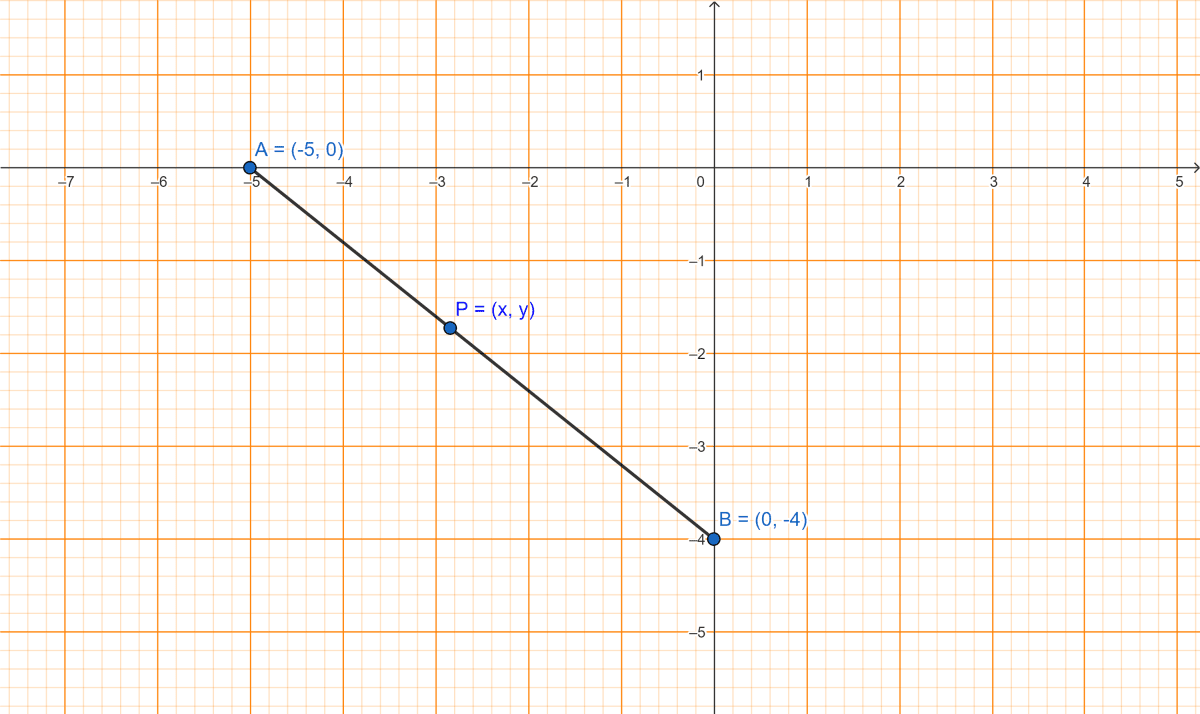
From figure,

The line 4x + 5y + 20 = 0 meets x-axis at point A and y-axis at point B. Find. (i) the coordinates of points A and B. (ii) the co-ordinates of point P in AB such that AB : BP = 5 : 3. (iii) the equation of the line through P and perpendicular to AB. Mixed Practice, Concise Mathematics Solutions ICSE Class 10.

⇒ AB = AP + PB

⇒ 5a = AP + 3a

⇒ AP = 5a - 3a = 2a.

AP : BP = 2a : 3a = 2 : 3.

Let coordinates of P be (x, y).

By section-formula,

(x, y) = (m1x2+m2x1m1+m2,m1y2+m2y1m1+m2)\Big(\dfrac{m_1x_2 + m_2x_1}{m_1 + m_2}, \dfrac{m_1y_2 + m_2y_1}{m_1 + m_2}\Big)

Substituting values for x-coordinate we get :

x=2×0+3×52+3x=0155x=155x=3.\Rightarrow x = \dfrac{2 \times 0 + 3 \times -5}{2 + 3} \\[1em] \Rightarrow x = \dfrac{0 - 15}{5} \\[1em] \Rightarrow x = \dfrac{-15}{5} \\[1em] \Rightarrow x = -3.

Substituting values for y-coordinate we get :

y=2×4+3×02+3y=8+05y=85=135.\Rightarrow y = \dfrac{2 \times -4 + 3 \times 0}{2 + 3} \\[1em] \Rightarrow y = \dfrac{-8 + 0}{5} \\[1em] \Rightarrow y = \dfrac{-8}{5} = -1\dfrac{3}{5}.

P = (x, y) = (3,135)\Big(-3, -1\dfrac{3}{5}\Big).

(iii) By formula,

Slope = y2y1x2x1\dfrac{y_2 - y_1}{x_2 - x_1}

Substituting values we get :

Slope of AB = 400(5)=45\dfrac{-4 - 0}{0 - (-5)} = -\dfrac{4}{5}

Let slope of line perpendicular to AB be m.

We know that,

Product of slope of perpendicular lines = -1.

45×m=1m=54.\therefore -\dfrac{4}{5} \times m = -1 \\[1em] \Rightarrow m = \dfrac{5}{4}.

By point-slope form,

Equation of line : y - y1 = m(x - x1)

Substituting values we get :

y(135)=54[x(3)]y+(85)=54[x+3]5y+85=5x+1544(5y+8)=5(5x+15)20y+32=25x+7525x20y+7532=025x20y+43=0\Rightarrow y - \Big(-1\dfrac{3}{5}\Big) = \dfrac{5}{4}[x - (-3)] \\[1em] \Rightarrow y + \Big(\dfrac{8}{5}\Big) = \dfrac{5}{4}[x + 3] \\[1em] \Rightarrow \dfrac{5y + 8}{5} = \dfrac{5x + 15}{4} \\[1em] \Rightarrow 4(5y + 8) = 5(5x + 15) \\[1em] \Rightarrow 20y + 32 = 25x + 75 \\[1em] \Rightarrow 25x - 20y + 75 - 32 = 0 \\[1em] \Rightarrow 25x - 20y + 43 = 0

Hence, equation of line through P and perpendicular to AB is 25x - 20y + 43 = 0.

Question 30

In the given figure, DE || BC and AE : EC = 5 : 4. Find :

In the given figure, DE || BC and AE : EC = 5 : 4. Find. (i) DE : BC (ii) DO : DC (iii) area of △DOE : area of △ DCE. Mixed Practice, Concise Mathematics Solutions ICSE Class 10.

(i) DE : BC

(ii) DO : DC

(iii) area of △DOE : area of △ DCE.

Answer

(i) Given,

DE || BC

In △ADE and △ABC,

∠ADE = ∠ABC [Corresponding angles are equal]

∠DAE = ∠BAC [Common angle]

△ADE ~ △ABC [By AA axiom]

Given,

AE : EC = 5 : 4

AE = 5x and EC = 4x

AC = AE + EC = 5x + 4x = 9x.

We know that,

Ratio of corresponding sides of two triangles are proportional to each other.

DEBC=AEACDEBC=5x9x=59.\Rightarrow \dfrac{DE}{BC} = \dfrac{AE}{AC} \\[1em] \Rightarrow \dfrac{DE}{BC} = \dfrac{5x}{9x} = \dfrac{5}{9}.

Hence, DE : BC = 5 : 9.

(ii) In △DOE and △BOC,

∠DOE = ∠BOC [Vertically opposite angles are equal]

∠ODE = ∠OCB [Alternate angles are equal]

△DOE ~ △BOC [By AA axiom]

Given,

DE : BC = 5 : 9

We know that,

Ratio of corresponding sides of two triangles are proportional to each other.

DOOC=DEBCDOOC=59.\Rightarrow \dfrac{DO}{OC} = \dfrac{DE}{BC} \\[1em] \Rightarrow \dfrac{DO}{OC} = \dfrac{5}{9}.

As,

DO : OC = 5 : 9

Let,

DO = 5y or OC = 9y

From figure,

DC = DO + OC = 5y + 9y = 14y.

DO : DC = 5y : 14y = 5 : 14.

Hence, DO : DC = 5 : 14.

(iii) We know that,

Ratio of areas of two triangles having equal heights is equal to the ratio of the corresponding bases.

Area of △DOEArea of △DCE=DODC=514\Rightarrow \dfrac{\text{Area of △DOE}}{\text{Area of △DCE}} = \dfrac{DO}{DC} = \dfrac{5}{14}

Hence, area of △DOE : area of △ DCE = 5 : 14.

Question 31

If chords AB and CD of a circle intersect each other at a point P inside the circle, prove that : PA × PB = PC × PD.

Answer

In △PAC and △PDB

∠APC = ∠DPB (Vertically opposite angles are equal)

∠CAP = ∠BDP (Angles in same segment are equal)

∴ △PAC ~ △PDB

We know that,

When two triangles are similar, the ratio of the lengths of their corresponding sides are proportional.

PAPD=PCPB\dfrac{PA}{PD} = \dfrac{PC}{PB}

⇒ PA × PB = PC × PD.

If chords AB and CD of a circle intersect each other at a point P inside the circle, prove that : PA × PB = PC × PD. Mixed Practice, Concise Mathematics Solutions ICSE Class 10.

Hence, proved that PA × PB = PC × PD.

Question 32

P and Q are centers of a circle of radii 9 cm and 2 cm respectively. PQ = 17 cm. R is the centre of a circle of radius x cm which touches the above circles externally. Given that ∠PRQ = 90°, write an equation in x and solve it.

Answer

From figure,

In △PQR,

By pythagoras theorem,

⇒ PQ2 = PR2 + QR2

⇒ 172 = (x + 9)2 + (x + 2)2

⇒ 289 = x2 + 81 + 18x + x2 + 4 + 4x

⇒ 289 = 2x2 + 22x + 85

⇒ 2x2 + 22x + 85 - 289 = 0

⇒ 2x2 + 22x - 204 = 0

⇒ 2(x2 + 11x - 102) = 0

⇒ x2 + 11x - 102 = 0

⇒ x2 + 17x - 6x - 102 = 0

⇒ x(x + 17) - 6(x + 17) = 0

⇒ (x - 6)(x + 17) = 0

⇒ x - 6 = 0 or x + 17 = 0

⇒ x = 6 or x = -17.

Since, radius cannot be negative.

⇒ x = 6 cm.

P and Q are centers of a circle of radii 9 cm and 2 cm respectively. PQ = 17 cm. R is the centre of a circle of radius x cm which touches the above circles externally. Given that ∠PRQ = 90°, write an equation in x and solve it. Mixed Practice, Concise Mathematics Solutions ICSE Class 10.

Hence, equation is x2 + 11x - 102 = 0 and x = 6 cm.

Question 33

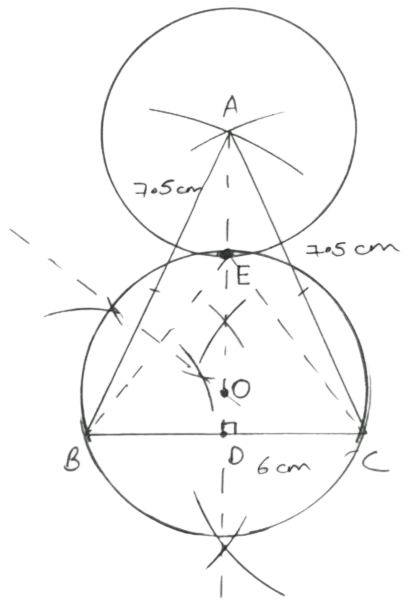
Use ruler and a pair of compasses only in this question :

(i) Draw a circle on AB = 6.4 cm as diameter.

(ii) Construct another circle of radius 2.5 cm to touch the circle in (i) above and the diameter AB produced.

Answer

(i) Steps of construction :

  1. Draw a line segment AB = 6.4 cm

  2. Draw perpendicular bisector of AB touching AB at point O.

  3. With O as center and radius OA or OB draw a circle.

  4. Draw a line LM parallel to AB at a distance of 2.5 cm.

  5. With centre O and radius 3.2 + 2.5 = 5.7 cm, draw an arc intersecting the line LM at D.

  6. With centre D and radius 2.5 cm, draw a circle which touches the given circle at E and AB produced at C.

Use ruler and a pair of compasses only in this question. (i) Draw a circle on AB = 6.4 cm as diameter. (ii) Construct another circle of radius 2.5 cm to touch the circle in (i) above and the diameter AB produced. Mixed Practice, Concise Mathematics Solutions ICSE Class 10.

Hence, above is the required circle.

Question 34

The internal and external diameters of a hollow hemispherical vessel are 14 cm and 21 cm respectively. The cost of silver plating of 1 cm2 of its surface is ₹ 32. Find the total cost of silver plating the vessel all over.

Answer

Given,

External radius (R) = 212\dfrac{21}{2} = 10.5 cm

Internal radius (r) = 142\dfrac{14}{2} = 7 cm

By formula,

Total surface area of hollow hemisphere (T)

= Curved surface area of inner hemispherical surface + Curved surface area of outer hemispherical surface + Area of shaded annular disc.

= 2πr2 + 2πR2 + πR2 - πr2

= 3πR2 + πr2

Substituting values we get :

T=3×227×(10.5)2227×72=667×110.25+154=66×15.75+154=1039.5+154=1193.5 cm2T = 3 \times \dfrac{22}{7} \times (10.5)^2 - \dfrac{22}{7} \times 7^2 \\[1em] = \dfrac{66}{7} \times 110.25 + 154 \\[1em] = 66 \times 15.75 + 154 \\[1em] = 1039.5 + 154 \\[1em] = 1193.5 \text{ cm}^2

Given,

Cost of silver plating of 1 cm2 of its surface is ₹ 32.

Total cost = 1193.5 × ₹ 32 = ₹ 38192

Hence, cost of silver plating the vessel = ₹ 38192.

Question 35(i)

Prove that :

cosec A + 1cosec A - 1\dfrac{\text{cosec A + 1}}{\text{cosec A - 1}} = (sec A + tan A)2

Answer

To prove:

cosec A + 1cosec A - 1\dfrac{\text{cosec A + 1}}{\text{cosec A - 1}} = (sec A + tan A)2

Solving L.H.S. of the equation :

1sin A+11sin A11 + sin Asin A1 - sin Asin A1 + sin A1 - sin A\Rightarrow \dfrac{\dfrac{1}{\text{sin A}} + 1}{\dfrac{1}{\text{sin A}} - 1} \\[1em] \Rightarrow \dfrac{\dfrac{\text{1 + sin A}}{\text{sin A}}}{\dfrac{\text{1 - sin A}}{\text{sin A}}} \\[1em] \Rightarrow \dfrac{\text{1 + sin A}}{\text{1 - sin A}}

Multiplying numerator and denominator by (1 + sin A), we get :

1 + sin A1 - sin A×1 + sin A1 + sin A(1 + sin A)21 - sin2A\Rightarrow \dfrac{\text{1 + sin A}}{\text{1 - sin A}} \times \dfrac{\text{1 + sin A}}{\text{1 + sin A}} \\[1em] \Rightarrow \dfrac{(\text{1 + sin A})^2}{\text{1 - sin}^2 A}

By formula,

1 - sin2 A = cos2 A

(1 + sin A)2cos2A(1 + sin Acos A)2(1cos A+sin Acos A)2(sec A + tan A)2.\Rightarrow \dfrac{\text{(1 + sin A)}^2}{\text{cos}^2 A} \\[1em] \Rightarrow \Big(\dfrac{\text{1 + sin A}}{\text{cos A}}\Big)^2 \\[1em] \Rightarrow \Big(\dfrac{1}{\text{cos A}} + \dfrac{\text{sin A}}{\text{cos A}}\Big)^2 \\[1em] \Rightarrow (\text{sec A + tan A})^2.

Since, L.H.S. = R.H.S.

Hence, proved that cosec A + 1cosec A - 1\dfrac{\text{cosec A + 1}}{\text{cosec A - 1}} = (sec A + tan A)2.

Question 35(ii)

Prove that :

cot A - tan A = 2 cos2A1sin A cos A\dfrac{\text{2 cos}^2 A - 1}{\text{sin A cos A}}

Answer

Solving R.H.S. of the equation :

2 cos2A1sin A cos Acos2A1+cos2Asin A cos Acos2A(1 - cos2A)sin A cos A\Rightarrow \dfrac{\text{2 cos}^2 A - 1}{\text{sin A cos A}} \\[1em] \Rightarrow \dfrac{\text{cos}^2 A - 1 + \text{cos}^2 A}{\text{sin A cos A}} \\[1em] \Rightarrow \dfrac{\text{cos}^2 A - \text{(1 - cos}^2 A)}{\text{sin A cos A}}

By formula,

1 - cos2 A = sin2 A

cos2Asin2Asin A cos Acos2Asin A cos Asin2Asin A cos Acos Asin Asin Acos Acot A - tan A.\Rightarrow \dfrac{\text{cos}^2 A - \text{sin}^2 A}{\text{sin A cos A}} \\[1em] \Rightarrow \dfrac{\text{cos}^2 A}{\text{sin A cos A}} - \dfrac{\text{sin}^2 A}{\text{sin A cos A}} \\[1em] \Rightarrow \dfrac{\text{cos A}}{\text{sin A}} - \dfrac{\text{sin A}}{\text{cos A}} \\[1em] \Rightarrow \text{cot A - tan A}.

Since, L.H.S. = R.H.S.

Hence, proved that cot A - tan A = 2 cos2A1sin A cos A\dfrac{\text{2 cos}^2 A - 1}{\text{sin A cos A}}.

Question 35(iii)

Prove that :

1 + cos A1 - cos A+1 - cos A1 + cos A\sqrt{\dfrac{\text{1 + cos A}}{\text{1 - cos A}}} + \sqrt{\dfrac{\text{1 - cos A}}{\text{1 + cos A}}} = 2 cosec A

Answer

To prove:

1 + cos A1 - cos A+1 - cos A1 + cos A\sqrt{\dfrac{\text{1 + cos A}}{\text{1 - cos A}}} + \sqrt{\dfrac{\text{1 - cos A}}{\text{1 + cos A}}} = 2 cosec A

Solving L.H.S. of the equation :

1 + cos A1 - cos A+1 - cos A1 + cos A1 + cos A1 - cos A×1 + cos A1 + cos A+1 - cos A1 + cos A×1 - cos A1 - cos A(1 + cos A)21 - cos2A+(1 - cos A)21 - cos2A\Rightarrow \sqrt{\dfrac{\text{1 + cos A}}{\text{1 - cos A}}} + \sqrt{\dfrac{\text{1 - cos A}}{\text{1 + cos A}}} \\[1em] \Rightarrow \sqrt{\dfrac{\text{1 + cos A}}{\text{1 - cos A}} \times \dfrac{\text{1 + cos A}}{\text{1 + cos A}}} + \sqrt{\dfrac{\text{1 - cos A}}{\text{1 + cos A}} \times \dfrac{\text{1 - cos A}}{\text{1 - cos A}}} \\[1em] \Rightarrow \sqrt{\dfrac{(\text{1 + cos A})^2}{\text{1 - cos}^2 A}} + \sqrt{\dfrac{(\text{1 - cos A})^2}{\text{1 - cos}^2 A}} \\[1em]

By formula,

1 - cos2 A = sin2 A

(1 + cos A)2sin2A+(1 - cos A)2sin2A1 + cos Asin A+1 - cos Asin A1sin A+cos Asin A+1sin Acos Asin Acosec A + cot A + cosec A - cot A2 cosec A.\Rightarrow \sqrt{\dfrac{(\text{1 + cos A})^2}{\text{sin}^2 A}} + \sqrt{\dfrac{(\text{1 - cos A})^2}{\text{sin}^2 A}} \\[1em] \Rightarrow \dfrac{\text{1 + cos A}}{\text{sin A}} + \dfrac{\text{1 - cos A}}{\text{sin A}} \\[1em] \Rightarrow \dfrac{1}{\text{sin A}} + \dfrac{\text{cos A}}{\text{sin A}} + \dfrac{1}{\text{sin A}} - \dfrac{\text{cos A}}{\text{sin A}} \\[1em] \Rightarrow \text{cosec A + cot A + cosec A - cot A} \\[1em] \Rightarrow \text{2 cosec A}.

Since, L.H.S. = R.H.S.

Hence, proved that 1 + cos A1 - cos A+1 - cos A1 + cos A\sqrt{\dfrac{\text{1 + cos A}}{\text{1 - cos A}}} + \sqrt{\dfrac{\text{1 - cos A}}{\text{1 + cos A}}} = 2 cosec A.

Question 35(iv)

Prove that :

cos Acosec A + 1+cos Acosec A - 1\dfrac{\text{cos A}}{\text{cosec A + 1}} + \dfrac{\text{cos A}}{\text{cosec A - 1}} = 2 tan A

Answer

To prove:

cos Acosec A + 1+cos Acosec A - 1\dfrac{\text{cos A}}{\text{cosec A + 1}} + \dfrac{\text{cos A}}{\text{cosec A - 1}} = 2 tan A

Solving L.H.S. of the equation

cos Acosec A + 1+cos Acosec A - 1cos A(cosec A - 1) + cos A(cosec A + 1)(cosec A + 1)(cosec A - 1)cos A.cosec A - cos A + cos A.cosec A+ cos Acosec2A1\Rightarrow \dfrac{\text{cos A}}{\text{cosec A + 1}} + \dfrac{\text{cos A}}{\text{cosec A - 1}} \\[1em] \Rightarrow \dfrac{\text{cos A(cosec A - 1) + cos A(cosec A + 1)}}{\text{(cosec A + 1)(cosec A - 1)}} \\[1em] \Rightarrow \dfrac{\text{cos A.cosec A - cos A + cos A.cosec A+ cos A}}{\text{cosec}^2 A - 1}

By formula,

cosec2 A - 1 = cot2 A

2 cos A cosec Acot2A2 cos A×1sin Acot2A2 cot Acot2A2cot A2 tan A.\Rightarrow \dfrac{\text{2 cos A cosec A}}{\text{cot}^2 A} \\[1em] \Rightarrow \dfrac{\text{2 cos A} \times \dfrac{1}{\text{sin A}}}{\text{cot}^2 A} \\[1em] \Rightarrow \dfrac{\text{2 cot A}}{\text{cot}^2 A} \\[1em] \Rightarrow \dfrac{2}{\text{cot A}} \\[1em] \Rightarrow \text{2 tan A}.

Since, L.H.S. = R.H.S.

Hence, proved that cos Acosec A + 1+cos Acosec A - 1\dfrac{\text{cos A}}{\text{cosec A + 1}} + \dfrac{\text{cos A}}{\text{cosec A - 1}} = 2 tan A.

Question 36

Solve for x, 0° ≤ x ≤ 90°

(i) 4 cos2 2x - 3 = 0

(ii) 2 sin2 x - sin x = 0

Answer

(i) Given,

⇒ 4 cos2 2x - 3 = 0

⇒ 4 cos2 2x = 3

⇒ cos2 2x = 34\dfrac{3}{4}

⇒ cos 2x = 34\sqrt{\dfrac{3}{4}}

⇒ cos 2x = 32\dfrac{\sqrt{3}}{2}

⇒ cos 2x = cos 30°

⇒ 2x = 30°

⇒ x = 30°2\dfrac{30°}{2} = 15°.

Hence, x = 15°.

(ii) Given,

⇒ 2 sin2 x - sin x = 0

⇒ sin x(2 sin x - 1) = 0

⇒ sin x = 0 or 2 sin x - 1 = 0

⇒ sin x = 0 or 2 sin x = 1

⇒ sin x = 0 or sin x = 12\dfrac{1}{2}

⇒ sin x = sin 0° or sin x = sin 30°

⇒ x = 0° or x = 30°.

Hence, x = 0° or 30°.

Question 37

A ladder rests against a wall at an angle α to the horizontal. Its foot is pulled away from the wall through a distance a, so that it slides a distance b down the wall making an angle β with the horizontal. Show that :

ab=cos α - cos βsin β - sin α\dfrac{a}{b} = \dfrac{\text{cos α - cos β}}{\text{sin β - sin α}}

Answer

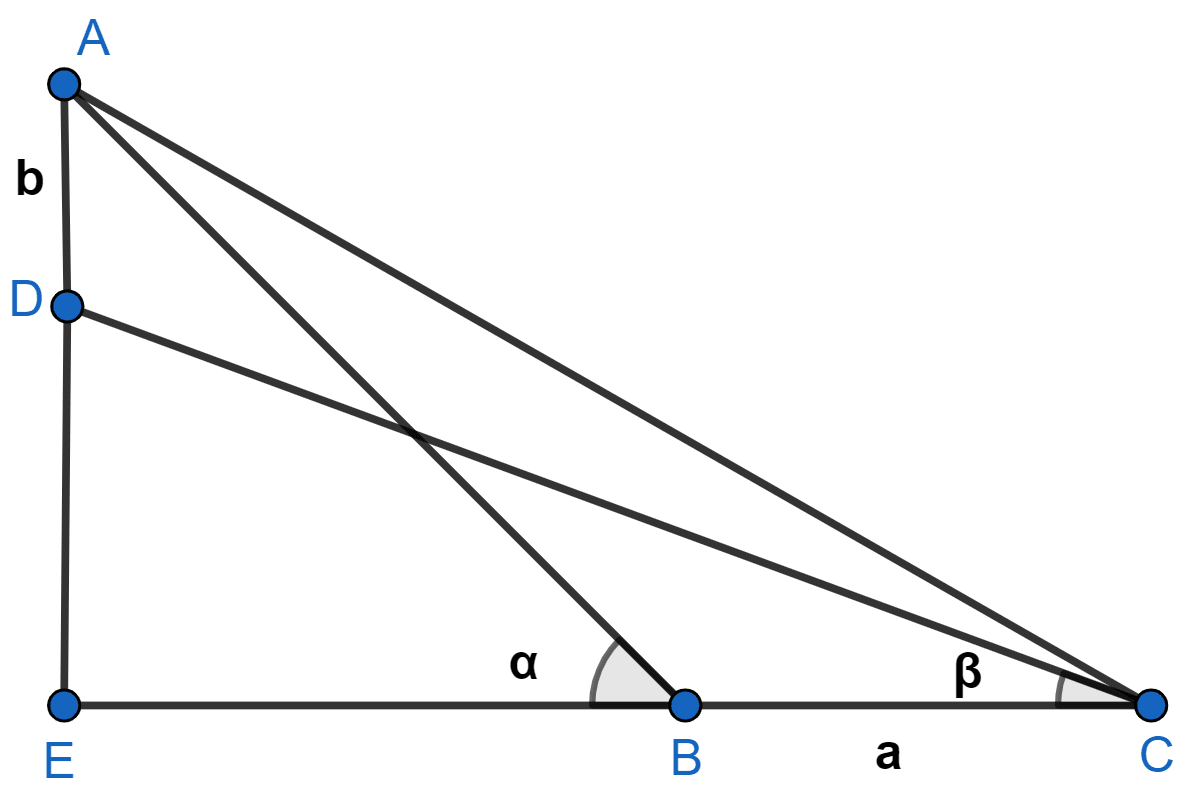
In the figure AB and CD represent the same ladder. So, their length must be equal.

A ladder rests against a wall at an angle α to the horizontal. Its foot is pulled away from the wall through a distance a, so that it slides a distance b down the wall making an angle β with the horizontal. Show that. Mixed Practice, Concise Mathematics Solutions ICSE Class 10.

Let length of the ladder be h.

∴ AB = CD = h

In △AEB :

sin α = AEAB\dfrac{AE}{AB}

AE = AB sin α = h sin α.

In △AEB :

cos α = BEAB\dfrac{BE}{AB}

BE = AB cos α = h cos α.

In △DEC :

sin β = DECD\dfrac{DE}{CD}

DE = CD sin β = h sin β

cos β = CECD\dfrac{CE}{CD}

CE = CD cos β = h cos β

From figure,

ab=BCADab=CEBEAEDEab=h cos βh cos αh sin αh sin βab=cos βcos αsin αsin β\Rightarrow \dfrac{a}{b} = \dfrac{BC}{AD} \\[1em] \Rightarrow \dfrac{a}{b} = \dfrac{CE - BE}{AE - DE} \\[1em] \Rightarrow \dfrac{a}{b} = \dfrac{\text{h cos β} - \text{h cos α}}{\text{h sin α} - \text{h sin β}} \\[1em] \Rightarrow \dfrac{a}{b} = \dfrac{\text{cos β} - \text{cos α}}{\text{sin α} - \text{sin β}}

Hence, proved that ab=cos βcos αsin αsin β\dfrac{a}{b} = \dfrac{\text{cos β} - \text{cos α}}{\text{sin α} - \text{sin β}}.

Question 38

For the following frequency distribution, draw an ogive and then use it to estimate the median.

C.I.f
450 - 55040
550 - 65068
650 - 75086
750 - 850120
850 - 95090
950 - 105040
1050 - 11506

For the same distribution, as given above, draw a histogram and then use it to estimate the mode.

Answer

Cumulative frequency distribution table is as follows :

C.I.fCumulative frequency
450 - 5504040
550 - 65068108 (40 + 68)
650 - 75086194 (108 + 86)
750 - 850120314 (194 + 120)
850 - 95090404 (314 + 90)
950 - 105040444 (404 + 40)
1050 - 11506450 (444 + 6)

Here no. of terms = 450, which is even.

By formula,

Median = n2\dfrac{n}{2} th term = 225.

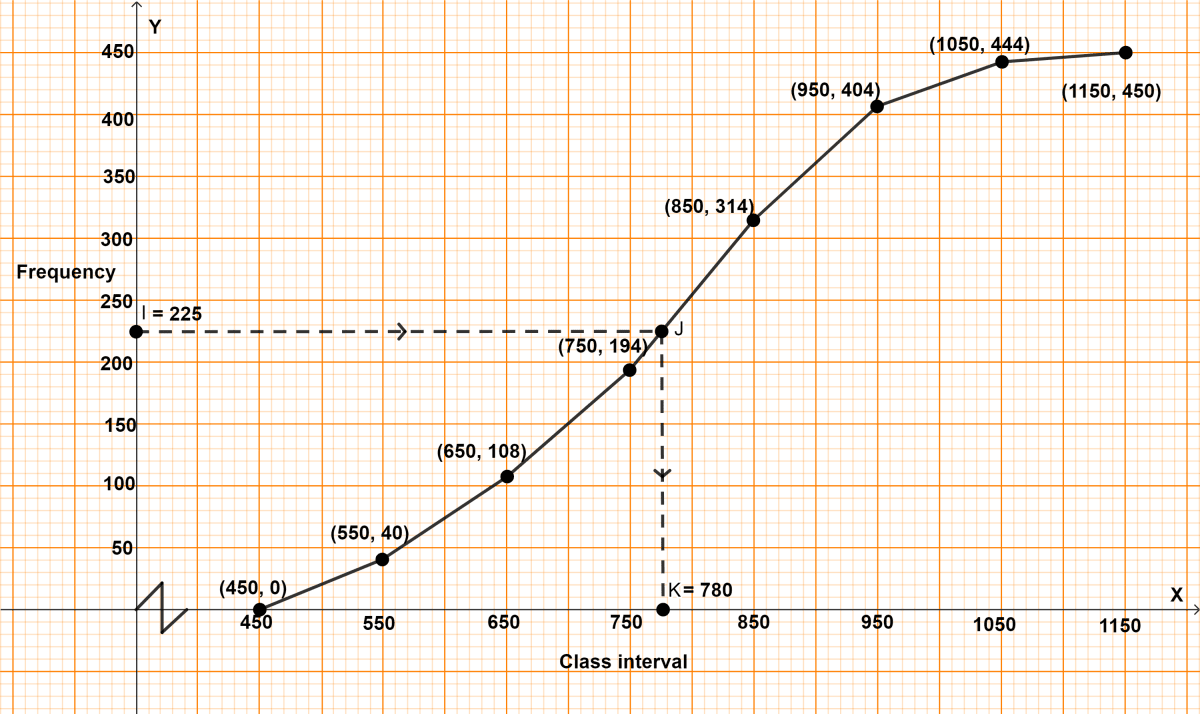
Steps of construction of ogive :

  1. Take 2 cm = 100 units (C.I.) on x-axis.

  2. Take 1 cm = 50 units (frequency) on y-axis.

  3. A kink is shown near x-axis as it starts from 450. Plot the point (450, 0) as ogive starts on x-axis representing lower limit of first class.

  4. Plot the points (550, 40), (650, 108), (750, 194), (850, 314), (950, 404), (1050, 444) and (1150, 450).

  5. Join the points by a free-hand curve.

  6. Draw a line parallel to x-axis from point I (frequency) = 225, touching the graph at point J. From point J draw a line parallel to y-axis touching x-axis at point K.

For the following frequency distribution, draw an ogive and then use it to estimate the median. For the same distribution, as given above, draw a histogram and then use it to estimate the mode. Mixed Practice, Concise Mathematics Solutions ICSE Class 10.

From graph, K = 780

Hence, median = 780.

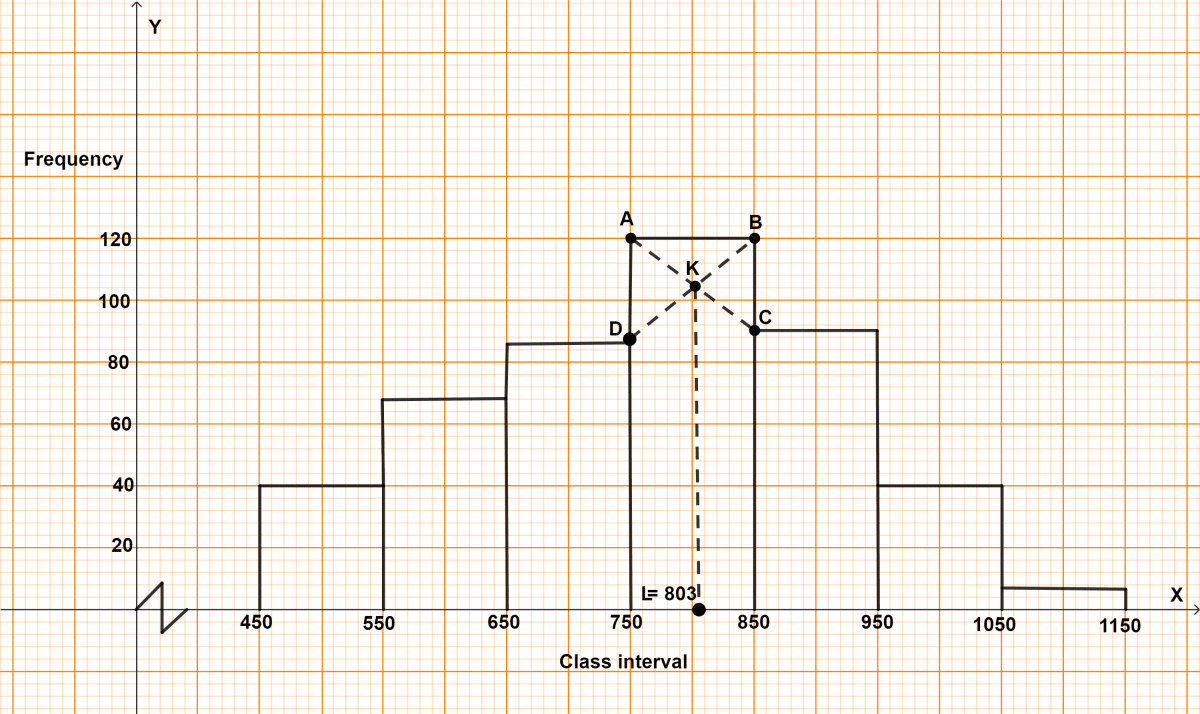
Steps :

  1. Draw a histogram of the given distribution.

  2. Inside the highest rectangle, which represents the maximum frequency (or modal class), draw two lines AC and BD diagonally from the upper corners A and B of adjacent rectangles.

  3. Through point K (the point of intersection of diagonals AC and BD), draw KL perpendicular to the horizontal axis.

  4. The value of point L on the horizontal axis represents the value of mode.

∴ Mode = 803.

For the following frequency distribution, draw an ogive and then use it to estimate the median. For the same distribution, as given above, draw a histogram and then use it to estimate the mode. Mixed Practice, Concise Mathematics Solutions ICSE Class 10.

Hence, mode = 803.

Question 39(i)

Find the probability of drawing an ace or a jack from a pack of 52 cards.

Answer

Total cards = 52

∴ No. of possible outcomes = 52

There are 4 ace and 4 jacks in a pack.

∴ No. of favourable outcomes = 8

P(drawing an ace or jack) = No. of favourable outcomesNo. of possible outcomes=852=213\dfrac{\text{No. of favourable outcomes}}{\text{No. of possible outcomes}} = \dfrac{8}{52} = \dfrac{2}{13}.

Hence, probability of drawing an ace or a jack = 213\dfrac{2}{13}.

Question 39(ii)

A bag contains 5 red balls and some blue balls. If the probability of drawing a blue ball is double that of red ball, find the number of blue balls in the bag.

Answer

Let no. of blue balls be x.

Total balls = (x + 5).

∴ No. of possible outcomes = x + 5

There are 5 red balls

∴ No. of favourable outcomes for drawing a red ball = 5

P(drawing a red ball) = No. of favourable outcomesNo. of possible outcomes=55+x\dfrac{\text{No. of favourable outcomes}}{\text{No. of possible outcomes}} = \dfrac{5}{5 + x}.

There are x blue balls

∴ No. of favourable outcomes for drawing a blue ball = x

P(drawing a blue ball) = No. of favourable outcomesNo. of possible outcomes=x5+x\dfrac{\text{No. of favourable outcomes}}{\text{No. of possible outcomes}} = \dfrac{x}{5 + x}.

Given,

Probability of drawing a blue ball is double that of red ball.

x5+x=2×55+xx5+x=105+xx=10.\therefore \dfrac{x}{5 + x} = 2 \times \dfrac{5}{5 + x} \\[1em] \Rightarrow \dfrac{x}{5 + x} = \dfrac{10}{5 + x} \\[1em] \Rightarrow x = 10.

Hence, no. of blue balls = 10.

Question 40

In a single throw of two dice, what is the probability of getting

(i) a total of 9

(ii) two aces (ones)

(iii) at least one ace

(iv) a doublet

(v) five on one die and six on the other

(vi) a multiple of 2 on one and a multiple of 3 on the other ?

Answer

In a single throw of two dice.

∴ No. of possible outcomes = 6 × 6 = 36.

(i) Favourable outcomes for getting a total of 9 = {(3, 6), (4, 5), (5, 4), (6, 3)}.

∴ No. of favourable outcomes = 4.

P(of getting a total of 9) = No. of favourable outcomesNo. of possible outcomes=436=19\dfrac{\text{No. of favourable outcomes}}{\text{No. of possible outcomes}} = \dfrac{4}{36} = \dfrac{1}{9}.

Hence, probability of getting a total of 9 = 19\dfrac{1}{9}.

(ii) Favourable outcomes for getting two aces = {(1, 1)}.

∴ No. of favourable outcomes = 1.

P(of getting two aces) = No. of favourable outcomesNo. of possible outcomes=136\dfrac{\text{No. of favourable outcomes}}{\text{No. of possible outcomes}} = \dfrac{1}{36}.

Hence, probability of getting two aces = 136\dfrac{1}{36}.

(iii) Favourable outcomes for getting at least one ace = {(1, 1), (1, 2), (1, 3), (1, 4), (1, 5), (1, 6), (2, 1), (3, 1), (4, 1), (5, 1), (6, 1)}.

∴ No. of favourable outcomes = 11.

P(of getting at least one ace) = No. of favourable outcomesNo. of possible outcomes=1136\dfrac{\text{No. of favourable outcomes}}{\text{No. of possible outcomes}} = \dfrac{11}{36}.

Hence, probability of getting at least one ace = 1136\dfrac{11}{36}.

(iv) Favourable outcomes for getting a doublet = {(1, 1), (2, 2), (3, 3), (4, 4), (5, 5), (6, 6)}.

∴ No. of favourable outcomes = 6.

P(of getting a doublet) = No. of favourable outcomesNo. of possible outcomes=636=16\dfrac{\text{No. of favourable outcomes}}{\text{No. of possible outcomes}} = \dfrac{6}{36} = \dfrac{1}{6}.

Hence, probability of getting a doublet = 16\dfrac{1}{6}.

(v) Favourable outcomes for getting 5 on one die and 6 on other = {(5, 6), (6, 5)}.

∴ No. of favourable outcomes = 2.

P(of getting 5 on one die and 6 on other)

= No. of favourable outcomesNo. of possible outcomes=236=118\dfrac{\text{No. of favourable outcomes}}{\text{No. of possible outcomes}} = \dfrac{2}{36} = \dfrac{1}{18}.

Hence, probability of getting 5 on one die and 6 on other = 118\dfrac{1}{18}.

(vi) Favourable outcomes for getting a multiple of 2 on one die and a multiple of 3 on other = {(2, 3), (2, 6), (3, 2), (3, 4), (3, 6), (4, 3), (4, 6), (6, 2), (6, 3), (6, 4), (6, 6)}.

∴ No. of favourable outcomes = 11.

P(of getting a multiple of 2 on one die and a multiple of 3 on other)

= No. of favourable outcomesNo. of possible outcomes=1136\dfrac{\text{No. of favourable outcomes}}{\text{No. of possible outcomes}} = \dfrac{11}{36}.

Hence, probability of getting a multiple of 2 on one die and a multiple of 3 on other = 1136\dfrac{11}{36}.

SET B

Question 41

A dealer sells goods/services, worth ₹ 30,000 to some other dealer in the same town at a discount of 25%. If the rate of GST is 12%, find the amount of bill.

Answer

Give,

M.R.P. = ₹ 30,000

Discount = 25%

Amount after deducting discount = M.R.P. - Discount

⇒ ₹ 30000 - ₹ 25100×30000\dfrac{25}{100} \times 30000

⇒ ₹ 30000 - ₹ 7500

⇒ ₹ 22500

Amount (including G.S.T.) = Amount after deducting discount + G.S.T.

= ₹ 22500 + ₹ 12100×22500\dfrac{12}{100} \times 22500

= ₹ 22500 + ₹ 12 × 225

= ₹ 22500 + ₹ 2700

= ₹ 25200.

Hence, amount of bill = ₹ 25200.

Question 42

The monthly installment of a recurring deposit account is ₹ 2400. If the account is held for 1 year 6 months and its maturity value is ₹ 47,304, find the rate of interest.

Answer

Given,

Time (n) = 1 year 6 months = 12 + 6 = 18 months.

Monthly installment (P) = ₹ 2400.

Maturity value = ₹ 47304.

Let rate of interest be r%.

By formula,

Maturity value = P × n + P × n(n+1)2×12×r100\dfrac{n(n + 1)}{2 \times 12} \times \dfrac{r}{100}

Substituting values we get :

47304=2400×18+2400×18×192×12×r10047304=43200+2400×3×192×2×r1004730443200=2400×574×r1004104=6×57rr=41046×57r=4104342=12\Rightarrow 47304 = 2400 \times 18 + 2400 \times \dfrac{18 \times 19}{2 \times 12} \times \dfrac{r}{100} \\[1em] \Rightarrow 47304 = 43200 + 2400 \times \dfrac{3 \times 19}{2 \times 2} \times \dfrac{r}{100} \\[1em] \Rightarrow 47304 - 43200 = 2400 \times \dfrac{57}{4} \times \dfrac{r}{100} \\[1em] \Rightarrow 4104 = 6 \times 57r \\[1em] \Rightarrow r = \dfrac{4104}{6 \times 57} \\[1em] \Rightarrow r = \dfrac{4104}{342} = 12 %.

Hence, rate of interest = 12%.

Question 43

The maturity value of a recurring deposit account is ₹ 42,400. If the account is held for 2 years and the rate of interest is 10% per annum, find the amount of each monthly installment.

Answer

Let monthly installment be ₹ P.

Given,

Time (n) = 2 years = 24 months.

Rate (r) = 10%.

Maturity value = ₹ 42400.

By formula,

Maturity value = P × n + P × n(n+1)2×12×r100\dfrac{n(n + 1)}{2 \times 12} \times \dfrac{r}{100}

Substituting values we get :

42400=P×24+P×24×252×12×1010042400=24P+P×25×11042400=24P+2.5P26.5P=42400P=4240026.5P=1600.\Rightarrow 42400 = P \times 24 + P \times \dfrac{24 \times 25}{2 \times 12} \times \dfrac{10}{100} \\[1em] \Rightarrow 42400 = 24P + P \times 25 \times \dfrac{1}{10} \\[1em] \Rightarrow 42400 = 24P + 2.5P \\[1em] \Rightarrow 26.5P = 42400 \\[1em] \Rightarrow P = \dfrac{42400}{26.5} \\[1em] \Rightarrow P = 1600.

Hence, monthly installment = ₹ 1600.

Question 44

A man invests equal amounts of money in two companies A and B. Company A pays a dividend of 15% and its ₹ 100 shares are available at 20% discount. The shares of company B has a nominal value of ₹ 25 and are available at 20% premium. If at the end of one year, the man gets equal dividends from both the companies, find the rate of dividend paid by company B.

Answer

For company A,

Let invested money be ₹ x

Nominal value of each share (N.V.) = ₹ 100

Discount = 20%

M.V. of share = F.V. - Discount

= ₹ 100 - 20100×100\dfrac{20}{100} \times 100

= ₹ 100 - ₹ 20 = ₹ 80.

No. of shares = Invested moneyM.V.=x80\dfrac{\text{Invested money}}{\text{M.V.}} = \dfrac{x}{80}

Rate of dividend = 15%

Total dividend for company A = No. of shares × Dividend × 100

= x80×15100×100\dfrac{x}{80} \times \dfrac{15}{100} \times 100

= 3x16\dfrac{3x}{16}

For company B,

Let invested money be ₹ x

Nominal value of each share (N.V.) = ₹ 25

Premium = 20%

M.V. of share = N.V. + Premium

= ₹ 25 + 20100×25\dfrac{20}{100} \times 25

= ₹ 25 + ₹ 5 = ₹ 30.

No. of shares = Invested moneyM.V.=x30\dfrac{\text{Invested money}}{\text{M.V.}} = \dfrac{x}{30}

Let rate of dividend = d%

Total dividend for company B = No. of shares × Dividend × 100

= x30×d100×25\dfrac{x}{30} \times \dfrac{d}{100} \times 25

= xd120\dfrac{xd}{120}

Since, man gets equal dividend from both companies so,

3x16=xd120d=3x×120x×16d=36016=22.5\Rightarrow \dfrac{3x}{16} = \dfrac{xd}{120} \\[1em] \Rightarrow d = \dfrac{3x \times 120}{x \times 16} \\[1em] \Rightarrow d = \dfrac{360}{16} = 22.5 %.

Hence, dividend paid by company B = 22.5%.

Question 45

A sum of ₹ 54000 is invested partly in shares paying 6% dividend at 40% premium and partly in 5% shares at 25% premium. If the nominal value of one share in each company is ₹ 100 and the total income of the man is ₹ 2,240, find the money invested in the second company.

Answer

For first company,

Let money invested be ₹ x.

N.V. = ₹ 100

Premium = 40%

M.V. = N.V. + Premium

= 100 + 40100×100\dfrac{40}{100} \times 100

= ₹ 100 + ₹ 40

= ₹ 140.

No. of shares = Invested moneyM.V.=x140\dfrac{\text{Invested money}}{\text{M.V.}} = \dfrac{x}{140}

Rate of dividend = 6%

Total dividend for first company = No. of shares × Dividend × 100

= x140×6100×100\dfrac{x}{140} \times \dfrac{6}{100} \times 100

= 3x70\dfrac{3x}{70}

For second company,

Let money invested be ₹ (54000 - x).

N.V. = ₹ 100

Premium = 25%

M.V. = N.V. + Premium

= 100 + 25100×100\dfrac{25}{100} \times 100

= ₹ 100 + ₹ 25

= ₹ 125.

No. of shares = Invested moneyM.V.=54000x125\dfrac{\text{Invested money}}{\text{M.V.}} = \dfrac{54000 - x}{125}

Rate of dividend = 5%

Total dividend for second company = No. of shares × Dividend × 100

= 54000x125×5100×100\dfrac{54000 - x}{125} \times \dfrac{5}{100} \times 100

= 54000x25\dfrac{54000 - x}{25}

Since, total income = ₹ 2240

54000x25+3x70=224014(54000x)+3x×5350=224075600014x+15x350=2240756000+x=2240×350756000+x=784000x=784000756000=28000.\therefore \dfrac{54000 - x}{25} + \dfrac{3x}{70} = 2240 \\[1em] \Rightarrow \dfrac{14(54000 - x) + 3x \times 5}{350} = 2240 \\[1em] \Rightarrow \dfrac{756000 - 14x + 15x}{350} = 2240 \\[1em] \Rightarrow 756000 + x = 2240 \times 350 \\[1em] \Rightarrow 756000 + x = 784000 \\[1em] \Rightarrow x = 784000 - 756000 = 28000.

₹ (54000 - x) = ₹ 54000 - ₹ 28000 = ₹ 26000.

Hence, money invested in second company = ₹ 26000.

Question 46

Solve and graph the solution set of :

(i) 2x - 9 < 7 and 3x + 9 ≤ 25; x ∈ R

(ii) 3x - 2 > 19 or 3 - 2x ≥ 7; x ∈ R

Answer

(i) Given,

⇒ 2x - 9 < 7

⇒ 2x < 7 + 9

⇒ 2x < 16

⇒ x < 162\dfrac{16}{2}

⇒ x < 8 ...........(1)

Also,

⇒ 3x + 9 ≤ 25

⇒ 3x ≤ 25 - 9

⇒ 3x ≤ 16

⇒ x ≤ 163\dfrac{16}{3}

⇒ x ≤ 5135\dfrac{1}{3}..........(2)

From (1) and (2), we get :

⇒ x ≤ 5135\dfrac{1}{3}

Solve and graph the solution set of : (i) 2x - 9 &lt; 7 and 3x + 9 &le; 25; x ∈ R (ii) 3x - 2 &gt; 19 or 3 - 2x &ge; 7; x ∈ R. Mixed Practice, Concise Mathematics Solutions ICSE Class 10.

Hence, solution = {x : x ≤ 5135\dfrac{1}{3}, x ∈ R}.

(ii) Given,

⇒ 3x - 2 > 19

⇒ 3x > 19 + 2

⇒ 3x > 21

⇒ x > 213\dfrac{21}{3}

⇒ x > 7 ........(1)

Also,

⇒ 3 - 2x ≥ 7

⇒ 2x ≤ 3 - 7

⇒ 2x ≤ -4

⇒ x ≤ 42-\dfrac{4}{2}

⇒ x ≤ -2 ........(2)

From (1) and (2), we get :

x > 7 or x ≤ -2

Solve and graph the solution set of : (i) 2x - 9 &lt; 7 and 3x + 9 &le; 25; x ∈ R (ii) 3x - 2 &gt; 19 or 3 - 2x &ge; 7; x ∈ R. Mixed Practice, Concise Mathematics Solutions ICSE Class 10.

Hence, solution = {x : x > 7 or x ≤ -2, x ∈ R}.

Question 47

Use formula to solve the quadratic equation :

x2 + x - (a + 1)(a + 2) = 0

Answer

Given,

x2 + x - (a + 1)(a + 2) = 0

Comparing above equation with ax2 + bx + c = 0, we get :

a = 1, b = 1 and c = -(a + 1)(a + 2)

By formula,

x = b±b24ac2a\dfrac{-b \pm \sqrt{b^2 - 4ac}}{2a}

Substituting values we get :

x=1±124×1×(a+1)(a+2)2×1x=1±1+4(a+1)(a+2)2x=1±1+4(a2+2a+a+2)2x=1±1+4(a2+3a+2)2x=1±1+4a2+12a+82x=1±4a2+12a+92x=1±(2a+3)22x=1±(2a+3)2x=1+(2a+3)2,1(2a+3)2x=2a+312,12a32x=2a+22,2a42x=2(a+1)2,2(a+2)2x=(a+1),(a+2).\Rightarrow x = \dfrac{-1 \pm \sqrt{1^2 - 4 \times 1 \times -(a + 1)(a + 2)}}{2 \times 1} \\[1em] \Rightarrow x = \dfrac{-1 \pm \sqrt{1 + 4(a + 1)(a + 2)}}{2} \\[1em] \Rightarrow x = \dfrac{-1 \pm \sqrt{1 + 4(a^2 + 2a + a + 2)}}{2} \\[1em] \Rightarrow x = \dfrac{-1 \pm \sqrt{1 + 4(a^2 + 3a + 2)}}{2} \\[1em] \Rightarrow x = \dfrac{-1 \pm \sqrt{1 + 4a^2 + 12a + 8}}{2} \\[1em] \Rightarrow x = \dfrac{-1 \pm \sqrt{4a^2 + 12a + 9}}{2} \\[1em] \Rightarrow x = \dfrac{-1 \pm \sqrt{(2a + 3)^2}}{2} \\[1em] \Rightarrow x = \dfrac{-1 \pm (2a + 3)}{2} \\[1em] \Rightarrow x = \dfrac{-1 + (2a + 3)}{2}, \dfrac{-1 - (2a + 3)}{2} \\[1em] \Rightarrow x = \dfrac{2a + 3 - 1}{2}, \dfrac{-1 - 2a - 3}{2} \\[1em] \Rightarrow x = \dfrac{2a + 2}{2}, \dfrac{-2a - 4}{2} \\[1em] \Rightarrow x = \dfrac{2(a + 1)}{2}, \dfrac{-2(a + 2)}{2} \\[1em] \Rightarrow x = (a + 1), -(a + 2).

Hence, x = (a + 1) or -(a + 2).

Question 48

By selling an article for ₹ 96, a man gains as much percent as its cost price. Find the cost price of the article.

Answer

Let cost price be ₹ x.

S.P. = ₹ 96

Profit = S.P. - C.P. = ₹ (96 - x)

Given,

Man gains as much percent as its cost price.

Profit percent = x %.

Substituting values we get :

ProfitC.P.×100=x96xx×100=x100(96x)=x2x2=9600100xx2+100x9600=0x2+160x60x9600=0x(x+160)60(x+160)=0(x60)(x+160)=0x60=0 or x+160=0x=60 or x=160.\Rightarrow \dfrac{\text{Profit}}{\text{C.P.}} \times 100 = x \\[1em] \Rightarrow \dfrac{96 - x}{x} \times 100 = x \\[1em] \Rightarrow 100(96 - x) = x^2 \\[1em] \Rightarrow x^2 = 9600 - 100x \\[1em] \Rightarrow x^2 + 100x - 9600 = 0 \\[1em] \Rightarrow x^2 + 160x - 60x - 9600 = 0 \\[1em] \Rightarrow x(x + 160) - 60(x + 160) = 0 \\[1em] \Rightarrow (x - 60)(x + 160) = 0 \\[1em] \Rightarrow x - 60 = 0 \text{ or } x + 160 = 0 \\[1em] \Rightarrow x = 60 \text{ or } x = -160.

Since, cost price cannot be negative.

∴ x = 60.

Hence, C.P. = ₹ 60.

Question 49

A trader brought a number of articles for ₹ 900, five were damaged and he sold each of the rest at ₹ 2 more than what he paid for it. If on the whole he gains ₹ 80, find the number of articles brought.

Answer

Let no. of articles brought be x.

Cost of each article = ₹ 900x\dfrac{900}{x}

5 articles were damaged.

No. of articles left = (x - 5).

Given,

No. of articles left were sold at ₹ 2 more than what he paid for it.

S.P. of each article = ₹ 900x+2\dfrac{900}{x} + 2

Given,

⇒ Gain = ₹ 80.

⇒ Total S.P. - Total C.P. = ₹ 80

(x5)(900x+2)900=80x×900x+2x5×900x5×2=80+900900+2x4500x10=980900x+2x2450010xx=980900x+2x2450010x=980x2x2+900x980x10x4500=02x290x4500=02(x245x2250)=0x245x2250=0x275x+30x2250=0x(x75)+30(x75)=0(x+30)(x75)=0x=30 or x=75.\Rightarrow (x - 5)\Big(\dfrac{900}{x} + 2\Big) - 900 = 80 \\[1em] \Rightarrow x \times \dfrac{900}{x} + 2x - 5 \times \dfrac{900}{x} - 5 \times 2 = 80 + 900 \\[1em] \Rightarrow 900 + 2x - \dfrac{4500}{x} - 10 = 980 \\[1em] \Rightarrow \dfrac{900x + 2x^2 - 4500 - 10x}{x} = 980 \\[1em] \Rightarrow 900x + 2x^2 - 4500 - 10x = 980x \\[1em] \Rightarrow 2x^2 + 900x - 980x - 10x - 4500 = 0 \\[1em] \Rightarrow 2x^2 - 90x - 4500 = 0 \\[1em] \Rightarrow 2(x^2 - 45x - 2250) = 0 \\[1em] \Rightarrow x^2 - 45x - 2250 = 0 \\[1em] \Rightarrow x^2 - 75x + 30x - 2250 = 0 \\[1em] \Rightarrow x(x - 75) + 30(x - 75) = 0 \\[1em] \Rightarrow (x + 30)(x - 75) = 0 \\[1em] \Rightarrow x = -30 \text{ or } x = 75.

Since, no. of articles cannot be negative.

Hence, no. of articles = 75.

Question 50

1077 boxes of oranges were loaded in three trucks. While unloading them 7, 12 and 8 boxes were found rotten in the trucks respectively. If the number of remaining boxes in the three trucks are in the ratio 4 : 6 : 5, find the number of boxes loaded originally in each truck.

Answer

Given,

Number of remaining boxes in the three trucks are in the ratio 4 : 6 : 5.

So, let remaining boxes be

In first truck = 4x, second truck = 6x and third truck = 5x

Total boxes including rotten boxes in each truck are

In first truck = 4x + 7, second truck = 6x + 12 and third truck = 5x + 8

Total boxes = 1077

⇒ 4x + 7 + 6x + 12 + 5x + 8 = 1077

⇒ 15x + 27 = 1077

⇒ 15x = 1077 - 27

⇒ 15x = 1050

⇒ x = 105015\dfrac{1050}{15} = 70.

So, no. of boxes :

In first truck = 4x + 7 = 4(70) + 7 = 280 + 7 = 287,

second truck = 6x + 12 = 6(70) + 12 = 420 + 12 = 432,

third truck = 5x + 8 = 5(70) + 8 = 358.

Hence, no. of boxes originally in each truck were 287, 432 and 358.

Question 51

If a ≠ b and a : b is the duplicate ratio of (a + c) and (b + c), show that a, c and b are in continued proportion.

Answer

Given,

a : b is the duplicate ratio of (a + c) and (b + c).

ab=a+cb+c×a+cb+cab=a2+ac+ac+c2b2+bc+bc+c2ab=a2+2ac+c2b2+2bc+c2a(b2+2bc+c2)=b(a2+2ac+c2)ab2+2abc+ac2=ba2+2abc+bc2ac2bc2=ba2ab2+2abc2abcc2(ab)=ab(ab)c2=ab.\therefore \dfrac{a}{b} = \dfrac{a + c}{b + c} \times \dfrac{a + c}{b + c} \\[1em] \Rightarrow \dfrac{a}{b} = \dfrac{a^2 + ac + ac + c^2}{b^2 + bc + bc + c^2} \\[1em] \Rightarrow \dfrac{a}{b} = \dfrac{a^2 + 2ac + c^2}{b^2 + 2bc + c^2} \\[1em] \Rightarrow a(b^2 + 2bc + c^2) = b(a^2 + 2ac + c^2) \\[1em] \Rightarrow ab^2 + 2abc + ac^2 = ba^2 + 2abc + bc^2 \\[1em] \Rightarrow ac^2 - bc^2 = ba^2 - ab^2 + 2abc - 2abc \\[1em] \Rightarrow c^2(a - b) = ab(a - b) \\[1em] \Rightarrow c^2 = ab.

Since, c2 = ab.

Hence, proved that a, c and b are in continued proportion.

Question 52

If 16(axa+x)3=(a+xax)16\Big(\dfrac{a - x}{a + x}\Big)^3 = \Big(\dfrac{a + x}{a - x}\Big); show that : a = 3x.

Answer

Given,

16(axa+x)3=(a+xax)16(axa+x)3=1axa+x16\Big(\dfrac{a - x}{a + x}\Big)^3 = \Big(\dfrac{a + x}{a - x}\Big) \\[1em] \Rightarrow 16\Big(\dfrac{a - x}{a + x}\Big)^3 = \dfrac{1}{\dfrac{a - x}{a + x}}

Let (axa+x)\Big(\dfrac{a - x}{a + x}\Big) = t.

Substituting (axa+x)\Big(\dfrac{a - x}{a + x}\Big) = t in given equation, we get :

16t3=1t16t4=1t4=116t4=(12)4t=12axa+x=122(ax)=a+x2a2x=a+x2aa=x+2xa=3x.\Rightarrow 16t^3 = \dfrac{1}{t} \\[1em] \Rightarrow 16t^4 = 1 \\[1em] \Rightarrow t^4 = \dfrac{1}{16} \\[1em] \Rightarrow t^4 = \Big(\dfrac{1}{2}\Big)^4 \\[1em] \Rightarrow t = \dfrac{1}{2} \\[1em] \Rightarrow \dfrac{a - x}{a + x} = \dfrac{1}{2} \\[1em] \Rightarrow 2(a - x) = a + x \\[1em] \Rightarrow 2a - 2x = a + x \\[1em] \Rightarrow 2a - a = x + 2x \\[1em] \Rightarrow a = 3x.

Hence, proved that a = 3x.

Question 53

Solve for x, using the properties of proportionality :

1+x+x21x+x2=62(1+x)63(1x)\dfrac{1 + x + x^2}{1 - x + x^2} = \dfrac{62(1 + x)}{63(1 - x)}

Answer

Applying componendo and dividendo, we get :

1+x+x2+1x+x21+x+x2(1x+x2)=62(1+x)+63(1x)62(1+x)63(1x)2+2x211+x+x+x2x2=62+62x+6363x62+62x63+63x2(1+x2)2x=125x125x11+x2x=125x125x1(125x1)(1+x2)=x(125x)125x+125x31x2=125xx2125x125xx2+x2+125x31=0125x31=0125x3=1x3=1125x3=(15)3x=15.\Rightarrow \dfrac{1 + x + x^2 + 1 - x + x^2}{1 + x + x^2 - (1 - x + x^2)} = \dfrac{62(1 + x) + 63(1 - x)}{62(1 + x) - 63(1 - x)} \\[1em] \Rightarrow \dfrac{2 + 2x^2}{1 - 1 + x + x + x^2- x^2} = \dfrac{62 + 62x + 63 - 63x}{62 + 62x - 63 + 63x} \\[1em] \Rightarrow \dfrac{2(1 + x^2)}{2x} = \dfrac{125 - x}{125x - 1} \\[1em] \Rightarrow \dfrac{1 + x^2}{x} = \dfrac{125 - x}{125x - 1} \\[1em] \Rightarrow (125x - 1)(1 + x^2) = x(125 - x)\\[1em] \Rightarrow 125x + 125x^3 - 1 - x^2 = 125x - x^2 \\[1em] \Rightarrow 125x - 125x - x^2 + x^2 + 125x^3 - 1 = 0 \\[1em] \Rightarrow 125x^3 - 1 = 0 \\[1em] \Rightarrow 125x^3 = 1 \\[1em] \Rightarrow x^3 = \dfrac{1}{125} \\[1em] \Rightarrow x^3 = \Big(\dfrac{1}{5}\Big)^3 \\[1em] \Rightarrow x = \dfrac{1}{5}.

Hence, x = 15\dfrac{1}{5}.

Question 54

Show that 2x + 7 is a factor of 2x3 + 7x2 - 4x - 14. Hence, solve the equation :

2x3 + 7x2 - 4x - 14 = 0.

Answer

Given,

⇒ 2x + 7 = 0

⇒ 2x = -7

⇒ x = -72\dfrac{7}{2}

Substituting x = -72\dfrac{7}{2} in L.H.S. of 2x3 + 7x2 - 4x - 14 = 0, we get :

=2×(72)3+7×(72)24×7214=2×3438+7×494+1414=3434+3434+1414=0.\phantom{=} 2 \times \Big(-\dfrac{7}{2}\Big)^3 + 7 \times \Big(-\dfrac{7}{2}\Big)^2 - 4 \times -\dfrac{7}{2} - 14 \\[1em] = 2 \times -\dfrac{343}{8} + 7 \times \dfrac{49}{4} + 14 - 14 \\[1em] = -\dfrac{343}{4} + \dfrac{343}{4} + 14 - 14 \\[1em] = 0.

Since, L.H.S. = R.H.S. = 0.

∴ 2x + 7 is a factor of 2x3 + 7x2 - 4x - 14 = 0.

Dividing 2x3 + 7x2 - 4x - 14 = 0 by 2x + 7:

2x+7)x222x+7)2x3+7x24x142x+72x3+7x22x+72x3×+2524x142x+7x3+2+252+4x+142x+7x3+25x233×\begin{array}{l} \phantom{2x + 7)}{x^2 - 2} \\ 2x + 7\overline{\smash{\big)}2x^3 + 7x^2 - 4x - 14} \\ \phantom{2x + 7}\underline{\underset{-}{}2x^3 \underset{-}{+}7x^2} \\ \phantom{{2x + 7}2x^3} \times \phantom{+25^2} - 4x - 14 \\ \phantom{{2x + 7}x^3+2+25^2}\underline{\underset{+}{-}4x \underset{+}{-} 14} \\ \phantom{{2x + 7}x^3+2-5x^23-3}\times \end{array}

∴ 2x3 + 7x2 - 4x - 14 = (2x + 7)(x2 - 2)

= (2x + 7)(x + 2)(x2\sqrt{2})(x - \sqrt{2})

Solving,

⇒ 2x + 7 = 0

⇒ 2x = -7

⇒ x = -72\dfrac{7}{2}

Also,

⇒ x + 2\sqrt{2} = 0

⇒ x = -2\sqrt{2} = -1.41

Also,

⇒ x - 2\sqrt{2} = 0

⇒ x = 2\sqrt{2} = 1.41

Hence, x = -72\dfrac{7}{2}, 1.41, -1.41

Question 55(a)

What number should be subtracted from 2x3 - 5x2 + 5x + 8 so that the resulting polynomial has a factor 2x - 3 ?

Answer

Let no. to be subtracted be a.

So, resulting polynomial is 2x3 - 5x2 + 5x + 8 - a.

By factor theorem,

A polynomial f(x) has a factor (x - a), if and only if, f(a) = 0.

Given,

Factor : 2x - 3 = 0

x = 32\dfrac{3}{2}

Substituting value of x = 32\dfrac{3}{2} in 2x3 - 5x2 + 5x + 8 - a, will give remainder = 0.

2×(32)35×(32)2+5×32+8a=02×2785×94+152+8a=0274454+15+162a=0184+312a=018+624a=0444a=011a=0a=11.\Rightarrow 2 \times \Big(\dfrac{3}{2}\Big)^3 - 5 \times \Big(\dfrac{3}{2}\Big)^2 + 5 \times \dfrac{3}{2} + 8 - a = 0 \\[1em] \Rightarrow 2 \times \dfrac{27}{8} - 5 \times \dfrac{9}{4} + \dfrac{15}{2} + 8 - a = 0 \\[1em] \Rightarrow \dfrac{27}{4} - \dfrac{45}{4} + \dfrac{15 + 16}{2} - a = 0 \\[1em] \Rightarrow -\dfrac{18}{4} + \dfrac{31}{2} - a = 0 \\[1em] \Rightarrow \dfrac{-18 + 62}{4} - a = 0 \\[1em] \Rightarrow \dfrac{44}{4} - a = 0 \\[1em] \Rightarrow 11 - a = 0 \\[1em] \Rightarrow a = 11.

Hence, number to be subtracted is 11.

Question 55(b)

The expression 4x3 - bx2 + x - c leaves remainder 0 and 30 when divided by (x + 1) and (2x - 3) respectively. Calculate the values of b and c.

Answer

By remainder theorem,

When a polynomial p(x) is divided by a linear polynomial (x - a), then the remainder is equal to p(a).

⇒ x + 1 = 0

⇒ x = -1

Given,

4x3 - bx2 + x - c leaves remainder 0 on dividing it by (x + 1).

∴ 4(-1)3 - b(-1)2 + (-1) - c = 0

⇒ 4(-1) - b(1) - 1 - c = 0

⇒ -4 - b - 1 - c = 0

⇒ b + c = -5

⇒ b = -5 - c .........(1)

Given,

4x3 - bx2 + x - c leaves remainder 30 on dividing it by (2x - 3).

2x - 3 = 0

⇒ 2x = 3

⇒ x = 32\dfrac{3}{2}

Substituting x = 32\dfrac{3}{2} in 4x3 - bx2 + x - c should give result as 30,

4×(32)3b×(32)2+(32)c=304×(278)b×(94)+(32)c=302729b4+32c=30549b+64c4=30609b4c=120\Rightarrow 4 \times \Big(\dfrac{3}{2}\Big)^3 - b \times \Big(\dfrac{3}{2}\Big)^2 + \Big(\dfrac{3}{2}\Big) - c = 30 \\[1em] \Rightarrow 4 \times \Big(\dfrac{27}{8}\Big) - b \times \Big(\dfrac{9}{4}\Big) + \Big(\dfrac{3}{2}\Big) - c = 30 \\[1em] \Rightarrow \dfrac{27}{2} - \dfrac{9b}{4} + \dfrac{3}{2} - c = 30 \\[1em] \Rightarrow \dfrac{54 - 9b + 6 - 4c}{4} = 30 \\[1em] \Rightarrow 60 - 9b - 4c = 120

Substituting value of b from (1) in above equation :

⇒ 60 - 9(-5 - c) - 4c = 120

⇒ 60 + 45 + 9c - 4c = 120

⇒ 5c + 105 = 120

⇒ 5c = 120 - 105

⇒ 5c = 15

⇒ c = 155\dfrac{15}{5} = 3.

Substituting value of c in (1), we get :

⇒ b = -5 - c = -5 - 3 = -8.

Hence, b = -8 and c = 3.

Question 56

If for two matrices M and N, N = [3221]\begin{bmatrix*}[r] 3 & 2 \\ 2 & -1 \end{bmatrix*} and product M × N = [-1 4]; find matrix M.

Answer

Let order of matrix M be a × b.

Ma×b×[3221]2×2=[14]1×2M_{a \times b} \times \begin{bmatrix*}[r] 3 & 2 \\ 2 & -1 \end{bmatrix*}_{2 \times 2} = \begin{bmatrix*}[r] -1 & 4 \end{bmatrix*}_{1 \times 2}

Since, the product of matrices is possible, only when the number of columns in the first matrix is equal to the number of rows in the second.

∴ b = 2

Also, the no. of rows of product (resulting) matrix is equal to no. of rows of first matrix.

∴ a = 1

Order of matrix M = a × b = 1 × 2.

Let M = [xy]\begin{bmatrix*}[r] x & y \end{bmatrix*}.

[xy]×[3221]=[14][x×3+y×2x×2+y×1]=[14][3x+2y2xy]=[14]\Rightarrow \begin{bmatrix*}[r] x & y \end{bmatrix*} \times \begin{bmatrix*}[r] 3 & 2 \\ 2 & -1 \end{bmatrix*} =\begin{bmatrix*}[r] -1 & 4 \end{bmatrix*} \\[1em] \Rightarrow \begin{bmatrix*}[r] x \times 3 + y \times 2 & x \times 2 + y \times -1 \end{bmatrix*} = \begin{bmatrix*}[r] -1 & 4 \end{bmatrix*} \\[1em] \Rightarrow \begin{bmatrix*}[r] 3x + 2y & 2x - y \end{bmatrix*} = \begin{bmatrix*}[r] -1 & 4 \end{bmatrix*}

By definition of equality of matrices we get,

⇒ 3x + 2y = -1 and 2x - y = 4

From 2x - y = 4

⇒ y = 2x - 4

Substituting value of y in 3x + 2y = -1

⇒ 3x + 2(2x - 4) = -1

⇒ 3x + 4x - 8 = -1

⇒ 7x = -1 + 8

⇒ 7x = 7

⇒ x = 1.

⇒ y = 2x - 4 = 2(1) - 4 = 2 - 4 = -2.

∴ M = [xy]=[12]\begin{bmatrix*}[r] x & y \end{bmatrix*} = \begin{bmatrix*}[r] 1 & -2 \end{bmatrix*}.

Hence, M = [12].\begin{bmatrix*}[r] 1 & -2 \end{bmatrix*}.

Question 57

If the sum of first 20 terms of an A.P. is same as the sum of its first 28 terms, find the sum of its 48 terms.

Answer

Let first term of A.P. be a and common difference be d.

By formula,

Sum of first n terms of an A.P. = n2[2a+(n1)d]\dfrac{n}{2}[2a + (n - 1)d]

Given,

S20 = S28

202[2a+(201)d]=282[2a+(281)d]10[2a+19d]=14[2a+27d]20a+190d=28a+378d28a20a=190d378d8a=188da=1888d .........(1)\therefore \dfrac{20}{2}[2a + (20 - 1)d] = \dfrac{28}{2}[2a + (28 - 1)d] \\[1em] \Rightarrow 10[2a + 19d] = 14[2a + 27d] \\[1em] \Rightarrow 20a + 190d = 28a + 378d \\[1em] \Rightarrow 28a - 20a = 190d - 378d \\[1em] \Rightarrow 8a = -188d \\[1em] \Rightarrow a = -\dfrac{188}{8}d \text{ .........(1)}

Sum of 48 terms is

S48=482[2a+(481)d]=24×[2×1888d+47d]=24×[3768d+47d]=24×[47d+47d]=24×0=0.S_{48} = \dfrac{48}{2}[2a + (48 - 1)d] \\[1em] = 24 \times [2 \times -\dfrac{188}{8}d + 47d] \\[1em] = 24 \times \Big[-\dfrac{376}{8}d + 47d\Big] \\[1em] = 24 \times \Big[-47d + 47d\Big] \\[1em] = 24 \times 0 \\[1em] = 0.

Hence, S48 = 0.

Question 58

If a, b, c are in A.P., show that : (b + c), (c + a) and (a + b) are also in A.P.

Answer

Given,

a, b and c are in A.P.

∴ b - a = c - b

⇒ b + b = a + c

⇒ 2b = a + c

If (b + c), (c + a) and (a + b) are in A.P., then

⇒ (a + b) - (c + a) = (c + a) - (b + c)

⇒ a + b - c - a = c + a - b - c

⇒ b - c = a - b

⇒ b + b = a + c

⇒ 2b = a + c

Since, 2b = a + c is proved above.

Hence, proved that (b + c), (c + a) and (a + b) are also in A.P.

Question 59

If a, b, c are in G.P; a, x, b are in A.P. and b, y, c are also in A.P.

Prove that : 1x+1y=2b\dfrac{1}{x} + \dfrac{1}{y} = \dfrac{2}{b}.

Answer

Given,

a, x, b are in A.P.

∴ b - x = x - a

⇒ 2x = a + b

⇒ x = a+b2\dfrac{a + b}{2} .........(1)

Given,

b, y, c are in A.P.

∴ c - y = y - b

⇒ 2y = b + c

⇒ y = b+c2\dfrac{b + c}{2} ...........(2)

Given,

a, b and c are in G.P.

ba=cb\dfrac{b}{a} = \dfrac{c}{b}

⇒ b2 = ac ..........(3)

To prove :

1x+1y=2b\dfrac{1}{x} + \dfrac{1}{y} = \dfrac{2}{b}

Substituting value of x and y from equation (1) and (2), in L.H.S. of above equation :

1a+b2+1b+c22a+b+2b+c2(b+c)+2(a+b)(a+b)(b+c)2b+2c+2a+2bab+ac+b2+bc2a+2c+4bab+b2+b2+bc [From(3)]2(a+c+2b)ab+2b2+bc2(a+c+2b)b(a+2b+c)2b.\Rightarrow \dfrac{1}{\dfrac{a + b}{2}} + \dfrac{1}{\dfrac{b + c}{2}} \\[1em] \Rightarrow \dfrac{2}{a + b} + \dfrac{2}{b + c} \\[1em] \Rightarrow \dfrac{2(b + c) + 2(a + b)}{(a + b)(b + c)} \\[1em] \Rightarrow \dfrac{2b + 2c + 2a + 2b}{ab + ac + b^2 + bc} \\[1em] \Rightarrow \dfrac{2a + 2c + 4b}{ab + b^2 + b^2 + bc} \space [\text{From} (3)] \\[1em] \Rightarrow \dfrac{2(a + c + 2b)}{ab + 2b^2 + bc} \\[1em] \Rightarrow \dfrac{2(a + c + 2b)}{b(a + 2b + c)} \\[1em] \Rightarrow \dfrac{2}{b}.

Hence, proved that 1x+1y=2b\dfrac{1}{x} + \dfrac{1}{y} = \dfrac{2}{b}.

Question 60

Evaluate : 9 + 99 + 999 + ........ upto n terms.

Answer

Given,

⇒ 9 + 99 + 999 + ........ upto n terms.

⇒ (10 - 1) + (100 - 1) + (1000 - 1) + ......... upto n terms

⇒ (10 + 100 + 1000 + ....... upto n terms) + (-1 + -1 + -1 + ......... upto n terms)

⇒ (10 + 102 + 103 + ....... upto n terms) + (-n)

(10 + 102 + 103 + ....... upto n terms) is a G.P. with first term (a) = 10 and common ratio (r) = 10.

By formula,

Sum of G.P. = a(rn1)r1\dfrac{a(r^n - 1)}{r - 1}

10(10n1)101+(n)10(10n1)9n.\Rightarrow \dfrac{10(10^n - 1)}{10 - 1} + (-n) \\[1em] \Rightarrow \dfrac{10(10^n - 1)}{9} - n.

Hence, 9 + 99 + 999 + ........ upto n terms = 10(10n1)9n.\dfrac{10(10^n - 1)}{9} - n.

Question 61

Find the point on the y-axis whose distances from the points (3, 2) and (-1, 1.5) are in the ratio 2 : 1.

Answer

We know that,

x-coordinate of the point on the y-axis is 0.

Let point on y-axis be (0, y).

By distance formula,

D = (y2y1)2+(x2x1)2\sqrt{(y_2 - y_1)^2 + (x_2 - x_1)^2}

Given,

Distances of (0, y) from the points (3, 2) and (-1, 1.5) are in the ratio 2 : 1.

(2y)2+(30)2(1.5y)2+(10)2=214+y24y+92.25+y23y+1=21y24y+13y23y+3.25=21\Rightarrow \dfrac{\sqrt{(2 - y)^2 + (3 - 0)^2}}{\sqrt{(1.5 - y)^2 + (-1 - 0)^2}} = \dfrac{2}{1} \\[1em] \Rightarrow \dfrac{\sqrt{4 + y^2 - 4y + 9}}{\sqrt{2.25 + y^2 - 3y + 1}} = \dfrac{2}{1} \\[1em] \Rightarrow \dfrac{\sqrt{y^2 - 4y + 13}}{\sqrt{y^2 - 3y + 3.25}} = \dfrac{2}{1}

Squaring both sides we get,

y24y+13y23y+3.25=41y24y+13=4(y23y+3.25)y24y+13=4y212y+134y2y212y+4y+1313=03y28y=0y(3y8)=0y=0 or 3y8=0y=0 or 3y=8y=0 or y=83=223.\Rightarrow \dfrac{y^2 - 4y + 13}{y^2 - 3y + 3.25} = \dfrac{4}{1} \\[1em] \Rightarrow y^2 - 4y + 13 = 4(y^2 - 3y + 3.25) \\[1em] \Rightarrow y^2 - 4y + 13 = 4y^2 - 12y + 13 \\[1em] \Rightarrow 4y^2 - y^2 - 12y + 4y + 13 - 13 = 0 \\[1em] \Rightarrow 3y^2 - 8y = 0 \\[1em] \Rightarrow y(3y - 8) = 0 \\[1em] \Rightarrow y = 0 \text{ or } 3y - 8 = 0 \\[1em] \Rightarrow y = 0 \text{ or } 3y = 8 \\[1em] \Rightarrow y = 0 \text{ or } y = \dfrac{8}{3} = 2\dfrac{2}{3}. \\[1em]

Since, point lies on y-axis.

So, y ≠ 0

Point = (0, y) = (0,223)\Big(0, 2\dfrac{2}{3}\Big).

Hence, required point = (0,223)\Big(0, 2\dfrac{2}{3}\Big).

Question 62

In what ratio does the point P(a, 2) divide the line segment joining the points A(5, -3) and B(-9, 4) ? Also, find the value of 'a'.

Answer

Let ratio be k : 1.

By section formula,

(x, y) = (m1x2+m2x1m1+m2,m1y2+m2y1m1+m2)\Big(\dfrac{m_1x_2 + m_2x_1}{m_1 + m_2}, \dfrac{m_1y_2 + m_2y_1}{m_1 + m_2}\Big)

Substituting values for y-coordinate we get :

2=k×4+1×3k+12(k+1)=4k32k+2=4k34k2k=2+32k=5k=52\Rightarrow 2 = \dfrac{k \times 4 + 1 \times -3}{k + 1} \\[1em] \Rightarrow 2(k + 1) = 4k - 3 \\[1em] \Rightarrow 2k + 2 = 4k - 3 \\[1em] \Rightarrow 4k - 2k = 2 + 3 \\[1em] \Rightarrow 2k = 5 \\[1em] \Rightarrow k = \dfrac{5}{2}

k : 1 = 52:1\dfrac{5}{2} : 1 = 5 : 2.

So, m1 : m2 = 5 : 2.

Substituting values for x-coordinate we get :

a=5×9+2×55+2a=45+107a=357=5.\Rightarrow a = \dfrac{5 \times -9 + 2 \times 5}{5 + 2} \\[1em] \Rightarrow a = \dfrac{-45 + 10}{7} \\[1em] \Rightarrow a = \dfrac{-35}{7} = -5.

Hence, a = -5 and ratio = 5 : 2.

Question 63

A straight line makes on the coordinate axes positive intercepts whose sum is 5. If the line passes through the point P(-3, 4), find its equation.

Answer

Given,

A straight line makes on the coordinate axes positive intercepts whose sum is 5.

Let intercept be a on x-axis and b on y-axis.

a + b = 5

a = 5 - b .........(1)

Intercept form of equation : xa+yb=1\dfrac{x}{a} + \dfrac{y}{b} = 1

Substituting values we get :

3a+4b=13b+4aab=14a3bab=14a3b=ab\Rightarrow \dfrac{-3}{a} + \dfrac{4}{b} = 1 \\[1em] \Rightarrow \dfrac{-3b + 4a}{ab} = 1 \\[1em] \Rightarrow \dfrac{4a - 3b}{ab} = 1 \\[1em] \Rightarrow 4a - 3b = ab

Substituting value of a from equation (1) in above equation :

4(5b)3b=(5b)b204b3b=5bb2207b=5bb2b27b5b+20=0b212b+20=0b210b2b+20=0b(b10)2(b10)=0(b2)(b10)=0b=2 or b=10.\Rightarrow 4(5 - b) - 3b = (5 - b)b \\[1em] \Rightarrow 20 - 4b - 3b = 5b - b^2 \\[1em] \Rightarrow 20 - 7b = 5b - b^2 \\[1em] \Rightarrow b^2 - 7b - 5b + 20 = 0 \\[1em] \Rightarrow b^2 - 12b + 20 = 0 \\[1em] \Rightarrow b^2 - 10b - 2b + 20 = 0 \\[1em] \Rightarrow b(b - 10) - 2(b - 10) = 0 \\[1em] \Rightarrow (b - 2)(b - 10) = 0 \\[1em] \Rightarrow b = 2 \text{ or } b = 10.

Substituting values of b in equation (1), we get :

When b = 2,

a = 5 - b = 5 - 2 = 3

When b = 10,

a = 5 - b = 5 - 10 = -5.

Since, both intercepts are positive,

So, a ≠ -5.

∴ a = 3 and b = 2

Substituting value of a and b in xa+yb=1\dfrac{x}{a} + \dfrac{y}{b} = 1, we get :

x3+y2=12x+3y6=12x+3y=6.\Rightarrow \dfrac{x}{3} + \dfrac{y}{2} = 1 \\[1em] \Rightarrow \dfrac{2x + 3y}{6} = 1 \\[1em] \Rightarrow 2x + 3y = 6.

Hence, required equation is 2x + 3y = 6.

Question 64

The line 3x - 4y + 12 = 0 meets x-axis at point A and y-axis at point B. Find :

(i) the coordinates of A and B.

(ii) equation of perpendicular bisector of line segment AB.

Answer

(i) We know that,

y-coordinate of any point on x-axis = 0.

So, let point A be (a, 0)

⇒ 3a - 4(0) + 12 = 0

⇒ 3a + 12 = 0

⇒ 3a = -12

⇒ a = 123-\dfrac{12}{3} = -4.

A = (-4, 0).

x-coordinate of any point on y-axis = 0.

So, let point B be (0, b).

⇒ 3(0) - 4b + 12 = 0

⇒ 4b = 12

⇒ b = 124\dfrac{12}{4} = 3.

B = (0, 3).

Hence, point A = (-4, 0) and B = (0, 3).

(ii) By formula,

Mid-point = (x1+x22,y1+y22)\Big(\dfrac{x_1 + x_2}{2}, \dfrac{y_1 + y_2}{2}\Big)

Mid-point of AB = (4+02,0+32)=(42,32)\Big(\dfrac{-4 + 0}{2}, \dfrac{0 + 3}{2}\Big) = \Big(\dfrac{-4}{2}, \dfrac{3}{2}\Big) = (-2, 1.5).

By formula,

Slope = y2y1x2x1\dfrac{y_2 - y_1}{x_2 - x_1}

Slope of AB = 300(4)=34\dfrac{3 - 0}{0 - (-4)} = \dfrac{3}{4}.

We know that,

Product of slope of perpendicular lines = -1.

⇒ Slope of AB × Slope of perpendicular line = -1

34×\dfrac{3}{4} \times Slope of perpendicular line = -1

⇒ Slope of perpendicular line (m) = 43-\dfrac{4}{3}.

By point-slope form, equation of line :

⇒ y - y1 = m(x - x1)

⇒ y - 1.5 = 43-\dfrac{4}{3}[x - (-2)]

⇒ 3(y - 1.5) = -4[x + 2]

⇒ 3y - 4.5 = -4x - 8

⇒ 4x + 3y - 4.5 + 8 = 0

⇒ 4x + 3y + 3.5 = 0

⇒ 4x + 3y + 3510\dfrac{35}{10} = 0

⇒ 4x + 3y + 72\dfrac{7}{2} = 0

8x+6y+72\dfrac{8x + 6y + 7}{2} = 0

⇒ 8x + 6y + 7 = 0.

Hence, equation of perpendicular bisector of AB is 8x + 6y + 7 = 0.

Question 65

In a triangle PQR, L and M are two points on the base QR, such that ∠LPQ = ∠QRP and ∠RPM = ∠RQP. Prove that :

(i) △PQL ~ △RPM

(ii) QL × RM = PL × PM

(iii) PQ2 = QR × QL

Answer

(i) From figure,

In a triangle PQR, L and M are two points on the base QR, such that ∠LPQ = ∠QRP and ∠RPM = ∠RQP. Prove that : (i) △PQL ~ △RPM (ii) QL × RM = PL × PM (iii) PQ2 = QR × QL. Mixed Practice, Concise Mathematics Solutions ICSE Class 10.

∠QRP = ∠MRP

and

∠LPQ = ∠MRP

Also,

∠RQP = ∠LQP

and

∠LQP = ∠RPM

In △PQL and △RPM,

∠LPQ = ∠MRP [Proved above]

∠LQP = ∠RPM [Proved above]

∴ △PQL ~ △RPM [By A.A. axiom]

Hence, proved that △PQL ~ △RPM.

(ii) We know that,

Ratio of corresponding sides of similar triangle are proportional.

QLPM=PLRM\therefore \dfrac{QL}{PM} = \dfrac{PL}{RM}

⇒ QL × RM = PL × PM

Hence, proved that QL × RM = PL × PM.

(iii) In △LPQ and △PQR,

∠Q = ∠Q [Common]

∠QPL = ∠PRQ [Given]

∴ △LPQ ~ △PQR [By A.A. axiom]

We know that,

Ratio of corresponding sides of similar triangle are proportional.

PQQR=QLPQ\therefore \dfrac{PQ}{QR} = \dfrac{QL}{PQ}

⇒ PQ2 = QL × QR

Hence, proved that PQ2 = QL × QR.

Question 66

In a rectangle ABCD, its diagonal AC = 15 cm and ∠ACD = α. If cot α = 32\dfrac{3}{2}, find the perimeter and the area of the rectangle.

Answer

Given,

cot α = 32\dfrac{3}{2}

In a rectangle ABCD, its diagonal AC = 15 cm and ∠ACD = α. If cot α = 3/2, find the perimeter and the area of the rectangle. Mixed Practice, Concise Mathematics Solutions ICSE Class 10.

By formula,

⇒ cosec2 α = 1 + cot2 α

⇒ cosec2 α = 1 + (32)2\Big(\dfrac{3}{2}\Big)^2

⇒ cosec2 α = 1 + 94\dfrac{9}{4}

⇒ cosec2 α = 4+94\dfrac{4 + 9}{4}

⇒ cosec2 α = 134\dfrac{13}{4}

⇒ cosec α = 134=132\sqrt{\dfrac{13}{4}} = \dfrac{\sqrt{13}}{2}.

By formula,

⇒ cosec α = HypotenusePerpendicular\dfrac{\text{Hypotenuse}}{\text{Perpendicular}}

⇒ cosec α = ACAD\dfrac{AC}{AD}

132=15AD\Rightarrow \dfrac{\sqrt{13}}{2} = \dfrac{15}{AD}

AD=15×213=3013\Rightarrow AD = \dfrac{15 \times 2}{\sqrt{13}} = \dfrac{30}{\sqrt{13}}

By formula,

⇒ cot α = BasePerpendicular\dfrac{\text{Base}}{\text{Perpendicular}}

⇒ cot α = CDAD\dfrac{CD}{AD}

32=CD3013\Rightarrow \dfrac{3}{2} = \dfrac{CD}{\dfrac{30}{\sqrt{13}}}

CD=32×3013=4513\Rightarrow CD = \dfrac{3}{2} \times \dfrac{30}{\sqrt{13}} = \dfrac{45}{\sqrt{13}}

Perimeter = 2(length + breadth) = 2(CD + AD)

= 2(4513+3013)2\Big(\dfrac{45}{\sqrt{13}} + \dfrac{30}{\sqrt{13}}\Big)

= 2(7513)2\Big(\dfrac{75}{\sqrt{13}}\Big)

= (15013)\Big(\dfrac{150}{\sqrt{13}}\Big)

= (15013×1313)\Big(\dfrac{150}{\sqrt{13}} \times \dfrac{\sqrt{13}}{\sqrt{13}}\Big)      [Rationalising]

= 1501313\dfrac{150\sqrt{13}}{13} cm.

Area = length × breadth

= CD × AD

= 4513×3013=135013=1031113\dfrac{45}{\sqrt{13}} \times \dfrac{30}{\sqrt{13}} = \dfrac{1350}{13} = 103\dfrac{11}{13} cm2.

Hence, perimeter = 1501313\dfrac{150\sqrt{13}}{13} cm and area = 1031113103\dfrac{11}{13} cm2.

Question 67

In the given figure, AB is a diameter of the circle. Chords AC and AD produced meet the tangent to the circle at point B in points P and Q respectively. Prove that :

AB2 = AC × AP

In the given figure, AB is a diameter of the circle. Chords AC and AD produced meet the tangent to the circle at point B in points P and Q respectively. Prove that. AB2 = AC × AP. Mixed Practice, Concise Mathematics Solutions ICSE Class 10.

Answer

Join BC.

In the given figure, AB is a diameter of the circle. Chords AC and AD produced meet the tangent to the circle at point B in points P and Q respectively. Prove that. AB2 = AC × AP. Mixed Practice, Concise Mathematics Solutions ICSE Class 10.

We know that,

The diameter of a circle subtends an angle of 90° at any point on circle.

∴ ∠ACB = 90°

We know that,

A tangent line is perpendicular to the radius line from the center to the point of contact

∴ ∠ABP = 90°

In △ACB and △ABP,

∠ACB = ∠ABP = 90°

∠A = ∠A [Common]

∴ △ACB ~ △ABP [By A.A. axiom]

We know that :

Ratio of corresponding sides of similar triangle are proportional.

ABAP=ACAB\therefore \dfrac{AB}{AP} = \dfrac{AC}{AB}

⇒ AB2 = AC × AP

Hence, proved that AB2 = AC × AP.

Question 68

Use ruler and compasses for this question.

(i) Construct an isosceles triangle ABC in which AB = AC = 7.5 cm and BC = 6 cm.

(ii) Draw AD, the perpendicular from vertex A to side BC.

(iii) Draw a circle with center A and radius 2.8 cm, cutting AD at E.

(iv) Construct another circle to circumscribe the triangle BCE.

Answer

Steps of construction :

  1. Draw a line BC = 6 cm.

  2. Draw two arc intersecting each other at A having radius 7.5 cm and centre B and C.

  3. Join AC and AB.

  4. Draw perpendicular bisector of BC as AD.

  5. With centre A and radius 2.8 cm, draw a circle which intersects AD at E.

  6. Join EB and EC and draw perpendicular bisector of EB intersecting AD at O.

  7. With centre O and radius OE or OB or OC draw a circle which passes through B and C and touches the first circle at E externally.

Use ruler and compasses for this question. (i) Construct an isosceles triangle ABC in which AB = AC = 7.5 cm and BC = 6 cm. (ii) Draw AD, the perpendicular from vertex A to side BC. (iii) Draw a circle with center A and radius 2.8 cm, cutting AD at E. (iv) Construct another circle to circumscribe the triangle BCE. Mixed Practice, Concise Mathematics Solutions ICSE Class 10.

Hence, above is the required circle.

Question 69

In triangle ABC, ∠BAC = 90°, AB = 6 cm and BC = 10 cm. A circle is drawn inside the triangle which touches all the sides of the triangle (i.e. an incircle of △ABC is drawn). Find the area of the triangle excluding the circle.

Answer

△ABC is shown in the figure below:

In triangle ABC, ∠BAC = 90°, AB = 6 cm and BC = 10 cm. A circle is drawn inside the triangle which touches all the sides of the triangle (i.e. an incircle of △ABC is drawn). Find the area of the triangle excluding the circle. Mixed Practice, Concise Mathematics Solutions ICSE Class 10.

In △ABC,

By pythagoras theorem,

⇒ BC2 = AB2 + AC2

⇒ 102 = 62 + AC2

⇒ AC2 = 100 - 36

⇒ AC2 = 64

⇒ AC = 64\sqrt{64} = 8 cm.

A tangent line is perpendicular to the radius line from the center to the point of contact

∴ DF ⊥ BC, DG ⊥ AC and DH ⊥ AB.

Let radius of circle be r.

∴ DF = DG = DH = r

By formula,

Area of triangle = 12×\dfrac{1}{2} \times base × height

From figure,

Area of △ABC = Area of △ADC + Area of △CDB + Area of △ADB

12×AC×AB=12×DG×AC+12×DF×BC+12×DH×AB12×8×6=12×r×8+12×r×10+12×r×612×48=12(8r+10r+6r)48=8r+10r+6r24r=48r=4824=2 cm.\Rightarrow \dfrac{1}{2} \times AC \times AB = \dfrac{1}{2} \times DG \times AC + \dfrac{1}{2} \times DF \times BC + \dfrac{1}{2} \times DH \times AB \\[1em] \Rightarrow \dfrac{1}{2} \times 8 \times 6 = \dfrac{1}{2} \times r \times 8 + \dfrac{1}{2} \times r \times 10 + \dfrac{1}{2} \times r \times 6 \\[1em] \Rightarrow \dfrac{1}{2} \times 48 = \dfrac{1}{2}\Big(8r + 10r + 6r\Big) \\[1em] \Rightarrow 48 = 8r + 10r + 6r \\[1em] \Rightarrow 24r = 48 \\[1em] \Rightarrow r = \dfrac{48}{24} = 2\text{ cm}.

Area of triangle (excluding circle) = Area of triangle - Area of circle

= 12×AC×AB\dfrac{1}{2} \times AC \times AB - πr2

= 12×8×6227\dfrac{1}{2} \times 8 \times 6 - \dfrac{22}{7} × (2)2

= 24 - 887\dfrac{88}{7}

= 168887\dfrac{168 - 88}{7}

= 807\dfrac{80}{7}

= 113711\dfrac{3}{7} cm2.

Hence, area of triangle excluding circle = 113711\dfrac{3}{7} cm2.

Question 70

A conical vessel of radius 6 cm and height 8 cm is completely filled with water. A sphere is lowered into the water and its size is such that when it touches the sides it is just immersed . What fraction of water overflows ?

Answer

Given,

Radius of conical vessel (R) = AC = 6 cm

Height of conical vessel (H) = OC = 8 cm

Radius of sphere (r)

∴ PC = PD = r cm.

A conical vessel of radius 6 cm and height 8 cm is completely filled with water. A sphere is lowered into the water and its size is such that when it touches the sides it is just immersed . What fraction of water overflows. Mixed Practice, Concise Mathematics Solutions ICSE Class 10.

We know that,

Since, lengths of two tangents from an external point to a circle are equal.

∴ AC = AD = 6 cm

As radius from center to the point of tangent are perpendicular to each other.

△OCA and △OPD are right angle triangles.

In △OCA,

By pythagoras theorem,

OA2=OC2+AC2OA=OC2+AC2OA=82+62OA=64+36OA=100=10 cm.\Rightarrow OA^2 = OC^2 + AC^2 \\[1em] \Rightarrow OA = \sqrt{OC^2 + AC^2} \\[1em] \Rightarrow OA = \sqrt{8^2 + 6^2} \\[1em] \Rightarrow OA = \sqrt{64+ 36} \\[1em] \Rightarrow OA = \sqrt{100} = 10 \text{ cm}.

In △OPD,

By pythagoras theorem,

OP2=OD2+PD2 ........(1)\Rightarrow OP^2 = OD^2 + PD^2 \text{ ........(1)}

From figure,

OD = OA - AD = 10 - 6 = 4 cm.

OP = OC - PC = 8 - r

Substituting values of OP, OD and PD in equation (1), we get :

(8r)2=42+r264+r216r=16+r2r2r2+641616r=016r=48r=4816=3 cm.\Rightarrow (8 - r)^2 = 4^2 + r^2 \\[1em] \Rightarrow 64 + r^2 - 16r = 16 + r^2 \\[1em] \Rightarrow r^2 - r^2 + 64 - 16 - 16r = 0 \\[1em] \Rightarrow 16r = 48 \\[1em] \Rightarrow r = \dfrac{48}{16} = 3 \text{ cm}.

Volume of water overflown = Volume of sphere

= 43πr3=43π(3)3\dfrac{4}{3}πr^3 = \dfrac{4}{3}π(3)^3

= 43π×27=36π\dfrac{4}{3}π \times 27= 36π cm3.

Original volume of water = Volume of cone

= 13πR2H=13π×62×8\dfrac{1}{3}πR^2H = \dfrac{1}{3}π \times 6^2 \times 8 = 96π cm3.

Fraction of water overflown = Volume of water overflownOriginal volume of water=36π96π=38\dfrac{\text{Volume of water overflown}}{\text{Original volume of water}} = \dfrac{36π}{96π} = \dfrac{3}{8}.

Hence, fraction of water overflown = 38\dfrac{3}{8}.

Question 71(i)

Prove that :

1 + cot Acos A+1 + tan Asin A\dfrac{\text{1 + cot A}}{\text{cos A}} + \dfrac{\text{1 + tan A}}{\text{sin A}} = 2(sec A + cosec A)

Answer

To prove:

1 + cot Acos A+1 + tan Asin A\dfrac{\text{1 + cot A}}{\text{cos A}} + \dfrac{\text{1 + tan A}}{\text{sin A}} = 2(sec A + cosec A)

Solving L.H.S. of the above equation :

1 + cot Acos A+1 + tan Asin Asin A(1 + cot A) + cos A(1 + tan A)cos A sin Asin A + sin A cot A + cos A + cos A tan Acos A sin Asin A + sin A×cos Asin A+cos A + cos A×sin Acos Acos A sin Asin A + cos A + cos A + sin Acos A sin A2(sin A + cos A)sin A cos A.\Rightarrow \dfrac{\text{1 + cot A}}{\text{cos A}} + \dfrac{\text{1 + tan A}}{\text{sin A}} \\[1em] \Rightarrow \dfrac{\text{sin A(1 + cot A) + cos A(1 + tan A)}}{\text{cos A sin A}} \\[1em] \Rightarrow \dfrac{\text{sin A + sin A cot A + cos A + cos A tan A}}{\text{cos A sin A}} \\[1em] \Rightarrow \dfrac{\text{sin A + sin A} \times \dfrac{\text{cos A}}{\text{sin A}} + \text{cos A + cos A} \times \dfrac{\text{sin A}}{\text{cos A}}}{\text{cos A sin A}} \\[1em] \Rightarrow \dfrac{\text{sin A + cos A + cos A + sin A}}{\text{cos A sin A}} \\[1em] \Rightarrow \dfrac{\text{2(sin A + cos A)}}{\text{sin A cos A}}.

Solving R.H.S. of the equation :

2(sec A + cosec A)2(1cos A+1sin A)2(sin A + cos Asin A cos A)2(sin A + cos A)sin A cos A.\Rightarrow \text{2(sec A + cosec A)} \\[1em] \Rightarrow 2\Big(\dfrac{1}{\text{cos A}} + \dfrac{1}{\text{sin A}}\Big) \\[1em] \Rightarrow 2\Big(\dfrac{\text{sin A + cos A}}{\text{sin A cos A}}\Big) \\[1em] \Rightarrow \dfrac{2\text{(sin A + cos A)}}{\text{sin A cos A}}.

Since, L.H.S. = R.H.S. = 2(sin A + cos A)sin A cos A\dfrac{\text{2(sin A + cos A)}}{\text{sin A cos A}}

Hence, proved that 1 + cot Acos A+1 + tan Asin A\dfrac{\text{1 + cot A}}{\text{cos A}} + \dfrac{\text{1 + tan A}}{\text{sin A}} = 2(sec A + cosec A).

Question 71(ii)

Prove that :

1+ sin A1 - sin A1 - sin A1 + sin A\sqrt{\dfrac{\text{1+ sin A}}{\text{1 - sin A}}} - \sqrt{\dfrac{\text{1 - sin A}}{\text{1 + sin A}}} = 2 tan A

Answer

To prove:

1+ sin A1 - sin A1 - sin A1 + sin A\sqrt{\dfrac{\text{1+ sin A}}{\text{1 - sin A}}} - \sqrt{\dfrac{\text{1 - sin A}}{\text{1 + sin A}}} = 2 tan A

Solving L.H.S. of the equation :

1 + sin A1 - sin A×1 + sin A1 + sin A1 - sin A1 + sin A×1 - sin A1 - sin A(1 + sin A)21 - sin2A(1 - sin A)21 - sin2A\Rightarrow \sqrt{\dfrac{\text{1 + sin A}}{\text{1 - sin A}} \times \dfrac{\text{1 + sin A}}{\text{1 + sin A}}} - \sqrt{\dfrac{\text{1 - sin A}}{\text{1 + sin A}} \times \dfrac{\text{1 - sin A}}{\text{1 - sin A}}} \\[1em] \Rightarrow \sqrt{\dfrac{(\text{1 + sin A})^2}{\text{1 - sin}^2 A}} - \sqrt{\dfrac{(\text{1 - sin A})^2}{\text{1 - sin}^2 A}}

By formula,

1 - sin2 A = cos2 A

(1 + sin A)2cos2A(1 - sin A)2cos2A1 + sin Acos A1 - sin Acos A1 + sin A - (1 - sin A)cos A11+sin A + sin Acos A2 sin Acos A2 tan A.\Rightarrow \sqrt{\dfrac{(\text{1 + sin A})^2}{\text{cos}^2 A}} - \sqrt{\dfrac{(\text{1 - sin A})^2}{\text{cos}^2 A}} \\[1em] \Rightarrow \dfrac{\text{1 + sin A}}{\text{cos A}} - \dfrac{\text{1 - sin A}}{\text{cos A}} \\[1em] \Rightarrow \dfrac{\text{1 + sin A - (1 - sin A)}}{\text{cos A}} \\[1em] \Rightarrow \dfrac{1 - 1 + \text{sin A + sin A}}{\text{cos A}} \\[1em] \Rightarrow \dfrac{\text{2 sin A}}{\text{cos A}} \\[1em] \Rightarrow \text{2 tan A}.

Since, L.H.S. = R.H.S.

Hence, proved that 1+ sin A1 - sin A1 - sin A1 + sin A\sqrt{\dfrac{\text{1+ sin A}}{\text{1 - sin A}}} - \sqrt{\dfrac{\text{1 - sin A}}{\text{1 + sin A}}} = 2 tan A.

Question 72

Solve for x ∈ W, 0° ≤ x ≤ 90°.

(i) 3 tan2 2x = 1

(ii) tan2 x = 3(sec x - 1)

Answer

(i) Given,

⇒ 3 tan2 2x = 1

⇒ tan2 2x = 13\dfrac{1}{3}

⇒ tan 2x = 13\sqrt{\dfrac{1}{3}}

⇒ tan 2x = 13\dfrac{1}{\sqrt{3}}

⇒ tan 2x = tan 30°

⇒ 2x = 30°

⇒ x = 30°2\dfrac{30°}{2} = 15°.

Hence, x = 15°.

(ii) Given,

⇒ tan2 x = 3(sec x - 1)

⇒ sec2 x - 1 = 3sec x - 3

⇒ sec2 x - 3 sec x - 1 + 3 = 0

⇒ sec2 x - 3 sec x + 2 = 0

⇒ sec2 x - 2 sec x - sec x + 2 = 0

⇒ sec x(sec x - 2) - 1(sec x - 2) = 0

⇒ (sec x - 1)(sec x - 2) = 0

⇒ sec x - 1 = 0 or sec x - 2 = 0

⇒ sec x = 1 or sec x = 2

⇒ sec x = sec 0° or sec x = sec 60°

⇒ x = 0° or x = 60°

Hence, x = 0° or 60°.

Question 73

The angle of elevation of the top of a tower as observed from a point on the ground is 'α' and on moving a metre towards the tower, the angle of elevation is 'β'.

Prove that the height of the tower is : a tan α tan βtan β - tan α\dfrac{\text{a tan α tan β}}{\text{tan β - tan α}}

Answer

Let CO be the tower of height h meters.

The angle of elevation of the top of a tower as observed from a point on the ground is 'α' and on moving a metre towards the tower, the angle of elevation is 'β'. Prove that the height of the tower is : a tan α tan β/tan β - tan α. Mixed Practice, Concise Mathematics Solutions ICSE Class 10.

In △AOC,

⇒ tan α = PerpendicularBase\dfrac{\text{Perpendicular}}{\text{Base}}

⇒ tan α = OCAO\dfrac{OC}{AO}

⇒ tan α = ha+x\dfrac{h}{a + x}

⇒ (a + x)tan α = h

⇒ a tan α + x tan α = h

⇒ x tan α = h - a tan α

⇒ x = h - a tan αtan α\dfrac{\text{h - a tan α}}{\text{tan α}} ........(1)

In △BOC,

⇒ tan β = PerpendicularBase\dfrac{\text{Perpendicular}}{\text{Base}}

⇒ tan β = OCBO\dfrac{OC}{BO}

⇒ tan β = hx\dfrac{h}{x}

⇒ x = htan β\dfrac{h}{\text{tan β}} ............(2)

From (1) and (2)

htan β=h - a tan αtan αhtan β=htan αa tan αtan αhtan βhtan α=ah tan α - h tan βtan α tan β=ah (tan α - tan β)tan α tan β=ah=a tan α tan β(tan α - tan β)h=a tan α tan β(tan β - tan α)\Rightarrow \dfrac{h}{\text{tan β}} = \dfrac{\text{h - a tan α}}{\text{tan α}} \\[1em] \Rightarrow \dfrac{h}{\text{tan β}} =\dfrac{h}{\text{tan α}} - \dfrac{\text{a tan α}}{\text{tan α}} \\[1em] \Rightarrow \dfrac{h}{\text{tan β}} - \dfrac{h}{\text{tan α}} = -a \\[1em] \Rightarrow \dfrac{\text{h tan α - h tan β}}{\text{tan α tan β}} = -a \\[1em] \Rightarrow \dfrac{\text{h (tan α - tan β)}}{\text{tan α tan β}} = -a \\[1em] \Rightarrow h = \dfrac{-\text{a tan α tan β}}{\text{(tan α - tan β)}} \\[1em] \Rightarrow h = \dfrac{\text{a tan α tan β}}{\text{(tan β - tan α)}}

Hence, proved that h=a tan α tan β(tan β - tan α)h = \dfrac{\text{a tan α tan β}}{\text{(tan β - tan α)}}.

Question 74

The mean of the following frequency distribution is 50, but the frequencies f1 and f2 in class 20-40 and 60-80 respectively are not known. Find these frequencies.

ClassFrequencies
0-2017
20-40f1
40-6032
60-80f2
80-10019

Given that the sum of frequencies is 120.

Answer

ClassFrequencies (f)Class marks (x)fx
0-201710170
20-40f13030f1
40-6032501600
60-80f27070f2
80-10019901710
TotalΣf = f1 + f2 + 68Σfx = 3480 + 30f1 + 70f2

Given,

Σf = 120

⇒ f1 + f2 + 68 = 120

⇒ f1 + f2 = 120 - 68

⇒ f1 + f2 = 52

⇒ f1 = 52 - f2 ..........(1)

By formula,

Mean = ΣfxΣf\dfrac{Σfx}{Σf}

Substituting values we get :

50=3480+30f1+70f21206000=3480+30f1+70f2\Rightarrow 50 = \dfrac{3480 + 30f_1 + 70f_2}{120} \\[1em] \Rightarrow 6000 = 3480 + 30f_1 + 70f_2

Substituting value of f1 from equation (1) in above equation, we get :

⇒ 6000 = 3480 + 30(52 - f2) + 70f2

⇒ 6000 = 3480 + 1560 - 30f2 + 70f2

⇒ 6000 = 5040 + 40f2

⇒ 40f2 = 6000 - 5040

⇒ 40f2 = 960

⇒ f2 = 96040\dfrac{960}{40} = 24.

⇒ f1 = 52 - f2 = 52 - 24 = 28.

Hence, f1 = 28 and f2 = 24.

Question 75

A card is drawn at random from a well-shuffled deck of 52 playing cards. Find the probability that it is :

(i) an ace

(ii) a jack of hearts

(iii) a three of clubs or a six of diamonds

(iv) a heart

(v) any suit except heart

(vi) a ten or a spade

(vii) neither a four nor a club

(viii) a picture card

(ix) a spade or a picture card.

Answer

Total cards = 52

∴ No. of possible outcomes = 52

(i) There are 4 aces in a deck (1 of each suit).

∴ No. of favourable outcomes = 4

P(drawing an ace) = No. of favourable outcomesNo. of possible outcomes=452=113\dfrac{\text{No. of favourable outcomes}}{\text{No. of possible outcomes}} = \dfrac{4}{52} = \dfrac{1}{13}.

Hence, probability of drawing an ace = 113\dfrac{1}{13}.

(ii) There is only one jack of hearts.

∴ No. of favourable outcomes = 1

P(drawing a jack of hearts) = No. of favourable outcomesNo. of possible outcomes=152\dfrac{\text{No. of favourable outcomes}}{\text{No. of possible outcomes}} = \dfrac{1}{52}.

Hence, probability of drawing a jack of hearts = 152\dfrac{1}{52}.

(iii) There is one three of clubs and one six of diamonds.

∴ No. of favourable outcomes = 2

P(drawing a three of clubs or a six of diamonds)

= No. of favourable outcomesNo. of possible outcomes=252=126\dfrac{\text{No. of favourable outcomes}}{\text{No. of possible outcomes}} = \dfrac{2}{52} = \dfrac{1}{26}.

Hence, probability of drawing a three of clubs or a six of diamonds = 126\dfrac{1}{26}.

(iv) There are 13 hearts in a deck.

∴ No. of favourable outcomes = 13

P(drawing a heart) = No. of favourable outcomesNo. of possible outcomes=1352=14\dfrac{\text{No. of favourable outcomes}}{\text{No. of possible outcomes}} = \dfrac{13}{52} = \dfrac{1}{4}.

Hence, probability of drawing a heart = 14\dfrac{1}{4}.

(v) There are 39 other cards except heart.

∴ No. of favourable outcomes = 39

P(drawing any suit except heart) = No. of favourable outcomesNo. of possible outcomes=3952=34\dfrac{\text{No. of favourable outcomes}}{\text{No. of possible outcomes}} = \dfrac{39}{52} = \dfrac{3}{4}.

Hence, probability of drawing any suit except heart = 34\dfrac{3}{4}.

(vi) There are 13 spade cards and 3 other 10's (1 of each suit except spade)

∴ No. of favourable outcomes = 16

P(drawing a ten or a spade)

= No. of favourable outcomesNo. of possible outcomes=1652=413\dfrac{\text{No. of favourable outcomes}}{\text{No. of possible outcomes}} = \dfrac{16}{52} = \dfrac{4}{13}.

Hence, probability of drawing a ten or a spade = 413\dfrac{4}{13}.

(vii) There are 13 club cards and 3 other four cards (1 of each suit apart from club)

Total cards = 16

Left cards = 52 - 16 = 36.

∴ No. of favourable outcomes = 36

P(drawing neither a club nor a four)

= No. of favourable outcomesNo. of possible outcomes=3652=913\dfrac{\text{No. of favourable outcomes}}{\text{No. of possible outcomes}} = \dfrac{36}{52} = \dfrac{9}{13}.

Hence, probability of drawing neither a club nor 4 = 913\dfrac{9}{13}.

(viii) Jack, King and Queen are considered as picture cards.

There are 4 jacks, 4 queens and 4 kings

∴ No. of favourable outcomes = 12

P(drawing a picture card)

= No. of favourable outcomesNo. of possible outcomes=1252=313\dfrac{\text{No. of favourable outcomes}}{\text{No. of possible outcomes}} = \dfrac{12}{52} = \dfrac{3}{13}.

Hence, probability of drawing a picture card = 313\dfrac{3}{13}.

(ix) No. of spade cards = 13

Jack, king and queen except that of spade are 3 each.

Total cards = 13 + 3 + 3 + 3 = 22.

∴ No. of favourable outcomes = 22

P(drawing a spade or a picture card)

= No. of favourable outcomesNo. of possible outcomes=2252=1126\dfrac{\text{No. of favourable outcomes}}{\text{No. of possible outcomes}} = \dfrac{22}{52} = \dfrac{11}{26}.

Hence, probability of drawing a spade or a picture card = 1126\dfrac{11}{26}.

PrevNext