
The given figure shows a solid cylinder and a solid cone on it according to the given measurement, the total surface area of the solid in terms of π and r is :
4πr2
5πr2
6πr2
7πr2

Answer
From figure,
Total surface area of solid = Curved surface area of cylinder + Curved surface area of cone + Area of cross-section
= 2πrh + πrl + πr2
= 2πr.r + πr.2r + πr2
= 2πr2 + 2πr2 + πr2
= 5πr2.
Hence, Option 2 is the correct option.
The radii of two solid spheres are 10 cm and 20 cm. The ratio between their volumes is :
3 : 8
1 : 4
1 : 8
8 : 3
Answer
Radius of first solid sphere (r) = 10 cm
Radius of second solid sphere (R) = 20 cm
Ratio of volumes of two spheres :
Hence, Option 3 is the correct option.
A cone and a sphere have equal volumes. If height of the cone = radius of the sphere = 10 cm, the radius of the cone is :
40 cm
10 cm
30 cm
20 cm
Answer
Given,
Height of the cone (H) = radius of the sphere (r) = 10 cm
Volume of cone and sphere are equal.
Let radius of cone be R cm.
Hence, Option 4 is the correct option.
A solid metal cuboid with dimension 10 cm, 11 cm and 8 cm is melted and identical solid spheres, each of radius 1 cm, are formed. The number of sphere formed is :
105
210
315
420
Answer
Given,
A solid metal cuboid with dimensions 10 cm, 11 cm and 8 cm is melted and identical solid spheres, each of radius 1 cm, are formed. Let no. of spheres formed be n.
∴ Volume of metal cuboid = n × Volume of sphere
⇒ l × b × h = n ×
⇒ 10 × 11 × 8 = n ×
⇒ 880 = n ×
⇒ n =
⇒ n = 10 x 21 = 210.
Hence, option 2 is the correct option.
By applying force on an uniform metallic wire, the wire is extended four times along its length with same width all around. Then :
(i) The volume of metal in both the cases is same.
(ii) The surface area of solid wires in both the cases is same.
Which of the above statements is/are true?
only (i)
only (ii)
both (i) and (ii)
neither (i) nor (ii)
Answer
On transforming a solid from one shape to another by any external force, the volume of solid remains same.
Let initial length of wire be l and radius be r.
After extension,
Length of wire = 4l and Radius be R.
Since, volume is equal in both the cases :
∴ πr2h = πR2H
⇒ πr2l = πR2.4l
⇒ r2 = 4R2
⇒ r =
⇒ r = 2R
⇒ R =
Surface area in first case :
⇒ 2πrh
⇒ 2πrl
Surface area in second case :
⇒ 2πRh
⇒
⇒ 4πrl.
∴ Surface area of solid wires in both the cases are different.
Hence, Option 1 is the correct option.
The given figure shows a toy made of very thin metal sheet. The toy has the hemisphere, a cylinder and a cone all of the same radius.

Assertion(A): The minimum area of metal sheet required is:
Curved surface area of conical part + curved surface area of cylinder part - curved surface area of hemispherical part
Reason(R): Metal sheet required = curved surface area of (conical part + cylindrical part + hemispherical part)
A is true, R is false.
A is false, R is true.
Both A and R are true and R is correct reason for A.
Both A and R are true and R is incorrect reason for A.
Answer
The toy has the hemisphere, a cylinder and a cone all of the same radius.
Metal sheet required = minimum area of metal sheet required
= curved surface area of conical part + curved surface area of cylinder part + curved surface area of hemisphere part
= curved surface area of (conical part + cylindrical part + hemispherical part)
∴ A is false, R is true.
Hence, option 2 is the correct option.
The base radius of two right circular cone of the same height are in ratio 3 : 5.
Assertion(A): The ratio between their volume is 9 : 25.
Reason(R): As
A is true, R is false.
A is false, R is true.
Both A and R are true and R is correct reason for A.
Both A and R are true and R is incorrect reason for A.
Answer
Given, the base radius of two right circular cone of the same height are in ratio 3 : 5.
As we know that volume of cone =
∴ Both A and R are true and R is correct reason for A.
Hence, option 3 is the correct option.
A solid cone of height 3 cm and radius 3 cm is recast into solid cylinder each of height 1 cm and radius 1 cm.
Assertion(A): Number of cylinders formed = x 3 x 3 x 3
Reason(R): Number of cylinders formed =
A is true, R is false.
A is false, R is true.
Both A and R are true and R is correct reason for A.
Both A and R are true and R is incorrect reason for A.
Answer
Given, radius of solid cone, R = 3 cm
Height of solid cone, H = 3 cm
Radius of solid cylinder, r = 1 cm
Height of solid cylinder, h = 1 cm
By formula,
Volume of cone =
Volume of cylinder = .
Given,
Solid cone is recasted into cylinders. Let no. of cylinders formed be n.
∴ Volume of cone = n × Volume of cylinder
∴ Both A and R are true and R is correct reason for A.
Hence, option 3 is the correct option.
A solid wooden cylinder is of height h cm and radius r cm. A conical cavity of same height and the same radius is drill out of the solid cylinder.
Statement (1): The volume of the remaining wood = volume of the solid cylinder - volume of the cone drilled.
Statement (2): The volume of the remaining wood = πr2h - πr2h = πr2h
Both the statement are true.
Both the statement are false.
Statement 1 is true, and statement 2 is false.
Statement 1 is false, and statement 2 is true.
Answer
The volume of the remaining wood is the volume of the original solid cylinder minus the volume of the conical cavity drilled out.
Let radius and height of cylinder and conical cavity (both are equal) be r and h units.
Volume of the cylinder : πr2h
Volume of the cone : πr2h
The volume of the remaining wood = Volume of the solid cylinder - Volume of the cone drilled.
= πr2h - πr2h
= πr2h
= πr2h
= πr2h.
∴ Both the statements are true.
Hence, option 1 is the correct option.
A solid sphere of radius 6 cm is melted and recast into solid spheres of diameter 2 cm each.
Statement (1): The number of solid sphere formed is 6 x 6 x 6 = 216.
Statement (2): If the smaller spheres formed are identical, the number of solid sphere formed =
Both the statement are true.
Both the statement are false.
Statement 1 is true, and statement 2 is false.
Statement 1 is false, and statement 2 is true.
Answer
Given, radius of solid sphere, R = 6 cm
Diameter of new sphere, d = 2 cm
Radius of new sphere, r = cm = 1 cm
Volume of the sphere: πr3
Given,
A solid sphere of radius 6 cm is melted and recast into solid spheres of diameter 2 cm each. Let no. of spheres formed be n.
∴ Volume of sphere = n × Volume of sphere recasted.
⇒ n =
∴ Statement 2 is true.
∴ Statement 1 is true.
Thus, both the statements are true.
Hence, option 1 is the correct option.
Water in a canal 6 m wide and 2 m deep, is flowing with the speed of 18 km/h.
Statement (1): The volume of water that flows through the canal in 20 minutes = 6 x 2 x x 20 x 60 m3.
Statement (2): The volume of water that flows through the canal = 6 x 2 x 18 x 20 m3.
Both the statement are true.
Both the statement are false.
Statement 1 is true, and statement 2 is false.
Statement 1 is false, and statement 2 is true.
Answer
Given, water in a canal 6 m wide and 2 m deep, is flowing with the speed of 18 km/h.
Volume of water flowing through the canal = Area of cross-section x speed x time
Area of cross-section = width × depth = (6 × 2) m2
Speed = 18 km/h = 18 × = m/sec
Time = 20 minutes = 20 × 60 sec
∴ Volume = 6 × 2 x 18 × x 20 × 60 m3
Thus, Statement 1 is true, and statement 2 is false.
Hence, option 3 is the correct option.
What is the least number of solid metallic spheres, each of 6 cm diameter, that should be melted and recast to form a solid metal cone whose height is 45 cm and diameter 12 cm ?
Answer
Given,
Diameter of metallic spheres = 6 cm
Radius of metallic spheres (r) = = 3 cm.
Height of cone (H) = 45 cm
Diameter of cone = 12 cm
Radius of cone (R) = = 6 cm.
Let no. of spheres melted to form a solid metal cone be n.
∴ n × Volume of each sphere = Volume of solid metal cone
Hence, 15 solid metallic spheres need to be melted.
A largest sphere is to be carved out of a right circular cylinder of radius 7 cm and height 14 cm. Find the volume of the sphere.
(Answer correct to the nearest integer)
Answer
Radius of largest sphere from a right circular cylinder will be equal to radius of circular cylinder = 7 cm.
Volume of sphere =
Hence, volume of sphere = 1437 m3.
A right circular cylinder having diameter 12 cm and height 15 cm is full of ice-cream. The ice-cream is to be filled in identical cones of height 12 cm and diameter 6 cm having a hemi-spherical shape on the top. Find the number of cones required.
Answer
Given,
Diameter of the cylinder = 12 cm
So, its radius (r) = = 6 cm
Height of the cylinder (h) = 15 cm
Diameter of the cone = 6 cm
So, its radius (R) = = 3 cm
Height of the cone (H) = 12 cm
Radius of the hemisphere = Radius of cone = R = 3 cm
Now,
Let the number of cones be n.
Volume of the cylinder = πr2h
= π × (6)2 × 15
= 540π cm2.
Volume of an ice-cream cone with ice-cream = Volume of cone + Volume of hemisphere
Let no. of cones required be n.
Volume of cylinder = n × Volume of each cone
n = = 10.
Hence, the number of cones required = 10.
A solid is in the form of a cone standing on a hemisphere with both their radii being equal to 8 cm and the height of cone is equal to its radius. Find in terms of π, the volume of the solid.
Answer
Given,
Radius of both cone and hemisphere (r) = 8 cm
Height of cone (h) = 8 cm
From figure,
Volume of the solid = Volume of cone + Volume of hemisphere
Hence, volume of solid = 512π cm3.
The diameter of a sphere is 6 cm. It is melted and drawn into a wire of diameter 0.2 cm. Find the length of wire.
Answer
Given,
Diameter of the sphere = 6 cm
So, its radius (R) = = 3 cm
Diameter of cylindrical wire = 0.2 cm
So, the radius of the wire (r) = = 0.1 cm
Let length of wire = h
Since, sphere is melted and recasted into a wire.
∴ Volume of sphere = Volume of wire
Hence, length of the wire = 36 m.
Determine the ratio of the volume of a cube to that of a sphere which will exactly fit inside the cube.
Answer
Let edge of the cube = a units.
Then, Volume of the cube = a x a x a = a3
The sphere that exactly fits in the cube will have diameter a units.
Radius of sphere (r) = units.
Hence, ratio of volume of cube to volume of sphere = 21 : 11.
An iron pole consisting of a cylindrical portion 110 cm high and of base diameter 12 cm is surmounted by a cone 9 cm high. Find the mass of the pole, given that 1 cm3 of iron has 8 gm of mass (approx). (Take π = )
Answer
Given,
Diameter of cylindrical portion = 12 cm
Radius of cylindrical portion (r) = = 6 cm
Height of the cylindrical part (H) = 110 cm
Height of the conical part (h) = 9 cm
From figure,

Radius of conical part = Radius of cylindrical portion = r = 6 cm.
Volume of iron pole = Volume of cylindrical portion + Volume of conical portion
Given,
Weight of 1 cm3 of iron = 8 gm.
Total weight = 12780 x 8 gm = 102240 gm
= kg = 102.24 kg.
Hence, mass of pole = 102.24 kg
A cylindrical water tank of diameter 2.8 m and height 4.2 m is being fed by a pipe of diameter 7 cm through which water flows at the rate of 4 m s-1. Calculate, in minutes, the time it takes to fill the tank.
Answer
Given,
Diameter of cylindrical tank = 2.8 m
So, its radius (R) = = 1.4 m
Height (H) = 4.2 m
Volume of water filled in it = πr2h
= x 1.4 x 1.4 x 4.2
= 25.872 m3
= 25.872 × (100)3 cm3
Given,
Diameter of the pipe = 7 cm
Radius (r) = = 3.5 cm
Area of cross section of pipe = πr2
=
= 22 × 0.5 × 3.5
= 38.5 cm2.
Volume of water discharged per second = 38.5 cm2 × 4 m s-1
= 38.5 × 400 cm s-1
Let the pipe fill the tank in n seconds.
∴ n × Volume of water discharged per second = Volume of tank
Hence, it takes 28 minutes to fill the tank.
Water flows, at 9 km per hour, through a cylindrical pipe of cross-sectional area 25 cm2. If this water is collected into a rectangular cistern of dimensions 7.5 m by 5 m by 4 m; calculate the rise in level in the cistern in 1 hour 15 minutes.
Answer
Given,
Rate of water flow = 9 km/hr
= 9 × 105 cm/hr. [As, 1 km = 105 cm.]
1 hour 15 minutes = hours.
Volume of water flowing in hours = Area of cross-section of pipe × Rate of water flow × hours
= 25 cm2 × 9 km/hr × hr
= 25 cm2 × (9 × 105) cm/hr × hr
= cm3.
Let increase in level of water be h cm.
Given,
Length of rectangular cistern = 7.5 m = 750 cm
Breadth of rectangular cistern = 5 m = 500 cm
Volume of water increase in cistern = 750 × 500 × h cm3
We know that,
Volume of water increase in cistern = Volume of water flowing in hours
Hence, there is an increase of 75 cm in level of water in cistern.
The given figure shows the cross-section of a cone, a cylinder and a hemisphere all with the same diameter 10 cm, and the other dimensions are as shown.
Calculate :
(i) the total surface area,
(ii) the total volume of the solid and
(iii) the density of the material if its total weight is 1.7 kg.

Answer
(i) Given,
Diameter of cone, cylinder and hemisphere = 10 cm
Radius of cone, cylinder and hemisphere (r) = = 5 cm.
From figure,
Height of cone (h) = 12 cm
By formula,
⇒ l2 = r2 + h2
⇒ l2 = 52 + 122
⇒ l2 = 25 + 144
⇒ l2 = 169
⇒ l = = 13 cm.
Total surface area = Surface area of cone + Surface area of cylinder + Surface area of hemisphere
= πrl + 2πrh + 2πr2
= πr(l + 2h + 2r)
=
=
=
= 738.57 cm2.
Hence, surface area of figure = 738.57 cm2.
(ii) From figure,
Volume of figure = Volume of cone + Volume of cylinder + Volume of hemisphere
Hence, volume of figure = 1519.05 cm3.
(iii) By formula,
Density =
Given,
Mass = 1.7 kg = 1700 gm
Substituting values we get,
Density = = 1.12 g/cm3.
Hence, density of material = 1.12 g/cm3.
A solid, consisting of a right circular cone standing on a hemisphere, is placed upright in a right circular cylinder, full of water, and touches the bottom. Find the volume of water left in the cylinder, having given that the radius of the cylinder is 3 cm and its height is 6 cm; the radius of the hemisphere is 2 cm and the height of cone is 4 cm. Give your answer to the nearest cubic centimeter.
Answer
Given,
Height of cylinder (H) = 6 cm
Radius of cylinder (R) = 3 cm
Height of cone (h) = 4 cm
Radius of cone = Radius of hemisphere = r = 2 cm

Volume of water left in cylinder = Volume of cylinder - Volume of cone - Volume of hemisphere
Hence, volume of water left in cylinder = 136 cm3.
A metal container in the form of a cylinder is surmounted by a hemisphere of the same radius. The internal height of the cylinder is 7 m and the internal radius is 3.5 m. Calculate :
(i) the total area of the internal surface, excluding the base;
(ii) the internal volume of the container in m3.
Answer
Given,
Radius of cylindrical portion = Radius of hemispherical portion = r = 3.5 m.
Height of cylinder (h) = 7 m.
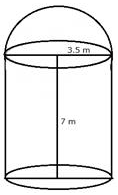
(i) Area of internal surface = Surface area of cylinder + Surface area of hemisphere
= 2πrh + 2πr2
= 2πr(h + r)
=
= 2 × 22 × 0.5 × 10.5
= 231 m2.
Hence, the total area of the internal surface = 231 m2.
(ii) Internal volume of container = Volume of hemisphere + Volume of cylinder
Hence, volume of container = 359.33 m3.
An exhibition tent is in the form of a cylinder surmounted by a cone. The height of the tent above ground is 85 m and height of the cylindrical part is 50 m. If the diameter of the base is 168 m, find the quantity of canvas required to make the tent. Allow 20% extra for fold and for stitching. Give your answer to the nearest m2.
Answer
Given,
Diameter of base = 168 m
From figure,
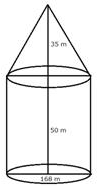
Diameter of cylindrical base = Diameter of cone
Radius of cylindrical base = Radius of conical base = r = = 84 m.
Height of cylindrical part (H) = 50 m
Height of conical part (h) = 35 m
By formula,
⇒ l2 = r2 + h2
⇒ l2 = 842 + 352
⇒ l2 = 7056 + 1225
⇒ l2 = 8281
⇒ l = = 91 m.
Surface area of exhibition tent = Surface area of cylindrical part + Surface area of conical part
= 2πrH + πrl
Area required for folds and stitching = = 10084.8 m2.
Total area of canvas required = 50424 + 10084.8 = 60508.8 m2 ≈ 60509 m2 (to the nearest m2).
Hence, area of canvas required = 60509 m2.
A test tube consists of a hemisphere and a cylinder of the same radius. The volume of the water required to fill the whole tube is cm3, and cm3 of water is required to fill the tube to a level which is 4 cm below the top of the tube. Find the radius of the tube and the length of its cylindrical part.
Answer
Given,
Let radius of hemisphere be r cm and height of cylindrical portion be h cm.
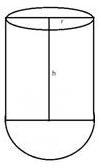
Total volume of test tube = Volume of hemisphere + Volume of cylinder
Given,
cm3 of water is required to fill the tube to a level which is 4 cm below the top of the tube.
Substituting value of πr2(2r + 3h) from equation 1 in above equation.
Substituting value of r in equation 1, we get :
Hence, radius of cylindrical part = 3.5 cm and height = 20 cm.
A solid is in the form of a right circular cone mounted on a hemisphere. The diameter of the base of the cone, which exactly coincides with hemisphere, is 7 cm and its height is 8 cm. The solid is placed in a cylindrical vessel of internal radius 7 cm and height 15 cm. How much water, in cm3, will be required to fill the vessel completely?
Answer
Given,
Diameter of cone = 7 cm
Radius of cone (r) = = 3.5 cm
Height of cone (h) = 8 cm
Radius of hemisphere = radius of cone = r = 3.5 cm
Radius of cylindrical vessel (R) = 7 cm
Height of cylindrical vessel (H) = 15 cm.

Volume of solid = Volume of cone + Volume of hemisphere
By formula,
Volume of cylindrical vessel = πR2H
Volume of water required to fill the vessel completely = Volume of cylindrical vessel - Volume of solid
= 2310 - 192.5
= 2117.5 cm3.
Hence, volume of water required to fill the vessel completely = 2117.5 cm3.
A certain number of metallic cones, each of radius 2 cm and height 3 cm, are melted and recast into a solid sphere of radius 6 cm. Find the number of cones used.
Answer
Given,
Radius of cone (r) = 2 cm,
Height of cone (h) = 3 cm,
Radius of sphere (R) = 6 cm.
Let n cones be melted to recast into a solid sphere.
∴ n × Volume of each cone = Volume of sphere
Hence, 72 cones need to be melted to recast into a solid sphere.
A conical tent is to accommodate 77 persons. Each person must have 16 m3 of air to breathe. Given the radius of the tent as 7 m, find the height of the tent and also its curved surface area.
Answer
Given,
Each person must have 16 m3 of air to breathe.
∴ 77 persons need 77 × 16 m3 = 1232 m3.
Radius of tent (r) = 7 m.
Let height of conical tent be h meters.
Since, conical tent needs to accommodate 77 persons, so its volume will be equal to volume of air required for 77 persons.
By formula,
⇒ l2 = r2 + h2
⇒ l2 = 72 + 242
⇒ l2 = 49 + 576
⇒ l2 = 625
⇒ l = = 25 m.
Curved surface area of tent = πrl
=
= 22 × 25
= 550 m2.
Hence, height of tent = 24 m and curved surface area of tent = 550 m2.
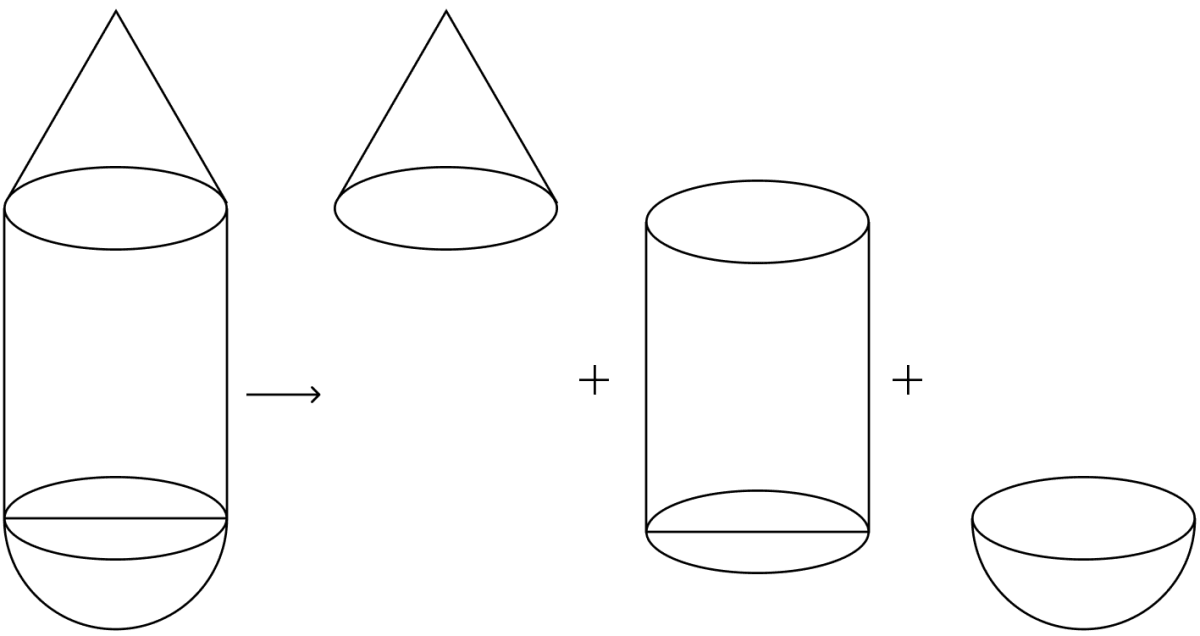
A metallic solid cylinder has one end surmounted by a cone of the same radius and a hemisphere, which is also of same radius as that of the cone. The conical portion, the cylindrical portion and the hemispherical portion are separated as shown below. If the radius of the given solid is r cm and the height of the cone = the height of the cylinder = h cm, find expression for the total surface area of the three parts obtained.
Answer
When the three portions are separated, each becomes a complete solid. So, we add the entire surface area of the cone, the cylinder and the hemisphere.
For the cone :
Radius = r cm and height = h cm.
Slant height (l) = cm.
Total surface area of cone = πrl + πr2 = + πr2.
For the cylinder :
Radius = r cm and height = h cm.
Total surface area of cylinder = 2πrh + 2πr2.
For the hemisphere :
Radius = r cm.
Total surface area of hemisphere = 2πr2 + πr2 = 3πr2.
∴ Total surface area of the three parts
Hence, total surface area of the three parts = πr cm2.
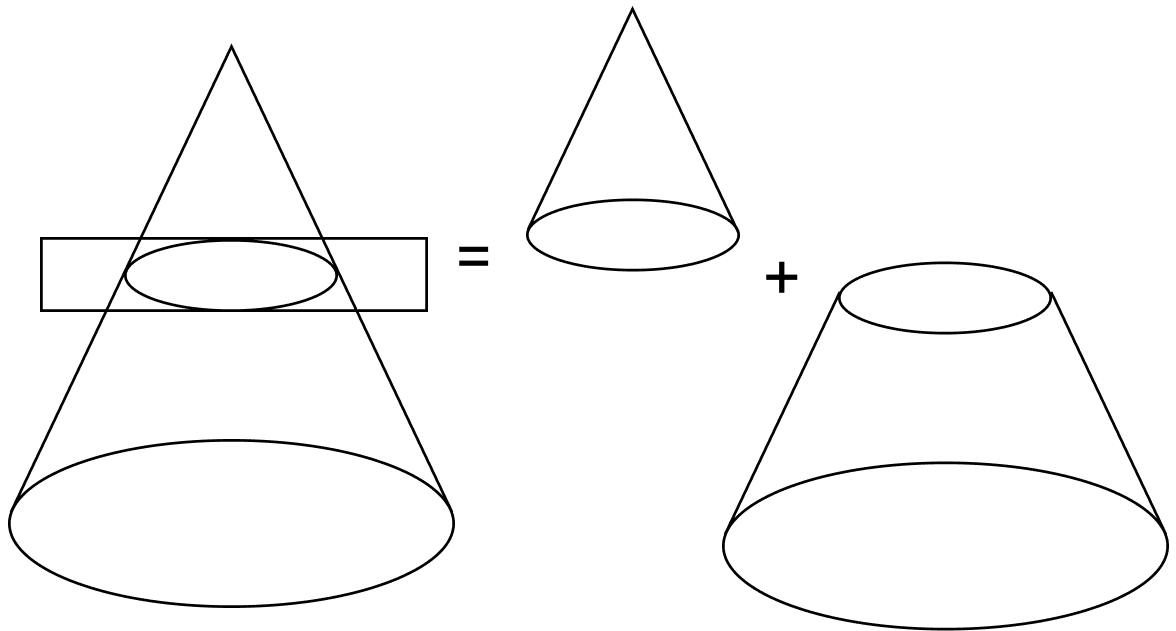
A solid cone of radius 20 cm is cut from its middle, parallel to its base, into two parts as shown. Find :
The ratio between the volumes of the two parts obtained.
Answer
Let the radius of the base of the cone be R = 20 cm and its height be H cm.
The cone is cut at the middle of its height by a plane parallel to the base. So the cut is at a height from the apex.
The upper part is a small cone similar to the whole cone. Since the height is halved, by similar triangles its radius is also halved.
∴ Radius of small cone (r) = = 10 cm and height = .
Volume of small cone (upper part) :
Volume of the whole cone :
Volume of lower part (frustum) = Volume of whole conce - Volume of small cone
∴ Ratio of the two parts :
Hence, the ratio between the volumes of the two parts (smaller cone : frustum) is 1 : 7.