KnowledgeBoat Logo
|
OPEN IN APP

Chapter 20

Cylinder, Cone & Sphere (Surface Area & Volume) — Exercise 20(F)

Class - 10 Concise Mathematics Selina


Exercise 20(F)

Question 1(a)

The volume of a solid cylinder and a solid cone are same. If their radii are also same, the ratio between the heights of cylinder and cone is :

  1. 3 : 1

  2. 2 : 3

  3. 1 : 3

  4. 3 : 2

Answer

Radii of cylinder = Radii of cone = r (let)

Let height of cylinder be h1 and height of cone be h2.

Given,

Volume of a solid cylinder and a solid cone are same.

⇒ πr2h1 = 13\dfrac{1}{3} πr2h2

⇒ h1 = 13\dfrac{1}{3} h2

h1h2=13\dfrac{h_1}{h_2} = \dfrac{1}{3}

⇒ h1 : h2 = 1 : 3.

Hence, Option 3 is the correct option.

Question 1(b)

The volume of the given solid is :

  1. 43πr3\dfrac{4}{3}πr^3

  2. 43πr2\dfrac{4}{3}πr^2

  3. 2πr3

  4. 4πr3

The volume of the given solid is : Cylinder, Cone, Sphere, Concise Mathematics Solutions ICSE Class 10.

Answer

From figure,

Height of cone (h) = r

Height of cylinder (H) = r

Radius of hemispherical portion = Radius of cylindrical portion = Radius of conical portion = r.

From figure,

Volume of body = Volume of conical portion + Volume of cylindrical portion + Volume of hemispherical portion

=13πr2h+πr2H+23πr3=13πr2.r+πr2.r+23πr3=13πr3+πr3+23πr3=πr3+3πr3+2πr33=6πr33=2πr3.= \dfrac{1}{3}πr^2h + πr^2H + \dfrac{2}{3}πr^3 \\[1em] = \dfrac{1}{3}πr^2.r + πr^2.r + \dfrac{2}{3}πr^3 \\[1em] = \dfrac{1}{3}πr^3 + πr^3 + \dfrac{2}{3}πr^3 \\[1em] = \dfrac{πr^3 + 3πr^3 + 2πr^3}{3} \\[1em] = \dfrac{6πr^3}{3}\\[1em] = 2πr^3.

Hence, Option 3 is the correct option.

Question 1(c)

Eight identical metallic spheres, each of radius 1 cm are melted and recast into a solid sphere. The radius of the solid sphere formed is :

  1. 3 cm

  2. 2 cm

  3. 1.5 cm

  4. 2.5 cm

Answer

Given,

Radius of small metallic sphere (r) = 1 cm

Eight identical metallic spheres, each of radius 1 cm are melted and recast into a solid sphere.

Let radius of solid sphere formed be R.

∴ Volume of large metallic sphere = 8 × Volume of each smaller sphere

43πR3=8×43πr3R3=8r3R3=8×13R3=8R3=23R=2 cm.\Rightarrow \dfrac{4}{3}πR^3 = 8 \times \dfrac{4}{3}πr^3 \\[1em] \Rightarrow R^3 = 8r^3 \\[1em] \Rightarrow R^3 = 8 \times 1^3 \\[1em] \Rightarrow R^3 = 8 \\[1em] \Rightarrow R^3 = 2^3 \\[1em] \Rightarrow R = 2 \text{ cm}.

Hence, Option 2 is the correct option.

Question 1(d)

The ratio between the heights of two solid cones is 2 : 3 and ratio between their radii is 9 : 8. The ratio between their volumes is :

  1. 27 : 32

  2. 32 : 27

  3. 3 : 2

  4. 2 : 3

Answer

Given,

Ratio between the heights of two solid cones is 2 : 3.

Let height of first (h1) and second cone (h2) be 2a and 3a.

Ratio between the radii of two solid cones is 9 : 8.

Let radii of first (r1) and second cone (r2) be 9x and 8x.

Vol. of 1st coneVol. of 2nd cone=13πr12h113πr22h2=r12h1r22h2=(9x)2×2a(8x)2×3a=81x2×2a64x2×3a=162x2a192x2a=2732=27:32.\dfrac{\text{Vol. of 1st cone}}{\text{Vol. of 2nd cone}} = \dfrac{\dfrac{1}{3}πr_1^2h_1}{\dfrac{1}{3}πr_2^2h_2} \\[1em] = \dfrac{r_1^2h_1}{r_2^2h_2} \\[1em] = \dfrac{(9x)^2 \times 2a}{(8x)^2 \times 3a} \\[1em] = \dfrac{81x^2 \times 2a}{64x^2 \times 3a} \\[1em] = \dfrac{162x^2a}{192x^2a} \\[1em] = \dfrac{27}{32} \\[1em] = 27 : 32.

Hence, Option 1 is the correct option.

Question 1(e)

The radius of a solid cylinder is doubled keeping the height same. The percentage increase in its volume is :

  1. 200%

  2. 100%

  3. 400%

  4. 300%

Answer

Before change :

Radius of cylinder = r

Height of cylinder = h

Volume of cylinder = πr2h

After change :

Radius of cylinder = 2r

Height of cylinder = h

Volume of cylinder = π(2r)2h = 4πr2h

Difference in volume = Volume after change - Volume before change
= 4πr2h - πr2h
= 3πr2h.

Percentage increase in volume

=Difference in vol.Vol. of cylinder before change×100=3πr2hπr2h×100=3×100=300= \dfrac{\text{Difference in vol.}}{\text{Vol. of cylinder before change}} \times 100 \\[1em] = \dfrac{3πr^2h}{πr^2h} \times 100 \\[1em] = 3 \times 100 \\[1em] = 300%

Hence, Option 4 is the correct option.

Question 2

From a solid right circular cylinder with height 10 cm and radius of the base 6 cm, a right circular cone of the same height and same base are removed. Find the volume of the remaining solid.

Answer

Given,

Height of the cylinder (H) = 10 cm

Radius of the base of cylinder (R) = 6 cm

Height of the cone (h) = 10 cm

Radius of the base of cone (r) = 6 cm

Volume of remaining part (V) = Volume of cylinder - Volume of cone

V=πR2H13πr2h=227×62×1013×227×62×10=227×62×10×(113)=227×36×10×23=22×12×10×27=52807=75427 cm3.V = πR^2H - \dfrac{1}{3}πr^2h \\[1em] = \dfrac{22}{7} \times 6^2 \times 10 - \dfrac{1}{3} \times \dfrac{22}{7} \times 6^2 \times 10 \\[1em] = \dfrac{22}{7} \times 6^2 \times 10 \times \Big(1 - \dfrac{1}{3}\Big) \\[1em] = \dfrac{22}{7} \times 36 \times 10 \times \dfrac{2}{3} \\[1em] = \dfrac{22 \times 12 \times 10 \times 2}{7} \\[1em] = \dfrac{5280}{7} \\[1em] = 754\dfrac{2}{7} \text{ cm}^3.

Hence, volume of remaining solid = 75427754\dfrac{2}{7} cm3.

Question 3

From a solid cylinder whose height is 16 cm and radius is 12 cm, a conical cavity of height 8 cm and of base radius 6 cm is hollowed out. Find the volume and total surface area of the remaining solid.

Answer

Given,

Height of the cylinder (H) = 16 cm

Radius of the base of cylinder (R) = 12 cm

Height of the cone (h) = 8 cm

Radius of the base of cone (r) = 6 cm
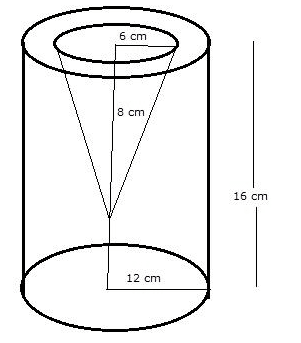
From a solid cylinder whose height is 16 cm and radius is 12 cm, a conical cavity of height 8 cm and of base radius 6 cm is hollowed out. Find the volume and total surface area of the remaining solid. Cylinder, Cone, Sphere, Concise Mathematics Solutions ICSE Class 10.

(i) Volume of remaining part (V) = Volume of cylinder - Volume of cone

V=πR2H13πr2h=227×122×1613×227×62×8=227×[(122×16)(13×62×8)]=227×(23042883)=227×69122883=227×66243=227×2208=485767=6939.43 cm3.V = πR^2H - \dfrac{1}{3}πr^2h \\[1em] = \dfrac{22}{7} \times 12^2 \times 16 - \dfrac{1}{3} \times \dfrac{22}{7} \times 6^2 \times 8 \\[1em] = \dfrac{22}{7} \times [(12^2 \times 16) - (\dfrac{1}{3} \times 6^2 \times 8)] \\[1em] = \dfrac{22}{7} \times \Big(2304 - \dfrac{288}{3}\Big) \\[1em] = \dfrac{22}{7} \times \dfrac{6912 - 288}{3} \\[1em] = \dfrac{22}{7} \times \dfrac{6624}{3} \\[1em] = \dfrac{22}{7} \times 2208 \\[1em] = \dfrac{48576}{7} \\[1em] = 6939.43 \text{ cm}^3.

Hence, volume of remaining part = 6939.43 cm3.

(ii) By formula,

⇒ l2 = r2 + h2

⇒ l2 = 62 + 82

⇒ l2 = 36 + 64

⇒ l2 = 100

⇒ l2 = 102

⇒ l = 10 cm.

Thus,

Total surface area of remaining solid (T) = Curved surface area of cylinder + Curved surface area of cone + Base area of cylinder + Area of circular ring on upper side of cylinder

(T) = 2πRH + πrl + πR2 + π(R2 - r2)

=π(2RH+rl+R2+R2r2)=π(2RH+rl+2R2r2)=227×(2×12×16+6×10+2×12262)=227×(384+60+28836)=227×696=153127=2187.43 cm2.= π(2RH + rl + R^2 + R^2 - r^2) \\[1em] = π(2RH + rl + 2R^2 - r^2) \\[1em] = \dfrac{22}{7} \times (2 \times 12 \times 16 + 6 \times 10 + 2 \times 12^2 - 6^2) \\[1em] = \dfrac{22}{7} \times (384 + 60 + 288 - 36) \\[1em] = \dfrac{22}{7} \times 696 \\[1em] = \dfrac{15312}{7} \\[1em] = 2187.43 \text{ cm}^2.

Hence, total surface area of remaining solid = 2187.43 cm2.

Question 4

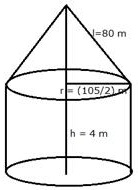
A circus tent is cylindrical to a height of 4 m and conical above it. If its diameter is 105 m and its slant height is 80 m, calculate the total area of canvas required. Also, find the total cost of canvas used at ₹ 15 per meter if the width is 1.5 m.

Answer

Given,

Radius of the cylindrical part of the tent (R) = 1052\dfrac{105}{2} m

Radius of conical part (r) = 1052\dfrac{105}{2} m.

Slant height (l) = 80 m

A circus tent is cylindrical to a height of 4 m and conical above it. If its diameter is 105 m and its slant height is 80 m, calculate the total area of canvas required. Also, find the total cost of canvas used at ₹ 15 per meter if the width is 1.5 m. Cylinder, Cone, Sphere, Concise Mathematics Solutions ICSE Class 10.

So, the total curved surface area of the tent = 2πRh + πrl

=(2×227×1052×4)+(227×1052×80)=1848014+18480014=1320+13200=14520 m2.= (2 \times \dfrac{22}{7} \times \dfrac{105}{2} \times 4) + (\dfrac{22}{7} \times \dfrac{105}{2} \times 80) \\[1em] = \dfrac{18480}{14} + \dfrac{184800}{14} \\[1em] = 1320 + 13200 \\[1em] = 14520 \text{ m}^2.

Width of canvas used = 1.5 m

Length of canvas = Area of canvasWidth of canvas=145201.5=9680 m\dfrac{\text{Area of canvas}}{\text{Width of canvas}} = \dfrac{14520}{1.5} = 9680 \text{ m}

Hence,

Total cost of canvas at the rate of ₹ 15 per meter = 9680 x 15 = ₹ 145200.

Hence, total area of canvas required = 9680 m2 and cost = ₹ 145200.

Question 5

A circus tent is cylindrical to a height of 8 m surmounted by a conical part. If total height of the tent is 13 m and the diameter of its base is 24 m; calculate:

(i) total surface area of the tent

(ii) area of canvas, required to make this tent allowing 10% of the canvas used for folds and stitching.

Answer

Given,

Height of the cylindrical part (H) = 8 m

Height of the conical part (h) = (13 - 8) m = 5 m

Diameter of base = 24 m

From figure,
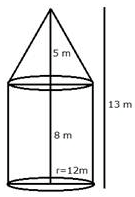
A circus tent is cylindrical to a height of 8 m surmounted by a conical part. If total height of the tent is 13 m and the diameter of its base is 24 m; calculate: (i) total surface area of the tent (ii) area of canvas, required to make this tent allowing 10% of the canvas used for folds and stitching. Cylinder, Cone, Sphere, Concise Mathematics Solutions ICSE Class 10.

Radius of cone and cylinder are equal (r) = 242\dfrac{24}{2} = 12 m.

By formula,

⇒ (l)2 = r2 + h2

⇒ l2 = 122 + 52

⇒ l2 = 144 + 25

⇒ l2 = 169

⇒ l = 169\sqrt{169}

⇒ l = 13 m.

(i) Total surface area of the tent = 2πrH + πrl = πr(2H + l)

= 227\dfrac{22}{7} x 12 x (2 x 8 + 13)

= 2647\dfrac{264}{7} (16 + 13)

= 76567\dfrac{7656}{7} m2

= 1093.71 m2.

Hence, total surface area of tent = 1093.71 m2.

(ii) According to question,

Area of canvas used in stitching = 10100×\dfrac{10}{100} \times Total area of canvas

⇒ Total area of canvas required = Total surface area of tent + Area of canvas used in stitching

⇒ Total area of canvas = 76567+110\dfrac{7656}{7} + \dfrac{1}{10} Total area of canvas

⇒ Total area of canvas - 110\dfrac{1}{10} Total area of canvas = 76567\dfrac{7656}{7}

910\dfrac{9}{10} Total area of canvas = 76567\dfrac{7656}{7}

⇒ Total area of canvas = 76567×109\dfrac{7656}{7} \times \dfrac{10}{9}

⇒ Total area of canvas = 1215.23 m2.

Hence, the total area of canvas required = 1215.23 m2.

Question 6

A cylindrical container with diameter of base 42 cm contains sufficient water to submerge a rectangular solid of iron with dimensions 22 cm × 14 cm × 10.5 cm. Find the rise in level of the water when the solid is submerged.

Answer

Given,

Diameter of base of cylindrical container = 42 cm

Radius of base of cylindrical container (r) = 422\dfrac{42}{2} = 21 cm.

Let rise in level of water be h cm.

∴ Volume of solid submerged = Volume of increased water

⇒ 22 cm × 14 cm × 10.5 cm = πr2h

⇒ 3234 = 227×212×h\dfrac{22}{7} \times 21^2 \times h

⇒ h = 3234×722×212\dfrac{3234 \times 7}{22 \times 21^2}

⇒ h = 226389702=213\dfrac{22638}{9702} = 2\dfrac{1}{3} cm.

Hence, water rises by 2132\dfrac{1}{3} cm in container.

Question 7

Spherical marbles of diameter 1.4 cm are dropped into a beaker containing some water and are fully submerged. The diameter of the beaker is 7 cm. Find how many marbles have been dropped in it if the water rises by 5.6 cm?

Answer

Given,

Diameter of spherical marbles = 1.4 cm

Radius (r) = 1.42\dfrac{1.4}{2} = 0.7 cm.

Diameter of beaker = 7 cm

Radius of beaker (R) = 72\dfrac{7}{2} = 3.5 cm

Increase in water level (h) = 5.6 cm.

Let n marbles are dropped.

⇒ Volume of water increased in beaker = n × Volume of one marble (sphere)

⇒ πR2h = n×43πr3n \times \dfrac{4}{3}πr^3

R2h=n×43r3n=3R2h4r3n=3×(3.5)2×5.64×(0.7)3n=3×12.25×5.64×0.343n=150.\Rightarrow R^2h = n \times \dfrac{4}{3}r^3\\[1em] \Rightarrow n = \dfrac{3R^2h}{4r^3} \\[1em] \Rightarrow n = \dfrac{3 \times (3.5)^2 \times 5.6}{4 \times (0.7)^3} \\[1em] \Rightarrow n = \dfrac{3 \times 12.25 \times 5.6}{4 \times 0.343} \\[1em] \Rightarrow n = 150.

Hence, 150 marbles are dropped in the beaker.

Question 8

An open cylindrical vessel of internal diameter 7 cm and height 8 cm stands on a horizontal table. Inside this is placed a solid metallic right circular cone, the diameter of whose base is 3123\dfrac{1}{2} cm and height 8 cm. Find the volume of water required to fill the vessel.

If this cone is replaced by another cone, whose height is 1341\dfrac{3}{4} cm and the radius of whose base is 2 cm, find the drop in the water level.

Answer

Given,

Diameter of cylindrical vessel = 7 cm

Radius of cylindrical vessel (R) = 72\dfrac{7}{2} = 3.5 cm

Height of cylindrical vessel (H) = 8 cm

Diameter of base of cone = 312=723\dfrac{1}{2} = \dfrac{7}{2} cm

Radius of base of cone (r) = 74\dfrac{7}{4} cm

Height of cone (h) = 8 cm

Volume of cylindrical vessel = πR2H=227×(3.5)2×8πR^2H = \dfrac{22}{7} \times (3.5)^2 \times 8

= 22×0.5×3.5×822 \times 0.5 \times 3.5 \times 8

= 308 cm3.

Volume of original cone = 13πr2h\dfrac{1}{3}πr^2h

= 13×227×(74)2×8\dfrac{1}{3} \times \dfrac{22}{7} \times \Big(\dfrac{7}{4}\Big)^2 \times 8

= 13×22×14×74×8\dfrac{1}{3} \times 22 \times \dfrac{1}{4} \times \dfrac{7}{4} \times 8

= 30812\dfrac{308}{12} cm3

Volume of water required to fill the vessel = Volume of cylindrical vessel - Volume of original cone

=30830812=12×30830812=338812=282.33 cm3.= 308 - \dfrac{308}{12} \\[1em] = \dfrac{12 \times 308 - 308}{12} \\[1em] = \dfrac{3388}{12} \\[1em] = 282.33 \text{ cm}^3.

Given,

Radius of new cone (r1) = 2 cm

Height of new cone (h1) = 74\dfrac{7}{4} cm

Volume of new cone = 13πr12h1\dfrac{1}{3}πr_1^2h_1

=13×227×22×74=13×22×4×14=223 cm3= \dfrac{1}{3} \times \dfrac{22}{7} \times 2^2 \times \dfrac{7}{4} \\[1em] = \dfrac{1}{3} \times 22 \times 4 \times \dfrac{1}{4} \\[1em] = \dfrac{22}{3} \text{ cm}^3

Volume of water which comes down = Volume of original cone - Volume of new cone

= 30812223\dfrac{308}{12} - \dfrac{22}{3}

= 773223=553\dfrac{77}{3} - \dfrac{22}{3} = \dfrac{55}{3} cm3.

Let drop in height of water be h2 cm.

Drop in volume of water = 553\dfrac{55}{3} cm3

πR2h2=553227×(3.5)2×h2=55322×0.5×3.5×h2=55338.5×h2=553h2=55115.5h2=1021 cm.\therefore πR^2h_2 = \dfrac{55}{3} \\[1em] \Rightarrow \dfrac{22}{7} \times (3.5)^2 \times h_2 = \dfrac{55}{3} \\[1em] \Rightarrow 22 \times 0.5 \times 3.5 \times h_2 = \dfrac{55}{3} \\[1em] \Rightarrow 38.5 \times h_2 = \dfrac{55}{3} \\[1em] \Rightarrow h_2 = \dfrac{55}{115.5} \\[1em] \Rightarrow h_2 = \dfrac{10}{21} \text{ cm}. \\[1em]

Hence, volume of water required to fill the vessel = 282.33 cm3 and drop in level of water = 1021\dfrac{10}{21} cm.

Question 9

A cylindrical can, whose base is horizontal and of radius 3.5 cm, contains sufficient water so that when a sphere is placed in the can, the water just covers the sphere. Given that the sphere just fits into the can, calculate :

(i) the total surface area of the can in contact with water when the sphere is in it;

(ii) the depth of water in the can before the sphere was put into the can.

Answer

(i) Given,

Radius of base of cylindrical can (R) = 3.5 cm
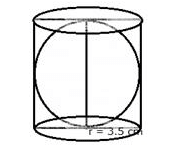
A cylindrical can, whose base is horizontal and of radius 3.5 cm, contains sufficient water so that when a sphere is placed in the can, the water just covers the sphere. Given that the sphere just fits into the can, calculate : (i) the total surface area of the can in contact with water when the sphere is in it; (ii) the depth of water in the can before the sphere was put into the can. Cylinder, Cone, Sphere, Concise Mathematics Solutions ICSE Class 10.

Since,

When a sphere is placed in the can, the water just covers the sphere.

∴ Height (H) = 2R = 7 cm.

Total surface area = 2πRH + πR2

= πR(2H + R)

= 227×3.5×(2×7+3.5)\dfrac{22}{7} \times 3.5 \times (2 \times 7 + 3.5)

= 22 × 0.5 × (14 + 3.5)

= 192.5 cm2.

Hence, the total surface area of the can in contact with water when the sphere is in it = 192.5 cm2.

(ii) Let the depth of the water be h cm in the can.

Volume of water = Volume of cylinder - Volume of sphere

πR2h=πR2H43πR3πR2h=πR2(H43πR)h=H43Rh=743×3.5h=7143h=21143h=73=213 cm.\Rightarrow πR^2h = πR^2H - \dfrac{4}{3}πR^3 \\[1em] \Rightarrow πR^2h = πR^2\Big(H - \dfrac{4}{3}πR\Big) \\[1em] \Rightarrow h = H - \dfrac{4}{3}R \\[1em] \Rightarrow h = 7 - \dfrac{4}{3} \times 3.5 \\[1em] \Rightarrow h = 7 - \dfrac{14}{3} \\[1em] \Rightarrow h = \dfrac{21 - 14}{3} \\[1em] \Rightarrow h = \dfrac{7}{3} = 2\dfrac{1}{3}\text{ cm}.

Hence, depth of water in the can before the sphere was put into the can = 2132\dfrac{1}{3} cm.

Question 10

A hollow cylinder has solid hemisphere inward at one end and on the other end it is closed with a flat circular plate. The height of water is 10 cm when flat circular surface is downward. Find the level of water, when it is inverted upside down, common diameter is 7 cm and height of cylinder is 20 cm.

Answer

Given,

For Cylinder :

Height (H) = 20 cm, Radius (R) = 3.5 cm

For Hemisphere :

Radius (r) = Radius of cylinder (R) = 3.5 cm
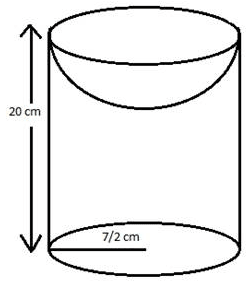
A hollow cylinder has solid hemisphere inward at one end and on the other end it is closed with a flat circular plate. The height of water is 10 cm when flat circular surface is downward. Find the level of water, when it is inverted upside down, common diameter is 7 cm and height of cylinder is 20 cm. Cylinder, Cone, Sphere, Concise Mathematics Solutions ICSE Class 10.

When flat surface is downward, then height of water (h) = 10 cm.

So, when circular surface part will be downward then,

Let height upto which water fills be h1.

Volume of cylinder (upto height h1) = Volume of cylinder (upto height h) + Volume of hemisphere

πR2h1=πR2h+23πr3πR2h1=πR2h+23πR3[As,r=R]πR2h1=πR2(h+23R)h1=h+23Rh1=10+23×3.5h1=10+73h1=30+73h1=373=1213=12.33 cm.\Rightarrow πR^2h_1 = πR^2h + \dfrac{2}{3}πr^3 \\[1em] \Rightarrow πR^2h_1 = πR^2h + \dfrac{2}{3}πR^3 [As, r = R] \\[1em] \Rightarrow πR^2h_1 = πR^2\Big(h + \dfrac{2}{3}R\Big) \\[1em] \Rightarrow h_1 = h + \dfrac{2}{3}R \\[1em] \Rightarrow h_1 = 10 + \dfrac{2}{3}\times 3.5 \\[1em] \Rightarrow h_1 = 10 + \dfrac{7}{3} \\[1em] \Rightarrow h_1 = \dfrac{30 + 7}{3} \\[1em] \Rightarrow h_1 = \dfrac{37}{3} = 12\dfrac{1}{3} = 12.33\text{ cm}.

Hence, the level of water, when cylinder is inverted upside down = 12.33 cm.

PrevNext