
Chords AB and CD of a circle intersect each other at point O such that OA : OC = 4 : 7. Then OB : OD is equal to :
4 : 7
5 : 4
7 : 4
4 : 5

Answer
Given,
OA : OC = 4 : 7
We know that,
If two chords of a circle intersect internally or externally then the product of the lengths of their segments is equal.
From figure,
⇒ OA × OB = OC × OD
⇒
⇒
⇒ .
⇒ OB : OD = 7 : 4.
Hence, Option 3 is the correct option.
If ∠PAC : ∠PCA = 4 : 5, ∠P is :
40°
60°
105°
45°

Answer
We know that,
Sum of co-interior angles in a trapezium is 180°.
In trapezium ABDC,
⇒ ∠B + ∠BAC = 180°
⇒ 60° + ∠BAC = 180°
⇒ ∠BAC = 180° - 60° = 120°.
From figure,
⇒ ∠PAC + ∠BAC = 180°
⇒ ∠PAC + 120° = 180°
⇒ ∠PAC = 180° - 120° = 60°.
Given,
⇒ ∠PAC : ∠PCA = 4 : 5
In △PCA,
By angle sum property of triangle,
⇒ ∠APC + ∠PAC + ∠PCA = 180°
⇒ ∠APC + 60° + 75° = 180°
⇒ ∠APC + 135° = 180°
⇒ ∠APC = 180° - 135° = 45°.
Hence, Option 4 is the correct option.
AC is a tangent to the given circle which touches the circle at point B. If ∠EBC = 45°; angle EDB is equal to :
45°
90°
125°
135°

Answer
From figure,
⇒ ∠ABE + ∠EBC = 180° [Linear pair]
⇒ ∠ABE + 45° = 180°
⇒ ∠ABE = 180° - 45° = 135°.
We know that,
The angle between a tangent and a chord through the point of contact is equal to an angle in the alternate segment.
⇒ ∠EDB = ∠ABE = 135°.
Hence, Option 4 is the correct option.
In the given circle, PA is tangent and PBC is secant, PA = 8 cm and PB = 4 cm. The length of BC is :
8 cm
12 cm
16 cm
2 cm

Answer
We know that,
If a chord and a tangent intersect externally, then the product of the lengths of the segments of the chord is equal to the square of the length of the tangent from the point of contact to the point of intersection.
⇒ PB × PC = PA2
⇒ 4 × PC = 82
⇒ 4 × PC = 64
⇒ PC = = 16 cm.
From figure,
BC = PC - PB = 16 - 4 = 12 cm.
Hence, Option 2 is the correct option.
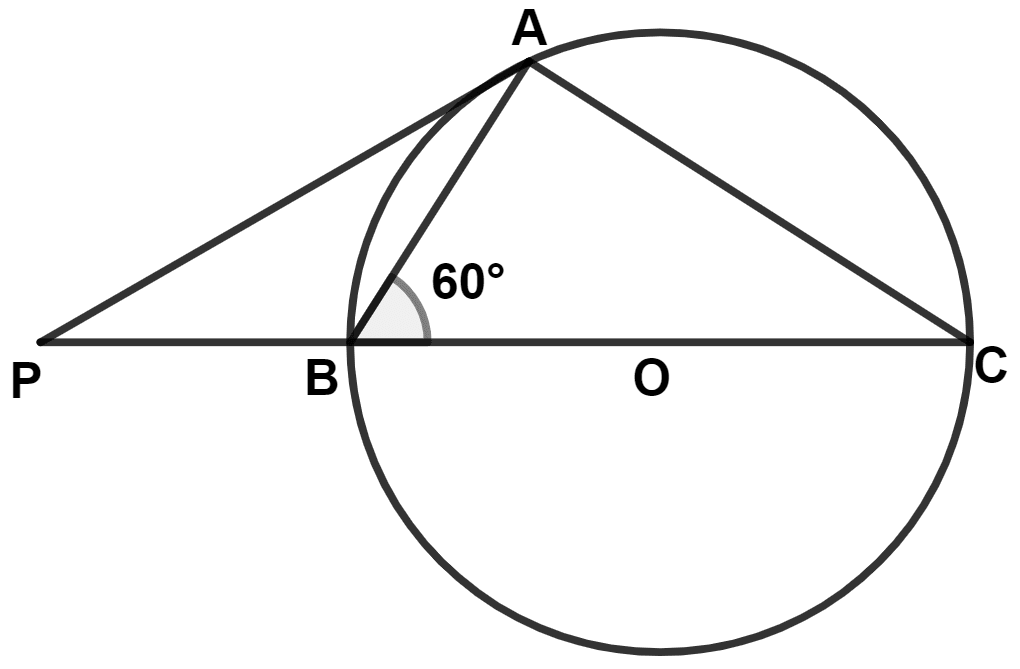
In the given figure, O is the center of the circle, PA is tangent and PBC is secant. If ∠ABC = 60°; ∠P is :
30°
60°
120°
90°
Answer
In △ABC,
∠BAC = 90° (Angle in semi-circle is a right angle)
⇒ ∠ABC + ∠BAC + ∠ACB = 180° (By angle sum property of triangle)
⇒ 60° + 90° + ∠ACB = 180°
⇒ 150° + ∠ACB = 180°
⇒ ∠ACB = 180° - 150° = 30°.
We know that,
The angle between a tangent and a chord through the point of contact is equal to an angle in the alternate segment.
⇒ ∠BAP = ∠ACB = 30°.
From figure,
⇒ ∠PBA + ∠ABC = 180° [Linear pairs]
⇒ ∠PBA + 60° = 180°
⇒ ∠PBA = 180° - 60° = 120°.
In △PBA,
⇒ ∠PBA + ∠BAP + ∠APB = 180° (By angle sum property of triangle)
⇒ 120° + 30° + ∠APB = 180°
⇒ 150° + ∠APB = 180°
⇒ ∠APB = 180° - 150° = 30°.
∴ ∠P = 30°.
Hence, Option 1 is the correct option.
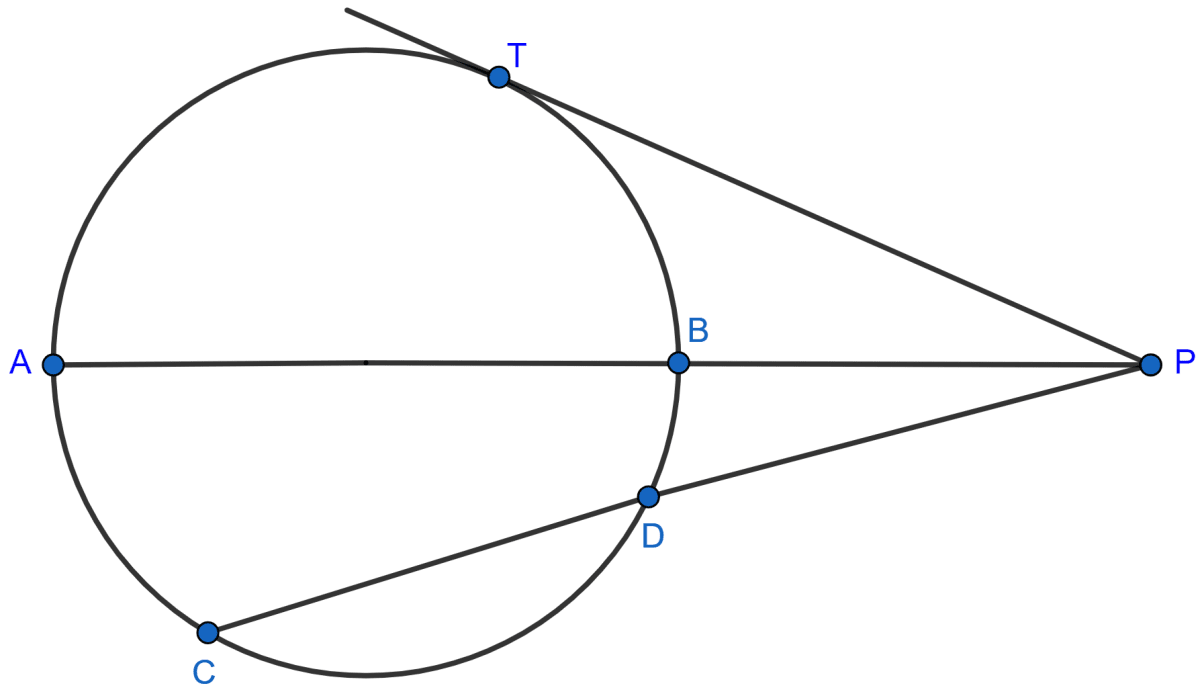
In the given figure, diameter AB and chord CD of a circle meet at P. PT is a tangent to the circle at T. CD = 7.8 cm, PD = 5 cm, PB = 4 cm. Find :
(i) AB
(ii) the length of tangent PT.
Answer
(i) From figure,
PC = PD + CD = 5 + 7.8 = 12.8 cm.
We know that,
If two chords of a circle intersect internally of externally then the product of the lengths of their segments is equal.
Since, here AB and CD intersect externally at P.
∴ AP x PB = CP x PD
⇒ AP x 4 = 12.8 x 5
⇒ AP = = 16 cm.
From figure,
AB = PA - PB = 16 - 4 = 12 cm.
Hence, AB = 12 cm.
(ii) We know that,
If a chord and a tangent intersect externally, then the product of lengths of the segments of the chord is equal to the square of the length of the tangent from the point of contact to the point of intersection.
∴ PA x PB = PT2
⇒ 16 x 4 = PT2
⇒ PT = = 8 cm.
Hence, PT = 8 cm.
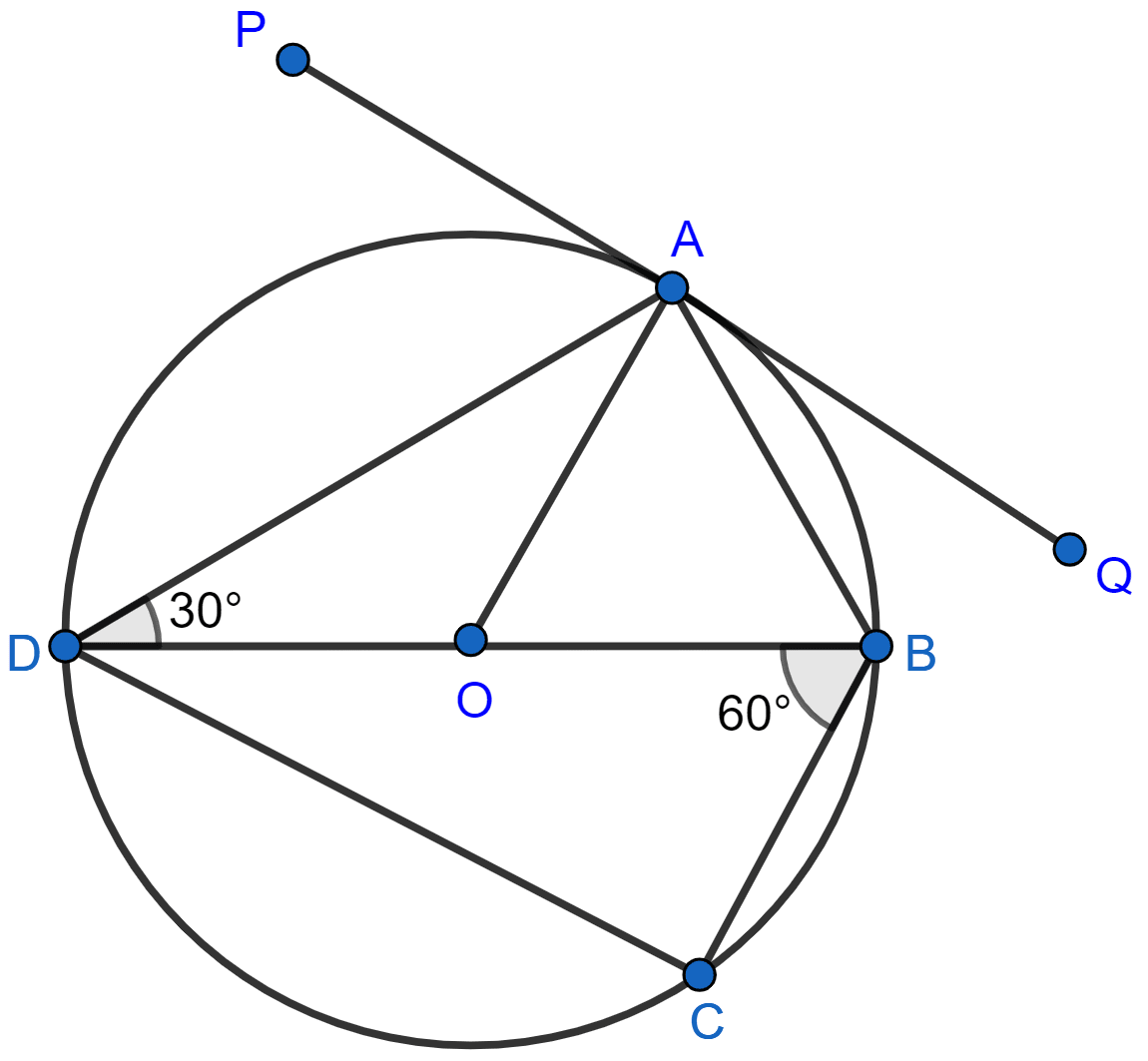
In the following figure, PQ is the tangent to the circle at A, DB is a diameter and O is the centre of the circle. If ∠ADB = 30° and ∠CBD = 60°, calculate:
(i) ∠QAB,
(ii) ∠PAD,
(iii) ∠CDB.
Answer
(i) ∠QAB = ∠ADB [∵ angles in alternate segment are equal.]
∴ ∠QAB = 30°.
Hence, the value of ∠QAB = 30°.
(ii) In △DAO,
OA = OD [∵ radii of the same circle]
So, ∠OAD = ∠ODA = 30° [∵ angles opposite to equal sides are equal.]
We know that,
The tangent at any point of a circle is perpendicular to the radius through the point of contact.
∴ ∠OAP = 90°.
From figure,
⇒ ∠PAD = ∠OAP - ∠OAD = 90° - 30° = 60°.
Hence, ∠PAD = 60°.
(iii) In △BCD,
∠BCD = 90° [∵ angle in a semi-circle is a right angle.]
∠CBD = 60°
∠CDB + ∠CBD + ∠BCD = 180° [By angle sum property of triangle]
⇒ ∠CDB + 60° + 90° = 180°
⇒ ∠CDB = 180° - 150° = 30°.
Hence, ∠CDB = 30°.
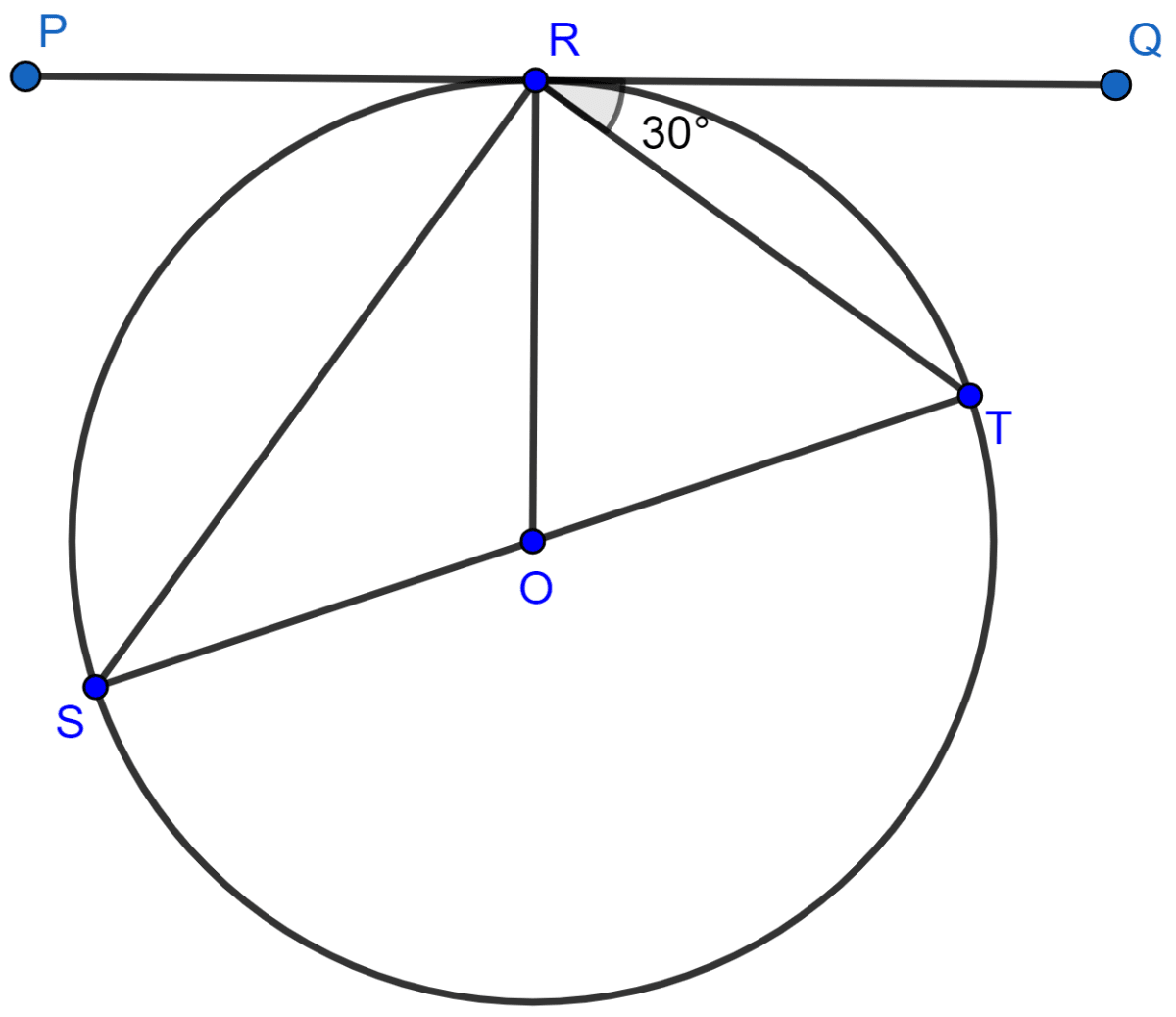
If PQ is a tangent to the circle at R; calculate :
(i) ∠PRS,
(ii) ∠ROT.
Given, O is the center of the circle and angle TRQ = 30°.
Answer
(i) Since, ST passes through O, so ST is the diameter of the circle.
We know that,
Angle in a semi-circle is a right angle.
∴ ∠SRT = 90°.
Since, PQ is a straight line.
∴ ∠PRS + ∠SRT + ∠TRQ = 180°
⇒ ∠PRS + 90° + 30° = 180°
⇒ ∠PRS + 120° = 180°
⇒ ∠PRS = 180° - 120°
⇒ ∠PRS = 60°.
Hence, ∠PRS = 60°.
(ii) We know that,
The angle between a tangent and chord through the point of contact is equal to an angle in the alternate segment.
∠TSR = ∠TRQ = 30°.
Since, angle subtended by a segment at the center is double the angle suspended at the circumference.
∠ROT = 2∠TSR = 2 × 30° = 60°.
Hence, ∠ROT = 60°.
Two circles with centers O and O' are drawn to intersect each other at points A and B. Center O of one circle lies on the circumference of the other circle and CD is drawn tangent to the circle with center O' at A. Prove that OA bisects angle BAC.
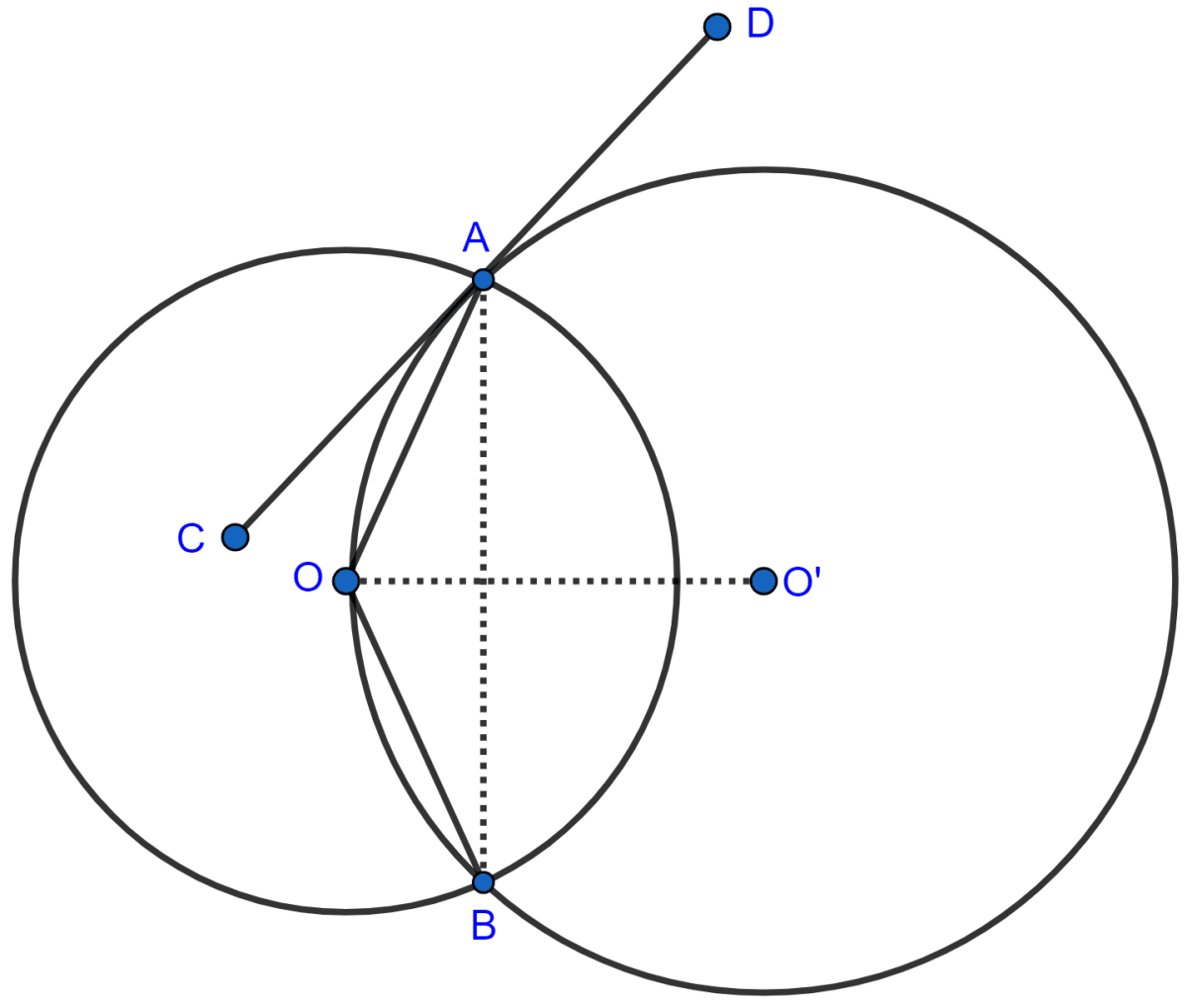
Answer
Join O'A and O'B.
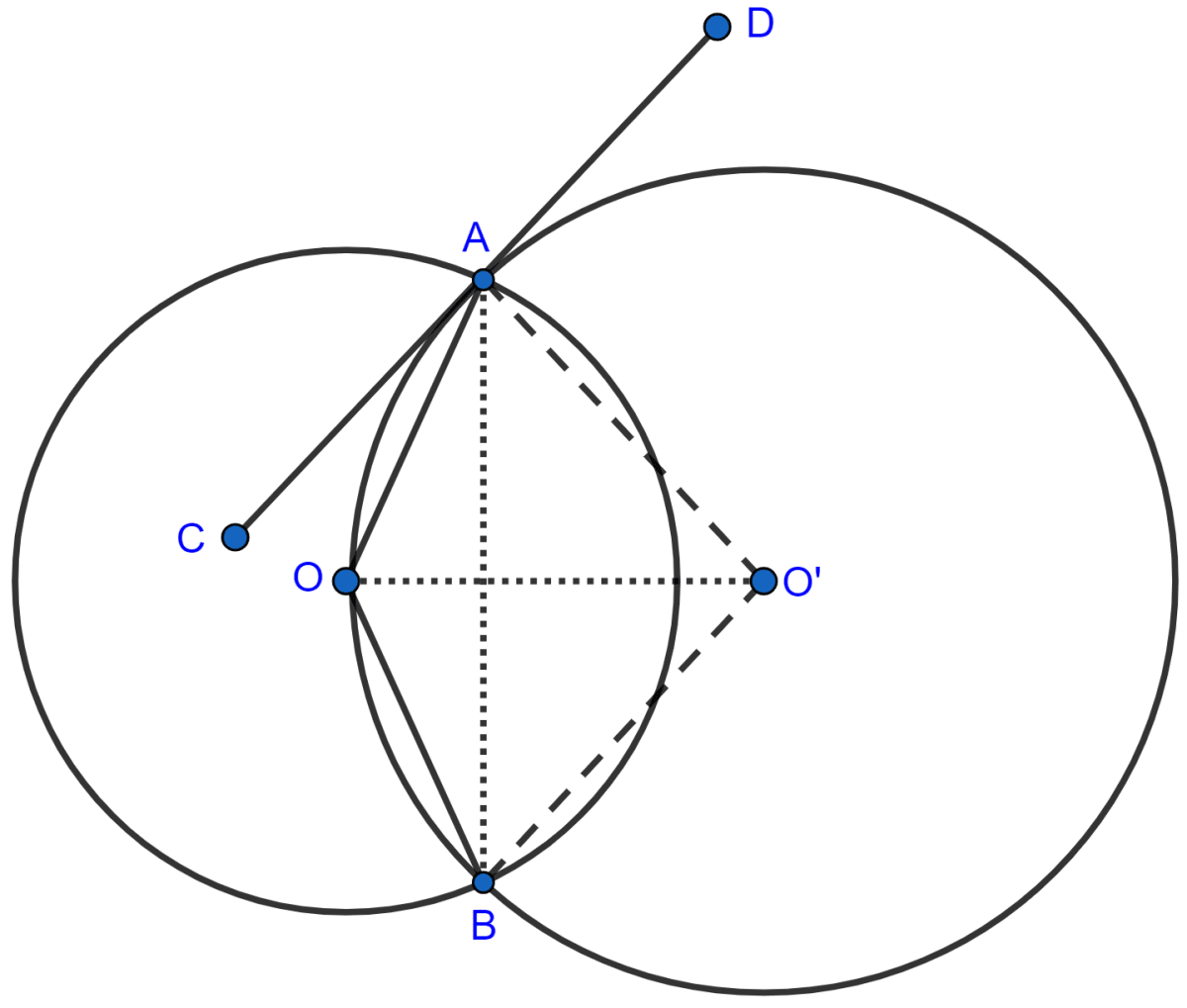
As, the angle between a tangent and a chord through the point of contact is equal to the angle in the alternate segment, we have :
CD is the tangent and AO is the chord.
∴ ∠OAC = ∠OBA ......... (1)
In ∆OAB,
OA = OB [Radius of the circle with center O.]
∠OAB = ∠OBA .......... (2) [Angles opposite to equal sides]
From (1) and (2), we have
∠OAC = ∠OAB
Hence, proved that OA is the bisector of ∠BAC.
In the figure, ABCD is a cyclic quadrilateral with BC = CD. TC is tangent to the circle at point C and DC is produced to point G. If ∠BCG = 108° and O is the center of the circle, find :
(i) angle BCT
(ii) angle DOC
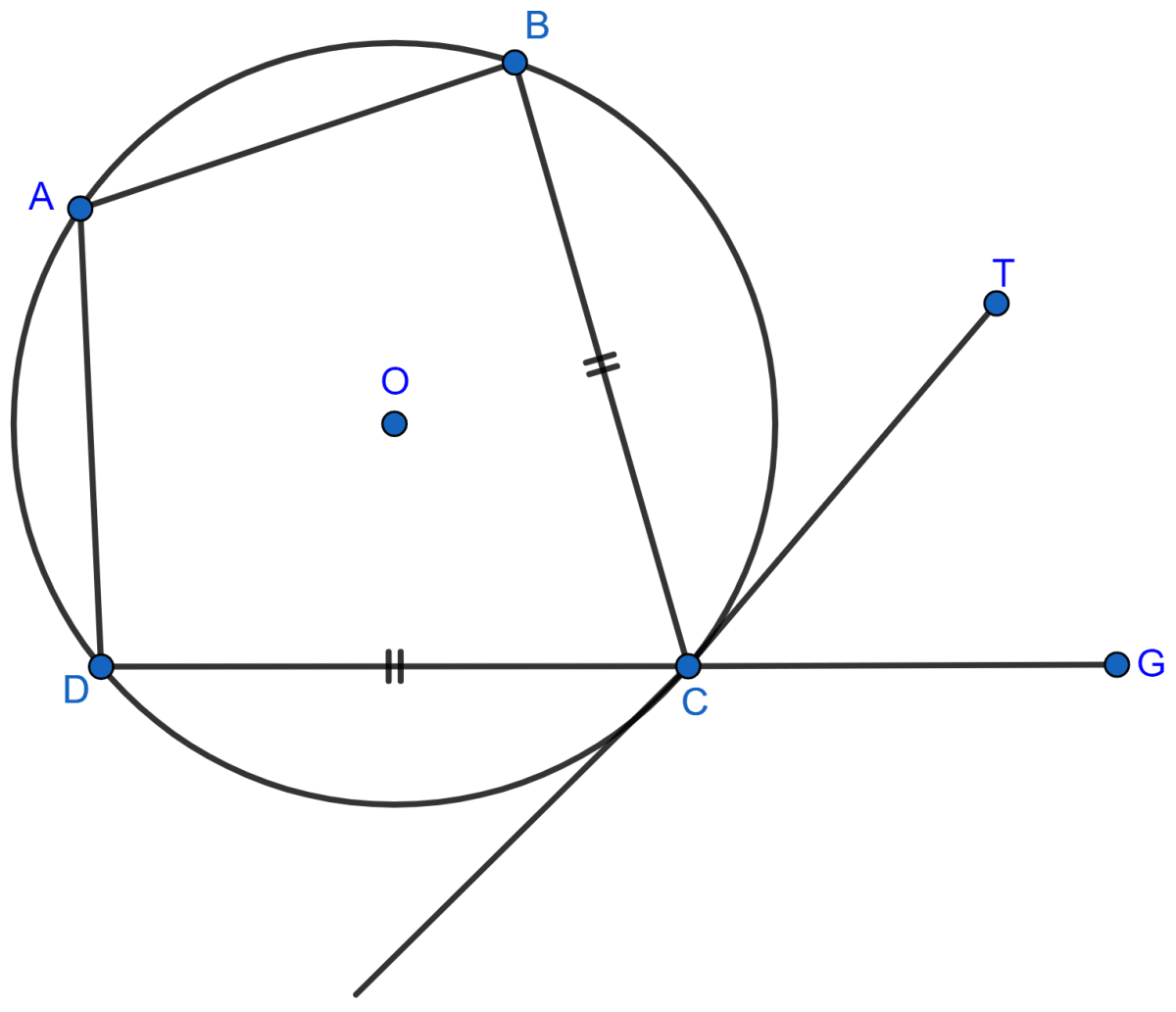
Answer
Join OC, OD and BD.
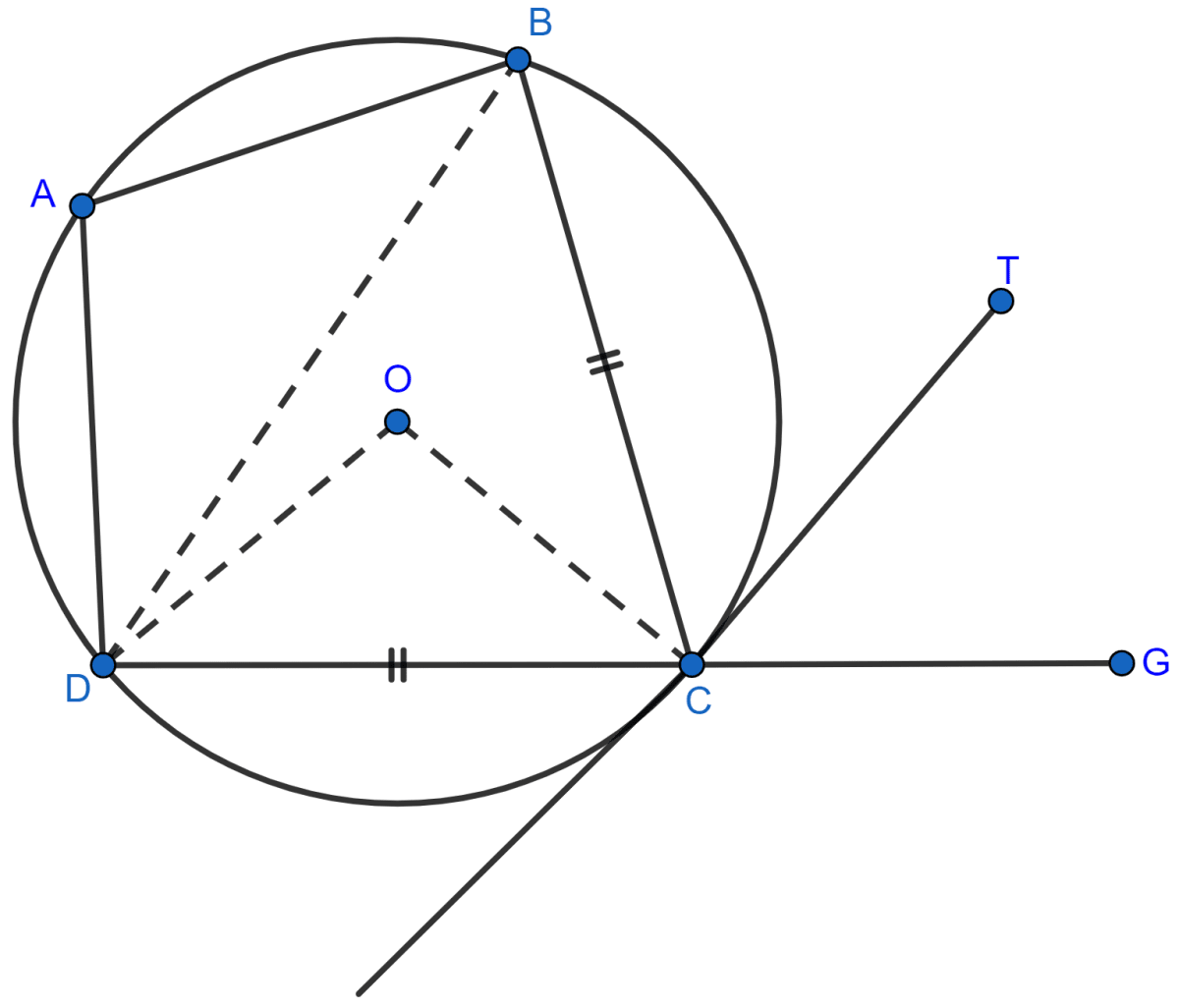
Given,
∠BCG = 108°
From figure,
⇒ ∠BCG + ∠BCD = 180° [Linear pairs]
⇒ 108° + ∠BCD = 180°
⇒ ∠BCD = 180° - 108°
⇒ ∠BCD = 72°.
From figure,
⇒ ∠BDC = ∠DBC = x(let) [As, angles opposite to equal sides are equal]
In triangle BDC,
⇒ ∠DBC + ∠BDC + ∠BCD = 180° [Angle sum property of triangle]
⇒ x + x + 72° = 180°
⇒ 2x + 72° = 180°
⇒ 2x = 180° - 72°
⇒ 2x = 108°
⇒ x =
⇒ x = 54°.
From figure.
∠BCT = ∠BDC (Angles in alternate segment are equal)
∠BCT = 54°.
Hence, ∠BCT = 54°.
(ii) As, angle subtended by a segment on center is twice the angle subtended by it on any other part of circumference.
⇒ ∠DOC = 2∠DBC
⇒ ∠DOC = 2(54°) = 108°.
Hence, ∠DOC = 108°.
In the figure; PA is a tangent to the circle, PBC is secant and AD bisects angle BAC. Show that triangle PAD is an isosceles triangle. Also, show that :
∠CAD = [∠PBA - ∠PAB]
![In the figure; PA is a tangent to the circle, PBC is secant and AD bisects angle BAC. Show that triangle PAD is an isosceles triangle. Also, show that ∠CAD = 1/2 [∠PBA - ∠PAB]. Tangents and Intersecting Chords, Concise Mathematics Solutions ICSE Class 10.](https://cdn1.knowledgeboat.com/img/cm10/q12-c18-ex-18-b-tangents-concise-maths-solutions-icse-class-10-1200x800.png)
Answer
As, the angle between a tangent and a chord through the point of contact is equal to the angle in the alternate segment, we have :
From figure,
PA is a tangent and AB is a chord.
∴ ∠PAB = ∠C [Angles in alternate segment are equal]...........(1)
Given,
AD is bisector of ∠BAC.
∴ ∠BAD = ∠DAC .......(2)
We know that,
An exterior angle is equal to sum of two opposite interior angles.
⇒ ∠ADP = ∠C + ∠DAC
⇒ ∠ADP = ∠PAB + ∠BAD [From (1) and (2)]
⇒ ∠ADP = ∠PAD
Since, sides opposite to equal sides are equal.
∴ PA = PD
∴ PAD is an isosceles triangle.
In △ABC,
⇒ ∠PBA = ∠C + ∠BAC [Exterior angle is equal to sum of two opposite interior angles]
⇒ ∠BAC = ∠PBA - ∠C
⇒ ∠BAC = ∠PBA - ∠PAB [As, ∠C = ∠PAB]
⇒ 2∠CAD = ∠PBA - ∠PAB [As, AD bisects ∠BAC]
⇒ ∠CAD = (∠PBA - ∠PAB).
Hence, proved that ∠CAD = (∠PBA - ∠PAB).
Two circles intersect each other at point A and B. Their common tangent touches the circles at points P and Q as shown in the figure. Show that the angles PAQ and PBQ are supplementary.
![In the figure; PA is a tangent to the circle, PBC is secant and AD bisects angle BAC. Show that triangle PAD is an isosceles triangle. Also, show that ∠CAD = 1/2 [∠PBA - ∠PAB]. Tangents and Intersecting Chords, Concise Mathematics Solutions ICSE Class 10.](https://cdn1.knowledgeboat.com/img/cm10/q13-c18-ex-18-b-tangents-concise-maths-solutions-icse-class-10-1200x843.png)
Answer
Join AB.
![In the figure; PA is a tangent to the circle, PBC is secant and AD bisects angle BAC. Show that triangle PAD is an isosceles triangle. Also, show that ∠CAD = 1/2 [∠PBA - ∠PAB]. Tangents and Intersecting Chords, Concise Mathematics Solutions ICSE Class 10.](https://cdn1.knowledgeboat.com/img/cm10/q13-c18-ex-18-b-answer-tangents-concise-maths-solutions-icse-class-10-1200x848.png)
As, the angle between a tangent and a chord through the point of contact is equal to the angle in the alternate segment, we have :
From figure,
PQ is a tangent and AB is a chord.
∴ ∠QPA = ∠PBA [Angles in alternate segment are equal] .........(1)
Also,
∴ ∠PQA = ∠QBA [Angles in alternate segment are equal] ..........(2)
Adding (1) and (2) we get,
⇒ ∠QPA + ∠PQA = ∠PBA + ∠QBA ..........(3)
⇒ ∠PBA + ∠QBA = ∠PBQ ...........(4)
In △PAQ,
⇒ ∠QPA + ∠PQA + ∠PAQ = 180° [Angle sum property of triangle]
⇒ ∠QPA + ∠PQA = 180° - ∠PAQ
⇒ ∠PBA + ∠QBA = 180° - ∠PAQ [From (3)] ..........(5)
From (4) and (5), we get :
⇒ ∠PBQ = 180° - ∠PAQ
⇒ ∠PBQ + ∠PAQ = 180°.
Hence, proved that PAQ and PBQ are supplementary.
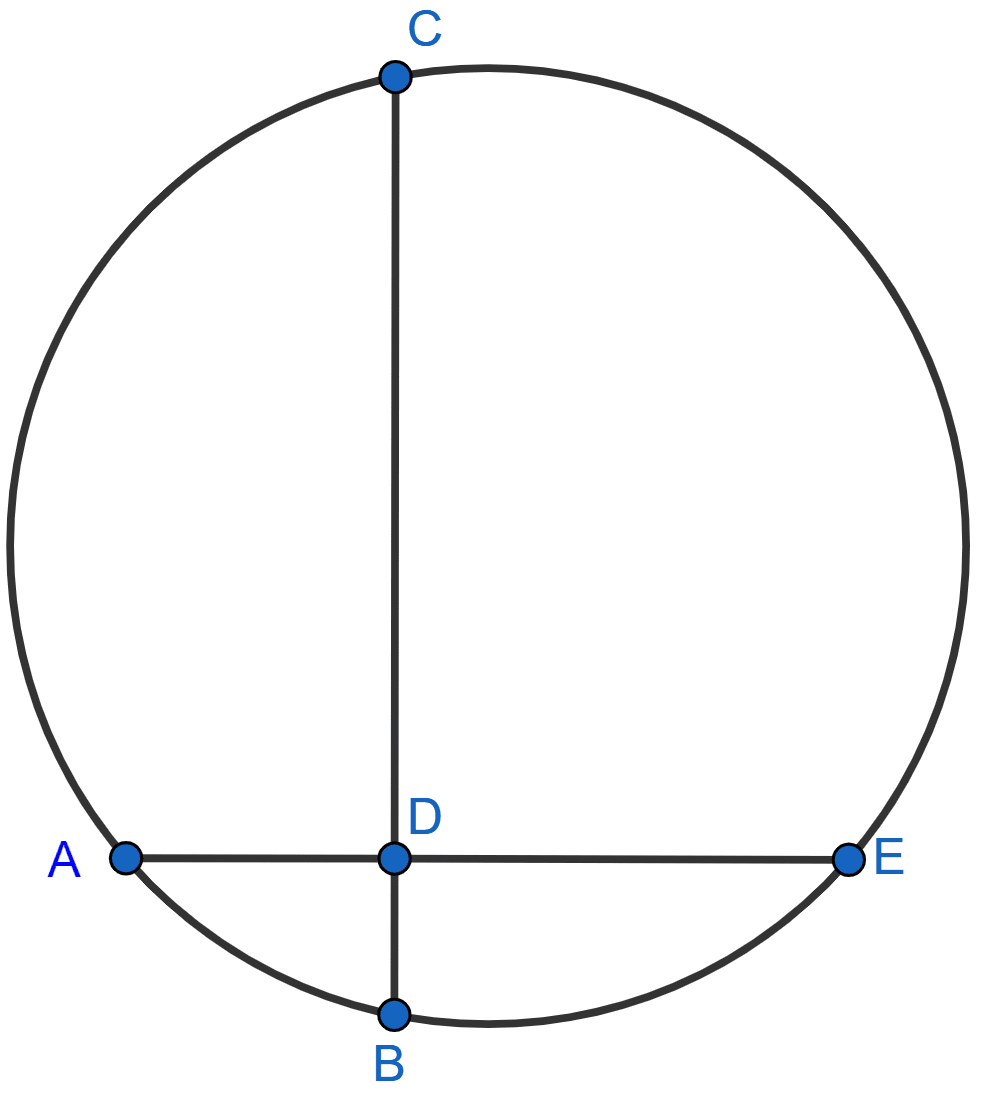
In the figure, chords AE and BC intersect each other at point D.
(i) If ∠CDE = 90°, AB = 5 cm, BD = 4 cm and CD = 9 cm; find DE.
(ii) If AD = BD, show that : AE = BC.
Answer
(i) Join AB.
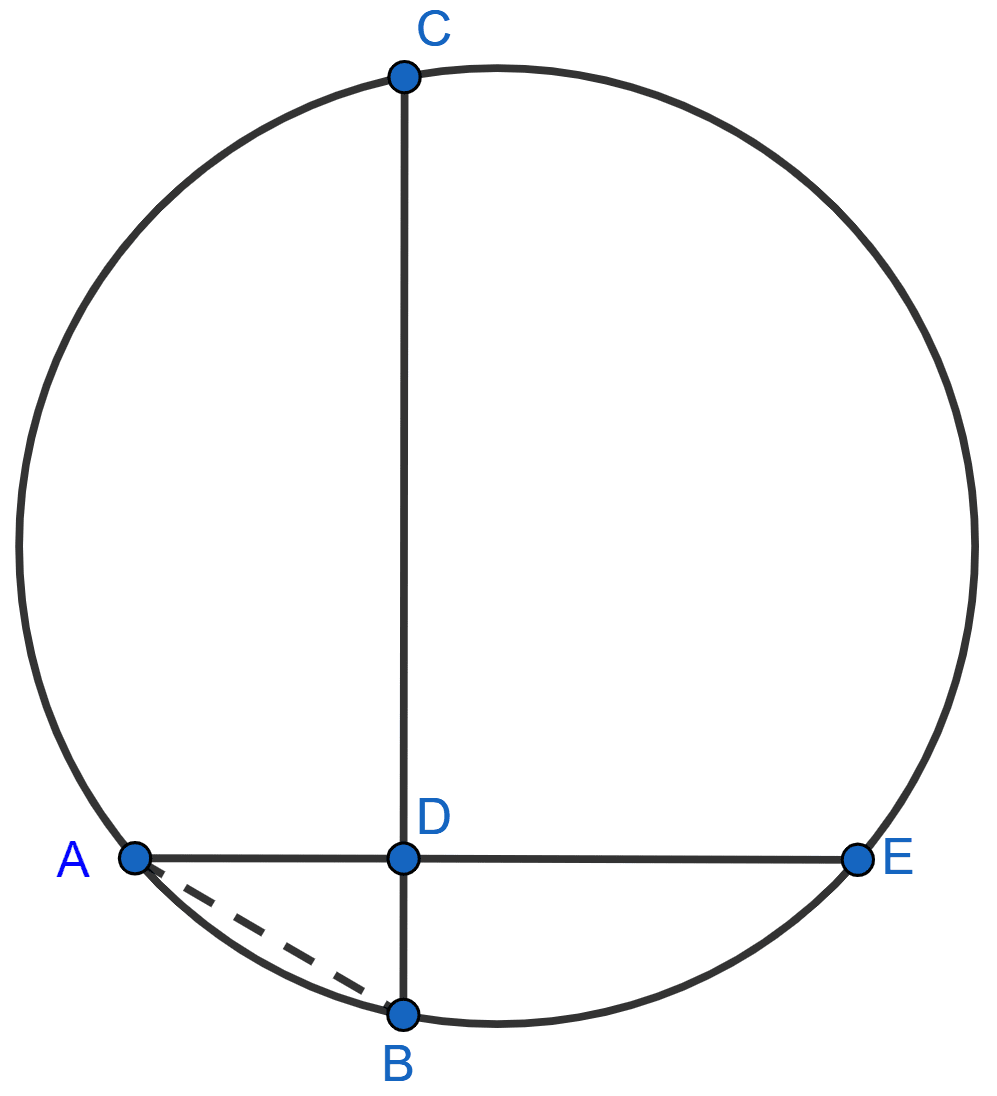
∠ADB = ∠CDE = 90° [Vertically opposite angles are equal.]
In right angle triangle ADB,
⇒ AB2 = AD2 + BD2
⇒ 52 = AD2 + 42
⇒ 25 = AD2 + 16
⇒ AD2 = 25 - 16
⇒ AD2 = 9
⇒ AD =
⇒ AD = 3 cm.
We know that,
If two chords of a circle intersect internally or externally then the product of the lengths of their segment is equal.
From figure,
Chords AE and CB intersect internally at point D.
⇒ AD × DE = CD × BD
⇒ 3 × DE = 4 × 9
⇒ DE =
⇒ DE = 12 cm.
Hence, DE = 12 cm.
(ii) Given,
AD = BD ........(1)
AD = BD = x (let)
We know that,
⇒ AD × DE = CD × BD
⇒ (x)DE = (x)CD
⇒ DE = CD ..........(2)
Adding (1) and (2), we get :
⇒ AD + DE = BD + CD
⇒ AE = BC.
Hence, proved that AE = BC.
In the adjoining figure, O is the center of the circle and AB is a tangent to it at point B. ∠BDC = 65°. Find ∠BAO.

Answer
From figure,
⇒ ∠ADE + ∠BDE = 180° [Linear pairs]
⇒ ∠ADE + 65° = 180°
⇒ ∠ADE = 180° - 65°
⇒ ∠ADE = 115° ..............(1)
∠DBO = 90° [As, DB is tangent and BC is diameter.]
In △BDC,
⇒ ∠BDC + ∠DBC + ∠DCB = 180° [Angle sum property of triangle]
⇒ 65° + 90° + ∠DCB = 180°
⇒ ∠DCB = 180° - 155° = 25°.
From figure,
OE = OC [Radius of same circle.]
⇒ ∠OCE = ∠OEC [As, angles opposite to equal sides are equal.]
⇒ ∠OEC = ∠DCB = 25°. [As, ∠OCE = ∠DCB]
In △ADE,
⇒ ∠ADE + ∠DEA + ∠DAE = 180° [Angle sum property of triangle]
⇒ 115° + 25° + ∠DAE = 180° [From figure, ∠DEA = ∠OEC [Vertically opposite angles are equal]]
⇒ ∠DAE = 180° - 140° = 40°.
From figure,
∠BAO = ∠DAE = 40°.
Hence, ∠BAO = 40°.