
In the given figure, AE = 5 cm and EC = 7 cm, then area of △ ADE : area of △ ABC is :
5 : 7
7 : 5
25 : 144
144 : 25

Answer
From figure,
In △ ADE and △ ABC,
⇒ ∠DAE = ∠BAC (Common angle)
⇒ ∠ADE = ∠ABC (Corresponding angles are equal)
∴ △ ADE ~ △ ABC (By A.A. postulate)
From figure,
AC = AE + EC = 5 + 7 = 12 cm.
We know that,
The areas of two similar triangles are proportional to the squares on their corresponding sides.
Hence, Option 3 is the correct option.
If AD = 5 cm and BD = 2 cm, then area of △ ADE : area of trapezium DBCE is equal to :
5 : 2
2 : 5
24 : 25
25 : 24

Answer
From figure,
In △ ADE and △ ABC,
⇒ ∠DAE = ∠BAC (Common angle)
⇒ ∠ADE = ∠ABC (Corresponding angles are equal)
∴ △ ADE ~ △ ABC (By A.A. postulate)
From figure,
AB = AD + DB = 5 + 2 = 7 cm.
We know that,
The areas of two similar triangles are proportional to the squares on their corresponding sides.
Let area of △ ADE = 25x and area of △ ABC = 49x.
From figure,
Area of trapezium DBCE = Area of △ ABC - Area of △ ADE = 49x - 25x = 24x.
⇒ Area of △ ADE : Area of trapezium DBCE = 25 : 24.
Hence, Option 4 is the correct option.
In the given figure, AD : DB = 2 : 5, then area of △ ODE : area of △ OCB is :
4 : 49
49 : 4
4 : 25
25 : 4

Answer
Given,
AD : DB = 2 : 5
Let AD = 2x and DB = 5x
From figure,
AB = AD + DB = 2x + 5x = 7x.
In △ ADE and △ ABC,
⇒ ∠DAE = ∠BAC (Common angle)
⇒ ∠ADE = ∠ABC (Corresponding angles are equal)
∴ △ ADE ~ △ ABC (By A.A. postulate)
We know that,
Corresponding sides of similar triangles are in proportion.
In △ ODE and △ OCB,
⇒ ∠DOE = ∠BOC (Vertically opposite angle are equal)
⇒ ∠ODE = ∠OCB (Alternate angles are equal)
∴ △ ODE ~ △ OCB (By A.A. postulate)
We know that,
The areas of two similar triangles are proportional to the squares on their corresponding sides.
Hence, Option 1 is the correct option.
In the given figure, area of △ ADE : area of trapezium BCED = 25 : 39, then AD : BD is :
5 : 8
8 : 5
3 : 5
5 : 3

Answer
In △ ADE and △ ABC,
⇒ ∠ADE = ∠ABC (Corresponding angles are equal)
⇒ ∠DAE = ∠BAC (Common angle)
∴ △ ADE ~ △ ABC (By A.A. postulate)
Given,
Area of △ ADE : Area of trapezium BCED = 25 : 39
Let area of △ ADE = 25x and area of trapezium BCED = 39x.
From figure,
Area of △ ABC = Area of △ ADE + Area of trapezium BCED = 25x + 39x = 64x.
We know that,
The areas of two similar triangles are proportional to the squares on their corresponding sides.
Let AD = 5y and AB = 8y.
From figure,
⇒ BD = AB - AD = 8y - 5y = 3y.
⇒ AD : BD = 5y : 3y = 5 : 3.
Hence, Option 4 is the correct option.
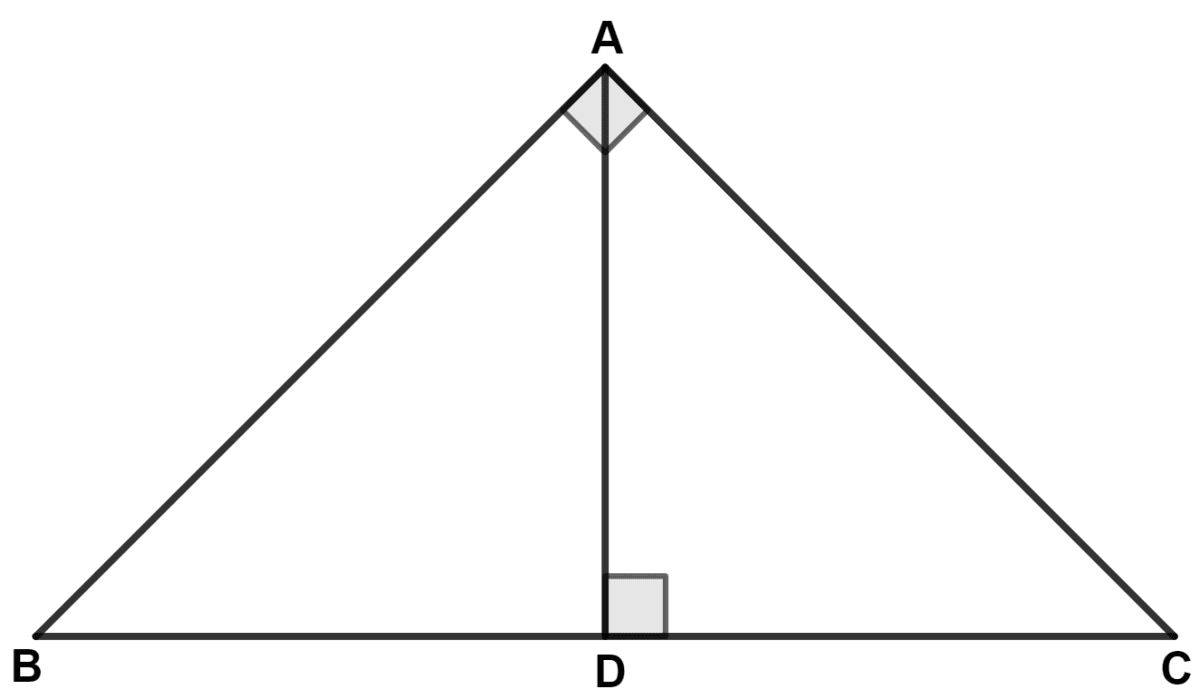
In the given figure, ∠BAC = 90°, AD is perpendicular to BC, BC = 13 cm and AC = 5 cm, then area of △ ADC : area of △ DBA is :
5 : 13
13 : 5
25 : 144
144 : 25
Answer
From figure,
In Δ BAC and Δ ADC,
⇒ ∠BAC = ∠ADC (Both equal to 90°)
⇒ ∠ACB = ∠ACD (Common angle)
∴ Δ BAC ~ Δ ADC (By A.A. postulate)
We know that,
The areas of two similar triangles are proportional to the squares of their corresponding sides.
Let, area of Δ BAC = 169x and area of Δ ADC = 25x.
From figure,
Area of Δ DBA = Area of Δ BAC - Area of Δ ADC = 169x - 25x = 144x.
Substituting values we get :
area of △ ADC : area of △ DBA = 25x : 144x = 25 : 144.
Hence, Option 3 is the correct option.
A line PQ is drawn parallel to the base BC of ΔABC which meets sides AB and AC at points P and Q respectively. If AP = PB; find the value of :
(i)
(ii)
Answer
Given, AP = PB
So,

Let AP = x and PB = 3x.
AB = AP + PB = x + 3x = 4x.
.
In ∆APQ and ∆ABC,
∠APQ = ∠ABC and ∠AQP = ∠ACB [Corresponding angles are equal]
Hence, ∆APQ ~ ∆ABC by AA criterion for similarity
(i) We know that,
The ratio of the areas of two similar triangles is equal to the ratio of squares of their corresponding sides.
Hence, = 16 : 1.
(ii) From figure,
Area of Trapezium PBCQ = Area of ΔABC – Area of ΔAPQ
From part (i) above we get,
Let Area of ΔABC = 16a and Area of ΔAPQ = a
Area of trapezium PBCQ = 16a - a = 15a.
= 1 : 15.
Hence, = 1 : 15.
The perimeters of two similar triangles are 30 cm and 24 cm. If one side of the first triangle is 12 cm, determine the corresponding side of the second triangle.
Answer
Let the triangles be ∆ABC and ∆DEF.
Given ∆ABC ~ ∆DEF
Since, corresponding sides of similar triangle are proportional to each other.
So,
Adding numerator and denominator we get :
So,
Hence, the length of corresponding side of second triangle is 9.6 cm.
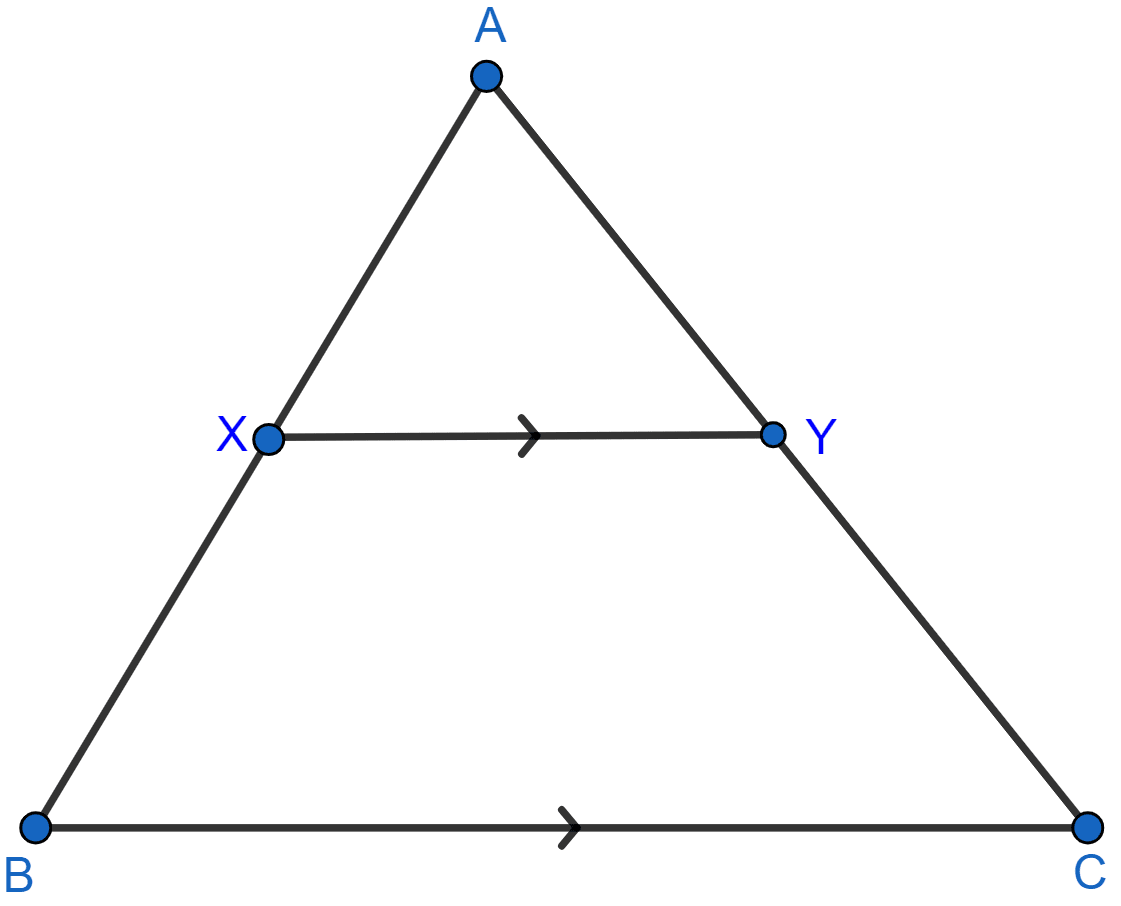
In the given figure, AX : XB = 3 : 5.
Find :
(i) the length of BC, if the length of XY is 18 cm.
(ii) the ratio between the areas of trapezium XBCY and triangle ABC.
Answer
(i) Given, AX : XB = 3 : 5
Let AX = 3a and XB = 5a.
From figure,
AB = AX + XB = 3a + 5a = 8a.
(i) In ΔAXY and ΔABC,
As XY || BC, corresponding angles are equal.
∠AXY = ∠ABC and ∠AYX = ∠ACB
∴ ∆AXY ~ ∆ABC [By AA]
Since, corresponding sides of similar triangle are proportional to each other.
Hence, BC = 48 cm.
(ii) We know that,
The ratio of the areas of two similar triangles is equal to the ratio of squares of their corresponding sides.
Let area of ∆AXY = 9b and area of ∆ABC = 64b.
From figure,
Area of trapezium XBCY = Area of ∆ABC - Area of ∆AXY
= 64b - 9b = 55b.
Hence, ratio of area of trapezium XBCY and triangle ABC = 55 : 64.
ABC is a triangle. PQ is a line segment intersecting AB in P and AC in Q such that PQ || BC and divides triangle ABC into two parts equal in area. Find the value of ratio BP : AB.
Answer
Triangle ABC is shown in the figure below:
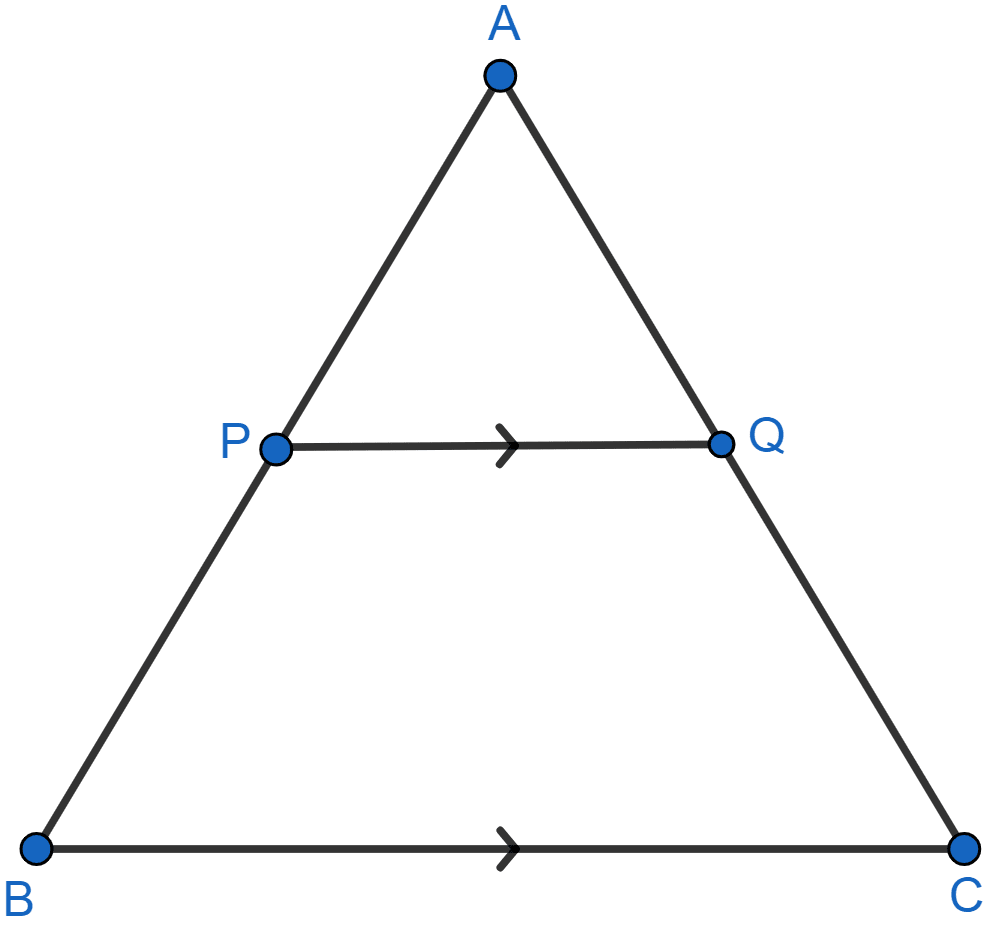
In ΔAPQ and ΔABC,
∠PAQ = ∠BAC [Common]
∠APQ = ∠ABC [Corresponding angles are equal]
∴ ΔAPQ ~ ΔABC [By AA].
According to question,
Area of ΔAPQ = Area of ΔABC
We know that,
The ratio of the areas of two similar triangles is equal to the ratio of squares of their corresponding sides.
Let AP = x and AB = x
From figure,
BP = AB - AP =
Hence, BP : AB = = .
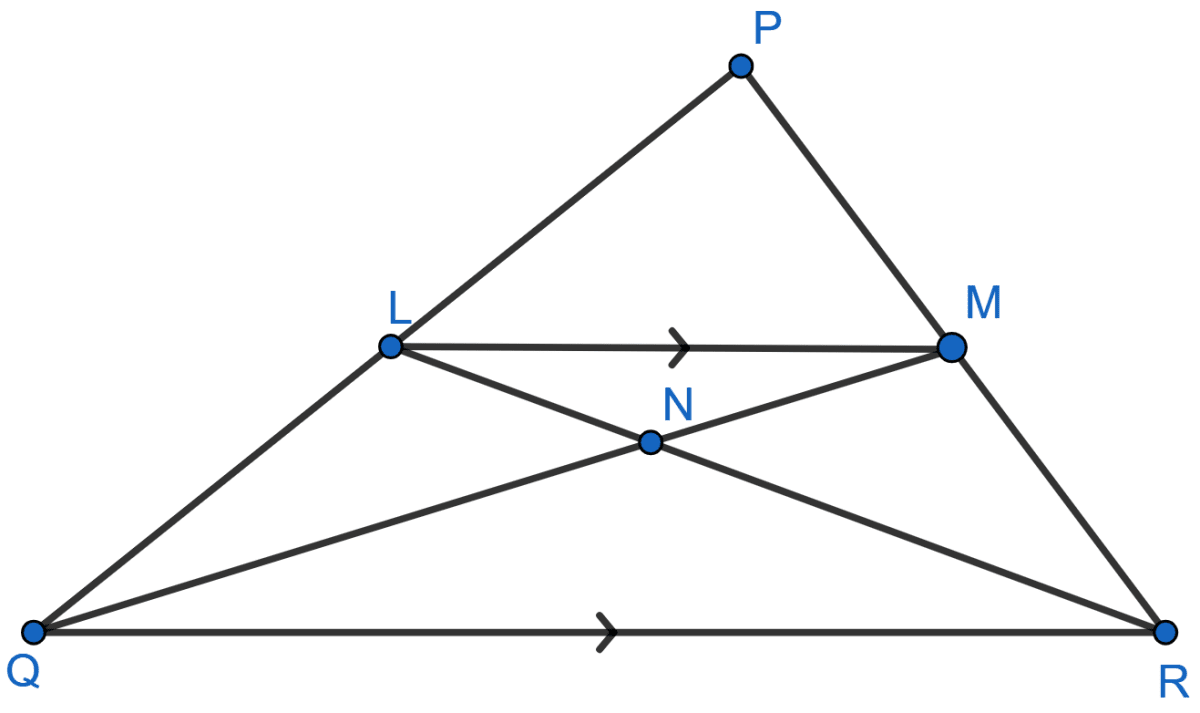
In the given triangle PQR, LM is parallel to QR and PM : MR = 3 : 4.
Calculate the value of ratio:
(i)
(ii)
(iii)
Answer
(i) Given,
Let PM = 3x and MR = 4x.
From figure,
PR = PM + MR = 3x + 4x = 7x.
.
In ΔPLM and ΔPQR,
As LM || QR, corresponding angles are equal.
∠PLM = ∠PQR
∠PML = ∠PRQ
∴ ∆PLM ~ ∆PQR [By AA]
Since, corresponding sides of similar triangles are proportional to each other we have :
Hence, PL : PQ = 3 : 7 and LM : QR = 3 : 7.
(ii) As ΔLMN and ΔMNR have common vertex at M and their bases LN and NR are along the same straight line.
.....(1)
Now, in ΔLMN and ΔRNQ we have,
⇒ ∠NLM = ∠NRQ [Alternate angles are equal]
⇒ ∠LMN = ∠NQR [Alternate angles are equal]
∴ ∆LNM ~ ∆RNQ [By AA]
Since corresponding sides of similar triangle are proportional to each other, we have :
Substituting value in (1) we get :
.
(iii) From part (ii) we get :
Let MN = 3a and QN = 7a
From figure,
MQ = MN + QN = 3a + 7a = 10a.
As ΔLQM and ΔLQN have common vertex at L and their bases QM and QN are along the same straight line.
.
Hence,
In the figure, given below, ABCD is a parallelogram. P is a point on BC such that BP : PC = 1 : 2. DP produced meets AB produced at Q. Given the area of triangle CPQ = 20 cm2.
Calculate :
(i) area of triangle CDP,
(ii) area of parallelogram ABCD.
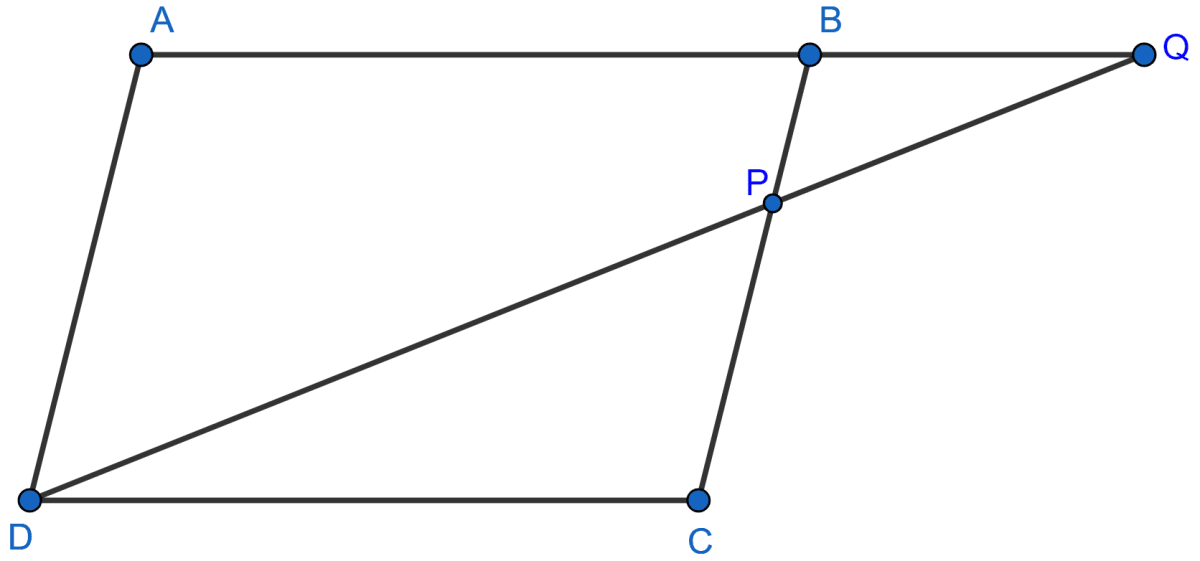
Answer
(i) In △BPQ and △CPD,
⇒ ∠BPQ = ∠CPD [Vertically opposite angles are equal]
⇒ ∠BQP = ∠PDC [Alternate angles are equal]
∴ △BPQ ~ △CPD [By AA]
Since, corresponding sides of similar triangle are proportional to each other.
.
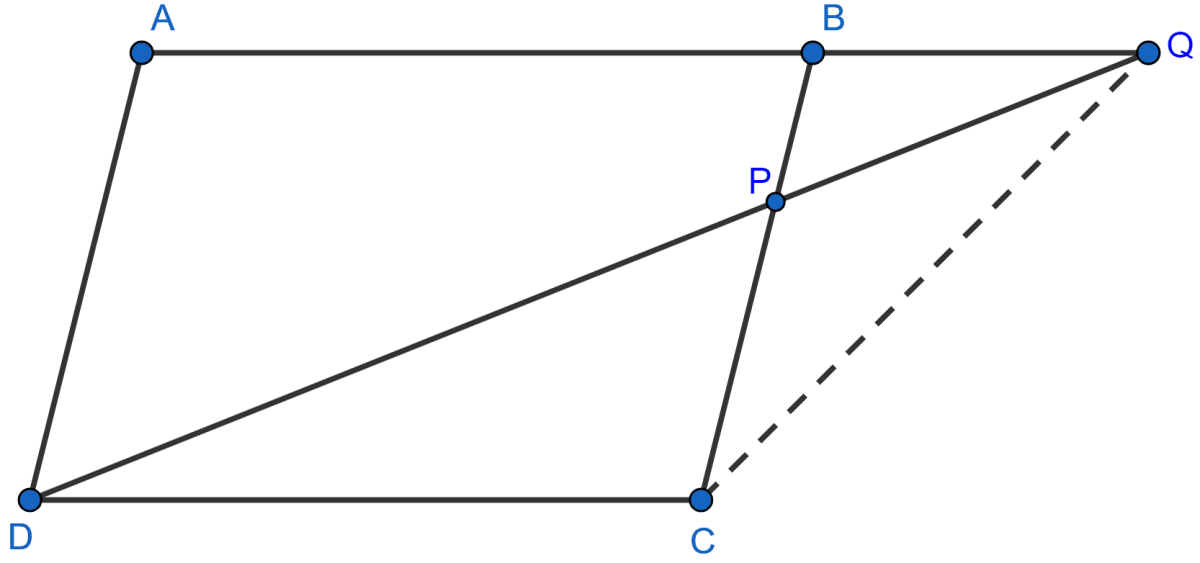
As ΔBPQ and ΔCPQ have common vertex at Q and their bases BP and CP are along the same straight line.
So,
We know that,
The ratio of the areas of two similar triangles is equal to the ratio of squares of their corresponding sides.
Hence, area of ΔCPD = 40 cm2.
(ii) From part (i),
Let PQ = x and PD = 2x.
From figure,
QD = PQ + PD = x + 2x = 3x.
........(1)
In △BPQ and △AQD,
⇒ ∠QBP = ∠QAD [Corresponding angles are equal]
⇒ ∠BQP = ∠AQD [Common]
∴ △BPQ ~ △AQD [By AA]
Since, corresponding sides of similar triangle are proportional to each other.
We know that,
The ratio of the areas of two similar triangles is equal to the ratio of squares of their corresponding sides.
Area of trapezium ADPB = Area of △AQD - Area of △BPQ = 90 - 10 = 80 cm2.
Area of || gm ABCD = Area of △CDP + Area of trapezium ADPB = 40 + 80 = 120 cm2.
Hence, area of || gm ABCD = 120 cm2.
In the given figure, BC is parallel to DE. Area of triangle ABC = 25 cm2, Area of trapezium BCED = 24 cm2 and DE = 14 cm. Calculate the length of BC.
Also, find the area of triangle BCD.

Answer
Area of △ADE = Area of △ABC + Area of trapezium BCED = 25 + 24 = 49 cm2.
Given,
BC || DE.
∠ABC = ∠ADE [Corresponding angles are equal]
∠ACB = ∠AED [Corresponding angles are equal]
∴ △ABC ~ △ADE [By AA]
We know that,
The ratio of the areas of two similar triangles is equal to the ratio of squares of their corresponding sides.
Let height of trapezium BCED be h cm.
Area = × (Sum of || sides) × h
⇒ 24 = × (BC + DE) × h
⇒ 24 × 2 = (BC + DE) × h
⇒ 48 = (10 + 14) × h
⇒ 24h = 48
⇒ h = 2 cm.
Area of △BCD = × base × height
= × BC × h
= × 10 × 2
= 10 cm2.
Hence, BC = 10 cm and area of △BCD = 10 cm2.
In the given figure, ABC is a triangle. DE is parallel to BC and .
(i) Determine the ratios .
(ii) Prove that △DEF is similar to △CBF. Hence, find .
(iii) What is the ratio of the areas of △DEF and △BFC?

Answer
(i) Given,
Let AD = 3x and BD = 2x.
From figure,
AB = AD + DB = 3x + 2x = 5x.
.
In △ADE and △ABC,
∠A = ∠A [Common]
∠ADE = ∠ABC [Corresponding angles are equal]
∴ △ADE ~ △ABC [By AA]
Since, corresponding sides of similar triangle are proportional to each other.
...........(1)
Hence, .
(ii) In △DEF and △CBF,
∠FDE = ∠FCB (Alternate angles are equal)
∠DFE = ∠BFC (Vertically opposite angles are equal)
∴ △DEF ~ △CBF [By AA]
Since, corresponding sides of similar triangle are proportional to each other.
Hence, .
(iii) We know that,
The ratio of the areas of two similar triangles is equal to the ratio of squares of their corresponding sides.
Hence, ratio of the areas of △DEF and △BFC = 9 : 25.
In the given figure,
∠B = ∠E, ∠ACD = ∠BCE, AB = 10.4 cm and DE = 7.8 cm. Find the ratio between areas of the △ABC and △DEC.
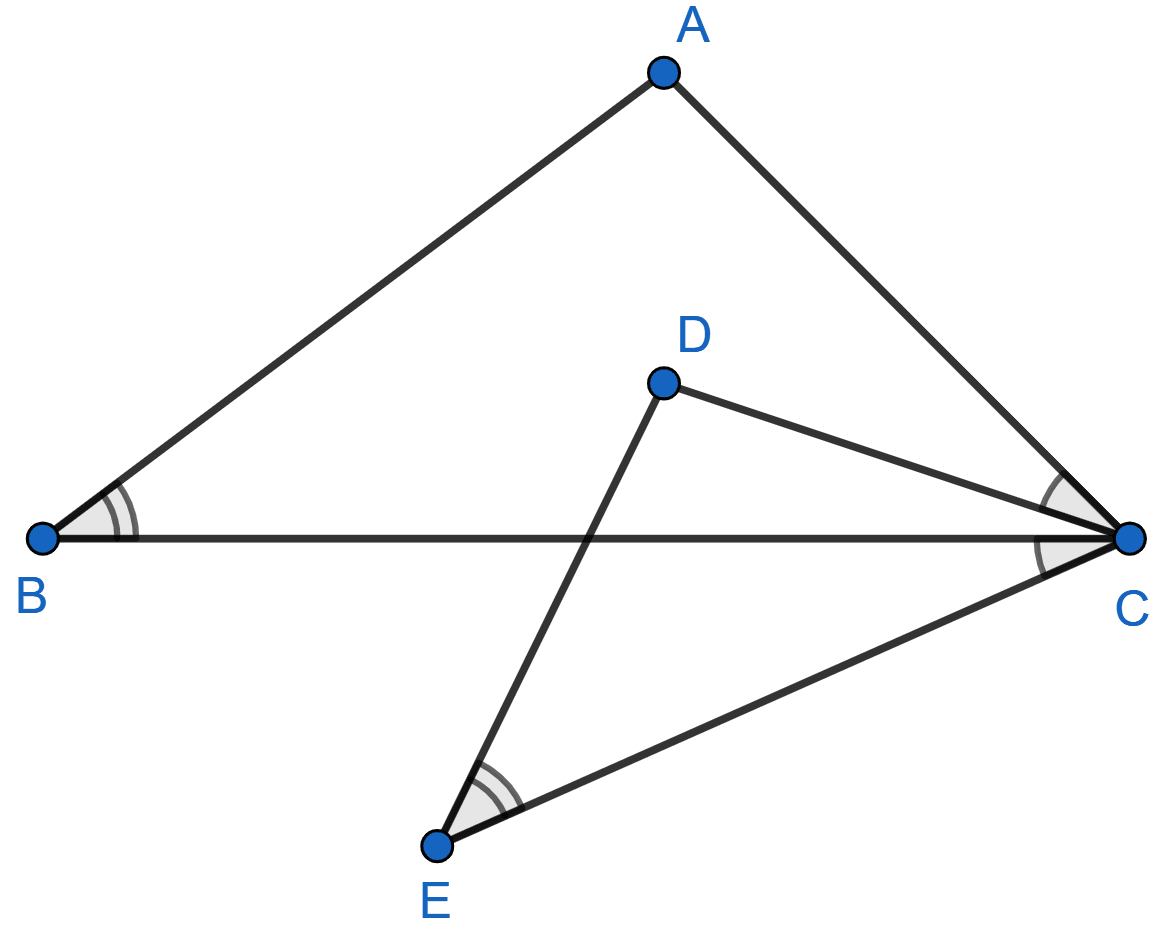
Answer
Given,
⇒ ∠ACD = ∠BCE
⇒ ∠ACD + ∠BCD = ∠BCE + ∠BCD
⇒ ∠ACB = ∠DCE
Also, ∠B = ∠E
∴ △ABC ~ △DEC [By AA]
We know that,
The ratio of the areas of two similar triangles is equal to the ratio of squares of their corresponding sides.
Hence, ratio between areas of the △ABC and △DEC = 16 : 9.