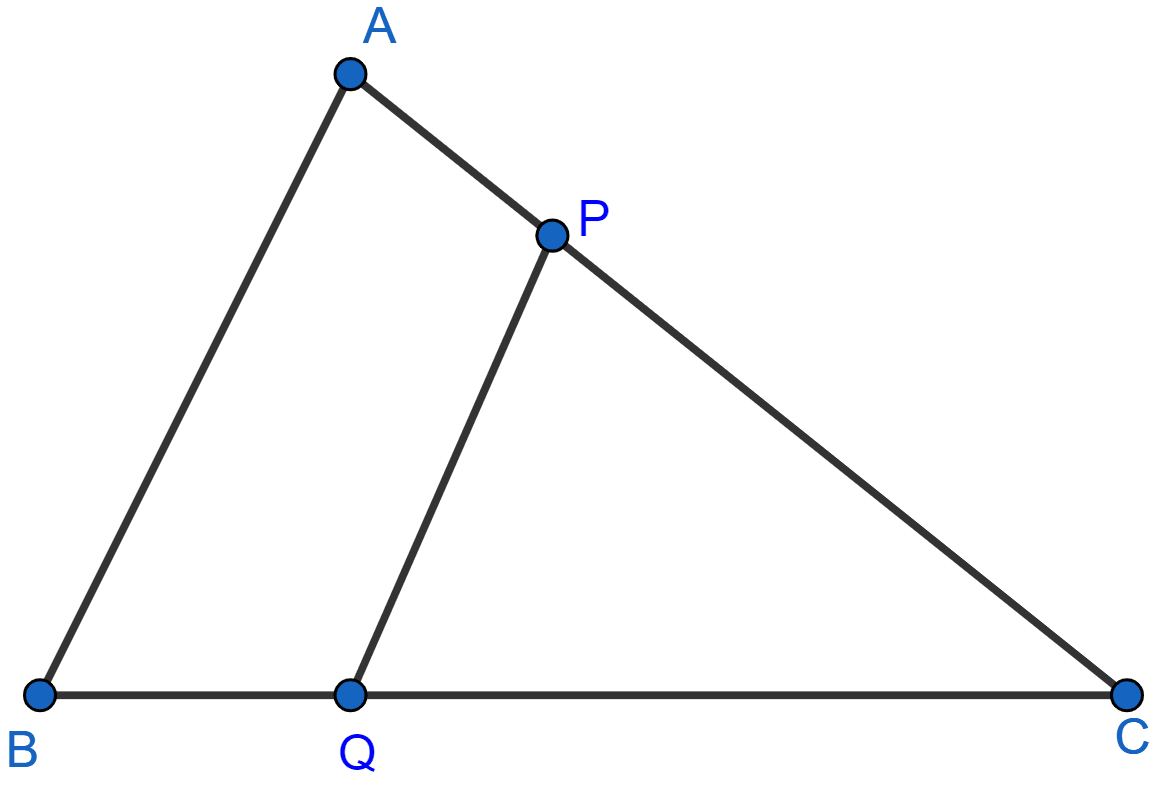
Since, corresponding sides of similar triangles are proportional we have :
∴ABPQ=CBCQ⇒6.3PQ=8.44.8⇒PQ=6.3×74=3.6 cm.
Hence, PQ = 3.6 cm
(iii) As, ∆CPQ ~ ∆CAB.
We have,
ACCP=CBCQACCP=8.44.8ACCP=74.
So, if AC is 7 parts and CP is 4 parts, then PA is 3 parts.
Given, AP = x
or, 3 parts = x
⇒ 1 part = 3x
⇒ 7 parts = 37x.
Hence, AC = 37x.
Question 4
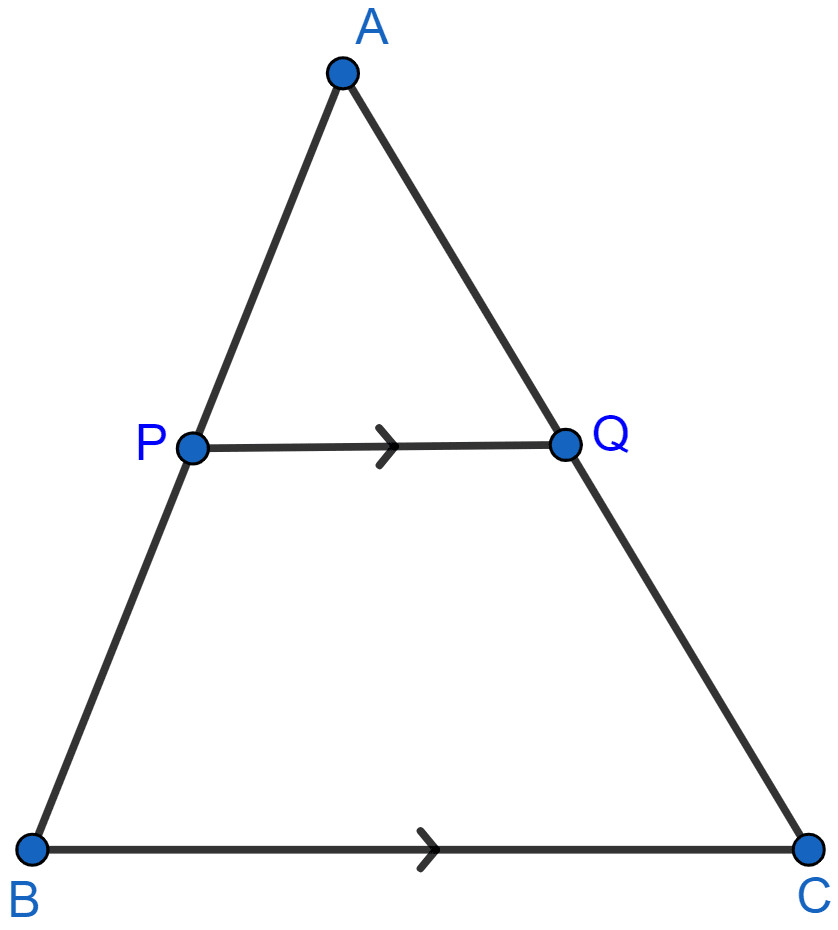
A line PQ is drawn parallel to the side BC of ΔABC which cuts side AB at P and side AC at Q. If AB = 9.0 cm, CA = 6.0 cm and AQ = 4.2 cm, find the length of AP.
Answer
Let AP = x cm.
From figure,
PB = AB - AP = 9 - x cm.
QC = AC - AQ = 6 - 4.2 = 1.8 cm.
Given PQ || AB,
By basic proportionality theorem :
⇒PBAP=QCAQ⇒9−xx=1.84.2⇒1.8x=4.2(9−x)⇒1.8x=37.8−4.2x⇒1.8x+4.2x=37.8⇒6x=37.8⇒x=6.3 cm.
Hence, AP = 6.3 cm.
Question 5
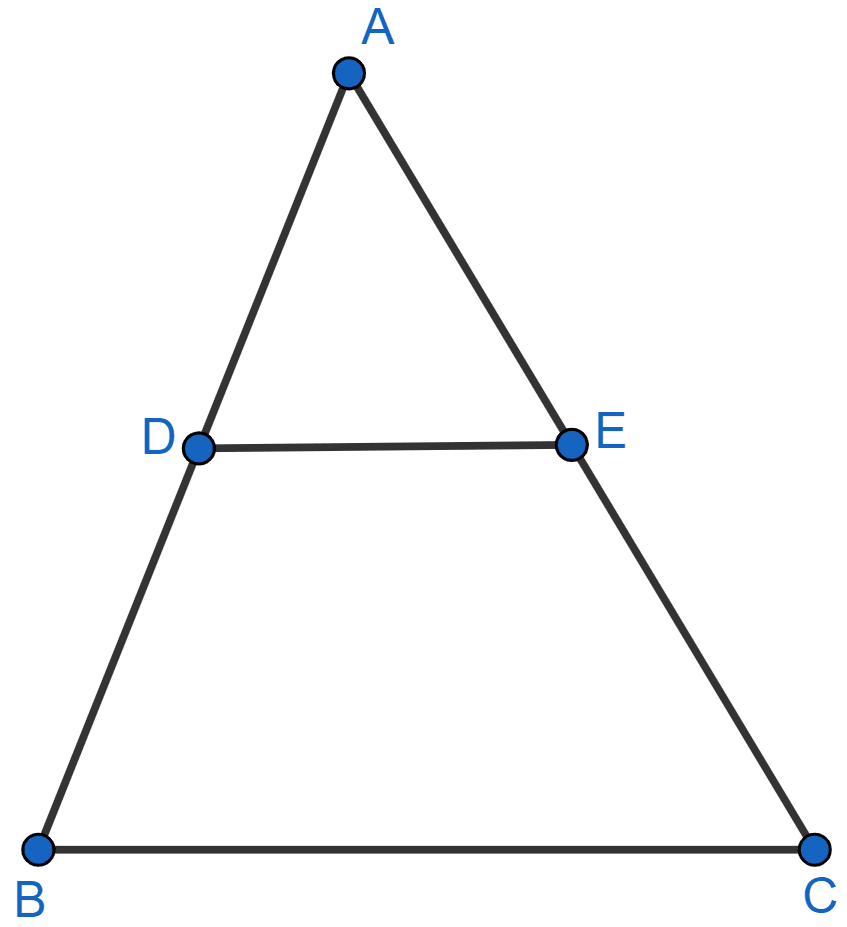
In ΔABC, D and E are the points on sides AB and AC respectively.
Find whether DE || BC, if
(i) AB = 9 cm, AD = 4 cm, AE = 6 cm and EC = 7.5 cm.
(ii) AB = 6.3 cm, EC = 11.0 cm, AD = 0.8 cm and AE = 1.6 cm.
Answer
(i) From figure,
BD = AB - AD = 9 - 4 = 5 cm
In ∆ADE and ∆ABC,
ECAE=7.56=54BDAD=54Since ECAE=BDAD.
Hence, DE || BC by the converse of Basic proportionality theorem.
Hence, DE || BC by the converse of Basic proportionality theorem.
Question 6
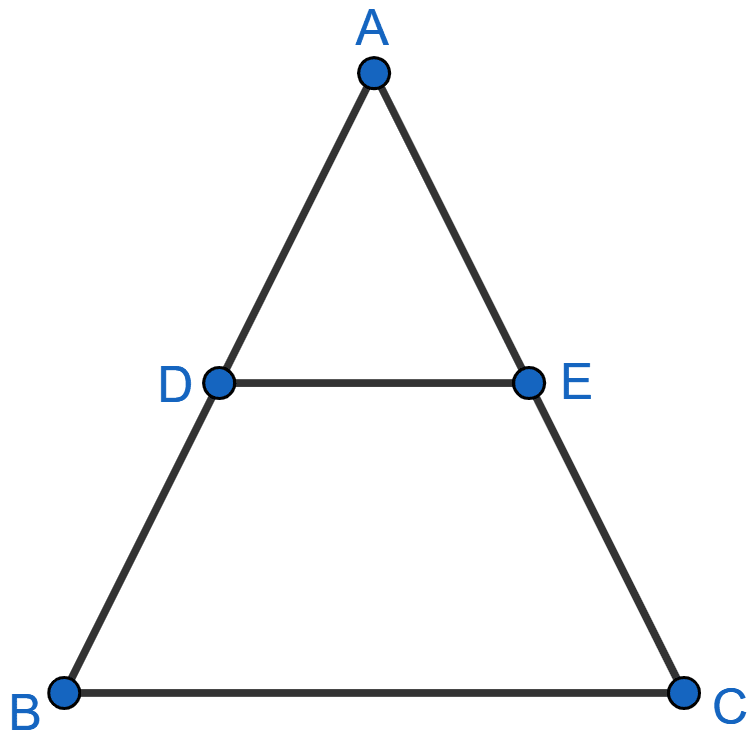
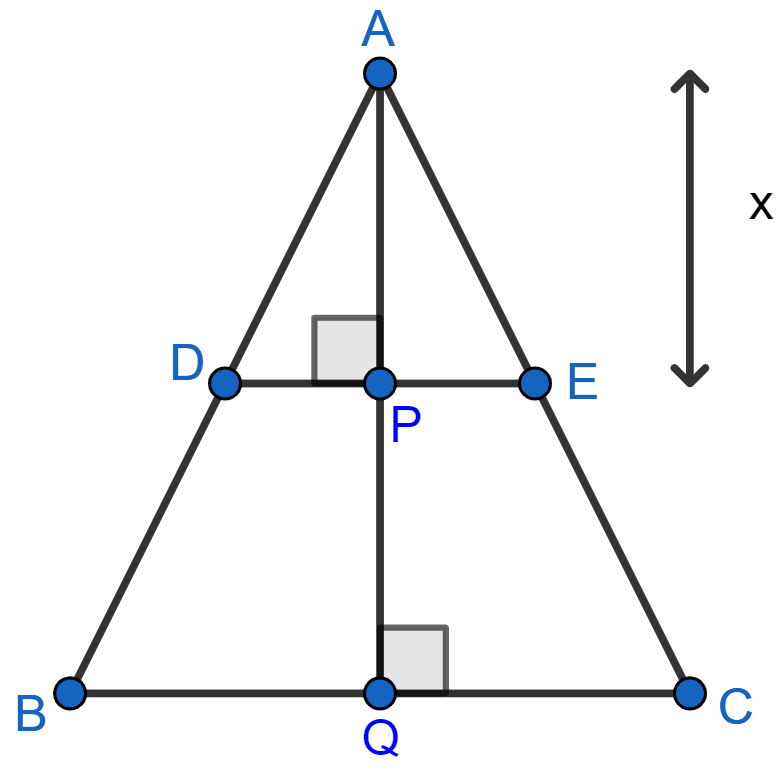
In the given figure, ΔABC ~ ΔADE. If AE : EC = 4 : 7 and DE = 6.6 cm, find BC. If 'x' be the length of the perpendicular from A to DE, find the length of perpendicular from A to BC in terms of 'x'.
Answer
Given,
ΔABC ~ ΔADE
Given,
AE : EC = 4 : 7
Let AE = 4y and EC = 7y.
So, AC = 4y + 7y = 11y.
From figure,
Since, corresponding sides of similar triangles are proportional we have :
⇒ACAE=BCDE⇒11y4y=BC6.6⇒114=BC6.6⇒BC=411×6.6=18.15 cm
As ΔABC ~ ΔADE, we have :
∠ABC = ∠ADE and ∠ACB = ∠AED
So, DE || BC as ∠ADE and ∠ABC are corresponding angles.
∴ADAB=AEAC=4y11y=411
Let perpendicular from A to DE meet DE at point P. Then,
AP = x
Let perpendicular from A to BC meet BC at point Q.
In ∆ADP and ∆ABQ,
∠ADP = ∠ABQ [Corresponding angles are equal.]
∠APD = ∠AQB [Both = 90°]
∴ ∆ADP ~ ∆ABQ [By AA]
⇒ABAD=AQAP⇒114=AQx⇒AQ=411x.
Hence, BC = 18.15 cm and AQ = 411x.
Question 7
A line segment DE is drawn parallel to base BC of ∆ABC which cuts AB at point D and AC at point E. If AB = 5BD and EC = 3.2 cm, find the length of AE.
Answer
Given,
⇒ AB = 5BD
⇒ AD + BD = 5BD
⇒ AD = 5BD - BD
⇒ AD = 4BD
⇒ BDAD=14.
Given DE || BC,
by basic proportionality theorem :
∴BDAD=ECAE⇒14=3.2AE⇒AE=4×3.2=12.8 cm.
Hence, AE = 12.8 cm
Question 8
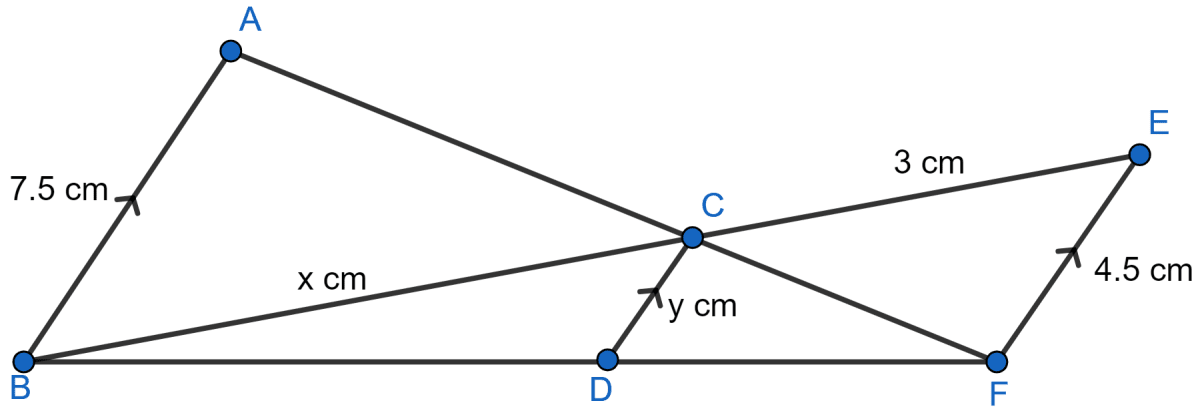
In the figure, given below, AB, CD and EF are parallel lines. Given AB = 7.5 cm, DC = y cm, EF = 4.5 cm, BC = x cm and CE = 3 cm, calculate the values of x and y.
Answer
In ∆BEF,
DC || FE
So, by basic proportionality theorem,
DFBD=CEBC=3x
DFBD=3x .....(1)
Let BD = ax and DF = 3a.
From figure,
BF = BD + DF = ax + 3a = a(x + 3).
DFBF=3aa(x+3)=3x+3 .....(2)
In ∆AFB and CDF,
∠AFB = ∠CFD [Common angles]
∠ABF = ∠CDF [Corresponding angles are equal]
∴ ∆AFB ~ ∆CDF [By AA]
Since, corresponding sides of similar triangles are proportional.
⇒DFBF=CDAB⇒DFBF=y7.5.....(3)From (2) and (3) we get,⇒3x+3=y7.5⇒y=x+322.5.....(4)
In ∆BCD and ∆BEF ,
∠FBE = ∠DBC [Common angles]
∠CDB = ∠EFB [Corresponding angles are equal]
∴ ∆BEF ~ ∆BCD [By AA]
Since, corresponding sides of similar triangles are proportional.
BFBD=FECD=4.5y
BFBD=4.5y
Let BD = ay and BF = 4.5a
From figure,
DF = BF - BD = 4.5a - ay = a(4.5 - y).
∴DFBD=a(4.5−y)ay=4.5−yy .....(5)
From (1) and (5) we get,
⇒3x=4.5−yy
Substituting value of y from (4) in above equation we get,
⇒3x=4.5−x+322.5x+322.5⇒3x=x+34.5x+13.5−22.5x+322.5⇒3x=4.5x−922.5⇒3x=3(1.5x−3)22.5⇒x=1.5x−322.5⇒x=1.5(x−2)22.5⇒x=x−215⇒x(x−2)=15⇒x2−2x−15=0⇒x2−5x+3x−15=0⇒x(x−5)+3(x−5)=0⇒(x+3)(x−5)=0⇒x=−3 or x=5.
Since, side of triangle cannot be negative. So, x = 5 cm.
Substituting value of x in (4) we get,
⇒y=x+322.5⇒y=5+322.5⇒y=822.5=2.8125 cm
Hence, x = 5 cm and y = 2.8125 cm
Question 9
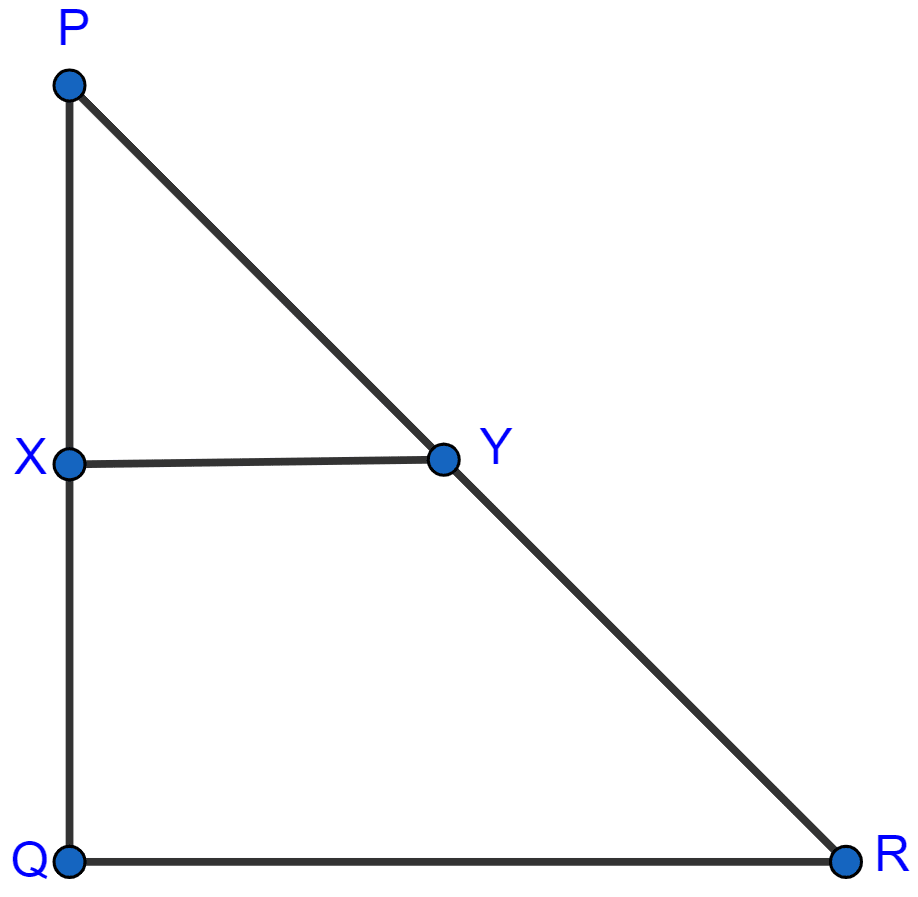
In the figure, given below, PQR is a right-angled triangle right-angled at Q. XY is parallel to QR, PQ = 6 cm, PY = 4 cm and PX : XQ = 1 : 2. Calculate the lengths of PR and QR.
Answer
Given XY || QR,
By basic proportionality theorem :
∴XQPX=YRPY⇒21=YR4⇒YR=4×2=8 cm.
From figure,
PR = PY + YR = 4 + 8 = 12 cm.
Since, PQR is a right-angled triangle.
By pythagoras theorem we get,
⇒PR2=PQ2+QR2⇒122=62+QR2⇒144=36+QR2⇒QR2=144−36⇒QR2=108⇒QR=108=10.392 cm.
Hence, PR = 12 cm and QR = 10.392 cm.
Question 10
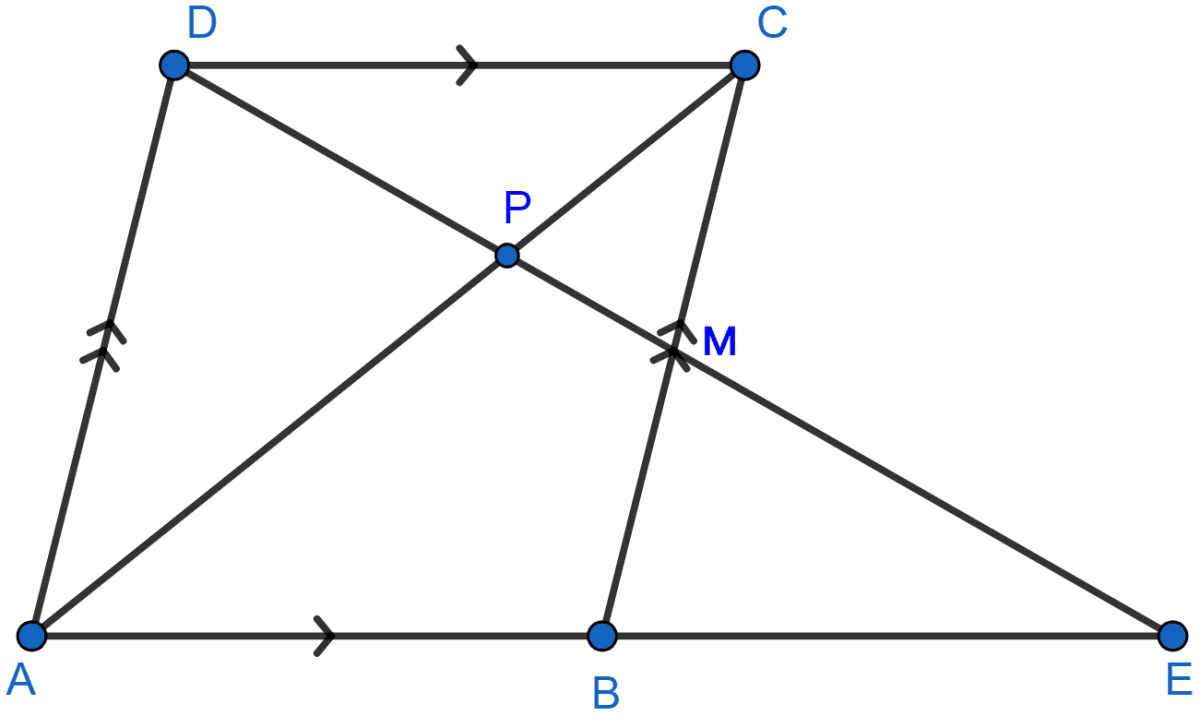
In the following figure, M is the mid-point of BC of a parallelogram ABCD. DM intersects the diagonal AC at P and AB produced at E. Prove that : PE = 2PD.
Answer
In ∆BME and ∆DMC,
∠BME = ∠CMD [Vertically opposite angles are equal.]
∠MCD = ∠MBE [Alternate angles are equal]
BM = MC [M is mid-point of BC]
∴ ∆BME ≅ ∆DMC [By AAS congruence rule]
∴ BE = DC [By C.P.C.T]
Since, opposite sides of parallelogram are equal.
∴ AB = DC
or, AB = DC = BE. ...........(1)
In ∆DCP and ∆EPA,
∠DPC = ∠EPA [Vertically opposite angles are equal.]
∠CDP = ∠AEP [Alternate angles are equal]
∴ ∆DCP ~ ∆EAP [By AA]
Since, corresponding sides of similar triangles are proportional we have :
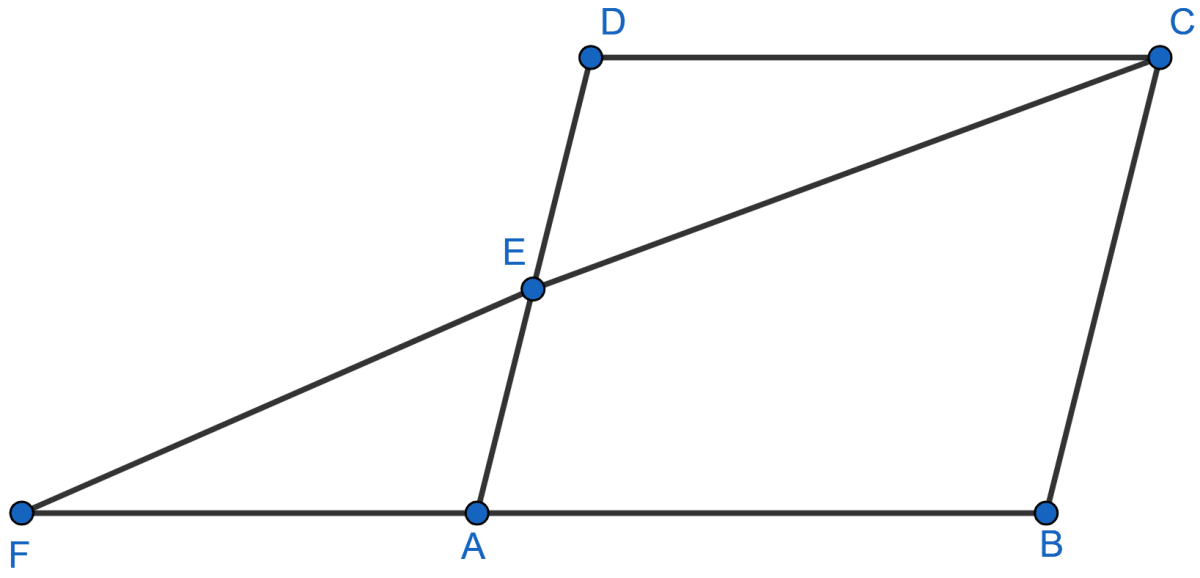
The given figure shows a parallelogram ABCD. E is a point in AD and CE produced meets BA produced at point F. If AE = 4 cm, AF = 8 cm and AB = 12 cm, find the perimeter of the parallelogram ABCD.
Answer
From figure,
FB = AF + AB = 8 + 12 = 20 cm.
In △DEC and △EAF
⇒ ∠DEC = ∠FEA [Vertically opposite angles are equal]
⇒ ∠EDC = ∠EAF [Alternate angles are equal]
∴ △DEC ~ △EAF [By AA]
Since, corresponding sides of similar triangles are proportional we have :
⇒AEDE=AFDC⇒AEDE=AFAB[∵ AB = CD]⇒4DE=812⇒DE=848=6 cm.