
The locus of the centers of all circles, which are tangents to the arms AB and BC of angle ABC is :
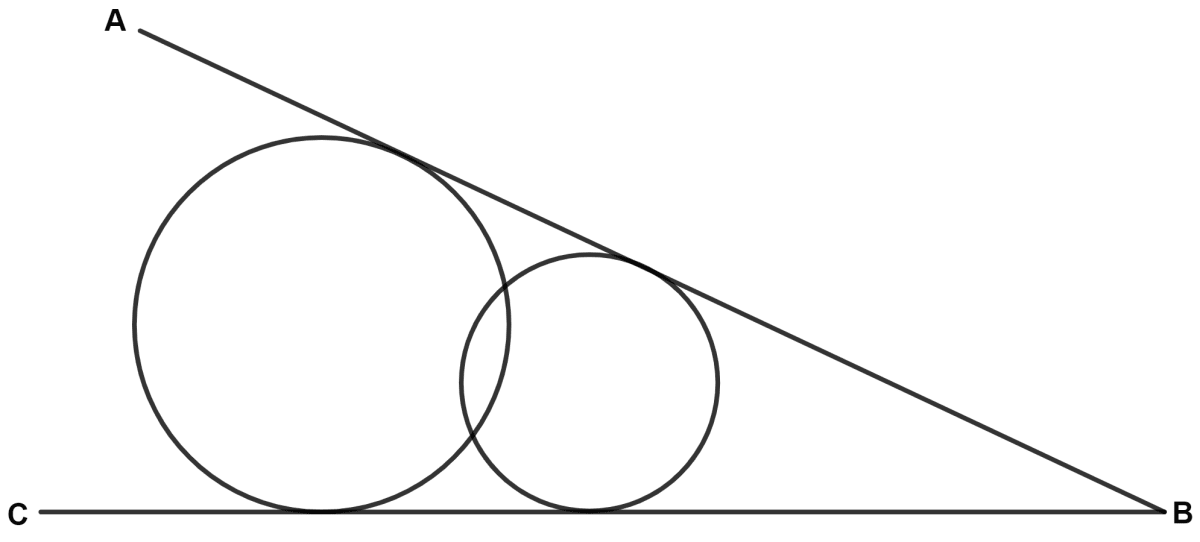
perpendicular bisector of arm AB
perpendicular bisector of arm BC
bisector of angle ABC
none of these
Answer
From figure,
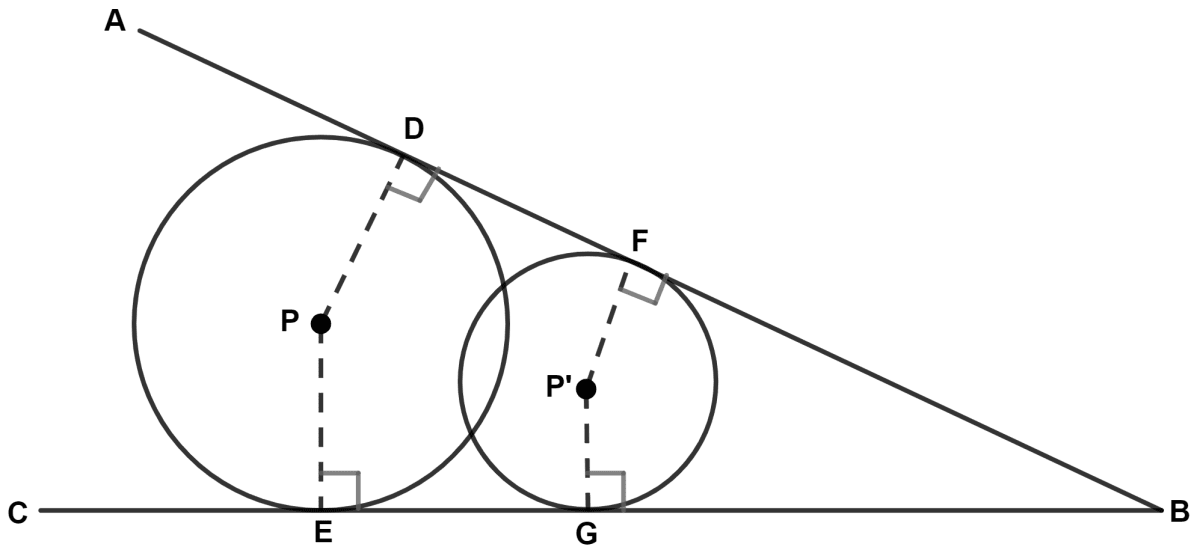
PD = PE (Radius of circle with center P)
P'F = P'G (Radius of circle with center P')
∴ The centers of circles are equidistant from the lines AB and BC.
We know that,
The locus of a point equidistant from two intersecting lines is the bisector of the angles between the lines.
∴ The locus of the centers of all circles, which are tangents to the arms AB and BC of angle ABC is the bisector of angle ABC.
Hence, Option 3 is the correct option.
P is a moving point and AB is a chord of a circle. If P moves, within this circle, in such a way that it is at equal distances from points A and B. The locus of P is :
a chord perpendicular to chord AB
a chord that bisects the chord AB
a diameter of the circle
the diameter of the circle which is perpendicular to chord AB
Answer
Let O be the center of the circle and AB be the chord.
Draw XY, perpendicular bisector of AB.

We know that,
Locus of a point equidistant from two given points is the perpendicular bisector of the line joining the two points.
∴ XY is the locus of point P.
We know that,
Perpendicular to a chord passes through center of the circle.
We know that,
Chord passing through the center is the diameter.
Locus of point P is the diameter of the circle which is perpendicular to chord AB.
Hence, Option 4 is the correct option.
AB is a line segment. A point P moves in such a way that the triangle APB is always an isosceles triangle with base AB. The locus of point P is the line which :
is parallel to AB
is perpendicular to AB
is perpendicular bisector of AB
passes through the mid-point of AB.
Answer
Steps of construction :
Draw a line segment AB.
Draw XY, the perpendicular bisector of AB.

We know that,
Locus of a point equidistant from two given points is the perpendicular bisector of the line joining the two points.
∴ Any point P on the line XY, will be such that PA = PB.
Hence, Option 3 is the correct option.
AB is a line segment and P is a moving point that moves in such a way that it is always equidistant from AB. The locus of point P is the line which :
is parallel to AB and through point P.
is perpendicular to AB through point P.
is perpendicular bisector of AB.
passes through the mid-point of AB.
Answer
Steps of construction :
Draw a line segment AB.
Draw lines l and m parallel to AB on either side.

We know that,
The locus of point which is equidistant from a particular line is a line parallel to it.
Hence, Option 1 is the correct option.
A point P moves in such a way that it is at a distance less than or equal to 5 cm from a fixed point O. The locus of point P is :
a circle with radius 5 cm.
a circle with OP as radius.
a circle with diameter of 10 cm.
a circle of radius 5 cm (including circumference of the circle and inside of it) and the fixed point O as its center.
Answer
Steps of construction :
- Draw a circle of radius 5 cm and center O.

From figure,
Any point on the circumference f the circle is at a distance 5 cm and any point inside the circle will be less than 5 cm.
Hence, Option 4 is the correct option.
Describe the locus of a point at a distant 3 cm from a fixed point.
Answer
Steps of construction :
Let fixed point be A and B be any point on circle.
- Taking fixed point (A) as center draw a circle of radius (AB) = 3 cm.
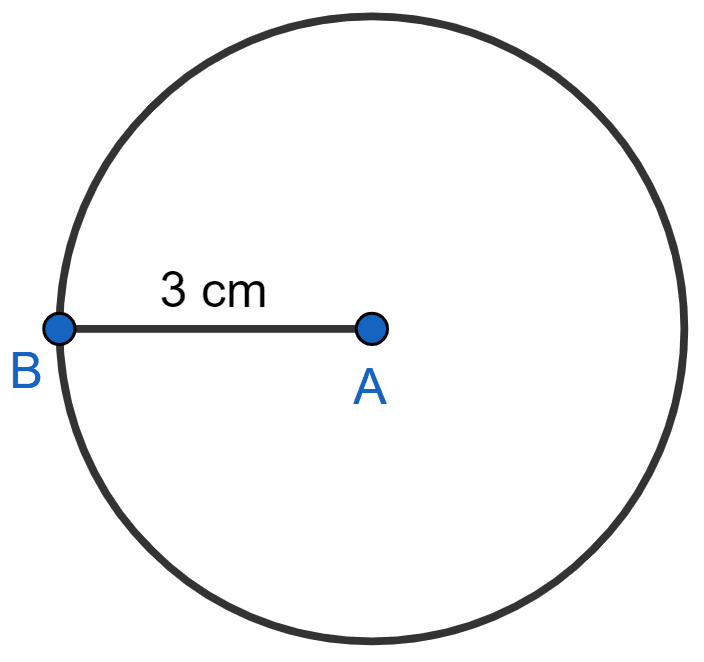
The locus of a point which is 3 cm away from a fixed point is circumference of a circle whose radius is 3 cm and the fixed point is the center of the circle.
Describe the locus of points at a distance 2 cm from a fixed line.
Answer
Steps of construction :
Let AB be the fixed line.
Draw a line l and m, parallel to AB on opposite sides at a distance of 2 cm from AB.

The locus of a point at a distance of 2 cm from a fixed line AB is a pair of straight lines (l and m) parallel to given fixed line and at a distance of 2 cm from it.
Describe the locus of the center of a wheel of a bicycle going straight along a level road.
Answer
Let radius of wheel be r units.

The locus of the center of a wheel, which is going straight along a level road will be a straight line parallel to the road at a distance equal to the radius of the wheel.
Describe the locus of the moving end of the minute hand of a clock.
Answer
Let radius of minute hand be r units.

The locus of the moving end of the minute hand of the clock will be the circumference of a circle with radius equal to the length of the minute hand.
Describe the locus of a stone dropped from the top of a tower.
Answer
The locus of a stone which is dropped from the top of a tower will be a line perpendicular to the ground through the point from which the stone is dropped.

Describe the locus of a runner, running round a circular track and always keeping a distance of 1.5 m from the inner edge.
Answer
Let the inner circular track be r meters.
The required locus will be the circumference of a circle concentric to the running circular track and whose radius will be equal to (r + 1.5) metres.

Describe the locus of the door handle, as the door opens.
Answer
The locus of the door handle will be the circumference of a circle with center at the axis of rotation of the door and radius equal to the distance between the door handle and the axis of rotation of the door.
Describe the locus of points inside a circle and equidistant from two fixed points on the circumference of the circle.
Answer
Steps of construction :
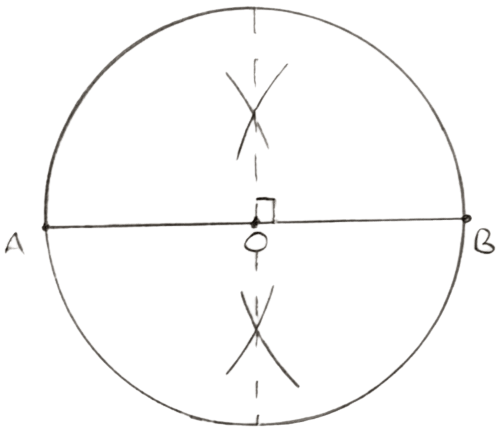
Draw a circle with O as center.
Mark two points A and B. Join AB.
Draw perpendicular bisector of AB. It should pass through center of the circle.
Since, O lies on perpendicular bisector of AB so OA = OB.
Hence, the locus of points inside the circle which are equidistant from the two fixed points on the circumference of a circle will be the diameter which is the perpendicular bisector of the chord joining the two fixed points on the circle.
Describe the locus of the centers of all circles passing through two fixed points.
Answer
Steps of construction :

Let two points be A and B.
Construct the circles passing through A and B.
Draw perpendicular bisector of AB.
From figure,
The centers lie on the perpendicular bisector of AB.
Hence, the locus of centers of all the circles which pass through two fixed points will be the perpendicular bisector of the line segment joining the two given fixed points.
Describe the locus of vertices of all isosceles triangles having a common base.
Answer
We know that,
The locus of point equidistant from two points is the perpendicular bisector of the line joining those points.
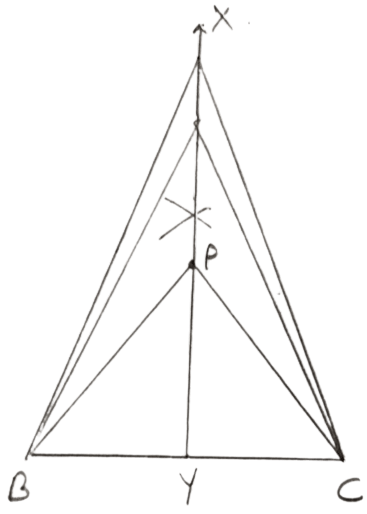
Steps of construction :
Draw a line segment BC (common base)
Draw XY, perpendicular bisector of BC.
Mark point P on XY.
So, PB = PC as P lies on perpendicular bisector of BC.
Hence, the locus of vertices of all isosceles triangles having a common base will be the perpendicular bisector of the common base of the triangles.
Describe the locus of a point P, so that :
AB2 = AP2 + BP2,
where A and B are two fixed points.
Answer
We know that,
Angle subtended by a diameter on any point of a circle is 90°.
From figure,
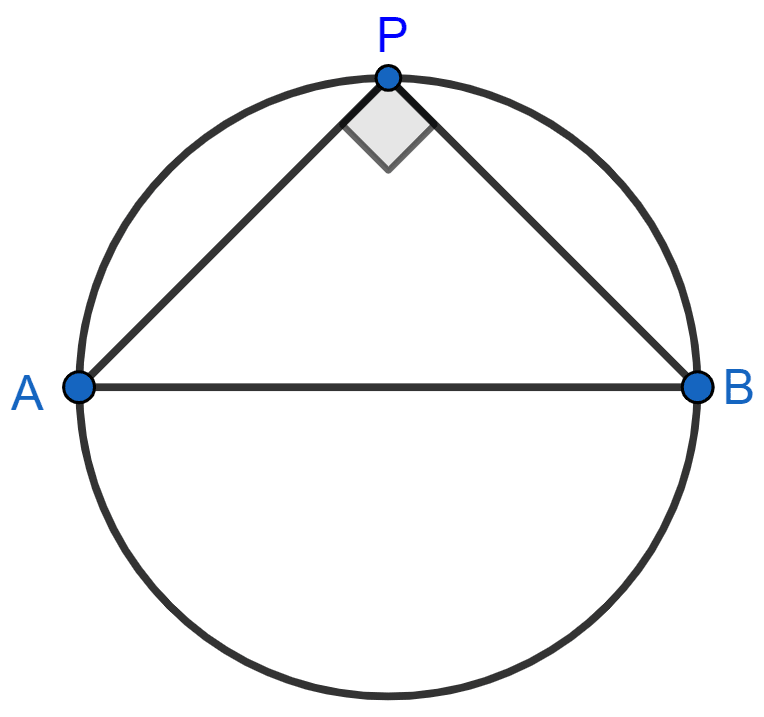
By pythagoras theorem,
⇒ Hypotenuse2 = Perpendicular2 + Base2
⇒ AB2 = AP2 + BP2
We know that,
Pythagoras theorem applies on right angle triangle.
∴ AP ⊥ BP.
Hence, the locus of the point P is the circumference of a circle with AB as diameter.
Describe the locus of a point in rhombus ABCD, so that it is equidistant from
(i) AB and BC.
(ii) B and D.
Answer
(i) We know that,
The locus of a point, which is equidistant from two intersecting straight lines, is a line which bisects the angle between the given lines.
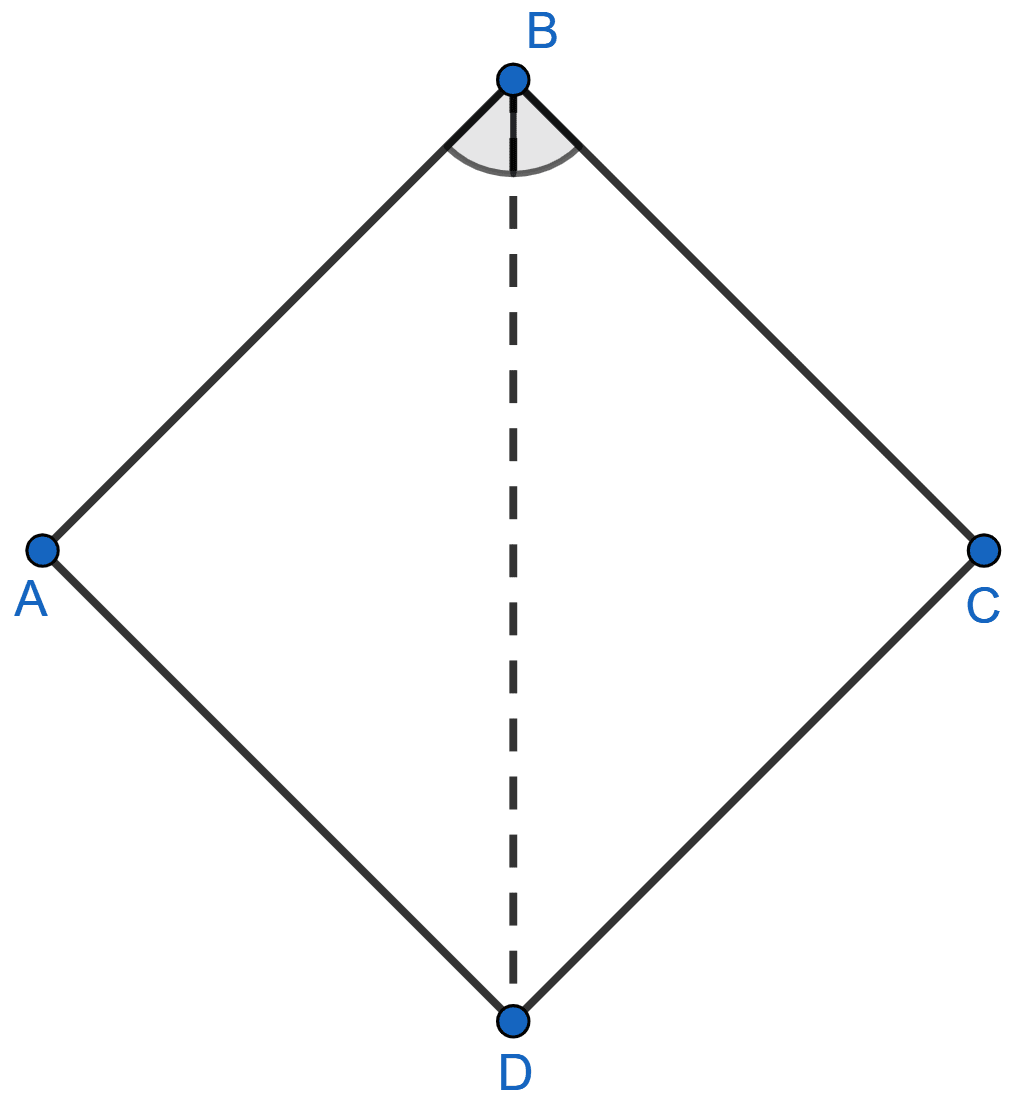
In rhombus,
The diagonals bisect the interior angles.
Hence, the locus of point in a rhombus ABCD which is equidistant from AB and BC will be the diagonal BD.
(ii) We know that,
The locus of a point, which is equidistant from two points is the perpendicular bisector of the line joining those points.
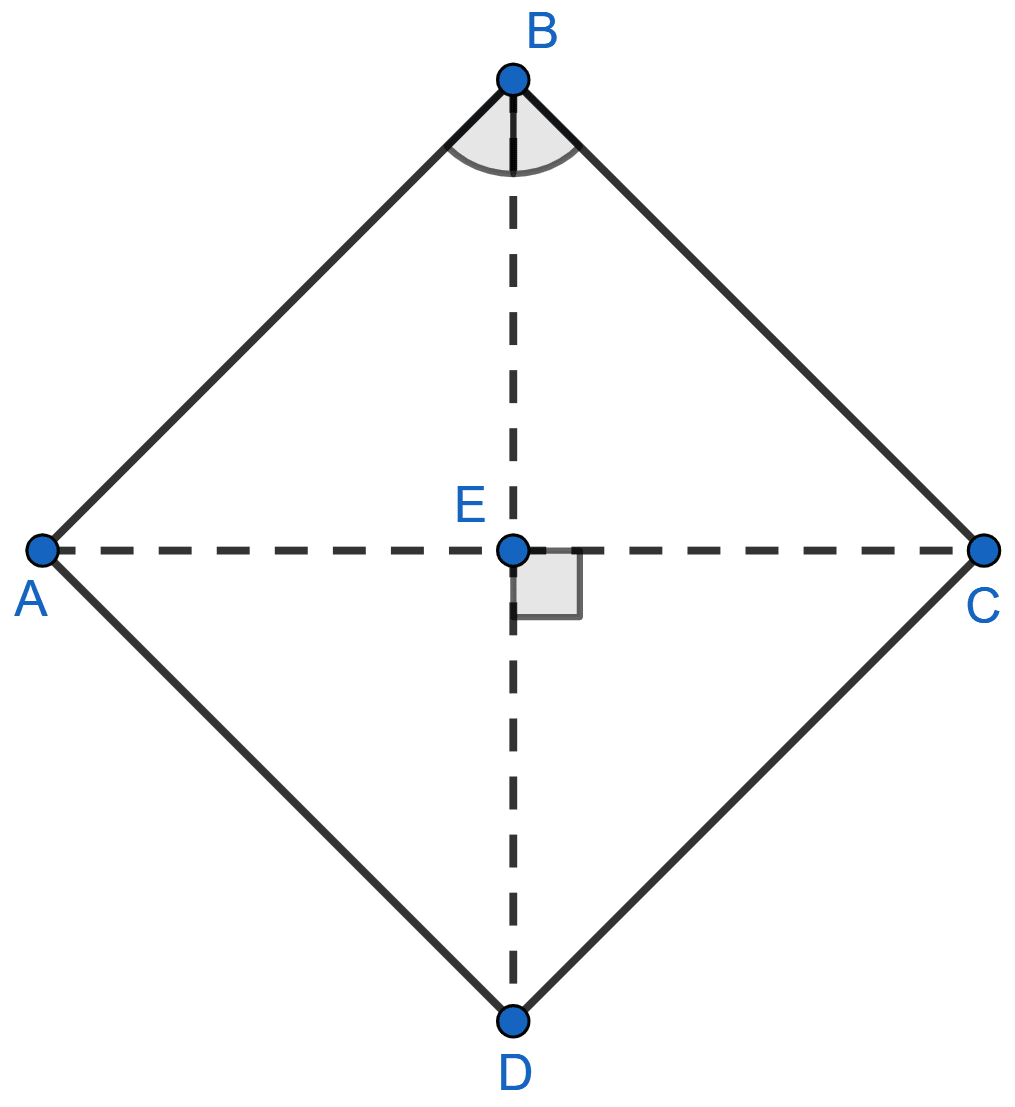
In rhombus,
Diagonals bisect each other at right angles.
Hence, the locus of point in a rhombus ABCD which is equidistant from B and D is diagonal AC.
Describe :
(i) The locus of points at distances less than 3 cm from a given point.
(ii) The locus of points at distances greater than 4 cm from a given point.
(iii) The locus of points at distances less than or equal to 2.5 cm from a given point.
(iv) The locus of points at distances greater than or equal to 35 mm from a given point.
(v) The locus of the center of a given circle which rolls around the outside of a second circle and is always touching it.
(vi) The locus of the centers of all circles that are tangent to both the arms of a given angle.
(vii) The locus of the mid-points of all chords parallel to a given chord of a circle.
(viii) The locus of points within a circle that are equidistant from the end points of a given chord.
Answer
(i) The locus is the space inside the circumference of the circle with the given point as centre and radius equal to 3 cm.
(ii) The locus is the space outside the circumference of the circle with the given point as centre and radius equal to 4 cm.
(iii) The locus is the space inside and on the circumference of the circle with the given point as centre and radius equal to 2.5 cm.
(iv) The locus is the space outside and on the circumference of the circle with the given point as centre and radius equal to 35 mm.
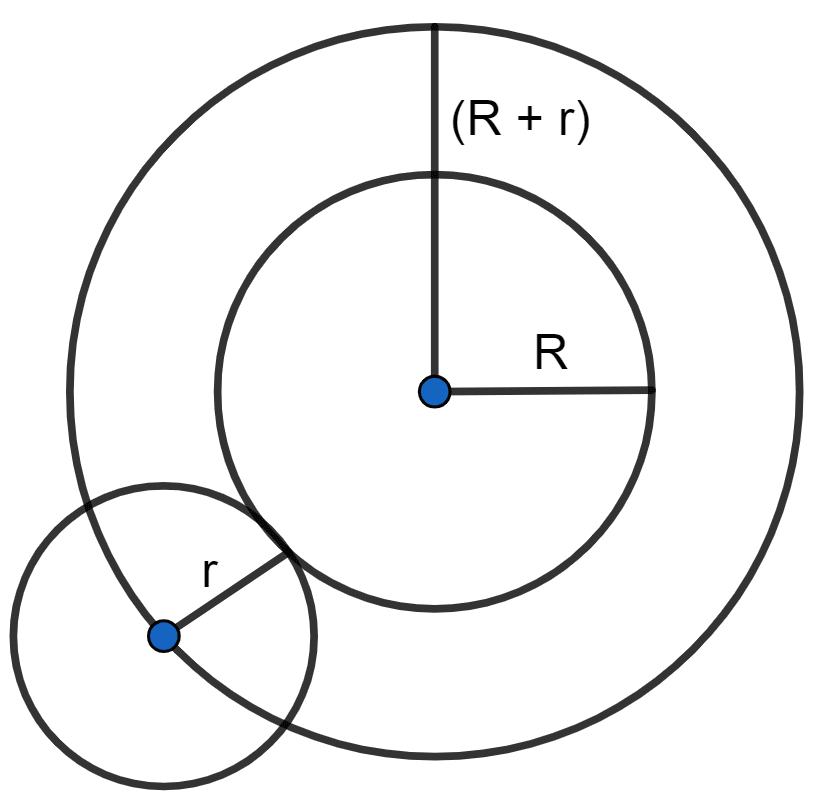
(v) The locus is the circumference of the circle concentric with the second circle whose radius is equal to the sum of the radii of the two given circles.
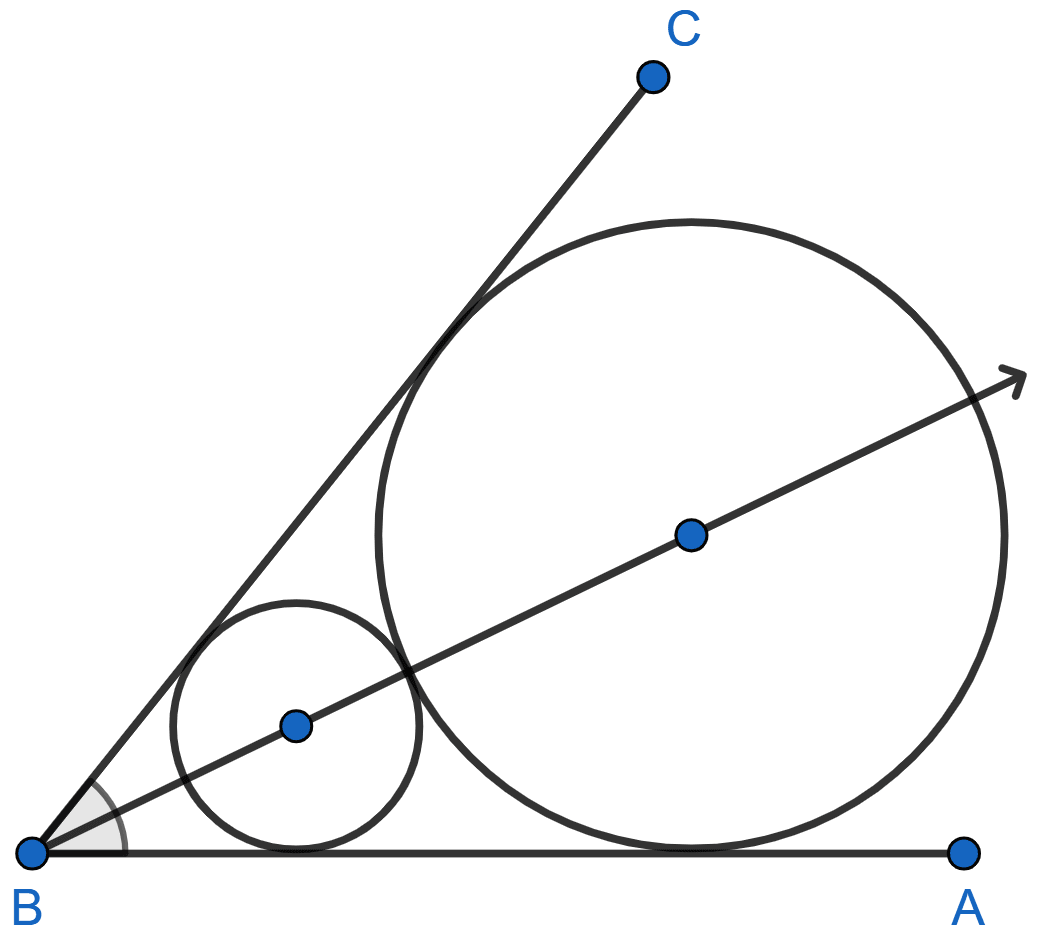
(vi) The locus of the centers of all circles that are tangent to both the arms of a given angle is the bisector of that angle.
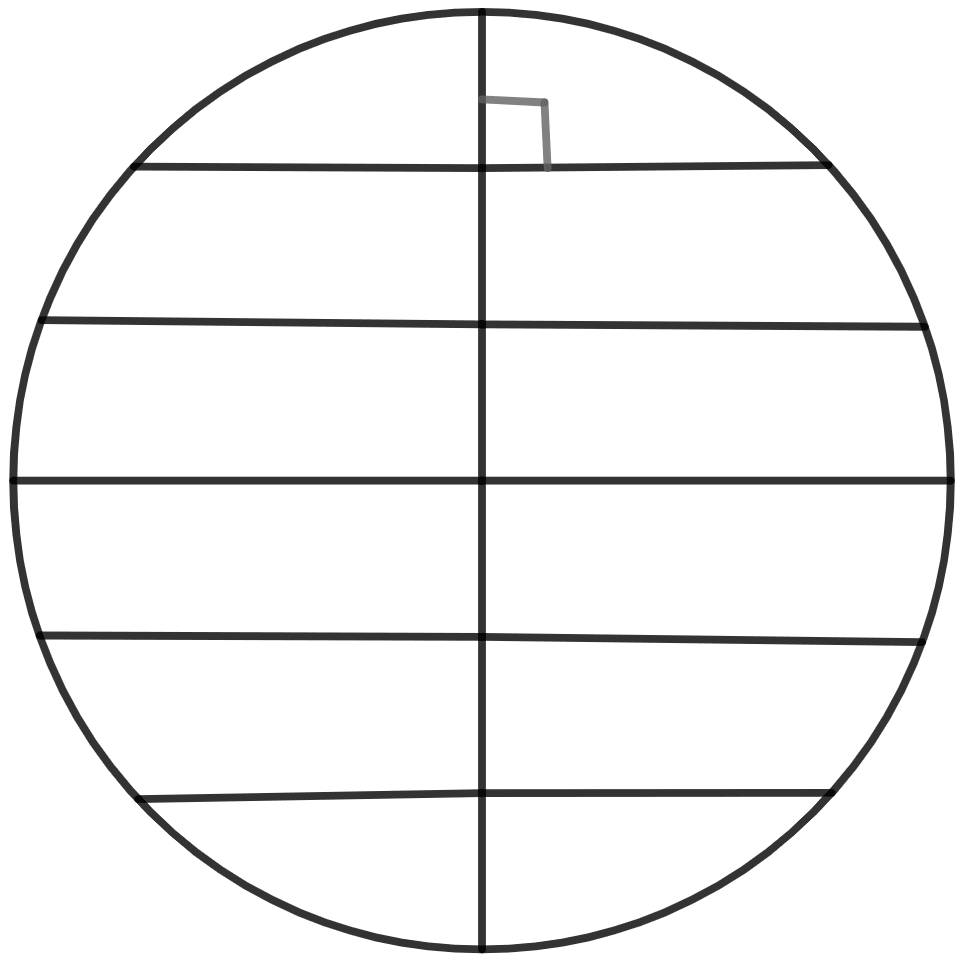
(vii) The locus of the mid-points of all chords parallel to a given chord of a circle is the diameter perpendicular to the given chords.
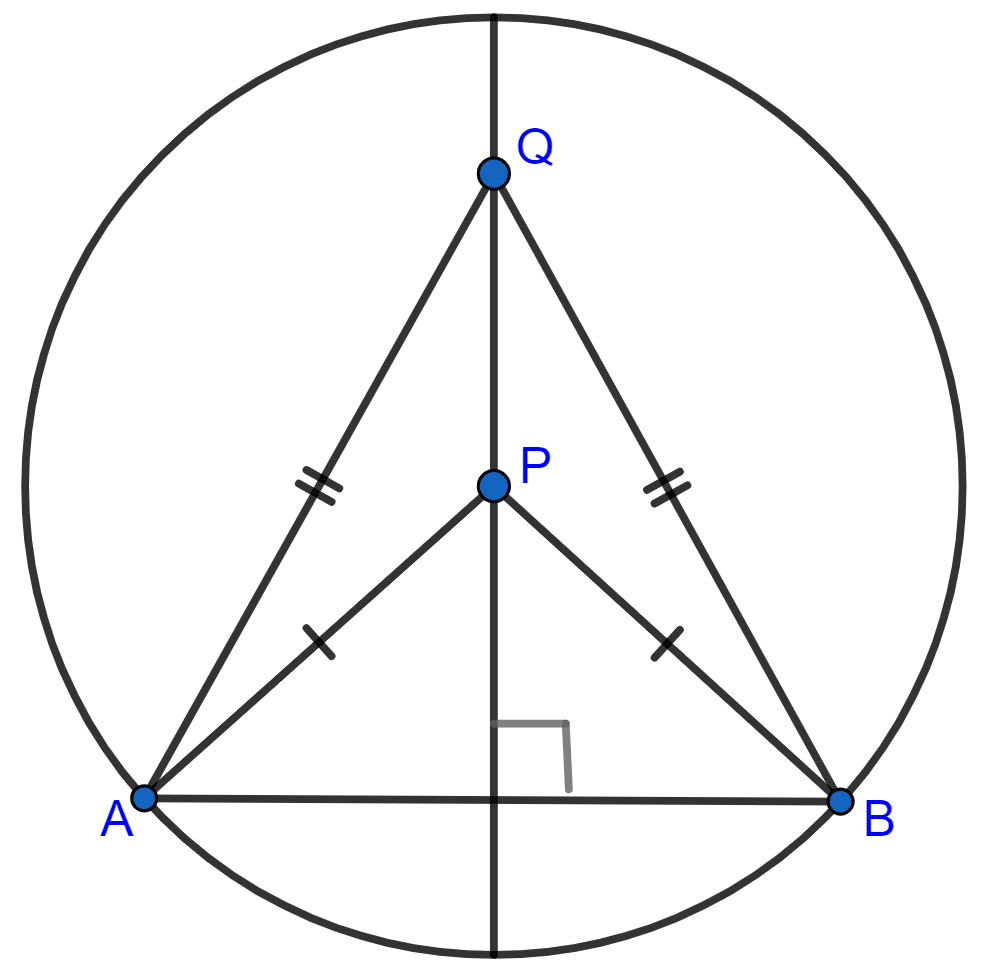
(viii) The locus of points within a circle that are equidistant from the end points of a given chord is the diameter which is perpendicular bisector of the given chord.
A straight line AB is 8 cm long. Draw and describe the locus of a point which is :
(i) always 4 cm from the line AB.
(ii) equidistant from A and B.
Mark the two points X and Y, which are 4 cm from AB and equidistant from A and B. Describe the figure AXBY.
Answer
Steps of construction :
Draw a line segment AB = 8 cm.
Draw two parallel lines l and m to AB at a distance of 4 cm.
Draw CD, the perpendicular bisector of AB which intersects parallel lines l and m at X and Y.
Join AX, AY, BX and BY.

Since, diagonals of AXBY are equal and intersect at right angles.
Hence, AXBY is a square.
(i) Hence, locus of point at a distance of 4 cm from AB will be a pair of lines, each parallel to AB.
(ii) Hence, locus of point equidistant from A and B will be perpendicular bisector of AB.