
Point (5, 6) is reflected in a line to get the point (-5, 6). The line of reflection is :
x-axis
x = 5
y = 0
y-axis
Answer
We know that,
On reflection in y-axis the sign of x co-ordinate changes.
∴ Point (5, 6) is reflected in y-axis to get the point (-5, 6).
Hence, Option 4 is the correct option.
(i) Point A is reflected in y-axis to get point B.
(ii) Point B is reflected in origin to get point C.
(iii) Point C is reflected in y = 0 to get point P. Now, which of the following coincides with point P.
Point A
Point B
Points B and C
Points A and B
Answer
Let point A be (x, y).
We know that,
On reflection in y-axis the sign of x co-ordinate changes.
Given,
Point A is reflected in y-axis to get point B.
∴ A(x, y) = B(-x, y)
We know that,
On reflection in origin the sign of both x and y co-ordinate changes.
Given,
Point B is reflected in origin to get point C.
∴ B(-x, y) = C(x, -y)
We know that,
On reflection in x-axis (or y = 0) the sign of y co-ordinate changes.
Given,
Point C is reflected in y = 0 to get point P.
∴ C(x, -y) = P(x, y).
∴ P coincides with point A.
Hence, Option 1 is the correct option.
The point P(3, 4) is reflected in the line y = x to point (a, b). Then:
a = b
a-b = 1
b - a = 1
none of these
Answer
When a point (x, y) is reflected across the line y = x, the coordinates are swapped, resulting in the point (y, x).
Therefore, the reflection of P(3, 4) is (4, 3). So, a = 4 and b = 3.
Checking all the given options :
Option 1. a = b ⇒ 4 ≠ 3, which is false.
Option 2. a-b = 1 ⇒ 4 x 3 = 12 ≠ 1, which is false.
Option 3. b - a = 1 ⇒ 3 - 4 = -1 ≠ 1, which is false.
Hence, option 4 is the correct option.
The point P(5, 7) is reflected to P' in x-axis and O' is the image of O (origin) in the line PP'. The co-ordinates of O' are :
(10, 0)
(0, 10)
(10, 10)
(5, 5)
Answer
We know that,
On reflection in x-axis, the sign of y-coordinate changes.
P(5, 7) = P'(5, -7)
Steps of construction :
Mark point P and P' in the graph.
Join the points to form line PP'.
From origin (O) draw a straight perpendicular line to PP' and produce. On this line mark a point O' which is at same distance as point O.

From figure,
O' = (10, 0).
Hence, Option 1 is the correct option.
The point P is reflected in x = 0 to get the point P' and the point P' is reflected in y = 0 to get the point P". Which two points out of P, P' and P" are invariant under this reflection.
P" = P
P" = P'
P' = P
no-one
Answer
Let co-ordinate of P be (x, y).
We know that,
On reflection in y-axis (x = 0), the sign of x-coordinate changes.
P(x, y) = P'(-x, y)
We know that,
On reflection in x-axis (y = 0), the sign of y-coordinate changes.
P'(-x, y) = P"(-x, -y)
No two points have same co-ordinate, there are no points that are invariant.
Hence, Option 4 is the correct option.
A triangle ABC is reflected in y-axis to get triangle A'B'C'. Triangle A'B'C' is reflected in line y = 0, to get △A"B"C". Then which of the following is not true ?
△A'B'C' ~ △A"B"C"
△A'B'C' ≅ △A"B"C"
△ABC ≅ △A"B"C"
△ABC ≠ △A"B"C"
Answer
We know that,
Reflections are isometrics.
∴ Triangles are congruent.
Since, triangles are congruent.
∴ Triangles are similar.
Hence, the statement △ABC ≠ △A"B"C" is not true.
Hence, Option 4 is the correct option.
Point M(x, y) is reflected in line AB, the reflection of M(x, y) in AB is the point M itself.
Assertion (A) : The reflection is called invariant transformation.
Reason (R) : In case of invariant transformation, the point is its own image.
A is true, R is false.
A is false, R is true.
Both A and R are true and R is correct reason for R.
Both A and R are true and R is incorrect reason for R.
Answer
Point M(x, y) is reflected across line AB, and the reflection is M itself.
Since, the reflection of M(x, y) in AB is the point M itself.
It means this is an invariant transformation.
Thus, both A and R are true and R is correct reason for R.
Hence, option 3 is the correct option.
Δ ABC is reflected in origin to get Δ A'B'C'.
Statement 1: Δ ABC is congruent to Δ A'B'C'.
Statement 2: The two triangles are similar to each other.
Both the statement are true.
Both the statement are false.
Statement 1 is true, and statement 2 is false.
Statement 1 is false, and statement 2 is true.
Answer
When a point (x, y) is reflected across the origin, its image becomes (-x, -y).
So, under this transformation:
All angles and side lengths are preserved.
The orientation (clockwise/counter-clockwise) is reversed, but the size and shape remain identical.
According to statement 1 : Δ ABC is congruent to Δ A'B'C' because in reflection lengths and angles are preserved.
So, statement 1 is true.
According to statement 2 : Δ ABC is similar to Δ A'B'C' because all congruent triangles are similar.
So, statement 2 is true.
Hence, option 1 is the correct option.
Points (-5, 1) and (4, 1) are invariant points under reflection in the line L.
Statement 1: The equation of the line L is x = 1.
Statement 2: A point P is called an invariant point with respect to a given line L, if its image in the line L is the point P itself.
Both the statement are true.
Both the statement are false.
Statement 1 is true, and statement 2 is false.
Statement 1 is false, and statement 2 is true.
Answer
Given, points (-5, 1) and (4, 1) are invariant points under reflection in the line L.
The points (-5, 1) and (4, 1) lie on the line y = 1, so the points remains invariant under the reflection in the line y = 1.
So, statement 1 is false.
According to statement 2, a point P is called an invariant point with respect to a given line L, if its image in the line L is the point P itself.
So, statement 2 is true.
Hence, option 4 is the correct option.
Point A (4, -1) is reflected as A' in the y-axis. Point B on reflection in the x-axis is mapped as B' (-2, 5). Write the co-ordinates of A' and B.
Answer
Reflection in y-axis is given by,
My(x, y) = (-x, y)
∴ Image on reflection of A(4, -1) in y-axis = A'(-4, -1).
Let B = (a, b)
Reflection in x-axis is given by,
Mx(x, y) = (x, -y)
∴ Image on reflection of B(a, b) in x-axis = B'(a, -b).
Given, B' = (-2, 5)
so, a = -2 and -b = 5
⇒ a = -2 and b = -5.
Hence, A' = (-4, -1) and B = (-2, -5).
The point (-5, 0) on reflection in a line is mapped as (5, 0) and the point (-2, -6) on reflection in the same line is mapped as (2, -6).
(a) Name the line of reflection.
(b) Write the co-ordinates of the image of (5, -8) in the line obtained in (a).
Answer
(a) Reflection in y-axis is given by,
My(x, y) = (-x, y)
The transformation (-5, 0) ⇒ (5, 0) is similar to above transformation.
∴ It is reflection in y-axis.
Hence, y-axis is the line of reflection.
(b) Reflection in y-axis is given by,
My(x, y) = (-x, y)
∴ Image of (5, -8) in y-axis = (-5, -8).
Hence, image of (5, -8) in line of reflection = (-5, -8).
The point P(3, 4) is reflected to P' in the x-axis; and O' is the image of O (the origin) when reflected in the line PP'. Write :
(i) the co-ordinates of P' and O',
(ii) the length of the segments PP' and OO',
(iii) the perimeter of the quadrilateral POP'O',
(iv) the geometrical name of the figure POP'O'.
Answer
(i) From graph,
The co-ordinates of P' = (3, -4) and O' = (6, 0).
(ii) By distance formula,
PP' = ......(1)
Substituting value of P(3, 4) and P'(3, -4) in equation 1 we get,
Substituting value of O(0, 0) and O'(6, 0) in equation 1 we get,
Hence, PP' = 8 units and OO' = 6 units.
(iii) By distance formula,
PO = ......(1)
Substituting value of P(3, 4) and O(0, 0) in equation 1 we get,
Substituting value of P'(3, -4) and O(0, 0) in equation 1 we get,
As adjacent sides are equal, so POP'O' is a rhombus.
∴ Perimeter = PO + OP' + P'O' + O'P = 5 + 5 + 5 + 5 = 20.
Hence, perimeter of POP'O' = 20 units.
(iv) POP'O' is a rhombus.
A(1, 1), B(5, 1), C(4, 2) and D(2, 2) are vertices of a quadrilateral. Name the quadrilateral ABCD. A, B, C, and D are reflected in the origin on to A', B', C' and D' respectively. Locate A', B', C' and D' on the graph sheet and write their co-ordinates. Are D, A, A' and D' collinear ?
Answer
From graph,
ABCD is an isosceles trapezium.
A' = (-1, -1), B' = (-5, -1), C' = (-4, -2) and D' = (-2, -2).
Since, D, A', A and D lie on same line so D, A, A' and D' are collinear.
P and Q have co-ordinates (0, 5) and (-2, 4).
(a) P is invariant when reflected in an axis. Name the axis.
(b) Find the image of Q on reflection in the axis found in (a).
(c) (0, k) on reflection in the origin is invariant. Write the value of k.
(d) Write the co-ordinates of the image of Q, obtained by reflecting it in the origin followed by reflection in x-axis.
Answer
(a) Since, P lies on y-axis and a point is invariant on the line in which it is present.
Hence, P is invariant on y-axis.
(b) From graph,
Q' is the image of reflection of Q in y-axis.
Hence, co-ordinates of Q' = (2, 4).
(c) In case of invariant point, the point is its own image.
Hence, (0, k) is origin itself.
Hence, k = 0.
(d) From graph,
Image of Q after reflection in origin followed by reflection in x-axis is Q'.
Hence, co-ordinates of image after reflection in origin followed by reflection in x-axis is (2, 4).
(a) The point P(2, -4) is reflected about the line x = 0 to get the image Q. Find the co-ordinates of Q.
(b) The point Q is reflected about the line y = 0 to get the image R. Find the co-ordinates of R.
(c) Name the figure PQR.
(d) Find the area of figure PQR.
Answer
(a) From graph,
The co-ordinates of Q = (-2, -4).
(b) From graph,
The co-ordinates of R = (-2, 4).
(c) Figure PQR is a right angled triangle.
(d) From graph we get,
1 block = 1 unit.
So,
QR = 8 units and PQ = 4 units.
Area of a right angle triangle = x base x height
= x PQ x QR
= x 4 x 8
= 16 sq. unit
Hence, area of PQR = 16 sq. unit.
Using a graph paper, plot the points A(6, 4) and B(0, 4).
(a) Reflect A and B in the origin to get the images A' and B'.
(b) Write the co-ordinates of A' and B'.
(c) State the geometrical name for the figure ABA'B'.
(d) Find its perimeter.
Answer
(b) From graph,
The co-ordinates of A' = (-6, -4) and B' = (0, -4).
(c) From graph,
ABA'B' is a parallelogram.
(d) From graph,
Since, 1 block = 1 unit
⇒ A'B' = AB = 6 units
⇒ BB' = 8 units
By pythagoras theorem in right angle △A'B'B
⇒ A'B2 = A'B'2 + BB'2
⇒ A'B2 = 62 + 82
⇒ A'B2 = 36 + 64
⇒ A'B2 = 100
⇒ A'B = 10 unit.
Since, ABA'B' is a parallelogram so opposite sides are equal
So,
⇒ AB' = A'B = 10 unit
Perimeter = A'B + BA + AB' + B'A' = 10 + 6 + 10 + 6 = 32 units.
Hence, perimeter = 32 units.
Use graph paper for this question.
Plot the points O(0, 0), A(-4, 4), B(-3, 0) and C(0, -3)
(i) Reflect points A and B on the y-axis and name them A' and B' respectively. Write down their co-ordinates.
(ii) Name the figure OABCB'A'.
(iii) State the line of symmetry of this figure.
Answer
(i) From graph,
The co-ordinates of A' = (4, 4) and B' = (3, 0).
(ii) From graph,
The figure OABCB'A' is an arrow head.
(iii) From graph,
The y-axis divides the figure in two similar halves.
Hence, y-axis is the line of symmetry.
Use a graph paper for this question.
(i) Plot the following points :
A(0, 4), B(2, 3), C(1, 1) and D(2, 0).
(ii) Reflect the points B, C, D on the y-axis and write down their coordinates. Name the images as B', C', D' respectively.
(iii) Join the points A, B, C, D, D', C', B' and A in order, so as to form a closed figure. Write down the equation of the line about which if this closed figure obtained is folded, the two parts of the figure exactly coincide.
Answer
(i) Below is the graph of the points:
(ii) From graph,
The co-ordinates of B' = (-2, 3), C' = (-1, 1) and D' = (-2, 0).
(iii) From graph,
y-axis is the line of symmetry.
Hence, x = 0 is the equation of the line about which if folded, the two parts of the figure exactly coincide.
Use a graph paper for this question taking 1 cm = 1 unit along both the x-axis and the y axis.
(i) Plot the points A(0, 5), B(2, 5), C(5, 2), D(5, -2), E(2, -5) and F(0, -5).
(ii) Reflect the points B, C, D and E on the y-axis and name them B', C', D' and E' respectively.
(iii) Write the co-ordinates of B', C', D' and E'.
(iv) Name the close figure formed.
Answer
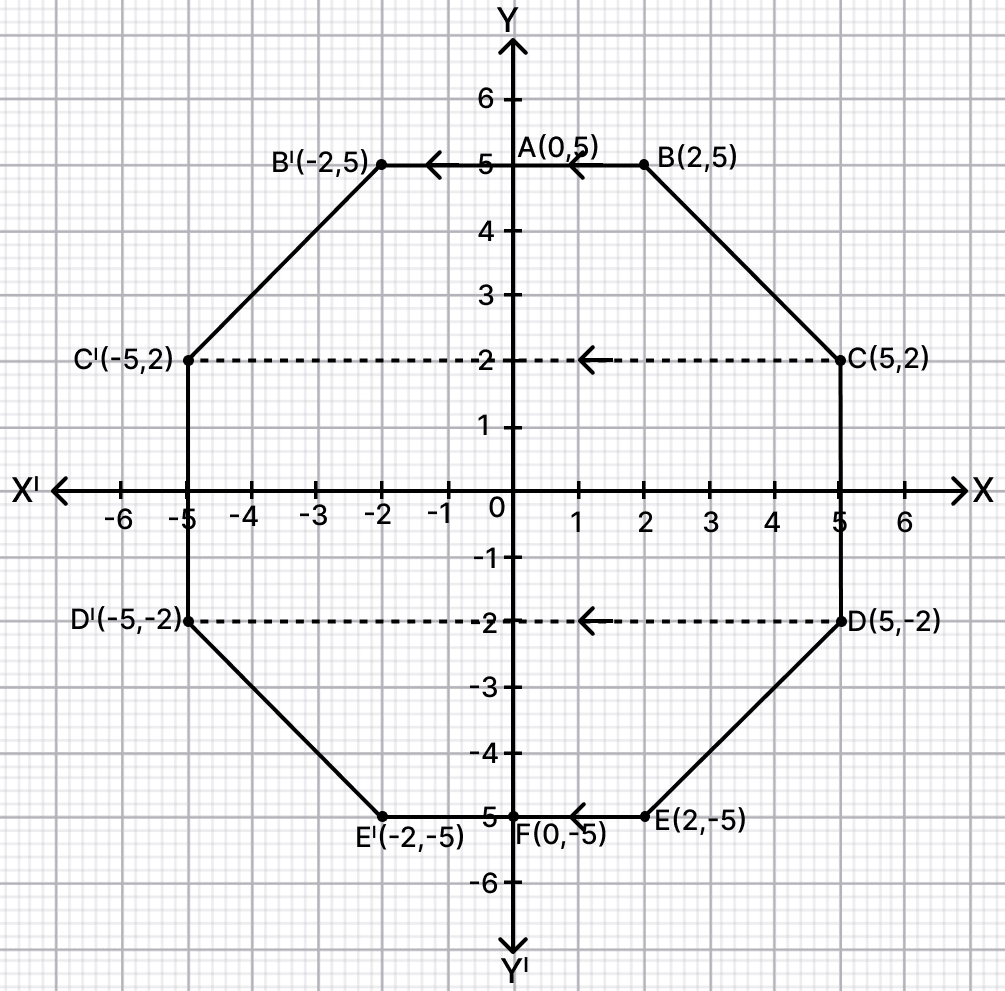
From graph,
Coordinates of B' = (-2, 5), C' = (-5, 2), D' = (-5, -2) and E' = (-2, -5).
The closed figure formed is an octagon with opposite sides equal.