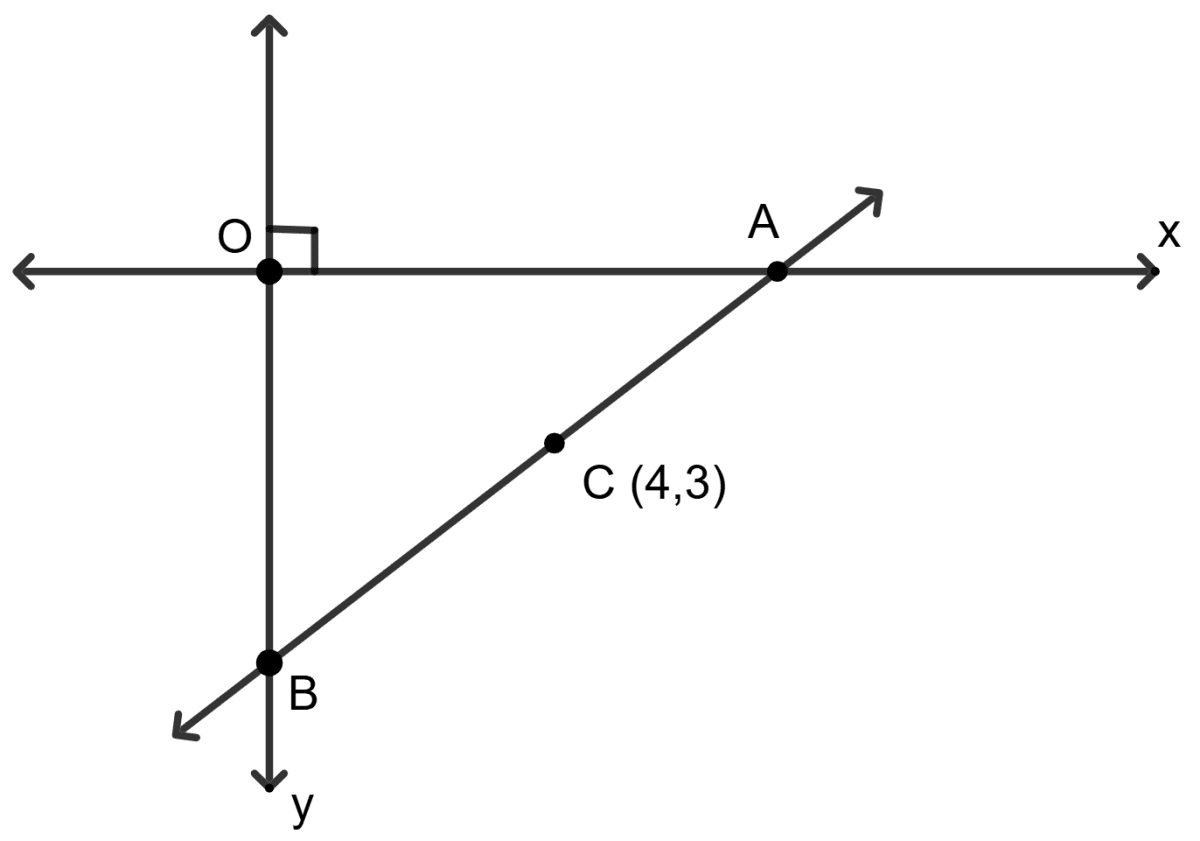
If P(4, 3) is mid-point of line segment AB, then
A = (6, 0), B = (0, 8)
A = (8, 6), B = (8, 0)
A = (6, 8), B = (0, 6)
A = (8, 0) and B = (0, 6)
Answer
From figure,
A lies on x-axis and B lies on y-axis.
Let co-ordinates of A be (x, 0) and B be (0, y).
Given,
P(4, 3) is mid-point of line segment AB.
By mid-point formula,
Mid-point = ( x 1 + x 2 2 , y 1 + y 2 2 ) \Big(\dfrac{x_1 + x_2}{2}, \dfrac{y_1 + y_2}{2}\Big) ( 2 x 1 + x 2 , 2 y 1 + y 2 )
Substituting values we get :
⇒ ( 4 , 3 ) = ( x + 0 2 , 0 + y 2 ) ⇒ ( 4 , 3 ) = ( x 2 , y 2 ) ⇒ x 2 = 4 and y 2 = 3 ⇒ x = 8 and y = 6. \Rightarrow (4, 3) = \Big(\dfrac{x + 0}{2}, \dfrac{0 + y}{2}\Big) \\[1em] \Rightarrow (4, 3) = \Big(\dfrac{x}{2}, \dfrac{y}{2}\Big) \\[1em] \Rightarrow \dfrac{x}{2} = 4 \text{ and } \dfrac{y}{2} = 3 \\[1em] \Rightarrow x = 8 \text{ and } y = 6. ⇒ ( 4 , 3 ) = ( 2 x + 0 , 2 0 + y ) ⇒ ( 4 , 3 ) = ( 2 x , 2 y ) ⇒ 2 x = 4 and 2 y = 3 ⇒ x = 8 and y = 6.
A = (x, 0) = (8, 0),
B = (0, y) = (0, 6).
Hence, Option 4 is the correct option.
Points A and B have co-ordinates (4, y) and (x, 8). The mid-point of AB = (0, 0); the values of x and y are :
x = -4, y = 8
x = 4, y = -8
x = -4, y = -8
x = 4, y = 8
Answer
By mid-point formula,
Mid-point = ( x 1 + x 2 2 , y 1 + y 2 2 ) \Big(\dfrac{x_1 + x_2}{2}, \dfrac{y_1 + y_2}{2}\Big) ( 2 x 1 + x 2 , 2 y 1 + y 2 )
Substituting values we get :
⇒ ( 0 , 0 ) = ( 4 + x 2 , y + 8 2 ) ⇒ x + 4 2 = 0 and y + 8 2 = 0 ⇒ x + 4 = 0 and y + 8 = 0 ⇒ x = − 4 and y = − 8. \Rightarrow (0, 0) = \Big(\dfrac{4 + x}{2}, \dfrac{y + 8}{2}\Big) \\[1em] \Rightarrow \dfrac{x + 4}{2} = 0 \text{ and } \dfrac{y + 8}{2} = 0 \\[1em] \Rightarrow x + 4 = 0 \text{ and } y + 8 = 0 \\[1em] \Rightarrow x = -4 \text{ and } y = -8. ⇒ ( 0 , 0 ) = ( 2 4 + x , 2 y + 8 ) ⇒ 2 x + 4 = 0 and 2 y + 8 = 0 ⇒ x + 4 = 0 and y + 8 = 0 ⇒ x = − 4 and y = − 8.
Hence, Option 3 is the correct option.
Two vertices of a triangle are (-5, 3) and (4, -7). If centroid of the triangle is (-1, 2) then the third vertex is :
(-2, 7)
(-2, 10)
(-2, -10)
(0, -2)
Answer
Let third vertex be (x, y).
By formula,
Centroid of triangle = ( x 1 + x 2 + x 3 3 , y 1 + y 2 + y 3 3 ) \Big(\dfrac{x_1 + x_2 + x_3}{3}, \dfrac{y_1 + y_2 + y_3}{3}\Big) ( 3 x 1 + x 2 + x 3 , 3 y 1 + y 2 + y 3 )
Substituting values we get :
⇒ ( − 1 , 2 ) = ( ( − 5 ) + 4 + x 3 , 3 + ( − 7 ) + y 3 ) ⇒ ( − 1 , 2 ) = ( x − 1 3 , y − 4 3 ) ⇒ − 1 = x − 1 3 and 2 = y − 4 3 ⇒ x − 1 = − 3 and y − 4 = 6 ⇒ x = − 3 + 1 and y = 6 + 4 ⇒ x = − 2 and y = 10. \Rightarrow (-1, 2) = \Big(\dfrac{(-5) + 4 + x}{3}, \dfrac{3 + (-7) + y}{3}\Big) \\[1em] \Rightarrow (-1, 2) = \Big(\dfrac{x - 1}{3}, \dfrac{y - 4}{3}\Big) \\[1em] \Rightarrow -1 = \dfrac{x - 1}{3} \text{ and } 2 = \dfrac{y - 4}{3} \\[1em] \Rightarrow x - 1 = -3 \text{ and } y - 4 = 6 \\[1em] \Rightarrow x = -3 + 1 \text{ and } y = 6 + 4 \\[1em] \Rightarrow x = -2 \text{ and } y = 10. ⇒ ( − 1 , 2 ) = ( 3 ( − 5 ) + 4 + x , 3 3 + ( − 7 ) + y ) ⇒ ( − 1 , 2 ) = ( 3 x − 1 , 3 y − 4 ) ⇒ − 1 = 3 x − 1 and 2 = 3 y − 4 ⇒ x − 1 = − 3 and y − 4 = 6 ⇒ x = − 3 + 1 and y = 6 + 4 ⇒ x = − 2 and y = 10.
Third vertex = (-2, 10).
Hence, Option 2 is the correct option.
Points A, B, C and D divide the join of O(0, 0) and P(0, 10) into five equal parts. The co-ordinates of point D are :
(10, 8)
(-8, 0)
(-10, 0)
(0, 8)
Answer
From figure,
D divides the line segment OP in the ratio 4 : 1.
Let co-ordinates of D be (x, y).
By section-formula,
(x, y) = ( m 1 x 2 + m 2 x 1 m 1 + m 2 , m 1 y 2 + m 2 y 1 m 1 + m 2 ) \Big(\dfrac{m_1x_2 + m_2x_1}{m_1 + m_2}, \dfrac{m_1y_2 + m_2y_1}{m_1 + m_2}\Big) ( m 1 + m 2 m 1 x 2 + m 2 x 1 , m 1 + m 2 m 1 y 2 + m 2 y 1 )
Substituting values we get :
⇒ ( x , y ) = ( 4 × 0 + 1 × 0 4 + 1 , 4 × 10 + 1 × 0 4 + 1 ) = ( 0 5 , 40 5 ) = ( 0 , 8 ) . \Rightarrow (x, y) = \Big(\dfrac{4 \times 0 + 1 \times 0}{4 + 1}, \dfrac{4 \times 10 + 1\times 0}{4 + 1}\Big) \\[1em] = \Big(\dfrac{0}{5}, \dfrac{40}{5}\Big) \\[1em] = (0, 8). ⇒ ( x , y ) = ( 4 + 1 4 × 0 + 1 × 0 , 4 + 1 4 × 10 + 1 × 0 ) = ( 5 0 , 5 40 ) = ( 0 , 8 ) .
Hence, Option 4 is the correct option.
Line segment joining points (4, 3) and (1, -2) is divided by the point (y, 0) in the ratio :
2 : 3
3 : 2
3 : 4
4 : 2
Answer
Let (y, 0) divide the line segment joining the points (4, 3) and (1, -2) in the ratio k : 1.
By section-formula,
(x, y) = ( m 1 x 2 + m 2 x 1 m 1 + m 2 , m 1 y 2 + m 2 y 1 m 1 + m 2 ) \Big(\dfrac{m_1x_2 + m_2x_1}{m_1 + m_2}, \dfrac{m_1y_2 + m_2y_1}{m_1 + m_2}\Big) ( m 1 + m 2 m 1 x 2 + m 2 x 1 , m 1 + m 2 m 1 y 2 + m 2 y 1 )
Substituting values for y-coordinate :
⇒ 0 = k × − 2 + 1 × 3 k + 1 ⇒ − 2 k + 3 = 0 ⇒ 2 k = 3 ⇒ k = 3 2 . \Rightarrow 0 = \dfrac{k \times -2 + 1 \times 3}{k + 1} \\[1em] \Rightarrow -2k + 3 = 0 \\[1em] \Rightarrow 2k = 3 \\[1em] \Rightarrow k = \dfrac{3}{2}. ⇒ 0 = k + 1 k × − 2 + 1 × 3 ⇒ − 2 k + 3 = 0 ⇒ 2 k = 3 ⇒ k = 2 3 .
Substituting value of k in k : 1, we get :
⇒ 3 2 : 1 \dfrac{3}{2} : 1 2 3 : 1
⇒ 3 : 2.
Hence, Option 2 is the correct option.
The point P divides the line segment joining the point (1, 2) and (-1, 2) internally in the ratio 1 : 2.
Assertion (A) : The co-ordinates of point P = (1, 6)
Reason (R) : If point P divides the line segment joining the points (x1 , y1 ) and (x2 , y2 ) in the ratio m1 : m2 then :
P = ( m 1 x 2 + m 2 x 1 m 1 + m 2 , m 1 y 2 + m 2 y 1 m 1 + m 2 ) \Big(\dfrac{m_1x_2 + m_2x_1}{m_1 + m_2}, \dfrac{m_1y_2 + m_2y_1}{m_1 + m_2}\Big) ( m 1 + m 2 m 1 x 2 + m 2 x 1 , m 1 + m 2 m 1 y 2 + m 2 y 1 )
A is true, R is false.
A is false, R is true.
Both A and R are true and R is correct reason for A.
Both A and R are true and R is incorrect reason for A.
Answer
We know that,
If point P divides the line segment joining the points (x1 , y1 ) and (x2 , y2 ) in the ratio m1 : m2 , then :
Co-ordinates of P = ( m 1 x 2 + m 2 x 1 m 1 + m 2 , m 1 y 2 + m 2 y 1 m 1 + m 2 ) \Big(\dfrac{m_1x_2 + m_2x_1}{m_1 + m_2}, \dfrac{m_1y_2 + m_2y_1}{m_1 + m_2}\Big) ( m 1 + m 2 m 1 x 2 + m 2 x 1 , m 1 + m 2 m 1 y 2 + m 2 y 1 )
So, reason (R) is true.
Here, (x1 , y1 ) = (1, 2) and (x2 , y2 ) = (-1, 2)
m1 : m2 = 1 : 2
Substituting the values, we get :
⇒ P = [ 1 × ( − 1 ) + 2 × 1 1 + 2 , 1 × 2 + 2 × 2 1 + 2 ] = ( − 1 + 2 3 , 2 + 4 3 ) = ( 1 3 , 6 3 ) = ( 1 3 , 2 ) \Rightarrow \text{P} = \Big[\dfrac{1\times (-1) + 2\times 1}{1 + 2}, \dfrac{1 \times 2 + 2 \times 2}{1 + 2}\Big]\\[1em] = \Big(\dfrac{-1 + 2}{3}, \dfrac{2 + 4}{3}\Big)\\[1em] = \Big(\dfrac{1}{3}, \dfrac{6}{3}\Big)\\[1em] = \Big(\dfrac{1}{3}, 2\Big)\\[1em] ⇒ P = [ 1 + 2 1 × ( − 1 ) + 2 × 1 , 1 + 2 1 × 2 + 2 × 2 ] = ( 3 − 1 + 2 , 3 2 + 4 ) = ( 3 1 , 3 6 ) = ( 3 1 , 2 )
So, assertion (A) is false.
Hence, option 2 is the correct option.
Point P(x, y) is equidistant from points A(7, 1) and B(3, 5).
Statement 1: x = 7 + 3 2 \dfrac{7 + 3}{2} 2 7 + 3 1 + 5 2 \dfrac{1 + 5}{2} 2 1 + 5
Statement 2: (x - 7)2 + (y - 1)2 = (x - 3)2 + (y - 5)2 .
Both the statement are true.
Both the statement are false.
Statement 1 is true, and statement 2 is false.
Statement 1 is false, and statement 2 is true.
Answer
It is given that point P(x, y) is equidistant from points A(7, 1) and B(3, 5).
If a point is equidistant from two points it is not necessary that it will be the mid-point of the two points, sp we cannot use mid-point formula to find the co-ordinates of P.
So, statement 1 is false.
Using distance formula,
Distance between two points = ( x 2 − x 1 ) 2 + ( y 2 − y 1 ) 2 \sqrt{(x_2 - x_1)^2 + (y_2 - y_1)^2} ( x 2 − x 1 ) 2 + ( y 2 − y 1 ) 2
⇒ PA = PB
⇒ ⇒ ( x − 7 ) 2 + ( y − 1 ) 2 = ( x − 3 ) 2 + ( y − 5 ) 2 \Rightarrow \sqrt{(x - 7)^2 + (y - 1)^2} = \sqrt{(x - 3)^2 + (y - 5)^2} ⇒ ( x − 7 ) 2 + ( y − 1 ) 2 = ( x − 3 ) 2 + ( y − 5 ) 2
⇒ (x - 7)2 + (y - 1)2 = (x - 3)2 + (y - 5)2
So, statement 2 is true.
Hence, option 4 is the correct option.
Given a triangle ABC in which A = (4, -4), B = (0, 5) and C = (5, 10). A point P lies on BC such that BP : PC = 3 : 2. Find the length of line segment AP.
Answer
Let the co-ordinates of P be (x, y)
∴ x = m 1 x 2 + m 2 x 1 m 1 + m 2 = 3 × 5 + 2 × 0 3 + 2 = 15 + 0 5 = 15 5 = 3. \therefore x = \dfrac{m_1x_2 + m_2x_1}{m_1 + m_2} \\[1em] = \dfrac{3 \times 5 + 2 \times 0}{3 + 2} \\[1em] = \dfrac{15 + 0}{5} \\[1em] = \dfrac{15}{5} = 3. ∴ x = m 1 + m 2 m 1 x 2 + m 2 x 1 = 3 + 2 3 × 5 + 2 × 0 = 5 15 + 0 = 5 15 = 3.
and,
y = m 1 y 2 + m 2 y 1 m 1 + m 2 = 3 × 10 + 2 × 5 3 + 2 = 30 + 10 5 = 40 5 = 8. y = \dfrac{m_1y_2 + m_2y_1}{m_1 + m_2} \\[1em] = \dfrac{3 \times 10 + 2 \times 5}{3 + 2} \\[1em] = \dfrac{30 + 10}{5} \\[1em] = \dfrac{40}{5} = 8. y = m 1 + m 2 m 1 y 2 + m 2 y 1 = 3 + 2 3 × 10 + 2 × 5 = 5 30 + 10 = 5 40 = 8.
P = (x, y) = (3, 8).
Distance between two points = ( x 2 − x 1 ) 2 + ( y 2 − y 1 ) 2 \sqrt{(x_2 - x_1)^2 + (y_2 - y_1)^2} ( x 2 − x 1 ) 2 + ( y 2 − y 1 ) 2
A P = ( 3 − 4 ) 2 + ( 8 − ( − 4 ) ) 2 = ( − 1 ) 2 + 12 2 = 1 + 144 = 145 = 12.04 AP = \sqrt{(3 - 4)^2 + (8 - (-4))^2} \\[1em] = \sqrt{(-1)^2 + 12^2} \\[1em] = \sqrt{1 + 144} \\[1em] = \sqrt{145} \\[1em] = 12.04 A P = ( 3 − 4 ) 2 + ( 8 − ( − 4 ) ) 2 = ( − 1 ) 2 + 1 2 2 = 1 + 144 = 145 = 12.04
Hence, AP = 12.04 units.
A(20, 0) and B (10, -20) are two fixed points. Find the co-ordinates of the point P in AB such that : 3PB = AB. Also, find the co-ordinates of some other point Q in AB such that AB = 6AQ.
Answer
From figure,
⇒ AB = AP + PB
⇒ 3PB = AP + PB
⇒ AP = 2PB
⇒ A P P B = 2 1 \dfrac{AP}{PB} = \dfrac{2}{1} PB A P = 1 2
⇒ AP : PB = 2 : 1.
Let the co-ordinates of P be (x, y)
∴ x = m 1 x 2 + m 2 x 1 m 1 + m 2 = 2 × 10 + 1 × 20 2 + 1 = 20 + 20 3 = 40 3 . \therefore x = \dfrac{m_1x_2 + m_2x_1}{m_1 + m_2} \\[1em] = \dfrac{2 \times 10 + 1 \times 20}{2 + 1} \\[1em] = \dfrac{20 + 20}{3} \\[1em] = \dfrac{40}{3}. ∴ x = m 1 + m 2 m 1 x 2 + m 2 x 1 = 2 + 1 2 × 10 + 1 × 20 = 3 20 + 20 = 3 40 .
and,
y = m 1 y 2 + m 2 y 1 m 1 + m 2 = 2 × − 20 + 1 × 0 2 + 1 = − 40 + 0 3 = − 40 3 . y = \dfrac{m_1y_2 + m_2y_1}{m_1 + m_2} \\[1em] = \dfrac{2 \times -20 + 1 \times 0}{2 + 1} \\[1em] = \dfrac{-40 + 0}{3} \\[1em] = \dfrac{-40}{3}. y = m 1 + m 2 m 1 y 2 + m 2 y 1 = 2 + 1 2 × − 20 + 1 × 0 = 3 − 40 + 0 = 3 − 40 .
From figure,
⇒ AB = AQ + QB
⇒ 6AQ = AQ + QB
⇒ QB = 5AQ
⇒ A Q Q B = 1 5 \dfrac{AQ}{QB} = \dfrac{1}{5} QB A Q = 5 1
⇒ AQ : QB = 1 : 5.
Let the co-ordinates of Q be (p, q)
∴ p = m 1 x 2 + m 2 x 1 m 1 + m 2 = 1 × 10 + 5 × 20 1 + 5 = 10 + 100 6 = 110 6 = 55 3 . \therefore p = \dfrac{m_1x_2 + m_2x_1}{m_1 + m_2} \\[1em] = \dfrac{1 \times 10 + 5 \times 20}{1 + 5} \\[1em] = \dfrac{10 + 100}{6} \\[1em] = \dfrac{110}{6} = \dfrac{55}{3}. ∴ p = m 1 + m 2 m 1 x 2 + m 2 x 1 = 1 + 5 1 × 10 + 5 × 20 = 6 10 + 100 = 6 110 = 3 55 .
and,
q = m 1 y 2 + m 2 y 1 m 1 + m 2 = 1 × − 20 + 5 × 0 1 + 5 = − 20 + 0 6 = − 10 3 . q = \dfrac{m_1y_2 + m_2y_1}{m_1 + m_2} \\[1em] = \dfrac{1 \times -20 + 5 \times 0}{1 + 5} \\[1em] = \dfrac{-20 + 0}{6} \\[1em] = \dfrac{-10}{3}. q = m 1 + m 2 m 1 y 2 + m 2 y 1 = 1 + 5 1 × − 20 + 5 × 0 = 6 − 20 + 0 = 3 − 10 .
Hence, P = ( 40 3 , − 40 3 ) and Q = ( 55 3 , − 10 3 ) \Big(\dfrac{40}{3}, -\dfrac{40}{3}\Big) \text{ and Q} = \Big(\dfrac{55}{3}, -\dfrac{10}{3}\Big) ( 3 40 , − 3 40 ) and Q = ( 3 55 , − 3 10 )
A(-8, 0), B(0, 16) and C(0, 0) are the vertices of a triangle ABC. Point P lies on AB and Q lies on AC such that AP : PB = 3 : 5 and AQ : QC = 3 : 5.
Show that : PQ = 3 8 \dfrac{3}{8} 8 3
Answer
The triangle is shown in the figure below:
Let the co-ordinates of P be (x, y)
∴ x = m 1 x 2 + m 2 x 1 m 1 + m 2 = 3 × 0 + 5 × − 8 3 + 5 = 0 − 40 8 = − 40 8 = − 5. \therefore x = \dfrac{m_1x_2 + m_2x_1}{m_1 + m_2} \\[1em] = \dfrac{3 \times 0 + 5 \times -8}{3 + 5} \\[1em] = \dfrac{0 - 40}{8} \\[1em] = \dfrac{-40}{8} = -5. ∴ x = m 1 + m 2 m 1 x 2 + m 2 x 1 = 3 + 5 3 × 0 + 5 × − 8 = 8 0 − 40 = 8 − 40 = − 5.
and,
y = m 1 y 2 + m 2 y 1 m 1 + m 2 = 3 × 16 + 5 × 0 3 + 5 = 48 + 0 8 = 6. y = \dfrac{m_1y_2 + m_2y_1}{m_1 + m_2} \\[1em] = \dfrac{3 \times 16 + 5 \times 0}{3 + 5} \\[1em] = \dfrac{48 + 0}{8} \\[1em] = 6. y = m 1 + m 2 m 1 y 2 + m 2 y 1 = 3 + 5 3 × 16 + 5 × 0 = 8 48 + 0 = 6.
P = (x, y) = (-5, 6).
Let the co-ordinates of Q be (m, n)
∴ m = m 1 x 2 + m 2 x 1 m 1 + m 2 = 3 × 0 + 5 × − 8 3 + 5 = 0 − 40 8 = − 40 8 = − 5. \therefore m = \dfrac{m_1x_2 + m_2x_1}{m_1 + m_2} \\[1em] = \dfrac{3 \times 0 + 5 \times -8}{3 + 5} \\[1em] = \dfrac{0 - 40}{8} \\[1em] = \dfrac{-40}{8} = -5. ∴ m = m 1 + m 2 m 1 x 2 + m 2 x 1 = 3 + 5 3 × 0 + 5 × − 8 = 8 0 − 40 = 8 − 40 = − 5.
and,
n = m 1 y 2 + m 2 y 1 m 1 + m 2 = 3 × 0 + 5 × 0 3 + 5 = 0 + 0 8 = 0. n = \dfrac{m_1y_2 + m_2y_1}{m_1 + m_2} \\[1em] = \dfrac{3 \times 0 + 5 \times 0}{3 + 5} \\[1em] = \dfrac{0 + 0}{8} \\[1em] = 0. n = m 1 + m 2 m 1 y 2 + m 2 y 1 = 3 + 5 3 × 0 + 5 × 0 = 8 0 + 0 = 0.
Q = (m, n) = (-5, 0).
Distance between two points = ( x 2 − x 1 ) 2 + ( y 2 − y 1 ) 2 \sqrt{(x_2 - x_1)^2 + (y_2 - y_1)^2} ( x 2 − x 1 ) 2 + ( y 2 − y 1 ) 2
P Q = ( − 5 − ( − 5 ) ) 2 + ( 0 − 6 ) 2 = 0 2 + ( − 6 ) 2 = 36 = 6 units . B C = ( 0 − 0 ) 2 + ( 0 − 16 ) 2 = 0 2 + ( − 16 ) 2 = 256 = 16 units . PQ = \sqrt{(-5 - (-5))^2 + (0 - 6)^2} \\[1em] = \sqrt{0^2 + (-6)^2} \\[1em] = \sqrt{36} \\[1em] = 6 \text{ units}. \\[1em] BC = \sqrt{(0 - 0)^2 + (0 - 16)^2} \\[1em] = \sqrt{0^2 + (-16)^2} \\[1em] = \sqrt{256} \\[1em] = 16 \text{ units}. PQ = ( − 5 − ( − 5 ) ) 2 + ( 0 − 6 ) 2 = 0 2 + ( − 6 ) 2 = 36 = 6 units . BC = ( 0 − 0 ) 2 + ( 0 − 16 ) 2 = 0 2 + ( − 16 ) 2 = 256 = 16 units .
⇒ BC = 16 units
⇒ 3 8 B C = 16 × 3 8 \dfrac{3}{8}BC = 16 \times \dfrac{3}{8} 8 3 BC = 16 × 8 3
Hence, proved that PQ = 3 8 \dfrac{3}{8} 8 3
A line segment joining A ( − 1 , 5 3 ) \Big(-1, \dfrac{5}{3}\Big) ( − 1 , 3 5 )
(i) Calculate the value of 'a'.
(ii) Calculate the co-ordinates of 'P'.
Answer
(i) Since, P is the point where the line segment AB intersects the y-axis.
Let P = (0, y).
Since, P divides AB in the ratio 1 : 3.
∴ 0 = m 1 x 2 + m 2 x 1 m 1 + m 2 ⇒ 0 = 1 × a + 3 × − 1 1 + 3 ⇒ 0 = a − 3 4 ⇒ 0 = a − 3 ⇒ a = 3. \therefore 0 = \dfrac{m_1x_2 + m_2x_1}{m_1 + m_2} \\[1em] \Rightarrow 0 = \dfrac{1 \times a + 3 \times -1}{1 + 3} \\[1em] \Rightarrow 0 = \dfrac{a - 3}{4} \\[1em] \Rightarrow 0 = a - 3 \\[1em] \Rightarrow a = 3. \\[1em] ∴ 0 = m 1 + m 2 m 1 x 2 + m 2 x 1 ⇒ 0 = 1 + 3 1 × a + 3 × − 1 ⇒ 0 = 4 a − 3 ⇒ 0 = a − 3 ⇒ a = 3.
Hence, a = 3.
(ii) By section formula,
y = m 1 y 2 + m 2 y 1 m 1 + m 2 = 1 × 5 + 3 × 5 3 1 + 3 = 5 + 5 4 = 10 4 = 5 2 = 2 1 2 . y = \dfrac{m_1y_2 + m_2y_1}{m_1 + m_2} \\[1em] = \dfrac{1 \times 5 + 3 \times \dfrac{5}{3}}{1 + 3} \\[1em] = \dfrac{5 + 5}{4} \\[1em] = \dfrac{10}{4} = \dfrac{5}{2} = 2\dfrac{1}{2}. y = m 1 + m 2 m 1 y 2 + m 2 y 1 = 1 + 3 1 × 5 + 3 × 3 5 = 4 5 + 5 = 4 10 = 2 5 = 2 2 1 .
P = (0, y) = ( 0 , 2 1 2 ) \Big(0, 2\dfrac{1}{2}\Big) ( 0 , 2 2 1 )
Hence, co-ordinates of P = ( 0 , 2 1 2 ) \Big(0, 2\dfrac{1}{2}\Big) ( 0 , 2 2 1 )
In what ratio is the line joining A(0, 3) and B (4, -1) divided by the x-axis ?
Write the co-ordinates of the point where AB intersects the x-axis.
Answer
Let AB intersect x-axis at P. So, co-ordinates of P = (x, 0).
Let ratio be m1 : m2 .
By section formula,
y = m 1 y 2 + m 2 y 1 m 1 + m 2 ⇒ 0 = m 1 × − 1 + m 2 × 3 m 1 + m 2 ⇒ 0 = − m 1 + 3 m 2 ⇒ m 1 = 3 m 2 ⇒ m 1 m 2 = 3 1 . y = \dfrac{m_1y_2 + m_2y_1}{m_1 + m_2} \\[1em] \Rightarrow 0 = \dfrac{m_1 \times -1 + m_2 \times 3}{m_1 + m_2} \\[1em] \Rightarrow 0 = -m_1 + 3m_2 \\[1em] \Rightarrow m_1 = 3m_2 \\[1em] \Rightarrow \dfrac{m_1}{m_2} = \dfrac{3}{1}. y = m 1 + m 2 m 1 y 2 + m 2 y 1 ⇒ 0 = m 1 + m 2 m 1 × − 1 + m 2 × 3 ⇒ 0 = − m 1 + 3 m 2 ⇒ m 1 = 3 m 2 ⇒ m 2 m 1 = 1 3 .
m1 : m2 = 3 : 1.
x = m 1 x 2 + m 2 x 1 m 1 + m 2 = 3 × 4 + 1 × 0 3 + 1 = 12 + 0 4 = 12 4 = 3. x = \dfrac{m_1x_2 + m_2x_1}{m_1 + m_2} \\[1em] = \dfrac{3 \times 4 + 1 \times 0}{3 + 1} \\[1em] = \dfrac{12 + 0}{4} \\[1em] = \dfrac{12}{4} = 3. \\[1em] x = m 1 + m 2 m 1 x 2 + m 2 x 1 = 3 + 1 3 × 4 + 1 × 0 = 4 12 + 0 = 4 12 = 3.
P = (x, 0) = (3, 0).
Hence, co-ordinates of P = (3, 0) and ratio = 3 : 1.
The mid-point of the segment AB, as shown in diagram, is C(4, -3). Write down the co-ordinates of A and B.
Answer
Since, A lies on x-axis, its co-ordinates be (x, 0) and B lies on y-axis , its co-ordinates be (0, y).
By formula,
Mid-point (M) = ( x 1 + x 2 2 , y 1 + y 2 2 ) \Big(\dfrac{x_1 + x_2}{2}, \dfrac{y_1 + y_2}{2}\Big) ( 2 x 1 + x 2 , 2 y 1 + y 2 )
Substituting values we get,
⇒ ( 4 , − 3 ) = ( x + 0 2 , 0 + y 2 ) ∴ 4 = x 2 and − 3 = y 2 ⇒ x = 8 and y = − 6. \Rightarrow (4, -3) = \Big(\dfrac{x + 0}{2}, \dfrac{0 + y}{2}\Big) \\[1em] \therefore 4 = \dfrac{x}{2} \text{ and } -3 = \dfrac{y}{2} \\[1em] \Rightarrow x = 8 \text{ and } y = -6. ⇒ ( 4 , − 3 ) = ( 2 x + 0 , 2 0 + y ) ∴ 4 = 2 x and − 3 = 2 y ⇒ x = 8 and y = − 6.
Hence, A = (8, 0) and B = (0, -6).
AB is a diameter of a circle with center C = (-2, 5). If A = (3, -7), find
(i) the length of radius AC.
(ii) the co-ordinates of B.
Answer
Distance between two points = ( x 2 − x 1 ) 2 + ( y 2 − y 1 ) 2 \sqrt{(x_2 - x_1)^2 + (y_2 - y_1)^2} ( x 2 − x 1 ) 2 + ( y 2 − y 1 ) 2
A C = [ 3 − ( − 2 ) ] 2 + [ − 7 − 5 ] 2 = ( 3 + 2 ) 2 + ( − 12 ) 2 = 25 + 144 = 169 = 13 units . AC = \sqrt{[3 - (-2)]^2 + [-7 - 5]^2} \\[1em] = \sqrt{(3 + 2)^2 + (-12)^2} \\[1em] = \sqrt{25 + 144} \\[1em] = \sqrt{169} \\[1em] = 13 \text{ units}. A C = [ 3 − ( − 2 ) ] 2 + [ − 7 − 5 ] 2 = ( 3 + 2 ) 2 + ( − 12 ) 2 = 25 + 144 = 169 = 13 units .
Hence, radius = 13 units.
(ii) Since, AB is diameter and C is center of circle so,
C is the mid-point of AB.
Let B = (x, y).
By formula,
Mid-point (M) = ( x 1 + x 2 2 , y 1 + y 2 2 ) \Big(\dfrac{x_1 + x_2}{2}, \dfrac{y_1 + y_2}{2}\Big) ( 2 x 1 + x 2 , 2 y 1 + y 2 )
Substituting values we get,
⇒ ( − 2 , 5 ) = ( 3 + x 2 , − 7 + y 2 ) ∴ − 2 = 3 + x 2 and 5 = − 7 + y 2 ⇒ x + 3 = − 4 and − 7 + y = 10 ⇒ x = − 7 and y = 17. \Rightarrow (-2, 5) = \Big(\dfrac{3 + x}{2}, \dfrac{-7 + y}{2}\Big) \\[1em] \therefore -2 = \dfrac{3 + x}{2} \text{ and } 5 = \dfrac{-7 + y}{2} \\[1em] \Rightarrow x + 3 = -4 \text{ and } -7 + y = 10 \\[1em] \Rightarrow x = -7 \text{ and } y = 17. ⇒ ( − 2 , 5 ) = ( 2 3 + x , 2 − 7 + y ) ∴ − 2 = 2 3 + x and 5 = 2 − 7 + y ⇒ x + 3 = − 4 and − 7 + y = 10 ⇒ x = − 7 and y = 17.
Hence, co-ordinates of B = (-7, 17).
The mid-point of the line segment joining (4a, 2b - 3) and (-4, 3b) is (2, -2a). Find the values of a and b.
Answer
By formula,
Mid-point (M) = ( x 1 + x 2 2 , y 1 + y 2 2 ) \Big(\dfrac{x_1 + x_2}{2}, \dfrac{y_1 + y_2}{2}\Big) ( 2 x 1 + x 2 , 2 y 1 + y 2 )
Substituting values we get,
⇒ ( 2 , − 2 a ) = ( 4 a + ( − 4 ) 2 , 2 b − 3 + 3 b 2 ) ∴ 2 = 4 a − 4 2 and − 2 a = 5 b − 3 2 ⇒ 4 a − 4 = 4 and 5 b − 3 = − 4 a ⇒ 4 a = 8 and 5 b = − 4 a + 3 ⇒ a = 2 and 5 b = − 4 ( 2 ) + 3 ⇒ a = 2 and 5 b = − 5 ⇒ a = 2 and b = − 1. \Rightarrow (2, -2a) = \Big(\dfrac{4a + (-4)}{2}, \dfrac{2b - 3 + 3b}{2}\Big) \\[1em] \therefore 2 = \dfrac{4a - 4}{2} \text{ and } -2a = \dfrac{5b - 3}{2} \\[1em] \Rightarrow 4a - 4 = 4 \text{ and } 5b - 3 = -4a \\[1em] \Rightarrow 4a = 8 \text{ and } 5b = -4a + 3 \\[1em] \Rightarrow a = 2 \text{ and } 5b = -4(2) + 3 \\[1em] \Rightarrow a = 2 \text{ and } 5b = -5 \\[1em] \Rightarrow a = 2 \text{ and } b = -1. ⇒ ( 2 , − 2 a ) = ( 2 4 a + ( − 4 ) , 2 2 b − 3 + 3 b ) ∴ 2 = 2 4 a − 4 and − 2 a = 2 5 b − 3 ⇒ 4 a − 4 = 4 and 5 b − 3 = − 4 a ⇒ 4 a = 8 and 5 b = − 4 a + 3 ⇒ a = 2 and 5 b = − 4 ( 2 ) + 3 ⇒ a = 2 and 5 b = − 5 ⇒ a = 2 and b = − 1.
Hence, a = 2 and b = -1.
(i) Write down the co-ordinates of the point P that divides the line joining A(-4, 1) and B(17, 10) in the ratio 1 : 2.
(ii) Calculate the distance OP, where O is the origin.
(iii) In what ratio does the y-axis divide the line AB ?
Answer
(i) Let the co-ordinates of P be (x, y)
∴ x = m 1 x 2 + m 2 x 1 m 1 + m 2 = 1 × 17 + 2 × − 4 1 + 2 = 17 + ( − 8 ) 3 = 9 3 = 3. \therefore x = \dfrac{m_1x_2 + m_2x_1}{m_1 + m_2} \\[1em] = \dfrac{1 \times 17 + 2 \times -4}{1 + 2} \\[1em] = \dfrac{17 + (-8)}{3} \\[1em] = \dfrac{9}{3} = 3. ∴ x = m 1 + m 2 m 1 x 2 + m 2 x 1 = 1 + 2 1 × 17 + 2 × − 4 = 3 17 + ( − 8 ) = 3 9 = 3.
and,
y = m 1 y 2 + m 2 y 1 m 1 + m 2 = 1 × 10 + 2 × 1 1 + 2 = 10 + 2 3 = 12 3 = 4. y = \dfrac{m_1y_2 + m_2y_1}{m_1 + m_2} \\[1em] = \dfrac{1 \times 10 + 2 \times 1}{1 + 2} \\[1em] = \dfrac{10 + 2}{3} \\[1em] = \dfrac{12}{3} = 4. y = m 1 + m 2 m 1 y 2 + m 2 y 1 = 1 + 2 1 × 10 + 2 × 1 = 3 10 + 2 = 3 12 = 4.
P = (x, y) = (3, 4).
Hence, co-ordinates of point P = (3, 4).
(ii) Distance between two points = ( x 2 − x 1 ) 2 + ( y 2 − y 1 ) 2 \sqrt{(x_2 - x_1)^2 + (y_2 - y_1)^2} ( x 2 − x 1 ) 2 + ( y 2 − y 1 ) 2
O P = ( 3 − 0 ) 2 + ( 4 − 0 ) 2 = ( 3 ) 2 + ( 4 ) 2 = 9 + 16 = 25 = 5 units . OP = \sqrt{(3 - 0)^2 + (4 - 0)^2} \\[1em] = \sqrt{(3)^2 + (4)^2} \\[1em] = \sqrt{9 + 16} \\[1em] = \sqrt{25} \\[1em] = 5 \text{ units}. OP = ( 3 − 0 ) 2 + ( 4 − 0 ) 2 = ( 3 ) 2 + ( 4 ) 2 = 9 + 16 = 25 = 5 units .
Hence, OP = 5 units.
(iii) Let point Q (0, z) on y-axis divide line AB in ratio m1 : m2 .
By section formula,
x = m 1 x 2 + m 2 x 1 m 1 + m 2 x = \dfrac{m_1x_2 + m_2x_1}{m_1 + m_2} x = m 1 + m 2 m 1 x 2 + m 2 x 1
Substituting values we get,
⇒ 0 = m 1 × 17 + m 2 × − 4 m 1 + m 2 ⇒ 0 = 17 m 1 − 4 m 2 ⇒ 4 m 2 = 17 m 1 ⇒ m 1 m 2 = 4 17 . \Rightarrow 0 = \dfrac{m_1 \times 17 + m_2 \times -4}{m_1 + m_2} \\[1em] \Rightarrow 0 = 17m_1 - 4m_2 \\[1em] \Rightarrow 4m_2 = 17m_1 \\[1em] \Rightarrow \dfrac{m_1}{m_2} = \dfrac{4}{17}. ⇒ 0 = m 1 + m 2 m 1 × 17 + m 2 × − 4 ⇒ 0 = 17 m 1 − 4 m 2 ⇒ 4 m 2 = 17 m 1 ⇒ m 2 m 1 = 17 4 .
m1 : m2 = 4 : 17.
Hence, ratio in which the y-axis divide the line AB = 4 : 17.
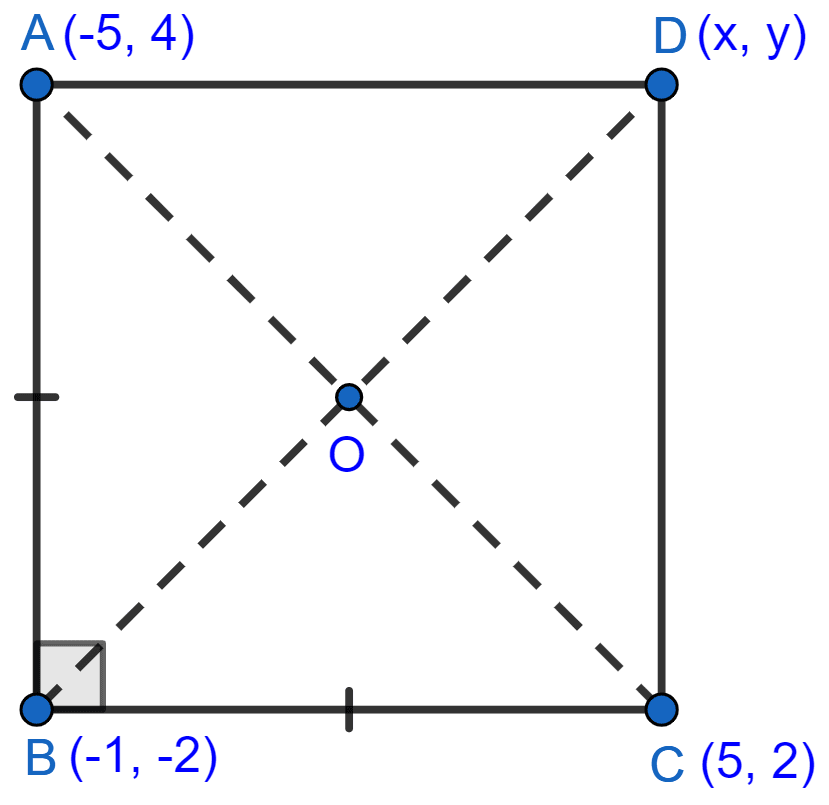
Prove that the points A(-5, 4); B(-1, -2) and C(5, 2) are the vertices of an isosceles right angled triangle. Find the co-ordinates of D so that ABCD is a square.
Answer
The points are shown in the figure below:
Distance between two points = ( x 2 − x 1 ) 2 + ( y 2 − y 1 ) 2 \sqrt{(x_2 - x_1)^2 + (y_2 - y_1)^2} ( x 2 − x 1 ) 2 + ( y 2 − y 1 ) 2
A B = [ − 1 − ( − 5 ) ] 2 + [ − 2 − 4 ] 2 = [ − 1 + 5 ] 2 + [ − 6 ] 2 = [ 4 ] 2 + 36 = 16 + 36 = 52 . B C = [ 5 − ( − 1 ) ] 2 + [ 2 − ( − 2 ) ] 2 = [ 5 + 1 ] 2 + [ 4 ] 2 = [ 6 ] 2 + 16 = 36 + 16 = 52 . A C = [ 5 − ( − 5 ) ] 2 + [ 2 − 4 ] 2 = [ 5 + 5 ] 2 + [ − 2 ] 2 = [ 10 ] 2 + 4 = 100 + 4 = 104 . A B 2 + B C 2 = ( 52 ) 2 + ( 52 ) 2 = 52 + 52 = 104 = A C 2 . AB = \sqrt{[-1 - (-5)]^2 + [-2 - 4]^2} \\[1em] = \sqrt{[-1 + 5]^2 + [-6]^2} \\[1em] = \sqrt{[4]^2 + 36} \\[1em] = \sqrt{16 + 36} \\[1em] = \sqrt{52}. \\[1em] BC = \sqrt{[5 - (-1)]^2 + [2 - (-2)]^2} \\[1em] = \sqrt{[5 + 1]^2 + [4]^2} \\[1em] = \sqrt{[6]^2 + 16} \\[1em] = \sqrt{36 + 16} \\[1em] = \sqrt{52}. \\[1em] AC = \sqrt{[5 - (-5)]^2 + [2 - 4]^2} \\[1em] = \sqrt{[5 + 5]^2 + [-2]^2} \\[1em] = \sqrt{[10]^2 + 4} \\[1em] = \sqrt{100 + 4} \\[1em] = \sqrt{104}. \\[1em] AB^2 + BC^2 = (\sqrt{52})^2 + (\sqrt{52})^2 \\[1em] = 52 + 52 \\[1em] = 104 = AC^2. A B = [ − 1 − ( − 5 ) ] 2 + [ − 2 − 4 ] 2 = [ − 1 + 5 ] 2 + [ − 6 ] 2 = [ 4 ] 2 + 36 = 16 + 36 = 52 . BC = [ 5 − ( − 1 ) ] 2 + [ 2 − ( − 2 ) ] 2 = [ 5 + 1 ] 2 + [ 4 ] 2 = [ 6 ] 2 + 16 = 36 + 16 = 52 . A C = [ 5 − ( − 5 ) ] 2 + [ 2 − 4 ] 2 = [ 5 + 5 ] 2 + [ − 2 ] 2 = [ 10 ] 2 + 4 = 100 + 4 = 104 . A B 2 + B C 2 = ( 52 ) 2 + ( 52 ) 2 = 52 + 52 = 104 = A C 2 .
Since, AB = BC and AC2 = AB2 + BC2 .
Hence, proved that ABC is an isosceles right angled triangle.
Since, diagonals of square bisect each other so,
Mid-point of AC = Mid-point of BD = O.
O = ( − 5 + 5 2 , 4 + 2 2 ) = ( 0 2 , 6 2 ) = ( 0 , 3 ) . O = \Big(\dfrac{-5 + 5}{2}, \dfrac{4 + 2}{2}\Big) \\[1em] = \Big(\dfrac{0}{2}, \dfrac{6}{2}\Big) \\[1em] = (0, 3). O = ( 2 − 5 + 5 , 2 4 + 2 ) = ( 2 0 , 2 6 ) = ( 0 , 3 ) .
Let co-ordinates of D = (x, y).
∴ O = ( − 1 + x 2 , − 2 + y 2 ) ⇒ ( 0 , 3 ) = ( − 1 + x 2 , − 2 + y 2 ) ⇒ 0 = − 1 + x 2 and 3 = − 2 + y 2 ⇒ − 1 + x = 0 and − 2 + y = 6 ⇒ x = 1 and y = 8. \therefore O = \Big(\dfrac{-1 + x}{2}, \dfrac{-2 + y}{2}\Big) \\[1em] \Rightarrow (0, 3) = \Big(\dfrac{-1 + x}{2}, \dfrac{-2 + y}{2}\Big) \\[1em] \Rightarrow 0 = \dfrac{-1 + x}{2} \text{ and } 3 = \dfrac{-2 + y}{2} \\[1em] \Rightarrow -1 + x = 0 \text{ and } -2 + y = 6 \\[1em] \Rightarrow x = 1 \text{ and } y = 8. ∴ O = ( 2 − 1 + x , 2 − 2 + y ) ⇒ ( 0 , 3 ) = ( 2 − 1 + x , 2 − 2 + y ) ⇒ 0 = 2 − 1 + x and 3 = 2 − 2 + y ⇒ − 1 + x = 0 and − 2 + y = 6 ⇒ x = 1 and y = 8.
D = (x, y) = (1, 8).
Hence, co-ordinates of D = (1, 8).
M is the mid-point of the line segment joining the points A(-3, 7) and B(9, -1). Find the co-ordinates of point M. Further, if R(2, 2) divides the line segment joining M and the origin in the ratio p : q, find the ratio p : q.
Answer
By formula,
Mid-point (M) = ( x 1 + x 2 2 , y 1 + y 2 2 ) \Big(\dfrac{x_1 + x_2}{2}, \dfrac{y_1 + y_2}{2}\Big) ( 2 x 1 + x 2 , 2 y 1 + y 2 )
Substituting values we get,
M = ( − 3 + 9 2 , 7 + ( − 1 ) 2 ) = ( 6 2 , 6 2 ) = ( 3 , 3 ) . M = \Big(\dfrac{-3 + 9}{2}, \dfrac{7 + (-1)}{2}\Big) \\[1em] = \Big(\dfrac{6}{2}, \dfrac{6}{2}\Big) \\[1em] = (3, 3). M = ( 2 − 3 + 9 , 2 7 + ( − 1 ) ) = ( 2 6 , 2 6 ) = ( 3 , 3 ) .
Given, R(2, 2) divides the line segment joining M and the origin in the ratio p : q.
By section formula,
⇒ x = m 1 x 2 + m 2 x 1 m 1 + m 2 \Rightarrow x = \dfrac{m_1x_2 + m_2x_1}{m_1 + m_2} ⇒ x = m 1 + m 2 m 1 x 2 + m 2 x 1
Substituting values we get,
⇒ 2 = p × 0 + q × 3 p + q ⇒ 2 ( p + q ) = 0 + 3 q ⇒ 2 p + 2 q = 3 q ⇒ 2 p = q ⇒ p q = 1 2 . \Rightarrow 2 = \dfrac{p \times 0 + q \times 3}{p + q} \\[1em] \Rightarrow 2(p + q) = 0 + 3q \\[1em] \Rightarrow 2p + 2q = 3q \\[1em] \Rightarrow 2p = q \\[1em] \Rightarrow \dfrac{p}{q} = \dfrac{1}{2}. ⇒ 2 = p + q p × 0 + q × 3 ⇒ 2 ( p + q ) = 0 + 3 q ⇒ 2 p + 2 q = 3 q ⇒ 2 p = q ⇒ q p = 2 1 .
p : q = 1 : 2.
Hence, M = (3, 3) and p : q = 1 : 2.
Calculate the ratio in which the line joining A(-4, 2) and B(3, 6) is divided by point P(x, 3). Also, find (i) x (ii) length of AP.
Answer
Let ratio be m1 : m2 .
By section formula,
y = m 1 y 2 + m 2 y 1 m 1 + m 2 y = \dfrac{m_1y_2 + m_2y_1}{m_1 + m_2} y = m 1 + m 2 m 1 y 2 + m 2 y 1
Substituting values we get,
3 = m 1 × 6 + m 2 × 2 m 1 + m 2 ⇒ 3 m 1 + 3 m 2 = 6 m 1 + 2 m 2 ⇒ m 2 = 3 m 1 ⇒ m 1 m 2 = 1 3 . 3 = \dfrac{m_1 \times 6 + m_2 \times 2}{m_1 + m_2} \\[1em] \Rightarrow 3m_1 + 3m_2 = 6m_1 + 2m_2 \\[1em] \Rightarrow m_2 = 3m_1 \\[1em] \Rightarrow \dfrac{m_1}{m_2} = \dfrac{1}{3}. 3 = m 1 + m 2 m 1 × 6 + m 2 × 2 ⇒ 3 m 1 + 3 m 2 = 6 m 1 + 2 m 2 ⇒ m 2 = 3 m 1 ⇒ m 2 m 1 = 3 1 .
m1 : m2 = 1 : 3.
(i) By section formula,
x = m 1 x 2 + m 2 x 1 m 1 + m 2 x = \dfrac{m_1x_2 + m_2x_1}{m_1 + m_2} x = m 1 + m 2 m 1 x 2 + m 2 x 1
Substituting values we get,
⇒ x = 1 × 3 + 3 × − 4 1 + 3 ⇒ x = 3 − 12 4 ⇒ x = − 9 4 . \Rightarrow x = \dfrac{1 \times 3 + 3 \times -4}{1 + 3} \\[1em] \Rightarrow x = \dfrac{3 - 12}{4} \\[1em] \Rightarrow x = -\dfrac{9}{4}. ⇒ x = 1 + 3 1 × 3 + 3 × − 4 ⇒ x = 4 3 − 12 ⇒ x = − 4 9 .
Hence, x = − 9 4 -\dfrac{9}{4} − 4 9
(ii) Distance between two points = ( x 2 − x 1 ) 2 + ( y 2 − y 1 ) 2 \sqrt{(x_2 - x_1)^2 + (y_2 - y_1)^2} ( x 2 − x 1 ) 2 + ( y 2 − y 1 ) 2
A P = [ − 9 4 − ( − 4 ) ] 2 + [ 3 − 2 ] 2 = [ − 9 4 + 4 ] 2 + [ 1 ] 2 = [ − 9 + 16 4 ] 2 + 1 = [ 7 4 ] 2 + 1 = 49 16 + 1 = 49 + 16 16 = 65 16 = 65 4 . AP = \sqrt{\Big[-\dfrac{9}{4} - (-4)\Big]^2 + [3 - 2]^2} \\[1em] = \sqrt{\Big[-\dfrac{9}{4} + 4\Big]^2 + [1]^2} \\[1em] = \sqrt{\Big[\dfrac{-9 + 16}{4}\Big]^2 + 1} \\[1em] = \sqrt{\Big[\dfrac{7}{4}\Big]^2 + 1} \\[1em] = \sqrt{\dfrac{49}{16} + 1} \\[1em] = \sqrt{\dfrac{49 + 16}{16}} \\[1em] = \sqrt{\dfrac{65}{16}} \\[1em] = \dfrac{\sqrt{65}}{4}. A P = [ − 4 9 − ( − 4 ) ] 2 + [ 3 − 2 ] 2 = [ − 4 9 + 4 ] 2 + [ 1 ] 2 = [ 4 − 9 + 16 ] 2 + 1 = [ 4 7 ] 2 + 1 = 16 49 + 1 = 16 49 + 16 = 16 65 = 4 65 .
Hence, AP = 65 4 . \dfrac{\sqrt{65}}{4}. 4 65 .
Find the ratio in which the line 2x + y = 4 divides the line segment joining the points P(2, -2) and Q(3, 7).
Answer
Let ratio in which 2x + y = 4 divides the line segment joining the points P(2, -2) and Q(3, 7) be k : 1 at point (x, y).
By section formula,
x = m 1 x 2 + m 2 x 1 m 1 + m 2 x = \dfrac{m_1x_2 + m_2x_1}{m_1 + m_2} x = m 1 + m 2 m 1 x 2 + m 2 x 1
Substituting values we get,
⇒ x = k × 3 + 1 × 2 k + 1 ⇒ x ( k + 1 ) = 3 k + 2 ⇒ x = 3 k + 2 k + 1 . \Rightarrow x = \dfrac{k \times 3 + 1 \times 2}{k + 1} \\[1em] \Rightarrow x(k + 1) = 3k + 2 \\[1em] \Rightarrow x = \dfrac{3k + 2}{k + 1}. ⇒ x = k + 1 k × 3 + 1 × 2 ⇒ x ( k + 1 ) = 3 k + 2 ⇒ x = k + 1 3 k + 2 .
y = m 1 y 2 + m 2 y 1 m 1 + m 2 y = \dfrac{m_1y_2 + m_2y_1}{m_1 + m_2} y = m 1 + m 2 m 1 y 2 + m 2 y 1
Substituting values we get,
⇒ y = k × 7 + 1 × − 2 k + 1 ⇒ y ( k + 1 ) = 7 k − 2 ⇒ y = 7 k − 2 k + 1 . \Rightarrow y = \dfrac{k \times 7 + 1 \times -2}{k + 1} \\[1em] \Rightarrow y(k + 1) = 7k - 2 \\[1em] \Rightarrow y = \dfrac{7k - 2}{k + 1}. ⇒ y = k + 1 k × 7 + 1 × − 2 ⇒ y ( k + 1 ) = 7 k − 2 ⇒ y = k + 1 7 k − 2 .
Substituting value of x and y in 2x + y = 4.
⇒ 2 ( 3 k + 2 k + 1 ) + 7 k − 2 k + 1 = 4 ⇒ 6 k + 4 k + 1 + 7 k − 2 k + 1 = 4 ⇒ 6 k + 4 + 7 k − 2 k + 1 = 4 ⇒ 13 k + 2 = 4 k + 4 ⇒ 9 k = 2 ⇒ k = 2 9 . ⇒ k : 1 = 2 9 : 1 = 2 : 9. \Rightarrow 2 \Big(\dfrac{3k + 2}{k + 1}\Big) + \dfrac{7k - 2}{k + 1} = 4 \\[1em] \Rightarrow \dfrac{6k + 4}{k + 1} + \dfrac{7k - 2}{k + 1} = 4 \\[1em] \Rightarrow \dfrac{6k + 4 + 7k - 2}{k + 1} = 4 \\[1em] \Rightarrow 13k + 2 = 4k + 4 \\[1em] \Rightarrow 9k = 2 \\[1em] \Rightarrow k = \dfrac{2}{9}. \\[1em] \Rightarrow k : 1 = \dfrac{2}{9} : 1 = 2 : 9. ⇒ 2 ( k + 1 3 k + 2 ) + k + 1 7 k − 2 = 4 ⇒ k + 1 6 k + 4 + k + 1 7 k − 2 = 4 ⇒ k + 1 6 k + 4 + 7 k − 2 = 4 ⇒ 13 k + 2 = 4 k + 4 ⇒ 9 k = 2 ⇒ k = 9 2 . ⇒ k : 1 = 9 2 : 1 = 2 : 9.
Hence, ratio in which the line 2x + y = 4 divides the line segment joining the points P(2, -2) and Q(3, 7) = 2 : 9.
If the abscissa of a point P is 2, find the ratio in which this point divides the line segment joining the points (-4, 3) and (6, 3). Also, find the co-ordinates of point P.
Answer
Let point P be (2, y) and ratio in which it divides line segment joining the points (-4, 3) and (6, 3) be m1 : m2 .
By section formula,
x = m 1 x 2 + m 2 x 1 m 1 + m 2 x = \dfrac{m_1x_2 + m_2x_1}{m_1 + m_2} x = m 1 + m 2 m 1 x 2 + m 2 x 1
Substituting values we get,
⇒ 2 = m 1 × 6 + m 2 × − 4 m 1 + m 2 ⇒ 2 m 1 + 2 m 2 = 6 m 1 − 4 m 2 ⇒ 2 m 2 + 4 m 2 = 6 m 1 − 2 m 1 ⇒ 6 m 2 = 4 m 1 ⇒ m 1 m 2 = 6 4 = 3 2 . \Rightarrow 2 = \dfrac{m_1 \times 6 + m_2 \times -4}{m_1 + m_2} \\[1em] \Rightarrow 2m_1 + 2m_2 = 6m_1 - 4m_2 \\[1em] \Rightarrow 2m_2 + 4m_2 = 6m_1 - 2m_1 \\[1em] \Rightarrow 6m_2 = 4m_1 \\[1em] \Rightarrow \dfrac{m_1}{m_2} = \dfrac{6}{4} = \dfrac{3}{2}. ⇒ 2 = m 1 + m 2 m 1 × 6 + m 2 × − 4 ⇒ 2 m 1 + 2 m 2 = 6 m 1 − 4 m 2 ⇒ 2 m 2 + 4 m 2 = 6 m 1 − 2 m 1 ⇒ 6 m 2 = 4 m 1 ⇒ m 2 m 1 = 4 6 = 2 3 .
m1 : m2 = 3 : 2.
y = m 1 y 2 + m 2 y 1 m 1 + m 2 y = \dfrac{m_1y_2 + m_2y_1}{m_1 + m_2} y = m 1 + m 2 m 1 y 2 + m 2 y 1
Substituting values we get,
⇒ y = 3 × 3 + 2 × 3 3 + 2 ⇒ y = 9 + 6 5 ⇒ y = 15 5 = 3. \Rightarrow y = \dfrac{3 \times 3 + 2 \times 3}{3 + 2} \\[1em] \Rightarrow y = \dfrac{9 + 6}{5} \\[1em] \Rightarrow y = \dfrac{15}{5} = 3. ⇒ y = 3 + 2 3 × 3 + 2 × 3 ⇒ y = 5 9 + 6 ⇒ y = 5 15 = 3.
P = (2, y) = (2, 3).
Hence, ratio = 3 : 2 and co-ordinates of P = (2, 3).
Find the image of the point A(5, -3) under reflection in the point P(-1, 3).
Answer
Let image be B(x, y).
Since, A is reflected in P to become B. So, P is mid-point of AB.
By formula,
Mid-point (M) = ( x 1 + x 2 2 , y 1 + y 2 2 ) \Big(\dfrac{x_1 + x_2}{2}, \dfrac{y_1 + y_2}{2}\Big) ( 2 x 1 + x 2 , 2 y 1 + y 2 )
Substituting values we get,
⇒ P = ( 5 + x 2 , − 3 + y 2 ) ⇒ ( − 1 , 3 ) = ( 5 + x 2 , − 3 + y 2 ) ∴ − 1 = 5 + x 2 and 3 = − 3 + y 2 ⇒ x + 5 = − 2 and y − 3 = 6 ⇒ x = − 7 and y = 9. \Rightarrow P = \Big(\dfrac{5 + x}{2}, \dfrac{-3 + y}{2}\Big) \\[1em] \Rightarrow (-1, 3) = \Big(\dfrac{5 + x}{2}, \dfrac{-3 + y}{2}\Big) \\[1em] \therefore -1 = \dfrac{5 + x}{2} \text{ and } 3 = \dfrac{-3 + y}{2} \\[1em] \Rightarrow x + 5 = -2 \text{ and } y - 3 = 6 \\[1em] \Rightarrow x = -7 \text{ and } y = 9. ⇒ P = ( 2 5 + x , 2 − 3 + y ) ⇒ ( − 1 , 3 ) = ( 2 5 + x , 2 − 3 + y ) ∴ − 1 = 2 5 + x and 3 = 2 − 3 + y ⇒ x + 5 = − 2 and y − 3 = 6 ⇒ x = − 7 and y = 9.
B = (x, y) = (-7, 9).
Hence, image of the point A(5, -3) under reflection in the point P(-1, 3) is (-7, 9).
M is the mid-point of the line segment joining the points A(0, 4) and B(6, 0). M also divides the line segment OP in the ratio 1 : 3. Find :
(i) co-ordinates of M
(ii) co-ordinates of P
(iii) length of BP
Answer
(i) By formula,
Mid-point (M) = ( x 1 + x 2 2 , y 1 + y 2 2 ) \Big(\dfrac{x_1 + x_2}{2}, \dfrac{y_1 + y_2}{2}\Big) ( 2 x 1 + x 2 , 2 y 1 + y 2 )
Substituting values we get,
M = ( 0 + 6 2 , 4 + 0 2 ) = ( 6 2 , 4 2 ) = ( 3 , 2 ) . M = \Big(\dfrac{0 + 6}{2}, \dfrac{4 + 0}{2}\Big) \\[1em] = \Big(\dfrac{6}{2}, \dfrac{4}{2}\Big) \\[1em] = (3, 2). M = ( 2 0 + 6 , 2 4 + 0 ) = ( 2 6 , 2 4 ) = ( 3 , 2 ) .
Hence, M = (3, 2).
(ii) Let co-ordinates of P be (x, y).
Given, M divides the line segment OP in the ratio 1 : 3.
By section formula,
x = m 1 x 2 + m 2 x 1 m 1 + m 2 x = \dfrac{m_1x_2 + m_2x_1}{m_1 + m_2} x = m 1 + m 2 m 1 x 2 + m 2 x 1
Substituting values we get,
⇒ 3 = 1 × x + 3 × 0 1 + 3 ⇒ 3 = x 4 ⇒ x = 12. y = m 1 y 2 + m 2 y 1 m 1 + m 2 \Rightarrow 3 = \dfrac{1 \times x + 3 \times 0}{1 + 3} \\[1em] \Rightarrow 3 = \dfrac{x}{4} \\[1em] \Rightarrow x = 12. \\[1em] y = \dfrac{m_1y_2 + m_2y_1}{m_1 + m_2} ⇒ 3 = 1 + 3 1 × x + 3 × 0 ⇒ 3 = 4 x ⇒ x = 12. y = m 1 + m 2 m 1 y 2 + m 2 y 1
Substituting values we get,
⇒ 2 = 1 × y + 3 × 0 1 + 3 ⇒ 2 = y 4 ⇒ y = 8. \Rightarrow 2 = \dfrac{1 \times y + 3 \times 0}{1 + 3} \\[1em] \Rightarrow 2 = \dfrac{y}{4} \\[1em] \Rightarrow y = 8. ⇒ 2 = 1 + 3 1 × y + 3 × 0 ⇒ 2 = 4 y ⇒ y = 8.
P = (x, y) = (12, 8).
Hence, co-ordinates of P = (12, 8).
(iii) Distance between two points = ( x 2 − x 1 ) 2 + ( y 2 − y 1 ) 2 \sqrt{(x_2 - x_1)^2 + (y_2 - y_1)^2} ( x 2 − x 1 ) 2 + ( y 2 − y 1 ) 2
B P = ( 12 − 6 ) 2 + ( 8 − 0 ) 2 = ( 6 ) 2 + ( 8 ) 2 = 36 + 64 = 100 = 10 units . BP = \sqrt{(12 - 6)^2 + (8 - 0)^2} \\[1em] = \sqrt{(6)^2 + (8)^2} \\[1em] = \sqrt{36 + 64} \\[1em] = \sqrt{100} = 10 \text{ units}. \\[1em] BP = ( 12 − 6 ) 2 + ( 8 − 0 ) 2 = ( 6 ) 2 + ( 8 ) 2 = 36 + 64 = 100 = 10 units .
Hence, BP = 10 units.
A(3, 1), B(y, 4) and C(1, x) are vertices of triangle ABC and G(3, 4) is its centroid. Find the values of x and y. Also, find the length of side BC.
Answer
Centroid of the triangle is given by (G) = ( x 1 + x 2 + x 3 3 , y 1 + y 2 + y 3 3 ) \Big(\dfrac{x_1 + x_2 + x_3}{3}, \dfrac{y_1 + y_2 + y_3}{3}\Big) ( 3 x 1 + x 2 + x 3 , 3 y 1 + y 2 + y 3 )
Substituting values we get,
⇒ G 1 = ( 3 + y + 1 3 , 1 + 4 + x 3 ) ⇒ ( 3 , 4 ) = ( y + 4 3 , x + 5 3 ) ⇒ 3 = y + 4 3 and 4 = x + 5 3 ⇒ y + 4 = 9 and 12 = x + 5 ⇒ y = 5 and x = 7. \Rightarrow G_1 = \Big(\dfrac{3 + y + 1}{3}, \dfrac{1 + 4 + x}{3}\Big) \\[1em] \Rightarrow (3, 4) = \Big(\dfrac{y + 4}{3}, \dfrac{x + 5}{3}\Big) \\[1em] \Rightarrow 3 = \dfrac{y + 4}{3} \text{ and } 4 = \dfrac{x + 5}{3} \\[1em] \Rightarrow y + 4 = 9 \text{ and } 12 = x + 5 \\[1em] \Rightarrow y = 5 \text{ and } x = 7. ⇒ G 1 = ( 3 3 + y + 1 , 3 1 + 4 + x ) ⇒ ( 3 , 4 ) = ( 3 y + 4 , 3 x + 5 ) ⇒ 3 = 3 y + 4 and 4 = 3 x + 5 ⇒ y + 4 = 9 and 12 = x + 5 ⇒ y = 5 and x = 7.
B = (y, 4) = (5, 4) and C = (1, x) = (1, 7).
Distance between two points = ( x 2 − x 1 ) 2 + ( y 2 − y 1 ) 2 \sqrt{(x_2 - x_1)^2 + (y_2 - y_1)^2} ( x 2 − x 1 ) 2 + ( y 2 − y 1 ) 2
B C = ( 1 − 5 ) 2 + ( 7 − 4 ) 2 = ( − 4 ) 2 + ( 3 ) 2 = 16 + 9 = 25 = 5 units . BC = \sqrt{(1 - 5)^2 + (7 - 4)^2} \\[1em] = \sqrt{(-4)^2 + (3)^2} \\[1em] = \sqrt{16 + 9} \\[1em] = \sqrt{25} = 5 \text{ units}. \\[1em] BC = ( 1 − 5 ) 2 + ( 7 − 4 ) 2 = ( − 4 ) 2 + ( 3 ) 2 = 16 + 9 = 25 = 5 units .
Hence, x = 7, y = 5 and BC = 5 units.