Points A and B have co-ordinates (3, 5) and (x, y) respectively. The mid-point of AB is (2, 3). Find the values of x and y.
Answer
By formula,
Mid-point (M) = (2x1+x2,2y1+y2)
Given, M = (2, 3)
Substituting values in above formula,
(2,3)=(23+x,25+y)∴2=23+x and 3=25+y⇒4=3+x and 6=5+y⇒x=1 and y=1.
Hence, x = 1 and y = 1.
Question 3
Given M is the mid-point of AB, find the co-ordinates of:
(i) A; if M = (1, 7) and B = (-5, 10),
(ii) B; if A = (3, -1) and M = (-1, 3).
Answer
By formula,
Mid-point (M) = (2x1+x2,2y1+y2)
(i) Let co-ordinates of A = (x, y).
Substituting values in above formula we get,
(1,7)=[2x+(−5),2y+10]∴1=2x−5 and 7=2y+10⇒2=x−5 and 14=y+10⇒x=7 and y=4.
A = (x, y) = (7, 4).
Hence, co-ordinates of A = (7, 4).
(ii) Let co-ordinates of B = (x, y).
Substituting values in above formula we get,
(−1,3)=(23+x,2−1+y)∴−1=23+x and 3=2y−1⇒−2=x+3 and 6=y−1⇒x=−5 and y=7.
B = (x, y) = (-5, 7).
Hence, co-ordinates of B = (-5, 7).
Question 4
P(-3, 2) is the mid-point of line segment AB as shown in the given figure. Find the co-ordinates of points A and B.
Answer
Since, A lie on y-axis, let its co-ordinates be (0, y) and B lie on x-axis, let its co-ordinates be (x, 0).
P is mid-point of AB.
By formula,
Mid-point = (2x1+x2,2y1+y2)
Substituting values we get,
P=(20+x,2y+0)⇒(−3,2)=(2x,2y)∴−3=2x and 2=2y⇒x=−6 and y=4.
A = (0, y) = (0, 4) and B = (x, 0) = (-6, 0).
Hence, the co-ordinates of points A and B are (0, 4) and (-6, 0).
Question 5
(-5, 2), (3, -6) and (7, 4) are the vertices of a triangle. Find the length of its median through the vertex (3, -6).
Answer
Let A = (3, -6), B = (-5, 2) and C = (7, 4).
From figure, AD is the median.
Since, AD is median so, BD = DC.
Thus, D is mid-point of BC.
By formula,
Mid-point = (2x1+x2,2y1+y2)
Substituting value we get,
D=(2−5+7,22+4)=(22,26)=(1,3).
Distance between two points = (x2−x1)2+(y2−y1)2
Substituting values we get,
AD=(1−3)2+[3−(−6)]2=(−2)2+(9)2=4+81=85=9.22
Hence, the length of its median through the vertex (3, -6) = 9.22 units.
Question 6
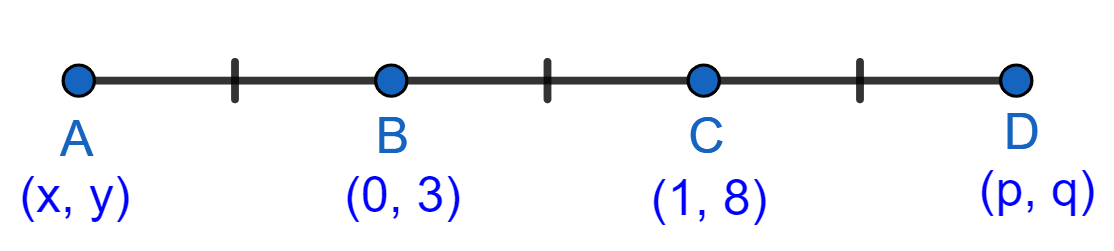
Given a line ABCD in which AB = BC = CD, B = (0, 3) and C = (1, 8). Find the co-ordinates of A and D.
Answer
Let co-ordinates of A be (x, y) and D be (p, q).
Since, AB = BC.
B is the mid-point of AC.
By formula,
Mid-point = (2x1+x2,2y1+y2)
Substituting values we get,
⇒B=(2x+1,2y+8)⇒(0,3)=(2x+1,2y+8)⇒0=2x+1 and 3=2y+8⇒x+1=0 and y+8=6⇒x=−1 and y=−2.
A = (x, y) = (-1, -2).
Since, BC = CD.
C is mid-point of BD.
By formula,
Mid-point = (2x1+x2,2y1+y2)
Substituting values we get,
⇒C=(20+p,23+q)⇒(1,8)=(2p,23+q)⇒1=2p and 8=23+q⇒p=2 and 3+q=16⇒p=2 and q=13.
D = (p, q) = (2, 13).
Hence, the co-ordinates of A = (-1, -2) and D = (2, 13).
Question 7
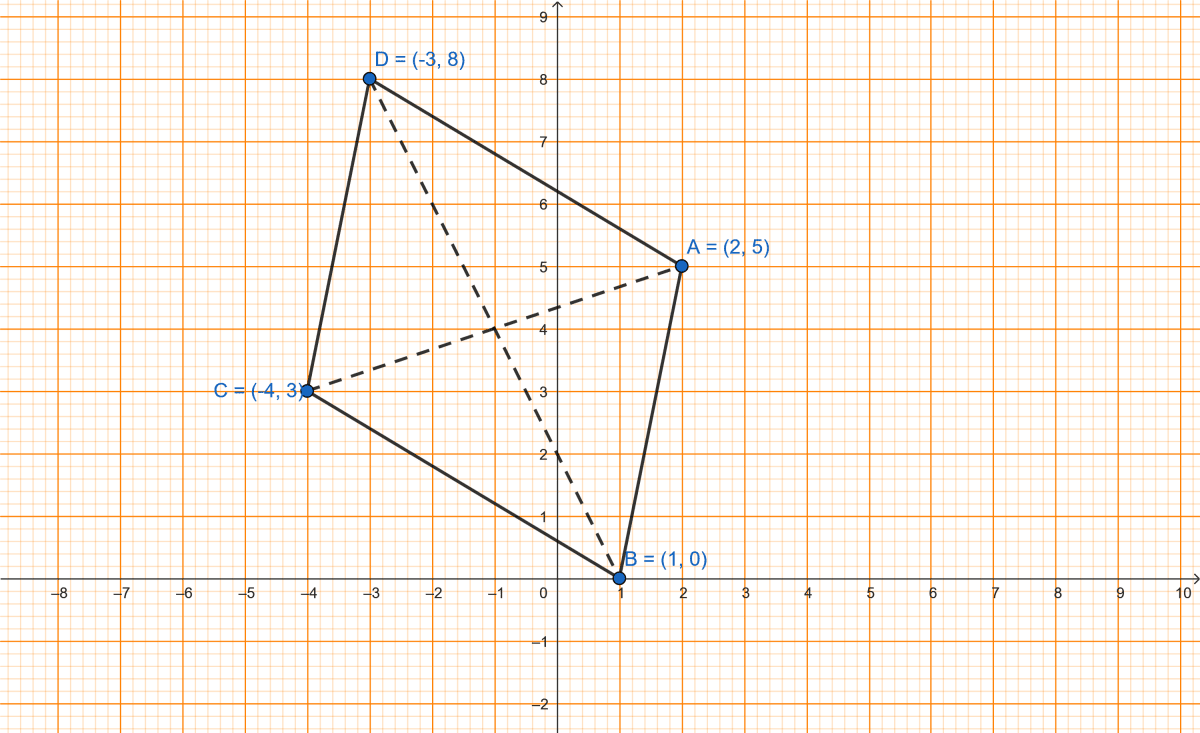
A (2, 5), B (1, 0), C(-4, 3) and D (-3, 8) are the vertices of quadrilateral ABCD. Find the co-ordinates of the mid-points of AC and BD. Give a special name to the quadrilateral.
Answer
By formula,
Mid-point = (2x1+x2,2y1+y2)
Let mid-point of AC be E.
Substituting value we get,
E=[22+(−4),25+3]=(−22,28)=(−1,4).
Let mid-point of BD be F.
Substituting value we get,
F=[21+(−3),20+8]=(−22,28)=(−1,4).
Thus, the co-ordinates of the mid-points of AC and BD are same i.e., AC and BD bisect each other.
∴ ABCD is a parallelogram.
Hence, the co-ordinates of the mid-points of AC = (-1, 4) and BD = (-1, 4) and ABCD is a parallelogram.
Question 8
P (4, 2) and Q (-1, 5) are the vertices of parallelogram PQRS and (-3, 2) are the co-ordinates of the point of intersection of the diagonals. Find co-ordinates of R and S.
Answer
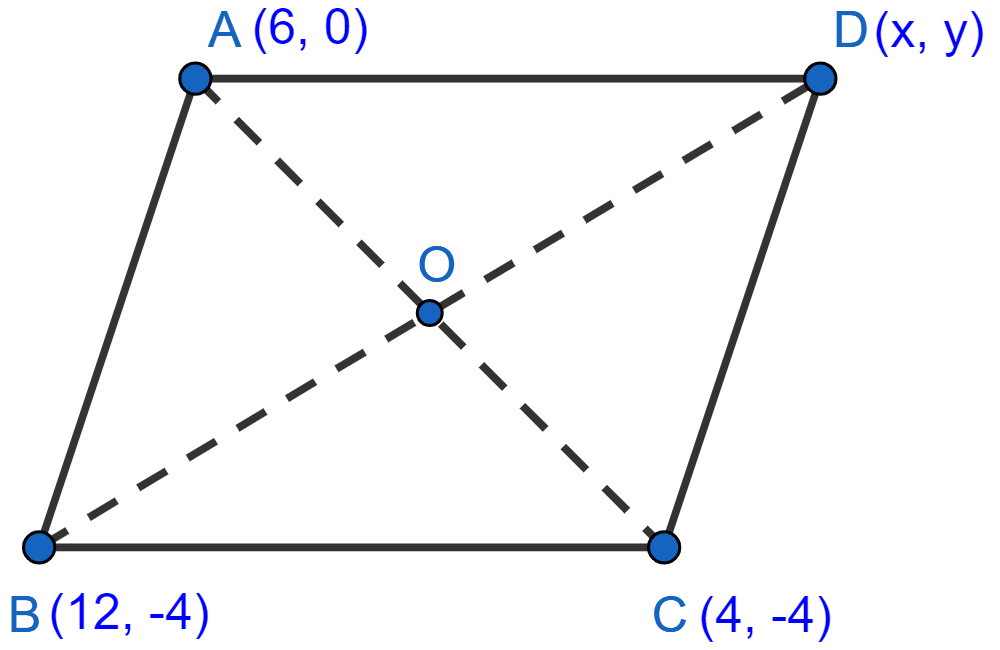
We know that diagonals of a parallelogram bisect each other.
Let co-ordinates of R= (a, b) and S = (c, d).
From figure,
O is the mid-point of PR.
By formula,
Mid-point = (2x1+x2,2y1+y2)
Substituting value we get,
⇒(−3,2)=(24+a,22+b)⇒−3=24+a and 2=22+b⇒4+a=−6 and 2+b=4⇒a=−10 and b=2.
R = (a, b) = (-10, 2).
O is also the mid-point of QS,
⇒(−3,2)=(2−1+c,25+d)⇒−3=2−1+c and 2=25+d⇒−1+c=−6 and 5+d=4⇒c=−5 and d=−1.
S = (c, d) = (-5, -1).
Hence, the co-ordinates of R = (-10, 2) and S = (-5, -1).
Question 9
The points (2, -1), (-1, 4) and (-2, 2) are mid-points of the sides of a triangle. Find its vertices.
Answer
Let D = (2, -1), E = (-1, 4) and F = (-2, 2).
Let A(x1, y1), B(x2, y2) and C(x3, y3) be the vertices of △ABC.
Mid-point of AB, i.e. D(2, -1).
∴2=2x1+x2 and −1=2y1+y2
⇒ x1 + x2 = 4 ........(1)
⇒ y1 + y2 = -2 ........(2)
Mid-point of BC, i.e. E(-1, 4).
∴−1=2x2+x3 and 4=2y2+y3
⇒ x2 + x3 = -2 ........(3)
⇒ y2 + y3 = 8 ........(4)
Mid-point of AC, i.e. F(-2, 2).
∴−2=2x1+x3 and 2=2y1+y3
⇒ x1 + x3 = -4 ........(5)
⇒ y1 + y3 = 4 ........(6)
Adding 1, 3 and 5 we get,
⇒ x1 + x2 + x2 + x3 + x1 + x3 = 4 + (-2) + (-4)
⇒ 2(x1 + x2 + x3) = -2
⇒ x1 + x2 + x3 = -1.
From (1),
⇒ 4 + x3 = -1
⇒ x3 = -5.
Substituting value of x3 in (5) we get,
⇒ x1 + (-5) = -4
⇒ x1 = 1.
Substituting value of x3 in (3) we get,
⇒ x2 + (-5) = -2
⇒ x2 = 3.
Adding (2), (4) and (6) we get,
⇒ y1 + y2 + y2 + y3 + y1 + y3 = -2 + 8 + 4
⇒ 2(y1 + y2 + y3) = 10
⇒ y1 + y2 + y3 = 5
From (2)
⇒ -2 + y3 = 5
⇒ y3 = 7.
Substituting value of y3 in (4) we get,
⇒ y2 + 7 = 8
⇒ y2 = 1.
Substituting value of y3 in (6) we get,
⇒ y1 + 7 = 4
⇒ y1 = -3.
A = (x1, y1) = (1, -3), B = (x2, y2) = (3, 1), C = (x3, y3) = (-5, 7).
Hence, A = (1, -3), B = (3, 1) and C = (-5, 7).
Question 10
Points A(-5, x), B(y, 7) and C(1, -3) are collinear (i.e. lie on same straight line) such that AB = BC. Calculate the values of x and y.
Answer
Since, A, B and C are collinear and AB = BC.
We can say that B is the mid-point of AC.
By formula,
Mid-point = (2x1+x2,2y1+y2)
Substituting value we get,
⇒B=(2−5+1,2x+(−3))⇒(y,7)=(2−4,2x−3)⇒y=2−4 and 7=2x−3⇒y=−2 and x−3=14⇒y=−2 and x=17.
Hence, x = 17 and y = -2.
Question 11
Points P(a, -4), Q(-2, b) and R(0, 2) are collinear. If Q lies between P and R, such that PR = 2QR, calculate the values of a and b.
Answer
From figure,
PR = PQ + QR
Given,
⇒ PR = 2QR
⇒ PQ +QR = 2QR
⇒ PQ = QR.
∴ Q is the mid-point of P and R.
By formula,
Mid-point = (2x1+x2,2y1+y2)
Substituting value we get,
⇒Q=(2a+0,2−4+2)⇒(−2,b)=(2a,2−2)⇒−2=2a and b=2−2⇒a=−4 and b=−1.
Hence, a = -4 and b = -1.
Question 12
The co-ordinates of the centroid of a triangle PQR are (2, -5). If Q = (-6, 5) and R = (11, 8); calculate the co-ordinates of vertex P.
Answer
Let co-ordinates of P = (x, y).
Centroid of the triangle is given by (G) = (3x1+x2+x3,3y1+y2+y3)
Substituting values we get,
⇒(2,−5)=(3x+(−6)+11,3y+5+8)⇒2=3x−6+11 and −5=3y+13⇒6=x+5 and −15=y+13⇒x=1 and y=−28.
P = (x, y) = (1, -28).
Hence, co-ordinates of P = (1, -28).
Question 13
A (5, x), B(-4, 3) and C (y, -2) are the vertices of the triangle ABC whose centroid is the origin. Calculate the values of x and y.
Answer
Centroid of the triangle is given by (G) = (3x1+x2+x3,3y1+y2+y3)
Substituting values we get,
⇒(0,0)=[35+(−4)+y,3x+3+(−2)]⇒0=35−4+y and 0=3x+3−2⇒0=y+1 and 0=x+1⇒y=−1 and x=−1.