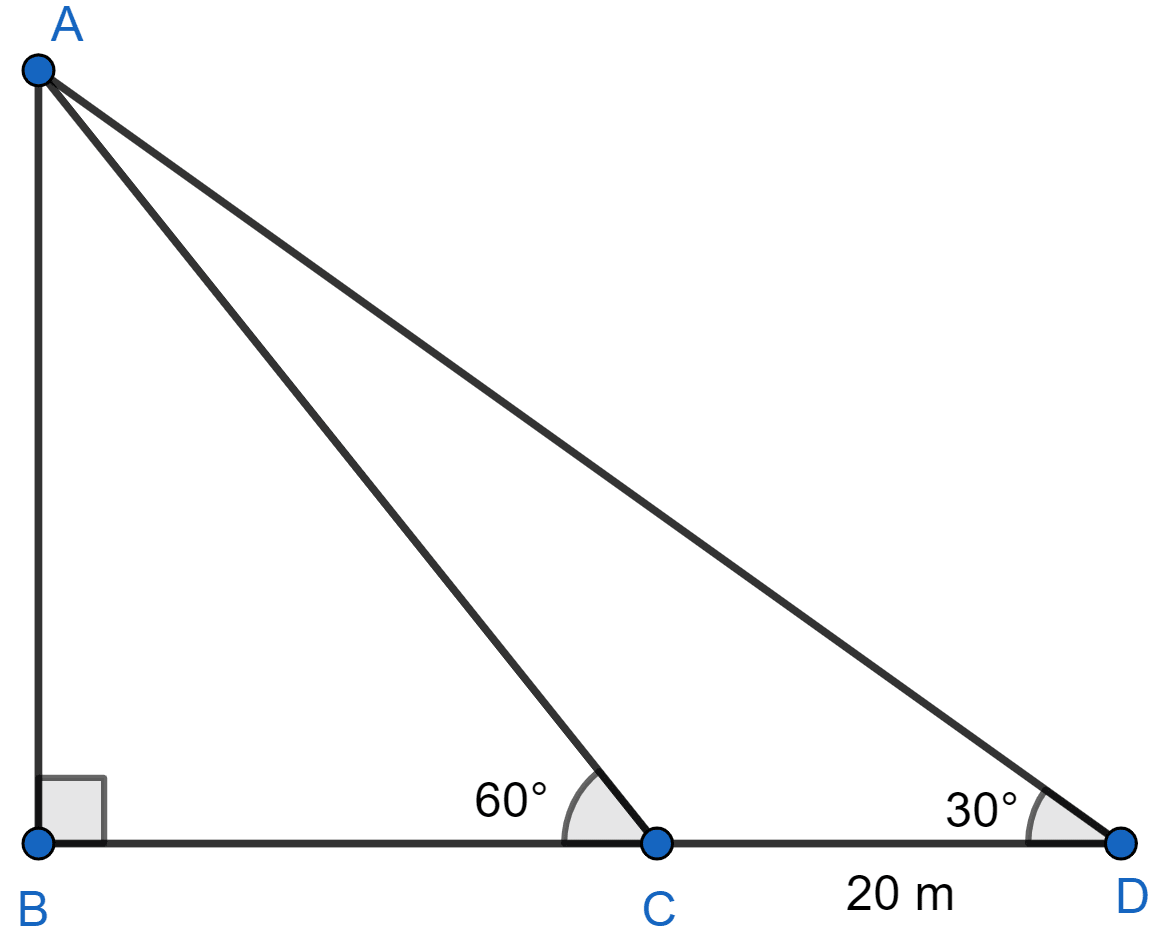
Find the height of a tree when it is found that on walking away from it 20 m, in a horizontal line through its base, the elevation of its top changes from 60° to 30°.
Answer
Let AB be the tree.
Let the two points be C and D such that CD = 20 m, ∠ADB = 30° and ∠ACB = 60°.
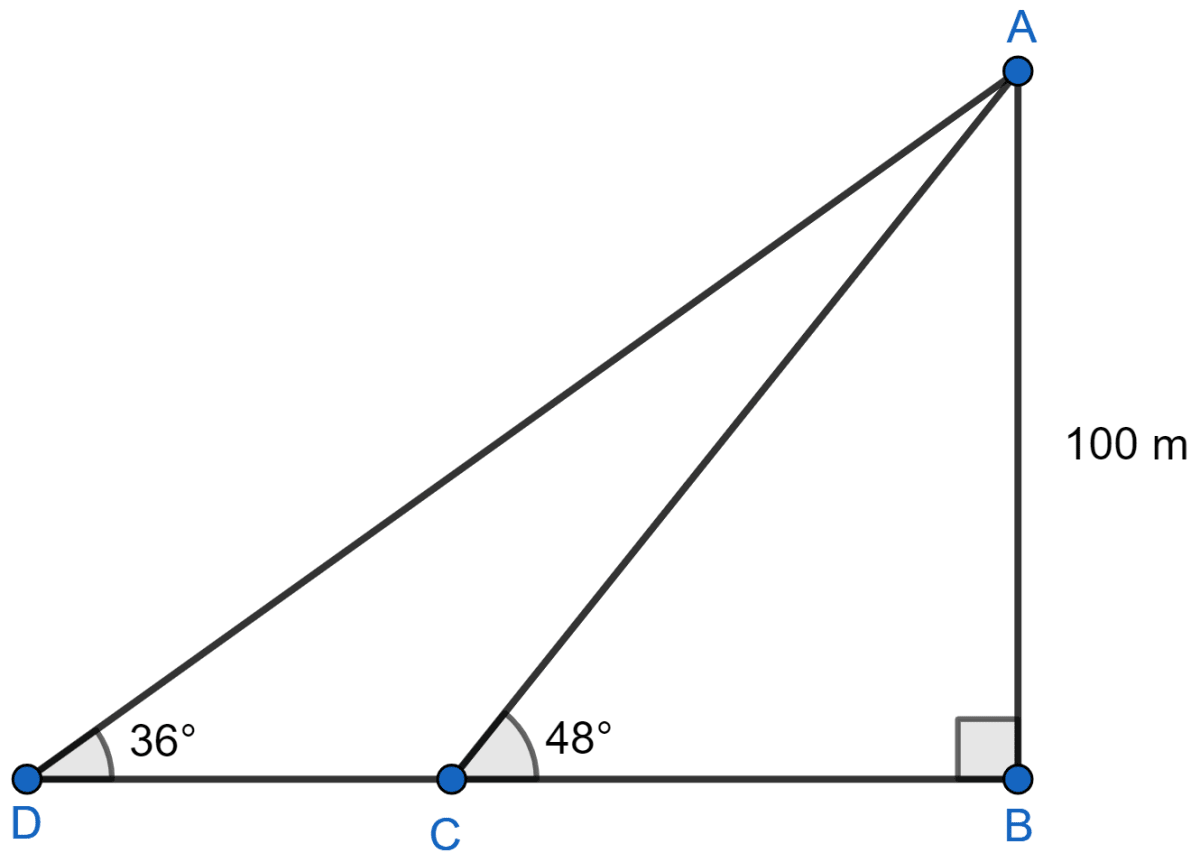
From the top of a light house 100 m high, the angles of depression of two ships are observed as 48° and 36° respectively. Find the distance between the two ships (in the nearest metre) if:
(i) the ships are on the same side of the light house.
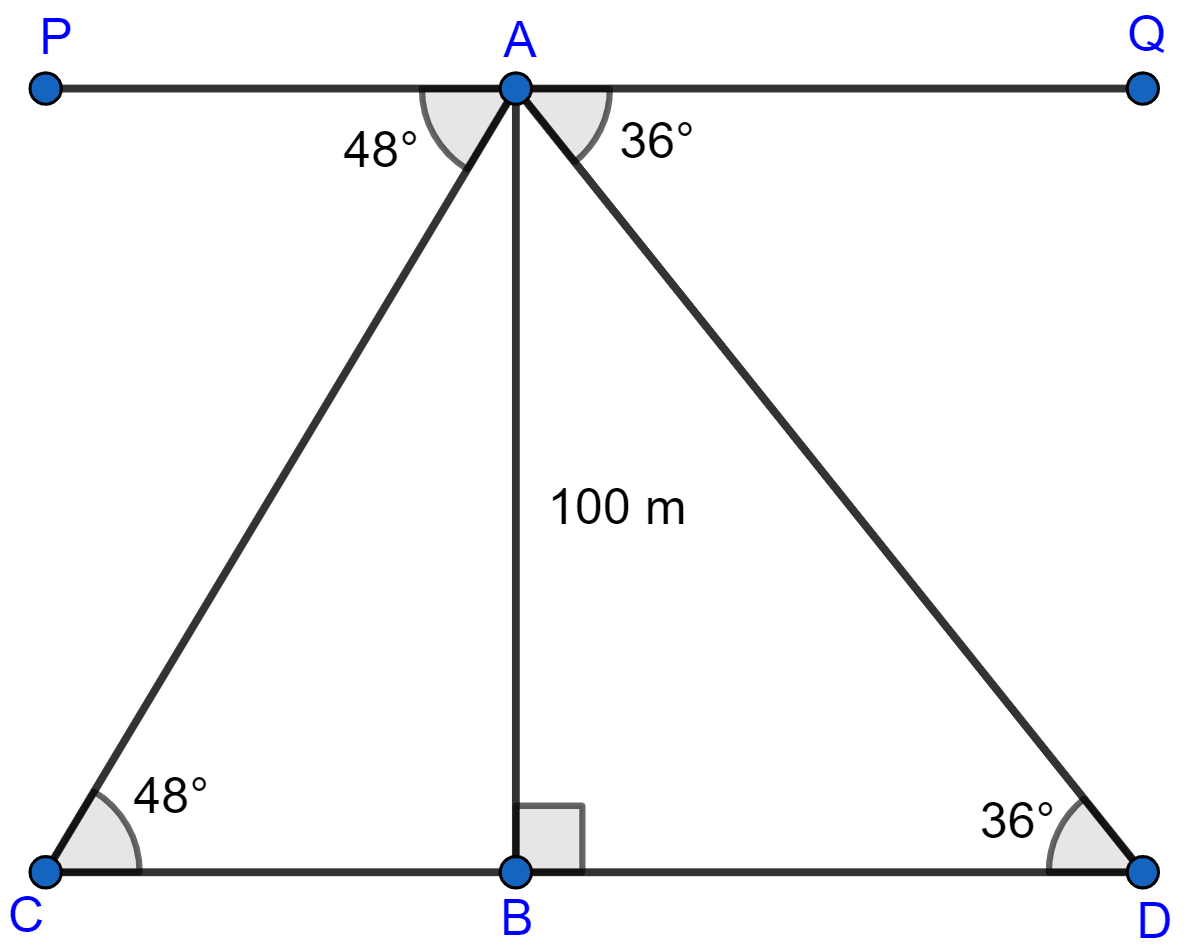
(ii) the ships are on the opposite sides of the light house.
Answer
(i) Let's consider AB to be the lighthouse.
Given, depression angles are 48° and 36°.
When ships are on the same side,
In ∆ABC,
tan 48°=BasePerpendicular⇒1.1106=BCAB⇒1.1106=BC100⇒BC=1.1106100⇒BC=90.04 meters.
In ∆ABD,
tan 36°=BasePerpendicular⇒0.7265=BDAB⇒0.7265=BD100⇒BD=0.7265100⇒BD=137.64 meters.
Distance between the two ships (CD) = BD – BC = 137.64 - 90.04
= 47.6 ≈ 48 m.
Hence, distance between ships when on the same side = 48 m.
(ii) Let's consider AB to be the lighthouse.
Given, depression angles are 48° and 36°.
As, alternate angles are equal.
∴ ∠ADB = ∠QAD = 36° and ∠ACB = ∠PAC = 48°.
When ships are on the opposite side,
In ∆ABC,
tan 48°=BasePerpendicular⇒1.1106=BCAB⇒1.1106=BC100⇒BC=1.1106100⇒BC=90.04 meters.
In ∆ABD,
tan 36°=BasePerpendicular⇒0.7265=BDAB⇒0.7265=BD100⇒BD=0.7265100⇒BD=137.64 meters.
Distance between the two ships (CD) = BD + BC = 137.64 + 90.04
= 227.68 ≈ 228 m.
Hence, the distance between two ships, when on opposite side = 228 m.
Question 5
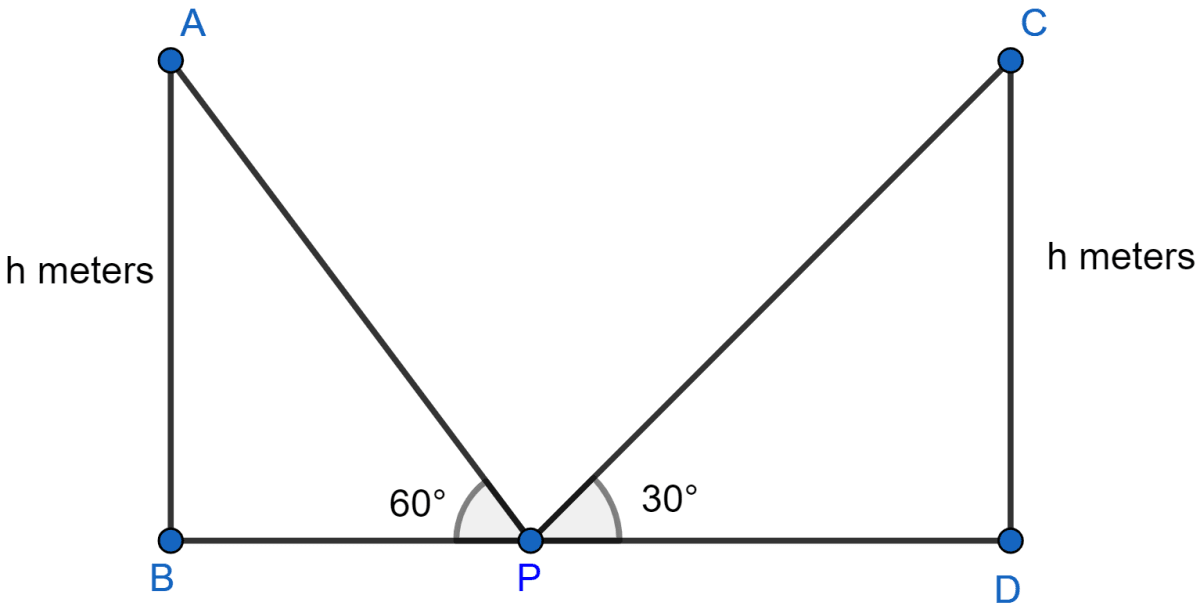
Two pillars of equal heights stand on either side of a roadway, which is 150 m wide. At a point in the roadway between the pillars the elevations of the tops of the pillars are 60° and 30°; find the height of the pillars and the position of the point.
Answer
Let AB and CD be the two towers of height h meters. Let P be a point in the roadway BD such that BD = 150 m, ∠APB = 60° and ∠CPD = 30°.
In ∆ABP,
tan 60°=BasePerpendicular⇒3=BPAB⇒BP=3AB⇒BP=3h............(1)
In ∆CDP,
tan 30°=BasePerpendicular⇒31=PDCD⇒PD=3CD⇒PD=3h............(2)
Hence, height of each pillar is 64.95 m and the point P is 37.5 m from the pillar AB.
Question 6
From the figure, given below, calculate the length of CD.
Answer
From figure,
DE = CB = 15 m.
In ∆AED,
tan 22°=BasePerpendicular⇒0.404=DEAE⇒0.404=15AE⇒AE=15×0.404⇒AE=6.06 meters.
In ∆ABC,
tan 47°=BasePerpendicular⇒1.0724=BCAB⇒1.0724=15AB⇒AB=15×1.0724⇒AB=16.086 meters.
From figure,
CD = BE = AB - AE
= 16.086 - 6.06
= 10.03 meters.
Hence, CD = 10.03 meters.
Question 7
The angle of elevation of the top of a tower is observed to be 60°. At a point, 30 m vertically above the first point of observation, the elevation is found to be 45°. Find:
(i) the height of the tower,
(ii) its horizontal distance from the points of observation.
Answer
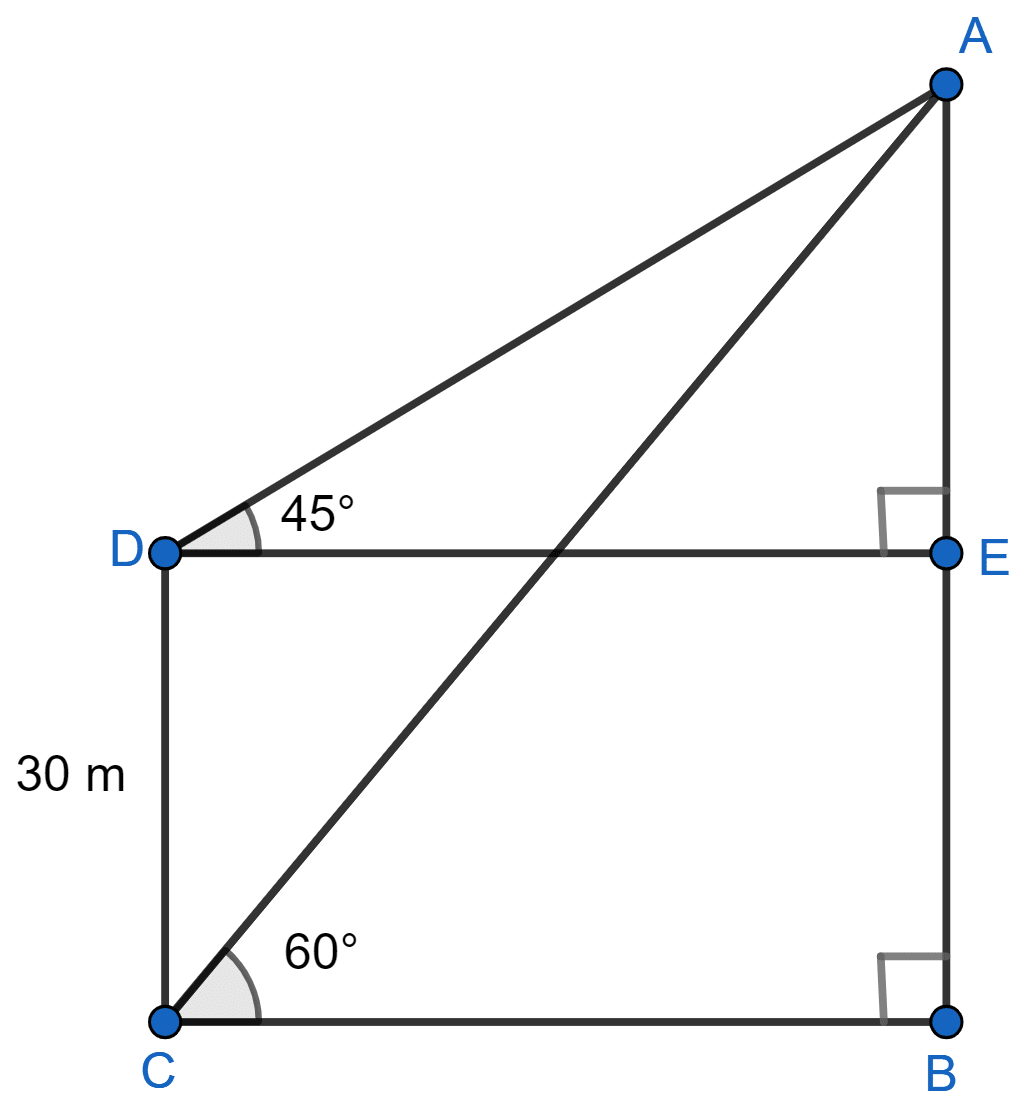
(i) Let AB be the the tower, C be the first point of observation and D be the second point.
From figure,
BC = ED = a (let) and BE = CD = 30 m.
In △ABC,
tan 60°=BasePerpendicular⇒3=BCAB⇒AB=3BC⇒AB=3a..........(1)
In △AED,
tan 45°=BasePerpendicular⇒1=EDAE⇒AE=ED⇒AE=a..........(2)
We know that,
⇒ CD = AB - AE
⇒ 30 = 3a−a
⇒ 30 = a(3−1)
⇒ a = 3−130=1.732−130=0.73230 = 40.98 metres.
From equation (1),
AB = 3a=1.732× 40.98 = 70.98 meters.
Hence, height of tower = 70.98 meters.
(ii) From part (i),
ED = a = 40.98 meters.
Hence, horizontal distance from the points of observation is 40.98 meters.
Question 8
From the top of a cliff, 60 meters high, the angles of depression of the top and bottom of a tower are observed to be 30° and 60°. Find the height of the tower.
Answer
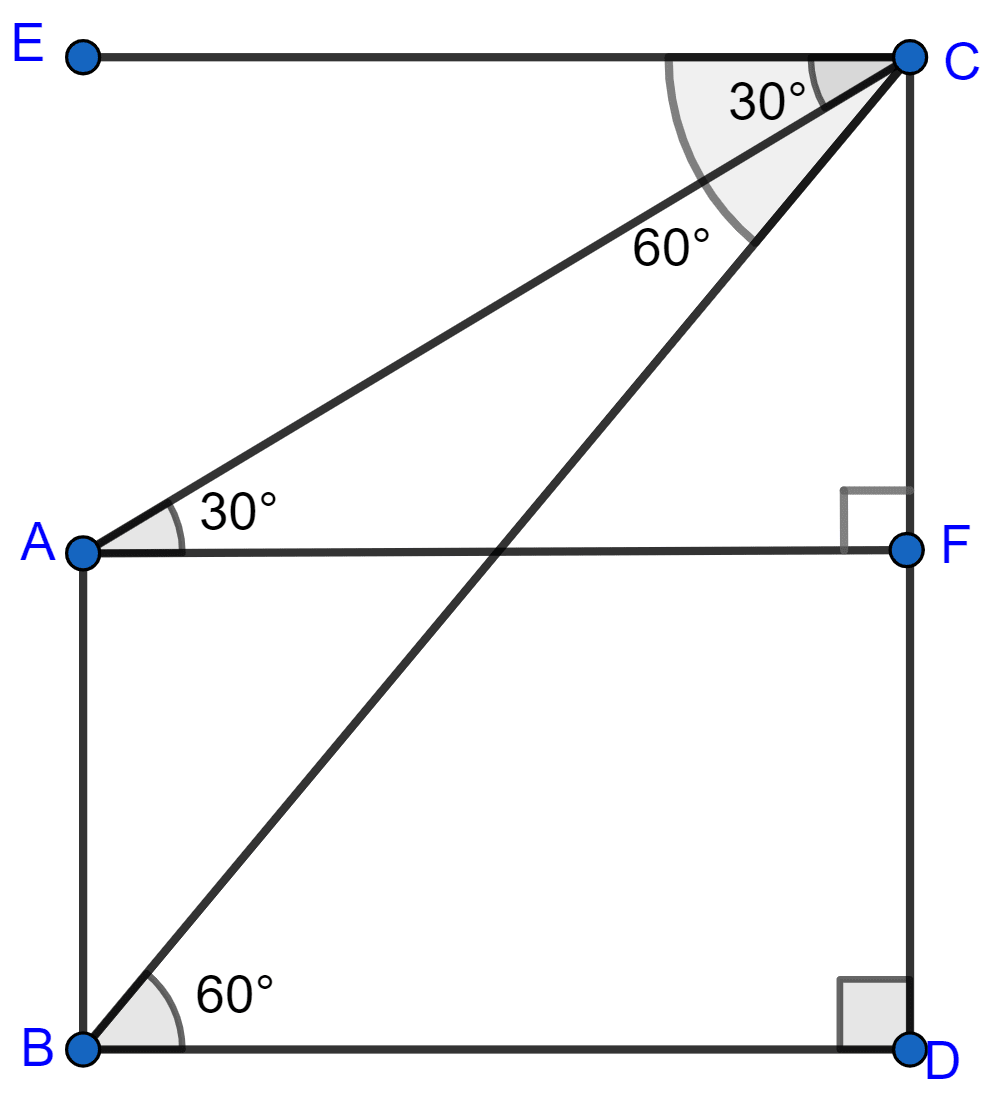
Let CD be the cliff so CD = 60 meters and AB be the tower.
Since, alternate angles are equal,
∴ ∠ECA = ∠CAF = 30° and ∠ECB = ∠CBD = 60°.
Let AF = BD = a meters.
In △BCD,
tan 60°=BasePerpendicular⇒3=BDCD⇒CD=3BD⇒CD=3a⇒60=3a⇒a=360⇒a=360×33⇒a=3603⇒a=203 meters.
In △AFC,
tan 30°=BasePerpendicular⇒31=AFCF⇒CF=3AF⇒CF=3a⇒CF=3203⇒CF=20 meters.
From figure,
⇒ AB = DF = CD - CF
⇒ AB = CD - CF
⇒ AB = 60 - 20 = 40 meters.
Hence, the height of tower = 40 meters.
Question 9
A man on a cliff observes a boat, at an angle of depression 30°, which is sailing towards the shore to the point immediately beneath him. Three minutes later, the angle of depression of the boat is found to be 60°. Assuming that the boat sails at a uniform speed, determine :
(i) how much more time it will take to reach the shore ?
(ii) the speed of the boat in metre per second, if the height of the cliff is 500 m.
Answer
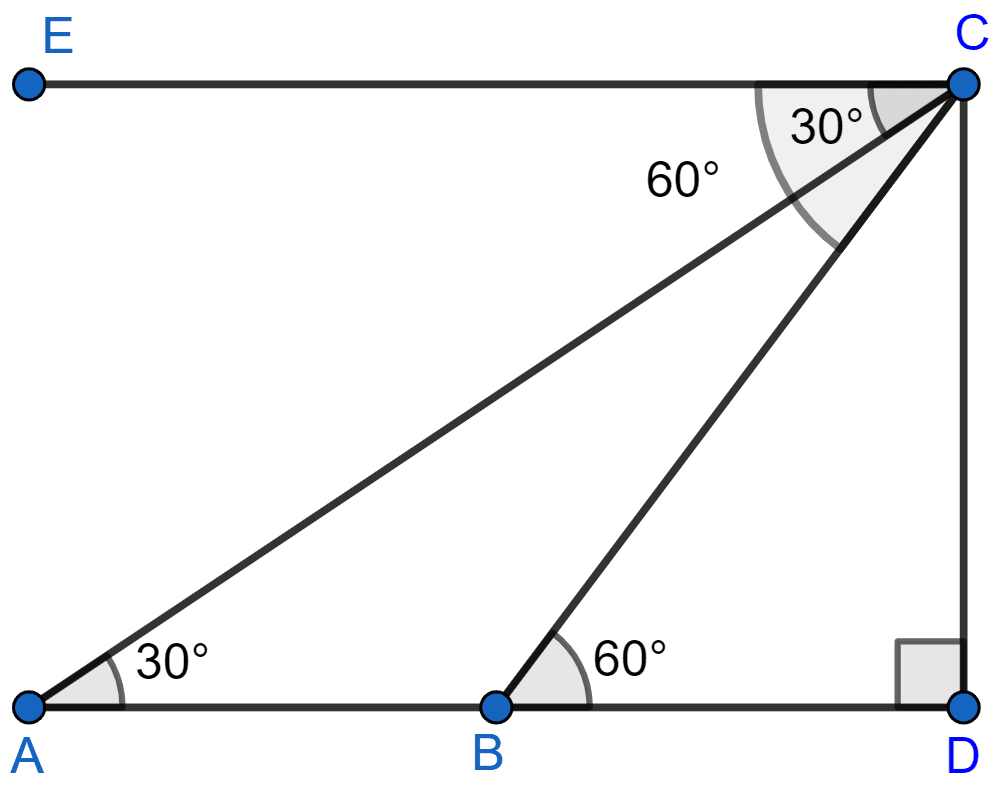
Let CD be the cliff and A be the position of the ship when angle of elevation is 30° and B be the position when angle of elevation is 60°.
(i) From figure,
tan 60°=BasePerpendicular⇒3=BDCD.............(1)tan 30°=BasePerpendicular⇒31=ADCD.............(2)
A man in a boat rowing away from a lighthouse 150 m high, takes 2 minutes to change the angle of elevation of the top of the lighthouse from 60° to 45°. Find the speed of the boat.
Answer
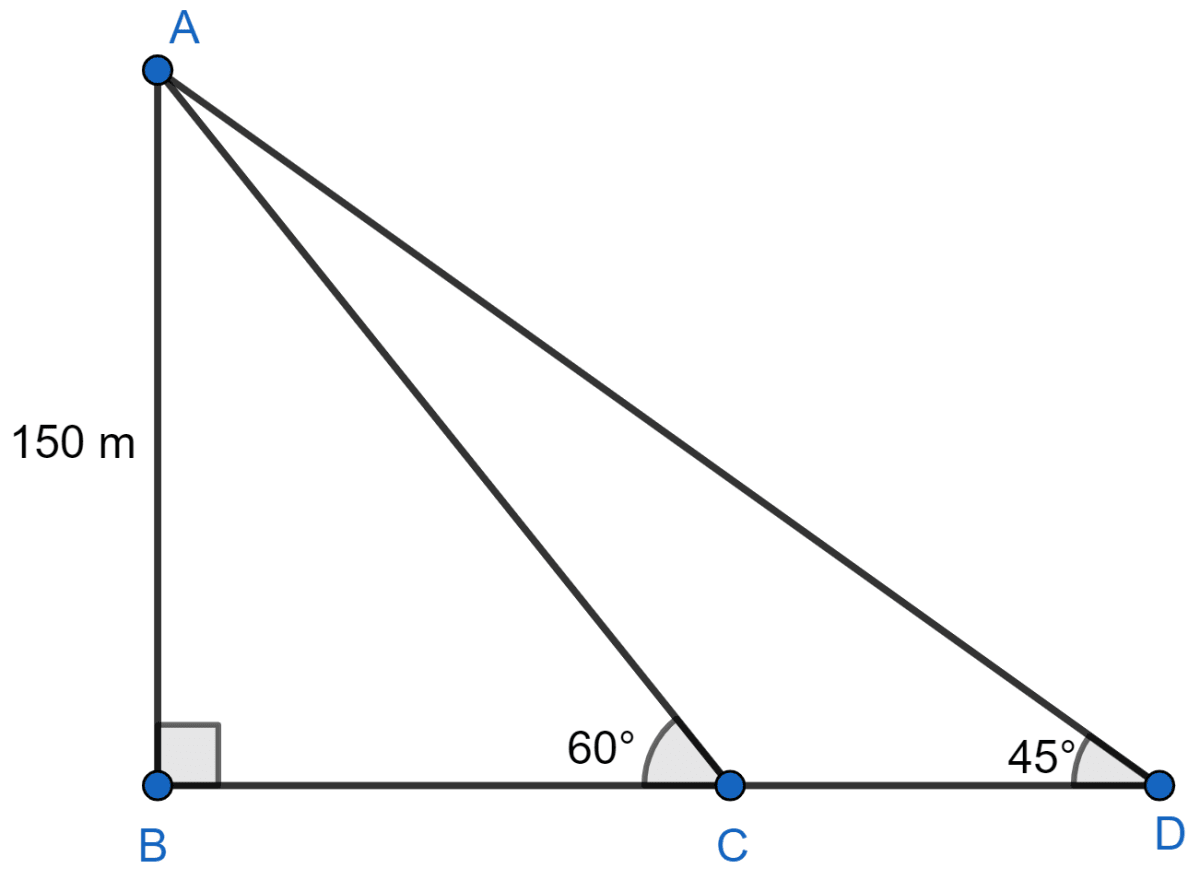
Let man in the boat be originally at point C and after 2 minutes it reaches the point D and AB be the lighthouse.
AB = 150 meters.
In △ABC,
tan 60°=BasePerpendicular⇒3=BCAB⇒AB=3BC⇒BC=3AB⇒BC=3150⇒BC=3150×33⇒BC=31503⇒BC=503 meters.
In △ABD,
tan 45°=BasePerpendicular⇒1=BDAB⇒AB=BD⇒BD=150 metres.
CD = BD - BC = 150 - 503
= 150 - 86.6
= 63.4 meters.
In 2 minutes boat covers 63.4 meters or boat covers 63.4 meters in 120 seconds.
Speed = TimeDistance=12063.4 = 0.53 m/sec.
Hence, the speed of boat = 0.53 m/sec.
Question 11
A person standing on the bank of a river observes that the angle of elevation of the top of a tree standing on the opposite bank is 60°. When he moves 40 m away from the bank, he finds the angle of elevation to be 30°. Find :
(i) the height of the tree, correct to 2 decimal places.
(ii) the width of the river.
Answer
Let CD be the tree and B be the position of the person when angle of elevation is 60° and A be the position when angle of elevation is 30°.
(i) In △BCD,
tan 60°=BasePerpendicular⇒3=BCCD⇒BC=3CD.
In △ACD,
tan 30°=BasePerpendicular⇒31=ACCD⇒AC=CD3.
From figure,
AB = AC - BC
⇒40=CD3−3CD⇒33CD−CD=40⇒32CD=40⇒CD=2403=203⇒CD=20×1.732=34.64 m.
Hence, height of tree = 34.64 meters.
(ii) From part (i), we get :
BC = 3CD=3203
= 20 meters.
Hence, width of river = 20 meters.
Question 12
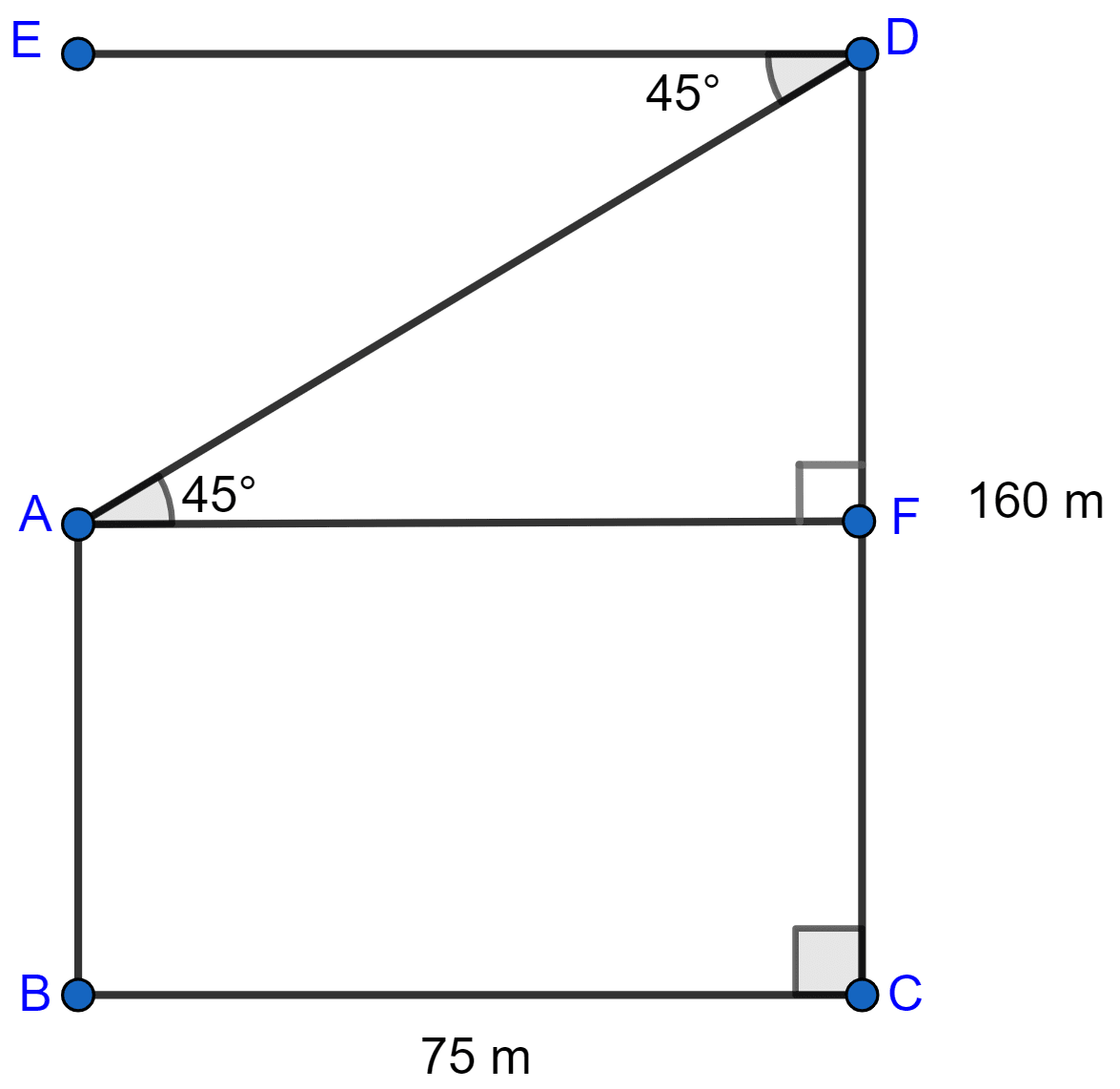
The horizontal distance between two towers is 75 m and the angular depression of the top of the first tower as seen from the top of the second, which is 160 m high, is 45°. Find the height of the first tower.
Answer
Let AB be the first tower and CD be the second tower and ∠EDA = 45° is the angle of depression.
Given, angle of depression of the top of the first tower as seen from the top of the second tower is 45°.
We know that,
Alternate angles are equal.
∴ ∠DAF = ∠EDA = 45°.
From figure,
AF = BC = 75 m.
In △ADF,
tan 45°=BasePerpendicular⇒1=AFDF⇒DF=AF=75 m.
From figure,
AB = FC = CD - DF = 160 - 75 = 85 m.
Hence, height of first tower = 85 m.
Question 13
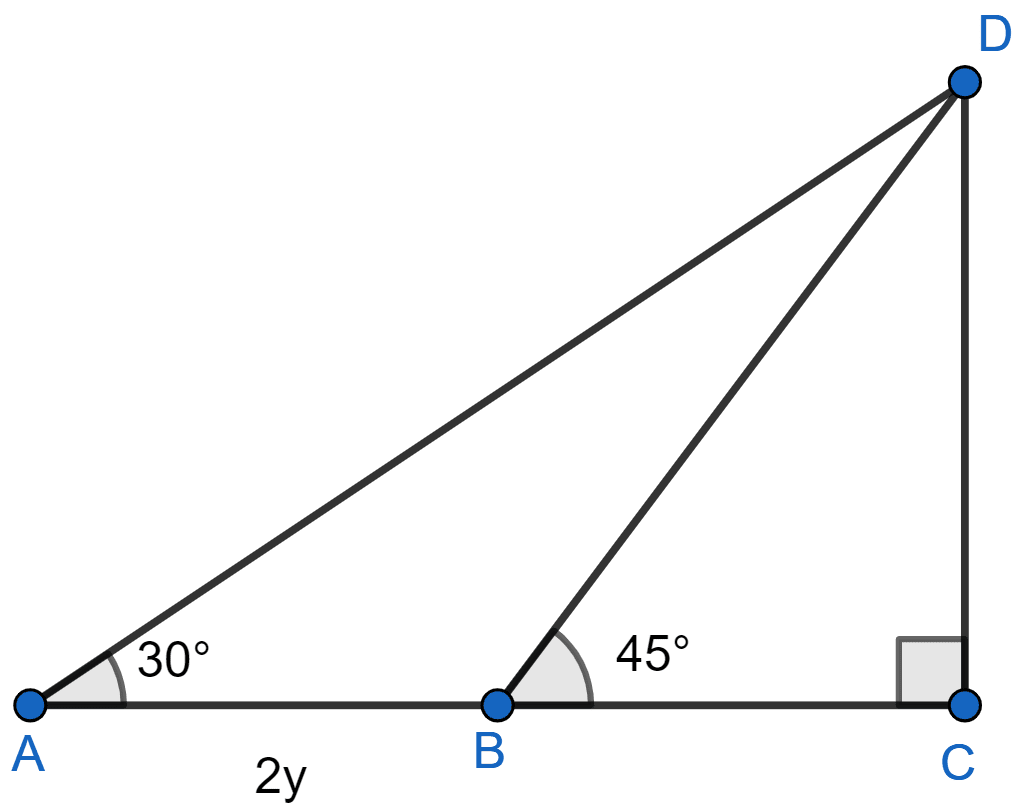
The length of the shadow of a tower standing on level plane is found to be 2y meters longer when the sun's altitude is 30° than when it was 45°. Prove that the height of the tower is y(3+1) meters.
Answer
Let CD be the tower of height h meters and BC be shadow when angle of elevation is 45° and AC be the shadow when angle of elevation is 30°.
In △ACD,
tan 30°=BasePerpendicular⇒31=ACCD⇒31=ACh⇒h=3AC m.........(1)
Hence, proved that the height of tower = y(3+1) meters.
Question 14
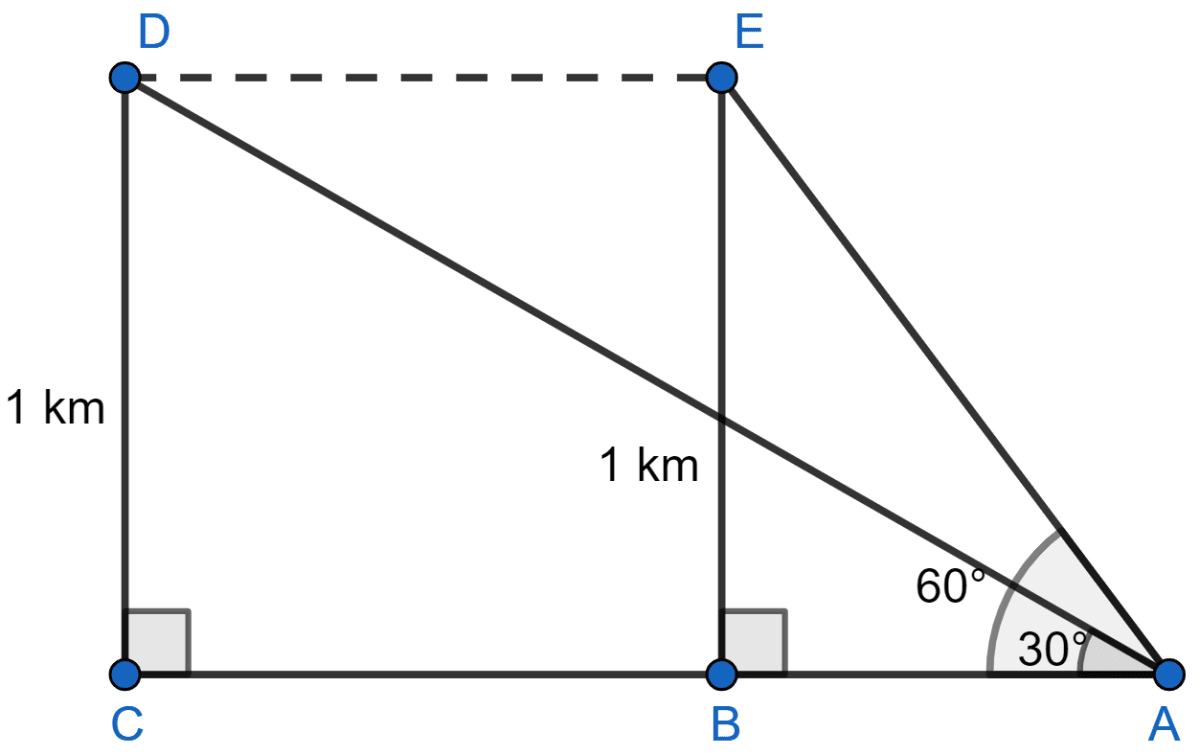
An aeroplane flying horizontally 1 km above the ground and going away from the observer is observed at an elevation of 60°. After 10 seconds, its elevation is observed to be 30°; find the uniform speed of the aeroplane in km per hour.
Answer
Let aeroplane be originally at point E and after 10 seconds it reaches point D.
In △ABE,
tan 60°=BasePerpendicular⇒3=ABBE⇒3=AB1⇒AB=31 km.
In △ACD,
tan 30°=BasePerpendicular⇒31=ACCD⇒AC=3CD⇒AC=3×1=3 km.
From figure,
DE = BC.
BC = AC - AB = 3−31
= 33−1
= 1.7322
= 1.1547 km.
∴ DE = 1.1547 km.
∴ Aeroplane travels 1.1547 km in 10 seconds.
Time = 10 seconds = 360010=3601 hours.
Speed = TimeDistance=36011.1547
= 1.1547 × 360
= 415.69 km/hr.
Hence, speed of aeroplane = 415.69 km/hr.
Question 15
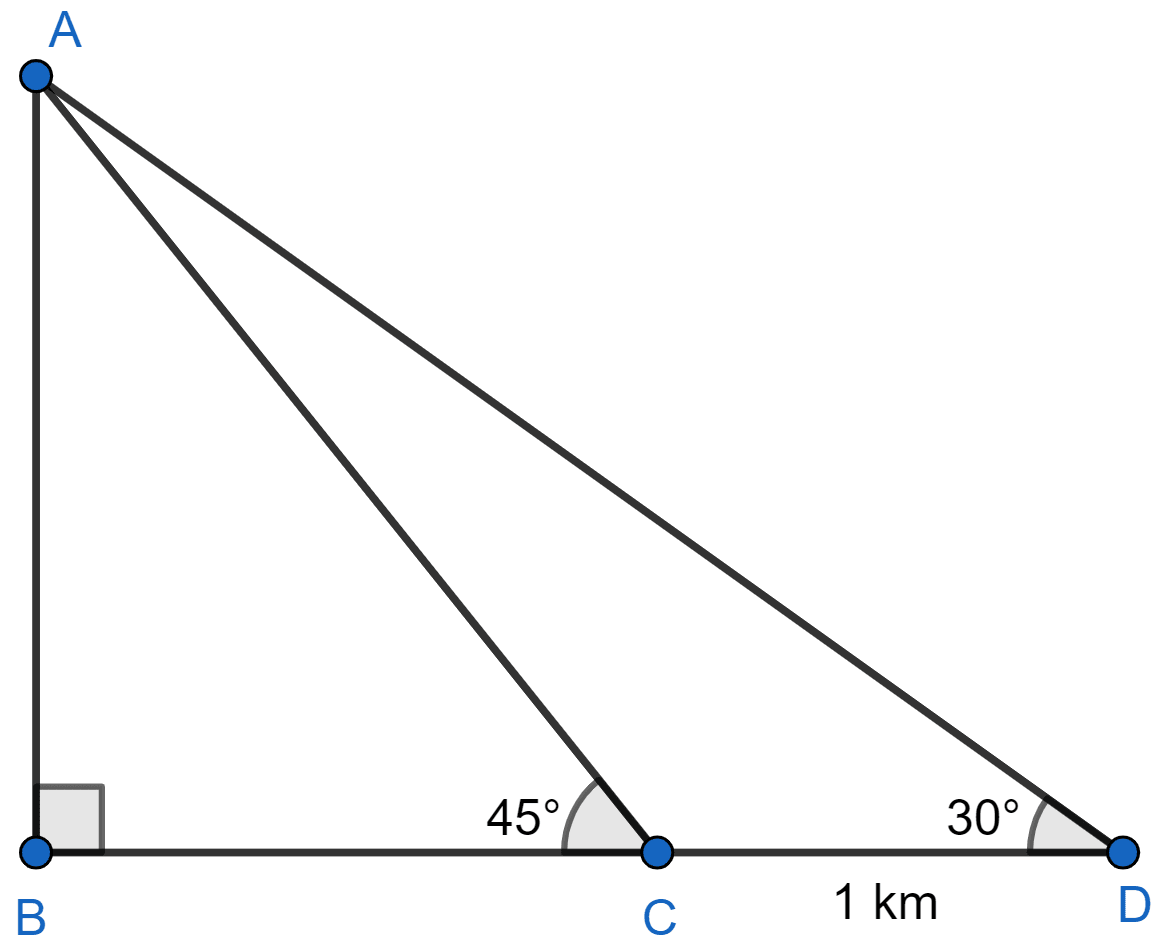
From the top of a hill, the angles of depression of two consecutive kilometer stones, due east are found to be 30° and 45° respectively. Find the distances of the two stones from the foot of hill.
Answer
Let C and D be the position of two kilometer stones and AB be the hill.
In △ABD,
tan 30°=BasePerpendicular⇒31=BDAB⇒BD=3AB.........(1)
In △ABC,
tan 45°=BasePerpendicular⇒1=BCAB⇒BC=AB............(2)
From figure,
⇒ CD = BD - BC
⇒ 1 = 3AB−AB
⇒ 1 = AB(3−1)
⇒ AB = 3−11=0.7321 = 1.366 km.
From equation (2),
BC = AB = 1.366 km
BD = BC + CD = 1.366 + 1 = 2.366 km.
Hence, kilometer stones are at a distance of 1.366 and 2.366 km.