
The equation of a line with x-intercept 5 and y-intercept also 5 is :
2x - y = 5
x + y = 5
x - y = 5
x + 2y = 5
Answer
By intercept form,
Equation of line :
Given,
x-intercept (a) : 5
y-intercept (b) : 5
Substituting values in equation, we get :
Hence, Option 2 is the correct option.
The inclination of a line, which is not passing through origin, is 1. Its intercept with both the axes are :
equal
having same sign
equal in magnitude with opposite signs
not equal
Answer
Let AB be the line not passing through the origin and intersecting x-axis at D and y-axis at E.
We know that,
y-coordinate = 0 at x axis and x-coordinate = 0 at y-axis.
Let D = (a, 0) and E = (0, b).
By formula,
Slope =
From figure,

Slope of DE = Slope of AB = 1
Substituting values we get :
From figure,
a and b are intercepts on x-axis and y-axis respectively.
Hence, Option 3 is the correct option.
The line passing through point (1, 1) and making y-intercept equal to 3 has equation :
2x - y = 3
2x - y + 3 = 0
2x + y = 3
2y + x = 3
Answer
By slope-intercept form :
Equation of line : y = mx + c ......(1)
Given,
Line passes through point (1, 1) and makes a y-intercept of 3.
Substituting value in equation (1), we get :
⇒ 1 = m(1) + 3
⇒ 1 = m + 3
⇒ m = 1 - 3 = -2.
∴ Slope of line (m) = -2 and y-intercept (c) = 3
Substituting value of m and c in equation (1), we get :
⇒ y = -2x + 3
⇒ 2x + y = 3.
Hence, Option 3 is the correct option.
Equation of a line passing through the intersection of the lines x - y = 3 and x + y = 0 with inclination 45° is :
x + y = 3
x - y = 3
y - x = 3
y = 3x + 1
Answer
Given,
Equations :
⇒ x - y = 3 ........(1)
⇒ x + y = 0 ........(2)
Adding equation (1) and (2), we get :
⇒ (x - y) + (x + y) = 3 + 0
⇒ x + x - y + y = 3
⇒ 2x = 3
⇒ x =
Substituting value of x in equation (2), we get :
⇒ + y = 0
⇒ y = .
∴ Point of intersection of lines x - y = 3 and x + y = 0 is .
Given,
Inclination (θ) = 45°
Slope = tan 45° = 1.
By point-slope form,
Equation of line : y - y1 = m(x - x1)
Equation of line passing through and slope = 1 is :
Hence, Option 2 is the correct option.
A line cuts equal intercepts with positive direction of both the axes and passes through the point (6, 6). The equation of the line is :
x - y = 12
x - y = 0
x + y = 6
x + y = 12
Answer
By intercept form :
Equation of line : .........(1)
Given,
Line cuts equal intercepts with both the axes.
∴ x-intercept (a) = y-intercept (b) = p (let)
Given,
Line passes through point (6, 6). So it will satisfy the equation (1).
Substituting values in equation we get :
∴ a = b = 12.
Substituting value of a and b in equation (1), we get :
Hence, Option 4 is the correct option.
Find the slope and y-intercept of the line :
(i) y = 4
(ii) ax - by = 0
(iii) 3x - 4y = 5
Answer
(i) Given,
y = 4
Comparing it with y = mx + c, we get,
m = 0 and c = 4.
Hence, slope = 0 and y-intercept = 4.
(ii) Given,
⇒ ax - by = 0
⇒ by = ax
⇒ y = x
Comparing it with y = mx + c, we get,
m = and c = 0.
Hence, slope = and y-intercept = 0.
(iii) Given,
⇒ 3x - 4y = 5
⇒ 4y = 3x - 5
⇒ y =
Comparing it with y = mx + c, we get,
m = and c = .
Hence, slope = and y-intercept = .
The equation of a line is x - y = 4. Find its slope and y-intercept. Also, find its inclination.
Answer
Given,
⇒ x - y = 4
⇒ -y = -x + 4
⇒ y = x - 4
Comparing it with y = mx + c, we get,
m = 1 and c = -4.
⇒ m = tan θ
⇒ 1 = tan θ
⇒ tan 45° = tan θ
⇒ θ = 45°.
Hence, slope = 1, y-intercept = -4 and inclination = 45°.
Is the line 3x + 4y + 7 = 0 perpendicular to the line 28x - 21y + 50 = 0?
Answer
Given lines,
⇒ 3x + 4y + 7 = 0 and 28x - 21y + 50 = 0
⇒ 4y = -3x - 7 and 21y = 28x + 50
⇒ y = and y =
Comparing above equations with y = mx + c we get,
Slope of 1st line =
Slope of 2nd line =
Since,
Slope of 1st line × Slope of 2nd line =
Hence, the lines 3x + 4y + 7 = 0 and 28x - 21y + 50 = 0 are perpendicular to each other.
Is the line x – 3y = 4 perpendicular to the line 3x – y = 7?
Answer
Given lines,
⇒ x - 3y = 4 and 3x - y = 7
⇒ 3y = x - 4 and y = 3x - 7
⇒ y = and y = 3x - 7
Comparing above equations with y = mx + c we get,
Slope of 1st line =
Slope of 2nd line = 3
Since,
Slope of 1st line × Slope of 2nd line = which is not equal to -1.
Hence, the lines x - 3y = 4 and 3x - y = 7 are not perpendicular to each other.
Is the line 3x + 2y = 5 parallel to the line x + 2y = 1?
Answer
Given lines,
⇒ 3x + 2y = 5 and x + 2y = 1
⇒ 2y = -3x + 5 and 2y = -x + 1
⇒ y = and y =
Comparing above equations with y = mx + c we get,
Slope of 1st line =
Slope of 2nd line =
Since,
Slope of 1st line ≠ Slope of 2nd line
Hence, the lines 3x + 2y = 5 and x + 2y = 1 are not parallel to each other.
Determine x so that the slope of the line through (1, 4) and (x, 2) is 2.
Answer
Slope =
Substituting values we get,
Hence, x = 0.
Find the slope of the line which is parallel to x + 2y + 3 = 0.
Answer
Given,
⇒ x + 2y + 3 = 0
⇒ 2y = -x - 3
⇒ y =
Comparing above equation with y = mx + c we get,
Slope =
Since, slope of parallel lines are equal.
Hence, slope of line parallel to x + 2y + 3 = 0 is .
Find the slope of the line which is parallel to
Answer
Given,
Comparing above equation with y = mx + c we get,
Slope =
Since, slope of parallel lines are equal.
Hence, slope of line parallel to is .
Find the slope of the line which is perpendicular to .
Answer
Given,
Comparing above equation with y = mx + c we get,
Slope = 2.
Let slope of perpendicular line be m.
Since, product of slopes of perpendicular lines = -1.
∴ m × 2 = -1
⇒ m = .
Hence, slope of the line perpendicular to the line
Find the slope of the line which is perpendicular to .
Answer
Given,
Comparing above equation with y = mx + c we get,
Slope = .
Let slope of perpendicular line be m.
Since, product of slopes of perpendicular lines = -1.
∴ m × = -1
⇒ m = -6.
Hence, slope of the line perpendicular to the line is -6.
Lines 2x – by + 5 = 0 and ax + 3y = 2 are parallel to each other. Find the relation connecting a and b.
Answer
Given lines,
⇒ 2x – by + 5 = 0 and ax + 3y = 2
⇒ by = 2x + 5 and 3y = -ax + 2
⇒ y = and
Comparing above equations with y = mx + c we get,
Slope of 1st line =
Slope of 2nd line =
Since,
Slopes of parallel lines are equal.
Hence, relation connecting a and b is ab = -6.
Lines mx + 3y = -7 and 5x - ny = 3 are perpendicular to each other. Find the relation connecting m and n.
Answer
Given lines,
⇒ mx + 3y = -7 and 5x - ny = 3
⇒ 3y = mx + 7 and ny = 5x - 3
⇒ y = and
Comparing above equations with y = mx + c we get,
Slope of 1st line =
Slope of 2nd line =
Since, product of slopes of perpendicular lines = -1.
Hence, relation connecting m and n is 5m + 3n = 0.
Find the value of p if the lines, whose equations are 2x – y + 5 = 0 and px + 3y = 4 are perpendicular to each other.
Answer
Given lines,
⇒ 2x - y + 5 = 0 and px + 3y = 4
⇒ y = 2x + 5 and 3y = -px + 4
⇒ y = 2x + 5 and y = .
Comparing above equations with y = mx + c we get,
Slope of 1st line = 2
Slope of 2nd line =
Since, product of slopes of perpendicular lines = -1.
Hence, p = .
The equation of a line AB is 2x - 2y + 3 = 0.
(i) Find the slope of the line AB.
(ii) Calculate the angle that the line AB makes with the positive direction of the x-axis.
Answer
(i) Given,
⇒ 2x - 2y + 3 = 0
⇒ 2y = 2x + 3
⇒ y = .
Comparing above equation with y = mx + c we get,
Slope = 1.
Hence, slope of line AB = 1.
(ii) Let angle be θ.
By formula,
⇒ Slope = tan θ
⇒ tan θ = 1
⇒ tan θ = tan 45°
⇒ θ = 45°.
Hence, angle that line makes with positive direction of x-axis = 45°.
The lines represented by 4x + 3y = 9 and px – 6y + 3 = 0 are parallel. Find the value of p.
Answer
Given lines,
⇒ 4x + 3y = 9 and px - 6y + 3 = 0
⇒ 3y = -4x + 9 and 6y = px + 3
⇒ y = and
Comparing above equations with y = mx + c we get,
Slope of 1st line =
Slope of 2nd line =
Since,
Slopes of parallel lines are equal.
Hence, p = -8.
The line through A(-2, 3) and B(4, b) is perpendicular to the line 2x – 4y = 5. Find the value of b.
Answer
Given,
⇒ 2x - 4y = 5
⇒ 4y = 2x - 5
⇒ y =
⇒ y =
Comparing above equation with y = mx + c we get,
Slope (m1) =
Since,
Product of slopes of perpendicular lines = -1.
Hence, b = -9.
Find the equation of the line passing through (-5, 7) and parallel to :
(i) x-axis
(ii) y-axis
Answer
(i) We know,
Slope of line parallel to x-axis = 0.
By point-slope form,
⇒ y - y1 = m(x - x1)
⇒ y - 7 = 0[x - (-5)]
⇒ y - 7 = 0
⇒ y = 7.
Hence, equation of the line parallel to x-axis is y = 7.
(ii) We know that,
Eqiuation of line parallel to y-axis is given by,
⇒ x - x1 = 0
⇒ x - (-5) = 0
⇒ x + 5 = 0.
Hence, equation of the line parallel to y-axis is x + 5 = 0.
Find the equation of the line passing through (5, -3) and parallel to x - 3y = 4.
Answer
Given,
⇒ x - 3y = 4
⇒ 3y = x - 4
⇒ y =
Comparing above equations with y = mx + c we get,
Slope =
Since, parallel lines have equal slope.
∴ Slope of line parallel to x - 3y = 4 is .
By point-slope form,
⇒ y - y1 = m(x - x1)
⇒ y - (-3) =
⇒ 3(y + 3) = x - 5
⇒ 3y + 9 = x - 5
⇒ x - 3y - 5 - 9 = 0
⇒ x - 3y - 14 = 0.
Hence, equation of the line passing through (5, -3) and parallel to x - 3y = 4 is x - 3y - 14 = 0.
Find the equation of the line passing through (-2, 1) and perpendicular to 4x + 5y = 6.
Answer
Given,
⇒ 4x + 5y = 6
⇒ 5y = -4x + 6
⇒ y =
Comparing above equations with y = mx + c we get,
Slope (m1) =
Let slope of line perpendicular to 4x + 5y = 6 be m2.
Since, product of slopes of perpendicular lines be -1,
By point-slope form,
⇒ y - y1 = m(x - x1)
⇒ y - 1 = [x - (-2)]
⇒ 4(y - 1) = 5(x + 2)
⇒ 4y - 4 = 5x + 10
⇒ 5x - 4y + 10 + 4 = 0
⇒ 5x - 4y + 14 = 0.
Hence, equation of the line passing through (-2, 1) and perpendicular to 4x + 5y = 6 is 5x - 4y + 14 = 0.
Find the equation of the perpendicular bisector of the line segment obtained on joining the points (6, -3) and (0, 3).
Answer
Let points be A(6, -3) and B(0, 3) and D be the mid-point of AB.
Co-ordinates of D = = (3, 0).
Slope of AB = = -1.
Let slope of perpendicular bisector be m.
Then
⇒ m × Slope of AB = -1
⇒ m × -1 = -1
⇒ m = 1.
Perpendicular bisector of AB will pass through mid-point of AB i.e. D.
By point-slope form,
⇒ y - y1 = m(x - x1)
⇒ y - 0 = 1(x - 3)
⇒ y = x - 3.
Hence, equation of the perpendicular bisector of the line segment obtained on joining the points (6, -3) and (0, 3) is y = x - 3.
B(-5, 6) and D(1, 4) are the vertices of rhombus ABCD. Find the equations of diagonals BD and AC.
Answer
The rhombus ABCD is shown in the figure below:

By formula,
Slope =
Substituting values we get,
Equation of BD by point-slope form,
⇒ y - y1 = m(x - x1)
⇒ y - 6 = [x - (-5)]
⇒ 3(y - 6) = -1(x + 5)
⇒ 3y - 18 = -x - 5
⇒ 3y + x - 18 + 5 = 0
⇒ x + 3y - 13 = 0
⇒ x + 3y = 13.
Since, diagonals of rhombus are perpendicular to each other.
So, product of their slopes will be -1.
Slope of AC × Slope of BD = -1
= -1
Slope of AC = -1 × -3 = 3.
We know that,
Diagonals of rhombus bisect each other. Let diagonals meet at point O.
∴ Mid-point of AC = Mid-point of BD.
Co-ordinates of mid-point of BD (i.e. O)
= = (-2, 5).
∴ Co-ordinates of mid-point of AC = (-2, 5).
Equation of AC by point-slope form,
⇒ y - y1 = m(x - x1)
⇒ y - 5 = 3[x - (-2)]
⇒ y - 5 = 3[x + 2]
⇒ y - 5 = 3x + 6
⇒ 3x - y + 6 + 5 = 0
⇒ 3x - y + 11 = 0
⇒ y = 3x + 11.
Hence, equation of BD is x + 3y = 13 and equation of AC is y = 3x + 11.
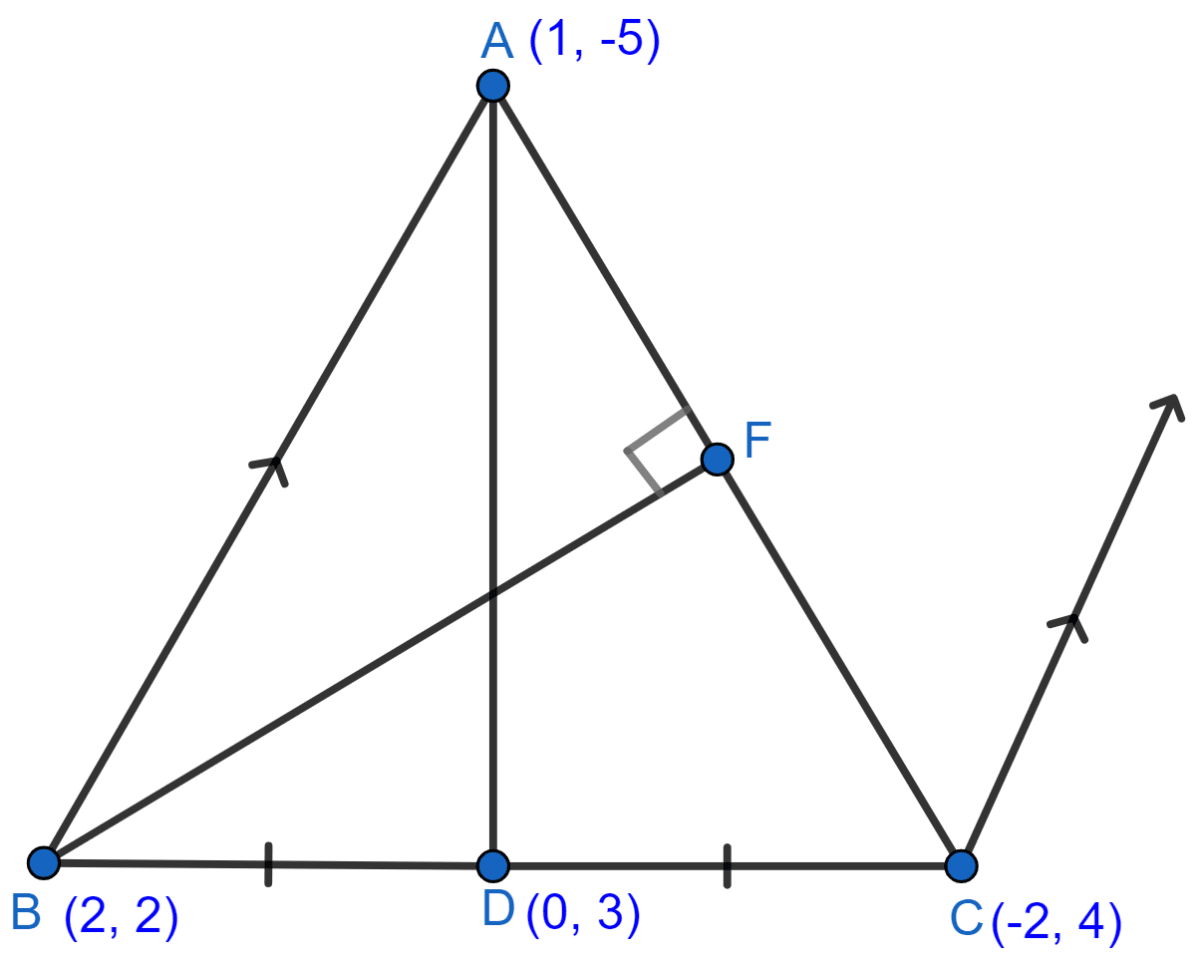
A(1, -5), B(2, 2) and C(-2, 4) are the vertices of triangle ABC. Find the equation of :
(i) the median of the triangle through A.
(ii) the altitude of the triangle through B.
(iii) the line through C and parallel to AB.
Answer
(i) Let AD be the median through A.
So, D will be the mid-point of BC.
Co-ordinates of D = = (0, 3).
⇒ y - y1 = m(x - x1)
⇒ y - (-5) = -8(x - 1)
⇒ y + 5 = -8x + 8
⇒ 8x + y = 3.
Hence, equation of median through A is 8x + y = 3.
(ii) Let BF be the altitude.
Since, altitude is at 90°.
So, altitude through B (i.e. BF) will be perpendicular to AC.
Let slope of altitude through B be m.
∴ m × -3 = -1
⇒ m = .
Equation of altitude through B by point-slope form,
⇒ y - y1 = m(x - x1)
⇒ y - 2 = (x - 2)
⇒ 3(y - 2) = x - 2
⇒ 3y - 6 = x - 2
⇒ x - 3y - 2 + 6 = 0
⇒ x - 3y + 4 = 0.
Hence, equation of altitude through B is x - 3y + 4 = 0.
(iii)
Since, parallel lines have equal slopes.
So slope of line through C and parallel to AB = 7.
Equation of line through C by point-slope form,
⇒ y - y1 = m(x - x1)
⇒ y - 4 = 7[x - (-2)]
⇒ y - 4 = 7(x + 2)
⇒ y - 4 = 7x + 14
⇒ 7x - y + 14 + 4 = 0
⇒ 7x - y + 18 = 0.
Hence, equation of line through C and parallel to AB is 7x - y + 18 = 0.
(i) Write down the equation of the line AB, through (3, 2) and perpendicular to the line 2y = 3x + 5.
(ii) AB meets the x-axis at A and the y-axis at B. Write down the co-ordinates of A and B. Calculate the area of triangle OAB, where O is the origin.
Answer
(i) Below figure shows the line AB, through (3, 2) and perpendicular to the line 2y = 3x + 5:

Given,
⇒ 2y = 3x + 5
⇒ y =
Comparing above equation with y = mx + c we get,
m =
Let slope of line AB be m1.
Since, AB and line 2y = 3x + 5 are perpendicular.
∴ Product of their slopes will be equal to -1.
∴ m × m1 = -1
.
By point-slope form,
Equation of AB : y - y1 = m(x - x1)
⇒ y - 2 = (x - 3)
⇒ 3(y - 2) = -2(x - 3)
⇒ 3y - 6 = -2x + 6
⇒ 2x + 3y = 6 + 6
⇒ 2x + 3y = 12.
Hence, equation of AB is 2x + 3y = 12.
(ii) Below figure shows AB with its intercepts on x axis and y axis:

At A,
y co-ordinate = 0 as it lies on x-axis.
Substituting y = 0 in equation of AB,
⇒ 2x + 3(0) = 12
⇒ 2x = 12
⇒ x = 6.
A = (x, 0) = (6, 0).
At B,
x co-ordinate = 0 as it lies on y-axis.
Substituting x = 0 in equation of AB,
⇒ 2(0) + 3y = 12
⇒ 3y = 12
⇒ y = 4.
B = (0, y) = (0, 4).
Area of right angle triangle OAB =
=
= 12 sq. units.
Hence, A = (6, 0), B = (0, 4) and area of triangle OAB = 12 sq. units.
The line 4x - 3y + 12 = 0 meets the x-axis at A. Write the co-ordinates of A.
Determine the equation of line through A and perpendicular to 4x - 3y + 12 = 0.
Answer
At A,
y co-ordinate = 0 as it lies on x-axis.
A = (x, 0)
Substituting y = 0 in equation 4x - 3y + 12 = 0 we get,
⇒ 4x - 3(0) + 12 = 0
⇒ 4x + 12 = 0
⇒ 4x = -12
⇒ x = -3.
A = (x, 0) = (-3, 0).
Given,
⇒ 4x - 3y + 12 = 0
⇒ 3y = 4x + 12
⇒ y = + 4
Comparing above equation with y = mx + c we get,
m = .
Let slope of line perpendicular to 4x - 3y + 12 = 0 be m1.
∴ Product of their slopes will be equal to -1.
∴ m × m1 = -1
⇒
⇒ .
By point slope form,
Equation of line through A and slope = ,
⇒ y - y1 = m(x - x1)
⇒ y - 0 = [x - (-3)]
⇒ 4y = -3(x + 3)
⇒ 4y = -3x - 9
⇒ 3x + 4y + 9 = 0.
Hence, equation of line through A and perpendicular to 4x - 3y + 12 = 0 is 3x + 4y + 9 = 0.
The point P is the foot of perpendicular from A(-5, 7) to the line 2x - 3y + 18 = 0. Determine :
(i) the equation of the line AP
(ii) the co-ordinates of P
Answer
(i) Given,
⇒ 2x - 3y + 18 = 0
⇒ 3y = 2x + 18
⇒ y =
Comparing above equation with y = mx + c we get,
m = .
Since, AP is perpendicular to 2x - 3y + 18 = 0.
∴ Product of slope of AP and 2x - 3y + 18 = 0 will be -1.
Let slope of AP = m1.
∴ m × m1 = -1
⇒
⇒ .
By point-slope form, equation of AP,
⇒ y - y1 = m(x - x1)
⇒ y - 7 = [x - (-5)]
⇒ 2(y - 7) = -3(x + 5)
⇒ 2y - 14 = -3x - 15
⇒ 3x + 2y - 14 + 15 = 0
⇒ 3x + 2y + 1 = 0.
Hence, equation of AP is 3x + 2y + 1 = 0.
(ii) P is the point where AP and 2x - 3y + 18 = 0 meets,
Solving 2x - 3y + 18 = 0 and 3x + 2y + 1 = 0 simultaneously,
⇒ 3x + 2y + 1 = 0
⇒ 2y = -3x - 1
⇒ y = .........(1)
Substituting value of y in 2x - 3y + 18 = 0 we get,
Substituting x = -3 in (1) we get,
P = (-3, 4).
Hence, co-ordinates of P = (-3, 4).
Th points A, B and C are (4, 0), (2, 2) and (0, 6) respectively. Find the equations of AB and BC.
If AB cuts the y-axis at P and BC cuts the x-axis at Q, find the coordinates of P and Q.
Answer
By formula,
Slope =
Substituting values we get,
By point-slope form,
Equation of AB is :
⇒ y - y1 = m(x - x1)
⇒ y - 0 = -1(x - 4)
⇒ y = -x + 4
⇒ x + y = 4.
By point-slope form,
Equation of BC is :
⇒ y - y1 = m(x - x1)
⇒ y - 2 = -2(x - 2)
⇒ y - 2 = -2x + 4
⇒ 2x + y = 6.
Let point P be (0, a) and Q be (b, 0).
Substituting value of P in equation of AB we get,
⇒ 0 + a = 4
⇒ a = 4.
Substituting value of Q in equation of BC we get,
⇒ 2b + 0 = 6
⇒ 2b = 6
⇒ b = 3.
Hence, equation of AB is x + y = 4 and BC is 2x + y = 6 and P = (0, 4) and Q = (3, 0).
Match the equations A, B, C and D with the lines L1, L2, L3 and L4, whose graphs are roughly drawn in the given diagram.
A ≡ y = 2x;
B ≡ y - 2x + 2 = 0;
C ≡ 3x + 2y = 6;
D ≡ y = 2

Answer
Putting x and y = 0 in y = 2x we get,
Both sides = 0.
So, line y = 2x passes through origin.
A → L3.
Putting x = 0 in y - 2x + 2 = 0,
⇒ y - 2(0) + 2 = 0
⇒ y = -2.
Putting y = 0 in y - 2x + 2 = 0
⇒ 0 - 2x + 2 = 0
⇒ 2x = 2
⇒ x = 1.
So, x-intercept is positive and y-intercept is negative.
B → L4.
Putting x = 0 in 3x + 2y = 6,
⇒ 3(0) + 2y = 6
⇒ 2y = 6
⇒ y = 3.
Putting y = 0 in 3x + 2y = 6
⇒ 3x + 2(0) = 6
⇒ 3x = 6
⇒ x = 2.
So, both intercept are positive.
C → L2.
Comparing y = 2 with y = mx + c we get,
Slope (m) = 0.
So, the line y = 2 is parallel to x-axis.
D → L1.
Hence, A → L3, B → L4, C → L2 and D → L1.