
The line 5x - ky + 3 = 0 passes through the point (x = y = 3). The value of k is :
-3
-6
6
3
Answer
Since, the line 5x - ky + 3 = 0 passes through point (x = y = 3).
∴ Point (3, 3) satisfies the equation 5x - ky + 3 = 0.
∴ 5(3) - 3k + 3 = 0
⇒ 15 - 3k + 3 = 0
⇒ -3k + 18 = 0
⇒ 3k = 18
⇒ k = = 6.
Hence, Option 3 is the correct option.
The inclination of the line = 0 is :
30°
45°
60°
75°
Answer
Given, equation :
Comparing above equation with y = mx + c, we get :
⇒ m =
⇒ tan θ = tan 30°
⇒ θ = 30°.
Hence, Option 1 is the correct option.
Assertion (A) : 2x + y = 8 and 6x + 3y = 20 are two straight lines. To find whether the lines are parallel to each other or not, we need to find the slope of each line.
Reason (R) : If slopes of both the lines are same, they are parallel to each other.
A is true, R is false.
A is false, R is true.
Both A and R are true and R is correct reason for A.
Both A and R are true and R is incorrect reason for A.
Answer
We know that,
It is true that if slopes of both the lines are same, they are parallel to each other and in order to find whether two lines are parallel or not we find and compare their slopes.
Hence, Option 3 is the correct option.
Assertion (A) : y = x + 4 and y = are two intersecting lines.
Reason (R) : The inclinations of both the given lines are not equal.
Answer
A is true, R is false.
A is false, R is true.
Both A and R are true and R is correct reason for A.
Both A and R are true and R is incorrect reason for A. Answer
Given,
1st equation :
y = x + 4
Comparing above equation with y = mx + c, we get :
m = 1
Slope of 1st line = 1.
2nd equation :
y =
Comparing above equation with y = mx + c, we get :
m =
Slope of 2nd line = .
Equating equations (1) and (2), we get :
Rationalising,
Substituting value of x in equation (1), we get :
∴ y = x + 4 and y = are two intersecting lines and also the inclinations of both the given lines are not equal.
Hence, Option 3 is the correct option.
If the lines 4x + 3y = 84 and 3x + ky + 7 = 0 are perpendicular to each other. Then the value of k is :
4
-4
Answer
Given,
1st equation :
⇒ 4x + 3y = 84
⇒ 3y = -4x + 84
⇒ y =
⇒ y = + 28
Comparing above equation with y = mx + c, we get :
Slope of first equation =
2nd equation :
⇒ 3x + ky + 7 = 0
⇒ ky = -3x - 7
⇒ y =
Slope of second equation =
We know that,
Product of slope of two perpendicular lines = -1.
Hence, Option 2 is the correct option.
The line 5x + 3y = 15 meets y-axis at point P. The co-ordinates of point P are :
(0, 5)
(0, 3)
(5, 0)
(3, 0)
Answer
We know that,
x-coordinate at y-axis = 0.
Let point P be (0, a).
Since,
Line 5x + 3y = 15 meets y-axis at point P.
∴ Point P(0, a) satisfies the equation 5x + 3y = 15.
⇒ 5(0) + 3a = 15
⇒ 0 + 3a = 15
⇒ 3a = 15
⇒ a = = 5.
∴ P = (0, a) = (0, 5).
Hence, Option 1 is the correct option.
The vertices A and C of rhombus ABCD are A = (3, -1) and C = (-4, -8). The slope of diagonal BD is :
7
-7
1
-1
Answer
By formula,
Slope =
Slope of AC = = 1.
We know that,
Diagonals of rhombus are perpendicular to each other.
Let slope of diagonal of BD be x.
We know that,
Product of slope of two perpendicular lines = -1.
∴ Slope of AC × Slope of BD = -1
⇒ 1 × Slope of BD = -1
⇒ Slope of BD = -1.
Hence, Option 4 is the correct option.
The equation of line AB is x + 8 = 0. The slope of the line OP which bisects angle O, is :
1
-1
0
2

Answer
Given,
Line OP bisects angle O.
Since, ∠O = 90°.
∴ OP makes 45° with x-axis.
From figure,
OP lies in the third quadrant.
Since, tan is positive in third quadrant.
Slope = tan 45° = 1.
Hence, Option 1 is the correct option.
The line 2x - 3y = 12, meets x-axis at point A and y-axis at point B, then :
A = (6, 0) and B = (0, -4)
A = (0, -4) and B = (6, 0)
A = (0, -4) and B = (-6, 0)
A = (-6, 0) and B = (4, 0)
Answer
We know that,
y-coordinate at x-axis = 0.
Let point A be (a, 0).
Since,
Line 2x - 3y = 12 meets x-axis at point A.
∴ Point A(a, 0) satisfies the equation 2x - 3y = 12.
⇒ 2a - 3(0) = 12
⇒ 2a - 0 = 12
⇒ 2a = 12
⇒ a = = 6.
∴ A = (a, 0) = (6, 0).
We know that,
x-coordinate at y-axis = 0.
Let point B be (0, b).
Since,
Line 2x - 3y = 12 meets y-axis at point B.
∴ Point B(0, b) satisfies the equation 2x - 3y = 12.
⇒ 2(0) - 3b = 12
⇒ 0 - 3b = 12
⇒ -3b = 12
⇒ b = = -4.
∴ B = (0, b) = (0, -4).
Hence, Option 1 is the correct option.
Two straight lines 3x - 2y = 15 and 2x + ky + 8 = 0.
Assertion (A) : The given two lines are perpendicular to each other and k = 3.
Reason (R) : If the inclination of two lines are α and β; then tan α = -cot β.
A is true, R is false.
A is false, R is true.
Both A and R are true and R is correct reason for A.
Both A and R are true and R is incorrect reason for A.
Answer
Given, two lines: 3x - 2y = 15 and 2x + ky + 8 = 0
Converting the equation of first line in slope-intercept form (y = mx + c), we get :
⇒ 3x - 2y = 15
⇒ -2y = -3x + 15
⇒ y =
∴ Slope of the line (m1) =
Converting the equation of second line in slope-intercept form (y = mx + c), we get :
⇒ 2x + ky + 8 = 0
⇒ ky = -2x - 8
⇒ y =
∴ Slope of the line (m2) =
We know that,
The two lines are perpendicular if product of their slopes is -1.
So, assertion (A) is true.
If the inclination of two lines are α and β, then Slope of first line (m1) = tan α and Slope of second line (m2) = tan β.
⇒ m1 x m2 = -1
⇒ tan α x tan β = -1
⇒ tan α =
⇒ tan α = -cot β
So, reason (R) is true, but it is not the correct reason for assertion (A).
Hence, option 4 is the correct option.
A line 2x + 8y = 15.
Assertion (A) : The equation of line passing through origin and parallel to the given line 2x + 8y = 15 is x + 4y = 0.
Reason (R) : Equation of the line passing through the origin and parallel to ax + by + c = 0 is ax + by = 0.
A is true, R is false.
A is false, R is true.
Both A and R are true and R is correct reason for A.
Both A and R are true and R is incorrect reason for A.
Answer
Given, 2x + 8y = 15
Converting in slope-intercept form (y = mx + c), we get :
⇒ 8y = -2x + 15
⇒ y =
⇒ y =
∴ Slope of the line (m) =
By point-slope formula,
⇒ (y - y1) = m(x - x1)
Equation of line parallel to the line 2x + 8y = 15 and passing through origin (0, 0) :
⇒ (y - 0) = (x - 0)
⇒ y = x
⇒ 4y = -x
⇒ x + 4y = 0
So, assertion (A) is true.
Given, equation of line : ax + by + c = 0
Converting in slope-intercept form (y = mx + c), we get :
⇒ by = -ax - c
⇒ y =
∴ Slope of the line (m) =
By point-slope formula,
⇒ (y - y1) = m(x - x1)
Equation of line parallel to ax + by + c = 0 and passing through origin (0, 0) :
⇒ (y - 0) = (x - 0)
⇒ y = x
⇒ by = -ax
⇒ ax + by = 0
So, reason (R) is true, and it is the correct reason for assertion (A).
Hence, option 3 is the correct option.
Points P(x, 2), A(-2, 3) and B(-5, 4) are collinear.
Statement 1: Slope of PA = Slope of PB = Slope of AB.
Statement 2: x = 1.
Both the statement are true.
Both the statement are false.
Statement 1 is true, and statement 2 is false.
Statement 1 is false, and statement 2 is true.
Answer
Given, P(x, 2), A(-2, 3) and B(-5, 4).
If three points are collinear, it means they lie on same line.
∴ Slope will be equal.
∴ Slope of PA = Slope of PB = Slope of AB
So, statement 1 is true.
Using formula,
Slope =
Slope of AB = Slope of PA
So, statement 2 is true.
Hence, option 1 is the correct option.
Lines 2x - by + 7 = 0 and ax - 2y - 7 = 0 are perpendicular to each other.
Statement 1: .
Statement 2: Slope of line 2x - by + 7 = 0 is and slope of line ax - 2y - 7 = 0 is .
Both the statement are true.
Both the statement are false.
Statement 1 is true, and statement 2 is false.
Statement 1 is false, and statement 2 is true.
Answer
Given equation of line 2x - by + 7 = 0 and ax - 2y - 7 = 0
Converting the equation of first line in slope-intercept form (y = mx + c), we get :
⇒ 2x - by + 7 = 0
⇒ by = 2x + 7
⇒ y =
∴ Slope of the line (m1) =
Converting the equation of second line in slope-intercept form y = mx + c, we get :
⇒ ax - 2y - 7 = 0
⇒ 2y = ax - 7
⇒ y =
∴ Slope of the line (m2) =
So, statement 2 is true.
We know that,
The two lines are perpendicular if product of their slopes is -1.
So, statement 1 is false.
Hence, option 4 is the correct option.
Point P divides the line segment joining the points A (8, 0) and B (16, -8) in the ratio 3 : 5. Find its co-ordinates of point P.
Also, find the equation of the line through P and parallel to 3x + 5y = 7.
Answer
Given points, A (8, 0) and B (16, -8)
By section formula, the co-ordinates of the point P which divides AB in the ratio 3 : 5 is given by
Given line equation is,
⇒ 3x + 5y = 7
⇒ 5y = -3x + 7
⇒ y =
Comparing above equation with y = mx + c we get,
Slope =
The line parallel to the line 3x + 5y = 7 will have the same slope.
Hence, the slope of the required line =
By point-slope form, equation of the required line,
⇒ y - y1 = m(x - x1)
⇒ y - (-3) = (x - 11)
⇒ 5(y + 3) = -3(x - 11)
⇒ 5y + 15 = -3x + 33
⇒ 3x + 5y = 33 - 15
⇒ 3x + 5y = 18.
Hence, P = (11, -3) and equation of the required line is 3x + 5y = 18.
The line segment joining the points A(3, -4) and B (-2, 1) is divided in the ratio 1 : 3 at point P in it. Find the co-ordinates of P. Also, find the equation of the line through P and perpendicular to the line 5x – 3y = 4.
Answer
Given points, A(3, -4) and B(-2, 1)
By section formula, the co-ordinates of the point P which divides AB in the ratio 1: 3 is given by
Given line equation is,
5x – 3y = 4
3y = 5x - 4
y =
So, the slope of this line (m) =
Let slope of perpendicular line be m1.
Then,
⇒ m1 × m = -1
⇒ m1
⇒ m1 = .
Slope of the required line = .
By point-slope form,
Equation of line through P and slope = is,
⇒ y – y1 = m(x – x1)
Hence, P = the equation of required line is 6x + 10y + 17 = 0.
A line 5x + 3y + 15 = 0 meets y-axis at point P. Find the co-ordinates of point P. Find the equation of a line through P and perpendicular to x - 3y + 4 = 0.
Answer
As the point P lies on y-axis, the x co-ordinate of point P will be = 0.
Putting x = 0 in the equation 5x + 3y + 15 = 0, we get
⇒ 5(0) + 3y + 15 = 0
⇒ 3y + 15 = 0
⇒ 3y = -15
⇒ y = -5.
Hence, the co-ordinates of the point P are (0, -5).
Given line equation,
x - 3y + 4 = 0
3y = x + 4
y =
Comparing above equation with y = mx + c we get,
Slope of this line (m) =
Product of slope of perpendicular lines = -1.
Let slope of line perpendicular to x - 3y + 4 = 0 be m1.
Then,
⇒ m1 × m = -1
⇒ m1
⇒ m1 = -3.
Slope of the required line = -3.
By point-slope form,
Equation of line through P and slope = -3 is,
⇒ y - y1 = m(x - x1)
⇒ y - (-5) = -3(x - 0)
⇒ y + 5 = -3x
⇒ 3x + y + 5 = 0.
Hence, P = (0, -5) and equation of required line is 3x + y + 5 = 0.
A straight line passes through the points P (-1, 4) and Q (5, -2). It intersects the co-ordinate axes at points A and B. M is the mid-point of the segment AB. Find:
(i) The equation of the line.
(ii) The co-ordinates of A and B.
(iii) The co-ordinates of M.

Answer
(i) Given points, P (-1, 4) and Q (5, -2)
By point-slope form,
Equation of the line PQ,
⇒ y – y1 = m(x – x1)
⇒ y – 4 = -1[x - (-1)]
⇒ y – 4 = -[x + 1]
⇒ y - 4 = -x - 1
⇒ x + y = -1 + 4
⇒ x + y = 3.
Hence, equation of line is x + y = 3.
(ii) For point A (on x-axis), y = 0.
So, putting y = 0 in the equation of PQ, we have
⇒ x + 0 = 3
⇒ x = 3.
∴ A = (3, 0).
For point B (on y-axis), x = 0.
So, putting x = 0 in the equation of PQ, we have
⇒ 0 + y = 3
⇒ y = 3
∴ B = (0, 3).
Hence, co-ordinates of A = (3, 0) and B = (0, 3).
(iii) M is the mid-point of AB.
∴ M =
Hence, M = .
Show that A (3, 2), B (6, -2) and C (2, -5) can be the vertices of a square.
(i) Find the co-ordinates of its fourth vertex D, if ABCD is a square.
(ii) Without using the co-ordinates of vertex D, find the equation of side AD of the square and also the equation of diagonal BD.
Answer
Given, A (3, 2), B (6, -2) and C (2, -5)
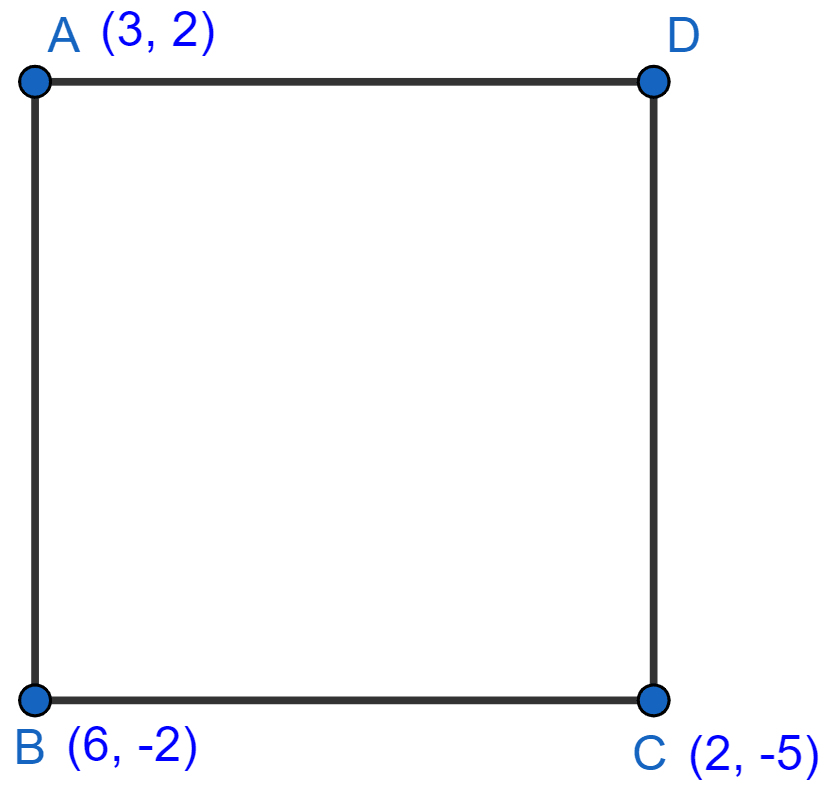
By distance formula,
Distance between two points =
Thus, AC = BC
By formula,
Slope =
Slope of AB =
Slope of BC =
Slope of AB x Slope of BC = = -1
Hence, AB ⊥ BC
Therefore, A, B, C can be the vertices of a square.
(i) Slope of CD = Slope of AB = (As they are parallel)
So, the equation of CD is
⇒ y – y1 = m(x – x1)
⇒ y - (-5) = (x – 2)
⇒ 3(y + 5) = -4(x - 2)
⇒ 3y + 15 = -4x + 8
⇒ 4x + 3y + 7 = 0 .........(1)
Slope of AD = Slope of BC = (As these lines are parallel)
So, the equation of the line AD is
⇒ y – y1 = m(x – x1)
⇒ y - 2 = (x - 3)
⇒ 4(y – 2) = 3(x – 3)
⇒ 4y - 8 = 3x - 9
⇒ 3x - 4y = -8 + 9
⇒ 3x - 4y = 1 ......... (2)
Now, D is the point of intersection of CD and AD.
Solving (1) and (2),
Multiplying equation (1) by 4 and (2) by 3 and adding them we get,
⇒ 16x + 12y + 28 + 9x – 12y = 0 + 3
⇒ 25x = 3 - 28
⇒ 25x = -25
⇒ x = -1
Putting value of x in (1), we get
⇒ 4(-1) + 3y + 7 = 0
⇒ 3y - 4 + 7 = 0
⇒ 3y + 3 = 0
⇒ 3y = -3
⇒ y = -1
Hence, the co-ordinates of point D are (-1, -1).
(ii) From the equation (2)
The equation of the line AD is,
⇒ 3x – 4y = 1
⇒ 4y = 3x - 1.
Slope of AC =
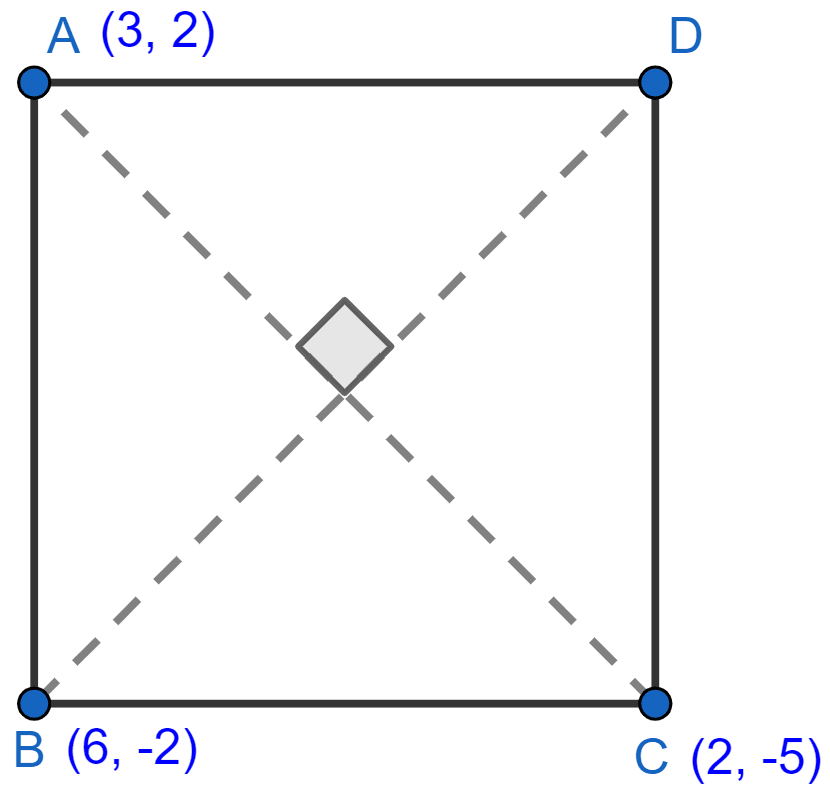
Since, diagonals of a square are perpendicular to each other. So, product of their slopes = -1.
∴ Slope of AC × Slope of BD = -1
⇒ Slope of BD = -1
⇒ Slope of BD = -.
The equation of the diagonal BD is
⇒ y – y1 = m(x – x1)
⇒ y - (-2) = (x - 6)
⇒ 7(y + 2) = –1(x – 6)
⇒ 7y + 14 = -x + 6
⇒ x + 7y + 14 - 6 = 0
⇒ x + 7y + 8 = 0.
Hence, equation of line BD is x + 7y + 8 = 0 and AD = 4y = 3x - 1.
A line through origin meets the line x = 3y + 2 at right angles at point X. Find the co-ordinates of X.
Answer
The given line equation is
⇒ x = 3y + 2 ..........(1)
⇒ 3y = x - 2
⇒ y =
Comparing above equation with y = mx + c we get,
Slope (m) =
Let slope of perpendicular line be m1.
⇒ m1 × m = -1 (As product of slope of perpendicular lines = -1).
⇒ = -1
⇒ m1 = -3.
Equation of the line passing through origin and with slope = -3, by point-slope form is:
⇒ y – y1 = m(x – x1)
⇒ y – 0 = -3(x – 0)
⇒ y = -3x
⇒ 3x + y = 0 ...........(2)
Next,
Point X is the intersection of the lines (1) and (2).
Substituting value of x from (1) in (2),
⇒ 3(3y + 2) + y = 0
⇒ 9y + 6 + y = 0
⇒ 10y = -6
⇒ y = .
⇒ x = 3y + 2 = .
Hence, the co-ordinates of the point X are .
A straight line passes through the point (3, 2) and the portion of this line, intercepted between the positive axes, is bisected at this point. Find the equation of the line.
Answer
Let P = (3, 2).
Let the line intersect the x-axis at point A (x, 0) and y-axis at point B (0, y).
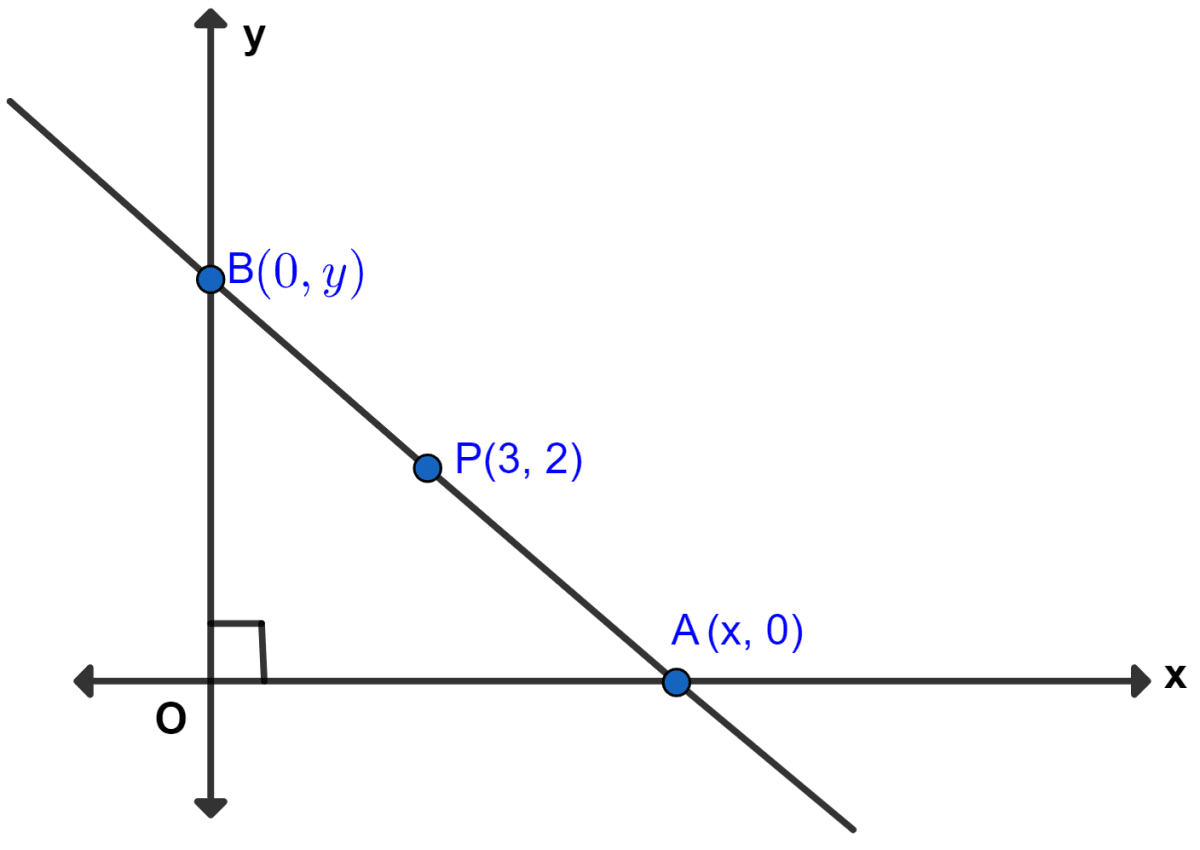
Since, P is the mid-point of AB, we have:
Thus, A = (6, 0) and B = (0, 4)
Slope of line AB = .
So, the required equation of the line AB is given by
⇒ y – y1 = m(x – x1)
⇒ y – 0 = (x – 6)
⇒ 3y = -2x + 12
⇒ 2x + 3y = 12
Hence, equation of the required line is 2x + 3y = 12.
Find the equation of the line passing through the point of intersection of 7x + 6y = 71 and 5x – 8y = -23; and perpendicular to the line 4x – 2y = 1.
Answer
Given line equations are,
7x + 6y = 71 .......(1)
and
5x - 8y = -23 .........(2)
Multiplying (1) by 4 and (2) by 3 we get,
⇒ 28x + 24y = 284 ......... (3)
⇒ 15x – 24y = -69 .........(4)
On adding (3) and (4), we get
⇒ 28x + 15x + 24y - 24y = 284 + (-69)
⇒ 43x = 215
⇒ x =
⇒ x = 5.
From (2), we get
⇒ 8y = 5x + 23
⇒ 8y = 5(5) + 23
⇒ 8y = 25 + 23
⇒ 8y = 48
⇒ y =
⇒ y = 6.
Hence, the required line passes through the point (5, 6).
Given, 4x – 2y = 1
⇒ 2y = 4x – 1
⇒ y = 2x – .
Comparing above equation with y = mx + c we get,
Slope (m) = 2
Let slope of required line be m1.
As, the lines are perpendicular to each other so product of their slopes = -1.
⇒ m × m1 = -1
⇒ 2 × m1 = -1
⇒ m1 = .
Thus, equation of the line is,
⇒ y – y1 = m(x – x1)
⇒ y – 6 = (x – 5)
⇒ 2(y – 6) = -1(x - 5)
⇒ 2y - 12 = -x + 5
⇒ 2y + x = 5 + 12
⇒ x + 2y = 17.
Hence, equation of required line is x + 2y = 17.
Determine whether the line through points (-2, 3) and (4, 1) is perpendicular to the line 3x = y + 1.
Does the line 3x = y + 1 bisect the line segment joining the two given points?
Answer
Let A = (-2, 3) and B = (4, 1)
By point-slope form, the equation of line AB is
⇒ y – y1 = m(x – x1)
⇒ y – 3 = [x - (-2)]
⇒ 3(y – 3) = -1(x + 2)
⇒ 3y - 9 = -x - 2
⇒ 3y + x = -2 + 9
⇒ x + 3y = 7 .........(1)
Given,
⇒ 3x = y + 1
⇒ y = 3x - 1
Comparing above equation with y = mx + c we get,
⇒ Slope (m2) = 3
Since, m1 × m2 = = -1.
Hence, the line through points A and B is perpendicular to the 3x = y + 1.
Given line is 3x = y + 1 ........(2)
Let P be the mid-point of AB,
The co-ordinates of the mid-point of AB (i.e. P) are
= (1, 2).
Now, Let’s check if point P satisfies the line equation (2)
⇒ 3(1) = 2 + 1
⇒ 3 = 3
Hence, the line 3x = y + 1 bisects the line segment joining the points A and B.
Given a straight line x cos 30° + y sin 30° = 2. Determine the equation of the other line which is parallel to it and passes through (4, 3).
Answer
Given line equation,
⇒ x cos 30° + y sin 30° = 2
⇒
⇒ y + = 4
⇒ y = -.
Comparing above equation with y = mx + c we get,
Slope (m1) = -.
Since, slope of parallel lines are equal,
Slope of a line which is parallel to this given line = -.
By slope-point form, the equation of the required line is,
⇒ y - y1 = m(x - x1)
⇒ y - 3 = -(x - 4)
⇒ y - 3 =
⇒ .
Hence, the equation of the required line is .
Find the value of k such that the line (k – 2)x + (k + 3)y – 5 = 0 is:
(i) perpendicular to the line 2x – y + 7 = 0
(ii) parallel to it.
Answer
Given line equation,
⇒ 2x - y + 7 = 0 ..........(1)
⇒ y = 2x + 7
Comparing above equation with y = mx + c we get,
Slope (m1) = 2
Given line equation,
⇒ (k - 2)x + (k + 3)y - 5 = 0 ..........(2)
⇒ (k + 3)y = -(k - 2)x + 5
⇒ y =
Comparing above equation with y = mx + c we get,
Slope (m2) =
(i) If lines (1) and (2) are perpendicular then product of their slopes = -1.
⇒ m1 x m2 = -1
Hence, k = 7.
(ii) If lines 1 and 2 are parallel then their slopes will be equal.
⇒ = 2
⇒ -(k - 2) = 2(k + 3)
⇒ -k + 2 = 2k + 6
⇒ 2k + k = 2 - 6
⇒ 3k = -4
⇒ k = .
Hence, k = .
The vertices of a triangle ABC are A (0, 5), B (-1, -2) and C (11, 7). Write down the equation of BC. Find :
(i) the equation of line through A and perpendicular to BC.
(ii) the co-ordinates of the point P, where the perpendicular through A, as obtained in (i), meets BC.
Answer
Then the equation of the line BC is
⇒ y - y1 = m(x - x1)
⇒ y - (-2) = [x - (-1)]
⇒ 4(y + 2) = 3(x + 1)
⇒ 4y + 8 = 3x + 3
⇒ 3x - 4y = 8 - 3
⇒ 3x - 4y = 5 ......... (1)
(i) Let slope of line perpendicular to BC = m1
As product of slope of perpendicular lines is -1
∴ m x m1 = -1
⇒ x m1 = -1
⇒ m1 =
So, the required equation of the line through A (0, 5) and perpendicular to BC is given by
⇒ y - y1 = m(x - x1)
⇒ y - 5 = (x - 0)
⇒ 3y - 15 = -4x
⇒ 4x + 3y = 15 ......... (2)
Hence, equation of the required line is 4x + 3y = 15.
(ii) The required point P will be the point of intersection of lines (1) and (2).
3x - 4y = 5 ......... (1)
4x + 3y = 15 ......... (2)
Multiplying equation (1) by 3 and (2) by 4 and adding we get,
⇒ 9x - 12y + 16x + 12y = 15 + 60
⇒ 25x = 75
⇒ x =
⇒ x = 3
Substituting the value of x in equation (1) we get,
3(3) - 4y = 5
⇒ 4y = 3(3) – 5
⇒ 4y = 9 - 5
⇒ 4y = 4
⇒ y = 1
Hence, the co-ordinates of the required point P is (3, 1).
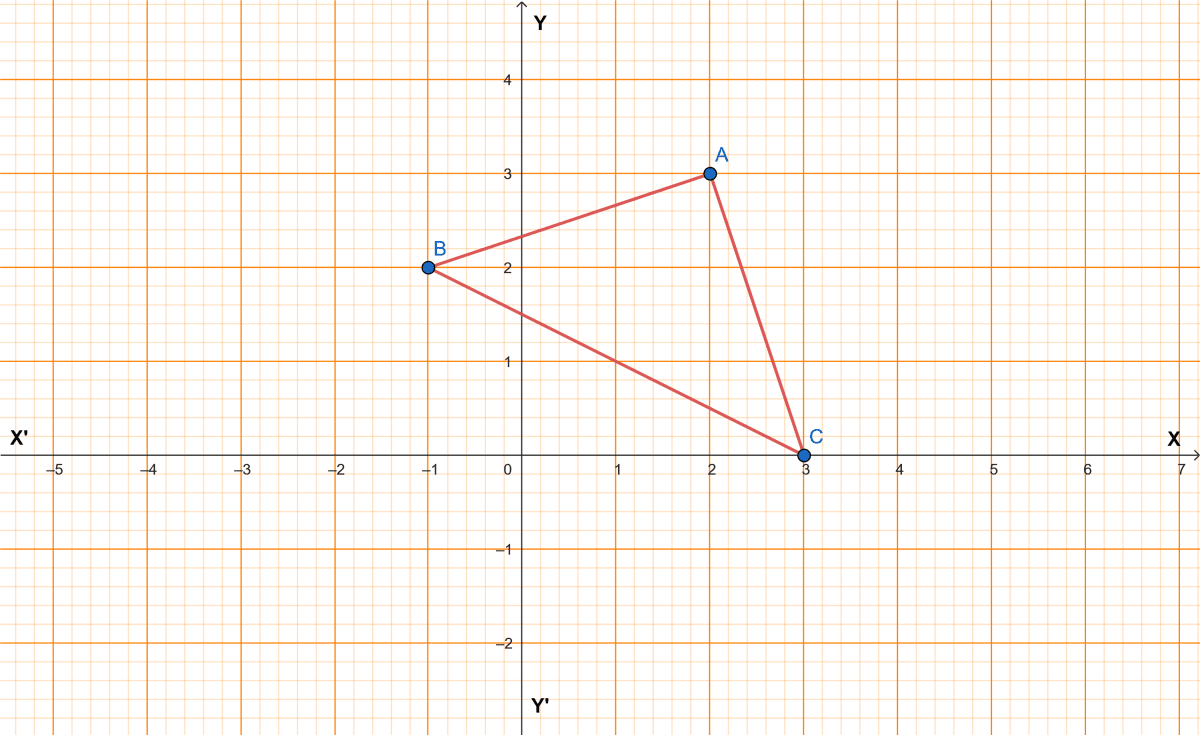
From the given figure, find:
(i) the co-ordinates of A, B and C.
(ii) the equation of the line through A and parallel to BC.
Answer
(i) From figure,
The co-ordinates of A = (2, 3), B = (-1, 2), C = (3, 0).
(ii) Slope of BC = .
Slope of the line which is parallel to BC = (As parallel lines have equal slope).
Hence, the required equation of the line through A and parallel to BC is given by
⇒ y – y1 = m(x – x1)
⇒ y – 3 = (x – 2)
⇒ 2(y – 3) = -1(x - 2)
⇒ 2y - 6 = -x + 2
⇒ x + 2y = 2 + 6
⇒ x + 2y = 8.
Hence, equation of line through A and parallel to BC is x + 2y = 8.
A (8, -6), B (-4, 2) and C (0, -10) are vertices of a triangle ABC. If P is the mid-point of AB and Q is the mid-point of AC, use co-ordinate geometry to show that PQ is parallel to BC. Give a special name of quadrilateral PBCQ.
Answer
ΔABC with vertices A (8, -6), B (-4, 2) and C (0, -10) is shown below:
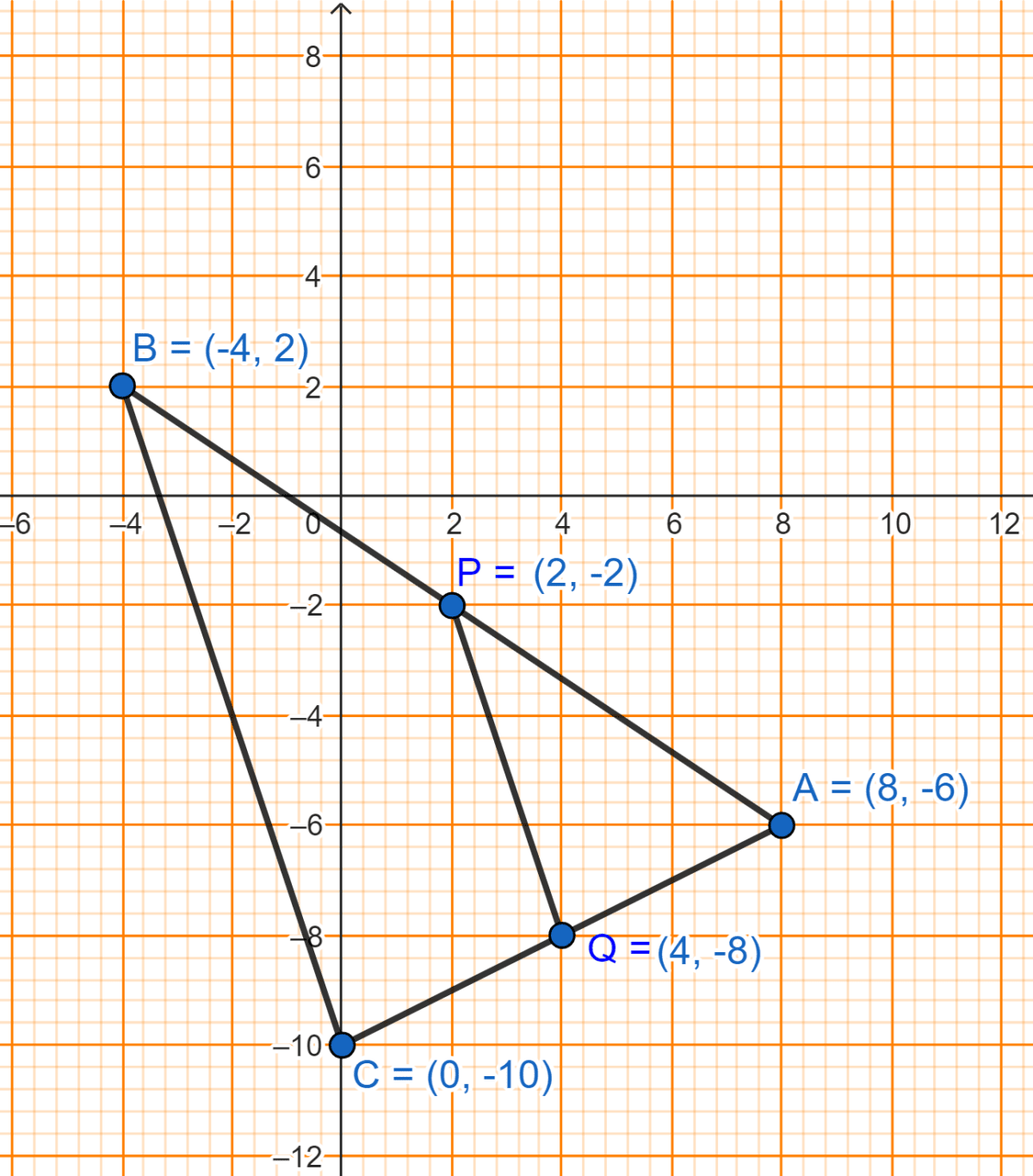
By Mid-point formula,
Mid-point =
Co-ordinates of P =
Co-ordinates of Q = = (4, -8).
By formula,
Slope =
Substituting values we get,
Slope of PQ = = -3.
Slope of BC = = -3.
Since, slope of PQ = slope of BC.
∴ PQ || BC.
From figure,
PBCQ is a trapezium.
A line AB meets the x-axis at point A and y-axis at point B. The point P (-4, -2) divides the line segment AB internally such that AP : PB = 1 : 2. Find:
(i) the co-ordinates of A and B.
(ii) the equation of line through P and perpendicular to AB.
Answer
(i) Let’s assume the co-ordinates of point A, lying on x-axis be (x, 0) and the co-ordinates of point B (lying on y-axis) be (0, y).
Given,
P = (-4, -2) and AP : PB = 1 : 2
By section formula, we get
Hence, the co-ordinates of A and B are (-6, 0) and (0, -6).
(ii) By formula,
Slope =
Slope of AB = = -1.
Let slope of perpendicular line be m.
⇒ m × -1 = -1
⇒ -m = -1
⇒ m = 1.
Therefore, the required equation of the line passing through P and perpendicular to AB is given by
⇒ y – y1 = m(x – x1)
⇒ y - (-2) = 1[x - (-4)]
⇒ y + 2 = x + 4
⇒ y = x + 2.
Hence, the equation of line through P and perpendicular to AB is y = x + 2.
A line intersects x-axis at point (-2, 0) and cuts off an intercept of 3 units from the positive side of y-axis. Find the equation of the line.
Answer
Let line intersect x-axis at point A.
So, A = (-2, 0)
Let line cuts off an intercept of 3 units from positive side of y-axis at point B.
So, co-ordinates of B are (0, 3).
By formula,
Slope =
Slope of AB = .
By point-slope form,
Equation of AB is :
⇒ y - y1 = m(x - x1)
⇒ y - 0 = [x - (-2)]
⇒ 2y = 3(x + 2)
⇒ 2y = 3x + 6
⇒ 3x - 2y + 6 = 0
⇒ 2y = 3x + 6.
Hence, equation of AB is 2y = 3x + 6.
Find the equation of a line passing through the point (2, 3) and having the x-intercept of 4 units.
Answer
Let the line intersect x-axis at point A.
So, A = (4, 0).
Let B = (2, 3).
By formula,
Slope =
Slope of AB = .
By point-slope form,
⇒ y - y1 = m(x - x1)
⇒ y - 0 = (x - 4)
⇒ 2y = -3(x - 4)
⇒ 2y = -3x + 12
⇒ 3x + 2y = 12.
Hence, the equation of required line is 3x + 2y = 12.
The given figure (not drawn to scale) shows two straight lines AB and CD. If equation of the line AB is : y = x + 1 and equation of line CD is : y = x - 1. Write down the inclination of lines AB and CD; also, find the angle θ between AB and CD.
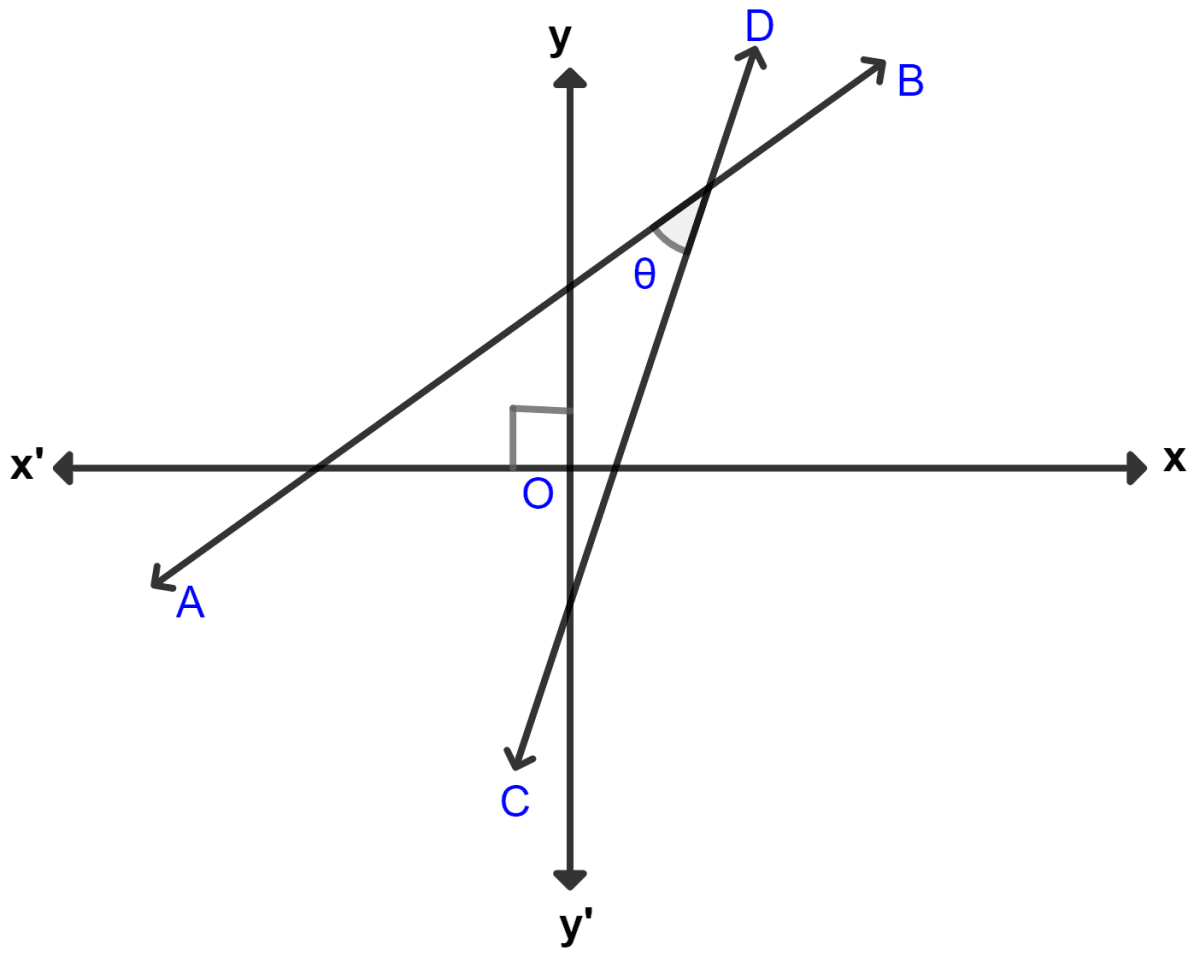
Answer
Given,
Equation of AB :
⇒ y = x + 1
Comparing the above equation with y = mx + c we get,
Slope of AB = 1.
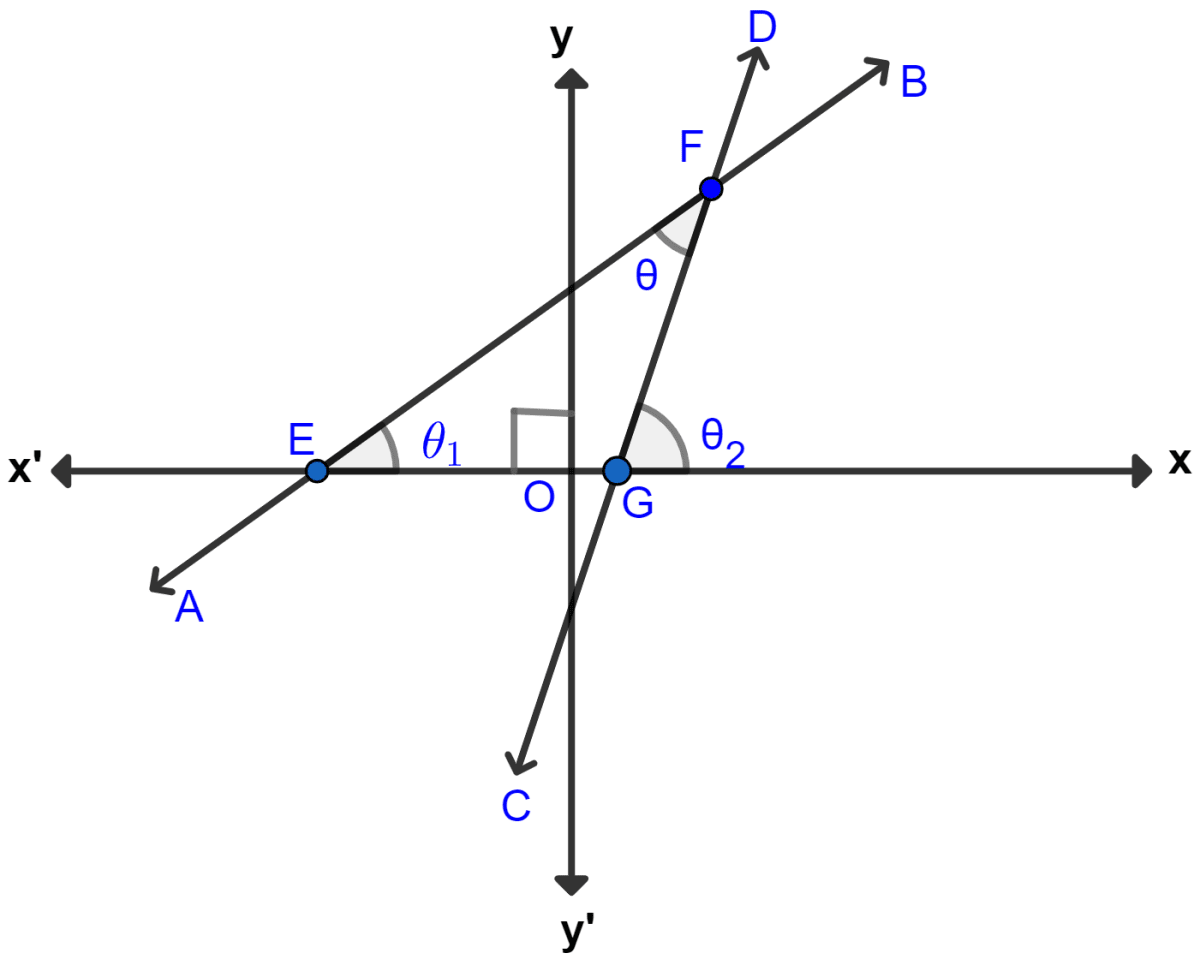
Let θ1 be the inclination of AB then,
⇒ tan θ1 = 1
⇒ tan θ1 = tan 45°
⇒ θ1 = 45°.
Equation of CD :
⇒ y = x - 1
Comparing the above equation with y = mx + c we get,
Slope of CD = .
Let θ2 be the inclination of AB then,
⇒ tan θ2 =
⇒ tan θ2 = tan 60°
⇒ θ2 = 60°.
From figure,
∠FGE = 180° - θ2 = 180° - 60° = 120°.
In △EFG,
∠E + ∠F + ∠G = 180
⇒ θ1 + θ + 120° = 180°
⇒ 45° + θ + 120° = 180°
⇒ θ + 165° = 180°
⇒ θ = 180° - 165° = 15°.
Hence, inclination of AB is 45°, inclination of CD is 60° and θ = 15°.
Write down the equation of the line whose gradient is and which passes through P, where P divides the line segment joining A(-2, 6) and B(3, -4) in the ratio 2 : 3.
Answer
By section-formula,
P =
Substituting values we get,
By point-slope form,
Equation of line with slope = and passing through (0, 2) is :
⇒ y - y1 = m(x - x1)
⇒ y - 2 = (x - 0)
⇒ 2(y - 2) = 3x
⇒ 2y - 4 = 3x
⇒ 2y = 3x + 4.
Hence, equation of required line is 2y = 3x + 4.
The ordinate of a point lying on the line joining the points (6, 4) and (7, -5) is -23. Find the co-ordinates of that point.
Answer
Let point A = (6, 4) and B = (7, -5).
Let the point P be (a, -23).
By formula,
Slope =
Slope of AB = = -9.
By point-slope form,
⇒ y - y1 = m(x - x1)
⇒ y - 4 = -9(x - 6)
⇒ y - 4 = -9x + 54
⇒ 9x + y = 54 + 4
⇒ 9x + y = 58.
Since, P lies on AB so it will satisfy the equation.
Substituting values of P in equation we get,
⇒ 9(a) + (-23) = 58
⇒ 9a - 23 = 58
⇒ 9a = 58 + 23
⇒ 9a = 81
⇒ a =
⇒ a = 9.
∴ P = (a, -23) = (9, -23).
Hence, co-ordinates of the required point are (9, -23).
Point A and B have co-ordinates (7, -3) and (1, 9) respectively. Find :
(i) the slope of AB.
(ii) the equation of perpendicular bisector of the line segment AB.
(iii) the value of 'p' if (-2, p) lies on it.
Answer
(i) By formula,
Slope =
Substituting values we get,
Hence, slope of AB = -2.
(ii) Let O be the mid-point of AB.
By mid-point formula,
Mid-point =
O = = (4, 3).
⇒ Slope of AB × Slope of perpendicular bisector = -1 (As product of slopes of perpendicular lines = -1)
⇒ -2 × Slope of perpendicular bisector = -1
⇒ Slope of perpendicular bisector = .
By point-slope form,
Equation of perpendicular bisector is :
⇒ y - y1 = m(x - x1)
⇒ y - 3 = (x - 4)
⇒ 2(y - 3) = 1(x - 4)
⇒ 2y - 6 = x - 4
⇒ x - 2y - 4 + 6 = 0
⇒ x - 2y + 2 = 0.
Hence, the equation of perpendicular bisector of AB is x - 2y + 2 = 0.
(iii) Since, (-2, p) lies on perpendicular bisector. So, it will satisfy the equation.
⇒ -2 - 2p + 2 = 0
⇒ -2p = 0
⇒ p = 0.
Hence, p = 0.
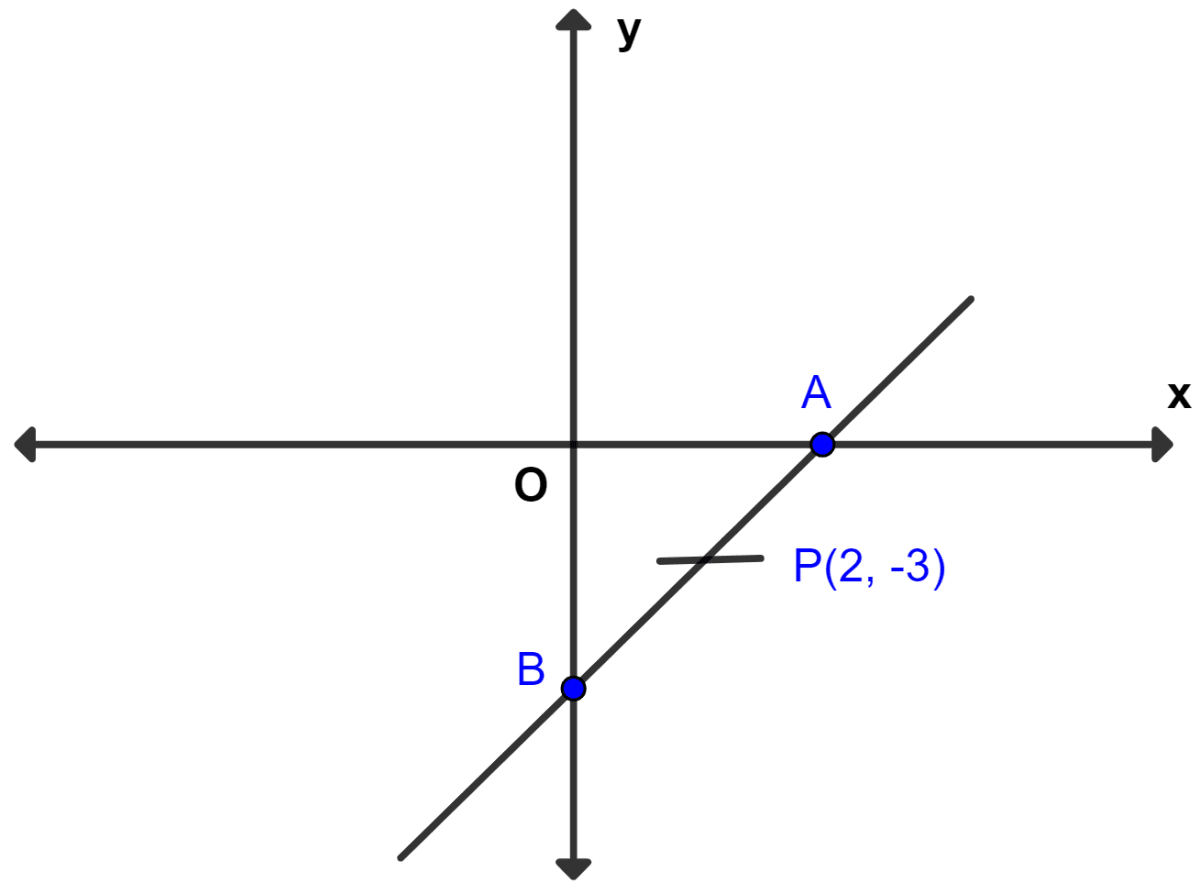
A and B are two points on the x-axis and y-axis respectively. P(2, -3) is the mid-point of AB. Find the
(i) the co-ordinates of A and B
(ii) slope of line AB
(iii) equation of line AB.
Answer
(i) Let point A be (x, 0) and B be (0, y). Since, P is the mid-point of AB.
∴ A = (x, 0) = (4, 0) and B = (0, y) = (0, -6).
Hence, co-ordinates of A = (4, 0) and B = (0, -6).
(ii) By formula,
Slope =
Substituting values we get,
Hence, slope of AB = .
(iii) By point-slope form,
Equation of AB is :
⇒ y - y1 = m(x - x1)
⇒ y - 0 = (x - 4)
⇒ 2y = 3(x - 4)
⇒ 2y = 3x - 12
⇒ 3x - 2y = 12
⇒ 2y = 3x - 12
Hence, equation of AB is 2y = 3x - 12.
ABCD is a parallelogram where A(x, y), B(5, 8), C(4, 7) and D(2, -4). Find :
(i) co-ordinates of A
(ii) equation of diagonal BD.
Answer
(i) Since, ABCD is a parallelogram.
So, AB || CD and AD || BC.
Since, AB || CD so slope of AB = slope of CD.
Since, AD || BC so slope of AD = slope of BC
Substituting value of x from (2) in (1) we get,
⇒ 11(y + 6) - 2y = 39
⇒ 11y + 66 - 2y = 39
⇒ 9y = 39 - 66
⇒ 9y = -27
⇒ y =
⇒ y = -3.
Substituting value of y in (2) we get,
⇒ x = -3 + 6 = 3.
∴ A = (3, -3).
Hence, co-ordinates of A = (3, -3).
(ii) By formula,
Slope =
Substituting values we get,
By-point slope form,
Equation of BD is :
⇒ y - y1 = m(x - x1)
⇒ y - 8 = 4(x - 5)
⇒ y - 8 = 4x - 20
⇒ 4x - y = -8 + 20
⇒ 4x - y = 12.
Hence, equation of BD is 4x - y = 12.
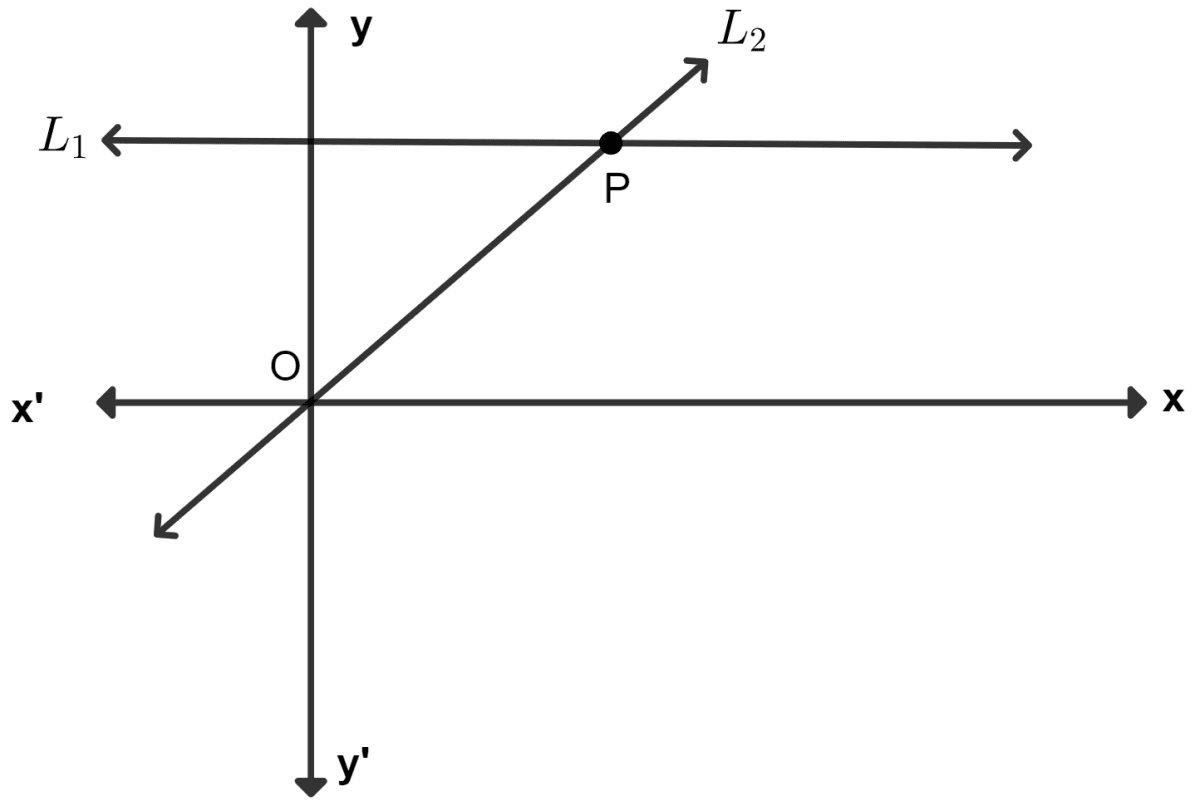
Given equation of line L1 is y = 4.
(i) Write the slope of line L2 if L2 is the bisector of angle O.
(ii) Write the co-ordinates of point P.
(iii) Find the equation of L2.
Answer
(i) The angle between x and y axis = 90°.
Given,
L2 is the bisector of angle O. So, inclination of line L2 is 45°.
Slope of L2 = tan 45° = 1.
Hence, slope of L2 = 1.
(ii) Equation of line L2, passing through origin (0, 0) and slope = 1 is :
⇒ y - y1 = m(x - x1)
⇒ y - 0 = 1(x - 0)
⇒ y = x.
From figure,
P is the point of intersection of y = 4 and y = x.
Solving,
y = 4 ........(1)
y = x ........(2)
Substituting value of y from (1) in (2) we get,
x = 4.
So, point of intersection = (4, 4).
Hence, P = (4, 4).
(iii) From part (ii) we get equation of L2 as,
y = x
Hence, equation of L2 is y = x.
Find the equation of the line that has x-intercept = -3 and is perpendicular to 3x + 5y = 1.
Answer
Let point where line touches x-axis be A. So, A = (-3, 0)
Given equation of line,
⇒ 3x + 5y = 1
⇒ 5y = -3x + 1
⇒ y =
Comparing above equation with y = mx + c we get,
Slope (m1) =
Let slope of line perpendicular to 3x + 5y = 1 be m2.
⇒ m1 × m2 = -1
⇒
⇒ .
By point-slope form,
Equation of line with slope = and passing through (-3, 0) is :
⇒ y - y1 = m(x - x1)
⇒ y - 0 = [x - (-3)]
⇒ 3y = 5[x + 3]
⇒ 3y = 5x + 15
⇒ 5x - 3y + 15 = 0.
Hence, equation of required line is 5x - 3y + 15 = 0.
A straight line passes through the points P(-1, 4) and Q(5, -2). It intersects x-axis at point A and y-axis at point B. M is the mid-point of the line segment AB. Find :
(i) the equation of the line.
(ii) the co-ordinates of points A and B.
(iii) the co-ordinates of point M.
Answer
(i) Slope of PQ = = -1.
By point-slope form,
Equation of PQ is :
⇒ y - y1 = m(x - x1)
⇒ y - 4 = -1[x - (-1)]
⇒ y - 4 = -1(x + 1)
⇒ y - 4 = -x - 1
⇒ x + y = -1 + 4
⇒ x + y = 3.
Hence, the equation of the line is x + y = 3.
(ii) Given,
PQ intersects x-axis at A and y-axis at B.
At x-axis, y co-ordinate = 0.
Substituting y = 0 in equation we get,
⇒ x + 0 = 3
⇒ x = 3.
∴ A = (3, 0)
At y-axis, x co-ordinate = 0.
Substituting x = 0 in equation we get,
⇒ 0 + y = 3
⇒ y = 3.
∴ B = (0, 3)
Hence, co-ordinates of A = (3, 0) and B = (0, 3).
(iii) By formula,
Mid-point =
Substituting values we get,
Hence, co-ordinates of M = .
In the given figure, line AB meets y-axis at point A. Line through C(2, 10) and D intersects line AB at right angle at point P. Find :
(i) equation of line AB.
(ii) equation of line CD.
(iii) co-ordinates of point E and D.

Answer
(i) By formula,
Slope =
Substituting values we get,
By point-slope form,
Equation of AB is :
⇒ y - y1 = m(x - x1)
⇒ y - 6 = (x - 0)
⇒ 3(y - 6) = -1(x)
⇒ 3y - 18 = -x
⇒ x + 3y = 18.
Hence, equation of line AB is x + 3y = 18.
(ii) From figure,
CD is perpendicular to AB.
Slope of AB (m1) =
Let slope of CD be m2.
⇒ m1 × m2 = -1
⇒
⇒ m2 = 3.
Equation of CD is :
⇒ y - y1 = m(x - x1)
⇒ y - 10 = 3(x - 2)
⇒ y - 10 = 3x - 6
⇒ 3x - y - 6 + 10 = 0
⇒ 3x - y + 4 = 0.
Hence, equation of CD is 3x - y + 4 = 0.
(iii) From figure,
E lies on x-axis. Let co-ordinates of E be (a, 0).
Since, E lies on line AB it will satisfy its equation.
Substituting value of E in AB we get,
⇒ a + 3(0) = 18
⇒ a = 18.
E = (18, 0)
D lies on x-axis. Let co-ordinates of D be (b, 0).
Since, D lies on CD it will satisfy its equation.
Substituting value of D in CD we get,
3b - 0 + 4 = 0
3b = -4
b = .
D = .
Hence, co-ordinates of E = (18, 0) and D = .
Find the equation of the line through the points A(-1, 3) and B(0, 2). Hence, show that the points A, B and C(1, 1) are collinear.
Answer
By formula,
Slope =
Substituting values we get,
Slope of AB = = -1.
By point-slope form,
Equation of AB is :
⇒ y - y1 = m(x - x1)
⇒ y - 3 = -1[x - (-1)]
⇒ y - 3 = -1(x + 1)
⇒ y - 3 = -x - 1
⇒ x + y = -1 + 3
⇒ x + y = 2.
Slope of BC = = -1.
Since, slope of AB = slope of BC.
Hence, proved that A, B and C are collinear and equation of AB is x + y = 2.
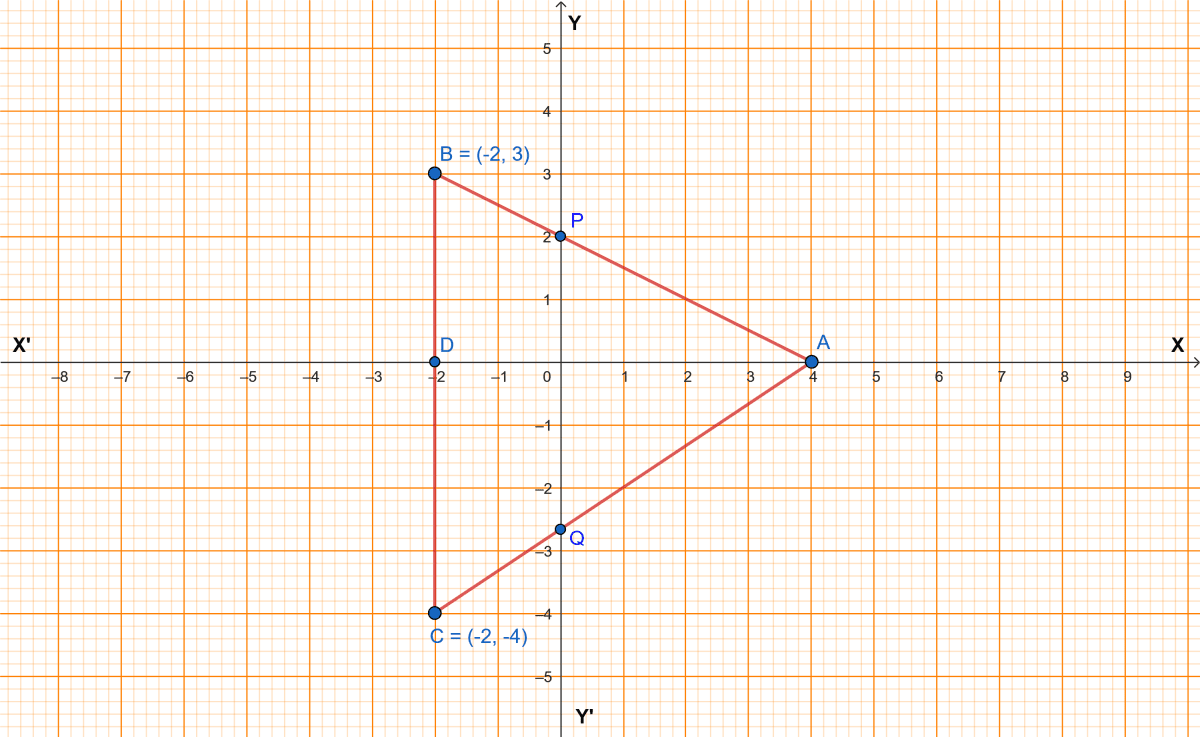
In the figure, given, ABC is a triangle and BC is parallel to the y-axis. AB and AC intersect the y-axis at P and Q respectively.
(i) Write the co-ordinates of A.
(ii) Find the length of AB and AC.
(iii) Find the ratio in which Q divides AC.
(iv) Find the equation of the line AC.
Answer
(i) From graph,
The co-ordinates of A are (4, 0).
(ii) By distance formula,
Distance =
Substituting values we get,
Hence, length of AB = units and AC = units.
(iii) From figure,
Q lies on y-axis.
∴ x co-ordinate of Q = 0.
Let co-ordinate of Q are (0, a).
Let ratio in which Q divides AC be k : 1.
By section-formula,
k : 1 = 2 : 1.
Hence, Q divides AC in the ratio 2 : 1.
(iv) Slope of AC = .
By point-slope form,
Equation of AB is :
⇒ y - y1 = m(x - x1)
⇒ y - 0 = (x - 4)
⇒ 3y = 2x - 8
⇒ 2x - 3y = 8.
Hence, equation of AC is 2x - 3y = 8.
A line AB meets X-axis at A and Y-axis at B. P(4, -1) divides AB in the ratio 1 : 2.
(i) Find the co-ordinates of A and B.
(ii) Find the equation of the line through P and perpendicular to AB.
Answer
(i) As A lies on x-axis let its co-ordinates be (a, 0) and B lies on y-axis so, co-ordinates = (0, b).
By section-formula,
Hence, A = (6, 0) and B = (0, -3).
(ii) By formula,
Slope =
Slope of AB = .
Let slope of perpendicular line be m1.
Since, slope of product of perpendicular lines = -1.
⇒ m1 × Slope of AB = -1
⇒ m1
⇒ m1 = -2.
By point-slope from,
Equation of line passing through P and slope = -2 is :
⇒ y - y1 = m(x - x1)
⇒ y - (-1) = -2(x - 4)
⇒ y + 1 = -2(x - 4)
⇒ y + 1 = -2x + 8
⇒ 2x + y = 7.
Hence, equation of required line is 2x + y = 7.
Find the equation of a line passing through the intersection of 2x + 5y - 4 = 0 with x-axis and parallel to the line 3x - 7y + 8 = 0.
Answer
Let the point of intersection of the line 2x + 5y - 4 = 0 and the x-axis be (x1, 0).
Substituting the value of points in equation,
⇒ 2x1 + 5 × 0 - 4 = 0
⇒ 2x1 = 4
⇒ x1 = 2.
Coordinates of the point of intersection will be (2, 0).
Given new line is parallel to 3x - 7y + 8 = 0.
Converting it in the form y = mx + c,
3x - 7y + 8 = 0
⇒ 7y = 3x + 8 ⇒ y =
Comparing equation with y = mx + c, we get slope = .
The equation of the line with slope and passing through (2, 0) can be given by point-slope form,
⇒ y - y1 = m(x - x1)
⇒ y - 0 =
⇒ 7y = 3(x - 2)
⇒ 7y = 3x - 6
⇒ 3x - 7y - 6 = 0.
Hence, the equation of the new line is 3x - 7y - 6 = 0.
The line 3x - 4y - 12 = 0 meets x-axis at point A and y-axis at point B.
(i) Find the co-ordinates of the point P on line segment AB dividing AB in the ratio 2 : 1.
(ii) Find the equation of the line that passes through the point P and is perpendicular to AB.
Answer
(i) Given,
The line 3x - 4y - 12 = 0 meets x-axis at point A and y-axis at point B.
Substituting x = 0, we get :
⇒ 3.0 - 4y - 12 = 0
⇒ 4y = -12
⇒ y = -3.
B = (0, -3)
Substituting y = 0, we get :
⇒ 3x - 4.0 - 12 = 0
⇒ 3x = 12
⇒ x = = 4.
A = (4, 0)
By section formula,
Point of division =
Substituting values we get :
Hence, coordinates of P = .
(ii) Slope of AB = .
We know that,
Product of slope of perpendicular lines = -1. Let slope of line perpendicular to AB be m.
By point slope form :
Equation of line :
y - y1 = m(x - x1)
Equation of line passing through P and perpendicular to AB is :
Hence, equation of line passing through P and perpendicular to AB is 12x + 9y + 2 = 0.
If the lines represented by the equations y + (2p + 1)x + 3 = 0 and 8y - (2p - l)x = 5 are perpendicular to each other, find p.
Answer
Given,
⇒ y + (2p + 1)x + 3 = 0
⇒ y = -(2p + 1)x - 3
Comparing above equation with y = mx + c, we get :
⇒ Slope (m1) = -(2p + 1)
Given,
⇒ 8y - (2p - 1)x = 5
⇒ 8y = (2p - 1)x + 5
⇒ y =
Comparing above equation with y = mx + c, we get :
⇒ Slope (m2) =
We know that,
Product of slopes of perpendicular lines = -1.
Hence, p = .