
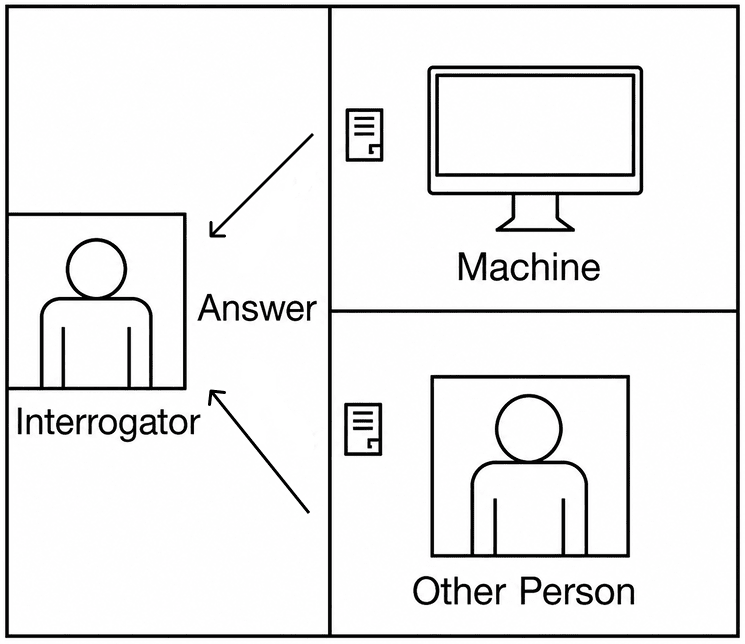
Which concept does the given picture represent?
- Human Intelligence
- Machine Intelligence
- The Turing Test
- Internet of Things (IoT)
Answer
The Turing Test
Reason — The given picture shows an interrogator asking questions to a machine and another person and then identifying which response comes from the machine and which from the human. This setup represents the Turing Test, which determines whether a machine can mimic human behaviour in conversation.
Which of the following is a feature of machine intelligence?
- Emotions and understanding others
- Learning through analysing data
- Creativity and Innovation
- Adapting to new situations independently
Answer
Learning through analysing data
Reason — Machine intelligence works by using large amounts of data, algorithms and programmed rules to learn patterns and make decisions. Machines are trained on data to "learn" and improve their performance, rather than using emotions, creativity or independent adaptation like humans.
Who is considered as the father of modern computer science and artificial intelligence?
- Alan Turing
- David Hanson
- Sam Altman
- Elon Musk
Answer
Alan Turing
Reason — Alan Turing is considered the father of modern computer science and artificial intelligence because of his pioneering work in developing the first modern computer and for proposing the Turing Test, which laid the foundation for Artificial Intelligence.
What is the purpose of the Turing Test?
- To measure the speed of a computer
- To determine, if a machine can behave like a human
- To assess human creativity
- To find errors in computer programs
Answer
To determine, if a machine can behave like a human
Reason — The Turing Test is used to evaluate whether a machine can respond, mimic or behave like a human in conversation, such that a human questioner cannot reliably distinguish between the machine and a human based on their responses.
What makes human intelligence unique as compared to machine intelligence?
- Its ability to analyse data quickly
- Its reliance on creativity, emotions, and adaptability
- Its capability to work continuously without rest
- Its ability to store unlimited amounts of data
Answer
Its reliance on creativity, emotions, and adaptability
Reason — Human intelligence is unique because it is based on creativity, emotions, adaptability and innovative ideas, whereas machine intelligence works using data, algorithms and programmed instructions.
What does the Internet of Things (IoT) technology involve?
- Creating smart robots for tasks
- Designing new programming languages
- Training machines to recognise human emotions
- Interconnecting devices to communicate with each other and the cloud
Answer
Interconnecting devices to communicate with each other and the cloud
Reason — Internet of Things (IoT) refers to the collective network of connected devices and the technology that facilitates communication between devices and the cloud, and between the devices themselves.
State whether the following statements are True or False:
- Machine intelligence relies on data to learn and solve tasks, unlike human intelligence, which uses creativity and emotions.
- The Turing Test was created to test whether a machine can think and behave like a human being.
- A machine that passes the Turing Test is considered to think and behave exactly like a human.
- Human intelligence is based on data patterns and algorithms, much like how machine intelligence works.
- IBM Watson became famous for its role in answering questions on the quiz show "Jeopardy!".
- AI technology like Siri, has been able to respond to voice commands, but it lacks the ability to adapt and learn from interactions.
Answer
- True
- True
- False
Corrected Statement: A machine that passes the Turing Test is considered intelligent because the questioner cannot distinguish its response from a human response. - False
Corrected Statement: Human intelligence is based on creativity, emotions, experiences and adaptability, not on data patterns and algorithms. - True
- False
Corrected Statement: AI technology like Siri can respond to voice commands, remember things about users and perform tasks asked by them.
Write down the full forms of the following:
- HMI
- CEO
- GPT
- VUI
- IoT
Answer
- HMI – Human-Machine Interaction
- CEO – Chief Executive Officer
- GPT – Generative Pre-training Transformer
- VUI – Voice User Interface
- IoT – Internet of Things
Assertion (A): The Turing Test determines whether a machine can mimic human behaviour in conversation.
Reason (R): The Turing Test uses emotional responses from both humans and machines to assess intelligence.
Based on the above discussion, pick an appropriate statement from the options given below:
(a) Both A and R are true, and R is the correct explanation of A.
(b) Both A and R are true, but R is not the correct explanation of A.
(c) A is false, but R is true.
(d) A is true, but R is false.
Answer
(d) A is true, but R is false.
Reason — The Turing Test determines whether a machine can mimic human behaviour in conversation. It does not use emotional responses from humans and machines to assess intelligence.
You are designing an AI system to help doctors diagnose diseases based on medical images. The AI needs to analyse thousands of medical images to detect patterns such as tumors or fractures. The system will learn from the data and improve its accuracy over time.
Which process within machine intelligence will the AI system use to identify patterns in medical images?
(a) Problem-solving
(b) Pattern Recognition
(c) Emotional Understanding
(d) Creativity
Answer
Pattern Recognition
Reason — Machine intelligence is trained using large amounts of data and is able to identify common features and patterns in data such as images, which helps in detecting tumors or fractures.
Write short notes on Human Intelligence.
Answer
Human intelligence is the ability of people to think, learn, solve problems and adapt to situations. It is what makes humans different from other living beings. It helps humans make decisions, create new things, improve the world around us and connect with others emotionally. Human intelligence has many parts that work together to help us succeed in different areas of life. It includes learning, problem solving, creativity, emotions and adaptability.
Write short notes on Machine Intelligence.
Answer
Machine intelligence, also called artificial intelligence (AI), is when machines, like computers or robots, are designed to think and make decisions like humans. Machines do not have a brain like humans. Instead, they are programmed with specific instructions and use data to solve problems or perform specific tasks. Machine intelligence works by learning through data, following programmed rules and identifying patterns to make decisions. It relies on algorithms and trained data rather than emotions or creativity.
Write short notes on Turing Test.
Answer
The Turing Test was proposed by Alan Turing. The test proposed that a machine can respond, mimic, behave or think like a human in a specific condition. In this test, there are three players: two humans and a computer. One person asks questions, while the other human and the computer answer them. If the questioner cannot distinguish between the responses given by the machine and the human, the machine is said to be intelligent.
Write short notes on Human-Machine Interaction.
Answer
Human-Machine Interaction (HMI) refers to the interaction between humans and machines. It encompasses the design, usability and effectiveness of collaboration between the two. HMI focuses on providing a seamless interaction between users and machines so that people can communicate with computers easily and efficiently. Human-Machine Interaction helps in improving the way users interact with machines through different interfaces and technologies.
Explain the key features of human intelligence and how they contribute to human success.
Answer
The key features of Human Intelligence are as follows:
Learning: Humans can learn new things every day. Whether it is a new skill, a subject in school or even a life lesson, our brains can remember and use this information later.
Problem Solving: When we face challenges, we use intelligence to think of solutions.
Creativity: Human intelligence allows us to imagine and create.
Emotions and Understanding Others: Human intelligence helps us understand feelings-both our own and others.
Adaptability: Human intelligence helps us adjust to new situations and succeed.
These features contribute to human success by enabling humans to learn continuously, solve problems, create new ideas, understand emotions and adapt to different situations, helping them improve their lives and the world around them.
How does Machine Intelligence differ from Human Intelligence?
Answer
Machine Intelligence differs from Human Intelligence in the following ways:
| Human Intelligence | Machine Intelligence |
|---|---|
| Human intelligence uses the brain to perform tasks. | Machine intelligence relies on trained data to get results. |
| It is based on previous experiences and creativity. | It is based on data patterns to predict results. |
| It has feelings and emotions. | It lacks feelings and emotions. |
| It is based on innovative or creative ideas. | It cannot be creative or innovative. |
| It has limited physical capabilities. | It can work 24 × 7 without any limitations. |
How does Turing Test assess whether a machine can exhibit human-like intelligence?
Answer
The Turing Test assesses whether a machine can exhibit human-like intelligence by determining whether a machine can respond, mimic, behave or think like a human in a specific condition.
In this test, there are three players: two humans and a computer. One person asks questions, while the other human and the computer answer them. After a while, the questioner has to decide which answer came from the computer and which from the human.
If the questioner cannot distinguish between the responses given by the machine and the human, the machine is said to be intelligent.
How does Human-Machine Interaction enhance the effectiveness of technology in daily life?
Answer
Human-Machine Interaction (HMI) enhances the effectiveness of technology in daily life by enabling seamless interaction between humans and machines. It focuses on the design, usability and effectiveness of collaboration between people and machines.
Human-Machine Interaction helps users communicate with computers through different interfaces and technologies, making systems easier to use and improving the way humans interact with machines in everyday situations.
Discuss the evolution of the following (highlighting the milestones):
(a) Siri
(b) Watson
(c) ChatGPT
Answer
(a) In 2008, voice recognition was introduced as a major achievement in Artificial Intelligence. In 2011, Siri came along as a virtual helper that could understand voice commands and answer questions and do things for the users. Siri can chat with users, remember things about them and do tasks asked by the users. It became a must-have feature on all Apple gadgets. With Siri, users can ask their iPhone, MacBook or Smart Watch to call someone, send a message or do other tasks.
(b) In 2011, IBM Watson became famous as a question-answering computer system capable of answering questions modelled in natural language. It is an artificial intelligence platform developed by IBM (International Business Machine). Watson gained its fame by competing and winning the quiz show Jeopardy! against human champions in 2011. It utilises advanced algorithms to understand and interpret human language and analyse large volumes of data.
(c) ChatGPT is a smart chatbot created through the collaboration between OpenAI and Microsoft Corporation and was launched on November 30, 2022. The term ChatGPT stands for Chat Generative Pre-training Transformer. ChatGPT is capable of engaging in conversations and generating human-like responses. It can translate text, summarise long passages, complete unfinished sentences, generate conversations and write computer code.
What are the limitations of machine intelligence compared to human intelligence?
Answer
The limitations of Machine Intelligence compared to Human Intelligence are as follows:
- Machine intelligence lacks feelings and emotions.
- It cannot be creative or innovative.
- It works only on trained data, algorithms and programmed instructions.
- It does not have natural understanding or consciousness like humans.