
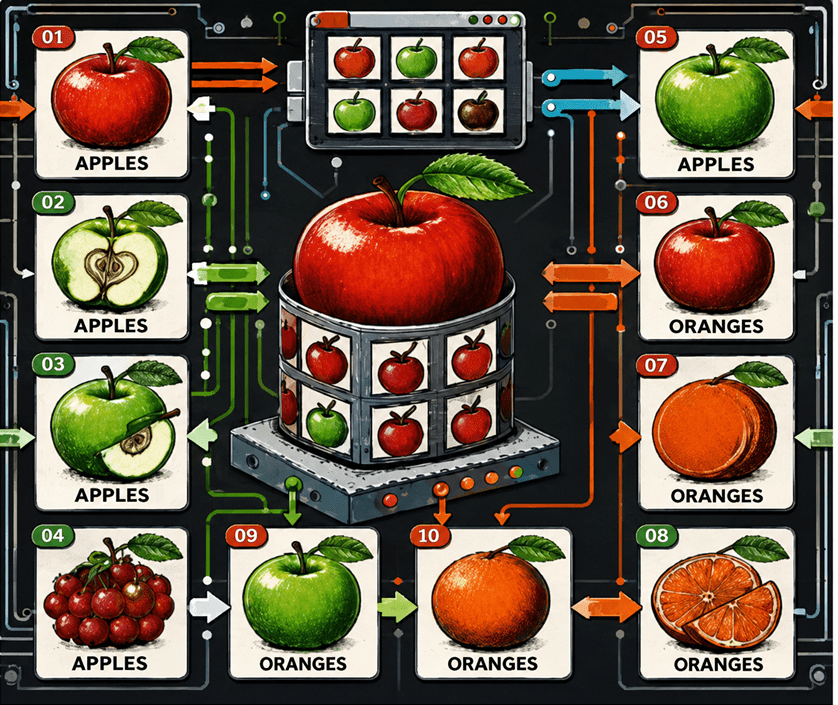
The machine is categorising images into "Apples" and "Oranges". Which type of machine learning is being used here?
- Supervised Learning
- Unsupervised Learning
- Reinforcement Learning
- Rule-Based Decision Making
Answer
Supervised Learning
Reason — The machine is trained using labelled images (Apples and Oranges), and after training it classifies similar images into the correct category. This process is defined as Supervised Learning, where both input data and corresponding output labels are provided.
What is the main difference between automated and autonomous systems?
- Autonomous systems require human intervention for every task
- Automated systems can adapt to new situations
- Autonomous systems can make decisions based on data and adapt to new situations
- Automated systems use AI to learn and improve
Answer
Autonomous systems can make decisions based on data and adapt to new situations
Reason — Autonomous systems can make decisions and adapt to new situations independently, whereas automated systems operate based on pre-programmed rules and instructions and cannot adapt without reprogramming.
Which feature is NOT associated with automated systems?
- Pre-defined rules
- Learning from experiences
- Repetition and consistency
- Cost-effectiveness
Answer
Learning from experiences
Reason — Automated systems do not learn from past experiences and cannot adapt to new situations. They work only on pre-defined rules, perform repetitive tasks with consistency, and are cost-effective, but lack learning ability.
What enables autonomous systems to adapt and learn from new situations?
- Pre-programmed rules
- Machine learning and AI
- Sensors and actuators
- Human intervention
Answer
Machine learning and AI
Reason — Autonomous systems are powered by Artificial Intelligence (AI) and use machine learning to learn from past experiences and improve their performance, which enables them to adapt to new or unexpected situations.
Which of the following is not a type of machine learning?
- Supervised Learning
- Unsupervised Learning
- Reinforcement Learning
- Semi-supervised Learning
Answer
Semi-supervised Learning
Reason — Machine learning is broadly categorised into three types: Supervised Learning, Unsupervised Learning and Reinforcement Learning.
What type of decision-making do machines rely on?
- Emotional decision-making
- Randomised decision-making
- Intuitive decision-making
- Rule-based, data-driven and AI-based decision-making
Answer
Rule-based, data-driven and AI-based decision-making
Reason — Decision-making in machines is categorised into Rule-Based Decision Making, Data-Driven Decision Making, and AI-Based Decision Making, where machines follow pre-set rules, analyse data patterns, or learn from past experiences to make decisions.
State whether the following statements are True or False:
- Automated systems can learn and adapt to new situations without reprogramming.
- Autonomous systems require minimal human intervention after setup.
- Decision-making in machines can be categorised into rule-based, data-driven and AI-based approaches.
- A self-driving car is an example of an automated system.
- Supervised learning requires labelled data for training, whereas unsupervised learning does not.
- In machine learning, the first step is data pre-processing before collecting data.
Answer
- False
Corrected Statement: Automated systems cannot learn and adapt to new situations without reprogramming. - True
- True
- False
Corrected Statement: A self-driving car is an example of an autonomous system. - True
- False
Corrected Statement: In machine learning, the first step is data collection before data pre-processing.
Assertion (A): Autonomous systems can operate independently and adapt to new environments.
Reason (R): Autonomous systems are equipped with AI and machine learning, enabling them to make decisions based on real-time data.
Based on the above discussion, choose an appropriate statement from the options given below:
- Both A and R are true and R is the correct explanation of A.
- Both A and R are true and R is not the correct explanation of A.
- A is true but R is false.
- A is false but R is true.
- Both A and R are false.
Answer
Both A and R are true and R is the correct explanation of A.
Reason — Autonomous systems can operate independently and adapt to new environments because they are powered by Artificial Intelligence (AI) and use machine learning to make decisions based on real-time data and learn from past experiences.
A robotic vacuum cleaner is cleaning a room. It detects furniture in its path and automatically navigates around it without human assistance, eventually learning the layout of the room. What type of system is the robotic vacuum cleaner, and which feature enables this behaviour?
(a) Automated system: Pre-defined rules
(b) Autonomous system: Learning capability
(c) Automated system: Repetition and consistency
(d) Autonomous system: Human intervention
Answer
Autonomous system: Learning capability
Reason — The robotic vacuum cleaner detects furniture, navigates around it without human assistance, and learns the layout of the room. This shows that it is an autonomous system with learning capability, which allows it to adapt and improve over time.
Write short notes on Automated Systems.
Answer
An automated system is a type of machine or process that is programmed to perform specific tasks without needing constant supervision or control by a person. These systems are designed to follow pre-defined rules or instructions, allowing them to complete repetitive or predictable tasks efficiently. They cannot think for themselves or adapt to new situations, but they follow instructions exactly as they were programmed to do.
Write short notes on Decision-making in Machines.
Answer
Decision making involves identifying the most suitable option from several alternatives based on specific guidelines or requirements. Machines and computers make decisions by processing information, following pre-defined rules and selecting actions that align with their programming. Machines use algorithms and step-by-step instructions to make decisions. Depending on the complexity, decision making in machines can be rule-based, data-driven, or AI-based, enabling them to perform tasks effectively and efficiently.
Write short notes on Reinforcement Learning.
Answer
Reinforcement learning is a type of machine learning in which a machine learns through the process of trial and error and is therefore also known as learning from mistakes. In this method, the machine learns by interacting with its environment and improves its performance based on the rewards it receives. Reinforcement learning involves three main components: Agent, Environment and State (Actions). The agent interacts with the environment, takes actions, learns from its experiences, and gradually finds the best outcome through repeated practice.
Write short notes on Role of data in Machine Learning.
Answer
Data refers to raw, unprocessed facts or inputs that serve as the foundation for machine learning. Machines store a huge amount of data and are trained using this data to identify patterns and relationships. Through processing, raw data is transformed into meaningful information, which helps machines make decisions, predictions, and classifications. The quality, diversity, and volume of data play a crucial role in determining the accuracy and effectiveness of machine learning systems.
Write short notes on Unsupervised Learning.
Answer
The term unsupervised means to perform certain activity without anyone’s supervision or direction. In this case, the data is not labelled explicitly. The machine is required to figure out the dataset to discover a pattern and derive an output. It means that the machine is required to figure out the patterns on its own without any supervision and derive a result.
Write short notes on Machine Learning.
Answer
Machine learning is a process in which a machine stores a huge amount of data and is trained based on previously stored data. With the help of this training, the machine tries to predict the expected outcome. This is how a machine starts learning.
Machine learning can be defined as the application of data and algorithms to replicate human learning capabilities, where computer systems learn from their own experiences and data sets instead of being specifically programmed. It enables systems to identify patterns, make predictions and improve performance over time.
Differentiate between automated and autonomous systems.
Answer
Differences between automated and autonomous systems are:
| Feature | Automated Systems | Autonomous Systems |
|---|---|---|
| Definition | Operate based on pre-programmed rules and instructions. | Can make decisions and adapt to new situations independently. |
| Decision-Making | No decision-making ability; follows a fixed set of rules. | Can analyse data and make decisions based on circumstances. |
| Flexibility | Cannot adapt or respond to changes without reprogramming. | Flexible and adaptable to unexpected changes in the environment. |
| Learning Ability | Do not learn from past experiences. | Use machine learning or AI to improve performance over time. |
| Human Intervention | Requires human programming and monitoring for updates. | Requires minimal human intervention after setup. |
| Handles | Handles simple, repetitive tasks efficiently. | Handles complex and dynamic tasks requiring real-time analysis. |
| Sensors and Data | Limited use of sensors and does not rely heavily on data. | Relies on advanced sensors and real-time data for decision-making. |
| Cost | Typically less expensive to develop and deploy. | Higher initial development costs due to complexity and AI. |
| Dependence on Programming | Fully dependent on pre-defined programming. | Uses AI to reduce reliance on rule-based programming. |
| Response to Unexpected Events | Cannot handle unexpected scenarios; may stop functioning. | Can evaluate and respond to unexpected situations intelligently. |
| Examples | Washing machines, traffic lights, assembly line robots. | Self-driving cars, delivery drones, smart personal assistants. |
Explain the importance and challenges of decision-making in machines.
Answer
Importance of decision making in machines:
- Efficiency: Machines can make decisions faster than humans and therefore save time.
- Precision: Machines follow exact rules, reducing errors.
- Scalability: Machines handle large amounts of data and decisions that humans cannot manage.
For example, AI systems process millions of online transactions to detect fraud.
Challenges in decision making in machines:
- Dependence on Data: Machines rely heavily on the quality and quantity of data. Poor data leads to poor decisions.
- Ethical Concerns: In critical areas like healthcare or self-driving cars, decision making raises ethical questions.
- Limited Understanding: Machines do not have human-like intuition or empathy, which limits their ability to handle unpredictable or subjective situations.
Differentiate between Data and Information.
Answer
Differences between between Data and Information are:
| Basis | Data | Information |
|---|---|---|
| Definition | Raw, unprocessed facts or inputs. | Processed and organised data with meaning. |
| Purpose | Serves as the foundation for machine learning. | Helps in making decisions or predictions. |
| Nature | Unorganised and requires processing. | Organised and interpreted with context and meaning. |
| Example | Images of animals. | Recognising patterns like “cats have whiskers.” |
What are the features and limitations of autonomous systems?
Answer
Features of Autonomous Systems:
- Decision-Making Ability: They can make decisions based on the data they collect and analyse.
- Adaptability: Autonomous systems can adjust their behaviour to handle unexpected situations or changes in the environment.
- Learning Capability: Many autonomous systems use machine learning to improve their performance by learning from past experiences.
- Minimal Human Intervention: Once set up, these systems require very little human supervision, making them highly efficient.
Limitations of Autonomous Systems:
- High Development Costs: Building and programming autonomous systems require significant investment in technology and expertise.
- Limited Creativity: Autonomous systems lack creativity or human intuition.
- Dependency on Data and Sensors: They rely heavily on sensors and accurate data. If a sensor fails or data is incorrect, the system might make poor decisions.
- Ethical Concerns: Decisions made by autonomous systems in critical situations can raise ethical questions.
- Lack of Full Autonomy: Most autonomous systems today are not fully autonomous and require occasional human intervention.
Distinguish between Supervised Learning and Unsupervised Learning.
Answer
Differences between Supervised Learning and Unsupervised Learning are:
| Supervised Learning | Unsupervised Learning |
|---|---|
| In this type of learning, a machine learns under the guidance of a user or a developer. | The term unsupervised means to perform certain activity without anyone’s supervision or direction. |
| Uses labelled data for training. | The data is not labelled explicitly. |
| The input/labelled data and the output are provided to train the model. | The machine is required to figure out the dataset to discover a pattern and derive an output. |
| After training, the model predicts the correct output for the same or similar test data. | The machine is required to figure out patterns on its own without any supervision and derive a result. |
How do machines and humans differ in decision-making?
Answer
Machines and humans differ in decision-making in the following ways:
| Basis | Human Decision Making (Subjective) | Machine Decision Making (Objective) |
|---|---|---|
| Basis of Decision | Personal judgment, emotions and experience. | Facts, data and predefined rules. |
| Flexibility | Highly flexible; adapts to unique and unforeseen situations. | Rigid; limited to pre-programmed logic and available data. |
| Bias | Susceptible to emotional and cognitive biases. | Free from emotional bias but can inherit bias from flawed data. |
| Consistency | Inconsistent; decisions may vary across similar scenarios. | Consistent; always delivers the same result for the same input. |
| Speed | Slower, especially for complex problems requiring thought. | Faster; processes data quickly to produce results. |
| Examples | Deciding to help someone based on their apparent need. | A vending machine dispensing snacks based on payment received. |
What are the key challenges in decision making in Machine?
Answer
The key challenges in decision making in machines are as follows:
Dependence on Data: Machines rely heavily on the quality and quantity of data. Poor data leads to poor decisions.
Ethical Concerns: In critical areas like healthcare or self-driving cars, decision making raises ethical questions.
Limited Understanding: Machines do not have human-like intuition or empathy, which limits their ability to handle unpredictable or subjective situations.
Describe the steps involved in the process of machine learning.
Answer
The steps involved in the process of machine learning are as follows:
Data Collection: Relevant data is gathered for the task, such as images, text, numbers or other examples.
Data Pre-processing: The collected data is cleaned, duplicate or incorrect data is removed, and the data is converted into a suitable format.
Training Data and Labels: The data is divided into training data and labels. Training data gives the inputs, while labels give the correct answers or outcomes.
Algorithm Training: A machine learning algorithm is applied to the training data so that the machine can learn patterns, relationships and rules.
Model Evaluation: The trained model is tested with separate data to check its accuracy and performance.
Model Optimisation: If the model does not perform well, changes are made to improve its accuracy.
Prediction or Decision Making: After training, the model is used to make predictions or decisions on new data.
Continuous Learning and Improvement: As new data becomes available, the model can be updated and retrained to improve its performance.
Discuss the applications of machine learning in real-world scenarios.
Answer
Machine learning has many real-world applications. Some important examples are:
Image and Speech Recognition: It helps machines identify objects, faces and scenes in images or videos, and also supports voice assistants and speech recognition systems.
Natural Language Processing: It helps machines understand and process human language in chatbots, translation tools, spam detection and text analysis.
Recommendation Systems: It suggests products, movies, music or articles by analysing user preferences and past behaviour.
Fraud Detection: It identifies unusual patterns in financial transactions and helps detect suspicious or fraudulent activities.
Healthcare: It helps in disease diagnosis, medical image analysis and predicting patient outcomes.
Autonomous Vehicles: It helps self-driving vehicles detect objects, track lanes, make decisions and use sensor data for safe movement.
Financial Forecasting: It is used for stock market analysis, credit scoring and predicting financial trends.
Energy Optimisation: It helps improve energy usage in smart grids and energy management systems.
Manufacturing and Quality Control: It helps detect defects, monitor machines and reduce downtime through predictive maintenance.
Environmental Monitoring: It helps analyse weather data, satellite images and sensor readings to monitor air quality and climate patterns.