
Fill in the blanks:
(a) The root cap acts as a ............... tissue.
(b) The apparatus used to demonstrate osmosis is called ................
(c) Osmosis is the diffusion of ............... molecules only.
Answer
(a) The root cap acts as a protective tissue.
(b) The apparatus used to demonstrate osmosis is called osmometer.
(c) Osmosis is the diffusion of water molecules only.
Name the following:
(a) Flow of water from the cell to the outer environment.
(b) The process in which dead plant cells absorb water by surface tension.
(c) The diffusion of water molecules only.
Answer
(a) Exosmosis
(b) Imbibition
(c) Osmosis
Name the following:
(i) Collectively, they form the transport system throughout the entire plant. What does 'they' refer to?
(ii) The pressure developed in the roots due to continuous inward movement of water through cell to cell osmosis.
(iii) The state of a cell, in which the cell wall is rigid and stretched by the increase in volume of vacuoles due to absorption of water.
(iv) The phenomenon of loss of water through a cut stem or injured part of plant.
(v) The solution, which keeps the size and shape of the cell unchanged.
Answer
(i) Vascular tissues, i.e., xylem and phloem.
(ii) Root pressure
(iii) Turgidity
(iv) Bleeding (exudation)
(v) Isotonic solution
List at least five important roles of water and other minerals in plants.
Answer
Five important roles of water and other minerals in plants are:
- Water acts as a medium for the transportation of dissolved substances from roots to the upper parts of the plant.
- Water is used as a raw material in photosynthesis for the synthesis of glucose.
- Water provides turgidity, giving mechanical stiffness to plant tissues.
- A large quantity of water is given out as vapour during transpiration and helps in maintaining the plant's temperature.
- Minerals act as building blocks for many compounds and serve as constituents of cells, cell organelles and enzymes synthesised by the plant.
List the processes by which absorption and upward conduction of water and other minerals occur in roots of plants.
Answer
Absorption of water and minerals occurs by the processes of imbibition, diffusion, osmosis and active transport.
Upward conduction of water and minerals occurs by root pressure, capillary force (capillarity) and transpiration pull, aided by the cohesive and adhesive forces of water molecules.
A cell kept in a solution shrinks in size and loses its shape. The solution is
- hypertonic
- isotonic
- hypotonic
- pond water
Answer
hypertonic
Reason — In a hypertonic solution the concentration of solutes is more than that of the cell sap. When a cell is kept in such a solution, water moves out of the cell by exosmosis, so the cell shrinks in size and loses its shape.
A shoot from a balsam plant is kept in an eosin solution (pink coloured) for 3–4 hours. The pink colour is likely to be seen in
- phloem tissue
- cortex
- xylem tissue
- endodermis
Answer
xylem tissue
Reason — Xylem conducts water and dissolved minerals upward in the plant. The coloured eosin solution rises up through the xylem, so the xylem tissue gets stained pink.
Hari is fond of watching the fish in an aquarium. So, he set up an aquarium in his house. Along with a number of freshwater fish, he also placed a clown fish which is a salt water fish. After few hours, the clown fish was found dead and floating on water. This was due to:
- Endosmosis
- Exosmosis
- Osmoregulation
- Excretion
Answer
Endosmosis
Reason — The clown fish is a saltwater fish whose body fluids are hypertonic to freshwater. In the freshwater aquarium (hypotonic surrounding), water enters its body cells by endosmosis, causing the cells to swell and burst, which leads to its death.
The space between the cell wall and plasma membrane in a plasmolysed cell is filled with
- hypotonic solution
- isotonic solution
- water
- hypertonic solution
Answer
hypertonic solution
Reason — During plasmolysis the cell is kept in a hypertonic solution. As the cell wall is freely permeable, this outside hypertonic solution passes in and fills the space created between the cell wall and the shrunken plasma membrane.
A plant cell may burst when:
- Turgor pressure equalises wall pressure.
- Turgor pressure exceeds wall pressure.
- Wall pressure exceeds turgor pressure.
- None of the above.
Answer
Turgor pressure exceeds wall pressure.
Reason — Wall pressure normally balances turgor pressure and prevents further entry of water. If turgor pressure exceeds the wall pressure, the wall can no longer resist the outward push of the cell contents and the cell may burst.
In osmosis, sequence of path of water is
- root hair, cortical cells, vascular cells
- cortical cells, vascular cells, root hair
- root hair, vascular cells, cortical cells
- vascular cells, cortical cells, root hair
Answer
root hair, cortical cells, vascular cells
Reason — Water first enters the root hair by osmosis, then passes from cell to cell through the cortical cells and finally reaches the vascular (xylem) cells.
Assertion (A): Diffusion involves the movement of molecules from the region of their lower concentration to the region of higher concentration.
Reason (R): Diffusion of molecules do not require energy.
- Both (A) and (R) are true
- Both (A) and (R) are false
- Both (A) and (R) are true and (R) is the correct explanation of (A)
- Both (A) and (R) are true but (R) is not the correct explanation of (A)
Answer
(A) is false and (R) is true.
Explanation — Diffusion is the movement of molecules from the region of their higher concentration to the region of their lower concentration, so the Assertion is false. Diffusion is a passive process that does not require energy, so the Reason is true.
Deplasmolysis occur when a plasmolysed cell is placed in
- Concentrated salt solution
- Tap water
- Concentrated sugar solution
- Hypertonic salt solution
Answer
Tap water
Reason — Tap water is hypotonic to the cell sap of a plasmolysed cell. Water re-enters the cell by endosmosis, the protoplasm swells back to its original position and the cell becomes turgid. This recovery is called deplasmolysis.
For which of the following, energy is required?
- Passive transport
- Osmosis
- Diffusion
- Active transport
Answer
Active transport
Reason — Active transport is the movement of substances against the concentration gradient (from lower to higher concentration) through a living membrane, and this requires energy in the form of ATP supplied by the cell.
The process of osmosis is considered as a special type of diffusion. Few important features of this process are listed below.
A. It involves the net movement of solute molecules only. B. It occurs across a semi-permeable membrane. C. The inward or outward movement of molecules across the cell depends upon the concentration of solution.
Choose the option that represents the correct statements about osmosis.
- A, B and C
- A and B
- B and C
- Only B
Answer
B and C
Reason — Osmosis involves the net movement of water (solvent) molecules only, not solute molecules, so statement A is wrong. Osmosis occurs across a semi-permeable membrane (B) and its inward or outward direction depends on the concentration of the surrounding solution (C).
The cell wall of root hair is made up of two layers. Outer layer is composed of
- Cellulose
- Lignin
- Pectin
- Lipids
Answer
Pectin
Reason — The cell wall of a root hair is made up of two layers — the outer layer is composed of pectin and the inner layer is composed of cellulose.
The hydrostatic pressure of the cell sap on the cell wall is called
- Wall pressure
- Atmospheric pressure
- Turgor pressure
- Osmotic pressure
Answer
Turgor pressure
Reason — The hydrostatic pressure exerted by the cell sap (cell contents) on the cell wall is called turgor pressure.
The pressure developed in the roots due to continuous inward movement of water by cell to cell osmosis:
- Root pressure
- Wall pressure
- Turgor pressure
- Air pressure
Answer
Root pressure
Reason — The continuous inward movement of water by cell to cell osmosis makes the cortical cells turgid, and they force water into the xylem. This develops a pressure in the roots called root pressure.
When a cell is placed in a ............... solution it becomes plasmolysed.
- Distilled water
- Hypertonic
- Isotonic
- Hypotonic
Answer
Hypertonic
Reason — In a hypertonic solution, water moves out of the cell by exosmosis. The protoplasm shrinks and the plasma membrane withdraws from the cell wall, so the cell becomes plasmolysed.
A shoot from a balsam plant is kept in a beaker containing eosin solution (pink). The pink colour will be distinctly seen in the:
- Xylem
- Phloem
- Epidermis
- Cortex
Answer
Xylem
Reason — Xylem is the tissue that conducts water and dissolved minerals upward. The coloured eosin solution rises through the xylem, so the pink colour is distinctly seen in the xylem.
Xylem tissue:
- Conducts water and minerals in leaves
- Does not conduct water and minerals in stems
- Conducts food and nutrients to roots
- Conducts food and nutrients to all parts of the plant
Answer
Conducts water and minerals in leaves
Reason — Xylem is the water-conducting tissue of the plant. It carries water and dissolved minerals upward from the roots to the stem and leaves.
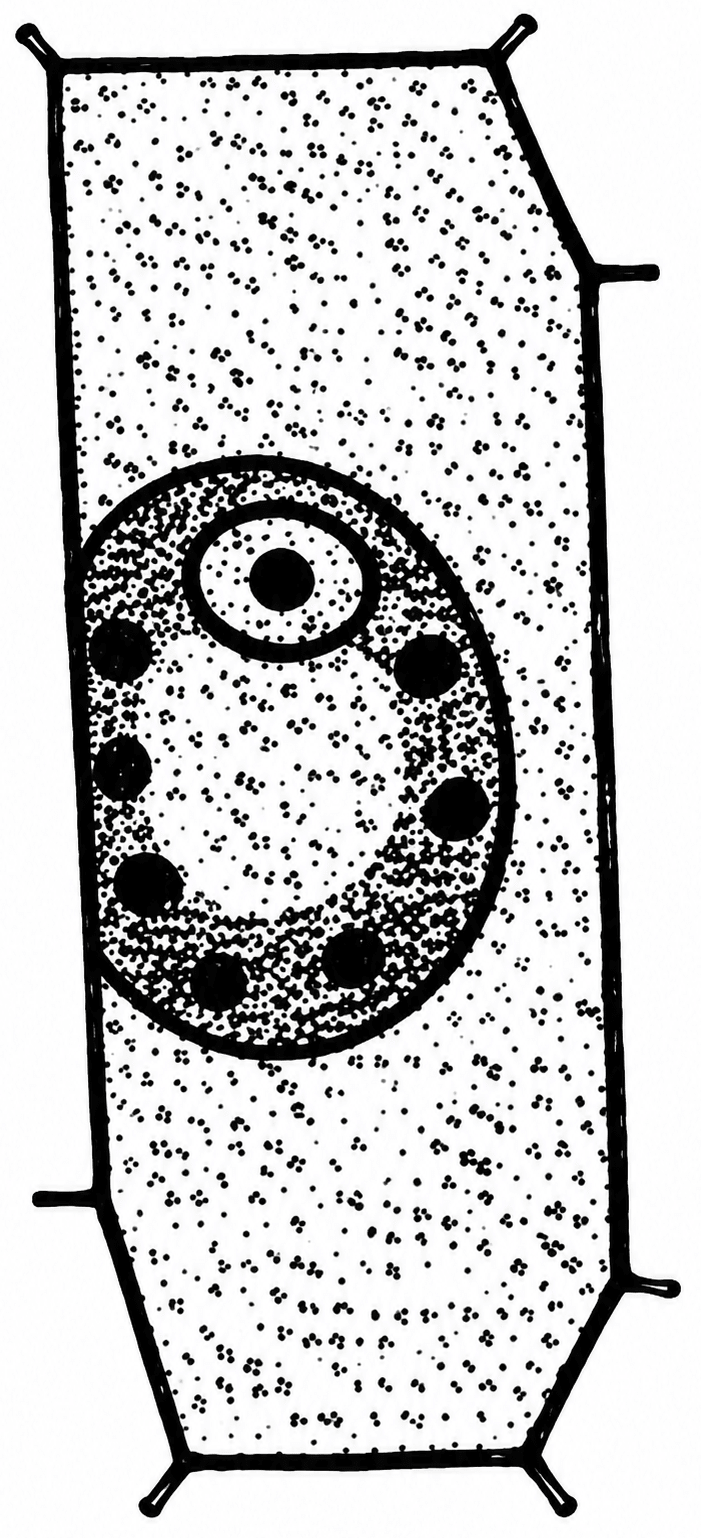
During a practical exam, a plant cell in a particular solution was placed under a compound microscope. Students were told to observe the cell and name the tonicity of the solution and mention the process that occurred in the cell.
- Isotonic, Endosmosis
- Hypotonic, Active Transport
- Hypertonic, Endosmosis
- Hypertonic, Exosmosis
Answer
Hypertonic, Exosmosis
Reason — In the figure the protoplasm has shrunk and withdrawn from the cell wall, showing that the cell has lost water. This happens when the cell is placed in a hypertonic solution, in which water moves out of the cell by exosmosis.
Assertion (A): A turgid plant cell is in a balanced state.
Reason (R): In a turgid cell, turgor pressure and wall pressure are equal and in the same direction.
- (A) is true and (R) is false.
- (A) is false and (R) is true.
- Both (A) and (R) are true.
- Both (A) and (R) are false.
Answer
(A) is true and (R) is false.
Explanation — A turgid cell is in a balanced state because no more water can enter it. However, in a turgid cell the turgor pressure and wall pressure are equal but act in opposite directions, not in the same direction. Hence the Reason is false.
............... is the result of inward movement of water molecules.
- Plasmolysis
- Flaccidity
- Exosmosis
- Deplasmolysis
Answer
Deplasmolysis
Reason — The inward movement of water molecules (endosmosis) into a plasmolysed cell makes the protoplasm swell back to its original position. This recovery is called deplasmolysis.
During the absorption of water by root hairs, processes P and Q are involved.
- P - Imbibition, Q - Diffusion
- P - Osmosis, Q - Active Transport
- P - Diffusion, Q - Active Transport
- P - Imbibition, Q - Osmosis
Answer
P - Imbibition, Q - Osmosis
Reason — During absorption of water, imbibition first helps in the uptake of soil water by the root hair, and then osmosis draws water into the root hair because its cell sap is of higher concentration than the surrounding soil water.
A cell of a leaf of an aquatic plant is kept in a 5% salt solution for some time. The phenomenon which will take place is/are:
- turgidity
- plasmolysis
- turgidity and flaccidity
- plasmolysis and flaccidity
Answer
plasmolysis and flaccidity
Reason — A 5% salt solution is hypertonic to the cell sap. Water moves out of the cell by exosmosis, the cell becomes flaccid and its protoplasm shrinks away from the cell wall, i.e., it gets plasmolysed.
A teacher asked her students to list the main functions of roots in plants.
Raj said: Roots absorb water and minerals from the soil.
Sonu said: Roots provide mechanical support and fix the plant to the soil.
Lata said: Roots conduct food prepared by leaves to other parts of the plant.
Abhay said: Roots participate in photosynthesis and maintain plant temperature.
Who were correct?
- Raj and Lata
- Sonu and Abhay
- Raj and Sonu
- Lata and Abhay
Answer
Raj and Sonu
Reason — Roots absorb water and minerals from the soil (Raj) and fix the plant firmly to the soil, giving mechanical support (Sonu). Conduction of food is done by phloem, not roots, so Lata is wrong, and roots do not carry out photosynthesis, so Abhay is wrong.
Mary sprinkled 5 kg of common salt on the grass growing on her lawn. After a couple of days, she observed that the grass had wilted and died. This was due to which of the following conditions?
- Endosmosis
- Turgidity
- Deplasmolysis
- Plasmolysis
Answer
Plasmolysis
Reason — The common salt makes the soil solution hypertonic to the grass cells. Water moves out of the cells by exosmosis, the cells become plasmolysed, and the grass wilts and dies.
Rohit was conducting an experiment to observe water absorption in plants. He placed two pots, one with a plant and one without, both containing soil and watered equally. After a week, he noticed that the plant in the pot with soil had grown significantly, while the pot without the plant showed no growth. Which process is most likely being demonstrated in Rohit's experiment?
- Imbibition
- Photosynthesis
- Diffusion
- Osmosis
Answer
Osmosis
Reason — The plant absorbed water from the soil through its roots by osmosis, which supported its growth. The pot without a plant had no root hairs to absorb water, so no such change was seen.
Tina was examining different types of cell transport mechanisms and makes the following observations:
| P | Requires energy to move substances |
| Q | Does not require energy to move substances |
Based on Tina's observations, match the following transport mechanisms to their characteristics:
- Active Transport - Moves substances from high to low concentration without energy; Passive Transport - Moves substances from low to high concentration with energy.
- Active Transport - Requires energy to move substances from low to high concentration; Passive Transport - Moves substances from high to low concentration without energy.
- Active Transport - Moves substances from high to low concentration with energy; Passive Transport - Moves substances from low to high concentration without energy.
- Active Transport - Moves substances from low to high concentration without energy; Passive Transport - Requires energy to move substances from high to low concentration.
Answer
Active Transport - Requires energy to move substances from low to high concentration; Passive Transport - Moves substances from high to low concentration without energy.
Reason — Active transport moves substances against the gradient, i.e., from lower to higher concentration, and needs energy (P). Passive transport moves substances along the gradient, i.e., from higher to lower concentration, without using energy (Q).
Name the following:
(i) The movement of water molecules from the region of their higher concentration to lower concentration through a semi-permeable membrane.
(ii) Food conducting tissue in plants.
(iii) The tissues responsible for upward movement of water.
(iv) The process by which water enters root hairs.
(v) The condition of plant cell placed in hypertonic solution.
(vi) The process by which root hairs absorb water from the soil.
(vii) Movement of molecules of a substance from their higher concentration to lower concentration when they are in direct contact.
Answer
(i) Osmosis
(ii) Phloem
(iii) Xylem
(iv) Endosmosis
(v) Plasmolysis
(vi) Osmosis
(vii) Diffusion
Given below is an experimental setup. Read the information given below the diagram and answer the questions.
Concentrated sugar solution is taken in the thistle funnel. The mouth of the thistle funnel is covered with cellophane paper. The thistle funnel is inverted in a beaker containing water.
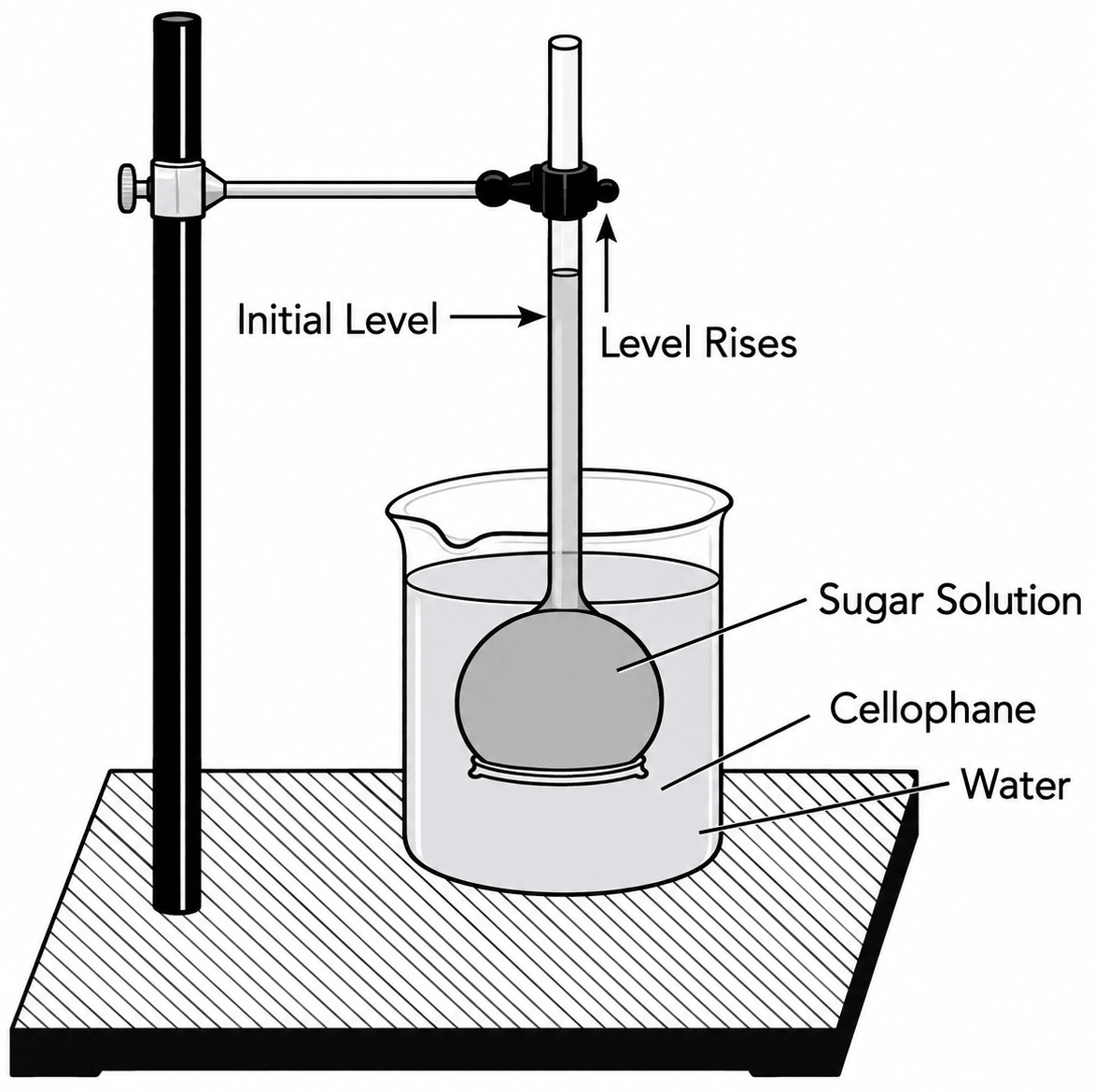
(a) The above experiment demonstrates ........(i)....... .
(b) After a few hours, the level of the sugar solution ........(ii)........ in the thistle funnel.
(c) It allows only ........(iii)........ molecules to pass through it freely.
(d) It prevents the passage of ........(iv)........ molecules.
(e) A control experiment can be set up by taking plain ........(v)........ in the thistle funnel and placing it in another beaker containing water.
Answer
(a) (i) osmosis
(b) (ii) rises
(c) (iii) water
(d) (iv) sugar (solute)
(e) (v) water
Give the specific function of the following structures:
(i) Xylem
(ii) Phloem
(iii) Root hairs
(iv) Stomata
(v) Thylakoids
Answer
(i) Xylem — Conducts water and dissolved minerals upward from the roots to the stem and leaves.
(ii) Phloem — Conducts (translocates) the prepared food from the leaves to other parts of the plant.
(iii) Root hairs — Absorb water and minerals from the soil.
(iv) Stomata — Help in the exchange of gases and in transpiration (loss of water vapour).
(v) Thylakoids — Contain chlorophyll and are the site of the light reactions of photosynthesis, trapping light energy.
Arrange and rewrite the terms in each group in correct order to be in a logical sequence beginning with the term that is underlined.
(i) Xylem, Soil water, cortical cells, Root hair.
(ii) Endodermis, Cortex, Xylem, Epidermis.
Answer
(i) Soil water → Root hair → cortical cells → Xylem
(ii) Epidermis → Cortex → Endodermis → Xylem
Match the following:
| Column A | Column B |
|---|---|
| (i) Diffusion | (a) Xylem |
| (ii) Semipermeable | (b) Osmosis |
| (iii) Diffusion of water | (c) Mixing of molecules |
| (iv) Upward flow of water | (d) Phloem |
| (v) Permeable | (e) Cell wall |
| (vi) Downward flow of food | (f) Cell membrane |
Answer
| Column A | Column B |
|---|---|
| (i) Diffusion | (c) Mixing of molecules |
| (ii) Semipermeable | (f) Cell membrane |
| (iii) Diffusion of water | (b) Osmosis |
| (iv) Upward flow of water | (a) Xylem |
| (v) Permeable | (e) Cell wall |
| (vi) Downward flow of food | (d) Phloem |
Mention whether the following statements are true (T) or false (F). In case of false, rewrite the correct form of the statement by changing the words underlined:
(i) Deplasmolysis is reverse of osmosis.
(ii) Dry seeds when soaked in water, swell up due to diffusion.
(iii) The leaves of a plant wilt on removing its xylem.
(iv) A plant cell placed in hypotonic solution gets plasmolysed.
(v) The cell wall of the root hair is a differentially permeable membrane.
(vi) The cell sap of root hair is Hypotonic.
(vii) Freshwater fish when placed in hypertonic salt solution absorb water and burst.
Answer
(i) False
Corrected Statement — Deplasmolysis is reverse of plasmolysis.
(ii) False
Corrected Statement — Dry seeds when soaked in water, swell up due to imbibition.
(iii) True
(iv) False
Corrected Statement — A plant cell placed in hypertonic solution gets plasmolysed.
(v) False
Corrected Statement — The cell wall of the root hair is a permeable membrane.
(vi) False
Corrected Statement — The cell sap of root hair is hypertonic.
(vii) False
Corrected Statement — Freshwater fish when placed in hypertonic salt solution lose water and shrink.
Define Osmosis.
Answer
Osmosis is the net movement of water molecules from their region of higher concentration (dilute solution with lower solute concentration) to their region of lower concentration (concentrated solution with higher solute concentration) through a semi-permeable membrane.
Define Imbibition.
Answer
Imbibition is the phenomenon in which living or dead plant cells, in their dry or semi-dry state, absorb water by surface attraction (surface tension).
Define Turgor pressure.
Answer
Turgor pressure is the hydrostatic pressure exerted by the cell sap (cell contents) on the cell wall.
Define Ascent of sap.
Answer
Ascent of sap is the upward movement of water and dissolved minerals absorbed by the roots, through the xylem, to the stem and leaves of the plant.
Define Turgidity.
Answer
Turgidity is the state of a cell in which the cell wall is rigid and stretched by the increase in the volume of vacuoles due to the absorption of water, so that the cell cannot accommodate any more water.
Define Active transport.
Answer
Active transport is the movement of substances through the cell membrane of living cells from their lower to higher concentration (against the concentration gradient) using metabolic energy (ATP).
Differentiate between Turgidity and Flaccidity
Answer
Differences between Turgidity and Flaccidity are:
| Turgidity | Flaccidity |
|---|---|
| It is the state of a cell in which the cell wall is rigid and stretched due to the absorption of water. | It is the condition in which the cell contents are shrunken and the cell is not tight. |
| It occurs when the cell is placed in a hypotonic solution. | It occurs when the cell is placed in a hypertonic solution. |
| It is caused by endosmosis. | It is caused by exosmosis. |
| Water moves into the cell. | Water moves out of the cell. |
Differentiate between Plasmolysis and Deplasmolysis
Answer
Differences between Plasmolysis and Deplasmolysis are:
| Plasmolysis | Deplasmolysis |
|---|---|
| It is the shrinkage of the cytoplasm and withdrawal of the plasma membrane from the cell wall due to loss of water when the cell is placed in a hypertonic solution. | It is the recovery of a plasmolysed cell when it is placed in water, in which the protoplasm swells back due to the re-entry of water. |
| In plasmolysis the cell becomes flaccid. | In deplasmolysis the cell becomes turgid. |
Differentiate between Hypotonic solution and Hypertonic solution
Answer
Differences between Hypotonic solution and Hypertonic solution are:
| Hypotonic Solution | Hypertonic Solution |
|---|---|
| The solution outside the cell has a lower solute concentration than the fluids inside the cell. | The solution outside the cell has a higher solute concentration than the fluids inside the cell. |
| Endosmosis occurs as water molecules move into the cell. | Exosmosis occurs as water molecules move out of the cell. |
| The cell enlarges and may even burst. | The cell shrinks in size and loses its shape. |
Differentiate between Turgor pressure and Wall pressure
Answer
Differences between Turgor pressure and Wall pressure are:
| Turgor Pressure | Wall Pressure |
|---|---|
| It is the pressure exerted by the cell contents (cell sap) on the cell wall. | It is the pressure exerted by the cell wall on the cell contents. |
| It acts outward against the cell wall. | It acts inward on the cell contents. |
| In a fully turgid cell, it is balanced by wall pressure. | In a fully turgid cell, it is equal and opposite to turgor pressure and prevents further expansion. |
Give reason — Lawn grass is killed if salt is sprinkled on it.
Answer
Sprinkled salt makes the soil solution hypertonic to the grass cells. Water moves out of the cells by exosmosis, the cells become plasmolysed and flaccid, and the grass is killed at that spot.
Give reason — Potato cubes when placed in water become firm and increase in size.
Answer
Potato cubes contain a higher concentration of salts and sugars than the water around them. Water enters the cubes by endosmosis, making the cells turgid, so the cubes become firm and increase in size.
Give reason — Resins swell up when kept in water.
Answer
Resins are made of hydrophilic substances that absorb water by surface attraction. Due to this imbibition of water, they swell up when kept in water.
Give reason — Freshwater fish cannot survive in sea water.
Answer
Sea water is hypertonic to the body fluids of a freshwater fish. Water moves out of its body cells by exosmosis, causing it to lose water and become dehydrated, so it cannot survive in sea water.
Give reason — Plants begin to die when excess of soluble fertilisers are added to the soil.
Answer
Excess soluble fertilisers make the soil solution hypertonic to the root hair cell sap. Water moves out of the root hairs by exosmosis, they become plasmolysed and can no longer absorb water, so the plant wilts and begins to die.
Give reason — Wilted lettuce leaves become crisp/firm when placed in cold water for a while.
Answer
Cold water is hypotonic to the cell sap of the wilted leaves. Water enters the cells by endosmosis, making them turgid, so the leaves become crisp and firm again.
Give reason — Much salt is added to pickles.
Answer
Much salt makes the surroundings hypertonic to microorganisms present in the pickle. Water moves out of their cells by exosmosis, causing plasmolysis and inhibiting their growth, so the pickle is preserved.
Give reason — Root hairs become flaccid and droop when excess fertilizers are added to the moist soil around them.
Answer
Excess fertilizers make the moist soil solution hypertonic to the root hair cell sap. Water moves out of the root hairs by exosmosis, so they lose their turgidity, become flaccid and droop.
Given below is the diagram of a plasmolysed cortical cell of a root.
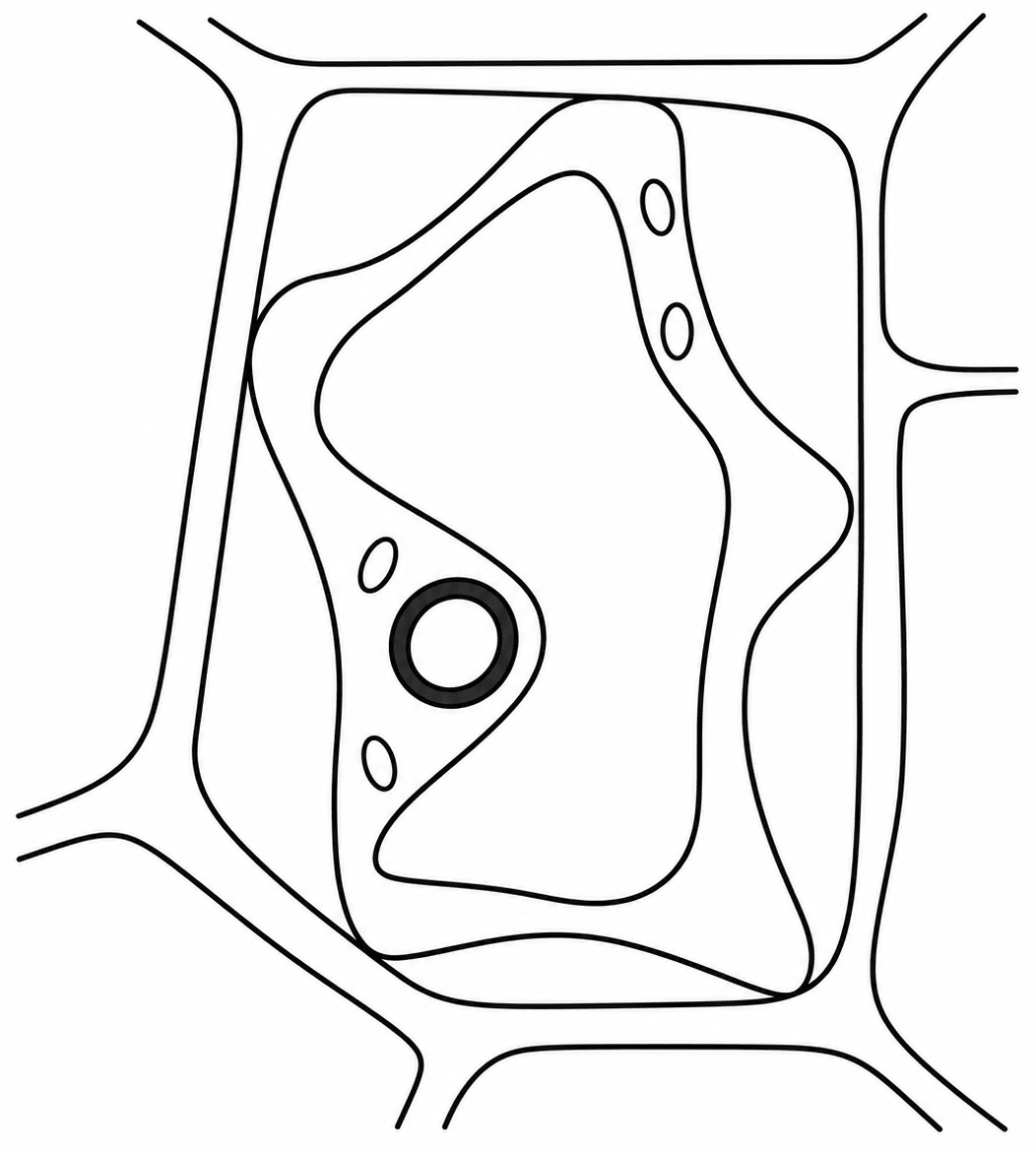
(i) Cytoplasm
(ii) Hypertonic solution
(iii) Plasma membrane
Answer
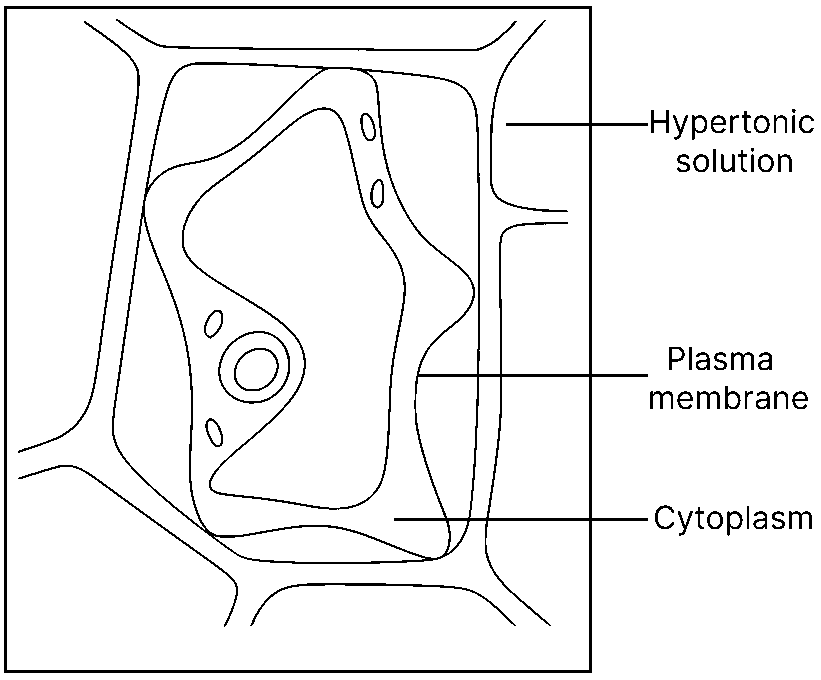
The labelled diagram of the plasmolysed cortical cell is shown below, with the cytoplasm (shrunken protoplasm), the hypertonic solution (in the space between the cell wall and the plasma membrane) and the plasma membrane marked.
What is the significance of osmosis? Explain in brief.
Answer
The significance of osmosis is as follows:
- It helps in the absorption of water and minerals by the roots from the soil.
- It develops turgidity and thus maintains turgor pressure in plant cells, which keeps the plant firm and erect.
- It allows the movement of water from one cell to another, thereby ensuring the flow of water and minerals throughout the plant.
- It regulates the opening and closing of stomata through its control of the turgidity of guard cells.
Explain the following:
(i) What is the utility of plasmolysis?
(ii) What is active transport?
Answer
(i) Utility of plasmolysis — Plasmolysis is used to kill weeds growing in lawns. It is also used in the preservation of food items such as pickles and jams, where a high concentration of salt or sugar plasmolyses and kills the bacteria, preventing their growth.
(ii) Active transport — Active transport is the movement of substances (salts or ions) through the cell membrane of living cells from their lower to higher concentration, i.e., against the concentration gradient. It requires metabolic energy in the form of ATP supplied by the cell.
Explain two manifestations of root pressure.
Answer
Two manifestations of root pressure are:
Bleeding — When the stem of a well-watered plant is cut close to the ground, the cell sap oozes out from the cut end due to root pressure. This exudation of sap from an injured or cut part of the plant is called bleeding.
Guttation — Due to excess root pressure, drops of water are given out along the margins of the leaves of certain plants, especially in the early morning. This loss of water in the form of liquid drops is called guttation.
A marine fish is kept in freshwater:
(i) What would happen to the fish?
(ii) Name the pressure that develops inside the cells of the fish.
Answer
(i) Freshwater is hypotonic to the body fluids of a marine fish. Water enters the body cells of the fish by endosmosis, causing the cells to swell and finally burst, which leads to the death of the fish.
(ii) The pressure that develops inside the cells of the fish is turgor pressure (osmotic pressure).
What is a semi permeable membrane? Name the semi-permeable present in a plant cell.
Answer
A semi-permeable membrane is a membrane which allows the passage of molecules selectively. It allows the solvent (water molecules) to pass through it freely but prevents the passage of the solute (sugar or salt molecules in solution).
The semi-permeable membrane present in a plant cell is the cell membrane (plasma membrane).
(i) Draw a neat, labelled diagram of a root hair.
(ii) Mention one characteristic of roots for absorbing water from the soil.
Answer
(i) A neat, labelled diagram of a root hair is shown below.
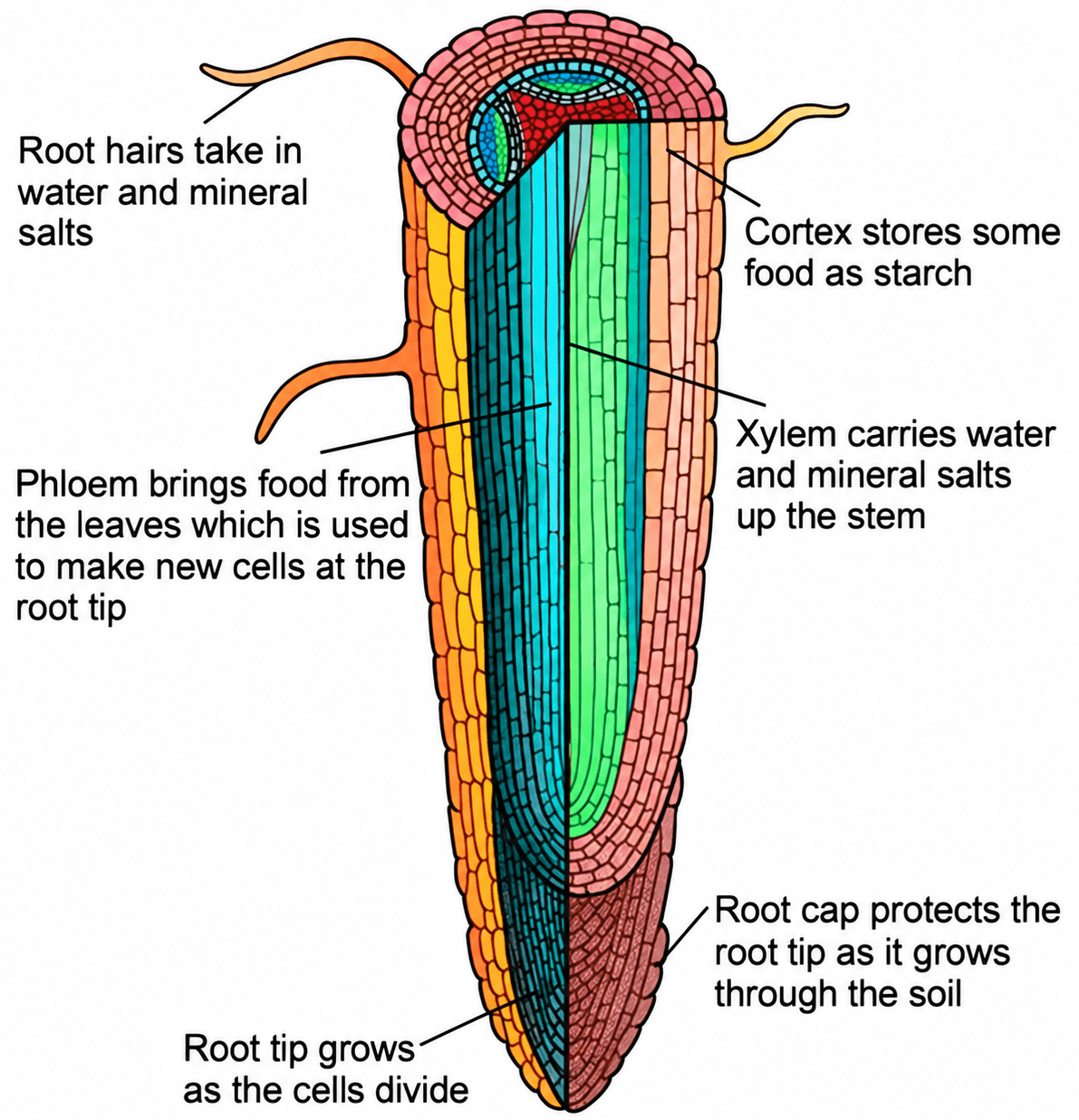
(ii) Root hairs contain cell sap which has a higher concentration than the surrounding soil water. This difference in concentration sets up osmosis, due to which water is drawn into the root hairs from the soil.
Given below are diagrams of plant cells as seen under the microscope after having been placed in two different solutions:
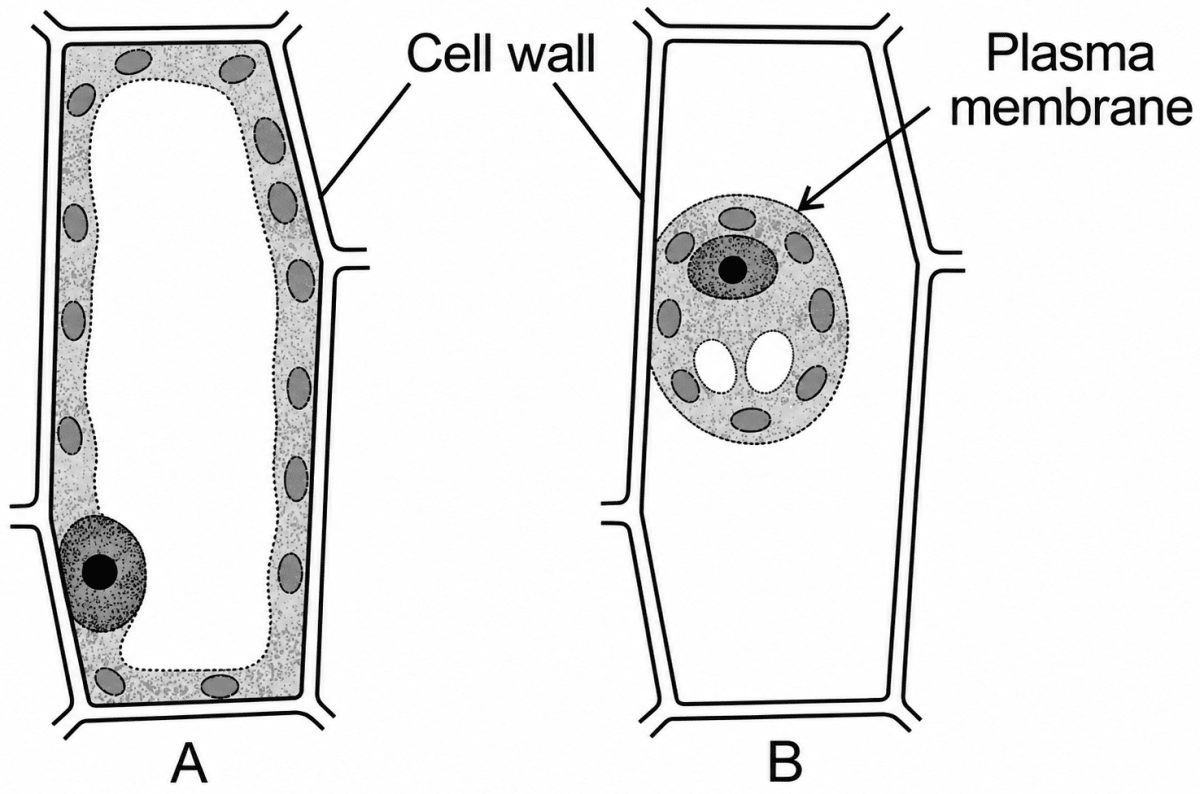
(i) What is the technical term for the condition of:
(a) Cell A
(b) Cell B?
(ii) From the solutions given in brackets (water, strong sugar solution, 1% salt solution) name the solution into which:
(a) Cell A
(b) Cell B, was placed before being viewed under the microscope.
(iii) Under what conditions in the soil will the root hair cell resemble:
(a) Cell A
(b) Cell B
(iv) Name the pressure responsible for the movement of water from the root hair cell to the xylem of the root. How is it set up?
(v) Name the pressure that helps in the movement of water up the xylem of the root.
Answer
(i) (a) Cell A — Turgid
(b) Cell B — Plasmolysed
(ii) (a) Cell A — water
(b) Cell B — strong sugar solution
(iii) (a) Cell A — when the soil has plenty of water, i.e., the soil water is hypotonic to the cell sap, so the root hair absorbs water and becomes turgid.
(b) Cell B — when the soil has an excess of salts or fertilizers, i.e., the soil solution is hypertonic to the cell sap, so the root hair loses water and becomes plasmolysed.
(iv) Root pressure is responsible for the movement of water from the root hair cell to the xylem of the root. It is set up when water absorbed by osmosis passes from cell to cell, making the cortical cells turgid; these turgid cells then force their water content into the xylem, developing root pressure.
(v) Transpiration pull helps in the upward movement of water through the xylem.
Given below is the diagram of an apparatus set-up to study a very important physiological process:
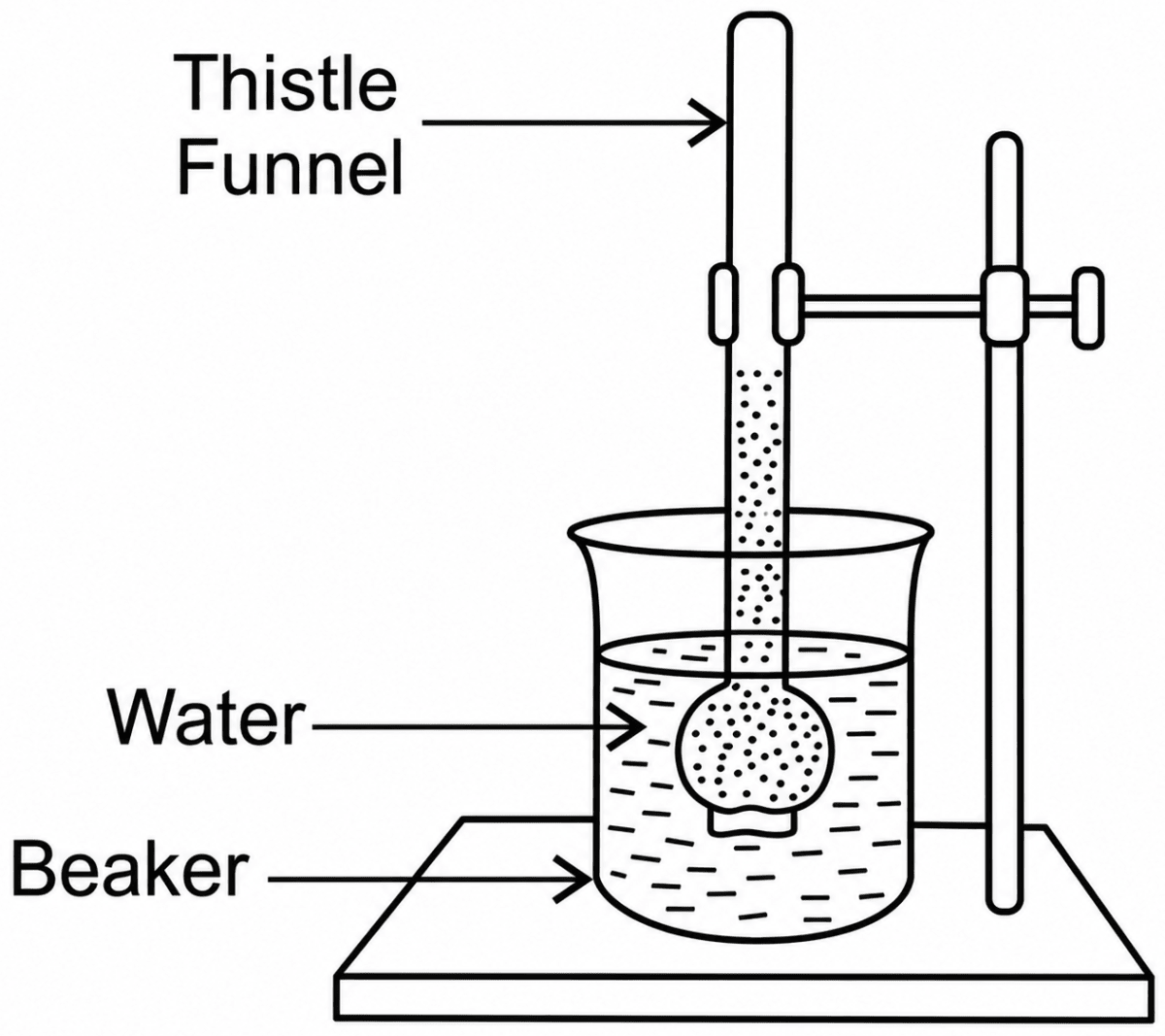
(i) Name the process being studied.
(ii) Explain the process.
(iii) What change would you observe in the thistle funnel containing sugar solution after about 10 minutes?
(iv) Is sugar solution hypertonic or hypotonic?
(v) Name the part of the plant cell which is represented by the sugar solution.
Answer
(i) Osmosis
(ii) Osmosis is the net movement of water molecules from their region of higher concentration (dilute solution with lower solute concentration) to their region of lower concentration (concentrated solution with higher solute concentration) through a semi-permeable membrane. Here, water from the beaker passes through the membrane into the concentrated sugar solution in the thistle funnel.
(iii) After about 10 minutes, the level of the sugar solution in the thistle funnel will rise.
(iv) The sugar solution is hypertonic.
(v) The sugar solution represents the cell sap of the plant cell.
A candidate in order to study the process of osmosis has taken 3 potato cubes and put them in 3 different beakers containing 3 different solutions. After 24 hours, in the first beaker the potato cube increased in size, in the second beaker the potato cube decreased in size and in the third beaker there was no change in the size of the potato cube. The following diagram shows the result of the same experiment:

(i) Give the technical terms for the solutions used in beakers, 1, 2 and 3.
(ii) In beaker 3 the size of the potato cube remains the same. Explain the reason in brief.
(iii) Write the specific feature of the cell sap of root hairs which helps in absorption of water.
(iv) What is osmosis?
(v) How does a cell wall and a cell membrane differ in their permeability?
Answer
(i) Beaker 1 — hypotonic solution; Beaker 2 — hypertonic solution; Beaker 3 — isotonic solution.
(ii) In beaker 3 the solution is isotonic, i.e., the solute concentration of the solution is equal to that of the cell sap of the potato cube. Hence there is no net movement of water into or out of the cube, so its size remains the same.
(iii) The cell sap of root hairs has a higher concentration of salts (it is hypertonic) as compared to the surrounding soil water, which sets up osmosis and draws water into the root hairs.
(iv) Osmosis is the net movement of water molecules from their region of higher concentration to their region of lower concentration through a semi-permeable membrane.
(v) The cell wall is freely permeable and allows both water and dissolved substances (solutes) to pass through it, whereas the cell membrane is semi-permeable and allows only water to pass through while preventing the passage of dissolved solute molecules.
The figure given below is a diagrammatic representation of a part of the cross section of the root in the hair zone. Study the same and then answer the questions that follow:

(i) Name the parts indicated by the guidelines 1 to 4.
(ii) Which is the process that enables the passage of water from the soil into the root hair?
(iii) Name the pressure that is responsible for the movement of water in the direction indicated by the arrows. Define it.
(iv) Due to an excess of this pressure sometimes drops of water are found along the leaf margins of some plants especially in the early mornings. What is the phenomenon called?
(v) Draw a well labelled diagram of the root hair cell as it would appear if an excess of fertiliser is added to the soil close to it.
Answer
(i) 1 — Root hair; 2 — Xylem vessel; 3 — Soil particles; 4 — Cortex (cortical cells).
(ii) Osmosis enables the passage of water from the soil into the root hair.
(iii) Root pressure is responsible for the movement of water in the direction indicated by the arrows. Root pressure is the pressure developed in the roots due to the continuous inflow of water, which helps in pushing the plant sap upwards.
(iv) The phenomenon is called guttation.
(v) The diagram of the root hair cell as it would appear when an excess of fertiliser is added to the soil (a plasmolysed root hair cell) is shown below.

The diagram given below represents a plant cell after being placed in a strong sugar solution:

(i) What is the state of the cell shown in the diagram?
(ii) Name the structure that acts as a selectively permeable membrane.
(iii) Label the parts numbered 1 to 4 in the diagram.
(iv) How can the above cell be brought back to its original condition? Mention the scientific term for the recovery of the cell.
(v) State any two features of the above plant cell which is not present in animal cells.
Answer
(i) The cell is in a plasmolysed state.
(ii) The plasma membrane (cell membrane) acts as a selectively permeable membrane.
(iii) 1 — Cell wall; 2 — Strong sugar solution (hypertonic solution); 3 — Plasma membrane (cell membrane); 4 — Nucleus.
(iv) The cell can be brought back to its original condition by placing it in water (a hypotonic solution). Water re-enters the cell by endosmosis and the cell becomes turgid again. The scientific term for this recovery is deplasmolysis.
(v) Two features of the plant cell not present in an animal cell are the presence of a cell wall and a large central vacuole.
At least 75% of the mass of a plant is composed of water, and over 90% of this water is taken in by the roots passes right through the stem and out through the leaves as water vapour.
Now answer the given questions:
(i) The fraction of soil water readily available to plants is
- Mineral water
- Cell sap
- Capillary water
- Water vapour
(ii) The condition of a cell when placed in a hypotonic solution is
- Turgid
- Flaccid
- Plasmolysed
- Shrinked
(iii) The process by which water enters root hairs is
- Exosmosis
- Endosmosis
- Guttation
- Transpiration
(iv) The pressure exerted by the cell wall to balance the turgor pressure is
- Osmotic pressure
- Active pressure
- Wall pressure
- Atmospheric pressure
Answer
(i) Capillary water
Reason — Capillary water is held in the small spaces between soil particles and is readily available for absorption by plant roots.
Mineral water is drinking water containing dissolved minerals. Cell sap is the fluid present inside plant cells, not in the soil. Water vapour is present in the air spaces of the soil.
(ii) Turgid
Reason — In a hypotonic solution, water enters the plant cell by endosmosis, making the cell turgid.
Flaccid cell has lost some water. Plasmolysis occurs in a hypertonic solution when water leaves the cell. Cell swells and becomes turgid in a hypotonic solution.
(iii) Endosmosis
Reason — Water enters the root hair cells from the soil by endosmosis, a type of osmosis in which water moves into the cell through a selectively permeable membrane.
Exosmosis is the movement of water out of the cell.Guttation is the loss of liquid water from leaf margins through hydathodes. Transpiration is the loss of water vapour from the aerial parts of the plant.
(iv) Wall pressure
Reason — As water enters the plant cell, the cell sap exerts turgor pressure on the cell wall. In response, the cell wall exerts an equal and opposite pressure called wall pressure, balancing the turgor pressure.
Osmotic pressure is the minimum pressure required to prevent osmosis. Active pressure is not a recognized biological term related to plant cells. Atmospheric pressure is the pressure exerted by the surrounding air.