
Name the following:
(a) The progeny produced as a result of sexual reproduction
(b) Alternative forms of a gene.
(c) The allele that fails to express.
(d) The unit of inheritance.
(e) The physical expression of a trait.
Answer
(a) Offspring
(b) Alleles
(c) Recessive allele
(d) Gene
(e) Phenotype
Which of the following are dominant forms of hereditary traits in humans? Tick mark (✓) the correct ones:
(a) Curly hair
(b) Blue eyes
(c) Thin lips
(d) Dimpled cheeks
(e) Rolling tongue
(f) Dark skin colour
Answer
The dominant forms of hereditary traits in humans are:
- Curly hair ✓
- Dimpled cheeks ✓
- Rolling tongue ✓
The recessive gene is one that expresses itself in
- Heterozygous condition
- Homozygous condition
- F2 generation
- Y-linked inheritance
Answer
Homozygous condition
Reason — A recessive allele fails to express itself in the presence of its contrasting dominant allele. Hence, it can express itself only when it is present along with an identical recessive allele, i.e., in the homozygous condition.
Ajay and Vijay are siblings. Ajay can roll his tongue while Vijay cannot. What is the genotype of their parents?
- Both the parents are homozygous dominant.
- Both the parents are homozygous recessive.
- One parent is homozygous dominant, and the other is homozygous recessive.
- Both the parents are heterozygous dominant.
Answer
Both the parents are heterozygous dominant.
Reason — Tongue rolling is a dominant trait and non-rolling is recessive. Vijay is a non-roller, so his genotype is homozygous recessive (rr), which means he received one recessive allele from each parent. Since Ajay is a tongue roller, both parents must carry the dominant allele too. Therefore, both parents are heterozygous (Rr), i.e., heterozygous dominant.
The cell component visible only during cell division
- Mitochondria
- Chloroplast
- Chromosome
- Chromatin
Answer
Chromosome
Reason — Chromosomes are thread-like structures that become distinct and visible only during cell division, when the chromatin condenses and coils into compact chromosomes.
A newly married couple are expecting their first child. What is the probability of them having a daughter?
- 10%
- 50%
- 75%
- 100%
Answer
50%
Reason — The female gamete carries only an X chromosome, while the male gametes are of two types — X-bearing and Y-bearing — in equal numbers. If an X-bearing sperm fertilises the egg, the child is a girl (XX); if a Y-bearing sperm fertilises the egg, the child is a boy (XY). Hence, the probability of having a daughter is 50%.
In the egg cell,
- the number of chromosomes are reduced to half
- the number of chromosomes get doubled
- the number of chromosomes are reduced to one fourth
- the number of chromosomes get four times
Answer
the number of chromosomes are reduced to half
Reason — Gametes such as the egg cell are formed by a reduction division, so they contain half the number of chromosomes present in the body cells. This ensures that the normal chromosome number is restored after fertilisation.
In monohybrid cross, the genotypic ratio is
- 1 : 2 : 1
- 3 : 1
- 2 : 1 : 1
- 1 : 3 : 1
Answer
1 : 2 : 1
Reason — In a monohybrid cross, the F2 generation shows a genotypic ratio of 1 : 2 : 1 (1 homozygous dominant : 2 heterozygous : 1 homozygous recessive), while the phenotypic ratio is 3 : 1.
In man, a sperm contains autosomes and
- X and Y chromosomes
- Only Y chromosome
- Only X chromosome
- X or Y chromosome
Answer
X or Y chromosome
Reason — In males, the sperms are of two types — X-chromosome bearing and Y-chromosome bearing. Therefore, a single sperm contains the autosomes and either an X chromosome or a Y chromosome.
Small differences between young ones and their parents are called
- variations
- heredity
- mutation
- evolutions
Answer
variations
Reason — Variations are the dissimilarities or differences found among the individuals of a species. These make each individual different from its parents and from one another.
Assertion (A): Haemophilia is X-linked recessive disease.
Reason (R): Haemophilia rarely affect males.
- Both (A) and (R) are true
- Both (A) and (R) are false
- Both (A) and (R) are true and (R) is the correct explanation of (A)
- Both (A) and (R) are true but (R) is not the correct explanation of (A)
Answer
(A) is true but (R) is false.
Explanation
Haemophilia is indeed an X-linked recessive disease, so the assertion is true. However, the reason is false because haemophilia affects males more commonly than females. Males have only one X chromosome, so a single recessive gene expresses itself, making them more likely to be affected.
Maya is learning some important terms in genetics. However she is not able to understand the following terms.
P- Homozygous Q- Allele
Which of the following are correct definitions of these terms?
- P - When two alleles are different, Q - Alternative forms of a gene found at the same position on homologous chromosomes.
- P - When two alleles are similar, Q - Alternative forms of a gene that express the same trait in different ways.
- P - When one allele is dominant, Q - The physical appearance of an organism.
- P - The observable trait, Q - The genetic makeup of an organism.
Answer
P - When two alleles are similar, Q - Alternative forms of a gene that express the same trait in different ways.
Reason — Homozygous condition occurs when the two alleles of a character are similar (identical). An allele is one of the alternative forms of a gene that occupies the same position on homologous chromosomes and expresses the same character in two different ways.
Suraj conducted a genetic cross between pea plants with round seeds (RR) and pea plants with wrinkled seeds (rr). In the F1 generation, all plants had round seeds. When these F1 plants were self-pollinated, the F2 generation showed a 3:1 ratio of round to wrinkled seeds. Based on this experiment, which of the following statements is correct?
- The F1 generation plants were homozygous for round seeds.
- The F2 generation showed a 1:1 ratio of round to wrinkled seeds.
- The F2 generation ratio of round to wrinkled seeds was 3:1.
- The round seed trait is recessive in this experiment.
Answer
The F2 generation ratio of round to wrinkled seeds was 3:1.
Reason — When a pure round (RR) plant is crossed with a pure wrinkled (rr) plant, all F1 plants are heterozygous round (Rr), not homozygous. On self-pollination, the F2 generation shows a phenotypic ratio of 3 round : 1 wrinkled. Round is the dominant trait, so the round seed trait is not recessive.
A biology teacher conducted an experiment on Mendel's dihybrid cross between pea plants with different seed traits. i.e.; yellow round seeds and wrinkled green seeds. After explaining the phenotypic ratio (9:3:3:1) in the F2 generation, she asked the students to identify the correct interpretation of the results.
Raj said: There are 9 yellow-round seeds.
Sonu said: There are 1 green-round seeds.
Lata said: There are 3 green-wrinkled seeds.
Abhay said: There are 3 yellow-wrinkled seeds.
Who gave the correct responses?
- Raj and Lata
- Sonu and Abhay
- Lata and Sonu
- Raj and Abhay
Answer
Raj and Abhay
Reason — In a dihybrid cross, the F2 phenotypic ratio is 9 : 3 : 3 : 1, i.e., 9 Yellow-Round : 3 Yellow-Wrinkled : 3 Green-Round : 1 Green-Wrinkled. Hence, Raj (9 yellow-round) and Abhay (3 yellow-wrinkled) are correct. Green-round is 3 (not 1) and green-wrinkled is 1 (not 3), so Sonu and Lata are incorrect.
Assertion (A): Darwin preferred pea plants for his experiments on genetics as it is a unisexual plant.
Reason (R): Pea plants are normally self-pollinated.
- (A) is true and (R) is false.
- (A) is false and (R) is true.
- Both (A) and (R) are true.
- Both (A) and (R) are false.
Answer
(A) is false and (R) is true.
Explanation
The assertion is false because it was Mendel (not Darwin) who preferred pea plants, and the pea plant is bisexual (has both male and female parts in the same flower), not unisexual. The reason is true because pea plants are normally self-pollinated, which is one of the features that made them suitable for Mendel's experiments.
Rahul has two different sex chromosomes, viz., X and Y in his body. Based on the Mendel's laws, the male offspring of Rahul will inherit which combination of chromosomes?
- Both the X chromosomes from one of its parents
- Both the Y chromosomes from one of its parents
- Combination of X chromosomes from either of its parents
- Combination of X and Y chromosome from either of its parents
Answer
Combination of X and Y chromosome from either of its parents
Reason — A male offspring has the constitution XY. He receives the X chromosome from his mother and the Y chromosome from his father. Thus, the male offspring inherits a combination of X and Y chromosomes, one from each parent.
The tendency of genes to remain in their parental combination is called
- Crossing over
- Pleiotropy
- Linkage
- Codominance
Answer
Linkage
Reason — Linkage is the tendency of genes to remain together in their parental combination. It is an exception to the law of independent assortment.
The genes which are never passed from father to son is
- Holandric genes
- Y-linked genes
- X-linked genes
- XY linked
Answer
X-linked genes
Reason — A father passes his Y chromosome to his sons and his X chromosome only to his daughters. Therefore, X-linked genes are never passed from father to son.
The phenotypic ratio of dihybrid cross is
- 9 : 3 : 3 : 1
- 9 : 3 : 1 : 3
- 1 : 2 : 1
- 9 : 3 : 3 : 3
Answer
9 : 3 : 3 : 1
Reason — In a dihybrid cross, the F2 generation shows a phenotypic ratio of 9 : 3 : 3 : 1, which is explained by the law of independent assortment.
The type of gene, which in the presence of a contrasting allele is not expressed :
- Homozygous
- Heterozygous
- Dominant
- Recessive
Answer
Recessive
Reason — A recessive allele fails to express itself in the presence of its contrasting dominant allele. Its effect is masked by the dominant allele.
The genotype of a person who cannot roll his tongue is ............... .
- Rr
- RR
- rr
- RRr
Answer
rr
Reason — Tongue rolling is a dominant trait and non-rolling is recessive. A person who cannot roll his tongue expresses the recessive trait, which is possible only in the homozygous recessive condition (rr).
The basic units of heredity are ............ .
- Chromosomes
- Chromatids
- Genes
- Centrosome
Answer
Genes
Reason — A gene is the unit of inheritance which controls the expression of a character. Chemically, a gene is a linear segment of DNA.
A homozygous pea plant having purple flowers is crossed with a homozygous pea plant bearing white flowers. The phenotypic ratio of the offspring obtained in F2 generation is :
- 2 : 1
- 1 : 1
- 1 : 2 : 1
- 3 : 1
Answer
3 : 1
Reason — Purple flower colour is dominant over white. When a pure purple (PP) plant is crossed with a pure white (pp) plant, the F1 plants are all purple (Pp). On self-pollination, the F2 generation shows a phenotypic ratio of 3 purple : 1 white.
Law of Dominance :
- Out of a pair of contrasting alleles present together, only the recessive allele is able to express itself while the dominant remains suppressed.
- Out of a pair of contrasting alleles present together, only the dominant allele is able to express itself while the recessive remains suppressed.
- Out of a pair of contrasting alleles present together, both the dominant and recessive cannot express themselves.
- Out of a pair of contrasting alleles present together, both the dominant and recessive can express themselves.
Answer
Out of a pair of contrasting alleles present together, only the dominant allele is able to express itself while the recessive remains suppressed.
Reason — According to the law of dominance, when a pair of contrasting characters are present together, only the dominant character expresses itself in the F1 generation while the recessive character remains suppressed.
Mutation :
- It is a sudden change in one or more genes in an organism's cells which is heritable.
- It is a change in the number of centrosomes in an organism's cells which is heritable.
- It is a change in the structure of cell membrane in an organism's cells which is heritable.
- It is a change in the shape of cells which is heritable.
Answer
It is a sudden change in one or more genes in an organism's cells which is heritable.
Reason — Mutation is a sudden random change in the genetic material (genes) of a cell that may cause it to differ in appearance or behaviour from the normal type. It alters the hereditary material and hence is heritable.
Genes :
- Present on cell wall
- Present on chloroplast
- Present on chromosomes
- Present on centrosomes
Answer
Present on chromosomes
Reason — Genes are located on chromosomes. A gene is a linear segment of DNA that occupies a specific position on the chromosome.
In a human male, a sperm will contain:
- Both X and Y chromosomes
- Only Y chromosome
- Only X chromosome
- Either X or Y chromosome
Answer
Either X or Y chromosome
Reason — In males, two types of sperms are produced — X-chromosome bearing and Y-chromosome bearing. Hence a single sperm contains either an X chromosome or a Y chromosome, along with the autosomes.
Name the following :
(i) The physical expression of genes in an individual.
(ii) The type of gene, which in the presence of a contrasting allele, is not expressed.
(iii) A pair of genes responsible for a particular characteristic in an individual.
(iv) The basic units of heredity.
(v) A specific part of a chromosome that determines hereditary characteristics.
(vi) A pair of chromosomes carrying dissimilar alleles for a particular character.
(vii) The type of gene, which in the presence of a contrasting allele is not expressed.
(viii) A genetic disorder in which the blood does not clot.
(ix) The condition in which a pair of chromosomes carry similar alleles of a particular character.
Answer
(i) Phenotype
(ii) Recessive gene (recessive allele)
(iii) Alleles
(iv) Genes
(v) Gene
(vi) Heterozygous
(vii) Recessive gene (recessive allele)
(viii) Haemophilia
(ix) Homozygous
Mention if the following statements are true (T) or false (F) :
(i) De Vries, Correus and Tschermark independently rediscovered Mendel's work.
(ii) Mendel observed only five traits in pea plant.
(iii) Pea plants can not self-pollinate.
(iv) Snapdragon exhibit the intermediate expression of genes.
(v) Hypertrichosis is X-linked condition.
(vi) The number of pairs of autosomes in man is 22.
(vii) Chromosomes other than the pair of sex chromosomes are called alleles.
(viii) The theory of Inheritance of Acquired Characters was proposed by Watson and Crick.
Answer
(i) True
(ii) False
Corrected statement — Mendel observed seven traits in pea plant.
(iii) False
Corrected statement — Pea plants can self-pollinate.
(iv) True
(v) False
Corrected statement — Hypertrichosis of the pinna is generally treated in school genetics as a Y-linked (holandric) condition, not an X-linked condition.
(vi) True
(vii) False
Corrected statement — Chromosomes other than the pair of sex chromosomes are called autosomes.
(viii) False
Corrected statement — The theory of Inheritance of Acquired Characters was proposed by Lamarck.
State the exact location of the following.
(i) Genes
(ii) Alleles
Answer
(i) Genes are located on the chromosomes as linear segments of DNA.
(ii) Alleles are located at the same position (loci) on a pair of homologous chromosomes.
Ravi cuts his finger while chopping vegetables. The bleeding from the injury did not stop immediately. What kind of genetic disorder is he suffering from?

Answer
Ravi is suffering from haemophilia. It is an X-linked recessive genetic disorder in which the blood does not clot easily because the affected individual lacks a factor responsible for the clotting of blood. As a result, bleeding does not stop immediately even from a minor injury.
Given below is a description of Mendel's genetic principles. Read the information and fill in the blanks.
Gregor Mendel's work on garden pea plants led to the discovery of fundamental principles of inheritance. In Mendel's experiments, he used pure breeding plants to observe the inheritance of traits.
The two main types of alleles are (a)............... and (b)................ . The allele that is expressed in the presence of a contrasting allele is known as the (c)............... allele, while the allele that is masked by the dominant allele is known as the (d)............... allele. Mendel's experiments with pea plants resulted in a phenotypic ratio of (e)............... in the F2 generation of a monohybrid cross.
Answer
(a) Dominant
(b) Recessive
(c) Dominant
(d) Recessive
(e) 3 : 1
Define Sex linkage
Answer
Sex linkage is the inheritance of those genes (characters) which are located exclusively on the sex chromosomes (X or Y chromosome). Such genes are inherited along with the sex of the individual.
Define Recessive allele
Answer
The allele that fails to express itself in the presence of its contrasting dominant allele is called the recessive allele.
Define Phenotype
Answer
Phenotype is the physical expression of a trait (character) of an organism, e.g., tall pea plant.
Define Homozygous
Answer
When the two alleles of a character are similar (identical) in a diploid condition, the individual is said to be homozygous for that character.
Define Genes
Answer
A gene is the unit of inheritance which controls the expression of a character in cooperation with its allele, other genes and the environment. Chemically, a gene is a linear segment of DNA.
Define Mutation
Answer
Mutation is a sudden random change in the genetic material of a cell that may cause it to differ in appearance or behaviour from the normal type. For example, sickle-cell anaemia is caused by a gene mutation.
Differentiate between Test cross and back cross
Answer
Differences between Test cross and back cross are:
| Test cross | Back cross |
|---|---|
| It is a cross between an F1 individual and its homozygous recessive parent. | It is a cross between an F1 individual and either one of its two parents. |
| It is used to determine whether an individual showing a dominant phenotype is homozygous or heterozygous. | It may involve either the dominant parent or the recessive parent. |
| Every test cross is a back cross. | Every back cross is not a test cross. |
Differentiate between Monohybrid and dihybrid cross
Answer
Differences between Monohybrid and dihybrid cross are:
| Monohybrid cross | Dihybrid cross |
|---|---|
| It is a cross in which only one pair of contrasting characters is taken into consideration. | It is a cross in which two pairs of contrasting characters are taken into consideration. |
| The F2 phenotypic ratio is 3 : 1. | The F2 phenotypic ratio is 9 : 3 : 3 : 1. |
| The F2 genotypic ratio is 1 : 2 : 1. | The F2 genotypic ratio is more complex. |
Differentiate between X-linked and Y-linked inheritance
Differences between X-linked and Y-linked inheritance are:
Answer
| X-linked inheritance | Y-linked inheritance |
|---|---|
| It is performed by genes located in the non-homologous sections of the X chromosome. | It is performed by genes located exclusively on the Y chromosome. |
| The genes involved are called sex-linked genes. | The genes involved are called holandric genes. |
| Such traits can be passed to both sons and daughters. | Such traits are passed from father to son only. |
Differentiate between Law of segregation and law of independent assortment
Answer
Differences between Law of segregation and law of independent assortment are:
| Law of segregation | Law of independent assortment |
|---|---|
| The paired factors (alleles) responsible for a character segregate into gametes and recombine at fertilisation. | When more than one pair of contrasting characters are brought together, the distribution of alleles of one character is free from that of another character. |
| It deals with a single pair of contrasting characters. | It deals with two or more pairs of contrasting characters. |
| It is also called the law of purity of gametes. | It explains the 9 : 3 : 3 : 1 dihybrid ratio. |
Differentiate between Pure and hybrid strains
Answer
Differences between Pure and hybrid strains are:
| Pure strain | Hybrid strain |
|---|---|
| It carries identical (similar) alleles for a character, i.e., it is homozygous. | It carries dissimilar (contrasting) alleles for a character, i.e., it is heterozygous. |
| It breeds true and produces the same type generation after generation. | It does not breed true and shows segregation in the next generation. |
Differentiate between Genotype and phenotype
Answer
Differences between Genotype and phenotype are:
| Genotype | Phenotype |
|---|---|
| It is the genetic make-up of an organism for a trait, e.g., TT or Tt for a tall plant. | It is the physical expression of a trait, e.g., tall pea plant. |
| It includes both expressed and unexpressed genes. | It includes only the expressed characters. |
| It can be determined by genetic study. | It can be determined by observation. |
What is a unit factor of heredity?
Answer
The unit factor of heredity is the gene. It is the unit of inheritance which controls the expression of a character and is passed on from parents to offspring. Chemically, a gene is a linear segment of DNA.
What is a true breeding plant?
Answer
A true breeding plant is one which is homozygous (pure) for a character and produces offspring of the same type, generation after generation, on self-pollination. For example, a pure tall plant (TT) always produces tall offspring.
A pure breeding red flower variety of pea plant (RR) is crossed with a pure breeding white flower variety of pea plant (rr). Draw a Punnett square to find out the Phenotypic and Genotypic ratios of the progeny belonging to the F2 generation.
Answer
When a pure red (RR) plant is crossed with a pure white (rr) plant, all F1 plants are red (Rr). On self-pollination of F1 plants, the F2 generation is obtained as shown below:
F2 Generation:
| Gametes | R | r |
|---|---|---|
| R | RR | Rr |
| r | Rr | rr |
Genotypic ratio — 1 (RR) : 2 (Rr) : 1 (rr), i.e., 1 : 2 : 1
Phenotypic ratio — 3 (Red) : 1 (White), i.e., 3 : 1
What is the scientific name of the pea plant that Mendel used for his experiments?
Answer
The scientific name of the pea plant used by Mendel is Pisum sativum.
Mendel studied seven traits in garden pea. Which one or more of the following were recessive: Wrinkled seeds, axillary flower, yellow pod.
Answer
Among the given traits, wrinkled seeds and yellow pod are recessive. (Axillary flower position is a dominant trait, while terminal flower position is recessive.)
What are homologous chromosomes?
Answer
Homologous chromosomes are a pair of chromosomes that are similar in size and shape, carry genes for the same characters at the same positions (loci), and receive one member from each parent. The alleles of a character occupy the same position on such homologous chromosomes.
The gene of red hair is recessive to the gene for black hair. What will be the hair colour of a person if he inherits a gene for red hair from his mother and a gene for black hair from his father?
Answer
The person will have black hair. Since the gene for black hair is dominant over the gene for red hair, the person is heterozygous (one gene for black hair and one for red hair). The dominant black hair gene expresses itself while the recessive red hair gene remains suppressed. Hence, the person's hair colour will be black.
Draw a neat, labelled diagram of a duplicate chromosome.
Answer
A duplicated chromosome consists of two identical sister chromatids joined together at a point called the centromere.

An atomic explosion in 1945 in Japan led to a large number of persisting deformities in the bodies of plants and animals. What might have happened?
Answer
The atomic explosion released large amounts of radiation. This radiation caused mutations, i.e., sudden changes in the genetic material (genes and chromosomes) of the plants and animals. Since mutations are heritable, these changes were passed on to the offspring, leading to persisting deformities in their bodies over generations.
Two heterozygous pea plants having round seeds (Rr) are crossed with each other.
(a) Write the phenotypic ratio of the offspring.
(b) What will the genotypic ratio of the offspring be?
(c) Which of the above two traits is recessive?
Answer
When two heterozygous round (Rr) plants are crossed:
| Gametes | R | r |
|---|---|---|
| R | RR | Rr |
| r | Rr | rr |
(a) Phenotypic ratio — 3 (Round) : 1 (Wrinkled), i.e., 3 : 1
(b) Genotypic ratio — 1 (RR) : 2 (Rr) : 1 (rr), i.e., 1 : 2 : 1
(c) Wrinkled seed is the recessive trait.
Draw a suitable cross to show Mendel's first law.
Answer
Mendel's first law is the Law of Dominance. It can be shown by a monohybrid cross between a pure tall (TT) and a pure dwarf (tt) pea plant. In the F1 generation, all plants are tall (Tt), showing that tallness is dominant over dwarfness while the recessive character (dwarfness) remains suppressed.
| Gametes | T | T |
|---|---|---|
| t | Tt | Tt |
| t | Tt | Tt |
Phenotype of F1 — 100% Tall
Genotype of F1 — 100% Tt (Heterozygous)
State Mendel's law of independent assortment.
Answer
Mendel's law of independent assortment states that when more than one pair of contrasting characters are brought together in an individual, the distribution of the alleles of one character (controlling one character) is free to separate from the distribution of any other pair of alleles (controlling another character).
Explain the following terms:
(i) Mutation
(ii) Monohybrid cross
(iii) Homologous Chromosomes
(iv) Phenotype
Answer
(i) Mutation — Mutation is a sudden random change in the genetic material of a cell that may cause it to differ in appearance or behaviour from the normal type. For example, sickle-cell anaemia is caused by a gene mutation.
(ii) Monohybrid cross — A monohybrid cross is a cross in which only one pair of contrasting characters is taken into consideration at a time. For example, a cross between a pure tall and a pure dwarf pea plant.
(iii) Homologous Chromosomes — Homologous chromosomes are a pair of chromosomes that are similar in size and shape and carry genes for the same characters at the same positions, one being received from each parent.
(iv) Phenotype — Phenotype is the physical expression of a trait (character) of an organism, e.g., tall pea plant.
Give the dihybrid ratio. Name and state the law which explains the same.
Answer
The dihybrid phenotypic ratio is 9 : 3 : 3 : 1.
This ratio is explained by the Law of Independent Assortment, which states that when more than one pair of contrasting characters are brought together in an individual, the distribution of the alleles of one character is free to separate from the distribution of any other pair of alleles (controlling another character).
State Mendal's law of segregation.
Answer
Mendel's law of segregation states that the paired factors (alleles) responsible for a character segregate (separate) into gametes and are recombined at fertilisation. Since each gamete carries only one factor for a character, the gametes are always pure. Hence, it is also called the law of purity of gametes.
State Mendel's Law of Dominance.
Answer
Mendel's law of dominance states that when a pair of contrasting characters are present together, only one character is able to express itself in the F1 generation while the other remains suppressed. The character which is expressed is called the dominant character, while the suppressed character is called the recessive character.
A pure tall plant (TT) is crossed with a pure dwarf plant (tt).
(i) Draw Punnett squares to show:
(a) F1 generation (b) F2 generation.
(ii) Give the phenotype of the F2 generation.
(iii) Give the phenotypic and genotypic ratio of the F1 and F2 generation.
Answer
(i) (a) F1 generation — Cross between pure tall (TT) and pure dwarf (tt):
| Gametes | T | T |
|---|---|---|
| t | Tt | Tt |
| t | Tt | Tt |
All F1 plants are tall (Tt).
(b) F2 generation — Self-pollination of F1 (Tt × Tt):
| Gametes | T | t |
|---|---|---|
| T | TT | Tt |
| t | Tt | tt |
(ii) Phenotype of F2 generation — Tall and Dwarf plants (3 Tall : 1 Dwarf).
(iii) F1 generation:
Phenotypic ratio — 100% Tall
Genotypic ratio — 100% Tt (Heterozygous tall)
F2 generation:
Phenotypic ratio — 3 (Tall) : 1 (Dwarf)
Genotypic ratio — 1 (TT) : 2 (Tt) : 1 (tt)
Explain any one X-linked disease found in humans.
Answer
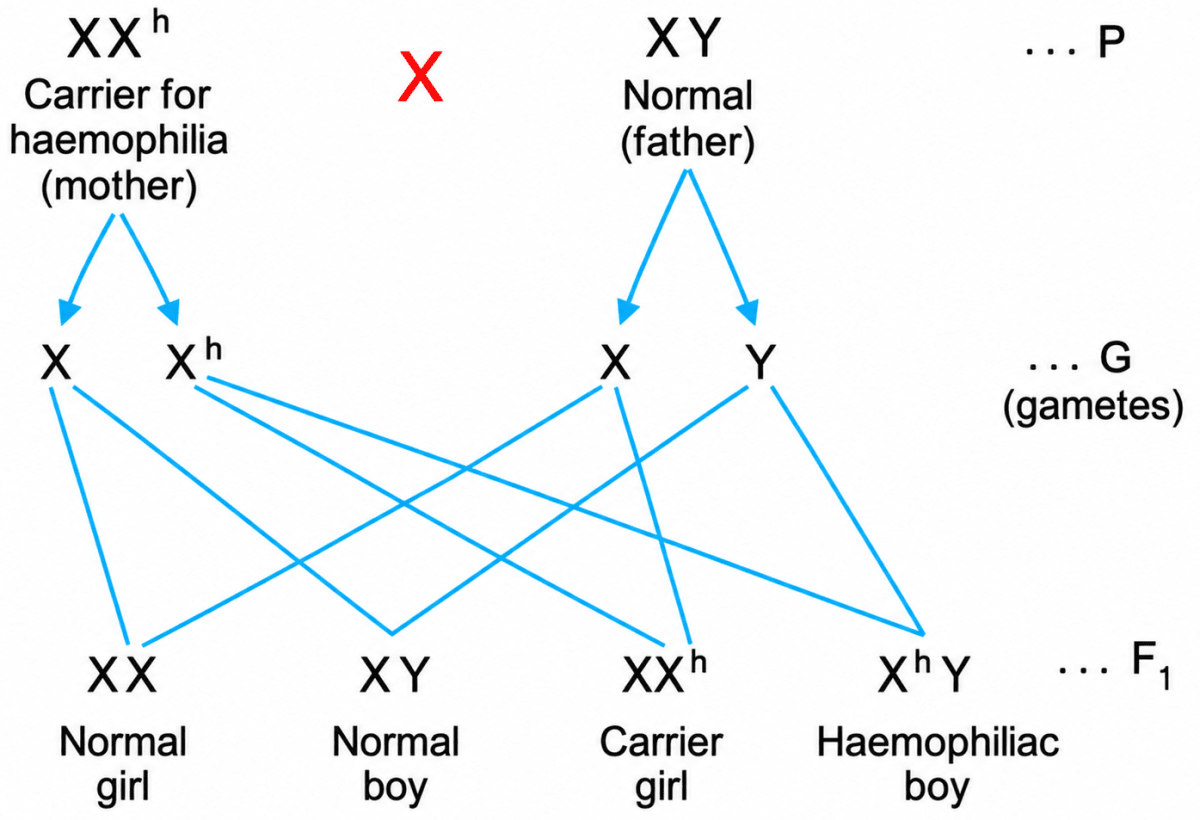
Haemophilia is an X-linked recessive disease found in humans. Individuals suffering from this disease lack a factor responsible for the clotting of blood, so bleeding does not stop easily. Since it is a recessive character, it is masked in the heterozygous condition. A mother may carry the disease (carrier) and can transmit it to 50% of her sons, even if the father is normal. The gene for haemophilia is located on the X chromosome.
A family consisting of two parents and their five children. The given below pedigree chart shows the inheritance of the trait of colour blinds in them. Answer the given questions based on it :
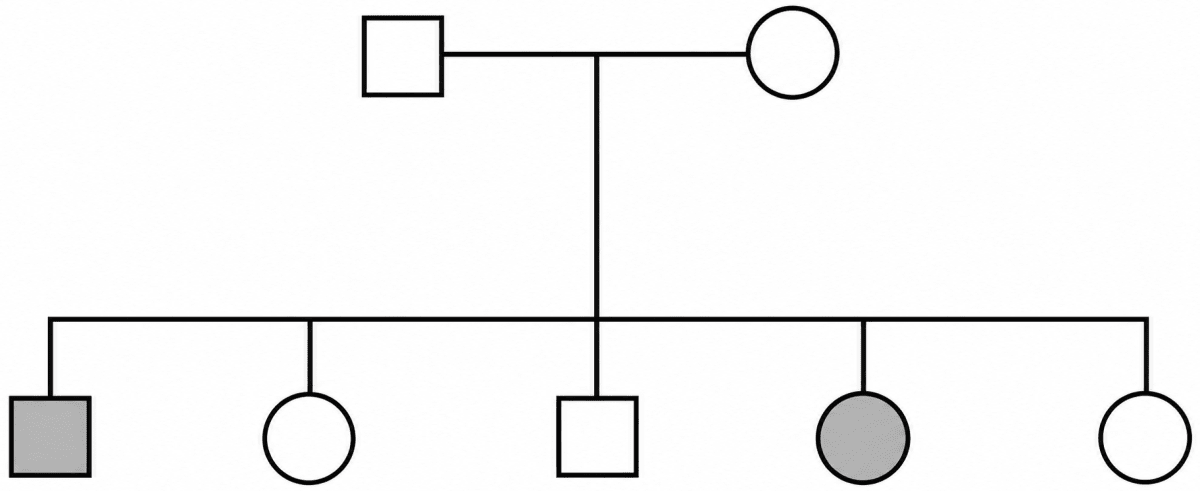
(i) Who is the heterozygous for the traits?
(ii) How many daughters and sons are colourblind in the family?
(iii) On which chromosome is the gene located for it?
Answer
(i) The mother is heterozygous (carrier) for the trait. She carries the recessive gene for colour blindness on one of her X chromosomes but is not colourblind herself.
(ii) One son and one daughter are colourblind in the family.
(iii) The gene for colour blindness is located on the X chromosome.
The answer to part (ii) is based on the two filled (affected) symbols shown in the chart — one son and one daughter.
A homozygous tall plant (TT) bearing red coloured (RR) flowers is crossed with a homozygous dwarf plant (tt) bearing white flowers (rr) :
(i) Give the genotype and phenotype of the F1 generation.
(ii) Give the possible combinations of the gametes that can be obtained from the F1 hybrid.
(iii) Give the dihybrid ratio and the phenotype of the offsprings of F2 generation when two plants of the F1 generation above are crossed.
Answer
(i) Genotype of F1 — TtRr
Phenotype of F1 — Tall plants with red flowers
(ii) The possible combinations of gametes from the F1 hybrid (TtRr) are: TR, Tr, tR, tr
(iii) Dihybrid ratio — 9 : 3 : 3 : 1
Phenotypes of F2 offspring:
- 9 Tall with red flowers
- 3 Tall with white flowers
- 3 Dwarf with red flowers
- 1 Dwarf with white flowers
In a homozygous plant, round seeds (R) are dominant over wrinkled seeds (r) :
(i) Draw a Punnett square to show the gametes and offspring when both the plants have heterozygous round seed (Rr).
(ii) Mention the Phenotype and Genotype ratios of the offspring in F2 generation.
(iii) Name the sex chromosomes in human males and females.
(iv) Briefly explain the term 'Mutation'.
(v) What is the number of chromosomes in the gametes of human beings.
Answer
(i) Cross between two heterozygous round plants (Rr × Rr):
| Gametes | R | r |
|---|---|---|
| R | RR | Rr |
| r | Rr | rr |
(ii) Phenotype ratio — 3 (Round) : 1 (Wrinkled)
Genotype ratio — 1 (RR) : 2 (Rr) : 1 (rr)
(iii) In human males, the sex chromosomes are X and Y (XY).
In human females, the sex chromosomes are X and X (XX).
(iv) Mutation — Mutation is a sudden random change in the genetic material of a cell that may cause it to differ in appearance or behaviour from the normal type. For example, sickle-cell anaemia is caused by a gene mutation.
(v) The gametes of human beings contain 23 chromosomes (i.e., half the number present in the body cells).
A homozygous tall plant (T) bearing red coloured (R) flowers is crossed with a homozygous dwarf (t) plant bearing white (r) flowers :
(i) Give the genotype and phenotype of the plants of F1 generation.
(ii) Mention the possible combinations of the gametes that can be obtained from the F1 hybrid plant.
(iii) State the Mendel's law of Independent Assortment.
(iv) Mention the phenotypes of the offspring obtained in F2 generation.
(v) What is the phenotypic ratio obtained in F2 generation?
Answer
(i) Genotype of F1 — TtRr
Phenotype of F1 — Tall plants with red flowers
(ii) The possible combinations of gametes from the F1 hybrid (TtRr) are: TR, Tr, tR, tr
(iii) Mendel's law of independent assortment states that when more than one pair of contrasting characters are brought together in an individual, the distribution of the alleles of one character is free to separate from the distribution of any other pair of alleles (controlling another character).
(iv) The phenotypes of the F2 offspring are:
- Tall with red flowers
- Tall with white flowers
- Dwarf with red flowers
- Dwarf with white flowers
(v) Phenotypic ratio in F2 generation — 9 : 3 : 3 : 1
In a homozygous pea plant, axial flowers (A) are dominant over terminal flowers (a).
(i) What is the phenotype and genotype of the F1 generation if a plant bearing pure axial flowers is crossed with a plant bearing pure terminal flowers?
(ii) Draw a Punnett square board to show the gametes and offsprings when both the parent plants are heterozygous for axial flowers.
(iii) What is the phenotypic ratio and genotypic ratio of the above cross shown in (ii)?
(iv) State Mendel's Law of Dominance.
Answer
(i) When a pure axial (AA) plant is crossed with a pure terminal (aa) plant:
Genotype of F1 — Aa
Phenotype of F1 — Axial flowers (all)
(ii) Cross between two heterozygous axial plants (Aa × Aa):
| Gametes | A | a |
|---|---|---|
| A | AA | Aa |
| a | Aa | aa |
(iii) Phenotypic ratio — 3 (Axial) : 1 (Terminal)
Genotypic ratio — 1 (AA) : 2 (Aa) : 1 (aa)
(iv) Mendel's law of dominance states that when a pair of contrasting characters are present together, only one character (the dominant character) is able to express itself in the F1 generation while the other (the recessive character) remains suppressed.
Mendel crossed a homozygous pea plant having axial flowers (AA) with a homozygous pea plant having terminal flowers (aa). He got different results. On the basis of it answer the following questions :
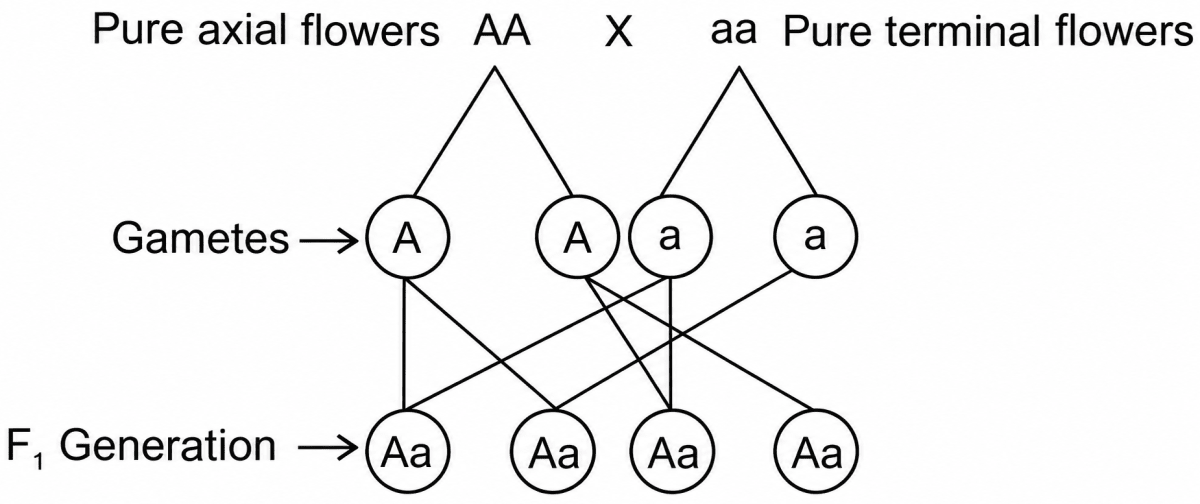
(i) Which feature is the dominant one?
(a) Axial flowering
(b) Terminal flowering
(c) White colour of flowers
(d) Green colour of seeds
(ii) The genotype of F1 generation is
(a) AA
(b) Aa
(c) aa
(d) Either Aa or aa
(iii) The phenotype ratio of F2 generation, if F1 progeny are self-fertilised, is
(a) 2 : 1
(b) 2 : 1 : 1
(c) 1 : 3
(d) 3 : 1
(iv) Mendel's law shown in above cross is
(a) Law of Independent Assortment
(b) Law of Dominance
(c) Law of Segregation
(d) Law of Purity of Gametes
(v) The homozygous feature reappeared in F2 generation is
(a) Terminal flowering
(b) Axial flowering
(c) Big flowers
(d) Bright coloured flowers
Answer
(i) (a) Axial flowering
Reason — Axial flowering is dominant over terminal flowering in pea plants.
Terminal flowering is a recessive trait and appears only in the homozygous recessive condition. White flower colour is a recessive trait and is unrelated to the given cross on flower position. Green seed colour is a different character studied by Mendel and is not related to flower position.
(ii) (b) Aa
Reason — Crossing a homozygous dominant parent (AA) with a homozygous recessive parent (aa) produces all heterozygous (Aa) offspring.
F1 offspring inherit one allele from each parent and cannot be homozygous dominant. F1 offspring receive one dominant allele from the dominant parent, so they cannot be homozygous recessive. F1 offspring are Aa in a monohybrid cross between pure dominant and pure recessive parents.
(iii) (d) 3 : 1
Reason — Self-fertilisation of heterozygous F1 plants (Aa × Aa) produces a phenotypic ratio of 3 dominant : 1 recessive.
2:1 is not the phenotypic ratio obtained in a Mendelian monohybrid cross. 2:1:1 is incorrect as monohybrid cross gives only two phenotypes, not three. 1:3 is incorrect as the dominant trait appears more frequently than the recessive trait in the F2 generation.
(iv) (b) Law of Dominance
Reason — The dominant trait is expressed in the F1 generation while the recessive trait is masked.
Law of Independent Assortment is incorrect as this law applies to the inheritance of two or more pairs of contrasting traits, not a single trait. Law of Segregation is incorrect as this law explains the separation of alleles during gamete formation, whereas the given observation mainly demonstrates dominance. Law of Purity of Gametes in incorrect as this is another name of law of segregation.
(v) (a) Terminal flowering
Reason — Terminal flowering is the recessive homozygous (aa) trait that disappears in F₁ and reappears in F2.
Axial flowering is incorrect because axial flowering appears in both AA and Aa plants, so it is not exclusively a homozygous feature. Big flowers is incorrect because flower size is not the character involved in this cross. Bright coloured flowers is incorrect because flower colour or brightness is unrelated to the given trait of flower position.
A pea plant which is homozygous for Green pods which are inflated [GGII] is crossed with a homozygous plant for yellow pods which are constricted [ggii].
Answer the following questions :
(i) Give the phenotype and genotype of the F1 generation. Which type of pollination has occurred to produce F1 generation?
(ii) Write the phenotypic ratio of the F2 generation.
(iii) Write the possible combinations of the gametes that can be obtained if two F1 hybrid plants are crossed.
(iv) State Mendel's law of 'Segregation of Gametes'.
(v) What is the scientific name of the plant which Mendel used for his experiments on inheritance?
Answer
(i) Genotype of F1 — GgIi
Phenotype of F1 — Green pods which are inflated
Cross-pollination has occurred to produce the F1 generation.
(ii) Phenotypic ratio of F2 generation — 9 : 3 : 3 : 1
(iii) The possible combinations of gametes from the F1 hybrid (GgIi) are: GI, Gi, gI, gi
(iv) Mendel's law of segregation (law of purity of gametes) states that the paired factors (alleles) responsible for a character segregate into gametes and are recombined at fertilisation. Each gamete carries only one factor for a character, so the gametes are always pure.
(v) The scientific name of the plant used by Mendel is Pisum sativum.
In Mendel's experiments, tall pea plants (T) are dominant over dwarf pea plants (t).
(i) What is the phenotype and genotype of the F1 generation if a homozygous tall plant is crossed with a homozygous dwarf plant?
(ii) Draw a Punnett square board to show the gametes and offspring when both the parents are heterozygous for tallness.
(iii) What is the phenotypic ratio and genotypic ratio of the above cross in (ii)?
(iv) State Mendel's Law of Dominance.
(v) What is a Dihybrid Cross?
Answer
(i) When a homozygous tall (TT) plant is crossed with a homozygous dwarf (tt) plant:
Genotype of F1 — Tt
Phenotype of F1 — Tall (all)
(ii) Cross between two heterozygous tall plants (Tt × Tt):
| Gametes | T | t |
|---|---|---|
| T | TT | Tt |
| t | Tt | tt |
(iii) Phenotypic ratio — 3 (Tall) : 1 (Dwarf)
Genotypic ratio — 1 (TT) : 2 (Tt) : 1 (tt)
(iv) Mendel's law of dominance states that when a pair of contrasting characters are present together, only one character (the dominant character) is able to express itself in the F1 generation while the other (the recessive character) remains suppressed.
(v) A dihybrid cross is a cross in which two pairs of contrasting characters are taken into consideration at a time.
A farmer cultivates a unique species of tomato plants. The two traits selected for breeding were: Colour of the fruits and height of the plants. The farmer initially crosses a homozygous tall plant bearing red fruits (TTRR) with a dwarf plant bearing yellow fruits (ttrr) and the genotype of all the offsprings of the F1 generation was TtRr. Next, he crosses two F1 generation plants (TtRr).

(i) Explain the phenotype of the offsprings of the F1 generation obtained from the initial cross.
(ii) Mention the phenotypic ratio of the F2 generation offsprings.
(iii) State Mendel's Law of Independent Assortment.
Answer
(i) All the F1 offspring are tall plants bearing red fruits. This is because tallness is dominant over dwarfness and red fruit colour is dominant over yellow. In the heterozygous F1 plants (TtRr), only the dominant traits (tall and red) are expressed while the recessive traits (dwarf and yellow) remain suppressed.
(ii) Phenotypic ratio of F2 generation — 9 : 3 : 3 : 1 (9 Tall red : 3 Tall yellow : 3 Dwarf red : 1 Dwarf yellow).
(iii) Mendel's law of independent assortment states that when more than one pair of contrasting characters are brought together in an individual, the distribution of the alleles of one character is free to separate from the distribution of any other pair of alleles (controlling another character).