
The pollution which affects the aquatic life is
- air pollution
- water pollution
- noise pollution
- soil pollution
Answer
water pollution
Reason — Water pollution contaminates rivers, lakes and oceans, thereby directly affecting the aquatic organisms living in them.
Which of the following does not pollute water?
- Oil spill
- Acid rain
- Industrial discharge
- Vehicular emission
Answer
Vehicular emission
Reason — Vehicular emission releases harmful gases like CO, SO2 and NO2 into the air, so it is a cause of air pollution and not water pollution.
Many nuclear power plants are constructed near water sources. They use water for cooling their machinery and release it back into the water stream. Identify the kind of pollution caused.
- Radiation pollution
- Water pollution
- Industrial pollution
- Thermal pollution
Answer
Thermal pollution
Reason — The warm water released back into the stream after cooling the machinery raises the temperature of the water body, causing thermal pollution.
Compressed natural gas (CNG) is proposed to be a better alternative to fossil fuel which of the following reasons makes it a better alternative?
P. Combustion leaves little or no residue
Q. Absence of Carbon in CNG
R. Easily available
- Only P
- Only Q
- Only P and R
- Only Q and R
Answer
Only P
Reason — CNG burns cleanly and leaves little or no residue, which makes it a better alternative. Statement Q is wrong because CNG (natural gas) does contain carbon.
Due to greenhouse effect, the average temperature of the earth is :
- remaining constant
- decreasing
- increasing
- none
Answer
increasing
Reason — Greenhouse gases trap heat and do not allow it to escape, so the average temperature of the earth keeps increasing, causing global warming.
An example of non-biodegradable waste is
- vegetable peel
- sewage
- livestock waste
- DDT
Answer
DDT
Reason — DDT is a pesticide that cannot be broken down by decomposers, so it is a non-biodegradable waste.
In Bhopal gas tragedy the gas leaked was
- Sodium isocynate
- Ethyl isocynate
- Methyl isocynate
- Sulphur dioxide
Answer
Methyl isocynate
Reason — The Bhopal gas tragedy was caused by the leakage of the poisonous gas Methyl Isocyanate from Union Carbide India Limited (UCIL) on the night of December 2–3, 1984.
The disease caused due to polluted water is —
- Asthma
- Lung cancer
- Cholera
- Malaria
Answer
Cholera
Reason — Cholera is a water-borne disease that spreads by drinking water contaminated with pathogenic microorganisms.
Spraying of DDT on crops produces pollution of —
- Soil and water
- Air and soil
- Crops and air
- Air and water
Answer
Soil and water
Reason — DDT sprayed on crops settles on the soil and is also washed away with rain water into water bodies, thereby polluting both soil and water.
The prime source of Chloro fluorocarbons is:
- Vehicular emissions
- Refrigeration equipment
- Sewage
- Effluents
Answer
Refrigeration equipment
Reason — CFCs are used as refrigerants in refrigeration and air-conditioning equipment, which is their prime source.
Ozone layer depletes mainly due to —
- Oxides
- Carbon dioxide
- Acid rain
- Chlorofluorocarbon
Answer
Chlorofluorocarbon
Reason — Chlorofluorocarbons (CFCs) break down and release chlorine, which destroys ozone molecules, and are mainly responsible for depletion of the ozone layer.
Which one of the following is a biodegradable waste?
- metal cans
- E-waste
- Plastic
- Flowers
Answer
Flowers
Reason — Flowers are of plant origin and can be broken down by decomposers, so they are biodegradable waste.
Which of the following is the cause of soil pollution?
- Oil spills
- Medical waste
- Burning of fossil fuels
- Vehicular emission
Answer
Medical waste
Reason — Biomedical waste such as used needles, syringes and soiled dressings adds harmful substances to the soil, causing soil pollution. Oil spills cause water pollution while burning of fossil fuels and vehicular emissions cause air pollution.
Biomagnification is result of —
- Air pollution
- Soil pollution
- Noise pollution
- Water pollution
Answer
Soil pollution
Reason — Soil pollutants enter the food chain and get accumulated in the tissues of humans and other organisms, resulting in biomagnification.
Which one is the control measure of radiation pollution?
- Reduce the unnecessary use of loud music and horns
- Industrial waste should be recycled
- Burying the nuclear wastes in the ocean floor
- Use of CNG
Answer
Burying the nuclear wastes in the ocean floor
Reason — Nuclear wastes are managed by sealing them in steel containers and burying them in the ocean floor, which is a control measure of radiation pollution.
Assertion (A): Spraying of pesticides and insecticides can cause water pollution.
Reason (R): Pesticides and insecticides are non-biodegradable agricultural wastes.
- (A) is true and (R) is false.
- (A) is false and (R) is true.
- Both (A) and (R) are true.
- Both (A) and (R) are false
Answer
Both (A) and (R) are true.
Explanation
Pesticides and insecticides like DDT are non-biodegradable agricultural wastes that cannot be broken down by decomposers. When sprayed on crops, they are washed away by rain water into rivers and lakes, thereby causing water pollution. Hence both the assertion and the reason are true and the reason correctly explains the assertion.
Name the following:
(i) One gaseous compound that depletes ozone layer.
(ii) The type of waste generated in hospitals and pathological laboratories.
(iii) The undesirable change in the environment leading to its deterioration.
(iv) A constituent that causes pollution.
(v) A water pollutant.
(vi) The pollutants that cannot be broken down to simple and harmless products.
(vii) The process causing an undesirable change in the environment.
Answer
(i) Chlorofluorocarbons (CFCs)
(ii) Biomedical waste
(iii) Pollution
(iv) Pollutant
(v) Sewage
(vi) Non-biodegradable wastes
(vii) Pollution
Select one suitable word from the two alternatives given to fill in the blanks in the following sentences:
(i) Biomagnification is resultant of ............... . (Air pollution/Soil pollution)
(ii) World ozone layer Preservation Day is ............... . (September 16 / September 19)
(iii) Acid rain is caused due to the pollutants released by ............... . (vehicles/sewages)
(iv) ............... is mainly responsible for acid rain. (SO2/CO2)
(v) Pollution is an ............... change in the physical, chemical or biological characteristics of air, water and soil. (desirable/undesirable)
Answer
(i) Biomagnification is resultant of Soil pollution.
(ii) World ozone layer Preservation Day is September 16.
(iii) Acid rain is caused due to the pollutants released by vehicles.
(iv) SO2 is mainly responsible for acid rain.
(v) Pollution is an undesirable change in the physical, chemical or biological characteristics of air, water and soil.
Give two examples each of the following:
(i) Waterborne diseases in humans.
(ii) Pollutants causing acid rain.
(iii) Greenhouse gases.
(iv) Man made sources of noise pollution.
(v) Air pollutants.
(vi) Chemicals responsible for O3 depletion.
Answer
(i) Cholera, Typhoid
(ii) Sulphur dioxide (SO2), Nitrogen oxides (NO2)
(iii) Carbon dioxide (CO2), Methane
(iv) Loudspeakers, Motor vehicles
(v) Carbon monoxide (CO), Sulphur dioxide (SO2)
(vi) Chlorofluorocarbons (CFCs), Nitrogen monoxide (NO)
Choose the odd one out from the following terms and name the category to which others belong:
(i) Used bandages, Pesticides, Face masks, syringes
(ii) Dust, Smoke, Carbon monoxide, Effluents.
(iii) Newspapers, Vegetable peels, Electric bulbs, Animal excreta.
Answer
(i) Odd one — Pesticides. The others (used bandages, face masks, syringes) are examples of biomedical waste.
(ii) Odd one — Effluents. The others (dust, smoke, carbon monoxide) are air pollutants.
(iii) Odd one — Electric bulbs. The others (newspapers, vegetable peels, animal excreta) are biodegradable wastes.
Define biodegradable waste.
Answer
Biodegradable wastes are those wastes which undergo degradation by the action of decomposers. Examples: food wastes, paper waste, vegetable and fruit peels.
Define Kyoto Protocol.
Answer
Kyoto Protocol is an international agreement made in the year 1997 to mitigate global warming by reducing the emission of greenhouse gases into the atmosphere.
Define global warming.
Answer
Global warming is the long-term rise in the average temperature of the earth's surface and atmosphere caused mainly due to the greenhouse effect.
Define eutrophication.
Answer
Eutrophication is a natural process in which ponds and lakes become rich in nutrients. Its literal meaning is "well nourished or enriched". According to Hutchinson, it is a natural state in ponds and lakes that occurs as a part of the ageing process as nutrients accumulate through natural succession.
Define biomedical waste.
Answer
Biomedical waste is the waste produced in hospitals and other healthcare centres. It includes used needles, syringes, soiled dressings, medicine bottles, etc.
Define biomagnification.
Answer
Biomagnification is the accumulation of heavy metals in the tissues of humans and other organisms when soil pollutants enter the food chain.
State three ways by which Swach Bharat Abhiyan is achieved.
Answer
Three ways by which Swachh Bharat Abhiyan is achieved are:
- Taking the broom to sweep the streets.
- Cleaning up the garbage.
- Focussing on sanitation and maintaining a hygienic environment.
State three ways by which ozone layer depletion can be prevented.
Answer
Three ways by which ozone layer depletion can be prevented are:
- Buying air-conditioning and refrigeration equipment that does not use hydrochlorofluorocarbons (HCFCs) as refrigerants.
- Disposing old refrigerators and air conditioners in recycling yards, as they contain ozone-depleting substances.
- Buying aerosol products that do not use HCFCs or CFCs as propellants.
State three ways by which soil gets polluted.
Answer
Three ways by which soil gets polluted are:
- Overuse of chemical fertilisers.
- Discharge of industrial wastes into the soil.
- Dumping of urban domestic wastes such as garbage, plastic bags and glass.
Describe the harmful effects of burning of fossil fuels.
Answer
Burning of fossil fuels releases harmful gases such as carbon dioxide, sulphur dioxide and nitrogen oxides into the atmosphere. These gases lead to global warming, acid rain, ozone layer depletion and respiratory diseases.
Describe the harmful effects of CFC's.
Answer
CFCs deplete the ozone layer of the atmosphere. As a result, harmful ultraviolet rays of the sun reach the earth and cause skin cancer, eye damage and damage to the immune system in humans.
Describe the harmful effects of noise pollution.
Answer
Noise pollution causes discomfort and may lead to temporary or permanent damage to hearing. It can cause a rise in blood pressure, a rise in intracranial pressure, an increase in heart rate and breathing, and may also cause visual disturbance.
Describe the harmful effects of formic acid released in forest fires.
Answer
Formic acid, along with formaldehyde, is produced from forest fires. It mixes with rain water and contributes to acid rain, which damages vegetation, corrodes buildings and monuments and harms aquatic life.
State any two harmful effects of acid rain.
Answer
Two harmful effects of acid rain are:
Damages Plants and Crops: Acid rain harms leaves, reduces photosynthesis, and weakens plant growth by polluting soil.
Pollutes Water Bodies: It makes lakes and rivers acidic, which can kill fish and other aquatic life.
Discuss any three effects of climate change on global warming.
Answer
Three effects of greenhouse effect (climate change and global warming) are:
- There is a gradual increase in the temperature of the earth's surface and the lower atmosphere, which may increase by about 1.5 to 4.5°C by the year 2050.
- Sudden changes in the climate lead to cyclones and other natural disasters.
- The temperature rise causes melting of ice-sheets, which increases the sea level by around 16 to 20 feet.
Mention any two effects of air pollution on human health.
Answer
Two effects of air pollution on human health are:
- It causes symptoms such as dizziness, headache, eye irritation, coughing and sore throat.
- It causes respiratory diseases such as asthma and bronchitis.
Explain any two effects of eutrophication.
Answer
Two effects of eutrophication are:
- The excess nutrients cause rapid growth of algae and decomposer bacteria in the water body.
- These organisms consume a large amount of dissolved oxygen, leading to the death of fish and other aquatic animals.
Excessive use of fertilisers in agricultural fields reduces the yield of crops. Justify the statement.
Answer
Excessive use of fertilizers in agricultural fields leads to accumulation of unused chemicals in soil. The soil becomes either acidic or basic, making the soil unfit for cultivation. Also the beneficial microorganisms present in the soil are killed due to chemicals and disturbed ph of soil. Therefore, excessive use of fertilizers in agricultural fields reduces the yield of crops.
Define Bharat Vehicular Standard.
Answer
Bharat Stage (Vehicular) emission standards are emission standards instituted by the Government of India to regulate the output of air pollutants from motor vehicles. They are based on European (Euro) regulations and are set by the Central Pollution Control Board.
How is the vegetation affected by acid rain?
Answer
Acid rain affects vegetation as the acids present in the soil undergo chemical changes and release toxic metals in forms that can be absorbed by plants. As a result, the plants may be damaged or destroyed.
Discuss any three effects of climate change on the global warming.
Answer
Three effects of greenhouse effect (climate change and global warming) are:
- There is a gradual increase in the temperature of the earth's surface and lower atmosphere, which may rise by about 1.5 to 4.5°C by the year 2050.
- Agriculture is adversely impacted.
- The melting of ice-sheets raises the sea level by around 16 to 20 feet.
State any two disadvantages of living close to an airport.
Answer
Two disadvantages of living close to an airport are:
Noise Pollution — Constant sound from airplanes taking off and landing can disturb sleep, lower efficiency of work and disturb peace of mind.
Air Pollution — Emissions from aircraft and airport traffic can lead to poor air quality, affecting respiratory health over time.
Is there any control measures to stop the acid rain?
Answer
Yes, acid rain can be controlled by the following measures:
- Reducing air pollution.
- Using emission-reducing equipment like scrubbers and electrostatic precipitators to reduce air pollutants.
- Adding a neutralising agent to the acidified water to increase its pH.
- Formulating laws by the government to regulate the emission of pollutants.
Explain any three dangers associated with the use of synthetic or chemical pesticides.
Answer
Three dangers associated with the use of synthetic or chemical pesticides are:
- Pesticides such as DDT are toxic to humans and other animals.
- They reduce the fertility of the soil.
- Being non-biodegradable, they enter the food chain and get accumulated in the tissues of organisms, causing biomagnification.
Give two examples of radiation pollution.
Answer
Two examples of radiation pollution are:
- Radioactive fallout from nuclear power plants, as seen in the Chernobyl disaster.
- Increased exposure to medical X-rays.
Describe any four ways of saving ozone layer.
Answer
Four ways of saving the ozone layer are:
- Buying air-conditioning and refrigeration equipment that does not use hydrochlorofluorocarbons (HCFCs) as refrigerants.
- Disposing old refrigerators and air conditioners in recycling yards, as they contain ozone-depleting substances.
- Buying aerosol products that do not use HCFCs or CFCs as propellants.
- Following the Montreal Protocol, which aims to freeze CFC production and phase out the use of ozone-depleting substances.
Explain any three causes and three consequences of eutrophication.
Answer
Three causes of eutrophication are:
- Excessive use of chemical fertilisers in agricultural fields.
- Discharge of sewage rich in nitrates and phosphates into water bodies.
- Household detergents containing phosphates entering the water bodies.
Three consequences of eutrophication are:
- Rapid growth of algae and decomposer bacteria in the water body.
- Depletion of dissolved oxygen in the water.
- Death of fish and other aquatic animals due to lack of oxygen.
State any two harmful effects of acid rain.
Answer
Two harmful effects of acid rain are:
- It corrodes buildings, monuments, metals and rock structures.
- It disrupts the reproductive processes of aquatic animals like fish due to increased acidity of water in lakes and rivers.
State any two harmful effects of noise pollution on human health.
Answer
Two harmful effects of noise pollution on human health are:
- It causes temporary or permanent damage to hearing.
- It causes a rise in blood pressure, an increase in heart rate and breathing.
List the aims and norms of Bharat Stage Standards.
Answer
Aim of Bharat Stage Standards: The aim of Bharat Stage (BS) emission standards is to regulate the output of air pollutants released from motor vehicles.
Main norms (features) of Bharat Stage Standards:
- The phasing out of the two-stroke engine for two wheelers.
- Introduction of electronic controls.
- Stopping the production of cars releasing more pollutants like Maruti 800 cars.
What is acid rain? Explain any two impacts of acid rain.
Answer
Acid rain can be defined as rain with a pH of less than 5. It is mainly caused by the emission of gases like sulphur dioxide and nitrogen oxides from the combustion of fossil fuels, which dissolve in rain water to form acids.
Two impacts of acid rain are:
- Impact on buildings and monuments — Acid rain is corrosive and has a corroding effect on buildings, monuments, metals and rock structures.
- Impact on human health — Acid rain causes irritation in the eyes and skin and leads to disorders in the respiratory system such as emphysema and bronchitis.
What are the impacts of greenhouse effect?
Answer
The impacts of greenhouse effect are:
- There is a gradual increase in the temperature of the earth's surface and lower atmosphere, which may rise by about 1.5 to 4.5°C by the year 2050.
- Agriculture is adversely impacted.
- Sudden changes in the climate lead to cyclones and other natural disasters.
- The temperature rise causes melting and disintegration of ice-sheets, which increases the sea level by around 16 to 20 feet.
(i) What are biomedical wastes? Give examples.
(ii) Expand CFC and CNG.
(iii) Mention any two Objectives of Swachh Bharat Abhiyan.
Answer
(i) Biomedical wastes are the wastes produced in hospitals and other healthcare centres. Examples: used needles, syringes, soiled dressings and medicine bottles.
(ii) CFC — Chlorofluorocarbons; CNG — Compressed Natural Gas
(iii) Two objectives of Swachh Bharat Abhiyan are:
- To clean the roads, streets and infrastructure of the cities and towns of India.
- To eradicate open defecation through the construction of individual, cluster and community toilets.
Describe any four ways of saving the ozone layer.
Answer
Four ways of saving the ozone layer are:
- Buying air-conditioning and refrigeration equipment that does not use hydrochlorofluorocarbons (HCFCs) as refrigerants.
- Disposing old refrigerators and air conditioners in recycling yards, as they contain ozone-depleting substances.
- Buying aerosol products that do not use HCFCs or CFCs as propellants.
- Following the Montreal Protocol to freeze CFC production and phase out the use of ozone-depleting substances.
A person shows some symptoms as given below due to pollution. On the basis of those answer the questions followed:
Symptoms — Eye irritation, dizziness, acid rain, headache, sore throat, chest pain, lung diseases, allergies
(i) Name the type of pollution responsible for it.
(ii) List four sources causing this pollution.
(iii) List two ways to control this type of pollution.
Answer
(i) Air pollution is responsible for these symptoms.
(ii) Four sources causing air pollution are:
- Vehicular emissions
- Industrial emissions
- Burning of garbage
- Brick kilns
(iii) Two ways to control air pollution are:
- Use of unleaded petrol and CNG in vehicles.
- Installing tall chimneys with filters in factories so that emissions are given out high up in the atmosphere.
Given below is a representation of a kind of pollution. Study the same and answer the questions that follow:

(i) Name the kind of pollution.
(ii) List any three common sources of this pollution.
(iii) Mention three harmful effects of this pollution on human health.
(iv) Explain the term 'Pollutant'.
(v) Name two soil pollutants.
Answer
(i) Noise pollution
(ii) Three common sources of noise pollution are :
- Vehicular Traffic
- Industrial machines & workshops
- Loudspeakers
(iii) Harmful effects of noise pollution on human health are:
- It may cause temporary or permanent damage to hearing.
- It can cause a rise in blood pressure.
- It can increase heart rate and breathing.
(iv) Any such constituent the addition of which to air, water or land deteriorates the natural quality of the environment is termed as a Pollutant.
(v) Two soil pollutants are:
- Industrial wastes
- Biomedical wastes
Study the picture given below and answer the questions that follow:

(i) Name the category of waste that is being disposed.
(ii) Give an example of such a waste.
(iii) Are they hazardous to humans and animals? Give a suitable reason to justify your answer.
Answer
(i) Biomedical waste
(ii) Used bandages
(iii) Biomedical waste, if not disposed of properly, can harm humans and animals by spreading disease-causing microorganisms. Some biomedical wastes may also contain chemicals that are toxic to humans, animals and soil microorganisms.
Given below is a representation of a type of pollution. Study the picture and answer the questions:

(i) Name the type of pollution shown in the picture.
(ii) Name one source of this pollution.
(iii) How does this pollution affect human health?
(iv) Write one measure to reduce this pollution.
(v) State one gaseous compound that leads to the depletion of the ozone layer and creates 'Ozone holes'.
Answer
(i) Air pollution is shown in the picture.
(ii) The exhaust given out by petrol/diesel vehicles.
(iii) Air pollution causes respiratory problems, lung disorders. Particulate lead may cause blood cell shortage. Smog leads to asthma and allergies. The exhaust gas SO2 causes serious damage to the air passages in lungs (the disease bronchitis).
(iv) Use of unleaded petrol and CNG in automobiles.
(v) Chlorofluorocarbon (CFC)
Look at the picture given below and answer the questions followed:
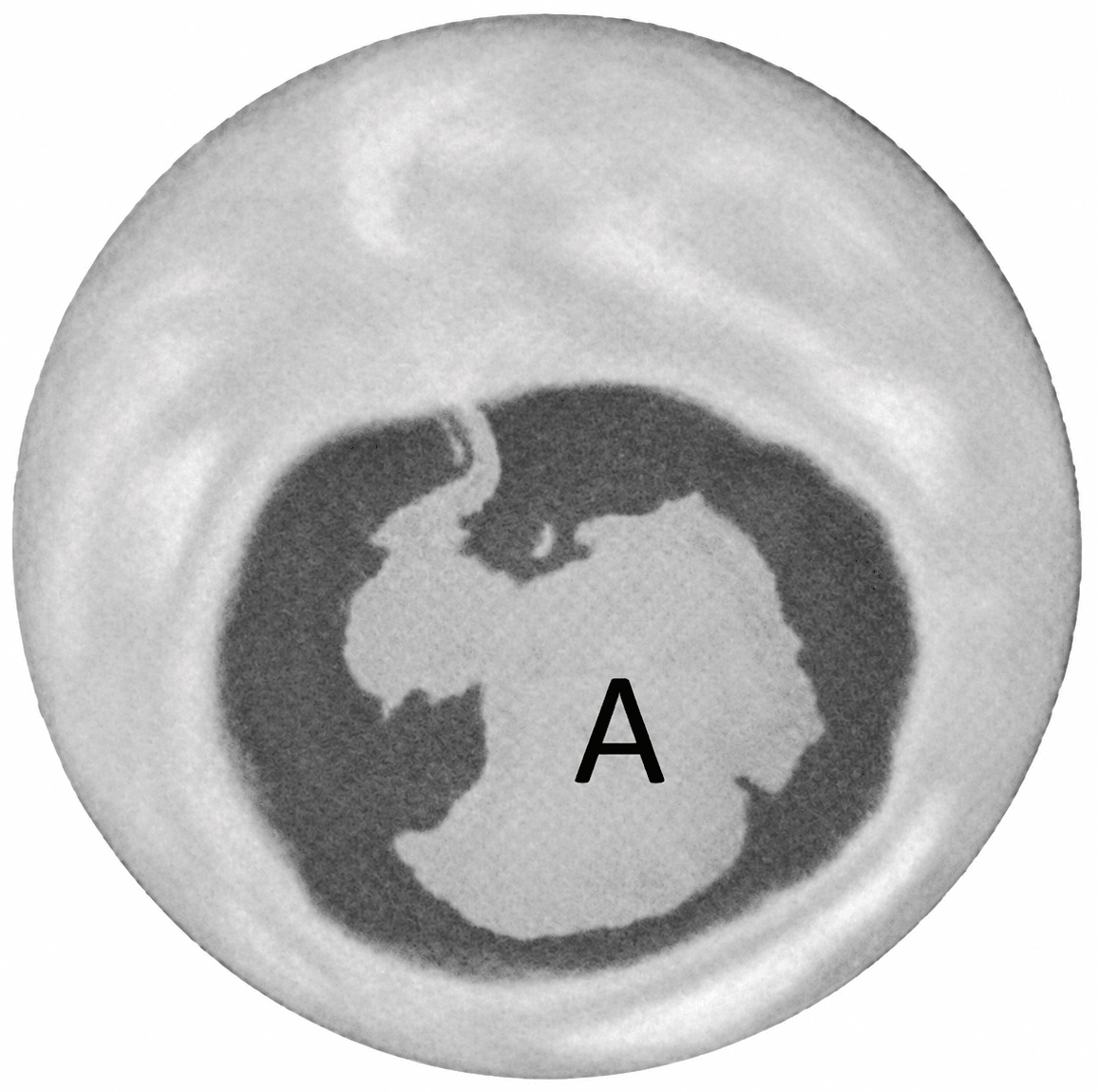
(i) What is the lightly shaded area (A) showing?
(ii) List the causes of this process (i).
(iii) Give two control measures to stop this loss.
(iv) Give a brief of an international agreement to solve this problem.
Answer
(i) The area (A) shows the ozone hole, that is, the region of ozone layer depletion over the Antarctic pole.
(ii) The causes of ozone layer depletion are:
- The use of chlorofluorocarbons (CFCs).
- The pollutant nitrogen monoxide (NO).
(iii) Two control measures to stop this loss are:
- Buying air-conditioning and refrigeration equipment that do not use HCFCs as refrigerant.
- Buying aerosol products that do not use HCFCs or CFCs as propellants.
(iv) The Montreal Protocol is an international agreement signed in 1987 by 27 industrialised countries. Under this agreement, the countries agreed to freeze CFC production at the 1986 levels, phase out the use of ozone-depleting substances, and help developing countries to implement the use of alternatives to CFCs.
The diagram given below depicts the climate change on planet Earth. Answer the following questions:

(i) Name the climatic phenomenon for the increase in Earth's temperature.
(ii) Mention one reason for this warming.
(iii) What measures can be taken to prevent this climate change?
Answer
(i) Global warming
(b) Green house effect due to accumulation of greenhouse gases like Carbon dioxide (CO2) and Methane (CH4) in the atmosphere.
(c) To prevent global warming, use of fossil fuels should be minimized and renewable energy sources should be adopted rapidly. Deforestation should be stopped and more trees should be planted.
Study the picture given below and answer the questions:

(a) How does water get polluted?
(b) What is the effect of water pollution on human life?
(c) Mention one control measure to stop the pollution of water bodies.
Answer
(a) Water gets polluted due to:
- Factories and industrial facilities releasing pollutants such as chemicals, heavy metals, and toxins into water bodies.
- Pesticides, herbicides, and fertilizers used in agriculture can wash into rivers, lakes, and streams through runoff, especially after heavy rainfall.
(b) Contaminated water can carry pathogens such as bacteria, viruses, and parasites that cause waterborne diseases like cholera, dysentery, hepatitis A, and giardiasis. Long-term exposure to polluted water containing harmful chemicals, such as heavy metals (e.g., lead, mercury) and industrial pollutants, can result in chronic health issues.
(c) Sewage and industrial wastes should be properly treated before being released into water bodies.