
Fill in the blanks:
(i) In an adult human ............... litres of blood is present and it makes up about ............... percent of body weight.
(ii) The fluid matrix of blood is called ............... .
(iii) Oxygen combines with haemoglobin present in RBCs and forms ............... .
(iv) The life span of RBCs is about ............... whereas the life span of platelets is ............... .
(v) Platelets help in ............... formation.
Answer
(i) In an adult human 5 to 6 litres of blood is present and it makes up about 7 to 8 percent of body weight.
(ii) The fluid matrix of blood is called plasma.
(iii) Oxygen combines with haemoglobin present in RBCs and forms oxyhaemoglobin.
(iv) The life span of RBCs is about 120 days whereas the life span of platelets is 3 to 5 days.
(v) Platelets help in blood clot formation.
Name the following:
(i) The organelles absent in mature RBCs.
(ii) The WBCs involved in eosinophilia.
(iii) WBCs with nucleus having three to five lobes.
(iv) A chemical produced by basophils.
(v) The respiratory pigment contained in RBCs.
Answer
(i) Nucleus, Mitochondria (and endoplasmic reticulum)
(ii) Eosinophils
(iii) Neutrophils
(iv) Histamine
(v) Haemoglobin
Fill in the blanks:
(i) Clotting of blood performs two functions, namely ............... and ............... .
(ii) The plasma without its fibrinogen is called ............... .
(iii) The prothrombin is converted into thrombin by ............... and ............... .
(iv) Fibrinogen is converted into fibrin by ............... .
Answer
(i) Clotting of blood performs two functions, namely preventing further loss of blood and preventing entry of pathogenic micro-organisms.
(ii) The plasma without its fibrinogen is called serum.
(iii) The prothrombin is converted into thrombin by thrombokinase and calcium ions (Ca++).
(iv) Fibrinogen is converted into fibrin by thrombin.
Mention if the following statements are True or False (T or F):
(i) Veins have wider lumen.
(ii) Vitamin E is essential for clotting.
(iii) Rh factor was first discovered in American monkey.
(iv) Bicuspid valve guards the opening between the left auricle and left ventricle.
Answer
(i) True
(ii) False
Corrected Statement — Vitamin K is essential for clotting.
(iii) False
Corrected Statement — Rh factor was first discovered in rhesus monkey.
(iv) True
Suggest the blood group of donor for the people of following blood group:
(i) Blood group A ...............
(ii) Blood group B ...............
(iii) Blood group AB ...............
(iv) Blood group O ...............
Answer
(i) Blood group A — A and O
(ii) Blood group B — B and O
(iii) Blood group AB — A, B, AB and O
(iv) Blood group O — O
Fill in the blanks:
(i) Arteries have small lumen and no ............... .
(ii) Arteries carry blood from ............... to ............... .
(iii) Veins carry blood from ............... to ............... .
(iv) Except ............... all arteries carry oxygenated blood.
(v) The largest artery in the body is called ............... .
Answer
(i) Arteries have small lumen and no valves.
(ii) Arteries carry blood from heart to different organs of the body.
(iii) Veins carry blood from different organs to heart.
(iv) Except pulmonary artery all arteries carry oxygenated blood.
(v) The largest artery in the body is called aorta.
Name the blood vessels which carry blood from:
(i) Kidney to posterior vena cava.
(ii) Aorta to the liver.
(iii) upper half body to right atrium.
(iv) Right ventricles to lungs.
Answer
(i) Renal vein
(ii) Hepatic artery
(iii) Superior vena cava
(iv) Pulmonary artery
Lymph has
- RBCs
- Red colour
- only WBCs
- More proteins and calcium than blood
Answer
only WBCs
Reason — Lymph is a light yellow coloured fluid which contains only leucocytes (WBCs); RBCs and platelets are absent in it. It also contains fewer proteins and less calcium than blood.
The blood cell which helps in blood clotting is
- RBC
- WBC
- Platelet
- Plasma
Answer
Platelet
Reason — Platelets (thrombocytes) disintegrate at the site of injury and release thrombokinase, which initiates the process of blood clotting.
The mineral ion needed for the formation of blood clot.
- Potassium
- Sodium
- Calcium
- Iron
Answer
Calcium
Reason — Calcium ions (Ca++) are needed to convert prothrombin into thrombin during the process of blood clotting.
Tricuspid valve is present between
- Right atrium and ventricle
- The two atria
- The two ventricles
- Left atrium and ventricle
Answer
Right atrium and ventricle
Reason — The tricuspid valve (three flaps) guards the opening between the right auricle and the right ventricle and prevents back flow of blood.
The heart sound LUBB is produced due to
- entry of blood in the artries
- contraction of heart muscles
- closure of the tricuspid and bicuspid valves
- closure of pulmonary valves
Answer
closure of the tricuspid and bicuspid valves
Reason — The first heart sound 'LUBB' is produced due to the closure of the tricuspid and bicuspid (atrio-ventricular) valves at the start of ventricular systole.
Oxygenated blood to heart is supplied by:
- Hepatic artery
- Coronary artery
- Renal artery
- Pulmonary artery
Answer
Coronary artery
Reason — Two coronary arteries arise from the base of the aorta and supply oxygenated blood to the heart muscles.
What prevents back flow of blood inside the heart during contraction?
- Valves in heart
- Thin walls of atria
- Thick muscular walls of ventricles
- All of these
Answer
Valves in heart
Reason — The valves in the heart permit the flow of blood in one direction only and thus prevent the back flow of blood during contraction.
Assertion (A): Veins starting from the intestines do not open directly into the inferior vena cava.
Reason (R): They unite and enter the liver as hepatic portal vein.
- (A) is true and (R) is false.
- (A) is false and (R) is true.
- Both (A) and (R) are true.
- Both (A) and (R) are false.
Answer
Both (A) and (R) are true.
Explanation The veins starting from the gut (stomach and intestine) do not open directly into the inferior vena cava. Instead, they unite and enter the liver as the hepatic portal vein, where it breaks up into numerous capillaries.
Blood pressure is measured by the instrument named as —
- Potometer
- Thermometer
- Barometer
- Sphygmomanometer
Answer
Sphygmomanometer
Reason — Blood pressure is measured by means of an instrument called sphygmomanometer.
Assertion (A): All the arteries in human body carries carbon dioxide rich blood.
Reason (R): Pulmonary artery connects the heart with lungs.
- Both (A) and (R) are true
- Both (A) and (R) are false
- Both (A) and (R) are true and (R) is the correct explanation of (A)
- Both (A) and (R) are true but (R) is not the correct explanation of (A)
Answer
Assertion (A) is false, but Reason (R) is true.
Explanation Most arteries carry oxygenated blood; the pulmonary artery is the exception and carries deoxygenated blood from the right ventricle to the lungs. The Reason is factually correct because the pulmonary artery connects the heart with the lungs.
None of the options is correct
Which one of the following blood vessels have thick, elastic walls?
- Veins
- Capillaries
- Arteries
- All of these
Answer
Arteries
Reason — Arteries have thick, elastic and muscular walls to withstand the high pressure of blood flowing through them from the heart.
Oxygenated blood to liver is supplied by:
- Hepatic artery
- Hepatic vein
- Inferior Venacava
- Hepatic portal Vein
Answer
Hepatic artery
Reason — The hepatic artery supplies oxygenated blood to the liver from the aorta.
Blood pressure is
- the pressure of blood on the heart muscles.
- the pressure of flow of blood exerted on the walls of arteries and veins.
- the pressure of blood on the walls of veins only.
- the pressure of blood on the walls of arteries only.
Answer
the pressure of flow of blood exerted on the walls of arteries and veins.
Reason — Blood pressure is the pressure exerted by blood against the walls of the blood vessels, due to the pumping of blood from the heart.
Right atrium receives blood from
- pulmonary aorta
- pulmonary veins
- inferior vena cava
- superior and inferior vena cava
Answer
superior and inferior vena cava
Reason — The right atrium receives deoxygenated blood from the upper half of the body through the superior vena cava and from the lower half of the body through the inferior vena cava.
The value of normal systolic and diastolic blood pressure in humans is
- 120 mm Hg and 80 mm Hg, respectively
- 80 mm Hg and 120 mm Hg, respectively
- 100 mm Hg and 90 mm Hg, respectively
- 130 mm Hg and 85 mm Hg, respectively
Answer
120 mm Hg and 80 mm Hg, respectively
Reason — In man, the systolic pressure is about 120 mm of Hg and the diastolic pressure is about 80 mm of Hg, so the blood pressure is expressed as 120/80 mm of Hg.
Assertion (A): Blood flows from the left atrium to the left ventricle of the heart.
Reason (R): The tricuspid valve separates the left atrium from the left ventricle.
- (A) is true and (R) is false.
- (A) is false and (R) is true.
- Both (A) and (R) are true.
- Both (A) and (R) are false.
Answer
(A) is true and (R) is false.
Explanation Blood does flow from the left atrium to the left ventricle. However, the left atrium and left ventricle are separated by the bicuspid (mitral) valve, and not the tricuspid valve. The tricuspid valve is present between the right atrium and the right ventricle.
During ventricular systole, the atrioventricular valves (P) ............... and semilunar valves (Q) ...............
- P-close, Q- Open
- P - close, Q - Close
- P- open, Q- Close
- P- open, Q-Open
Answer
P-close, Q- Open
Reason — During ventricular systole, the ventricles contract, closing the atrioventricular valves to prevent back flow into the atria, while the semilunar valves open to allow blood to pass into the aorta and pulmonary artery.
The main function of lymph node is to—
- produce WBCs
- produce hormone
- destroy old RBCs
- distribute nutrients
Answer
produce WBCs
Reason — In the lymph nodes, antibodies and new white cells are produced, and stationary white cells ingest bacteria that gain access to the lymph.
The life span of an RBC is:
- 120 days
- 220 days
- 20 days
- 2 weeks
Answer
120 days
Reason — A red blood cell lasts for about four months (120 days), after which it breaks down and is disintegrated in the liver or spleen.
Human heart possess different valves to regulate the flow of blood in a particular direction. If the tricuspid valve of the heart becomes non-functional due to a disease or disorder, the blood flow is likely to be interrupted in which of the following part?
A. Pericardium
B. Right portion of heart
C. Left portion of heart
Choose the correct option.
- Only A
- B and C
- Only B
- Only C
Answer
Only B
Reason — The tricuspid valve guards the opening between the right auricle and the right ventricle. Hence, if it becomes non-functional, the blood flow in the right portion of the heart will be interrupted.
The mineral element in haemoglobin:
- Manganese
- Iron
- Sodium
- Calcium
Answer
Iron
Reason — Haemoglobin is an association of the protein globin with iron (haeme).
Pericardium covers the:
- Heart
- Brain
- Spinal cord
- Eyeball
Answer
Heart
Reason — Pericardium is the double walled sac which encloses and protects the heart.
The blood vessel that carries oxygenated blood is:
- Pulmonary artery
- Pulmonary vein
- Renal vein
- Hepatic vein
Answer
Pulmonary vein
Reason — The pulmonary vein carries oxygenated blood from the lungs to the left atrium of the heart. Being a vein, it is an exception, as all other veins carry deoxygenated blood.
While recording the pulse rate, where exactly does a doctor press on our wrist?
- Nerve
- Vein
- Artery
- Capillary
Answer
Artery
Reason — The rhythmic contraction of the heart is felt as pulsations in the artery at the wrist, which is called pulse.
A muscular wall is absent in:
- Capillary
- Venule
- Arteriole
- Vein
Answer
Capillary
Reason — The wall of a capillary consists of only a single layer of squamous epithelial cells (endothelium) and lacks a muscular layer.
During a routine health check, Aman learned that his blood had a high white blood cell (WBC) count. His doctor explained that this could indicate an ongoing infection. Additionally, the doctor noted the importance of platelets in blood clotting. Based on Aman's situation, which of the following statements is most accurate?
- A high WBC count indicates a low risk of infection.
- Platelets play a crucial role in transporting oxygen.
- The increase in WBCs suggests the body is fighting an infection.
- Platelets have a long lifespan and are found in large numbers.
Answer
The increase in WBCs suggests the body is fighting an infection.
Reason — The number of WBCs increases during infections, as WBCs defend the body by destroying germs. Hence, a high WBC count suggests the body is fighting an infection.
Identify the correct order of stages in the blood clotting process.
- 1 - Formation of thrombin, 2 - Conversion of fibrinogen to fibrin, 3 - Formation of a clot, 4 - Involvement of platelets and calcium ions
- 1 - Involvement of platelets and calcium ions, 2 - Conversion of fibrinogen to fibrin, 3 - Formation of a clot, 4 - Formation of thrombin
- 1 - Conversion of fibrinogen to fibrin, 2 - Formation of thrombin, 3 - Formation of a clot, 4 - Involvement of platelets and calcium ions
- 1 - Formation of thrombin, 2 - Involvement of platelets and calcium ions, 3 - Conversion of fibrinogen to fibrin, 4 - Formation of a clot
Answer
Involvement of platelets and calcium ions → Formation of thrombin → Conversion of fibrinogen to fibrin → Formation of a clot.
Correct sequence — Injury causes tissue cells and platelets to release thrombokinase (thromboplastin). In the presence of calcium ions, thrombokinase converts prothrombin into thrombin. Thrombin then converts fibrinogen into fibrin, and the fibrin mesh traps blood corpuscles to form a clot.
None of the given options is correct.
During an exercise session, a person notices their heart rate increases significantly. What physiological mechanism is primarily responsible for this increase in heart rate?
- Decreased blood volume
- Increased blood pressure
- Stimulation of the sympathetic nervous system
- Reduced oxygen demand
Answer
Stimulation of the sympathetic nervous system
Reason — During exercise, the body needs more oxygen, so the sympathetic nervous system is stimulated, which increases the heart rate to supply more oxygenated blood to the tissues.
Meera studied the circulation process of blood through the heart and noted the following statements about blood vessels associated with the heart:
A. The pulmonary artery carries deoxygenated blood to the lungs.
B. The aorta carries oxygenated blood to all body parts.
C. The superior vena cava brings blood from the lower half of the body to the heart.
D. The hepatic vein transports blood from the liver to the posterior vena cava.
Which of the statements are correct?
- A and B only
- A, B, and C only
- A, B, and D only
- B, C, and D only
Answer
A, B, and D only
Reason — Statements A, B and D are correct. Statement C is incorrect because the superior vena cava brings blood from the upper half of the body (not the lower half); the inferior vena cava brings blood from the lower half.
Name the following:
(i) The respiratory pigment in erythrocytes.
(ii) The phase of cardiac cycle in which the auricles contract.
(iii) White cells that show phagocytosis and those that produce antibodies.
(iv) The mineral element essential for the clotting of blood.
(v) The fluid portion of blood.
(vi) A foreign body that induces the formation of antibodies in the body.
(vii) The protective covering of the heart.
(viii) The sound produced when the atrio-ventricular valves close in the heart.
(ix) The vein which drains the blood from the intestine to the liver.
(x) Blood vessels carrying blood to the left atrium.
(xi) The circulation of blood from right ventricle to lungs then back to the left atrium.
(xii) Cellular components of blood containing haemoglobin.
(xiii) The blood vessel which supplies blood to the liver.
(xiv) Process by which white blood cells ingesting the foreign material.
(xv) The relaxation phase of the heart.
(xvi) The compound formed when haemoglobin combines with carbon dioxide in blood.
Answer
(i) Haemoglobin
(ii) Atrial systole
(iii) Phagocytosis — Neutrophils; Antibodies — Lymphocytes
(iv) Calcium
(v) Plasma
(vi) Antigen
(vii) Pericardium
(viii) LUBB
(ix) Hepatic portal vein
(x) Pulmonary vein
(xi) Pulmonary circulation
(xii) Red blood cells (Erythrocytes)
(xiii) Hepatic artery
(xiv) Phagocytosis
(xv) Diastole
(xvi) Carbaminohaemoglobin
Given below is the diagram of a human heart. Read the information below the diagram and fill in the blanks:

The human heart pumps blood throughout the body. It is the size of a large fist. The heart is located between the lungs in the thoracic cavity. It has four chambers. The heart functions all through the lifespan of a person and is responsible for the survival of the person.
The heart is enclosed by a membrane called (a) ............... . The ventricles give rise to two large blood vessels called (b) ............... and (c) ............... . The flaps of the cuspid valves are kept in position by (d) ............... . (e) ............... arteries supply oxygenated blood to the walls of the heart.
Answer
The heart is enclosed by a membrane called (a) Pericardium . The ventricles give rise to two large blood vessels called (b) Pulmonary artery and (c) Aorta . The flaps of the cuspid valves are kept in position by (d) Chordae tendineae . (e) Coronary arteries supply oxygenated blood to the walls of the heart.
Fill in the blanks with correct words from those given in the brackets:
(i) The valve which prevents back flow of blood in the veins is ............... (tricuspid, valve, mitral valve, semilunar valve).
(ii) A blood vessel that begins and ends in capillaries is ............... . (hepatic veins, hepatic artery, hepatic portal vein)
(iii) A person with ............... blood group is called universal recipient. (AB, O, B)
(iv) The blood vessels which have small lumen and thick wall is ............... . (vein, capillary, artery)
Answer
(i) The valve which prevents back flow of blood in the veins is semilunar valve.
(ii) A blood vessel that begins and ends in capillaries is hepatic portal vein.
(iii) A person with AB blood group is called universal recipient.
(iv) The blood vessels which have small lumen and thick wall is artery.
Match the following:
| Column A | Column B |
|---|---|
| (i) Blood without corpuscles | (a) plasma |
| (ii) Muscles in the heart | (b) Phagocytosis |
| (iii) Engulfing bacteria | (c) Basic dyes |
| (iv) Fibrin | (d) produce antibodies |
| (v) Basophils | (e) Microscopic threads |
| (vi) Lymphocytes | (f) Cardiac muscles |
Answer
| Column A | Column B |
|---|---|
| (i) Blood without corpuscles | (a) plasma |
| (ii) Muscles in the heart | (f) Cardiac muscles |
| (iii) Engulfing bacteria | (b) Phagocytosis |
| (iv) Fibrin | (e) Microscopic threads |
| (v) Basophils | (c) Basic dyes |
| (vi) Lymphocytes | (d) produce antibodies |
What are the two types of blood circulation in humans?
Answer
The two types of blood circulation in humans are:
- Pulmonary circulation
- Systemic circulation
A mature mammalian erythrocyte lacks nucleus and mitochondria but is efficient in its functioning. Explain by giving suitable reasons.
Answer
A mature mammalian erythrocyte is efficient in its functioning due to the following reasons:
- Absence of nucleus makes the red cells biconcave, thus increasing their surface area to absorb and transport more oxygen.
- Absence of mitochondria means the erythrocytes cannot use the oxygen themselves, so all the oxygen absorbed is delivered to the tissues without any loss.
Give the exact location of Pulmonary semilunar valve. When does it close?
Answer
The pulmonary semilunar valve is located at the opening of the right ventricle into the pulmonary artery. It closes at the beginning of ventricular diastole, when the ventricles relax, thus preventing the back flow of blood into the ventricle.
Which one has more urea? Blood in the renal artery or renal vein.
Answer
Blood in the renal artery has more urea, because the kidney filters out the nitrogenous wastes (like urea) from the blood, so the blood leaving through the renal vein has less urea.
Which one contains less oxyhaemoglobin? Blood in the pulmonary artery or pulmonary vein.
Answer
Blood in the pulmonary artery contains less oxyhaemoglobin, as it carries deoxygenated blood from the right ventricle to the lungs.
Write any two functions of lymph.
Answer
Two functions of lymph are:
- It supplies nutrition and oxygen to those parts where blood cannot reach.
- It carries digested fats and returns proteins from the tissue spaces to the blood.
Arrange and rewrite the terms in each group in the correct order so as to be in a logical sequence beginning with the term that is underlined:
(i) Fibrin, thrombin, Fibrinogen, Platelets.
(ii) Hepatic portal vein, Stomach, Hepatic vein, Liver
(iii) Lungs, Right auricle, Inferior venacava, Pulmonary Artery.
(iv) Arterioles Vein, Artery, capillaries.
Answer
(i) Platelets, Thrombin, Fibrinogen, Fibrin
(ii) Stomach, Hepatic portal vein, Liver, Hepatic vein
(iii) Inferior venacava, Right auricle, Pulmonary Artery, Lungs
(iv) Artery, Arterioles, Capillaries, Vein
Define plasma.
Answer
Plasma is the pale-yellow coloured alkaline liquid part of the blood, forming about 55% of the total blood volume, in which the blood cells are suspended.
Define pulse.
Answer
Pulse is the rhythmic contraction of the heart felt in certain areas like the wrist in the form of pulsations. The pulse rate is the same as the heart beat rate.
Define endothelium.
Answer
Endothelium is the innermost single layer of squamous epithelial cells that lines the inner wall of blood vessels. In capillaries, the entire wall is made up of this single layer of cells.
Define lymph nodes.
Answer
Lymph nodes are structures present at various points along the lymph vessels, in which antibodies and new white cells are produced, and stationary white cells ingest any bacteria that gain access to the lymph.
State the exact location:
(i) Papillary muscles
Answer
(i) Papillary muscles are located in the walls of the ventricles of the heart. They are attached to the tricuspid and bicuspid valves through the chordae tendineae.
State the function:
(i) Blood
(ii) Coronary artery
(iii) Thrombocytes
(iv) Lymphocytes
(v) Chordae tendineae
(vi) Neutrophils
(vii) Pulmonary semilunar valve
Answer
(i) Blood is a connective tissue that provides the liquid medium through which transportation of materials such as oxygen, carbon dioxide, digested food, hormones and excretory wastes is carried out throughout the body.
(ii) The coronary arteries arise from the base of the aorta and supply oxygenated blood to the heart muscles.
(iii) Thrombocytes (platelets) help in the clotting of blood.
(iv) Lymphocytes produce antibodies, provide immunity to the body, and contribute in wound healing.
(v) Chordae tendineae are thread-like fibrous tissues that attach the tricuspid and bicuspid valves of the heart to the papillary muscles and anchor the valves in position.
(vi) Neutrophils protect the body from microbial invasion by engulfing the microbes through the process of phagocytosis.
(vii) The pulmonary semilunar valve permits the flow of blood from the right ventricle into the pulmonary artery in one direction only and prevents the back flow of blood into the ventricle.
Differentiate between Arteries and veins (Structure).
Answer
Differences between Arteries and veins (Structure) are:
| Arteries | Veins |
|---|---|
| Have thick, elastic and muscular walls. | Have thin, less muscular walls. |
| Have a narrow lumen. | Have a wide lumen. |
| Valves are absent. | Valves are present. |
Differentiate between Erythrocytes and leucocytes.
Answer
Differences between Erythrocytes and leucocytes are:
| Erythrocytes | Leucocytes |
|---|---|
| They lack a nucleus (in mature state). | They possess a nucleus. |
| Haemoglobin is present. | Haemoglobin is absent. |
| They help in the transport of respiratory gases. | They help in defence and immunity of the body. |
Differentiate between Bicuspid valve and tricuspid valve.
Answer
Differences between Bicuspid valve and tricuspid valve are:
| Bicuspid valve | Tricuspid valve |
|---|---|
| It has two flaps. | It has three flaps. |
| It guards the opening between the left auricle and the left ventricle. | It guards the opening between the right auricle and the right ventricle. |
Differentiate between RBC and WBC (Shape).
Answer
Differences between RBC and WBC (Shape) are:
| RBC | WBC |
|---|---|
| They are minute, biconcave, disc-like structures with a definite shape. | They are irregular in shape and can change their shape (amoeboid). |
Differentiate between LUBB and DUBB (names of the valves whose closure produce the sound).
Answer
Differences between LUBB and DUBB are:
| LUBB | DUBB |
|---|---|
| It is produced by the closure of the tricuspid and bicuspid (atrio-ventricular) valves. | It is produced by the closure of the semilunar valves. |
When does the heart produce the sounds 'LUBB' and 'DUBB' during heart beat?
Answer
The first heart sound 'LUBB' is produced during ventricular systole, when the tricuspid and bicuspid valves close. The second heart sound 'DUBB' is produced during ventricular diastole, when the semilunar valves close.
Give the significance of hepatic portal system.
Answer
The significance of the hepatic portal system is:
- The hepatic portal system carries nutrient-rich blood from the digestive tract to the liver, where the absorbed nutrients can be processed.
- Excess amount of glucose is converted and stored as glycogen in the liver.
- Excess amino acids are broken down through the process called deamination.
- It helps in neutralising the toxic substances.
- It helps in drainage of veins from the pancreas and spleen.
A pregnant lady is suffering from viral fever. Will the foetus be infected?
Answer
Not necessarily. A viral fever in the mother does not automatically mean that the foetus will be infected. Whether infection reaches the foetus depends on the particular virus and whether it can cross the placental barrier.
On a winter night, a group of workers slept in a closed room, having a burning furnace to keep themselves warm. Most of them died in their sleep. What is the reason for their fatality?
Answer
The burning furnace in the closed room produced carbon monoxide. Carbon monoxide combines with haemoglobin to form a stable compound (carboxyhaemoglobin), which prevents haemoglobin from carrying oxygen to the body tissues. Due to this lack of oxygen supply, the workers died in their sleep.
Why is a bicuspid valve in the human heart named so?
Answer
The bicuspid valve is named so because it has two flaps (cusps). It guards the opening between the left auricle and the left ventricle.
Haemorrhage frequently happens in viral dengue fever. Compare this condition with haemophilia.
Answer
In dengue fever, haemorrhage (bleeding) may occur because the platelet count falls markedly, impairing blood clotting. Haemophilia, on the other hand, is an inherited disorder in which one or more clotting factors are deficient, so blood clots very slowly or may fail to clot normally. Thus, dengue-related haemorrhage is associated mainly with an acquired fall in platelets, whereas haemophilia is an inherited defect of the clotting mechanism.
What is a blood clot? Describe briefly the three stages of blood clotting.
Answer
A blood clot (thrombus) is a solid mass of blood corpuscles entangled in a network of fibrin threads that forms at the site of a wound and plugs the leak, preventing further loss of blood.
The three stages of blood clotting are:
- Stage 1 — The injured tissue cells and the platelets release the enzyme thrombokinase (or thromboplastin).
- Stage 2 — Thrombokinase and calcium ions (Ca++) convert the inactive plasma protein prothrombin (formed by the liver) into the active enzyme thrombin.
- Stage 3 — The enzyme thrombin converts the soluble plasma protein fibrinogen (formed by the liver) into insoluble fibrin, which forms a network of threads at the wound in which blood corpuscles get entangled to form the clot.
Mention any two functions of blood.
Answer
Two functions of blood are:
- Transportation of oxygen — Blood carries oxygen from the lungs to the tissues with the help of haemoglobin present in RBCs.
- Transportation of carbon dioxide — Blood carries carbon dioxide from the tissues to the lungs, partly in combination with haemoglobin and partly as a solution in plasma.
What is heartbeat and cardiac cycle?
Answer
Heartbeat — One contraction (systole) and one relaxation (diastole) of the heart together constitute one heartbeat. The normal heartbeat in human beings is about 70 per minute.
Cardiac cycle — The sequential event of systole and diastole of both the atria and the ventricles, which is cyclically repeated, is called the cardiac cycle. One complete cardiac cycle thus consists of one systole and one diastole.
What are the two types of circulation of blood present in our body?
Answer
The two types of circulation of blood present in our body are:
- Pulmonary circulation — The circulation of blood from the right ventricle to the lungs, and from the lungs back to the left auricle.
- Systemic circulation — The circulation of oxygenated blood from the left ventricle through the aorta to all body parts, and the circulation of deoxygenated blood from the body parts back to the right auricle.
Explain the process of phagocytosis.
Answer
Phagocytosis is the process of engulfing and ingesting foreign particles like bacteria by WBCs, especially the neutrophils. This is a defensive process against germs in which the WBCs engulf the bacteria and destroy them. A rapid increase in WBCs up to 50,000 per cubic ml of blood indicates some infection in the body.
List the differences between blood and lymph.
Answer
Differences between blood and lymph are:
| Blood | Lymph |
|---|---|
| It is a red-coloured tissue fluid. | Lymph is a yellow-coloured fluid. |
| It contains more proteins, calcium and phosphorus. | It contains fewer proteins and less calcium and phosphorus. |
| It contains RBCs with haemoglobin, hence red in colour. | Only leucocytes are present; RBCs are absent. |
| Platelets are present. | Platelets are absent. |
| It flows rapidly. | It flows slowly. |
Name the compound formed when haemoglobin combines with
(a) carbon monoxide
(b) oxygen.
Answer
(a) Carbon monoxide — Carboxyhaemoglobin
(b) Oxygen — Oxyhaemoglobin
Give reason — It is must to know the blood group of both the donor and the recipient before transfusing blood.
Answer
It is a must to know the blood group of both the donor and the recipient because if blood of incompatible groups is mixed, clumping (agglutination) occurs due to the antigen-antibody interaction. This can be fatal for the recipient. Hence, blood groups must be matched before transfusion.
Give reason — A matured mammalian erythrocyte lacks nucleus and mitochondria.
Answer
A matured mammalian erythrocyte lacks nucleus and mitochondria because:
- Absence of the nucleus makes the red cell biconcave, thus increasing its surface area for greater oxygen absorption.
- Absence of mitochondria ensures that the erythrocyte does not use up the oxygen itself, so all the oxygen absorbed is delivered to the tissues without any loss.
Give reason — Blood flows in arteries under pressure.
Answer
Blood flows in arteries under pressure because the arteries carry blood pumped directly from the heart. The forceful contraction of the ventricles pushes the blood out with great pressure, and so the blood in the arteries flows with jerks under high pressure.
Give reason — The left ventricle of the heart has a thicker wall than the right ventricle.
Answer
The left ventricle has a thicker wall than the right ventricle because it has to pump oxygenated blood with great force to all parts of the body through the aorta, whereas the right ventricle pumps blood only up to the nearby lungs. The greater force required by the left ventricle needs a thicker muscular wall.
Give the functions of spleen and tonsils.
Answer
Functions of spleen:
- It produces lymphocytes.
- It releases the stored blood into the blood stream during emergency, so it acts like a blood reservoir.
- In a foetus (embryo), it produces erythrocytes.
- Along with the liver, it destroys worn-out RBCs.
Functions of tonsils:
Tonsils are lymphatic organs that help defend the body against infection by producing lymphocytes and preventing germs entering through the mouth and nose from spreading in the body.
The diagram below depicts the human heart in one of its phases.

Answer the questions that follow:
(i) Which part of the heart is in the contraction phase?
(ii) Give a suitable reason to justify your answer in (i).
(iii) Distinguish between Systole and Diastole.
Answer
(i) Ventricles are in contraction phase
(ii) Blood is passing into aorta and pulmonary artery through semilunar valves.
(iii) Difference between Systole and Diastole:
| Systole | Diastole |
|---|---|
| Systole is the contraction phase of a chamber of the heart. | Diastole is the relaxation phase of a chamber of the heart. |
| During systole, the concerned chamber contracts and forces blood out. | During diastole, the concerned chamber relaxes and fills with blood. |
The diagram given below represents circulation in the human body. Answer the questions that follow:
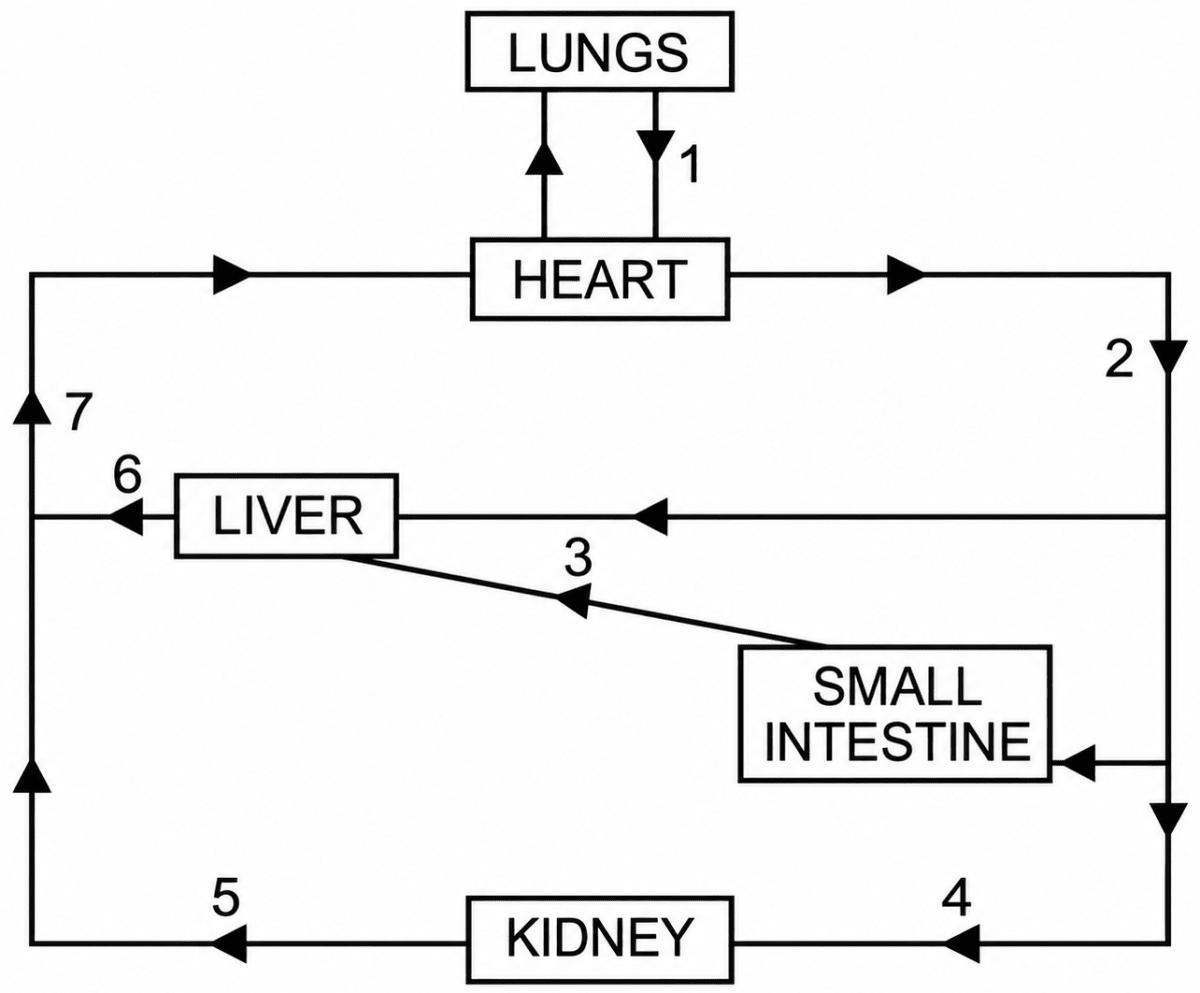
(i) Name the blood vessels labelled 1, 3, 6, and 7.
(ii) Name the blood vessel that supplies the walls of the heart with oxygen.
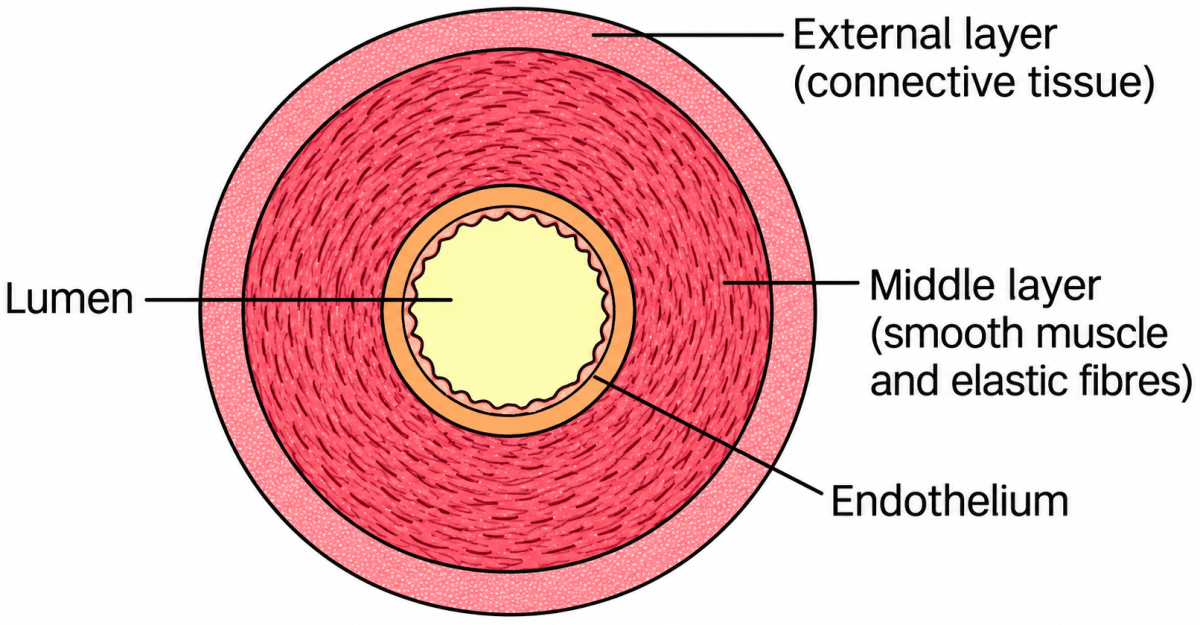
(iii) Draw a neat labelled diagram, of the blood vessel numbered '2' as seen in a cross section.
(iv) Mention one structural difference between blood vessels numbered 4 and 5.
Answer
(i) The blood vessels labelled are:
- 1 → Pulmonary vein
- 3 → Hepatic portal vein
- 6 → Hepatic vein
- 7 → (Posterior) Vena cava
(ii) The coronary artery supplies the walls of the heart with oxygen.
(iii) The blood vessel numbered '2' is the aorta (an artery). A neat labelled diagram of its cross section is given below:
(iv) One structural difference between blood vessels numbered 4 (renal artery) and 5 (renal vein) is:
| 4 (Renal artery) | 5 (Renal vein) |
|---|---|
| Has a thick, muscular wall and a narrow lumen. | Has a thin, less muscular wall and a wide lumen. |
The diagrams given below are cross sections of blood vessels:

(i) Identify the blood vessels A, B and C.
(ii) Name the parts labelled 1 to 3.
(iii) Name the type of blood that flows through A.
(iv) Mention one structural difference between A and B.
(v) In which of the above vessels does exchange of gases actually take place?
Answer
(i) The blood vessels A, B, C are:
- A → Artery
- B → Vein
- C → Capillary
(ii) Parts labelled 1 to 3 are:
- 1 → Connective tissue / Tunica externa
- 2 → Lumen
- 3 → Muscular tissue / Tunica media
(iii) Oxygenated blood flows through A.
(iv) Arteries have narrow lumen whereas Veins have wide lumen.
(v) Capillary (i.e., blood vessel C marked above)
Madhu fell down while playing in the school playground and injured her knee. There was bleeding from the injured part but after some time a brown thick layer was formed on the injury to stop the bleeding.

(a) Name the solid structure labelled X that is formed on the injury.
(b) What is the enzyme that initiates the formation of X?
(c) Which mineral element is essential for the formation of X?
Answer
(a) Thrombus (Blood clot)
(b) Thrombokinase
(c) Calcium
Given below is a diagram of a human blood smear. Study the diagram and answer the questions that follow:

(i) Name the components numbered '1' to '4'.
(ii) Mention two structural differences between the parts '1' and '2'.
(iii) Name the soluble protein found in part '4' which forms insoluble threads during clotting of blood.
(iv) What is the average lifespan of the component numbered '1'?
(v) Component numbered '1' do not have certain organelles but are very efficient in their function. Explain.
Answer
(i) Components numbered '1' to '4' are:
- 1 → RBC / Erythrocytes
- 2 → WBC / Leucocytes
- 3 → Platelets / Thrombocytes
- 4 → Plasma
(ii) Two structural differences between the parts '1' (RBC) and '2' (WBC) are:
| RBC | WBC |
|---|---|
| Biconcave disc like | Irregular, Amoeboid |
| Nucleus absent | Nucleus present |
(iii) The soluble protein found in part '4' is Fibrinogen.
(iv) The average lifespan of the component numbered '1' (i.e., RBC) is 120 days.
(v) The component numbered 1, i.e., the red blood corpuscle (RBC), lacks a nucleus, mitochondria and endoplasmic reticulum. Absence of a nucleus helps it maintain a biconcave form with a high surface-area-to-volume ratio for efficient oxygen exchange. Absence of mitochondria prevents it from using the oxygen it transports. Absence of endoplasmic reticulum increases its flexibility, helping it pass through narrow capillaries.