
Name the following plant hormones:
(i) These are produced by young shoots, buds, leaves and roots.
(ii) These increases elasticity of stem.
(iii) These promote cytokinesis during cell division.
(iv) It promotes ripening of fruits.
Answer
(i) Auxins
(ii) Gibberellins
(iii) Cytokinins
(iv) Ethylene
State if the following statements are true (T) or false (F):
(i) The roots of a plant shows negative geotropism.
(ii) The water functions as a stimulus for hydrotropism.
(iii) The shoot of a plant shows negative phototropism.
(iv) The leaves of touch-me-not plant shows chemotropism.
Answer
(i) False
Corrected Statement — The roots of a plant show positive geotropism as they grow towards gravity.
(ii) True
(iii) False
Corrected Statement — The shoot of a plant shows positive phototropism as it grows towards light.
(iv) False
Corrected Statement — The leaves of touch-me-not plant respond to touch, i.e. they show a response to the stimulus of contact.
Give one example of each type of plant (organ) showing the following movement.
(i) Negatively geotropism ............... .
(ii) Positively hydrotropism ............... .
(iii) Negatively phototropism ............... .
(iv) Chemotropism ............... .
(v) Thigmotropism ............... .
Answer
(i) Negatively geotropism — Shoot (stem)
(ii) Positively hydrotropism — Roots
(iii) Negatively phototropism — Roots
(iv) Chemotropism — Pollen tube
(v) Thigmotropism — Tendrils of climbers (pea, cucumber or bitter gourd)
Assertion (A): Stems are positively geotropic and negatively phototropic.
Reason (R): roots are negatively phototropic.
- Both (A) and (R) are true
- Both (A) and (R) are false
- Both (A) and (R) are true and (R) is the correct explanation of (A)
- Both (A) and (R) are true but (R) is not the correct explanation of (A)
Answer
Assertion (A) is false and Reason (R) is true.
Explanation
Stems are negatively geotropic (they grow away from gravity) and positively phototropic (they grow towards light), so Assertion (A) is false. Most roots are negatively phototropic as they grow away from light, so Reason (R) is true.
None of the given options is correct.
Auxins are produced by
- old leaves
- fruits
- buds
- wood
Answer
buds
Reason — Auxins are produced by young, physiologically active parts of plants such as buds, young shoots, young leaves and roots.
Which of the following is used in agriculture for ripening banana and mango?
- Ethephon
- ABA
- Gibberellin
- Cytokinin
Answer
Ethephon
Reason — Ethephon is a source of ethylene and is widely used in agriculture to promote ripening of fruits such as banana and mango.
Which of the following acts as a stimulus for geotropism?
- Light
- Water
- Contact
- Gravity
Answer
Gravity
Reason — Geotropism is the directional movement of a plant organ in response to gravity as a stimulus.
The growing leaves show
- geotropism
- hydrotropism
- phototropism
- thigmotropism
Answer
phototropism
Reason — Leaves, like most stems and flower-stalks, are positively phototropic and bend towards the source of light.
Sunil tried to match the tropic movements in plants with the stimulus they respond to. The tabulation is given below:
| Tropism | Stimulus | |
|---|---|---|
| P | Thigmotropism | Touch |
| Q | Geotropism | Water |
| R | Chemotropism | Chemicals |
| S | Phototropism | Gravity |
Identify the correct pair:
- P and R
- Q and S
- R and S
- P and S
Answer
P and R
Reason — Thigmotropism responds to touch (P) and chemotropism responds to chemicals (R). Geotropism responds to gravity (not water) and phototropism responds to light (not gravity), so Q and S are incorrectly matched.
Which hormone helps in rapid cell division and inhibition of apical dominance?
- Auxins
- Ethylene
- Cytokinins
- Abscisic acid
Answer
Cytokinins
Reason — Cytokinins promote cytokinesis (cell division) and suppress apical dominance by encouraging the growth of lateral buds even in the presence of the apical bud.
Apical dominance phenomenon is caused by
- Auxins
- GA
- Cytokinins
- ABA
Answer
Auxins
Reason — Auxins produced at the shoot apex suppress the growth of lateral buds, causing apical dominance.
The stress hormone in plants which functions during a drought is:
- Auxins
- Abscisic acid
- Ethylene
- Cytokinins
Answer
Abscisic acid
Reason — Abscisic acid is called the stress hormone as it causes closure of stomata and increases the tolerance of plants to drought and other stresses.
Stems are
- Positively geotropic and negatively phototropic
- Positively geotropic and positively phototropic
- Negatively geotropic and positively phototropic
- Negatively phototropic and negatively geotropic
Answer
Negatively geotropic and positively phototropic
Reason — Stems grow upwards against gravity (negatively geotropic) and bend towards light (positively phototropic).
The most common gibberellin is
- GA3
- GA2
- GA1
- GA7
Answer
GA3
Reason — GA3, known as gibberellic acid, is the most common and widely studied gibberellin.
Phytohormones helps to promote or inhibit the growth of plants. Which among the following is/are growth inhibitor?
A. Auxin
B. Abscisic acid
C. Cytokinin
Choose the correct option.
- A and C
- Only C
- Only B
- B and C
Answer
Only B
Reason — Abscisic acid (B) is a growth inhibitor, whereas auxin (A) and cytokinin (C) are growth promoting hormones.
The growth of pollen tube towards ovule is due to
- Phototropism
- Geotropism
- Hydrotropism
- Chemotropism
Answer
Chemotropism
Reason — The pollen tube grows towards the ovule in response to sugars present in the stigma and style, which is an example of chemotropism.
A plant hormone related to inhibition of senescence is
- Ethylene
- ABA
- Bromic acid
- Cytokinin
Answer
Cytokinin
Reason — Cytokinins delay senescence (ageing) by slowing down chlorophyll disappearance and protein breakdown.
Higher concentration of Ethylene is found in
- Green banana
- Ripe banana
- Fresh potato tuber
- Green apple
Answer
Ripe banana
Reason — Ethylene is produced in large amounts during ripening, so its concentration is highest in a ripe banana.
Which of the following hormones regulates stomatal closure?
- Auxins
- GA
- ABA
- Cytokinin
Answer
ABA
Reason — Abscisic acid (ABA) causes closure of stomata and hence prevents transpiration.
In tropic movements plant parts move
- away from the stimulus
- towards the stimulus
- either towards or away from the stimulus
- only towards water
Answer
either towards or away from the stimulus
Reason — In tropic movements, growth towards the stimulus is positive tropism and growth away from the stimulus is negative tropism.
A substance which accelerates secondary growth in stem is
- Zeatin
- Auxin
- Vitamin
- Enzyme
Answer
Auxin
Reason — Auxin promotes cell division in the cambium, thereby accelerating secondary growth in the stem.
Which of the following is a stress hormone of plants
- Abscisic acid
- Auxin
- Gibberellin
- Ethylene
Answer
Abscisic acid
Reason — Abscisic acid is called the stress hormone as it increases the tolerance or resistance of plants to cold, drought and other stresses.
In the study of plant hormones, abscisic acid (ABA) is known for its role in regulating plant responses to stress and dormancy. It causes the closure of stomata, which in turn prevents 'P' and enhances plant resistance to 'Q' conditions.
- P- water loss; Q- favourable
- P- transpiration; Q- adverse
- P- nutrient absorption; Q- optimal
- P- growth; Q- stable
Answer
P- transpiration; Q- adverse
Reason — Closure of stomata by ABA prevents transpiration (P) and increases the plant's resistance to adverse (Q) conditions such as drought.
Meeta attempted to categorise the functions of certain plant hormones. She made the following pairs:
| Hormone | Effect on the plant |
|---|---|
| A | Promotes ripening of fruits |
| B | Inhibits seed germination |
Identify the correct pairing of hormones.
- A - Ethylene, B - Abscisic Acid
- A - Abscisic Acid, B - Ethylene
- A - Cytokinins, B - Ethylene
- A - Auxin, B - Cytokinins
Answer
A - Ethylene, B - Abscisic Acid
Reason — Ethylene promotes ripening of fruits, while abscisic acid prevents or slows down seed germination.
Complete the given statements:
(i) The shoot of a plant bends towards the source of ............... .
(ii) When a seed germinates the root grows towards the ............... .
(iii) The tendrils of pea plant grow round the surface of ............... .
(iv) IAA, IBA, NAA and 2, 4-D are ............... .
(v) GA, GA2, GA3 and so on are ............... .
Answer
(i) The shoot of a plant bends towards the source of light .
(ii) When a seed germinates the root grows towards the earth (ground) .
(iii) The tendrils of pea plant grow round the surface of contact (support) .
(iv) IAA, IBA, NAA and 2, 4-D are auxins .
(v) GA, GA2, GA3 and so on are gibberellins .
Match the following:
| Column A | Column B |
|---|---|
| (i) Touch | (a) Phototropism |
| (ii) Moisture | (b) Chemotropism |
| (iii) Sunlight | (c) Thigmotropism |
| (iv) Gravitational force | (d) Hydrotropism |
| (v) Sugar | (e) Geotropism |
Answer
| Column A | Column B |
|---|---|
| (i) Touch | (c) Thigmotropism |
| (ii) Moisture | (d) Hydrotropism |
| (iii) Sunlight | (a) Phototropism |
| (iv) Gravitational force | (e) Geotropism |
| (v) Sugar | (b) Chemotropism |
Name the following:
A gaseous plant hormone which promotes ripening of fruits.
Answer
Ethylene
The statements given below are false. Correct and rewrite the complete statements:
(i) Fruit ripening is induced by Abscisic acid.
(ii) Roots show negative Hydrotropism.
(iii) Thigmotropism can be demonstrated by using a Clinostat.
Answer
(i) Fruit ripening is induced by Ethylene.
(ii) Roots show positive Hydrotropism.
(iii) Geotropism can be demonstrated by using a Clinostat.
Fill in the blanks with correct terms.
Abscisic acid (ABA) is a plant hormone that occurs widely in all vascular plants and some mosses. It was discovered for its role in regulating .......(a)...... and dormancy. ABA acts as a plant growth ......(b)......., slowing down or preventing growth and metabolism. One of its key functions is to prevent or slow down .......(c)......, helping plants cope with various stresses such as drought and high salinity. Additionally, ABA causes the closure of .......(d)......, reducing transpiration and water loss. In certain short-day plants like strawberries and black currants, ABA even promotes .......(e)......, demonstrating its diverse physiological effects on plant growth and development.
Answer
(a) abscission
(b) inhibitor
(c) seed germination
(d) stomata
(e) flowering
Define tropism.
Answer
The directional growth of a plant organ in response to an external stimulus such as light, touch or gravity is called tropism.
Define hydrotropism.
Answer
The growth of a plant part in response to water or moisture as a stimulus is called hydrotropism.
Define stress hormone.
Answer
A stress hormone is a plant hormone that increases the tolerance or resistance of a plant to unfavourable conditions such as drought and cold. Abscisic acid (ABA) is called the stress hormone.
Define thigmotropism.
Answer
The response of a plant to the stimulus of contact with a solid foreign body is called thigmotropism.
Write briefly about cell elongation due to auxins.
Answer
Cell elongation is the primary effect of auxin. It stimulates the elongation of cells in the shoot. When light falls unequally on a plant, the stem on the shaded side receives more auxin and elongates more rapidly, causing the shoot to bend towards light.
Write briefly about phototropism.
Answer
The directional movement of a plant organ in response to the stimulation of light is called phototropism. Most stems, leaves and flower-stalks are positively phototropic and bend towards light, while most roots are negatively phototropic and grow away from light.
Write briefly about effects of ethylene hormone on plants.
Answer
Ethylene is a gaseous plant hormone with the following effects:
- It promotes transverse or horizontal growth and swelling of the axis but inhibits longitudinal growth.
- It aids in the ripening of fruits and dehiscence of dry fruits.
- It induces flowering in mango and promotes the growth of female flowers in cucumbers.
- It promotes seed germination, bud opening and root initiation in some plants.
Write briefly about physiological effects of gibberellins.
Answer
The physiological effects of gibberellins are:
- They induce elongation of internodes (stem elongation) by increasing the elasticity of the cell wall.
- They overcome the genetic dwarfism of plants such as pea and maize.
- They promote bolting, flowering, seed germination and parthenocarpy.
- They break the natural dormancy of buds, tubers and seeds.
Write briefly about cytokinin.
Answer
Cytokinins are hormones that promote cytokinesis (cell division) in various parts of a plant. Their important effects include cell division, cell enlargement, morphogenesis and delay of senescence. They also break seed dormancy and suppress apical dominance by promoting the growth of lateral buds.
Ramesh is a farmer who has a vineyard and cultivates grapes. To improve the shape of the grapes and make them elongated he sprays a particular phytohormone at the time of fruiting.
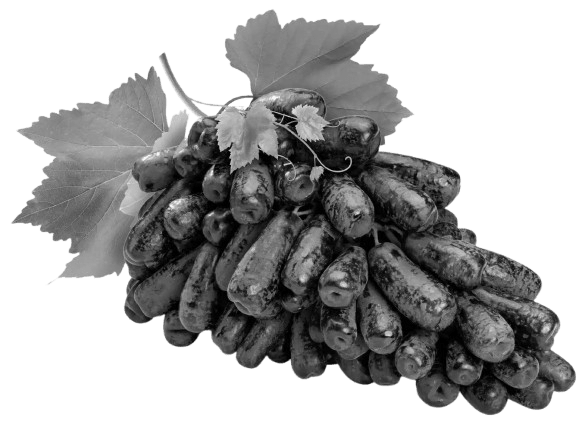
(i) Name the phytohormone that Ramesh sprays on the plant at the time of fruiting.
(ii) These grapes are said to be seedless. What is the technical term for the formation of such fruits?
Answer
(i) Gibberellins
(ii) Parthenocarpy
What are phytohormones? Give an example of the growth retarding hormone.
Answer
Phytohormones are chemical substances produced in plants that regulate growth, development, and responses to stimuli.
Example of a growth-retarding hormone: Abscisic acid (ABA). It slows down growth and promotes dormancy in seeds and buds.
What do you know about growth hormones of plants? Explain the effects of any one hormone.
Answer
Growth hormones of plants, also called plant hormones or phytohormones, are small but simple molecules of chemical composition manufactured by living protoplasm. They act as chemical coordinators and control the growth and other physiological functions of plants, being active in extremely minute quantities. Based on their functions, they are divided into two groups — growth promoting hormones and growth inhibiting hormones. Some common phytohormones are auxins, gibberellins, cytokinins, abscisic acid and ethylene.
The effects of Auxins are:
- Cell elongation — It stimulates the elongation of cells in the shoot, which causes bending of the shoot towards light.
- Cell division — It promotes cell division in tissues such as cambium and induces callus formation on injury.
- Develops roots — It helps to initiate rooting in stem cuttings.
- Promotes flowering — In some plants like pineapple, auxin promotes flowering.
- Prevents fruit and leaf drop — It helps the plant to prevent early fruit and leaf drop.
- The synthetic auxin 2, 4-D is used as a herbicide to kill dicotyledonous weeds.
Explain the geotropic movement in plants with the help of an experiment.
Answer
The directional movement or orientation of a plant organ in response to gravity is called geotropism. The roots move downwards in the direction of gravity (positive geotropism), while the shoot grows upwards against gravity (negative geotropism).
Experiment:
- Take a potted plant and turn it at 180° on the ground.
- Leave the potted plant for at least 7–8 days and observe it carefully.
- It is observed that the shoot bends and grows upwards, showing negative geotropism.
- Now take out the whole plant with soil and remove the soil from the roots. The roots are found growing downwards, showing positive geotropism.
This proves that gravity acts as the stimulus that causes roots to grow towards the earth and the shoot to grow away from it.
Which parts of a plant exhibit:
(a) Negative Geotropism
(b) Positive Hydrotropism
Answer
(a) Negative Geotropism — Shoot (stem)
(b) Positive Hydrotropism — Roots
Give reason — Leaves of certain plants roll up on a hot sunny day.
Answer
On a hot sunny day, the leaves of certain plants roll up to reduce the exposed surface area. This reduces transpiration and helps to prevent excessive loss of water from the plant.
Give reason — The leaflets of Mimosa pudica droop on being touched by a finger or an object.
Answer
The leaflets of Mimosa pudica (touch-me-not plant) droop because the plant is sensitive to touch. When the compound leaf is touched, it responds to the stimulus of contact, and the leaflets fold together and collapse.
Give reason — The tendrils of a climber grows around the support.
Answer
The tendrils of a climber grow around the support due to thigmotropism, the response to the stimulus of touch or contact. The tendrils bend and coil around the surface of contact, which provides support to the climber.
Give reason — Roots move towards soil in the ground.
Answer
Roots move towards the soil because they are positively geotropic. They respond to the stimulus of gravity and grow downwards into the soil, which anchors the plant and helps in the absorption of water and minerals.
What is Parthenocarpy? Give one example.
Answer
Parthenocarpy is the production of fruits without the fertilisation of ovules, which makes the fruits seedless. Example — grapes.
What are Tropic hormones? Give one example.
Answer
Tropic movements are the directional growth movements of a plant organ in response to an external stimulus such as light, gravity or touch. Example — Phototropism, in which the shoot bends towards the source of light.
Which hormone promotes parthenocarpy? Give one example.
Answer
Gibberellins promote parthenocarpy. Example — grapes (and tomato), in which gibberellins increase the productivity and size of the fruits, making them seedless.
Look at the picture given below and answer the below questions:
(i) Name the tropic movement shown by the seedling.
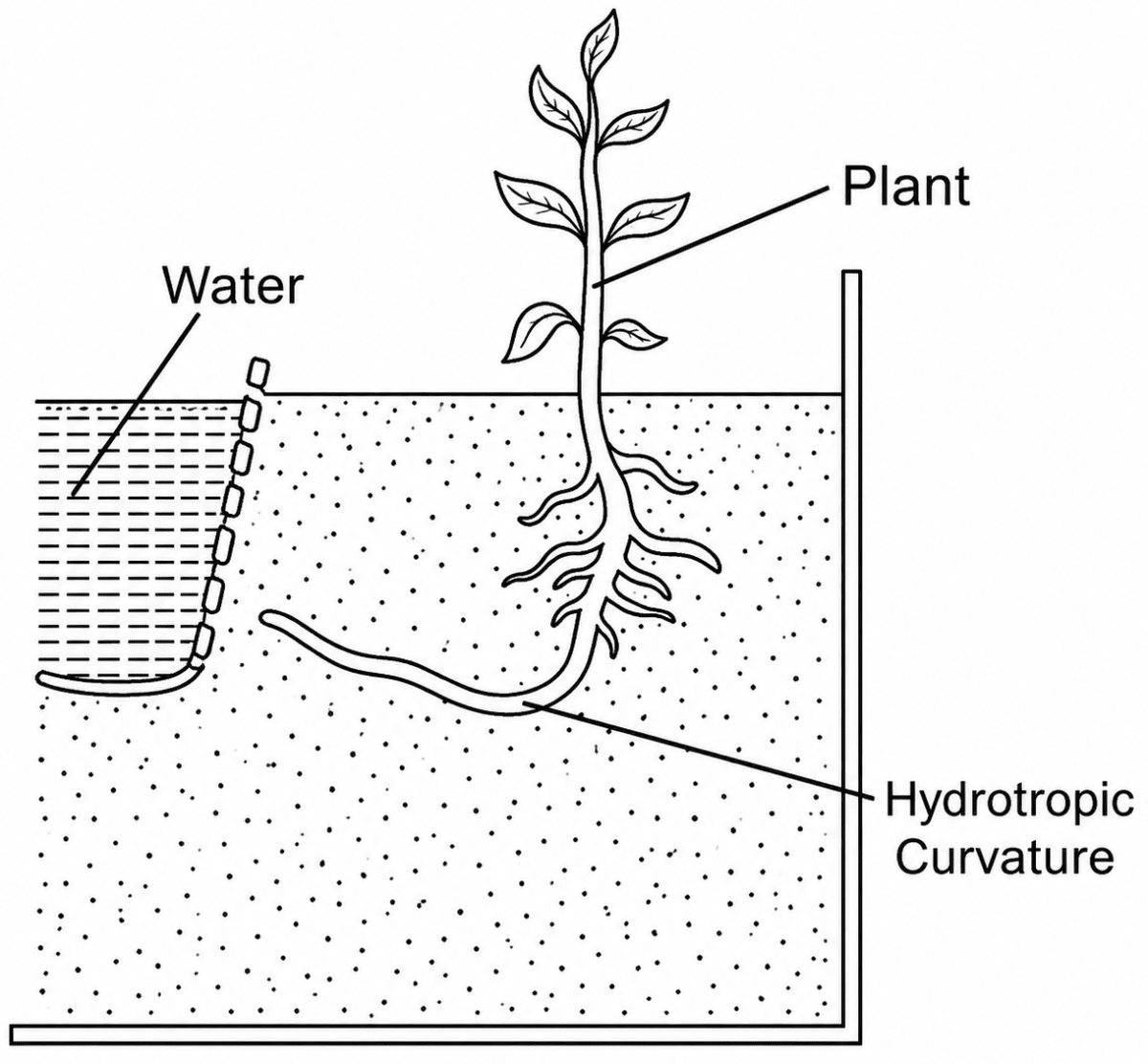
(ii) Name the stimulus responsible for this movement.
(iii) Define the process of (i).
(iv) Which part of this seedling is showing the negative response to the given stimulus?
Answer
(i) The tropic movement shown by the seedling is hydrotropism, as the roots curve and grow towards the source of water.
(ii) The stimulus responsible for this movement is water (moisture).
(iii) Hydrotropism is the growth of a plant part in response to water or moisture as a stimulus.
(iv) The shoot (stem) shows the negative response to the given stimulus, as it grows away from the water source.
Given below is an experimental setup to demonstrate a particular tropic movement in germinating seeds. Study the diagram and answer the questions that follow :

(i) Label the parts 1 and 2.
(ii) Name the tropic movement shown by part 1.
(iii) Part 1 is affected by two stimuli. Name them. Which one of the two is stronger?
(iv) What is Thigmotropism ? Give one example.
(v) What is meant by 'Positive' and 'Negative' tropic movements in plants?
Answer
(i) The parts labelled 1 and 2 are:
- 1 → Radicle
- 2 → Plumule
(ii) The tropic movement shown in part 1 is Hydrotropism.
(iii) Part 1 is affected by gravity and water (moisture). Water is the stronger stimulus.
(iv) The growth movement of a plant part in response to the stimulus of touch or contact is called thigmotropism. Example: Tendrils of climbers such as pea and cucumber coil around a support in response to one-sided contact or touch.
(v) Directional growth of a plant part towards a stimulus is called a positive tropic movement, whereas growth away from the stimulus is called a negative tropic movement.
Study the diagram given below and answer the questions that follow:

(i) Name the phenomenon depicted by the shoot in the above diagram.
(ii) Which plant hormone plays an important role in the above movement?
(iii) Complete and rewrite the given statement by filling in the correct terms:
Shoots show positive ............... whereas, roots show positive ............... .
Answer
(i) Phototropism
(ii) Auxin
(iii) Shoots show positive phototropism whereas, roots show positive geotropism.