
Our Parliamentary system is based on
- universal adult franchise
- proportional representation
- male franchise
- male, female and adult franchise
Answer
universal adult franchise
Reason — The members of the Lok Sabha are directly elected by the people on the principle of Universal Adult Franchise, which gives every citizen aged 18 years and above the right to vote, irrespective of caste, creed, colour, gender, or economic status. This establishes a true democracy.
The Lok Sabha
- cannot have its life extended beyond 6 years
- is never dissolved within 5 years
- is dissolved after every 5 years
- is never subject to dissolution
Answer
is dissolved after every 5 years
Reason — The Lok Sabha has a normal term of five years, after which it is dissolved and fresh elections are held. However, it may be dissolved earlier by the President on the advice of the Prime Minister, and during a National Emergency, its term can be extended by Parliament for one year at a time.
Among the disqualifications for the membership of Parliament, we can't include one of the following. That is
- being of unsound mind
- not being a graduate
- holding office of profit
- being an undischarged insolvent
Answer
not being a graduate
Reason — A member of Parliament is disqualified if he holds an office of profit, is of unsound mind, is an undischarged insolvent, has ceased to be a citizen of India or has been disqualified under any law made by the Indian Parliament. No educational qualification, such as being a graduate, is prescribed for membership of the Parliament.
Identify the correct statement.
- The Rajya Sabha elects its own Chairman from among its own members.
- The Vice President of India is elected by both the Houses of the Parliament.
- A state of national emergency is proclaimed by the Vice President of India.
- The Rajya Sabha can decide by three-fourths majority to set up a new All India service.
Answer
The Vice President of India is elected by both the Houses of the Parliament.
Reason — As part of the electoral functions of the Parliament, the Vice-President of India is elected by both the Houses of the Parliament. The other statements are incorrect as the Vice President of India is the ex-officio Chairman of the Rajya Sabha, a national emergency is proclaimed by the President and the Rajya Sabha can decide to set up a new All India Service by a 2/3rd majority.
Who can suspend a member in case of misconduct in the Lok Sabha?
- President of India
- Prime Minister of India
- Chief Justice of India
- Speaker of Lok Sabha
Answer
Speaker of Lok Sabha
Reason — Under his disciplinary powers, the Speaker maintains order and decorum in the House. He can suspend a member in case of misconduct.
After being elected as Speaker of the Lok Sabha a person
- remains a member of his party
- is not a member of Parliament
- becomes a non-party man
- may or may not remain a party man
Answer
becomes a non-party man
Reason — The Speaker is the impartial presiding officer of the Lok Sabha. After his election, the Speaker rises above party considerations and becomes a non-party man.
In the question given below, there are two statements marked as Assertion (A) and Reason (R). Read the statements and choose the correct option.
Assertion (A): In case of a Money Bill, the Rajya Sabha has almost no powers.
Reason (R): The Rajya Sabha can make no changes and at the most it can delay it for 14 days.
- (R) contradicts (A)
- (R) is the reason for (A)
- (A) is true but (R) is false
- (A) and (R) are independent of each other
Answer
(R) is the reason for (A)
Explanation — After being passed in the Lok Sabha, a Money Bill is sent to the Rajya Sabha which can, at the most, delay it for 14 days. After the expiry of the period, it is deemed to have been passed by the Rajya Sabha. Hence, the Rajya Sabha has almost no powers over a Money Bill.
The house has 550 members. On a particular day, 45 members are present. The Government wants to present a Bill. What do you think will happen?
- The Government has a majority, so the Bill will be passed.
- The Government cannot pass the Bill because the opposition is against it.
- The Government is unable to introduce the Bill because the Speaker adjourns the House.
- The Government can introduce the Bill but cannot pass it.
Answer
The Government is unable to introduce the Bill because the Speaker adjourns the House.
Reason — The quorum for the House is one-tenth of its total membership, i.e., at least 55 members should be present. But in the given case, the quorum requirement is not met so the House cannot conduct its proceedings and pass bills. So, the Speaker will adjourn the House until there is a requisite quorum.
31st July 2023, ANI reported:
Government to introduce Delhi Services Ordinance Bill in Lok Sabha tomorrow
Why should the Government introduce an ordinance in the Lok Sabha?
- The Government needs the approval of only the Lok Sabha.
- The Government needs the approval of the Opposition.
- The Rajya Sabha has no power over an ordinance.
- Every ordinance needs to be approved by both houses of the Parliament to become law.
Answer
Every ordinance needs to be approved by both houses of the Parliament to become law.
Reason — When the Houses reassemble, the Ordinance should be approved by them within six weeks from the date of their reassembly, otherwise it lapses.
Identify the exclusive powers of the Lok Sabha.
P : Introduces the Money Bill
Q : Passes an ordinary bill
R : Can vote a government out of power
S : Can impeach the President
- P and Q
- R and S
- P and R
- Q and S
Answer
P and R
Reason — A Money Bill can be introduced only in the Lok Sabha, and a motion of No-Confidence, which can vote the Government out of power, can be introduced and passed only in the Lok Sabha. An ordinary Bill can be passed by either House and impeachment of the President can be initiated in either House, so these are not exclusive powers of the Lok Sabha.
Your uncle is a renowned scientist. He has neither contested nor won any election to the Rajya Sabha. But he has recently become a member of the Rajya Sabha and has been appointed as a minister. How is this possible?
- He was appointed by the Chief Justice of India.
- He was nominated by the President.
- He was appointed by the Prime Minister.
- He was nominated by the Governor.
Answer
He was nominated by the President.
Reason — The President of India can nominate 12 people to the Rajya Sabha who have special knowledge or practical experience in matters such as literature, science, art, and social service.
The house is discussing an issue regarding the nation in the month of November. Which session is in motion?
- Summer Session
- Budget Session
- Winter Session
- Monsoon Session
Answer
Winter Session
Reason — Normally, there are three sessions of the Parliament held in a year — the Budget Session (February-May), the Monsoon Session (July-September) and the Winter Session (November-December).
Identify the reasons why the Lok Sabha is considered superior to the Rajya Sabha?
P : An ordinary Bill can originate in either of the two Houses.
Q : In case of a Money Bill, the Rajya Sabha has virtually no powers.
R : A vote of no-confidence can be passed only in the Lok Sabha.
S : Impeachment of the President or a Judge of the Supreme Court can only be initiated in the Lok Sabha.
- P and Q
- Q and R
- R and S
- P and S
Answer
Q and R
Reason — A Money Bill can originate only in the Lok Sabha and the Rajya Sabha can, at the most, delay it for 14 days. A motion of No-Confidence against the Union Government can be introduced and passed only in the Lok Sabha. An ordinary Bill can originate in either House and impeachment can be initiated in either House, so P and S do not show the superiority of the Lok Sabha.
Read the two statements given below about the financial powers of the Parliament and select the option that shows the correct relationship between (A) and (B).
Statement (A) : The Union Parliament is the custodian of the national purse.
Statement (B) : The Parliament is empowered to vote a cut in the budget or to reject it as a whole.
- (B) contradicts (A)
- (B) is the reason for (A)
- (A) is true but (B) is false
- (A) and (B) are independent of each other
Answer
(B) is the reason for (A)
Explanation — The Union Parliament is the custodian of the National Purse. Neither a pie can be spent on any item, nor a paisa can be collected by way of taxes without the prior approval of the Parliament. As the Parliament is empowered to vote a cut in the Budget or to reject it as a whole, it controls the finance of the country. Hence, (B) is the reason for (A).
Identify the exclusive powers of the Rajya Sabha.
P : Can introduce a new All India Service
Q : Can impeach the President
R : Can never be dissolved as a whole
S : Can introduce a Money Bill
- P and Q
- R and S
- P and R
- Q and S
Answer
P and R
Explanation — The Rajya Sabha has the exclusive power to declare the creation of new All India Services in accordance with national interest. Also, it is a permanent house and cannot be dissolved as each member is elected for a period of six years, which means that one-third of the total members retire after every two years.
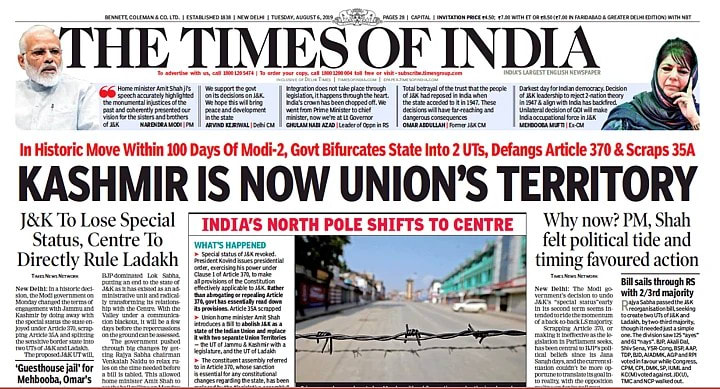
Who made the amendment which resulted in the below headline?
- The Supreme Court
- The President
- The Parliament
- The Prime Minister
Answer
The Parliament
Reason — The Central Government took an important political and constitutional step on August 5, 2019 by abrogating Article 370 and bifurcating Jammu and Kashmir into two separate Union Territories (UTs), i.e., Jammu and Kashmir with a Legislative Assembly and Ladakh without a Legislative Assembly.
The opposition comes to the conclusion that the ruling party has lost majority in the Lok Sabha.
Which of these motions will the Leader of the Opposition move?
- Adjournment Motion
- Motion for Impeachment
- Call — Attention Motion
- No Confidence Motion
Answer
No Confidence Motion
Reason — In a Parliamentary set-up, the Council of Ministers works till it enjoys the confidence of the Legislature. If a successful motion of No-Confidence is passed in the Lok Sabha, the Council of Ministers has to resign. Hence, on concluding that the ruling party has lost majority, the Leader of the Opposition will move a No Confidence Motion.
Given below are details of a few Indian citizens.
| Candidate | Age | Other details |
|---|---|---|
| S | 30 | Undischarged insolvent |
| T | 28 | A man of unsound mind |
| U | 36 | A big industrialist |
| V | 34 | Sentenced to imprisonment for 2 years. |
Select the candidate who fulfils the eligibility criteria to become a member of the Lok Sabha.
- S
- T
- U
- V
Answer
U
Reason — To seek election to the Lok Sabha, a person must be at least 25 years old, should not be of unsound mind and should not be an undischarged insolvent. Further, a person convicted and sentenced to imprisonment for not less than two years is disqualified. S is an undischarged insolvent, T is of unsound mind and V has been sentenced to imprisonment for 2 years. Hence, only U, a 36-year-old industrialist, fulfils the eligibility criteria.
The strength of the House is 350 members; the quorum will be ...............
- 36 members
- 40 members
- 60 members
- 35 members
Answer
35 members
Reason — As per rule, 1/10 of the total membership of each House constitutes the quorum. Hence, for a House of 350 members, the quorum will be 35 members.
A major natural calamity has taken place and the opposition wants the house to lay aside all other business and take up this matter of urgent importance.
Which motion should the house move to allow this?
- Adjournment Motion
- No-confidence Motion
- Confidence Motion
- Censure Motion
Answer
Adjournment Motion
Reason — Daily business of the House is programmed well in advance. But if a question of immense public importance crops up, the members can demand adjournment of the discussion on slated business and discuss that matter immediately.
How many elected members are there in the Rajya Sabha?
- 235
- 232
- 238
- 245
Answer
238
Reason — The maximum strength of the Rajya Sabha can be 250 members. Of these, 238 are elected by the States of the Union and 12 members are nominated by the President.
Given below are details of a few Indian Citizens.
| Person | Age (In years) | Description |
|---|---|---|
| W | 25 | Is a famous journalist |
| X | 45 | Is an industrialist |
| Y | 35 | Has declared insolvency |
| Z | 50 | Has taken citizenship of another country |
Select the one who is eligible to be a member of the Rajya Sabha.
- X
- W
- Y
- Z
Answer
X
Explanation — A member of the Rajya Sabha must be a citizen of India and should be at least 30 years of age. He should not be an undischarged insolvent and should not have ceased to be a citizen of India. Only X, aged 45, fulfils all these conditions.
Observe the given picture. In case of a similar unruly situation in the Lok Sabha, choose the action that may be taken by the Speaker.
- adjourn the house for lack of quorum.
- dissolve the Lok Sabha.
- adjourn the house for lack of discipline.
- disqualify the members under Anti-defection law.
Answer
adjourn the house for lack of discipline.
Explanation — It is the duty of the Speaker to maintain order and discipline in the Lok Sabha. He can adjourn the House for lack of discipline.
If an Adjournment Motion is passed in the Lok Sabha ...............
- the Lok Sabha will be dissolved.
- the House will discuss a matter of urgent public importance.
- the President ends the session.
- the Government will fall.
Answer
the House will discuss a matter of urgent public importance.
Reason — An Adjournment Motion is passed by the Lok Sabha to discuss a matter of urgent public importance. Such a Motion leads to the interruption of the normal business of the House.
What is the maximum strength of members of the Lok Sabha or the House of the People?
Answer
The maximum strength of the Lok Sabha, as provided by the Constitution, is 550.
How are the members of the Lok Sabha elected?
Answer
Members of the Lok Sabha are directly elected by the people through Universal Adult Franchise. Every citizen of India who is 18 years of age or above has the right to vote. The elections are held by secret ballot, which enables voters to cast their votes without fear or political pressure.
How are the members of the Rajya Sabha elected?
Answer
The representatives of each State in the Rajya Sabha are elected by the elected members of the State Legislative Assembly in accordance with the system of proportional representation by means of the single transferable vote
If the Parliament has prorogued its session by the end of February, within which month it must have its next session?
Answer
The Parliament must have its next session by the end of August, i.e., within six months. This is because there cannot be a gap of more than six months between two consecutive sessions.
The Lok Sabha has been the pulse of the vitality of Indian democracy. Mention any three exclusive powers of the Lok Sabha to justify this statement.
Answer
Three exclusive powers of the Lok Sabha are as follows:
- Motions of No-Confidence against the government can only be introduced and passed in the Lok Sabha, and not the Rajya Sabha.
- Money Bills can only be introduced in the Lok Sabha, and upon being passed, are sent to the Rajya Sabha, where it can be deliberated on for upto 14 days.
- In case of a deadlock between the two Houses over an ordinary bill, the will of the Lok Sabha normally prevails, as its strength is more than double that of Rajya Sabha.
It is the function of Parliament to exercise control over the Executive and to ensure parliamentary surveillance of administration. Mention any three ways in which the Parliament adheres to the above function.
Answer
Three ways in which Parliament exercises control over the Executive are given below:
- Interpellation during Question Hour
- By passing Vote of No-confidence
- Through Monetary Controls
What is the procedure that should be followed if there is a deadlock between the two Houses of the Parliament on a Non-Money Bill?
Answer
In the case of a deadlock between the two Houses over a Non-Money bill, it is to be resolved in a joint session of the Houses with the Speaker of the Lok Sabha in the chair.
What happens to a Money Bill, which having been passed by the Lok Sabha and sent to the Rajya Sabha, but is not returned within 14 days?
Answer
If a Money Bill, passed by the Lok Sabha, is not returned by the Rajya Sabha within 14 days, it is deemed to have been passed by both Houses in the form in which it was passed by the Lok Sabha.
What can the President do if he does not wish to sign a Non-Money Bill passed by the Parliament?
Answer
If the President does not wish to sign a Non-Money Bill passed by Parliament, he may withhold his assent or return the Bill for reconsideration. If the Bill is passed again by both Houses, with or without amendments, the President must give his assent.
State the meaning of the term Question Hour.
Answer
The first hour of every sitting of the House is reserved for asking questions to the Government. This period is called the Question Hour. Members may ask questions relating to the administration and policies of the Government, and the Ministers are obliged to answer them.
What is meant by the term 'Session'?
Answer
The period during which the House meets to conduct its business is called a session. The President summons the sessions of each House of Parliament. Normally, there are three sessions of Parliament in a year—the Budget Session (February–May), Monsoon Session (July–September) and Winter Session (November–December).
Mr. Kaushal is 26 years of age, Which House of Parliament can he be a member of? Why?
Answer
Mr. Kaushal can be a member of the Lok Sabha because a person seeking election to the Lok Sabha must be at least 25 years old, whereas a candidate for the Rajya Sabha must be at least 30 years old. Since Mr. Kaushal is 26 years old, he is eligible only for the Lok Sabha.
Read the extract given below and answer the question which follow:
Congress member's adjournment motion disallowed. The notice, along with another moved demanding a discussion on China, was disallowed in the Lok Sabha.
—The Times of India, Feb 10, 2023
Who can allow or disallow the above motion? What does this motion mean?
Answer
The Speaker of the Lok Sabha has the right to allow or disallow an Adjournment motion.
An Adjournment Motion means a proposal to lay aside all other business and take up a 'definite matter of urgent importance'. Such a motion leads to the interruption of normal business of the House.
Mention any two powers of the Prime Minister with reference to the President.
Answer
Two powers of the Prime Minister with reference to the President are:
- It is on the advice of the Prime Minister that the President summons and prorogues the Parliament and dissolves the Lok Sabha.
- The PM advises the President on various appointments to important posts such as the Judges of the Supreme Court, the Governors and Ambassadors.
29th March 2023, The Hindu reported:
Opposition MPs, in this case, largely the Congress legislature party, are mooting an idea of a resolution against Lok Sabha Speaker Om Birla for being "unfair" to the opposition.
What is the consequence when the Lok Sabha moves a resolution against the Speaker? In the above case, do you think the resolution would have led to such a consequence? Why?
Answer
If the resolution is passed with majority in the Lok Sabha, the Speaker will have to vacate the office.
In the above case, the resolution would not have passed as the Opposition (Congress) lacked majority.
14th December 2023, The Hindustan Times reported:
Parliament session highlights: Total 13 opposition MPs suspended, SR Parthiban's suspension revoked.
Who can suspend the members from the Lok Sabha? Mention any one probable circumstance under which he/she can suspend the members.
Answer
The Speaker of the Lok Sabha can suspend the members from the Lok Sabha.
One probable circumstance for suspension is lack of discipline.
With reference to the Lok Sabha, explain the following :
(a) What is its total membership?
(b) What are the qualifications of the members of the Lok Sabha?
(c) Who presides over the meetings of the Lok Sabha?
Answer
(a) The maximum strength of the Lok Sabha, as provided by the Constitution, is 550 members. At present, the strength is 543 members.
(b) In order to seek election to the Lok Sabha, a person must possess the following qualifications:
- He should be a citizen of India.
- He should be at least 25 years old.
- He should not be disqualified under any law made by Parliament.
- He should have his name in the electoral rolls in any part of the country.
- He or she should possess such other qualifications as may be specified by Parliament from time to time.
- He should not hold any office of profit under the State or Central Government.
- He should not be of unsound mind.
- He should not be an undischarged insolvent, i.e he should not be in debt.
(c) The Speaker of the Lok Sabha presides over the meetings of the Lok Sabha.
With reference to the Union Legislature answer the following:
(a) How are the members of the Rajya Sabha elected?
(b) Why is it called a Permanent house?
(c) State any two Financial and any two Legislative powers of the Indian Parliament.
Answer
(a) The representatives of each State in the Council of States (or Rajya Sabha) are elected by the elected members of the Legislative Assembly of the State in accordance with the system of proportional representation by means of a single transferable vote for a period of six years. Union Territories having a Legislative Assembly (Delhi, Puducherry, Jammu & Kashmir) also elect members to the Rajya Sabha in the same manner. In addition, twelve members are nominated by the President from amongst men of repute in various spheres of life, e.g., Science, Art, Literature and Social Service.
(b) The Rajya Sabha is called a Permanent House because it cannot be dissolved like the Lok Sabha. Each member of the Rajya Sabha is elected for a period of six years. One-third of the total members of the House retire after every two years, so that the House never ceases to exist as a whole.
(c) FINANCIAL POWERS OF THE INDIAN PARLIAMENT
Two financial powers of the Indian Parliament are:
- Annual Budget: The Statement of the sources of income and the items of expenditure for the coming year, popularly called the Budget, is presented in the Parliament by the Union Minister for Finance with the prior approval of the President. The Parliament is empowered to vote a cut in the Budget or to reject it as a whole.
- Salary and Allowances of the Members of Parliament: It is the privilege of the Parliament to decide the salaries and allowances of its own members and also those of the Ministers and the Chief Justices and Judges of the Supreme Court and the High Courts.
LEGISLATIVE POWERS OF THE INDIAN PARLIAMENT
Two legislative powers of the Indian Parliament are:
- The Parliament is the law-making body at the central level. It frames new laws and amends or repeals them, if necessary, on all the 97 Subjects of the Union List and all the Residuary Subjects which have not found a place in any of the lists.
- As far as the 47 Subjects in the Concurrent List are concerned, both the Parliament and the State Legislatures have got the right to make laws. But if any State Law comes into conflict with the Central Law, the Central Law shall prevail.
The Union Legislature comprises the President and the two Houses of the Parliament. With reference to the Parliament, answer the following questions:
(a) Mr. Raj wants to be a member of the Lok Sabha. Mention any three qualifications required to contest elections for the Lok Sabha.
(b) Mention any three legislative powers of the Union Parliament.
(c) The Parliament controls the Executive. Mention any four ways in which it exercises its control.
Answer
(a) Three qualifications required to contest elections for the Lok Sabha are:
- He should be a citizen of India.
- He should be at least 25 years old.
- He should have his name in the electoral rolls in any part of the country.
(b) Three legislative powers of the Union Parliament are:
- The Parliament is the law-making body at the central level. It frames new laws and amends or repeals them, if necessary, on all the 97 Subjects of the Union List and all the Residuary Subjects which have not found a place in any of the lists.
- As far as the 47 Subjects in the Concurrent List are concerned, both the Parliament and the State Legislatures have got the right to make laws. But if any State Law comes into conflict with the Central Law, the Central Law shall prevail.
- All ordinances issued by the President must be approved by Parliament within six weeks after its session has begun, failing which an ordinance lapses.
(c) The Parliament exercises control over the Executive in the following ways:
- Question Hour: An hour a day in the daily routine of the Parliament, when in session, is reserved for asking questions from the Government. The members can ask any questions relating to the administration and policies and the Ministers are obliged to answer them.
- Vote of No-Confidence: The Council of Ministers remains in office only so long as it enjoys the confidence of the Lok Sabha. If a No-Confidence Motion is passed, the Council of Ministers must resign.
- Other Motions of Censure: The Parliament exercises its control over the Government by a number of other motions also which, if passed, amount to no-confidence. They include adjournment motions, motions of censure against a minister or ministers, rejection of a Government Bill and passing of a private member's bill against the wishes of the Government.
- Monetary Controls: The Parliament can hold the strings of the Government tight by voting a cut in the annual or supplementary budget or a cut in the salaries of the Ministers. It also appoints the Public Accounts Committee to examine the mode of government expenditure.
India has a parliamentary system of governance. With reference to the Indian Parliament, answer the following questions:
(a) State any three ways in which the legislature controls the executive.
(b) How and by whom is the Speaker of the Lok Sabha elected?
(c) Mention any four financial powers of the Parliament.
Answer
(i) Three ways in which the Legislature controls the Executive are:
Interpellation: The Question Hour, Calling Attention Notices and Half-an-Hour Discussion are some of the devices to seek information from the government about its policies and performance.
For example - The first hour of a sitting in both Houses is allotted for asking and answering of questions related to matters of public importance or to highlight a grievance. It is a valuable device against injustice and slackness of the government.Vote of No-confidence: If a Government acts against the Constitutional provisions, it can be voted out of office by passing a vote of no-confidence against the Prime Minister, or the Ministry as a whole or any of its members. In such a case, the whole Ministry has to resign.
Monetary Controls: During the budget session a cut motion may be moved. Parliamentary Committee on Public Accounts ensures that public money is spent in accordance with Parliament's decision. It examines reports of the Comptroller and Auditor-General of India.
(ii) The Speaker of the Lok Sabha is elected from among its own members soon after the newly elected House meets for the first time. The previous Speaker does not vacate his/her office till a new speaker is elected by the new Lok Sabha in its first meeting. The Speaker is elected for a period of five years, and can seek re-election for any number of times, if he/she is elected as a member of the Lok Sabha.
(iii) The Union Parliament has following four financial powers:
- Passing the Union Budget — The Parliament has the power to pass the annual Union Budget.
- Making Supplementary Grants — If the amount authorized by the budget is insufficient, the Parliament can make supplementary grants.
- Vote on Account — If the Budget is not passed before April, then there would be no money for the executive to spend. To provide money to the executive for day-to-day expenditure till the passage of the budget, a “Vote on Account” is passed.
- Salaries — The salaries and allowances of MPs and Ministers are determined by Parliament.
Analyse the given image and the information provided about the Lok Sabha to answer the following questions:

(a) Identify the presiding officer of the Lok Sabha and explain one of his/her key responsibilities during a session.
(b) Compare the composition of the Lok Sabha with that of the Rajya Sabha. How does this difference reflect the principle of representative democracy?
(c) Evaluate the significance of the Lok Sabha in India's parliamentary system. Provide one specific example of how it ensures democratic governance.
Answer
(a) The presiding officer of the Lok Sabha is the Speaker. The Speaker presides over the meetings of the House and maintains order and decorum during its proceedings.
(b) The Lok Sabha has a maximum strength of 550 members, who are directly elected by the people on the basis of Universal Adult Franchise.
The Rajya Sabha has a maximum strength of 250 members. Its elected members are indirectly elected by the elected members of the State Legislative Assemblies, while 12 members are nominated by the President.
Thus, the Lok Sabha represents the people directly, while the Rajya Sabha represents the States, ensuring representative democracy at both levels.
(c) The Lok Sabha is significant because it controls the Executive and has greater power in financial matters. The Council of Ministers is collectively responsible to the Lok Sabha, and a Money Bill can be introduced only in this House.
Example: The Lok Sabha can pass a No-Confidence Motion against the Government. If passed, the Council of Ministers must resign, ensuring that the Government remains accountable to the elected representatives of the people.