
Raja Rammohan Roy was associated with the
- Samwad Kaumudi
- Jomhouri Eslami
- Bengal Gazette
- Young India
Answer
Samwad Kaumudi
Reason — Raja Rammohan Roy was a social and religious reformer who used the newspaper Samwad Kaumudi to spread his reformist ideas and create public awareness.
In 1851, Jyotiba Phule started one of the first girl's schools in
- Nasik
- Gwalior
- Pune
- Kanpur
Answer
Pune
Reason — Jyotiba Phule believed that all the problems of Dalits could be solved if proper education was provided to them, and so he established one of the first Girls Schools in India at Pune in 1851.
Who presided over the Congress Session in 1886?
- W.C. Bonnerjee
- Dadabhai Naoroji
- K.T. Telang
- Pherozeshah Mehta
Answer
Dadabhai Naoroji
Reason — The second session of the Indian National Congress was held in 1886 at Kolkata under the presidentship of Dadabhai Naoroji. W C Bonnerjee had presided over the first session held at Bombay in 1885.
In the question given below, there are two statements marked as Assertion (A) and Reason (R). Read the statements and choose the correct option.
Assertion (A) : A. O. Hume is considered as the father of Indian National Congress.
Reason (R) : He played a pivotal role in the establishment of Indian National Congress.
- Both Assertion (A) and Reason (R) are correct and Reason (R) is the correct explanation of Assertion (A).
- Both Assertion (A) and Reason (R) are correct but Reason (R) is not the correct explanation of Assertion (A).
- Assertion (A) is true, but Reason (R) is false.
- Assertion (A) is false, but Reason (R) is true.
Answer
Both Assertion (A) and Reason (R) are correct and Reason (R) is the correct explanation of Assertion (A).
Explanation — Allan Octavian Hume (AO Hume) played an important role in the foundation of the Indian National Congress. That is why he is considered as the 'Father of the Indian National Congress'.
Identify the objectives of the Indian National Congress as declared by the founding president.
P : To train and organise the public opinion.
Q : To formulate popular demands and place them before the Government.
R : To attain Swaraj or self-rule.
S : To gain complete independence or poorna swaraj.
- P and Q
- Q and R
- P and S
- P and R
Answer
P and Q
Reason — In his presidential address, W.C. Bonnerjee stated that the objectives of the Congress were to train and organise public opinion and formulate popular demands and place them before the Government.
Read the two statements given below about the factors promoting the growth of nationalism. Select the option that shows the correct relationship between (A) and (B).
(A) Goods manufactured in England were dumped into India.
(B) The economic system of India was adjusted to the needs of England.
- (B) contradicts (A)
- (B) is the reason for (A)
- (A) is true but (B) is false
- (A) and (B) are independent of each other
Answer
(B) is the reason for (A)
Reason — The British adjusted India's economic system to suit the needs of England. As a result, goods manufactured in England were dumped into India, causing the decline of Indian cottage industries.
Which of the following was NOT a factor contributing to the growth of Indian nationalism?
- Economic exploitation
- Repressive colonial policies
- Socio-religious reform movements
- Increased British immigration to India
Answer
Increased British immigration to India
Reason — Economic exploitation, repressive colonial policies and socio-religious reform movements were factors promoting the growth of Indian nationalism. Increased British immigration is not.
What was the primary purpose of the East India Association founded by Dadabhai Naoroji?
- To promote trade between India and Britain
- To advocate for Indian interests in British politics
- To support British colonial policies
- To organise social events for Indians in Britain
Answer
To advocate for Indian interests in British politics
Reason — Dadabhai Naoroji founded the East India Association in London in 1866 to place the true condition of India before the people of England so that the grievances of Indians could be addressed.
How did the press contribute to the growth of Indian nationalism?
- By promoting British culture
- By spreading awareness about colonial exploitation
- By suppressing nationalist views
- By focusing solely on international news
Answer
By spreading awareness about colonial exploitation
Reason — Newspapers such as Amrit Bazar Patrika, The Hindu, Kesari and Mahratta criticised the unjust policies of the Government and aroused political consciousness among the people.
The central government of a country has decided to enforce a law that involves issuing licenses to keep arms. Who among the following British Governor Generals had passed a similar law in India in 1878?
- Lord Curzon
- Lord Lytton
- Lord Ripon
- Lord Dalhousie
Answer
Lord Lytton
Reason — The British Governor General who passed a similar law in India in 1878 was Lord Lytton. He enacted the Indian Arms Act of 1878, which prohibited Indians from carrying arms without a license.
Choose the options that DO NOT apply to the immediate objectives of the Indian National Congress.
P : To prevent national workers from all parts of India from becoming personally known to each other.
Q : To end all racial, religious, and provincial prejudices to promote national unity.
R : To formulate popular demands on vital Indian problems and their presentation before the government.
S : To manipulate the public opinion.
- P and Q
- Q and R
- P and S
- R and S
Answer
P and S
Reason — The Congress aimed to promote friendly relations between nationalist political workers from different parts of the country and to train and organise the public opinion of the country. Keeping national workers unknown to each other and manipulating public opinion were never its objectives.
Analysing the picture given below, identify the statement that does NOT align with its content.
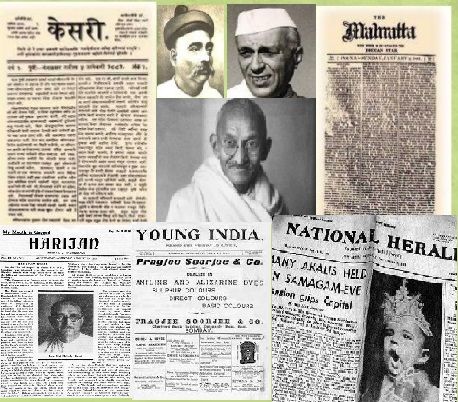
- The press spread modern liberal ideals such as liberty, freedom, and equality among the populace.
- The press provided a platform for various social groups from different regions of the country to exchange their views.
- The press played an important role in organising political movements.
- The press regularly praised the policies of the British Government in India.
Answer
The press regularly praised the policies of the British Government in India.
Reason — The Indian press criticised the unjust policies of the government and roused political consciousness among the people. It never praised the policies of the British Government in India.
Choose the correct option to match the following:
| Column A | Column B |
|---|---|
| 1. Jyotiba Phule | (i) Indian National Congress |
| 2. Raja Ram Mohan Roy | (ii) Forward Bloc |
| 3. Subash Chandra Bose | (iii) Brahmo Samaj |
| 4. A. O Hume | (iv) Satyashodhak Samaj |
- i 2. ii 3. iii 4. iv
- ii 2. i 3. iv 4. iii
- iii 2. iv 3. i 4. ii
- iv 2. iii 3. ii 4. i
Answer
- iv 2. iii 3. ii 4. i
Explanation — Jyotiba Phule founded the Satyashodhak Samaj, Raja Rammohan Roy founded the Brahmo Samaj, Subhas Chandra Bose founded the Forward Bloc and A O Hume played the leading role in the foundation of the Indian National Congress.
Which repressive policy of Lord Lytton is this picture associated with?
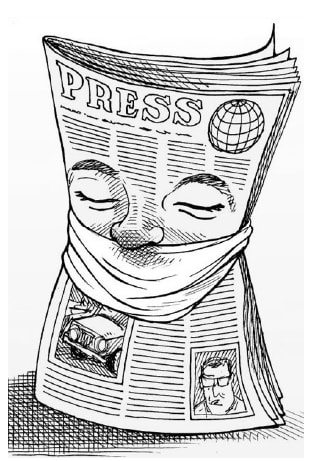
- The Vernacular Press Act
- The Arms Act
- Removal of Import Duties
- Organising the Grand Delhi Durbar
Answer
The Vernacular Press Act
Reason — The Vernacular Press Act, enacted in 1878, forbade vernacular papers to publish any material that might incite feelings of dissatisfaction against the British Government. This act was not applicable to English newspapers.
Who among the following is MOST associated with this picture?

- Jyotiba Phule
- Raja Ram Mohan Roy
- Swami Dayanand Saraswati
- Aurobindo Ghosh
Answer
Jyotiba Phule
Reason — Jyotiba Phule played a crucial role in advancing girls' education in India. He established the first school for girls in Pune in 1848.
Mention any two factors that helped in the growth of nationalism in India.
Answer
Two factors that helped in the growth of nationalism in India are:
- British policy of economic exploitation.
- Repressive colonial policies
Name any two social and religious reformers who promoted the cause of Indian nationalism.
Answer
Two social and religious reformers who promoted the cause of Indian nationalism are Raja Rammohan Roy and Swami Dayanand Saraswati.
When and by whom was the East India Association formed?
Answer
Dadabhai Naoroji, 'The Grand Old Man of India', laid the foundation of East India Association in London in 1866.
Who is regarded as the founder of the Indian National Congress?
Answer
Allan Octavian Hume (AO Hume) is regarded as the founder of the Indian National Congress.
Name any two aims of the Indian National Congress. When was it founded?
Answer
Indian National Congress was founded on December 28, 1885. Two aims of INC are given below:
- To promote friendly relations among nationalist political workers from different parts of the country.
- To formulate popular demands and place them before the government.
When and by whom was the Bengali weekly Samvad Kaumudi Started?
Answer
Raja Rammohan Roy started a Bengali weekly called the Samvad Kaumudi in 1821.
Mention any two social reforms favoured by Jyotiba Phule.
Answer
Two social reforms favoured by Jyotiba Phule were the upliftment of the depressed classes and promotion of women's education.
Name the two Presidents under whom the first two sessions of the Indian National Congress were held.
Answer
The two Presidents are given below:
- W C Bonnerjee — He presided over the first session of the Indian National Congress held at Bombay (Mumbai) in December, 1885.
- Dadabhai Naoroji — He presided over the second session of the Indian National Congress held at Kolkata in 1886.
Name each of the organisations founded by Jyothiba Phule and Raja Rammohan Roy.
Answer
- Jyotiba Phule founded the Satyashodhak Samaj in 1873.
- Raja Rammohan Roy laid the foundation of the Brahmo Samaj in 1828.
He led a movement in India that called for the creation of a new social order in which no one would be subordinate to the upper-caste Brahmans. He also fought for women's rights, believing that education was essential to bringing about social change.
Identify the social reformer from the given passage. Name the organisation he established in 1873 with the aim of securing social justice for the weaker sections of society.
Answer
The social reformer being talked about is Jyotiba Phule. He established the Satya Shodhak Samaj in 1873 with the aim of securing social justice for the weaker sections of society.
Highlight three ways in which India's wealth was being diverted to England.
Answer
Three ways in which India's wealth was being diverted to England are given below:
- Heavy land taxes — The peasants suffered under heavy land taxes and many of them were forced to grow jute and cotton for the factories in England.
- Unequal trade — Raw material was exported to England at cheaper rates, while goods manufactured in England were dumped into India and sold at higher prices.
- High salaries of British officers — The British officers working in India drew high salaries and were, therefore, a heavy drain on the Indian resources.
To benefit British industry, British rule pursued a policy of free trade in India. The nationalists were generally concerned about the lack of public investment in agriculture and argued that the British were trying to turn India into a valuable source of raw materials and a consumer of British-manufactured goods to make India an extension of the British economy.
(Source: History of Modern India by Bipin Chandra.)
Discuss how the British empire deindustrialised India.
Answer
The British Empire deindustrialised India in the following ways:
Destruction of Handicrafts — Heavy duties were imposed on Indian goods exported to Britain, while British manufactured goods entered India at very low duties. This made Indian handicrafts uncompetitive.
Import of Machine-made Goods — Cheap, machine-made British goods flooded Indian markets, causing the decline of traditional industries and ruining many artisans and weavers.
Lack of Industrial Development — The British did little to promote or modernise Indian industries. India was mainly developed as a supplier of raw materials and a market for British finished goods.
Loss of Livelihood — Displaced artisans and craftsmen were forced to depend on agriculture, increasing pressure on land and rural poverty.
Commercialisation of Agriculture — Cultivation of cash crops such as cotton, indigo and opium was encouraged to meet the needs of British industries, strengthening India's dependence on the British economy.
Read the excerpt given below and answer the question that follows:
News outlets played a big role in instigating the dispute around the bill, sparking outrage in Britain and India, as the political press "to influence government legislation for India" for the first time. The Gazette, the Times, and other newspapers continued to release statements condemning the bill and criticising the desire to "please the native community at any cost". The widespread news reports invoked more opposition from those in Britain regarding the need to bring in judicial equality.
Source: Wikipedia
Which Bill is being referred to in the above passage? What was its implication on the Indian judicial system?
Answer
Ilbert Bill (1883) is being referred to in the above passage. This bill provided for the trial of British or European persons by Indians. By this act, the British tried to introduce equality between British and Indian judges in India.
With reference to the growth of nationalism, explain the relevance of the following:
(a) Impact of Socio-Religious Movements
(b) Write any three repressive colonial policies of the British
(c) State any three ways in which the Press played an important role in developing nationalist interest amongst Indians.
Answer
(a) Social and religious reformers like Raja Rammohan Roy, Swami Dayanand Saraswati, Jyotiba Phule, Swami Vivekananda and Annie Besant carried out reforms that paved the way for the national movement. They inspired the people with the ideals of self-respect, self-confidence and self-reliance and roused feelings of patriotism and nationalism. Raja Rammohan Roy laid the foundation of the Brahmo Samaj in 1828, which brought in a New Awakening in India, and it was because of his efforts that Lord Bentinck passed a law in 1829 making the practice of Sati illegal and punishable by law. Jyotiba Phule established one of the first Girls Schools in India at Pune in 1851 and founded the Satyashodhak Samaj in 1873 to mitigate the distress and sufferings of dalits and women. These movements attacked social evils, spread education and rational thinking, and thus prepared the ground for the growth of nationalism.
(b) Three repressive colonial policies of the British are given below:
- The Vernacular Press Act (1878) — Introduced by Lord Lytton, it forbade vernacular papers from publishing any material that might excite feelings of dissatisfaction against the British government. This Act was not applicable to English newspapers. It crushed the freedom of the vernacular press. In 1882 this Act was repealed by Lord Ripon.
- The Indian Arms Act (1878) — It made it a criminal offence for Indians to carry arms without licence. It imposed a badge of racial inferiority on Indians.
- Reduction of the age limit for the Indian Civil Service Examination — The maximum age limit for the Indian Civil Service Examination was gradually reduced from 23 to 19 years. This was a calculated move to ruin the prospects of Indian candidates for the Indian Civil Service.
(c) Three ways in which the Press played an important role in developing nationalist interest amongst Indians are given below:
- Many newspapers were published in different parts of the country such as the Amrit Bazar Patrika, The Hindu, the Patriot, the Maratha, the Kesari, the Azad, the Indian Mirror, The Tribune, the Advocate, the Kohinoor, etc. They criticised the unjust policies of the government and thus exposed British exploitation before the people.
- They played a vital role in infusing political ideas and patriotic sentiments, and rousing political consciousness among the people.
- Tilak's weeklies Kesari and Mahratta instilled pride among Indians for their country and inspired them to work for the freedom of the motherland.
Many causes were responsible for the rise and growth of the National Movement. In this context, explain the following:
(a) Contribution of Indian press and literature.
(b) Rediscovery of India's glorious past.
(c) Contribution of religious and social reformers.
Answer
(a) The Indian press and literature aroused the feelings of patriotism and national consciousness.
- Many newspapers were published in different parts of the country such as the Amrit Bazar Patrika, The Hindu, the Patriot, the Maratha, the Kesari, the Azad, the Indian Mirror, The Tribune, the Advocate, the Kohinoor, etc. They criticised the unjust policies of the government and infused political ideas and patriotic sentiments, and roused political consciousness among the people.
- Tilak's weeklies Kesari and Mahratta instilled pride among Indians for their country.
- The writings of Bankim Chandra Chatterjee, Rabindranath Tagore, Vishnu Shastri, Bharatendu Harishchandra, Din Bandhu Mitra, etc. stirred the hearts of the Indian masses and brought about a revolution in their minds and prepared them to make any sacrifice for the sake of their motherland.
- B.C. Chatterjee's Bengali novel Anand Math became the Bible of modern Bengali patriotism. It contained the national song "Bande Matram" which greatly inspired the people.
(b) Many foreign scholars conducted many studies on Indian history. They were greatly impressed by the political, social and cultural advancement of India in the past. They praised the rich cultural heritage of India to the utmost. Indian writers such as R.G. Bhandarkar, M.G. Ranade, Hara Prashad Shastri, etc. threw light on the greatness and glory of ancient India. The works of these scholars roused the feelings of self-respect, self-confidence, patriotism and nationalism among the people.
(c) Social and religious reformers like Raja Rammohan Roy, Swami Dayanand (author of Satyartha Prakash), Jyotiba Phule, Swami Vivekananda, Annie Besant, etc. carried out many reforms in the 19th century which paved the way for the national movement. They inspired the people with the ideas of self-respect, self-confidence and self-reliance and roused in them the feelings of patriotism and nationalism. Some of the important reforms are given below:
Raja Rammohan Roy
- Raja Rammohan Roy founded the Brahmo Samaj in 1828. It brought about a New Awakening in India and became a catalyst for social and political reforms.
- Due to his efforts, the practice of Sati was made illegal and punishable by law in 1829.
- He started a Bengali weekly Samvad Kaumudi and Persian paper Mirat-ul-Akbar, with distinct nationalist and progressive characters.
Jyotiba Phule
- Phule opened many schools for the upliftment of the down trodden people, and one of the first Girls Schools at Pune in 1851.
- He founded the Satyashodhak Samaj in 1873 to mitigate the distress and sufferings of dalits and women. The Samaj opposed idolatry and denounced the caste system, campaigned for spread of rational thinking and rejected the need for priests.
Read the given excerpt and answer the question that follows:
An English politician who served as Viceroy of India. He is commonly regarded as a ruthless viceroy due to his approach to the Great Indian Famine of 1876-1878.
(a) Identify the Viceroy in the given statement.
(b) Mention any three of his policies which impacted colonial India from 1876 to 1880.
Answer
(a) The Viceroy being mentioned in the given statement is Lord Lytton.
(b) Three policies of Lord Lytton which impacted colonial India from 1876 to 1880 are:
- Lord Lytton introduced the Vernacular Press Act in 1878. The Vernacular Press Act forbade vernacular papers to publish any material that might incite feelings of dissatisfaction against the British Government. Editors who opposed this Act were sentenced to jail. This Act was not applicable to English newspapers. In 1882, this Act was repealed by Lord Ripon.
- Lord Lytton introduced the Indian Arms Act in 1878. The Indian Arms Act of 1878 made it a criminal offence for Indians to carry arms without licence. This Act was not applicable to the British.
- Lord Lytton removed import duties on cotton textiles for the benefit of British cloth industry at the cost of nascent Indian textile industry.
With reference to the picture given here, answer the following questions:

(a) Identify and name the person.
(b) What were his contributions to uplift the status of lower castes and women.
(c) Mention the aims and activities of Satyashodhak Samaj.
Answer
(a) The person shown in the given picture is Jyotiba Phule.
(b) His contributions to uplift the status of lower castes and women are given below:
- Phule opened many schools for the upliftment of the down trodden people, and the first Girls Schools at Pune in 1851.
- He set up an orphanage to provide shelter to poor widows and their children.
- He founded the Satyashodhak Samaj in 1873.
(c) The Satyashodhak Samaj was founded by Jyotiba Phule in 1873 to mitigate the distress and sufferings of dalits and women. The Samaj opposed idolatry and denounced the caste system, campaigned for spread of rational thinking and rejected the need for priests.
A black and white photograph showing a group of Indian men in traditional attire. A banner in the background reads "Congress Foundation Day", 28th December 1885. In this context, answer the following questions:

(a) Name any two aims of the Indian National Congress. When was it founded?
(b) Name the President during the first two sessions of the Indian National Congress.
(c) Why did Lord Dufferin, the then Viceroy, favour the foundation of the Indian National Congress?
Answer
(a) Indian National Congress was founded on December 28, 1885. Two aims of the Indian National Congress are given below:
- To develop and consolidate the feelings of national unity irrespective of religious beliefs, colour or creed.
- To formulate popular demands and place them before the government.
(b) The Presidents during the first two sessions of the Indian National Congress were:
- W C Bonnerjee — First session held at Bombay (Mumbai) in December, 1885.
- Dadabhai Naoroji — Second session held at Kolkata in 1886.
(c) The then Viceroy, Lord Dufferin, favoured the foundation of the Congress because he wanted it to act as a safety valve for popular discontentment to safeguard the British Rule and its interests in India.