
Who was called the 'Duce'?
- Hitler
- Mussolini
- Orlando
- Kaisar William II
Answer
Mussolini
Reason — Benito Mussolini, the Fascist dictator of Italy, was called the "Duce", which means "the Leader." After establishing a Fascist government in Italy, he became known by this title.
Who said, "If I advance, follow me; if I retreat, kill me, if I die, avenge me?"
- The Duce
- Hitler
- F.D. Roosevelt
- Woodrow Wilson
Answer
The Duce
Reason — These words were spoken by Benito Mussolini, who was known as "the Duce" (the Leader). He used such slogans to inspire absolute loyalty and devotion among his followers.
When was the Weimer constitution introduced?
- 1919
- 1925
- 1935
- 1945
Answer
1919
Reason — The Weimar Constitution was introduced on 10 August 1919, establishing Germany as a democratic republic.
Which of the following was one of the causes of rise of Nazism?
- Humiliating Treaty of Versailles
- Economic crisis (1929-32)
- Personality of Hitler
- All of these
Answer
All of these
Reason — The humiliating Treaty of Versailles, the economic crisis (1929–32) and Hitler's personality were all responsible for the rise of Nazism. Hence, all of these are correct.
Which of the following was not a feature of ideology of Nazism?
- People exist for the state
- To root out liberalism and communism
- To praise the Treaty of Versailles
- To end parliamentary institutions
Answer
To praise the Treaty of Versailles
Reason — Nazism believed in "People exist for the State", opposed Liberalism and Communism, and sought to end parliamentary democracy. It strongly condemned the Treaty of Versailles; therefore, praising it was not a feature of Nazism.
Which was the immediate cause of the Second World War?
- Conquest of Poland by Hitler
- Conquest of Poland by Mussolini
- Conquest of Stalingrad
- Conquest of Spain
Answer
Conquest of Poland by Hitler
Reason — Hitler invaded Poland on 1 September 1939. Britain and France declared war on Germany, making this the immediate cause of the Second World War.
Which of the following statements is not correct regarding March on Rome?
- It was organised by Fascists on October 24, 1922
- The king of Italy invited Mussolini to form the government
- Mussolini led the March on Rome
- All of these
Answer
Mussolini led the March on Rome
Reason — The Fascists organised the March on Rome on 24 October 1922, after which King Victor Emmanuel III invited Mussolini to form the government. Mussolini himself did not participate in the March, so the statement is incorrect.
Which of the following was one of the causes of rise of Fascism in Italy?
- Dissatisfaction with the Treaty of Versailles
- Economic crisis
- Revolutionary activities of the Socialists
- All of these
Answer
All of these
Reason — Dissatisfaction with the Treaty of Versailles, the economic crisis and the revolutionary activities of the Socialists were all causes of the rise of Fascism in Italy. Hence, all of these are correct.
Identify the major reasons for the rise of Fascism in Italy.
P : "Italy got nothing from the colonial dinner."
Q : Economic crisis during the post-war period.
R : Influence of Hitler on Italy
S : Strong and influential Government after the First World War.
- P and Q
- R and S
- Q and R
- P and S
Answer
P and Q
Reason — Italy felt cheated after the Treaty of Versailles, summed up by the saying "Italy got nothing from the colonial dinner." The post-war economic crisis further increased public dissatisfaction. Hitler's influence came later, and Italy had an unstable, not strong, government.
Read the two statements given below regarding Hitler and select the option that shows the correct relationship between (A) and (B).
(A) "Of propaganda he was past master."
(B) He was a great orator, his speeches were very effective, logical and had ability to sway the masses.
- (B) contradicts (A)
- (B) is the reason for (A)
- (A) is true but (B) is false
- (A) and (B) are independent of each other
Answer
(B) is the reason for (A)
Explanation — Hitler was called "a past master of propaganda" because he was a powerful orator whose speeches effectively influenced and swayed the masses.
Which of the following was not a common ideology of the dictators?
- Faith in totalitarian rule
- One party and One Leader
- Faith in Communism
- Aggressive Nationalism and Imperialism
Answer
Faith in Communism
Reason — The dictators believed in totalitarian rule, one party and one leader, and aggressive nationalism and imperialism. They opposed Communism; therefore, faith in Communism was not their common ideology.
Which of the following is a common cause for the rise of dictatorship?
- Faith in Democracy
- Economic Crisis
- Freedom of Press
- Political Stability
Answer
Economic Crisis
Reason — Financial instability leading to economic crisis often creates conditions for the rise of dictatorship. Dictatorship provides strong leadership to the citizens.
Which of the following policies of a dictator ruling over Country X is MOST aligned with the ideologies of Mussolini during his time in power?
- prioritising military expansion
- promoting environmental sustainability
- creating a healthcare programme for all citizens equally
- Offering financial aid to support the education of students from poor backgrounds
Answer
prioritising military expansion
Reason — Mussolini followed an aggressive imperialist policy and believed in military strength to expand Italy's power and prestige. Therefore, prioritising military expansion best reflects his ideology.
Give any two features of dictatorship.
Answer
Two features of dictatorship are given below:
- They were governments under the rule of one man or a small group of men and the masses had little say in the administration.
- Great importance was attached to national interests rather than to individual interests. Everybody lived for the state.
Why was Italy dissatisfied after 1918?
Answer
Italy was dissatisfied after 1918 due to the following reasons:
- Discontentment after the Treaty of Versailles : Italy could get only Southern Tyrol and Trentino, and the Coastal Regions of Dalmatia. She could get no part of the German and Turkish colonial empire.
- Economic Crisis : Due to the expenses of World War I, Italy's national debt increased manifold, and people had to suffer for basic necessities like food and grains.
- Weak Government and Political Instability : The people were greatly distressed due to the weak policies and inefficiency of the government, which was incapable of solving their problems. Since no single party could gain clear majority in the elections, there was complete instability after 1918.
- Activities of the Socialists : The Socialists intensified tensions with their revolutionary ideas, while the Communists plotted to overthrow the government. Amid growing lawlessness and insecurity, people sought a strong party to restore peace and prosperity.
How did the failure of the League of Nations lead to the rise of dictatorship?
Answer
The League of Nations failed to check the aggressive policies of countries like Italy, Germany and Japan. Its inability to maintain peace weakened people's faith in democratic governments and encouraged the rise of dictatorships.
Why did the Italians feel that they had been deceived by the Treaty of Versailles?
Answer
Italy joined the Allies in the First World War and by the Secret Treaty of London (1915). She hoped to gain Trentino, Trieste, Istria, Fiume, Coastal Regions of Dalmatia, Albania and some parts of Turkey and Germany. But by the Treaty of Versailles she could get only Southern Tyrol and Trentino, and the Coastal Regions of Dalmatia. She could get no part of the German and Turkish colonial empire. The Italians felt as if they had been deceived and thought that their right demands were ignored. The Italians felt that they had been deceived and that their rightful claims had been ignored.
How did the economic crisis in Italy, after the First World War, create unrest there?
Answer
Due to the expenses in the First World War, Italy's national debt had increased manifold. The price and the value of money had decreased. There was a great shortage of food-grains in the country and unemployment was increasing day-by-day. The industries and trade were ruined. The condition of the middle class people, farmers and the working class became very critical. As a result of the war, Italy suffered a lot and her people became very poor. Such a deteriorated condition created unrest in the country.
How did the humiliating Treaty of Versailles lead to the rise of dictatorship in Germany?
Answer
Germany was compelled to sign the Treaty of Versailles which imposed harsh terms upon her. She had to pay a huge war-indemnity. Germany lost its overseas colonies, one-tenth of its population, 13 per cent of its territories, 75 per cent of its iron and 26 per cent of coal to France, Poland, Denmark and Lithuania. Germany was forced to pay compensation amounting to £6 billion. Many Germans held the new Weimar Republic responsible for disgrace at Versailles. This created the feeling of dissatisfaction among the people of Germany. The Republic was regarded as a symbol of national disgrace. Germany wanted to restore her lost prestige. When Hitler assured the Germans about the restoring their old prestige, they became his followers.
Why was there an economic crisis in Germany after the First World War?
Answer
Germany suffered heavy losses of life and property in the First World War. After the war many soldiers became unemployed. Trade and commerce were also ruined. The workmen were thrown out of employment. In 1929, there was a great economic depression. It affected Germany also. Germany was in the grip of unemployment and starvation. The prices rose and value of money declined. The Republic failed to solve the economic crisis.
How did the spread of Communism lead to the rise of Nazism in Germany?
Answer
Being inspired by the Russian Revolution of 1917, German Communists also tried to bring about a revolution in Germany. Hitler feared that Germany would become a slave of Russia if Communism spread there. He exposed the destructive results of Communism to his people. He roused the national feeling among the people and instigated them against Communism. Consequently, the workmen and the masses joined the Nazi Party in large numbers.
Give any two reasons for the rise of fascism.
Answer
Two reasons for the rise of Fascism are given below:
- Discontentment after the Treaty of Versailles : Italy could get only Southern Tyrol and Trentino, and the Coastal Regions of Dalmatia. She could get no part of the German and Turkish colonial empire, so the Italians felt that they had been deceived.
- Economic Crisis : Due to the expenses of the First World War, Italy's national debt increased manifold. There was a great shortage of food-grains and rising unemployment, which created unrest in the country.
Mention any two common ideologies of Fascism and Nazism.
Answer
Two common ideologies of Fascism and Nazism are:
- To have faith in the totalitarian rule.
- To hold that the state is supreme and it could suppress the fundamental rights and freedoms of individuals.
With reference to the Rise of Fascism in Italy, explain the following :
(a) What were the factors responsible for the rise of Fascism in Italy?
(b) Describe a decisive action taken by Mussolini with the aim of making Italy a colonial power.
Answer
(a) There were many factors responsible for the rise of Fascism in Italy.
- Discontentment after the Treaty of Versailles : Italy could get only Southern Tyrol and Trentino, and the Coastal Regions of Dalmatia. She could get no part of the German and Turkish colonial empire.
- Economic Crisis : Due to the expenses of World War I, Italy's national debt increased manifold, and people had to suffer for basic necessities like food and grains.
- Weak Government and Political Instability : The people were greatly distressed due to the weak policies and inefficiency of the government, which was incapable of solving their problems. Since no single party could gain clear majority in the elections, there was complete instability after 1918.
- Activities of the Socialists : The Socialists intensified tensions with their revolutionary ideas, while the Communists plotted to overthrow the government. Amid growing lawlessness and insecurity, people sought a strong party to restore peace and prosperity.
- Failure of the League of Nations : The League of Nations failed to check aggression and maintain peace. Its failure encouraged dictators like Mussolini and Hitler and contributed to the rise of dictatorship.
(b) Mussolini wanted to revive the glory of the Old Roman Empire. Italy adopted an aggressive policy and captured Abyssinia and Albania, with the aim of making Italy a colonial power.
How did the following prove important causes of the Rise of Fascism in Italy?
(a) Discontent in Italy after the Treaty of Versailles.
(b) Economic Crisis of 1929.
(c) Weak government of Italy.
Answer
(a) Italy joined the Allies in the First World War and by the Secret Treaty of London (1915) she hoped to gain Trentino, Trieste, Istria, Fiume, Coastal Regions of Dalmatia, Albania and some parts of Turkey and Germany. But during the Paris Conference her hopes were dashed to the ground by Wilson's opposition and so by the Treaty of Versailles she could get only Southern Tyrol and Trentino, and the Coastal Regions of Dalmatia. She could get no part of the German and Turkish colonial empire. The Italians felt as if they had been deceived and thought that their right demands were ignored. The Italians felt that their rightful claims had been ignored. This very fact helped in spreading Fascism in Italy.
(b) Due to the expenses in the First World War, Italy's national debt had increased manifold. The price and the value of money had decreased. There was a great shortage of food-grains in the country and unemployment was increasing day-by-day. The industries and trade were ruined. The condition of the middle class people, farmers and the working class became very critical. As a result of the war, Italy suffered a lot and her people became very poor. Such a deteriorated condition created unrest in the country. The people demanded a government that could solve their problems and restore their original prestige.
(c) The economic crisis in Italy created a situation of unrest there. The liberal government of Italy was disinterested in solving the problems of the country and it was too weak to keep the situation under control. People were much distressed due to the weak policy and inefficiency of the government. They wanted to replace such a weak and inefficient government by a powerful and bold government. This feeling of the people helped Fascism to flourish in Italy.
With reference to the Rise of Dictatorships and the Second World War, answer the following:
(a) State any three reasons for the Rise of Fascism in Italy.
(b) Explain any three consequences of World War II.
(c) Name the two rival blocs that fought against each other during World War II and state its signatory countries.
Answer
(a) Three reasons for the Rise of Fascism in Italy are given below:
- Discontentment after the Treaty of Versailles : Italy could get only Southern Tyrol and Trentino, and the Coastal Regions of Dalmatia. She could get no part of the German and Turkish colonial empire, so the Italians felt deceived.
- Economic Crisis : Due to the expenses of the First World War, Italy's national debt increased manifold and there was a great shortage of food-grains and rising unemployment.
- Weak Government and Political Instability : The liberal government was too weak to solve the country's problems, so the people wanted a powerful and bold government in its place.
(b) Three consequences of the Second World War are given below:
- It caused a colossal loss of life and property and led to the fall of dictatorship in Europe, as both Fascism in Italy and Nazism in Germany came to an end.
- It led to the emergence of the USA and the USSR as two rival superpowers, which resulted in the Cold War.
- It led to the establishment of the United Nations Organisation (UNO) to maintain peace and security in the world.
(c) The two rival blocs that fought against each other during World War II were the Allied Powers and the Axis Powers. The Allied Powers included Britain, France, the USSR, the USA and China, while the Axis Powers included Germany, Italy and Japan.
The world wars marked a turning point in the history of the world. With reference to this period, answer the following questions:
(a) Mention any three similarities between the ideologies of Fascism and Nazism.
(b) State the three consequences of the Second World War.
(c) Mention any four causes of the Second World War.
Answer
(a) Three similarities between the ideologies of Fascism and Nazism are given below:
- Both Fascism and Nazism were supporters of one party and one leader — Mussolini in Italy and Hitler in Germany.
- They were dictators through and through. No one could challenge the authority of the leader of the party. Both Mussolini and Hitler had all the military and civil powers and nobody could criticise them.
- Both Fascism and Nazism preferred the state as compared to the individual. The individual exists only for the State.
(b) Three consequences of the Second World War are given below:
- It caused a colossal loss of life and property and led to the end of dictatorship in Europe, as both Fascism in Italy and Nazism in Germany fell.
- It led to the rise of the USA and the USSR as two rival superpowers, which resulted in the Cold War.
- It led to the establishment of the United Nations Organisation (UNO) to maintain peace and security in the world.
(c) Four causes of the Second World War are given below:
- The harsh and humiliating Treaty of Versailles, which created bitterness among the Germans.
- The rise of dictatorship — Fascism in Italy and Nazism in Germany — with their aggressive and imperialist policies.
- The failure of the League of Nations to check aggression and maintain peace.
- The immediate cause was the invasion (conquest) of Poland by Hitler.
With reference to the given picture, answer the following questions :
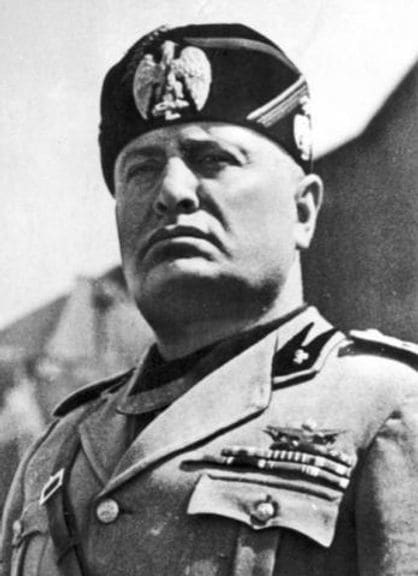
(a) Identify the personality and give the popular name he was called.
(b) Name the ideology and two of its features propounded by him.
(c) Give two reasons for his meteoric rise at the helm of affairs.
Answer
(a) The person in the given picture is Benito Mussolini, the dictator of Italy. He was called the "Duce".
(b) The ideology propounded by Mussolini was Fascism. Two of its features are given below:
- Fascism was the supporter of one party and one leader. According to Fascism, dictatorship was the best form of government. There was no place for opposition in Fascism and it was in favour of bringing an end to all other forces.
- Fascism preferred the State to the individual. It believed that the individual existed only for the State. It laid greater emphasis on the duties of the individual than on his rights.
(c) Benito Mussolini's meteoric rise to power can be attributed to several factors. Two key reasons are given below:
- Weak Government and Political Instability : The people were greatly distressed due to the weak policies and inefficiency of the government, which was incapable of solving their problems. Since no single party could gain clear majority in the elections, there was complete instability after 1918.
- Revolutionary ideas of the Socialists : The Socialists spread revolutionary ideas, while the Communists tried to overthrow the government. People wanted a strong government to restore law and order.