
The First World War broke out in the year
- 1914
- 1924
- 1918
- 1920
Answer
1914
Reason — In 1914, there broke out a war which soon engulfed the whole of the world in its vicious circle. Therefore, 1914 is the correct answer.
Whose assassination led to the first World War?
- Bismarck
- Francis Ferdinand
- Kaiser William II
- None of these
Answer
Francis Ferdinand
Reason — The Austrian Prince Archduke Francis Ferdinand was murdered at Sarajevo on June 28, 1914. Austria-Hungary blamed Serbia for the murder and declared war on her. This soon culminated in the First World War.
Which of the following was not a part of the 'Allies'?
- Serbia
- France
- Britain
- Turkey
Answer
Turkey
Reason — Serbia, France and Britain belonged to 'The Allies'. Turkey (the Ottoman Empire) joined 'The Central Powers'. Hence, Turkey was not a part of the Allies.
'The Central Powers' did not include
- Austria
- Germany
- Bulgaria
- Japan
Answer
Japan
Reason — Germany, Austria-Hungary, Turkey (the Ottoman Empire) and Bulgaria formed 'The Central Powers'. Japan fought on the side of the Allies. Therefore, Japan was not one of the Central Powers.
The Treaty of Versailles was signed between
- Allies and Poland
- Allies and Central Powers
- Allies and Germany
- Allies and Japan
Answer
Allies and Germany
Reason — Germany was forced to sign the Treaty of Versailles after the war. Therefore, it was signed between the Allies and Germany.
Which of the following was not one of the terms of Treaty of Versailles?
- Germany and her allies were held guilty of aggression
- Alsace and Lorraine were returned to France
- Germany lost all her colonies
- German army was reduced to 10 lakh
Answer
German army was reduced to 10 lakh
Reason — The Treaty of Versailles held Germany and her allies guilty of aggression, returned Alsace and Lorraine to France, and deprived Germany of all her colonies. It also reduced the German army to 1,00,000 soldiers, not 10 lakh. Therefore, option (4) is incorrect.
In the question given below, there are two statements marked as Assertion (A) and Reason (R). Read the statements and choose the correct option.
Assertion (A) : The Sarajevo crisis was the immediate cause of the First World War.
Reason (R) : Austria blamed Serbia for murder of Prince Francis Ferdinand and declared war on Serbia.
- Both Assertion (A) and Reason (R) are correct and Reason (R) is the correct explanation of Assertion (A).
- Both Assertion (A) and Reason (R) are correct but Reason (R) is not the correct explanation of Assertion (A).
- Assertion (A) is true, but Reason (R) is false.
- Assertion (A) is false, but Reason (R) is true.
Answer
Both Assertion (A) and Reason (R) are correct and Reason (R) is the correct explanation of Assertion (A).
Explanation — The murder of Prince Francis Ferdinand at Sarajevo on June 28, 1914, led Austria-Hungary to blame Serbia and declare war on her on July 28, 1914. This triggered the First World War. Hence, both Assertion (A) and Reason (R) are correct, and Reason (R) is the correct explanation of Assertion (A).
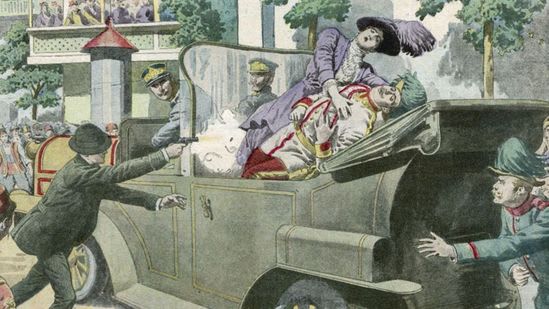
What was the immediate effect of the incident shown alongside?
- Beginning of Second World War
- Beginning of First World War
- Surrender of Poland to Germany
- Germany's invasion of USSR
Answer
Beginning of First World War
Reason — The picture shows the assassination of Archduke Francis Ferdinand at Sarajevo, which was the immediate cause that led to the outbreak of the First World War.
Read the two statements given below about the League of Nations. Select the option that shows the correct relationship between (A) and (B).
(A) The League of Nations failed to establish peace in the world.
(B) Hitler and Mussolini paid scant regard to the League and began expansion of military power and aggressive propaganda.
- (B) contradicts (A)
- (B) is the reason for (A)
- (A) is true but (B) is false
- (A) and (B) are independent of each other
Answer
(B) is the reason for (A)
Explanation — The League of Nations failed to establish peace because it could not settle disputes in which any of the major powers was involved. Hitler and Mussolini paid scant regard to the League of Nations and began expansion of military power and aggressive propaganda. Therefore, statement (B) is the reason for statement (A).
Identify the main reasons for the First World War.
P : Division of Europe into two hostile groups of nations
Q : Aggressive nationalism and imperialism
R : Rise of Hitler and Mussolini
S : Japanese invasion of the Pearl Harbour
- P and Q
- Q and R
- P and R
- P and S
Answer
P and Q
Reason — The division of Europe into two hostile groups of nations (P) and aggressive nationalism and imperialism (Q) were among the main causes of the First World War. The rise of Hitler and Mussolini and the Japanese attack on Pearl Harbour were not causes of the First World War. Hence, P and Q are correct.
The Treaty of Versailles mandated Germany to pay a war reparation of ............... .
- 35 billion dollars
- 40 billion dollars
- 33 billion dollars
- 50 million pounds
Answer
33 billion dollars
Reason — Under the Treaty of Versailles, Germany was held guilty of aggression and was compelled to pay a heavy war indemnity of 33 billion dollars.
The immediate cause of the First World War was ............... .
- Imperialism
- Alliance System
- Sarajevo Crisis
- Arms Race
Answer
Sarajevo Crisis
Reason — The immediate cause of the First World War was the Sarajevo Crisis. The murder of Prince Archduke Francis Ferdinand at Sarajevo on 28 June 1914 led Austria-Hungary to declare war on Serbia, which soon culminated in the First World War.
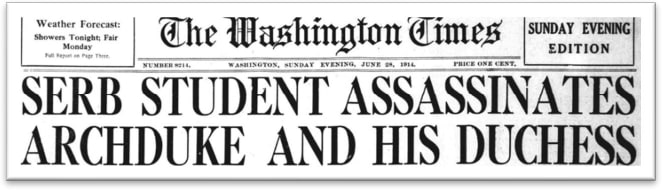
Which of the following causes of the First World War is connected to this headline?
- Imperialism
- Aggressive Nationalism
- Armament Race
- Sarajevo Crisis
Answer
Sarajevo Crisis
Reason — The headline refers to the assassination of Archduke Francis Ferdinand by a Serbian at Sarajevo, which is connected to the Sarajevo Crisis — the immediate cause of the First World War.
Which of the following is INCORRECT with reference to World War I?
- Triple Entente — France, Russia, Japan
- Allied Powers — Britain, France, Russia
- Triple Alliance — Germany, Italy, Austria-Hungary
- Central Powers — Germany, Austria, Italy
Answer
Central Powers — Germany, Austria, Italy
Reason — Italy was not a member of the Central Powers. The Central Powers consisted of Germany, Austria-Hungary, Turkey (the Ottoman Empire) and Bulgaria. Therefore, the statement 'Central Powers — Germany, Austria, Italy' is incorrect.
Why is the war between 1914 and 1918 called the First World War?
Answer
The war that started in 1914 is known as the First World War as it engulfed the whole of the world in its vicious circle. It was fought on land, in the air, on the sea and under the sea. New methods of destruction and defence were used in it. It was fought by armies, navies and air forces. It was fought on a worldwide scale and deeply influenced all the countries of the world.
Name the two alliances which divided Europe into two hostile groups before 1914.
Answer
The two alliances which divided Europe into two hostile groups before 1914 were — the Triple Alliance and the Triple Entente.
Name two countries whose imperial interests became one of the potent factors of the First World War.
Answer
Two countries whose imperial interests became one of the potent factors of the First World War were Germany and Britain.
What was the immediate cause of the First World War?
Answer
The immediate cause of the First World War was the Sarajevo Crisis. Prince Archduke Francis Ferdinand, the heir to the Austrian throne, was murdered at Sarajevo on June 28, 1914 by a secret society called the 'Black Hand' or 'Union of Death' of Serbia. Austria-Hungary blamed the Serbian Government for the crime. As Serbia refused to comply with some of the conditions, Austria-Hungary declared war on Serbia on July 28, 1914. Many countries joined the war in support of one or the other.
Why is it said that the Treaty of Versailles led to the Second World War?
Answer
The Treaty of Versailles was responsible for the Second World War because of the following reasons —
- The Allies annexed the German territories and created several new States in Europe.
- All the German colonies were forcibly taken away from her.
- Germany was burdened with a huge war indemnity which she could never pay.
- Her military power was reduced.
- The Treaty was based on the spirit of revenge and Germany was forced to sign it.
Name the Signatory Countries of the Triple Alliance.
Answer
The signatory countries of the Triple Alliance were Germany, Austria-Hungary and Italy. Germany formed a Dual Alliance with Austria in 1879, and when Italy joined in 1882, it was converted into the Triple Alliance.
State any two objections imposed by the Treaty of Versailles on the German military power.
Answer
Two restrictions imposed by the Treaty of Versailles on the German military power were —
- The German army was reduced to 1,00,000.
- Germany was not allowed to have any air force and submarines.
Why was the League of Nations established?
Answer
The League of Nations was established after the First World War to maintain international peace and security, prevent future wars, develop friendly relations among nations, and promote material and intellectual cooperation so that people's life may become happier and nobler.
What was meant by the term 'Imperialism', as a cause for World War I?
Answer
Imperialism was a system by which a powerful nation established its control over another country, either by political pressure, infiltration, annexation or by outright wars. Once conquered, the country was claimed as a colony, and the imperial nation exploited its resources such as raw material, cheap labour, agricultural land and trading ports. The entry of Germany into the race for colonies intensified its rivalry with older colonial powers like Britain and France. This filled the atmosphere with fear, apprehension, mutual hatred and international tension, and thus became one of the causes of the First World War.
Mention any two clauses of the Treaty of Versailles.
Answer
Two clauses of the Treaty of Versailles were:
- The area of the Rhine Valley was to be demilitarised and the German territory west of Rhine was to be occupied by the Allied Troops for 15 years.
- The German Army was restricted to a force of 1,00,000 soldiers and the Navy was limited to 15,000 men and 24 ships. The Air Force and submarines were banned.
Name the two alliances formed in Europe before the beginning of the First World War.
Answer
Before the beginning of the First World War, two major alliances formed in Europe were:
- Triple Alliance which included Germany, Austria-Hungary, and Italy.
- Triple Entente which included France, Russia, and the United Kingdom.
Name any two countries of the Triple Entente.
Answer
Two countries of the Triple Entente were — France and Russia.
Mention any two ways in which the Treaty of Versailles affected the German Military Force.
Answer
Two ways in which the Treaty of Versailles affected the German Military Force are:
- The German Army was restricted to a force of 1,00,000 soldiers and the Navy was limited to 15,000 men and 36 ships.
- The Air Force and submarines of German Navy were banned.
Mention any two objectives of the League of Nations.
Answer
Two objectives of the League of Nations were:
- All States were to refer their mutual disputes, if any, to the League of Nations for a peaceful settlement.
- The member-States were to take necessary action as directed by the League against any state which tried to disturb world peace and order.
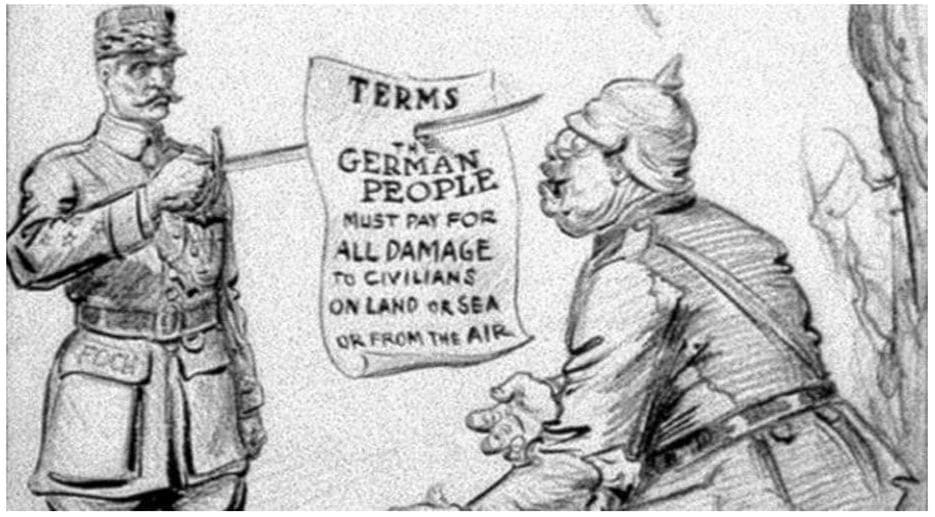
Mention any three ways in which Germany was affected by this treaty.
Answer
Three ways in which Germany was affected by this treaty are:
- The area of the Rhine Valley was to be demilitarised, and the German territory west of the Rhine was to be occupied by the Allied Troops for 15 years.
- The coal mines in the German area called Saar were ceded to France for 15 years, and the area was to be governed by the League of Nations.
- The German Army was restricted to a force of 1,00,000 soldiers and the Navy was limited to 15,000 men and 24 ships. The Air Force and submarines were banned.
Name any one single nation-state and one imperial state before 1914.
Answer
One single nation-state before 1914 — France.
One imperial state before 1914 — Russian empire
Name the two alliances formed in Europe before the beginning of the First World War.
Answer
Before the beginning of the First World War, two major alliances formed in Europe were:
- Triple Alliance which included Germany, Austria-Hungary, and Italy.
- Triple Entente which included France, Russia, and the United Kingdom.
With reference to the causes of the First World War, explain the following :
(a) Armament race
(b) militant nationalism
Answer
(a) The major European nations began stockpiling armaments in the name of self-defence and preservation of peace. As a result, if one country increased its armaments, other countries were compelled to do the same. It filled the atmosphere with fear, apprehension and mutual hatred.
Germany began to increase its naval force and started large-scale production of arms and ammunition. This resulted in race for armaments among rival groups. Britain embarked on a large naval programme with a view to achieve parity with Germany.
(b) Militant or Aggressive nationalism meant love for one's own country and hatred for other countries. Each nation thought about its national interests alone. The spirit of nationalism was a strong driving force in European politics of the 19th century.
- France wanted to get back its provinces of Alsace and Lorraine from Germany.
- Italy wanted to get back the territory of Trentino and Trieste from Austria.
- Balkan states like Serbia wanted that their fellow nationals (Slavs) who lived in other states should come together to form a greater Balkan State.
- Kaiser Wilhelm II, the new emperor of Germany, wanted his country to be the leader of the world.
- Britain had already emerged as the foremost colonial power with almost a quarter of the world under her control.
Thus, the whole atmosphere was charged with militant nationalism and inter-state rivalries, which became one of the important causes of the First World War.
With reference to the given picture, answer the following questions :

(a) Describe the incident.
(b) Why did Austria declare war on Serbia?
(c) What were the effects of this incident on the world?
Answer
(a) The incident depicted in the given picture is the Assassination of Archduke Francis Ferdinand. It was the immediate cause leading to the First World War. The Austrian Prince Archduke Francis Ferdinand was murdered in the Bosnian capital of Sarajevo on June 28, 1914. The assassination was organised by a secret society, called the 'Black Hand' or 'Union of Death', of extremist Serbian nationalists whose aim was to unite all Serbians into a single Serbian state.
(b) Austria-Hungary put the blame on the Serbian Government for this crime. As Serbia refused to comply with some of the conditions, because Russia instigated her, so Austria-Hungary declared a war against Serbia on July 28, 1914.
(c) Many countries joined the war in support of one or the other after the Sarajevo Crisis, which led to the start of the First World War.
- France and Russia came to the help of Serbia. At this, Germany declared war against Russia.
- Britain wanted to keep aloof but when Germany attacked Belgium, then Britain was compelled to join the War in order to safeguard the Belgian neutrality and her own political interests.
- On one side there were Serbia, Russia, France, Britain, Japan, Italy, USA, etc. They were called 'The Allies'. On the other side were Germany, Austria — Hungary, Ottoman Empire and Bulgaria and they were known as 'The Central Powers'.
The final act of the long-drawn-out negotiations took place at Versailles on Saturday afternoon, and to-day Germany and the Allies - always with the exception of America - are at peace. Peace is a blessed word, and both the word and the fact are welcome to-day. So far as Germany is concerned there is for the present an end of strife, and at least a formal return to the decent relations of civilised states.
Editorial: Peace in force (12 January 1920)
The Guardian
(a) Mention any three causes of the World War which ended with the signing of the treaty being discussed in the passage above.
(b) Name the organisation which was established in 1920 to maintain peace after this war. Mention any two of its objectives.
(c) Mention any four clauses of the Treaty which affected Germany.
Answer
(a) Three causes of the First World War were —
- Division of Europe into two hostile groups — the Triple Alliance and the Triple Entente.
- The armament race, in which every major power began stockpiling arms in the name of self-defence.
- Militant/aggressive nationalism and imperialism, which filled the atmosphere with mutual hatred and international rivalry. (The immediate cause was the Sarajevo Crisis.)
(b) The organisation established in 1920 to maintain peace after the war was the League of Nations. Two of its objectives were —
- To maintain international peace and security and establish international relations based on justice and honour.
- To promote material and intellectual co-operation between the nations of the world so that people's life may become happier and nobler.
(c) Four clauses of the Treaty of Versailles which affected Germany were —
- Germany and her allies were held guilty for aggression and hence she was forced to cede certain parts of her pre-war territories to Denmark, Belgium, Poland and Czechoslovakia.
- Alsace and Lorraine were returned to France, and the Saar Valley was ceded to France for 15 years.
- Germany had to lose all her colonial empire, which was divided among the victors.
- The German army was reduced to 1,00,000, she was deprived of any air force and submarines, and she was compelled to pay 33 billion dollars as war-indemnity.