
The District Judge is appointed by
- Governor
- Chief Justice of High Court
- Chief Minister
- Advocate General of the State
Answer
Governor
Reason — The District Judge and the Additional District Judge are appointed by the Governor in consultation with the Chief Justice and other judges of the High Court. Hence, among the given options, Governor is the correct answer.
Which of the following statements is correct with reference to the Lok Adalats?
- Lok Adalats have the jurisdiction to settle the matters at pre-litigative stage only and not matter pending before any court.
- Lok Adalats can deal with matters which are civil and not criminal in nature
- Lok Adalat consists of either serving or retired judicial officers only and not any other person
- None of these
Answer
Lok Adalats can deal with matters which are civil and not criminal in nature
Reason — The Lok Adalat is a voluntary forum that settles disputes amicably through mutual compromise, and so it deals with civil disputes rather than criminal cases. Options (1) and (3) are incorrect because Lok Adalats also relieve the regular courts of pending cases and comprise public spirited people such as lawyers, students and social workers, not only judicial officers.
A person dissatisfied with the verdict given by court of District Judge could appeal to which of the following courts?
- Trial Court
- Supreme Court
- Session Court
- High Court
Answer
High Court
Reason — The court of the District Judge is the highest court in the district and functions under the High Court of the state; hence an appeal against its verdict lies with the High Court.
Civil Courts exercise jurisdiction in cases related to
- Land
- Property
- Monetary transaction
- All of these
Answer
All of these
Reason — Civil courts exercise jurisdiction in cases related to land, property and monetary transaction (as well as arbitration, marriage, divorce, guardianship and will); hence all the given options are correct.
Which is the highest court in a district?
- Court of District Judge
- Court of Civil Judge or Sub-Judge
- Munsif's Court
- None of these
Answer
Court of District Judge
Reason — The Court of the District Judge is the highest civil court in the district and hears appeals from subordinate civil courts.
The highest criminal court in a district is
- Session Court
- Court of Chief Judicial Magistrate (CJM)
- Court of Second Class Judicial Magistrate
- Court of First Class Judicial Magistrate
Answer
Session Court
Reason — The Sessions Court is the highest criminal court in a district; it hears serious cases like murder, dacoity and violence, and the Sessions Judge can award capital punishment, subject to the approval of the High Court.
The Highest authority in the field of revenue in a state is
- Tehsildar's Court
- Collector's Court
- Commissioner's Court
- Board of Revenue
Answer
Board of Revenue
Reason — The revenue courts are arranged in ascending order as Naib Tehsildar's Court, Tehsildar's Court, Collector's Court, Commissioner's Court, and Board of Revenue. Therefore, the Board of Revenue is the highest authority in the field of revenue in a state.
Which of the following statements regarding Lok Adalat is incorrect?
- It reduces the burden on High Courts
- It works on the spirit of compromise
- It involves less expenses
- Cases take a long time to get resolved
Answer
Cases take a long time to get resolved
Reason — Lok Adalats settle disputes speedily, often disposing of hundreds of cases in a single day. Therefore, the statement that cases take a long time to get resolved is incorrect.
Cases regarding marriages, divorce and will are decided by
- Civil courts
- Sessions court
- Revenue courts
- None of these
Answer
Civil courts
Reason — Cases relating to marriage, divorce and will are civil matters, and civil courts exercise jurisdiction over such cases (along with land, property, monetary transaction and guardianship).
In the questions given below, there are two statements marked as Assertion (A) and Reason (R). Read the statements and choose the correct option.
- (R) contradicts (A)
- (R) is the reason for (A)
- (A) is true but (R) is false
- (A) and (R) are independent of each other
Assertion (A) : Court of District Judge is the Highest Court in a district.
Reason (R) : It decides both civil as well as criminal cases.
Answer
(A) and (R) are independent of each other
Explanation — Both statements are correct. The Court of the District Judge is the highest court in the district, and it does decide both civil and criminal cases (when a judge decides civil cases he is called the District Judge (DJ), and when he decides criminal cases he is referred to as the Sessions Judge (SJ)). However, the court is the highest court in the district because of its position at the top of the district's judicial hierarchy, not because it decides both types of cases; hence Reason (R) is not the reason for Assertion (A).
12 February 2023, The Economic Times reported:
More than 97.64 lakh cases settled in the first National Lok Adalat of 2023: NALSA.
Which advantage of the Lok Adalat is MOST highlighted in the above headline?
- Saves money.
- Speedy justice.
- Works on compromise.
- Reduces burden on Higher courts.
Answer
Speedy justice.
Reason — Lok Adalats have no complex procedures and delivers quick justice to people by mutual compromise and understanding. Any person can move Lok Adalat by an application on a plain paper or using the format available with Legal Service Authorities.
The Lok Adalat has many advantages. Which of the following statements about the advantages of the Lok Adalat is best described in the picture given below?

- It is inexpensive
- It is organised in various parts of the country
- It works on the spirit of compromise
- It reduces the burden of the higher courts
Answer
It works on the spirit of compromise
Reason — Lok Adalat works on the spirit of compromise as shown the given case, the counselling parties agreed to put aside their differences and came to a mutual agreement.
Mention two types of subordinate courts in a State.
Answer
Two types of subordinate courts in a state are Civil Courts and Criminal Courts.
Name the courts at the district level.
Answer
The administration of justice in each district in India is entrusted to three types of courts :
- Civil Courts
- Criminal Courts
- Courts of Revenue
Name the highest civil court in a district.
Answer
The highest civil court in a district is the Court of the District Judge.
Name the highest court dealing with the criminal cases at the district level.
Answer
The highest criminal court in a district is the Sessions Court.
What is meant by Lok Adalat's?
Answer
'Lok Adalat' means 'People's Court'. It is a voluntary forum comprising public-spirited people, including judicial officers, lawyers, social workers and law students, who persuade the parties to bring their disputes before them for a speedy and amicable settlement.
Name the highest criminal court in a district.
Answer
Sessions Judge's or Additional Sessions Judge's Court is the highest Criminal Court in a district.
State one point of distinction between a District Judge and a Sessions Judge.
Answer
The District Judge decides civil cases (relating to land, property, marriage, guardianship, divorce and will), whereas the Sessions Judge decides criminal cases (like theft, murder, dacoity and violence).
Mention any one advantage of the Lok Adalat.
Answer
One advantage of the Lok Adalat is that it delivers fast and inexpensive justice, saving much time in the settlement of disputes.
Ms. Anita wants to approach the Lok Adalat regarding a case. Mention any two advantages she will have by taking her case to the Lok Adalat.
Answer
Two advantages Ms. Anita will have by taking her case to the Lok Adalat are as follows:
- Ms. Anita will get speedy justice as Lok Adalats deliver fast judgement.
- Ms. Anita will get inexpensive justice as she will save on the costs involved in court procedures.
With reference to the picture given above, explain a common problem of the judicial system and how it can be solved through a subordinate court.
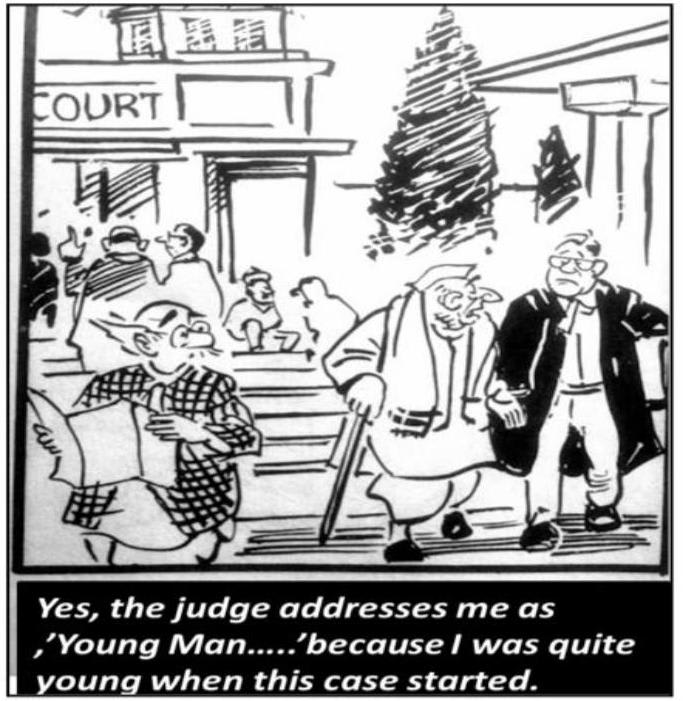
Answer
The cartoon highlights delay in the judicial system, where cases remain pending for years, leading to the idea that "justice delayed is justice denied."
Lok Adalats help solve this problem by settling disputes speedily, amicably and at low cost through compromise. They also reduce the burden on regular courts and help clear pending cases.
The Lok Adalat is a Statutory Organisation under the Legal Services Authorities Act of 1987 and was created as an alternative dispute resolution mechanism. Analyse the role of the Lok Adalat by giving three advantages.
Answer
The Lok Adalat plays an important role as an alternative dispute resolution mechanism. Three advantages are:
- Saves time — It settles disputes speedily; if hundreds of cases can be decided in a single day, much precious time is saved.
- Saves money — It delivers inexpensive justice, sparing the parties the heavy expenses and long delays of regular litigation.
- Reduces burden on regular courts — By settling large numbers of cases, it relieves the regular law courts of much of their heavy load, enabling them to deal with more serious matters.
With reference to the Lok Adalats, explain the following :
(a) Meaning of the Lok Adalats.
(b) Working of the Lok Adalats.
(c) Advantages of the Lok Adalats.
Answer
(a) 'Lok Adalat' means 'the People's Court'. It is a voluntary forum comprising judicial officers, lawyers, social workers and law students who persuade the parties to bring their disputes before them for a speedy and amicable settlement.
(b) Lok Adalats are voluntary forums comprising judicial officers, lawyers, social workers and law students. They persuade the parties to bring their disputes before them for a speedy settlement. The regular courts provide the relevant case records. In an atmosphere of compromise, without any feeling of victory or defeat, disputes are settled amicably through mutual understanding.
(c) The advantages of Lok Adalats are given below:
- Lok Adalats play important role in the settlement of family feuds, disputes between the neighbours and minor cases of assault and injury by settling the disputes through compromise. Since the Lok Adalats work in the spirit of compromise and understanding, both the parties feel satisfied.
- Lok Adalats deliver fast and inexpensive justice. Any person can move Lok Adalat by an application on a plain paper or using the format available with Legal Service Authorities and expect speedy justice.
- The Lok Adalats reduce the workload of other courts enabling them to deal with more serious matters. This reduces delays in higher courts.
The Constitution of India provides for a High Court for each State. With reference to the High Courts and Subordinate Courts, answer the following questions:
(a) Who appoints the judges of the High Court? Mention any two qualifications required for a person to be appointed as a judge of a High Court.
(b) Mention two cases that come under the Original Jurisdiction of the High Court.
(c) What are Lok Adalats? Mention any three advantages of the Lok Adalats.
Answer
(a) The judges of a High Court are appointed by the President of India. Two qualifications required for a person to be appointed as a judge of a High Court are:
- He/She should be a citizen of India.
- He/She should have held a judicial office in the territory of India for at least ten years, or should have been an advocate of a High Court (or of two or more such courts in succession) for at least ten years.
(b) Two cases that come under the Original Jurisdiction of the High Court are:
- Cases relating to the enforcement of the Fundamental Rights of citizens.
- Cases relating to wills, divorce, company law, admiralty and contempt of court.
- Under the power of Judicial Review, High Court can interpret the Constitution.
(c) 'Lok Adalat' means 'the People's Court'. It is a voluntary forum where disputes are settled amicably and speedily without formal court procedures. Three advantages are:
- It settles disputes speedily and saves much time.
- It delivers inexpensive justice and saves money.
- It reduces the workload of the regular courts, and its settlements leave no bitter taste as everything is decided in an atmosphere of harmony.
(a) Based on the image, explain how Lok Adalat's might help in reducing the backlog of cases in regular courts.
(b) Define "Lok Adalat".
(c) Briefly explain the advantages of the Lok Adalat.

Answer
(a) The image shows a Lok Adalat in progress, where disputing parties settle their cases quickly through mutual compromise. Lok Adalats help in reducing the backlog of cases in regular courts because they settle large numbers of disputes speedily and amicably in a single sitting. By taking over family feuds, neighbours' disputes and minor cases, they relieve the regular law courts of much of their heavy load, enabling those courts to deal with more serious matters and thus reducing delays.
(b) 'Lok Adalat' means 'the People's Court'. It is a voluntary forum comprising judicial officers, lawyers, social workers and law students who persuade the opposite parties in a dispute to bring their cases before them for a speedy and amicable settlement.
(c) The advantages of the Lok Adalat are:
- It settles disputes speedily and saves much time.
- It delivers inexpensive justice and saves money.
- It reduces the workload of the regular courts, enabling them to deal with more serious matters.
- Its settlements are reached through compromise and leave no bitter taste, as everything is decided in an atmosphere of harmony.