
Which of the following was not one of the chief architects of NAM?
- President Sukarno
- Marshall Tito
- G.A. Nasser
- Winston Churchill
Answer
Winston Churchill
Reason — the chief architects of the Non-Aligned Movement (NAM) were Pandit Jawaharlal Nehru (India), President Sukarno (Indonesia), President Gamal Abdel Nasser (Egypt), and Marshal Tito (Yugoslavia). Winston Churchill is not mentioned as one of the chief architects of NAM.
The first summit of NAM was held at
- Bandung
- Belgrade
- Delhi
- Tokyo
Answer
Belgrade
Reason — The first summit of the non-aligned countries took place at Belgrade in Yugoslavia in September 1961. It was attended by 25 countries from Asia and Africa and one European country, Cyprus.
Which of the following is not one of the principles of Panchsheel?
- Non-aggression
- Equality and mutual benefit
- Peaceful coexistence
- To form a military alliance to safeguard territories
Answer
To form a military alliance to safeguard territories
Reason — The five principles of Panchsheel are mutual respect for sovereignty and territorial integrity, mutual non-aggression, equality and mutual benefit, non-interference in each other's internal affairs and peaceful co-existence. Forming a military alliance is not one of these principles.
Where was the second summit of NAM held?
- Delhi
- Belgrade
- Cairo
- Tokyo
Answer
Cairo
Reason — The Second Summit of the NAM took place at Cairo in 1964, by which time the number of non-aligned countries had risen to 47.
Which of the following is not one of the objectives of NAM?
- Peaceful co-existence
- Against power-blocs
- Against colonialism
- Supporting capitalist bloc led by USA
Answer
Supporting capitalist bloc led by USA
Reason — The main objective of the Non-Aligned Movement was to keep the newly independent countries away from the power blocs and safeguard their independence. Therefore, supporting the capitalist bloc led by the USA cannot be an objective of the NAM.
Who was the chairman of the First Summit of NAM?
- Jawaharlal Nehru
- Marshal Tito
- K. Kaunda
- G.A. Nasser
Answer
Marshal Tito
Reason — The First Summit of the NAM was held in September 1961 at Belgrade in Yugoslavia, and it was presided over by Marshal Tito, the head of the host country.
Who was not one of the main architects of NAM?
- J.L. Nehru
- F.D. Roosevelt
- Marshal Tito
- G.A. Nasser
Answer
F.D. Roosevelt
Reason — The chief architects of the NAM were Pandit Jawaharlal Nehru of India, President Sukarno of Indonesia, President Nasser of Egypt and Marshall Tito of Yugoslavia. F.D. Roosevelt, being the President of the USA, one of the two super powers, had no role in the founding of the NAM.
Which of the following foreign policy principles was adopted by NAM?
- Panchsheel
- Panchkirti
- Panchniyam
- Panchnama
Answer
Panchsheel
Reason — The NAM adopted Panchsheel, the five principles of peaceful co-existence, which were included in the Sino-Indian Agreement of 1954. Panchsheel formed the basis of the Bandung Conference and was a great contribution to the development of the Non-Aligned Movement.
Which of these leaders was an architect of the Non-Aligned Movement?
- Joseph Stalin
- Abdel Nasser
- Winston Churchill
- Franklin Roosevelt
Answer
Abdel Nasser
Reason — President Abdel Nasser of Egypt, along with Prime Minister Jawaharlal Nehru of India and President Josip Broz Tito of Yugoslavia, were the main founders of the Non-Aligned Movement (NAM).
Identify the principle of Panchsheel.
- Mutual non-aggression
- Regulate armaments
- Take action against aggressor
- Recommend admission of members
Answer
Mutual non-aggression
Reason — Mutual non-aggression is one of the five principles of Panchsheel. The other four are — mutual respect for sovereignty and territorial integrity, equality for mutual benefit, non-interference in each other's internal affairs and peaceful co-existence.
Which of the following has influenced the objectives of the Non-Aligned Movement?
- NATO
- The Panchsheel
- SEATO
- The Warsaw Pact
Answer
The Panchsheel
Reason — The Panchsheel or the five principles of peaceful co-existence formed the basis of the Bandung Conference of 1955 and were a great contribution to the development of the NAM, thus shaping its objectives. NATO, SEATO and the Warsaw Pact were military alliances formed by the two power blocs.
Which of the following scenarios describes the Non-Alignment Policy (NAM)?
- A country forms a military alliance only with the United States.
- A country maintains relations with both factions during the Cold War and does not take sides.
- A country is part of a religious movement advocating non-violence.
- A country aligns with the Soviet Union and receives military aid.
Answer
A country maintains relations with both factions during the Cold War and does not take sides.
Reason — Non-alignment is the international policy of a sovereign state whereby it does not align itself with any of the major power blocs, while actively participating in world affairs to promote peace, harmony, and international cooperation.
What is meant by the term Non-Alignment?
Answer
The strategy of the new independent states of Asia, Africa and South America to keep themselves away from the power blocs in order to protect their independence.
Name any two factors which led to the establishment of the Non-Aligned Movement.
Answer
Two factors which led to the establishment of the Non-Aligned Movement are:
- Military alliances and the division of the world into two power blocs
- The race for armaments
What do you understand by 'Panchsheel'?
Answer
"Panchsheel" means the Five Principles of Peaceful Co-existence. These principles were included in the Sino-Indian Agreement of 1954. Panchsheel formed the basis of the Bandung Conference of 1955 and made a great contribution to the development of the Non-Aligned Movement.
When and in which country was the Bandung Conference held?
Answer
The Bandung Conference was held in Indonesia in the year 1955.
Who represented India at the Belgrade Conference?
Answer
India was represented by Prime Minister Jawaharlal Nehru at the Belgrade Conference.
In which two ways was Jawaharlal Nehru instrumental in laying the foundation of the Non-Aligned Movement?
Answer
Jawaharlal Nehru was instrumental in laying the foundation of the Non-Aligned Movement in the following two ways:
- He urged the newly independent countries to maintain their separate identity and not join either of the two power blocs.
- Jawaharlal Nehru played an important role in the Bandung Conference of 1955. It was decided that the newly independent countries should keep themselves aloof from international disputes and try to settle their disputes by following the five principles of mutual co-existence or "Panchsheel".
Enumerate any three objectives of the movement started by newly independent countries in Asia and Africa.
Answer
Three objectives of Non-Aligned Movement are:
- To eliminate all those causes which could lead to war.
- To oppose colonialism, imperialism and racial discrimination.
- To oppose the use of force and the use of nuclear weapons.
Name any two objectives of the Non-Aligned Movement.
Answer
Two objectives of the Non-Aligned Movement are:
- The new independent states should avoid alignment to preserve their independence because they are militarily weak.
- Colonialism and imperialism have encouraged the spirit of exploitation, so every attempt is made by the non-aligned countries to end colonialism and imperialism.
State any two principles of 'Panchsheel' in the Non-Aligned Movement.
Answer
Two principles of 'Panchsheel' are:
- Mutual respect for sovereignty and territorial integrity
- Mutual non-aggression
What is meant by the term Non-Alignment? Name any two founders of the Non-Aligned Movement.
Answer
The strategy of the new independent states of Asia, Africa and South America to keep themselves away from the power blocs in order to protect their independence is known as Non-Alignment.
Two founders of the Non-Aligned Movement are:
- Pandit Jawaharlal Nehru of India
- Marshall Tito of Yugoslavia
With reference to the Non-Aligned Movement explain the following:
(a) Meaning of the Non-Aligned Movement.
(b) Major objectives of the NAM.
Answer
(a) The strategy of the new independent states of Asia, Africa and South America to keep themselves away from the power blocs in order to protect their independence is known as Non-Alignment.
(b) The main objectives of the NAM are given below:
- The new independent states should avoid alignment in order to safeguard their independence.
- The newly emerged states do not like to be involved in foreign wars in which they have no interest.
- Colonialism and imperialism have encouraged the spirit of exploitation, so every attempt is made by the non-aligned countries to end colonialism and imperialism.
- The Non-Aligned countries keep themselves away from power blocs so that they may do something to defuse the tense atmosphere and if there is any war they may act as mediators and prevent war and bring peace in the world.
- The NAM is opposed to war and has full faith in co-operation and peaceful co-existence.
- The Non-Aligned countries have firm faith in the principle of equality. They condemn racial discrimination as negation of humanity.
- The Non-Aligned countries want to establish economic relations between the nations based on equality because they are essential for economic and social reconstruction at home.
- The NAM is against the manufacture of dangerous weapons because they poison the whole atmosphere.
- The Non-Aligned countries have full respect for human rights because they are necessary for the development of the individuals.
With reference to the role of Jawaharlal Nehru in the foundation of NAM, explain the following:
(a) His role in urging the newly independent countries to maintain their unity and separate identity.
(b) His role in the first two Summits of the NAM.
Answer
(a) Nehru's thoughts and ideas prompted the newly independent countries of Asia, Africa and Latin America to remain united and maintain their separate identity.According to him, this could only be done if they form some sort of a common institution which would give them strength, keep their separate identity secure, enable them to help each other and help them to maintain peace and order in the world.
(b) The First Summit of the Non-Aligned countries took place at Belgrade in September 1961. About 25 countries participated in it. The conference gave formal shape to the Non-Aligned Movement, and Jawaharlal Nehru played an important role in planning its composition, policies and aims.
When the Second Summit of the NAM took place at Cairo in 1964, the number of non-aligned countries had risen to 47. The member countries freely discussed the problems concerning the newly independent countries of Asia, Africa and Latin America. It was mainly because of Nehru's efforts that NAM became a great force in the modern polity.
With reference to the given picture, answer the following questions :
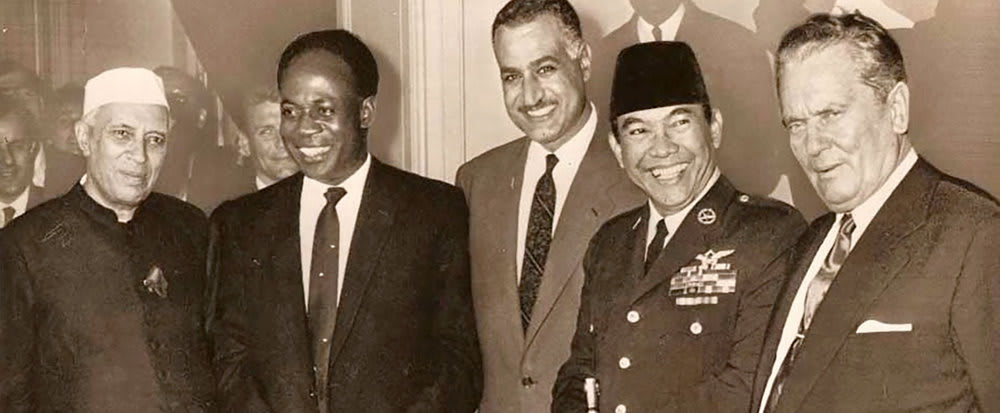
(a) Name the organisation founded by these leaders.
(b) Identify and name the leaders in the picture.
(c) Mention any three objectives of the organisation.
Answer
(a) The organisation founded by these leaders is the Non-Aligned Movement.
(b) The leaders in the given picture are — Pandit Jawaharlal Nehru of India, President Sukarno of Indonesia, President Nasser of Egypt and Marshall Tito of Yugoslavia.
(c) Three objectives of NAM are given below:
- The new independent states should avoid alignment to preserve their independence because they are militarily weak.
- Colonialism and imperialism have encouraged the spirit of exploitation, so every attempt is made by the non-aligned countries to end colonialism and imperialism.
- The NAM is against the spirit of warfares. It has full faith in co-operation and peaceful co-existence.