
When was the United Nations set up?
- 1945
- 1939
- 1940
- 1946
Answer
1945
Reason — The United Nations Organisation was set up on 24 October 1945, after the Second World War, to end wars, maintain permanent peace, and promote the economic and cultural development of mankind
UN headquarters are located in
- New York
- Paris
- London
- Switzerland
Answer
New York
Reason — The headquarters of the United Nations Organisation are situated at New York city in the U.S.A.
Which of the following statements is INCORRECT about the President & Vice President of the International Court of Justice?
- Term in office is 3 years.
- They are both nominated by the United Nations General Assembly and the Security Council.
- The Vice-President takes charge in the absence of the President.
- The President and Vice-President may be re-elected.
Answer
They are both nominated by the United Nations General Assembly and the Security Council.
Reason — The judges of the International Court of Justice are elected by the General Assembly and the Security Council voting separately, and that the Chief Justice (President) is elected for three years. The President and Vice-President are chosen by the judges of the Court from among themselves, not separately nominated by the General Assembly and the Security Council. Hence statement (2) is incorrect.
What is the tenure of judges at International Court of Justice (ICJ)?
- 5 years
- 6 years
- 7 years
- 9 years
Answer
9 years
Reason — The judges of the International Court of Justice work for a term of nine years and may be re-elected.
Who appoints the Secretary General of the UNO?
- Security Council
- General Assembly on the recommendation of Security Council
- USA
- Permanent Members of the Security Council
Answer
General Assembly on the recommendation of Security Council
Reason — The Secretary General is appointed by the General Assembly on the recommendation of the Security Council.
Which of the following countries is not a permanent member of the Security Council?
- USA
- France
- Britain
- Japan
Answer
Japan
Reason — The five permanent members of the Security Council are the U.S.A., Russia, England (Britain), France and China. Japan is not among them, so it is not a permanent member.
Which body elects the ten non-permanent members of the Security Council?
- Permanent members of the Security Council
- General Assembly
- International Court of Justice
- USA
Answer
General Assembly
Reason — The ten non-permanent members of the Security Council are elected by the General Assembly for a term of two years.
Which one of the following is not one of the principles of the UNO?
- It is based on the sovereign equality of all its members.
- All member-nations will not make use of threat and violence in their international relations.
- The UNO shall intervene in the internal affairs of a country.
- The UNO shall oversee that all member-nations work towards maintaining international peace and security.
Answer
The UNO shall intervene in the internal affairs of a country.
Reason — According to its principles, the U.N.O. will not intervene in the internal affairs of a country. Therefore, intervening in a country's internal affairs is not a principle of the U.N.O.
The Non-permanent members of the Security Council are elected for a period of
- 5 years
- 4 years
- 3 years
- 2 years
Answer
2 years
Reason — The ten non-permanent members of the Security Council are elected by the General Assembly for a period of two years.
Identify the functions of the Security Council.
P : To declare war or peace on any country
Q : To maintain international peace and security
R : To formulate policies for the regulation of armaments
S : To appoint the Judges of the Supreme Courts of member countries
- P and Q
- Q and R
- R and S
- P and S
Answer
Q and R
Reason — The Security Council is responsible for maintaining international peace and security and formulating plans for the regulation of armaments. It does not appoint judges of the Supreme Courts of member countries or declare war or peace on any country.
Read the two statements given below about the International Court of Justice. Select the option that shows the correct relationship between (A) and (B)
(A) It is the Chief Court of the UNO
(B) Its main function is to settle disputes between nations
- (B) contradicts (A)
- (B) is the reason for (A)
- (A) is true but (B) is false
- (A) and (B) are independent of each other
Answer
(B) is the reason for (A)
Explanation — The International Court of Justice is the chief court of the U.N.O. Its main function is to settle disputes between nations through peaceful means. Therefore, statement (B) explains statement (A).
The non-permanent members of the Security Council are elected by the members of ............... .
- General Assembly
- International Court of Justice
- The Trusteeship Council
- The Secretariat
Answer
General Assembly
Reason — The ten non-permanent members of the Security Council are elected by the members of the General Assembly.
Which of the following statements about the composition of the General Assembly is NOT true?
- All countries are members.
- Decisions are made by the voting of the majority members.
- Each State has five representatives but has one vote.
- Permanent members have the Veto Power.
Answer
Permanent members have the Veto Power.
Reason — Veto power refers to the Security Council, not the General Assembly. The five permanent members of the Security Council (China, France, Russia, the United Kingdom, and the United States) do have veto power over substantive decisions.
Which of the following is NOT an objective of the United Nations Organisation?
- Disarm
- Disengage
- Decolonise
- Develop
Answer
Disengage
Reason — Disengagement, meaning to withdraw or detach, is contrary to the UN’s objective of fostering collaboration and resolving conflicts.
Which of the following countries will NOT be part of this cartoon?
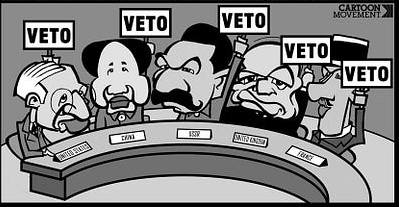
- China
- Japan
- Russia
- Britain
Answer
Japan
Reason — VETO power is enjoyed by the permanent members of the UN. Since, Japan is not the permanent member of the UN, it does not enjoy VETO power.
When was the U.N.O. established and where?
Answer
The U.N.O. was established at the San Francisco Conference held in San Francisco (U.S.A.) in June 1945. It came into existence on 24 October 1945, when its Charter came into force.
Mention any two objectives of the U.N.O.
Answer
Two objectives of the U.N.O are:
- To maintain international peace and security.
- To develop friendly relations among nations.
Name any two organs of the U.N.O.
Answer
Two organs of the U.N.O. are:
- The General Assembly
- The Security Council
Mention any two principles of the U.N.O.
Answer
Two principles of the U.N.O. are:
- The U.N.O. is based on the sovereign equality of all its members.
- All member-nations will not make use of threat and violence in their international relations.
What is the importance of the General Assembly?
Answer
The General Assembly is the chief deliberative organ of the U.N.O. It is regarded as the Parliament of Nations because all member countries are represented in it. It discusses important international issues and makes recommendations for maintaining international peace and cooperation.
How is the Security Council constituted?
Answer
The Security Council consists of 15 members, out of which five are permanent members, while the remaining ten are non-permanent members elected by the General Assembly for 2 years.
What is the term of office of the non-permanent members of the Security Council?
Answer
The term of office of the non-permanent members of the Security Council is two years.
What is the importance of the International Court of Justice?
Answer
The International Court of Justice is the chief judicial organ of the U.N.O. It consists of 15 judges elected for a term of nine years. Its main function is to settle disputes between nations by peaceful means. It also gives advisory opinions on legal questions referred to it by the General Assembly, the Security Council and other U.N. agencies.
Discuss a special power enjoyed by the permanent members of the UN Security Council that impacts the decision-making by the Council.
Answer
The special power enjoyed by the permanent members is the veto power. The negative vote of a permanent member is called a veto. If any one of the five permanent members casts a negative vote on a matter, the Security Council is powerless to act on it, even if all the other members are in favour. However, abstention from voting does not amount to a veto. Thus, a single permanent member can block any decision, which strongly impacts the decision-making of the Council.
Name the two International Organisations that were formed, one as a consequence of World War I and the other after World War II.
Answer
League of Nations was formed as a consequence of World War I and the United Nations Organisation (UNO) was formed as a consequence of World War II.
With reference to the General Assembly, answer the following :
(a) How many delegates can each country send to the General Assembly?
(b) How are decisions taken in the General Assembly?
(c) Mention any two of its functions.
Answer
(a) Each country can send five delegates to the General Assembly.
(b) Decisions on important questions require a two-thirds majority, while decisions on ordinary matters are made by a simple majority.
(c) Two functions of the General Assembly are:
- To discuss matters relating to international peace and security.
- To consider and approve the budgets of the U.N.O. and its specialised agencies.
The General Assembly and the Security Council are two principal organs of the United Nations. Describe :
(a) The composition of these two organs of the U.N.O.
(b) Their functions.
Answer
(a) Composition of the General Assembly
The General Assembly is the main deliberative body of the United Nations, comprising all 193 member states, each with one vote. It is considered as the parliament of the U.N.O.
Composition of the Security Council
The Security Council has 15 members. The U.S.A., Russia, England, France and China are the permanent members. The remaining 10 non-permanent members are elected by the General Assembly for 2 years.
(b) Functions of the General Assembly
- To discuss matters relating to international peace and security.
- To promote international cooperation in economic, social, educational, cultural and health fields.
- To promote the development and codification of international law.
- To promote cooperation in the realisation of human rights and fundamental freedoms for all.
- To promote friendly relations among nations.
- To discuss and make recommendations on any question affecting the powers and functions of any organ of the U.N.O.
- To consider and approve the budgets of the U.N.O. and its specialised agencies.
- To appoint the Secretary General at the recommendation of the Security Council.
Functions of the Security Council
The functions of the Security Council are given below:
- To maintain international peace and security.
- To investigate any dispute or situation which might lead to international friction.
- To recommend methods of adjusting such disputes or the terms of settlement.
- To formulate plans for the regulation of armaments.
- To determine the existence of a threat to peace or act of aggression and to recommend what action should be taken.
- To call on the members to apply economic sanctions and other measures to prevent or stop aggressions.
- To take military action against an aggressor.
- To recommend to the General Assembly the appointment of the Secretary General.
With reference to the International Court of Justice, answer the following :
(a) Total number of its judges and their tenure.
(b) Its main functions.
Answer
(a) The International Court of Justice consists of 15 judges. The judges work for a term of nine years and may be re-elected. The Chief Justice is elected from among them for three years.
(b) The main functions of the International Court of Justice are:
- To settle mutual disputes among different nations by peaceful methods.
- Disputes regarding treaties, international law, interpretation of agreements or legal questions.
- ICJ also advises the General Assembly, the Security Council, and other agencies of the U.N.O. on legal matters.
With reference to the given picture, answer the following questions :
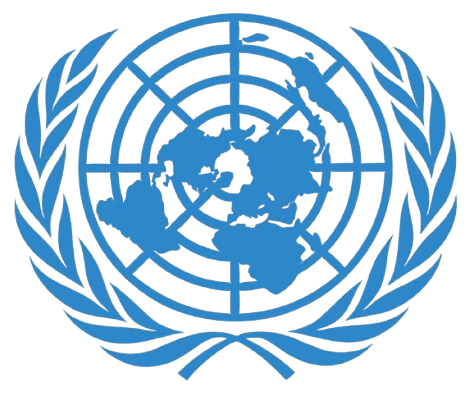
(a) Identify the organisation associated with the given emblem.
(b) Mention any three principles of this organisation.
(c) Name the principal judicial organ of this organisation and explain its composition.
Answer
(a) The given emblem is associated with the United Nations Organisation (U.N.O.).
(b) Three principles of the U.N.O. are given below:
- The U.N.O. is based on the sovereign equality of all its members.
- Each member-nation should settle the disputes by peaceful means so that peace, security and justice in the world are not disturbed.
- The U.N.O. will not intervene in the internal affairs of a country.
(c) The principal judicial organ of the United Nations Organisation is the International Court of Justice.
Composition of the International Court of Justice — The International Court of Justice consists of 15 judges elected by the General Assembly and the Security Council voting separately. No two judges can belong to the same country. The judges are elected for a term of nine years and may be re-elected. The Chief Justice is elected for a term of three years.