KnowledgeBoat Logo
|
OPEN IN APP

Chapter 13

Similarity

Class - 10 ML Aggarwal Understanding ICSE Mathematics


Exercise 13.1

Question 1

State which pairs of triangles in the figure given below are similar. Write the similarity rule used and also write the pairs of similar triangles in symbolic form (all lengths of sides are in cm):

State which pairs of triangles in the figure given below are similar. Write the similarity rule used and also write the pairs of similar triangles in symbolic form (all lengths of sides are in cm). Similarity, ML Aggarwal Understanding Mathematics Solutions ICSE Class 10.

Answer

Given,

(i) In △ABC and △PQR

ABPQ=3.24=3240=45ACPR=3.64.5=3645=45BCQR=35.4=3054=59\dfrac{AB}{PQ} = \dfrac{3.2}{4} \\[1em] = \dfrac{32}{40} = \dfrac{4}{5} \\[1em] \dfrac{AC}{PR} = \dfrac{3.6}{4.5} \\[1em] = \dfrac{36}{45} = \dfrac{4}{5} \\[1em] \dfrac{BC}{QR} = \dfrac{3}{5.4} \\[1em] = \dfrac{30}{54} = \dfrac{5}{9}

Since, the ratio of the sides of both the triangle are not same. Hence, they are not similar.

(ii) In △DEF and △LMN

∠ E = ∠ N = 40°

DELN=42=21EFMN=4.82.4=21\dfrac{DE}{LN} = \dfrac{4}{2} = \dfrac{2}{1} \\[1em] \dfrac{EF}{MN} = \dfrac{4.8}{2.4} = \dfrac{2}{1} \\[1em]

Thus, by SAS rule of similarity △DEF ~ △LMN.

Question 2

If in two right triangles, one of the acute angle of one triangle is equal to an acute angle of the other triangle, can you say that the two triangles are similar? Why?

Answer

Given two right angle triangles,

One angle of both triangle will be equal to 90°.

Given, acute angle of both triangles are equal let it be a°.

The third angle of both the triangle will be [180° - (90 + a)°].

Hence, by AA rule of similarity both triangles are similar.

Question 3

It is given that △ABC ~ △EDF such that AB = 5cm, AC = 7cm, DF = 15cm and DE = 12cm. Find the lengths of the remaining sides of the triangles.

Answer

Given, △ABC ~ △EDF

ABDE=ACEF=BCDF.Consider, ABDE=ACEF512=7EFEF=845EF=16.8 cm.\therefore \dfrac{AB}{DE} = \dfrac{AC}{EF} = \dfrac{BC}{DF}. \\[1em] \text{Consider, } \dfrac{AB}{DE} = \dfrac{AC}{EF} \\[1em] \Rightarrow \dfrac{5}{12} = \dfrac{7}{EF} \\[1em] \Rightarrow EF = \dfrac{84}{5} \\[1em] \Rightarrow EF = 16.8 \text{ cm.}

Now consider,

ABDE=BCDF512=BC15BC=5×1512BC=7512BC=6.25.\dfrac{AB}{DE} = \dfrac{BC}{DF} \\[1em] \Rightarrow \dfrac{5}{12} = \dfrac{BC}{15} \\[1em] \Rightarrow BC = \dfrac{5 \times 15}{12} \\[1em] \Rightarrow BC = \dfrac{75}{12} \\[1em] \Rightarrow BC = 6.25.

Hence, EF = 16.8 cm and BC = 6.25 cm.

Question 4(a)

If △ABC ~ △DEF, AB = 4 cm, DE = 6 cm, EF = 9 cm and FD = 12 cm, then find the perimeter of △ABC.

Answer

Given △ABC ~ △DEF, so

ABDE=ACDF=BCEFConsider, ABDE=ACDF46=AC12AC=486AC=8.\therefore \dfrac{AB}{DE} = \dfrac{AC}{DF} = \dfrac{BC}{EF} \\[1em] \text{Consider, } \dfrac{AB}{DE} = \dfrac{AC}{DF} \\[1em] \dfrac{4}{6} = \dfrac{AC}{12} \\[1em] AC = \dfrac{48}{6} \\[1em] AC = 8.

Now consider,

ABDE=BCEF46=BC9BC=366BC=6\dfrac{AB}{DE} = \dfrac{BC}{EF} \\[1em] \dfrac{4}{6} = \dfrac{BC}{9} \\[1em] BC = \dfrac{36}{6} \\[1em] BC = 6

Perimeter of △ABC = AB + BC + AC = 4 + 6 + 8 = 18 cm.

Hence, perimeter of △ABC = 18 cm.

Question 4(b)

If △ABC ~ △PQR, perimeter of △ABC = 32cm, perimeter of △PQR = 48cm and PR = 6cm, then find the length of AC.

Answer

Given, △ABC ~ △PQR

ABPQ=ACPR=BCQR\therefore \dfrac{AB}{PQ} = \dfrac{AC}{PR} = \dfrac{BC}{QR} \\[1em]

Since triangles are similar so the ratio of perimeter will be equal to ratio of sides.

Perimeter of △ABCPerimeter of △PQR=ACPR3248=AC6AC=19248AC=4.\Rightarrow \dfrac{\text{Perimeter of △ABC}}{\text{Perimeter of △PQR}} = \dfrac{AC}{PR} \\[1em] \dfrac{32}{48} = \dfrac{AC}{6} \\[1em] AC = \dfrac{192}{48} \\[1em] AC = 4.

Hence, length of AC = 4 cm.

Question 5

Calculate the other sides of a triangle whose shortest side is 6cm and which is similar to a triangle whose sides are 4cm, 7cm and 8cm.

Answer

Let △ABC ~ △DEF in which shortest side of △ABC be BC = 6cm.
△DEF, DE = 8cm, EF = 4cm and DF = 7cm.

Since, △ABC ~ △DEF so,

ABDE=BCEF=ACDFConsider, ABDE=BCEFAB8=64AB=484AB=12.\dfrac{AB}{DE} = \dfrac{BC}{EF} = \dfrac{AC}{DF} \\[1em] \text{Consider, } \dfrac{AB}{DE} = \dfrac{BC}{EF} \\[1em] \dfrac{AB}{8} = \dfrac{6}{4} \\[1em] AB = \dfrac{48}{4} \\[1em] AB = 12.

Now consider,

BCEF=ACDF64=AC7AC=424AC=10.5.\dfrac{BC}{EF} = \dfrac{AC}{DF} \\[1em] \dfrac{6}{4} = \dfrac{AC}{7} \\[1em] AC = \dfrac{42}{4} \\[1em] AC = 10.5.

Hence, the other sides of triangle are 10.5cm and 12cm.

Question 6(a)

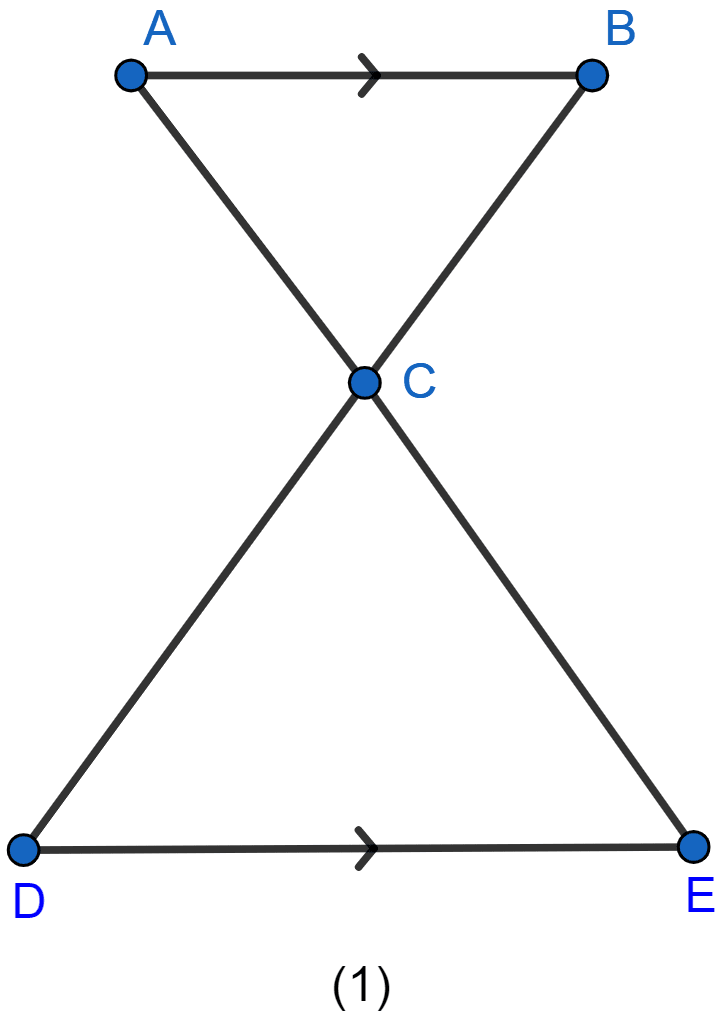
In the figure given below, AB ∥ DE, AC = 3cm, CE = 7.5cm and BD = 14cm. Calculate CB and DC.

In the figure given below, AB ∥ DE, AC = 3cm, CE = 7.5cm and BD = 14cm. Calculate CB and DC. Similarity, ML Aggarwal Understanding Mathematics Solutions ICSE Class 10.

Answer

In the given figure,

AB ∥ DE, AC = 3cm, CE = 7.5cm, BD = 14cm.

From the figure,

∠ACB = ∠DCE [Vertically opposite angles]
∠BAC = ∠CED [Alternate angles]

Then, by AA rule of similarity, △ABC ~ △CDE.

So,

ACCE=BCCD37.5=BCCD7.5BC=3CD[....Eq 1]\Rightarrow \dfrac{AC}{CE} = \dfrac{BC}{CD} \\[1em] \Rightarrow \dfrac{3}{7.5} = \dfrac{BC}{CD} \\[1em] \Rightarrow 7.5BC = 3CD \qquad \text{[....Eq 1]} \\[1em]

∵ BD = 14 cm, Let BC = x cm

∴ From fig, CD = (14 - x) cm.

Putting these values of BC and CD in equation 1 we get,

7.5x=3(14x)7.5x=423x7.5x+3x=4210.5x=42x=4210.5x=4.\Rightarrow 7.5x = 3(14 - x) \\[1em] \Rightarrow 7.5x = 42 - 3x \\[1em] \Rightarrow 7.5x + 3x = 42 \\[1em] \Rightarrow 10.5x = 42 \\[1em] \Rightarrow x = \dfrac{42}{10.5} \\[1em] \Rightarrow x = 4.

∴ x = 4 and 14 - x = 10.

Hence, CB = 4cm and DC = 10cm.

Question 6(b)

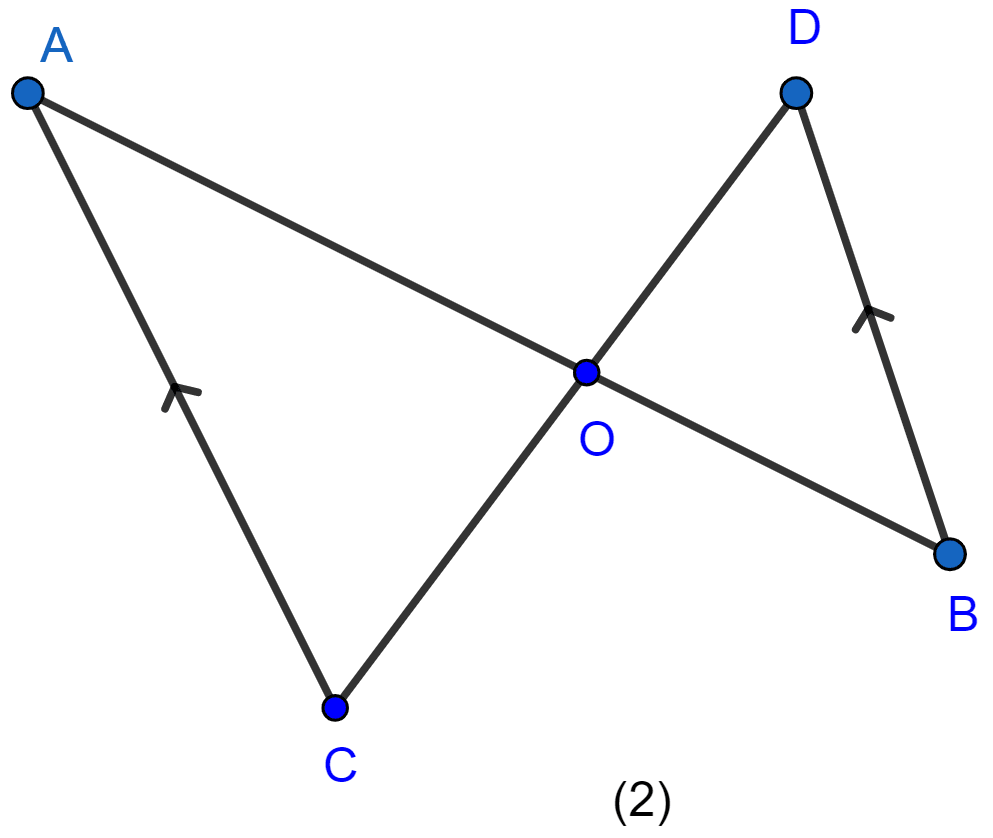
In the figure (2) given below, CA ∥ BD, the lines AB and CD meet at O.

In the figure (2) given below, CA ∥ BD, the lines AB and CD meet at O. Prove that △ACO ~ △BDO. If BD = 2.4 cm, OD = 4 cm, OB = 3.2 cm and AC = 3.6 cm, calculate OA and OC. Similarity, ML Aggarwal Understanding Mathematics Solutions ICSE Class 10.

(i) Prove that △ACO ~ △BDO.

(ii) If BD = 2.4 cm, OD = 4 cm, OB = 3.2 cm and AC = 3.6 cm, calculate OA and OC.

Answer

Considering △ACO and △BDO,

∠ AOC = ∠ BOD [Vertically opposite angles]
∠ A = ∠ B [Alternate angles]

Then, by AA rule of similarity, △AOC ~ △BOD.

So,

OAOB=OCOD=ACBDConsider, ACBD=OAOB3.62.4=OA3.2OA=3.6×3.22.4OA=11.522.4OA=4.8.\Rightarrow \dfrac{OA}{OB} = \dfrac{OC}{OD} = \dfrac{AC}{BD} \\[1em] \Rightarrow \text{Consider, } \dfrac{AC}{BD} = \dfrac{OA}{OB} \\[1em] \Rightarrow \dfrac{3.6}{2.4} = \dfrac{OA}{3.2} \\[1em] OA = \dfrac{3.6 \times 3.2}{2.4} \\[1em] OA = \dfrac{11.52}{2.4} \\[1em] OA = 4.8.

Now, consider

ACBD=OCOD3.62.4=OC4OC=14.42.4OC=6.\dfrac{AC}{BD} = \dfrac{OC}{OD} \\[1em] \dfrac{3.6}{2.4} = \dfrac{OC}{4} \\[1em] OC = \dfrac{14.4}{2.4} \\[1em] OC = 6.

Hence, OA = 4.8 cm and OC = 6 cm.

Question 7(a)

In the figure (i) given below, ∠P = ∠RTS. Prove that △RPQ ~ △RTS.

In the figure (i) given below, ∠P = ∠RTS. Prove that △RPQ ~ △RTS. Similarity, ML Aggarwal Understanding Mathematics Solutions ICSE Class 10.

Answer

In △RPQ and △RTS.

∠R = ∠R ( Common )
∠P = ∠RTS (Given)

Hence, by AA rule of similarity △RPQ ~ △RTS.

Question 7(b)

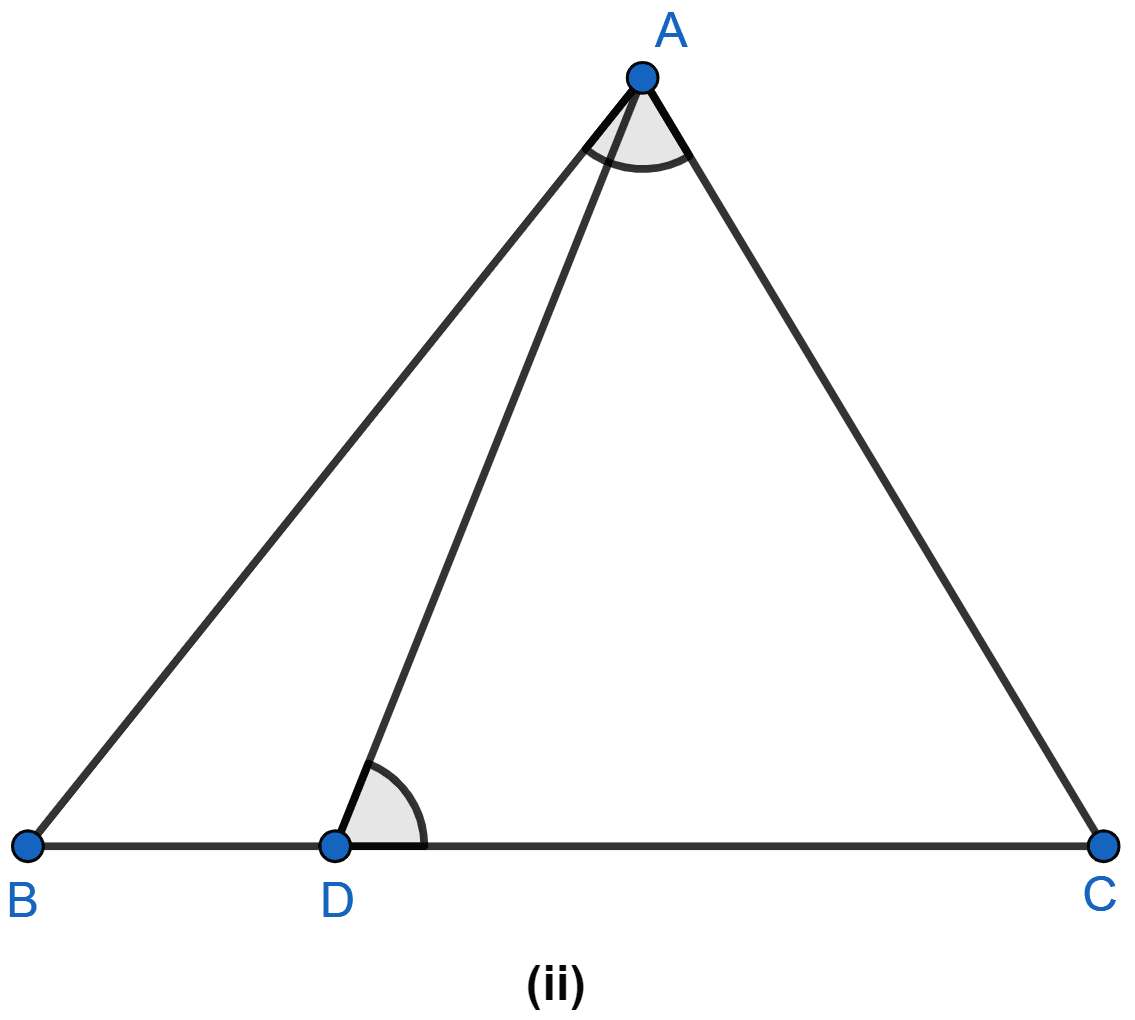
In the figure (ii) given below, ∠ADC = ∠BAC. Prove that CA2 = DC × BC.

In the figure (ii) given below, ∠ADC = ∠BAC. Prove that CA2 = DC × BC. Similarity, ML Aggarwal Understanding Mathematics Solutions ICSE Class 10.

Answer

In △ABC and △ADC

∠C = ∠C (Common angle for both triangle)

∠BAC = ∠ADC (Given)

Then, by AA rule of similarity, △BAC ~ △ADC.

So,

CADC=BCCACA2=DC×BC.\dfrac{CA}{DC} = \dfrac{BC}{CA} \\[1em] CA^2 = DC \times BC.

Hence proved.

Question 8(a)

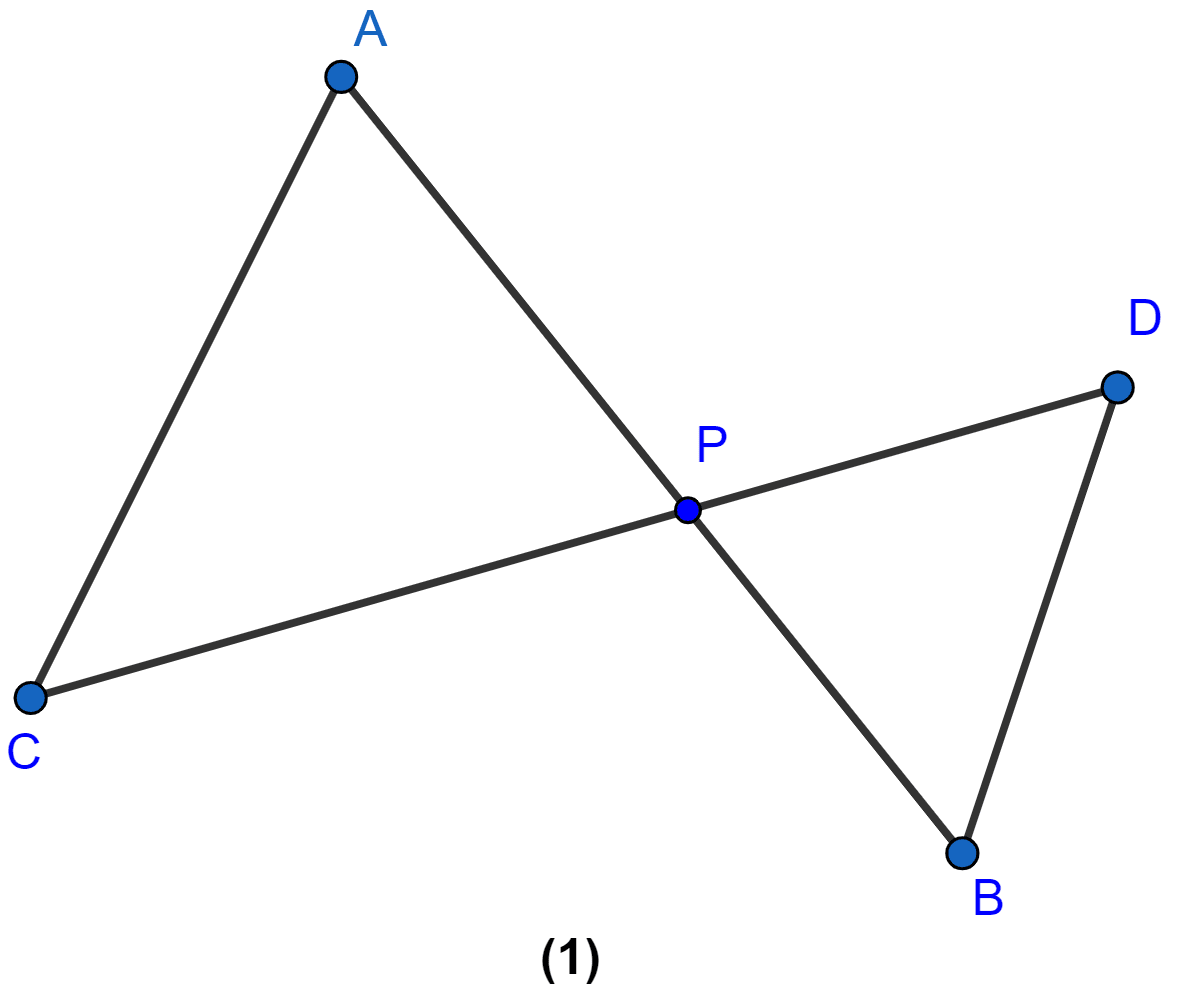
In the figure (1) given below, AP = 2PB and CP = 2PD.

(i) Prove that △ACP is similar to △BDP and AC ∥ BD.

(ii) If AC = 4.5 cm, calculate the length of BD.

In the figure (1) given below, AP = 2PB and CP = 2PD. (i) Prove that △ACP is similar to △BDP and AC ∥ BD. (ii) If AC = 4.5 cm, calculate the length of BD. Similarity, ML Aggarwal Understanding Mathematics Solutions ICSE Class 10.

Answer

(i) Given, AP = 2PB and CP = 2PD.

APPB=21 and CPPD=21.\therefore \dfrac{AP}{PB} = \dfrac{2}{1} \text{ and } \dfrac{CP}{PD} = \dfrac{2}{1}.

∠ APC = ∠ BPD [Vertically opposite angles]

So by SAS rule of similarity △ACP ~ △BDP.

Since, triangles are similar,

∴ ∠ CAP = ∠ PBD.

Since, these angles are alternate angles therefore, AC ∥ BD.

Hence, proved that △ACP ~ △BDP and AC ∥ BD.

(ii) Since triangles are similar. So,

APPB=ACBDACBD=21BD=AC2BD=4.52BD=2.25.\dfrac{AP}{PB} = \dfrac{AC}{BD} \\[1em] \dfrac{AC}{BD} = \dfrac{2}{1} \\[1em] BD = \dfrac{AC}{2} \\[1em] BD = \dfrac{4.5}{2} \\[1em] BD = 2.25.

Hence, BD = 2.25 cm.

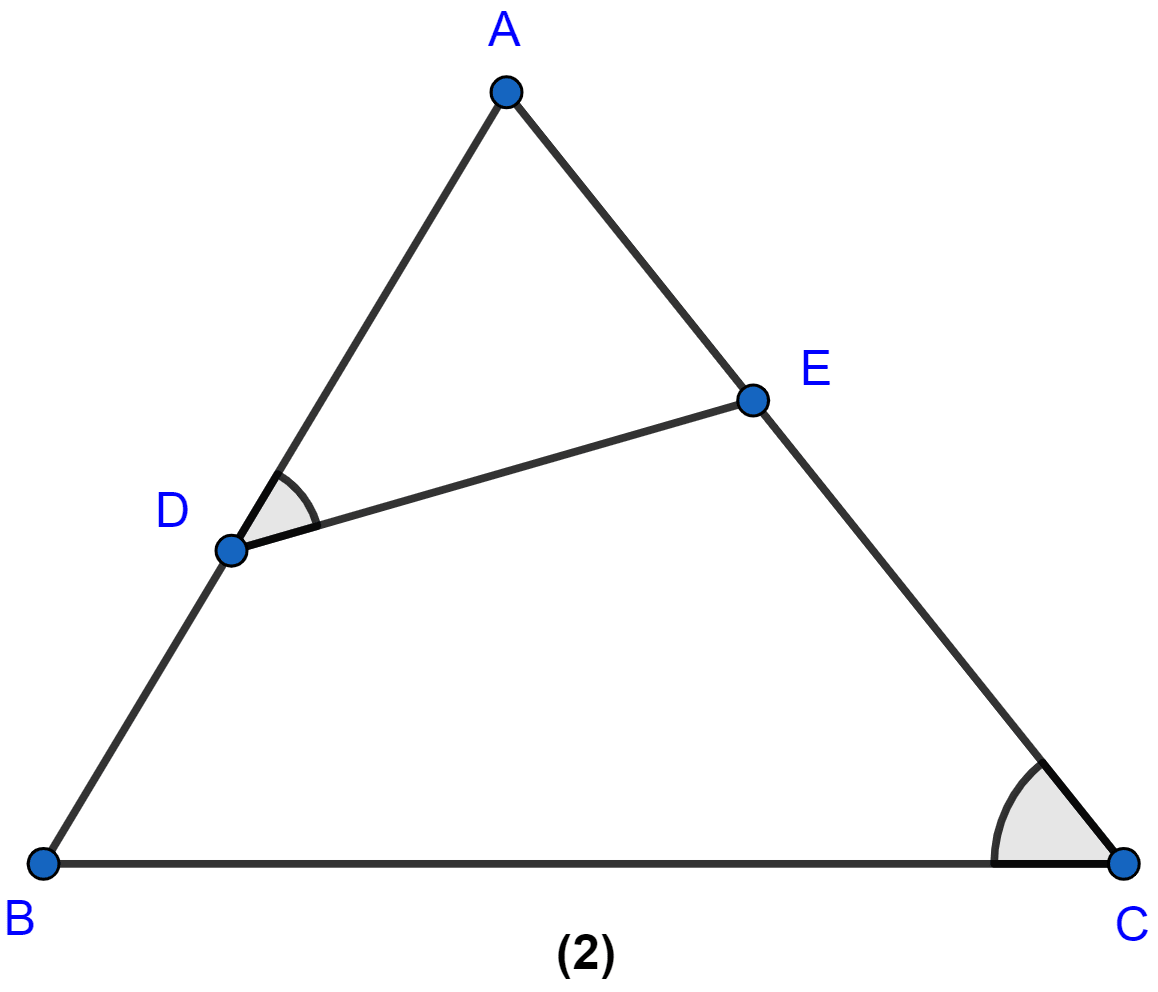
Question 8(b)

In the figure (2) given below, ∠ ADE = ∠ ACB.

(i) Prove that △s ABC and AED are similar.

(ii) If AE = 3 cm, BD = 1 cm and AB = 6 cm, calculate AC.

In the figure (2) given below, ∠ ADE = ∠ ACB. (i) Prove that △s ABC and AED are similar. (ii) If AE = 3 cm, BD = 1 cm and AB = 6 cm, calculate AC. Similarity, ML Aggarwal Understanding Mathematics Solutions ICSE Class 10.

Answer

(i) From the given figure,

∠ ADE = ∠ ACB (Given)
∠ A = ∠ A. (Common)

Hence, by AA rule of similarity △ABC ~ △AED.

(ii) Since triangles are similar,

BCDE=ABAE=ACAD\therefore \dfrac{BC}{DE} = \dfrac{AB}{AE} = \dfrac{AC}{AD} \\[1em]

From figure:
AD = AB - BD = 6 - 1 = 5 cm.

Consider,

ABAE=ACAD63=AC5AC=303AC=10.\dfrac{AB}{AE} = \dfrac{AC}{AD} \\[1em] \dfrac{6}{3} = \dfrac{AC}{5} \\[1em] AC = \dfrac{30}{3} \\[1em] AC = 10.

Hence, the length of AC = 10 cm.

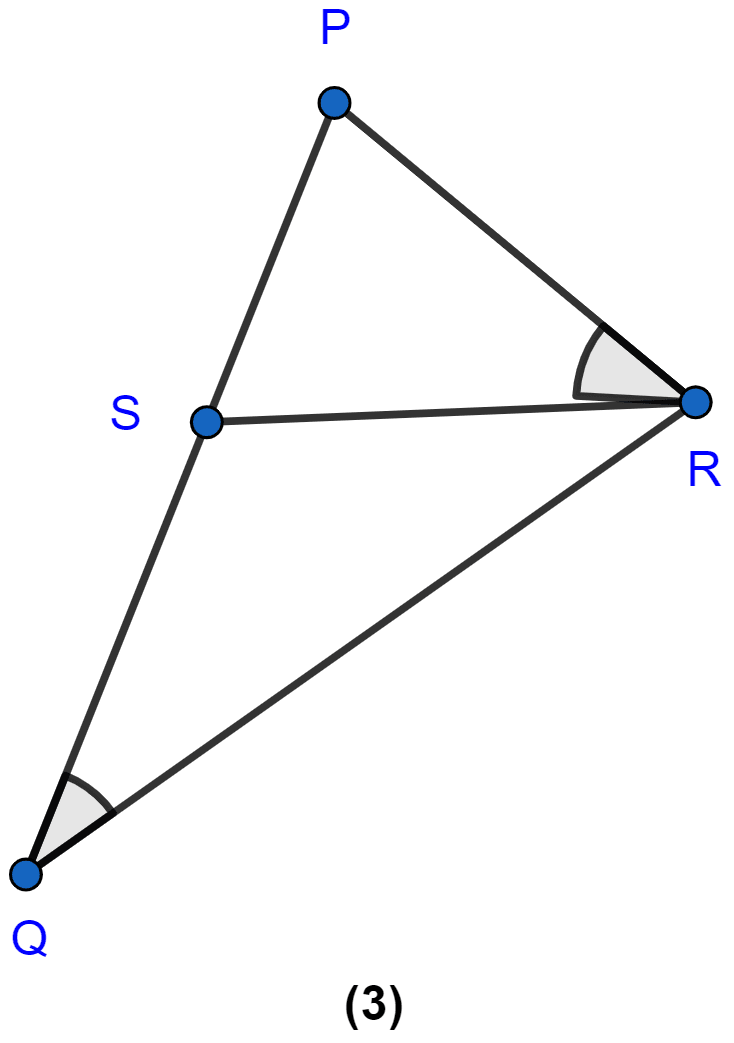
Question 8(c)

In the Figure (3) given below, ∠ PQR = ∠ PRS. Prove that triangles PQR and PRS are similar. If PR = 8 cm, PS = 4 cm, calculate PQ.

In the figure (3) given below, ∠ PQR = ∠ PRS. Prove that triangles PQR and PRS are similar. If PR = 8 cm, PS = 4 cm, calculate PQ. Similarity, ML Aggarwal Understanding Mathematics Solutions ICSE Class 10.

Answer

Given, ∠ PQR = ∠ PRS.

∠ P = ∠ P (common for both the triangles).

By AA rule of similarity, △PQR ~ △PRS.

Then,

PQPR=PRPS=QRSRConsidering, PQPR=PRPSPQ8=84PQ=644PQ=16.\dfrac{PQ}{PR} = \dfrac{PR}{PS} = \dfrac{QR}{SR} \\[1em] \text{Considering, } \dfrac{PQ}{PR} = \dfrac{PR}{PS} \\[1em] \dfrac{PQ}{8} = \dfrac{8}{4} \\[1em] PQ = \dfrac{64}{4} \\[1em] PQ = 16.

Hence, the length of PQ = 16 cm.

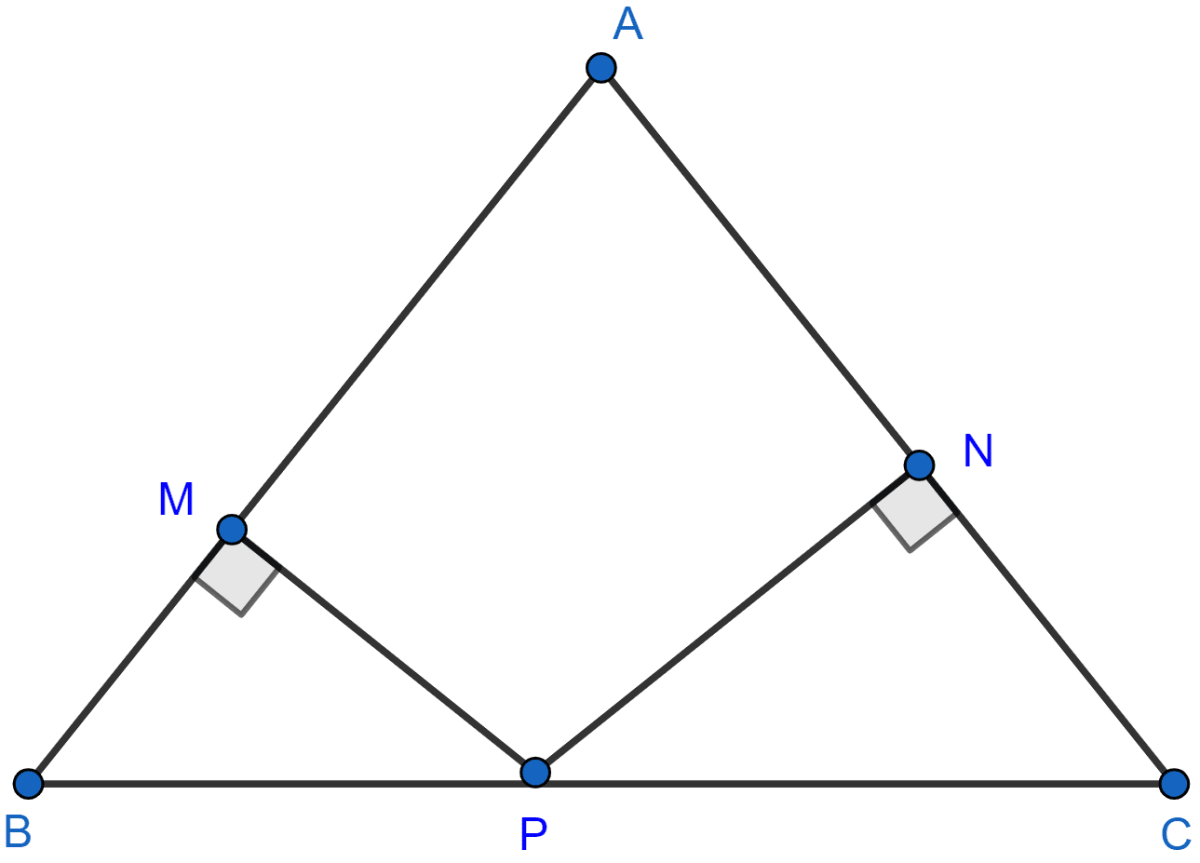
Question 9

In the adjoining figure, ABC is a triangle in which AB = AC. P is a point on the side BC such that PM ⊥ AB and PN ⊥ AC. Prove that BM × NP = CN × MP.

In the adjoining figure, ABC is a triangle in which AB = AC. P is a point on the side BC such that PM ⊥ AB and PN ⊥ AC. Prove that BM × NP = CN × MP. Similarity, ML Aggarwal Understanding Mathematics Solutions ICSE Class 10.

Answer

Consider △ABC

Given, AB = AC

∠ B = ∠ C [Angles opposite to equal sides (Property of isosceles triangle)]

Considering △BMP and △CNP

∠ M = ∠ N = 90°.

∠ B = ∠ C.

So, by AA rule of similarity △BMP ~ △CNP.

As triangles are similar,

BMCN=MPNPBM×NP=CN×MP.\Rightarrow \dfrac{BM}{CN} = \dfrac{MP}{NP} \\[1em] \Rightarrow BM \times NP = CN \times MP.

Hence proved.

Question 10

Prove that the ratio of the perimeters of two similar triangles is the same as the ratio of their corresponding sides.

Answer

Let two similar triangles be △ABC and △PQR.

We know that when triangles are similar ratio of corresponding sides are equal.

ABPQ=BCQR=ACPR.\therefore \dfrac{AB}{PQ} = \dfrac{BC}{QR} = \dfrac{AC}{PR}.

By property of ratio i.e.,

if ab=bc=de,\dfrac{a}{b} = \dfrac{b}{c} = \dfrac{d}{e}, then each ratio = sum of antecedentssum of consequents\dfrac{\text{sum of antecedents}}{\text{sum of consequents}}.

So,

ABPQ=BCQR=ACPR=AB+BC+ACPQ+QR+PR\dfrac{AB}{PQ} = \dfrac{BC}{QR} = \dfrac{AC}{PR} = \dfrac{AB + BC + AC}{PQ + QR + PR}

Since, AB + BC + AC = Perimeter of △ABC and PQ + QR + PR = Perimeter of △PQR. So,

ABPQ=BCQR=ACPR=Perimeter of △ABCPerimeter of △PQR.\dfrac{AB}{PQ} = \dfrac{BC}{QR} = \dfrac{AC}{PR} = \dfrac{\text{Perimeter of △ABC}}{\text{Perimeter of △PQR}}.

Hence, proved.

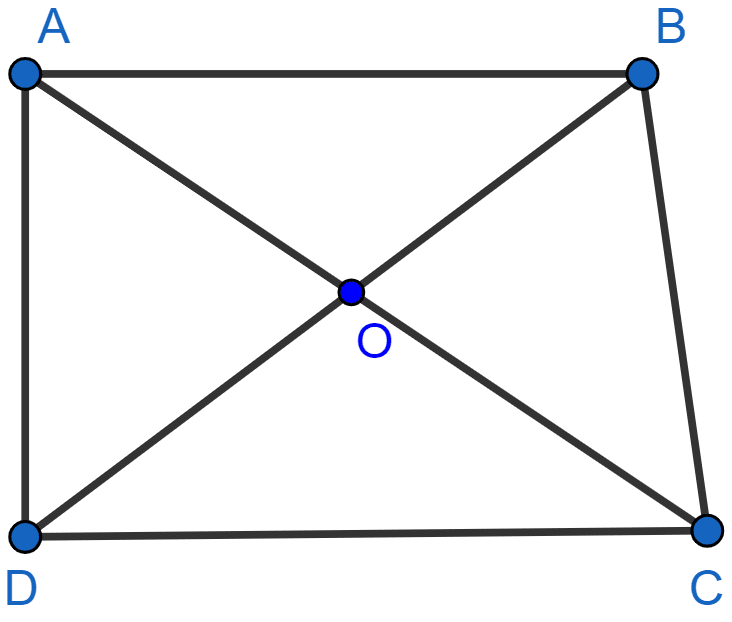
Question 11

In the adjoining figure, ABCD is a trapezium in which AB ∥ DC. The diagonals AC and BD intersect at O. Prove that AOOC=BOOD.\dfrac{AO}{OC} = \dfrac{BO}{OD}.

Using the above result, find the value(s) of x if OA = 3x - 19, OB = x - 4, OC = x - 3 and OD = 4.

In the adjoining figure, ABCD is a trapezium in which AB ∥ DC. The diagonals AC and BD intersect at O. Prove that AO/OC = BO/OD. Using the above result, find the value(s) of x if OA = 3x - 19, OB = x - 4, OC = x - 3 and OD = 4. Similarity, ML Aggarwal Understanding Mathematics Solutions ICSE Class 10.

Answer

Consider triangle AOB and COD,

∠ AOB = ∠ COD [Vertically opposite angles]

∠ OAB = ∠ OCD [Alternate angles]

So, by AA rule of similarity △AOB ~ △COD.

As triangles are similar, ratio of sides will be similar,

OAOC=OBOD\dfrac{OA}{OC} = \dfrac{OB}{OD}

Putting values of sides from question in equation,

3x19x3=x444(3x19)=(x3)(x4)12x76=x24x3x+12x27x+12=12x76x27x12x+12+76=0x219x+88=0x211x8x+88=0x(x11)8(x11)=0(x8)(x11)=0x8=0 or x11=0x=8 or x=11.\dfrac{3x - 19}{x - 3} = \dfrac{x - 4}{4} \\[1em] 4(3x - 19) = (x - 3)(x - 4) \\[1em] 12x - 76 = x^2 - 4x - 3x + 12 \\[1em] x^2 - 7x + 12 = 12x - 76 \\[1em] x^2 - 7x - 12x + 12 + 76 = 0 \\[1em] x^2 - 19x + 88 = 0 \\[1em] x^2 - 11x - 8x + 88 = 0 \\[1em] x(x - 11) - 8(x - 11) = 0 \\[1em] (x - 8)(x - 11) = 0 \\[1em] x - 8 = 0 \text{ or } x - 11 = 0 \\[1em] x = 8 \text{ or } x = 11.

Hence, the value of x = 8 or 11.

Question 12(a)

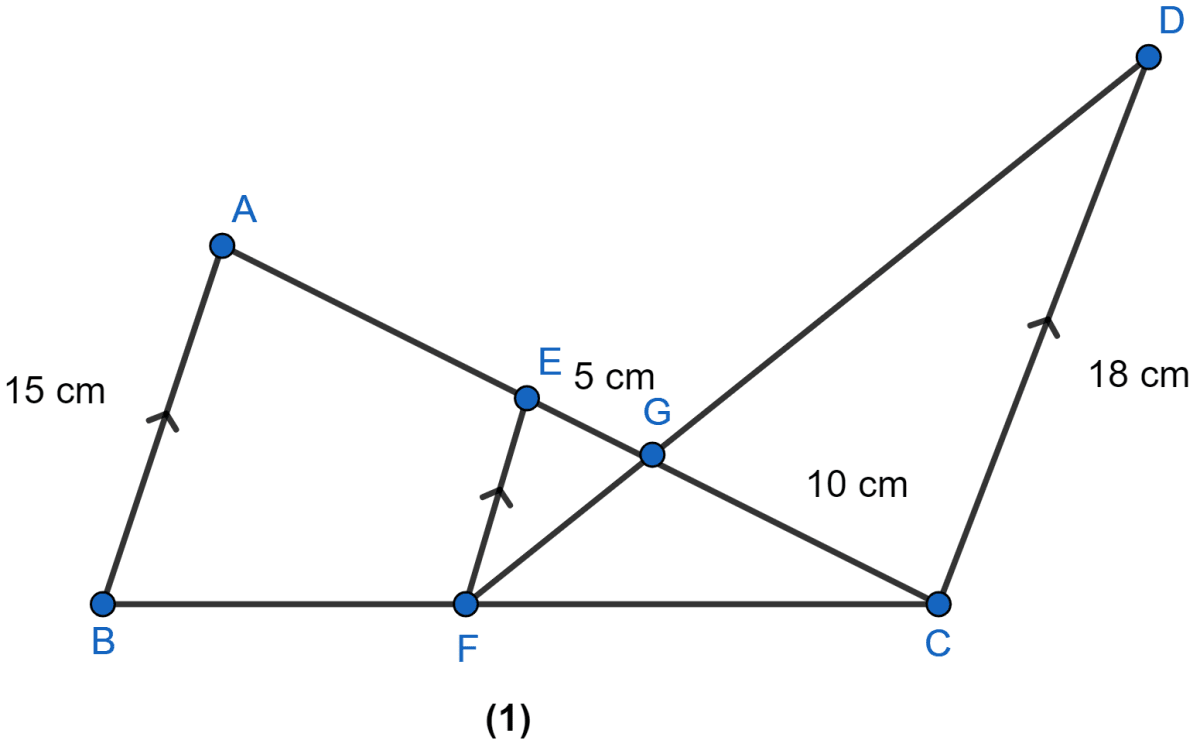
In the figure (1) given below, AB, EF and CD are parallel lines. Given that AB = 15 cm, EG = 5 cm, GC = 10 cm and DC = 18 cm. Calculate
(i) EF (ii) AC

In the figure (1) given below, AB, EF and CD are parallel lines. Given that AB = 15 cm, EG = 5 cm, GC = 10 cm and DC = 18 cm. Calculate (i) EF (ii) AC. Similarity, ML Aggarwal Understanding Mathematics Solutions ICSE Class 10.

Answer

(i) Consider △EFG and △CGD

∠ EGF = ∠ CGD [Vertically opposite angles]

∠ FEG = ∠ GCD [Alternate angles are equal]

So, by AA rule of similarity △EFG ~ △CGD.

Then,

EGGC=EFCD510=EF18EF=9010EF=9.\dfrac{EG}{GC} = \dfrac{EF}{CD} \\[1em] \dfrac{5}{10} = \dfrac{EF}{18} \\[1em] EF = \dfrac{90}{10} \\[1em] EF = 9.

Hence, the length of EF = 9 cm.

(ii) Consider △ABC and △EFC

∠ C = ∠ C [Common angles]

∠ ABC = ∠ EFC [Alternate angles are equal]

So, by AA rule of similarity △ABC ~ △EFC

Then,

ACEC=ABEFACEG+GC=159AC5+10=159AC15=159AC=2259AC=25.\dfrac{AC}{EC} = \dfrac{AB}{EF} \\[1em] \dfrac{AC}{EG + GC} = \dfrac{15}{9} \\[1em] \dfrac{AC}{5 + 10} = \dfrac{15}{9} \\[1em] \dfrac{AC}{15} = \dfrac{15}{9} \\[1em] AC = \dfrac{225}{9} \\[1em] AC = 25.

Hence, the length of AC = 25 cm.

Question 12(b)

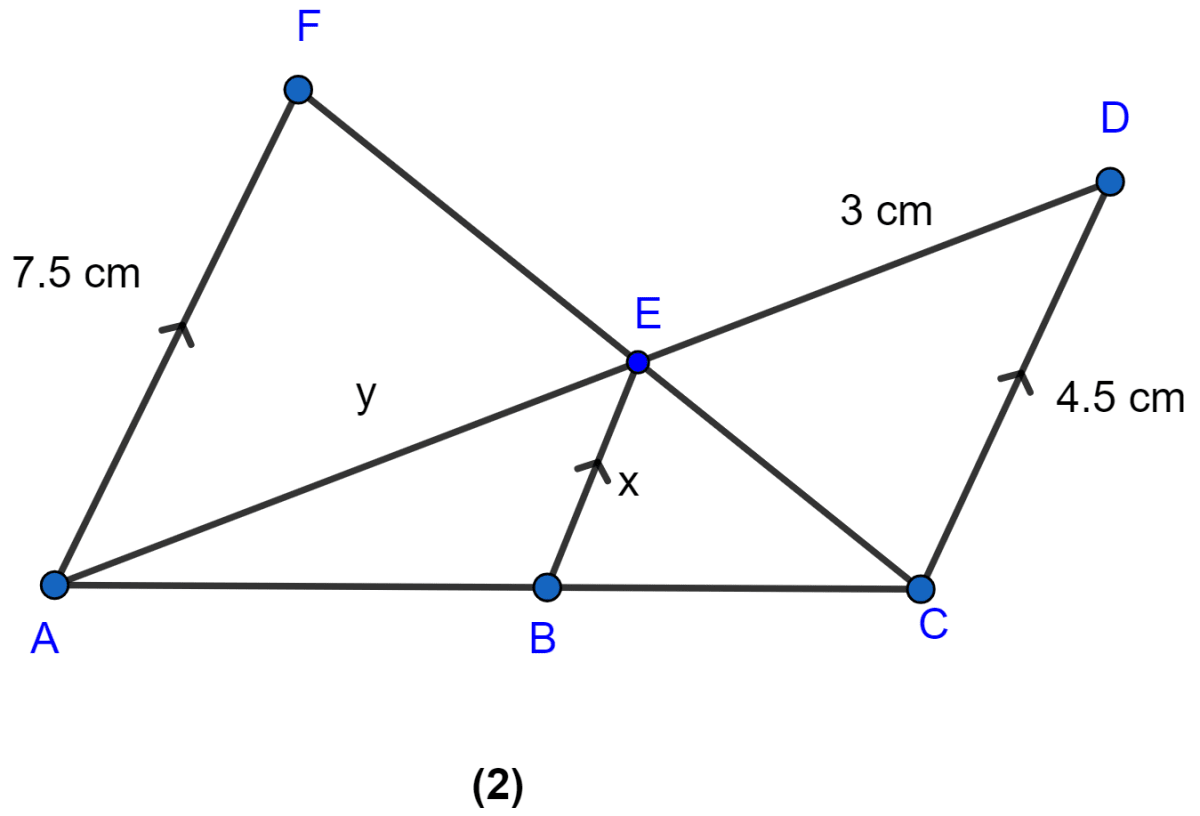
In the figure (2) given below, AF, BE and CD are parallel lines. Given that AF = 7.5 cm, CD = 4.5 cm, ED = 3 cm and BE = x and AE = y. Find the values of x and y.

In the figure (2) given below, AF, BE and CD are parallel lines. Given that AF = 7.5 cm, CD = 4.5 cm, ED = 3 cm and BE = x and AE = y. Find the values of x and y. Similarity, ML Aggarwal Understanding Mathematics Solutions ICSE Class 10.

Answer

Consider △AEF and △CED

∠AEF = ∠CED [Vertically opposite angles]

∠F = ∠C [Alternate angles are equal]

So, by AA rule of similarity △AEF ~ △CED

Then,

AFCD=AEED7.54.5=y3y=22.54.5y=5.\dfrac{AF}{CD} = \dfrac{AE}{ED} \\[1em] \dfrac{7.5}{4.5} = \dfrac{y}{3} \\[1em] y = \dfrac{22.5}{4.5} \\[1em] y = 5.

Consider △ABE and △ACD

∠A = ∠A [Common angles]

∠ABE = ∠ACD [Alternate angles are equal]

So, by AA rule of similarity △ABE ~ △ACD.

Then,

EBCD=AEADx4.5=yAE+EDx4.5=yy+3x=4.5×58x=22.58x=22580=4516x=21316.\dfrac{EB}{CD} = \dfrac{AE}{AD} \\[1em] \dfrac{x}{4.5} = \dfrac{y}{AE + ED} \\[1em] \dfrac{x}{4.5} = \dfrac{y}{y + 3} \\[1em] x = \dfrac{4.5 \times 5}{8} \\[1em] x = \dfrac{22.5}{8} \\[1em] x = \dfrac{225}{80} = \dfrac{45}{16} \\[1em] x = 2\dfrac{13}{16}.

Hence, the value of x = 213162\dfrac{13}{16} cm and y = 5 cm.

Question 13

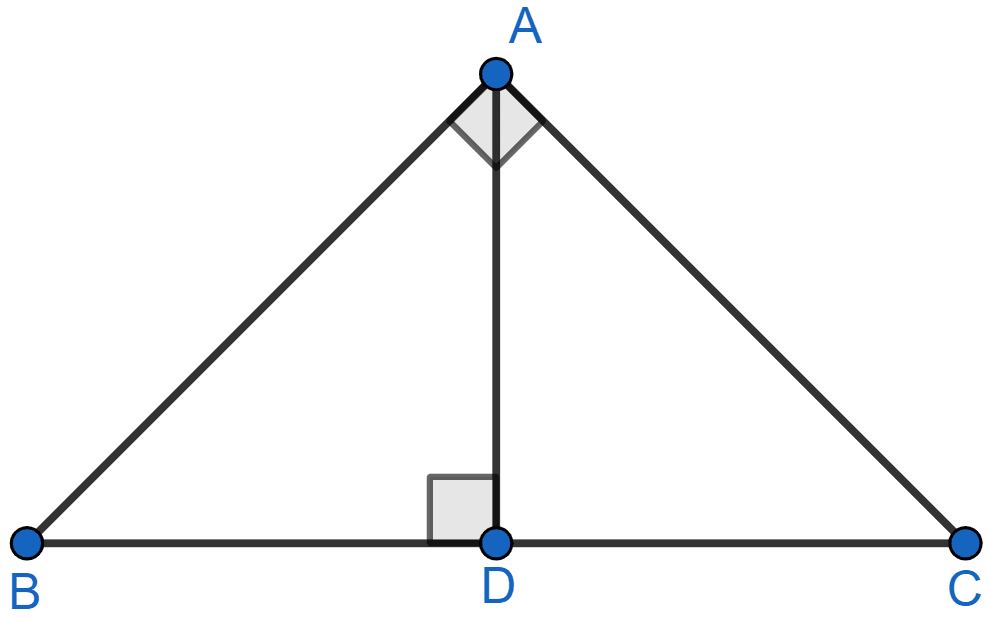
In the given figure, ∠A = 90° and AD ⊥ BC. If BD = 2 cm and CD = 8 cm, find AD.

In the given figure, ∠A = 90° and AD ⊥ BC. If BD = 2 cm and CD = 8 cm, find AD. Similarity, ML Aggarwal Understanding Mathematics Solutions ICSE Class 10.

Answer

Given ∠A = 90°,

or, ∠BAD + ∠DAC = 90° .....(i)

Now, consider △ADC

∠ADC = 90°

or, ∠DCA + ∠DAC = 90° .....(ii)

From equation (i) and equation (ii)

We have,

∠BAD + ∠DAC = ∠DCA + ∠DAC

∠BAD = ∠DCA .....(iii)

So, from △BDA and △ADC

∠BDA = ∠ADC = 90°
∠BAD = ∠DCA [From equation (iii)]

So, by AA rule of similarity △BDA ~ △ADC.

Since, corresponding sides of similar triangles are proportional,

BDAD=ADDC=ABACConsidering, BDAD=ADDCAD2=BD×CDAD2=2×8AD2=16AD216=0AD242=0(AD4)(AD+4)=0AD4=0 and AD+4=0AD=4 and AD=4.\therefore \dfrac{BD}{AD} = \dfrac{AD}{DC} = \dfrac{AB}{AC} \\[1em] \text{Considering, } \dfrac{BD}{AD} = \dfrac{AD}{DC} \\[1em] AD^2 = BD \times CD \\[1em] AD^2 = 2 \times 8 \\[1em] AD^2 = 16 \\[1em] AD^2 - 16 = 0 \\[1em] AD^2 - 4^2 = 0 \\[1em] (AD - 4)(AD + 4) = 0 \\[1em] AD - 4 = 0 \text{ and } AD + 4 = 0 \\[1em] AD = 4 \text{ and } AD = -4.

Since, length cannot be negative hence, AD ≠ -4.

Hence, the length of AD = 4 cm.

Question 14

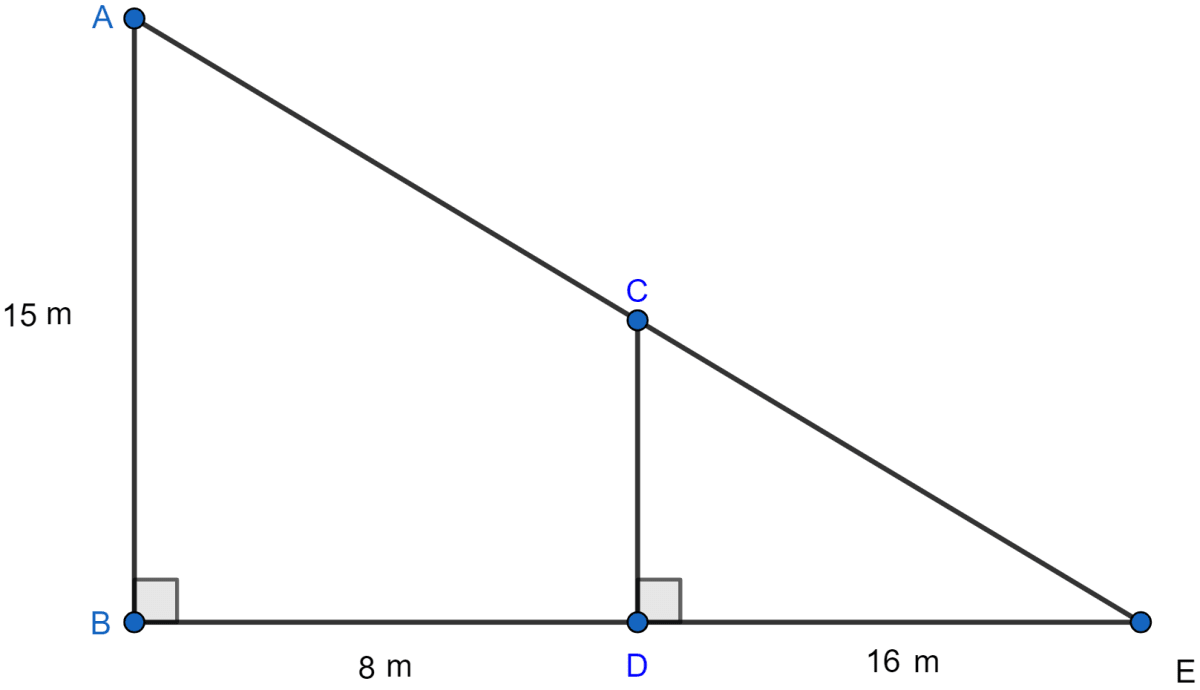
A 15 meters high tower casts a shadow of 24 metres long at a certain time and at the same time, a telephone pole casts a shadow 16 meters long. Find the height of the telephone pole.

Answer

Let AB be tower and CD be pole.

A 15 meters high tower casts a shadow of 24 metres long at a certain time and at the same time, a telephone pole casts a shadow 16 meters long. Find the height of the telephone pole. Similarity, ML Aggarwal Understanding Mathematics Solutions ICSE Class 10.

BE = Shadow of tower and
DE = Shadow of telephone pole.

Considering △ABE and △CDE

∠ABE = ∠CDE (Both are equal to 90°)
∠AEB = ∠CED [Common angles]

So, by AA rule of similarity △ABE ~ △CDE. Hence, the ratio of corresponding sides will be equal.

ABCD=BEDE15CD=2416CD=15×1624CD=24024CD=10.\therefore \dfrac{AB}{CD} = \dfrac{BE}{DE} \\[1em] \Rightarrow \dfrac{15}{CD} = \dfrac{24}{16} \\[1em] \Rightarrow CD = \dfrac{15 \times 16}{24} \\[1em] \Rightarrow CD = \dfrac{240}{24} \\[1em] \Rightarrow CD = 10.

Hence, the height of telephone pole is 10 m.

Question 15

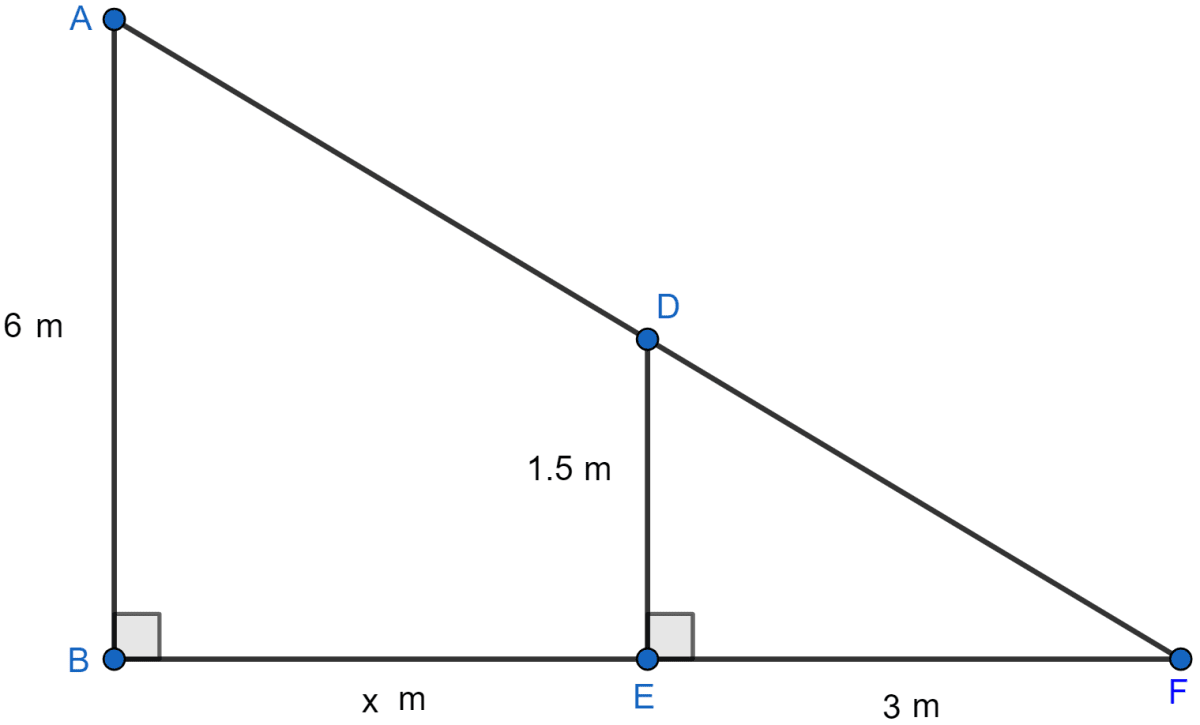
A street light bulb is fixed on a pole 6m above the level of street. If a woman of height 1.5 m casts a shadow of 3 m, find how far she is away from the base of the pole ?

Answer

Let AB be the pole and DE be the woman as shown in the figure below:

A street light bulb is fixed on a pole 6m above the level of street. If a woman of height 1.5 m casts a shadow of 3 m, find how far she is away from the base of the pole? Similarity, ML Aggarwal Understanding Mathematics Solutions ICSE Class 10.

Height of pole (AB) = 6 m
and height of a woman (DE) = 1.5 m

Here shadow EF = 3 m

Let BE(Distance of woman from pole) = x meters.

Considering △ABF and △EFD

∠ABF = ∠DEF (Both are equal to 90°)
∠F = ∠F [Common angles]

So, by AA rule of similarity △ABF ~ △EFD. Hence, the ratio of corresponding sides will be equal.

BFEF=ABDE3+x3=61.53+x3=601515(3+x)=18045+15x=18015x=1804515x=135x=13515x=9.\therefore \dfrac{BF}{EF} = \dfrac{AB}{DE} \\[1em] \Rightarrow \dfrac{3 + x}{3} = \dfrac{6}{1.5} \\[1em] \Rightarrow \dfrac{3 + x}{3} = \dfrac{60}{15} \\[1em] \Rightarrow 15(3 + x) = 180 \\[1em] \Rightarrow 45 + 15x = 180 \\[1em] \Rightarrow 15x = 180 - 45 \\[1em] \Rightarrow 15x = 135 \\[1em] \Rightarrow x = \dfrac{135}{15} \\[1em] \Rightarrow x = 9.

Hence, woman is 9 m away from the pole.

Exercise 13.2

Question 1(a)

In the figure (i) given below, if DE ∥ BC, AD = 3 cm, BD = 4 cm and BC = 5 cm, find (i) AE : EC (ii) DE.

In the figure (i) given below, if DE ∥ BC, AD = 3 cm, BD = 4 cm and BC = 5 cm, find (i) AE : EC (ii) DE. Similarity, ML Aggarwal Understanding Mathematics Solutions ICSE Class 10.

Answer

(i) Considering △ABC and △ADE,

∠ A = ∠ A (Common angle)
∠ ADE = ∠ABC (Alternate angle)

So, by AA rule of similarity △ABC ~ △ADE.

AEAC=ADABAEAE+EC=ADAD+BDAEAE+EC=33+47AE=3(AE+EC)7AE=3AE+3EC7AE3AE=3EC4AE=3ECAEEC=34.\therefore \dfrac{AE}{AC} = \dfrac{AD}{AB} \\[1em] \Rightarrow \dfrac{AE}{AE + EC} = \dfrac{AD}{AD + BD} \\[1em] \Rightarrow \dfrac{AE}{AE + EC} = \dfrac{3}{3 + 4} \\[1em] \Rightarrow 7AE = 3(AE + EC) \\[1em] \Rightarrow 7AE = 3AE + 3EC \\[1em] \Rightarrow 7AE - 3AE = 3EC \\[1em] \Rightarrow 4AE = 3EC \\[1em] \Rightarrow \dfrac{AE}{EC} = \dfrac{3}{4}.

Hence, AE : EC = 3 : 4.

(ii) Since, △ABC ~ △ADE

DEBC=ADABDEBC=ADAD+BDDE5=33+4DE=157DE=217.\therefore \dfrac{DE}{BC} = \dfrac{AD}{AB} \\[1em] \Rightarrow \dfrac{DE}{BC} = \dfrac{AD}{AD + BD} \\[1em] \Rightarrow \dfrac{DE}{5} = \dfrac{3}{3 + 4} \\[1em] \Rightarrow DE = \dfrac{15}{7} \\[1em] \Rightarrow DE = 2\dfrac{1}{7}. \\[1em]

Hence, DE = 217.2\dfrac{1}{7}.

Question 1(b)

In the figure (ii) given below, PQ ∥ AC, AP = 4 cm, PB = 6 cm and BC = 8 cm, find CQ and BQ.

In the figure (ii) given below, PQ ∥ AC, AP = 4 cm, PB = 6 cm and BC = 8 cm, find CQ and BQ. Similarity, ML Aggarwal Understanding Mathematics Solutions ICSE Class 10.

Answer

Considering △ABC and △PBQ,

∠B = ∠B (Common angle)
∠BPQ = ∠BAC (Corresponding angle are equal)

So, by AA rule of similarity △ABC ~ △PBQ.

BQBC=BPABBQ8=6AP+PBBQ8=64+6BQ=4810BQ=4.8\therefore \dfrac{BQ}{BC} = \dfrac{BP}{AB} \\[1em] \Rightarrow \dfrac{BQ}{8} = \dfrac{6}{AP + PB} \\[1em] \Rightarrow \dfrac{BQ}{8} = \dfrac{6}{4 + 6} \\[1em] \Rightarrow BQ = \dfrac{48}{10} \\[1em] \Rightarrow BQ = 4.8

CQ = BC - BQ = 8 - 4.8 = 3.2 .

Hence, BQ = 4.8 cm and CQ = 3.2 cm.

Question 1(c)

In the figure (iii) given below, if XY ∥ QR, PX = 1 cm, QX = 3 cm, YR = 4.5 cm and QR = 9 cm, find PY and XY.

In the figure (iii) given below, if XY ∥ QR, PX = 1 cm, QX = 3 cm, YR = 4.5 cm and QR = 9 cm, find PY and XY. Similarity, ML Aggarwal Understanding Mathematics Solutions ICSE Class 10.

Answer

Considering △PQR and △PXY,

∠P = ∠P (Common angle)
∠PXY = ∠PQR (Corresponding angles)

So, by AA rule of similarity △PQR ~ △PXY. Since ratio of corresponding sides is same,

PXQX=PYYR13=PY4.5PY=4.53PY=1.5\therefore \dfrac{PX}{QX} = \dfrac{PY}{YR} \\[1em] \Rightarrow \dfrac{1}{3} = \dfrac{PY}{4.5} \\[1em] \Rightarrow PY = \dfrac{4.5}{3} \\[1em] \Rightarrow PY = 1.5 \\[1em]

As triangles are similar so ratio of corresponding sides is same,

XYQR=PXPQXY9=11+3XY=94XY=2.25\therefore \dfrac{XY}{QR} = \dfrac{PX}{PQ} \\[1em] \Rightarrow \dfrac{XY}{9} = \dfrac{1}{1 + 3} \\[1em] \Rightarrow XY = \dfrac{9}{4} \\[1em] \Rightarrow XY = 2.25

Hence, the value of PY = 1.5 cm and XY = 2.25 cm.

Question 2

In the adjoining figure, DE ∥ BC.

(i) If AD = x, DB = x - 2, AE = x + 2 and EC = x - 1, find the value of x.

(ii) If DB = x - 3, AB = 2x, EC = x - 2 and AC = 2x + 3, find the value of x.

In the adjoining figure, DE ∥ BC. (i) If AD = x, DB = x - 2, AE = x + 2 and EC = x - 1, find the value of x. (ii) If DB = x - 3, AB = 2x, EC = x - 2 and AC = 2x + 3, find the value of x. Similarity, ML Aggarwal Understanding Mathematics Solutions ICSE Class 10.

Answer

(i) Considering △ABC and △ADE,

∠A = ∠A (Common angle)
∠ADE = ∠ABC (Corresponding angles)

So, by AA rule of similarity △ABC ~ △ADE. Since ratio of corresponding sides is same,

ADAB=AEACADAD+DB=AEAE+ECxx+x2=x+2x+2+x1x2x2=x+22x+1x(2x+1)=(x+2)(2x2)2x2+x=2x22x+4x42x22x2+x+2x4x=4x=4x=4.\therefore \dfrac{AD}{AB} = \dfrac{AE}{AC} \\[1em] \Rightarrow \dfrac{AD}{AD + DB} = \dfrac{AE}{AE + EC} \\[1em] \Rightarrow \dfrac{x}{x + x - 2} = \dfrac{x + 2}{x + 2 + x - 1} \\[1em] \Rightarrow \dfrac{x}{2x - 2} = \dfrac{x + 2}{2x + 1} \\[1em] \Rightarrow x(2x + 1) = (x + 2)(2x - 2) \\[1em] \Rightarrow 2x^2 + x = 2x^2 - 2x + 4x - 4 \\[1em] \Rightarrow 2x^2 - 2x^2 + x + 2x - 4x = 4 \\[1em] \Rightarrow -x = -4 \\[1em] \Rightarrow x = 4.

Hence, the value of x = 4.

(ii) Since, triangles are similar so, ratio of corresponding sides is same,

ADAB=AEACABDBAB=ACECAC2x(x3)2x=2x+3(x2)2x+3x+32x=x+52x+3(x+3)(2x+3)=2x(x+5)2x2+3x+6x+9=2x2+10x2x22x2+9=10x9xx=9\therefore \dfrac{AD}{AB} = \dfrac{AE}{AC} \\[1em] \Rightarrow \dfrac{AB - DB}{AB} = \dfrac{AC - EC}{AC} \\[1em] \Rightarrow \dfrac{2x - (x - 3)}{2x} = \dfrac{2x + 3 - (x - 2)}{2x + 3} \\[1em] \Rightarrow \dfrac{x + 3}{2x} = \dfrac{x + 5}{2x + 3} \\[1em] \Rightarrow (x + 3)(2x + 3) = 2x(x + 5) \\[1em] \Rightarrow 2x^2 + 3x + 6x + 9 = 2x^2 + 10x \\[1em] \Rightarrow 2x^2 - 2x^2 + 9 = 10x - 9x \\[1em] \Rightarrow x = 9 \\[1em]

Hence, the value of x = 9.

Question 3

E and F are points on the sides PQ and PR respectively of a △PQR. For each of the following cases, state whether EF || QR.

(i) PE = 3.9 cm, EQ = 3 cm, PF = 8cm and RF = 9 cm.

(ii) PQ = 1.28 cm, PR = 2.56 cm, PE = 0.18 cm and PF = 0.36 cm.

Answer

(i) So, according to question two triangles will be formed PQR and PEF.

E and F are points on the sides PQ and PR respectively of a △PQR. For each of the following cases, state whether EF || QR. (i) PE = 3.9 cm, EQ = 3 cm, PF = 8cm and RF = 9 cm. (ii) PQ = 1.28 cm, PR = 2.56 cm, PE = 0.18 cm and PF = 0.36 cm. Similarity, ML Aggarwal Understanding Mathematics Solutions ICSE Class 10.

Comparing ratios of corresponding side we get,

PEPQ and PFPRPEPE+EQ and PFPF+FR3.93.9+3 and 88+93.96.9 and 8173969 and 817.\Rightarrow \dfrac{PE}{PQ} \text{ and } \dfrac{PF}{PR} \\[1em] \Rightarrow \dfrac{PE}{PE + EQ} \text{ and } \dfrac{PF}{PF + FR} \\[1em] \Rightarrow \dfrac{3.9}{3.9 + 3} \text{ and } \dfrac{8}{8 + 9} \\[1em] \Rightarrow \dfrac{3.9}{6.9} \text{ and } \dfrac{8}{17} \\[1em] \Rightarrow \dfrac{39}{69} \text{ and } \dfrac{8}{17}.

Since, both ratios are different hence, EF and QR are not parallel.

(ii) The triangles are shown in the figure below:

E and F are points on the sides PQ and PR respectively of a △PQR. For each of the following cases, state whether EF || QR. (i) PE = 3.9 cm, EQ = 3 cm, PF = 8cm and RF = 9 cm. (ii) PQ = 1.28 cm, PR = 2.56 cm, PE = 0.18 cm and PF = 0.36 cm. Similarity, ML Aggarwal Understanding Mathematics Solutions ICSE Class 10.

Comparing ratios of corresponding side we get,

PEPQ and PFPR0.181.28 and 0.362.5618128 and 36256964 and 964.\Rightarrow \dfrac{PE}{PQ} \text{ and } \dfrac{PF}{PR} \\[1em] \Rightarrow \dfrac{0.18}{1.28} \text{ and } \dfrac{0.36}{2.56} \\[1em] \Rightarrow \dfrac{18}{128} \text{ and } \dfrac{36}{256} \\[1em] \Rightarrow \dfrac{9}{64} \text{ and } \dfrac{9}{64}.

Since, both ratios are same hence by converse of basic proportionality theorem triangles are similar and so EF and QR are parallel.

Question 4

A and B are respectively the points on the sides PQ and PR of a triangle PQR such that PQ = 12.5 cm, PA = 5cm, BR = 6 cm and PB = 4 cm. Is AB || QR ? Give reasons for your answer.

Answer

Checking the ratios in order to check the similarity of triangles PAB and PQR.

PAPQ and PBPRPAPQ and PBPB+BR512.5 and 44+650125 and 41025 and 25\Rightarrow \dfrac{PA}{PQ} \text{ and } \dfrac{PB}{PR} \\[1em] \Rightarrow \dfrac{PA}{PQ} \text{ and } \dfrac{PB}{PB + BR} \\[1em] \Rightarrow \dfrac{5}{12.5} \text{ and } \dfrac{4}{4 + 6} \\[1em] \Rightarrow \dfrac{50}{125} \text{ and } \dfrac{4}{10} \\[1em] \Rightarrow \dfrac{2}{5} \text{ and } \dfrac{2}{5} \\[1em]

Since, both ratios (PAPQ=PBPR)\Big(\dfrac{PA}{PQ} = \dfrac{PB}{PR}\Big) are same hence by converse of basic proportionality theorem triangles are similar and so AB and QR are parallel.

Question 5(a)

In the figure (i) given below, CD || LA and DE || AC. Find the length of CL if BE = 4 cm and EC = 2 cm.

In the figure (i) given below, CD || LA and DE || AC. Find the length of CL if BE = 4 cm and EC = 2 cm. Similarity, ML Aggarwal Understanding Mathematics Solutions ICSE Class 10.

Answer

Considering △ABC and △BDE,

∠B = ∠B (Common angle)
∠DEB = ∠ACB (Corresponding angles)

So, by AA rule of similarity △ABC ~ △BDE. Since ratio of corresponding sides is same,

BEBC=BDBABEBE+EC=BDBA44+2=BDAB46=BDAB[....Eq 1]\Rightarrow \dfrac{BE}{BC} = \dfrac{BD}{BA} \\[1em] \Rightarrow \dfrac{BE}{BE + EC} = \dfrac{BD}{BA} \\[1em] \Rightarrow \dfrac{4}{4 + 2} = \dfrac{BD}{AB}\\[1em] \Rightarrow \dfrac{4}{6} = \dfrac{BD}{AB} \qquad \text{[....Eq 1]} \\[1em]

Considering △ABL and △BDC,

∠B = ∠B (Common angle)
∠BDC = ∠BAL (Corresponding angles)

So, by AA rule of similarity △ABL ~ △BDC. Since ratio of corresponding sides is same,

BDBA=BCBLBDBA=BE+ECBE+EC+CLBDBA=4+24+2+CLBDBA=66+CL[....Eq 2]\Rightarrow \dfrac{BD}{BA} = \dfrac{BC}{BL} \\[1em] \Rightarrow \dfrac{BD}{BA} = \dfrac{BE + EC}{BE + EC + CL} \\[1em] \Rightarrow \dfrac{BD}{BA} = \dfrac{4 + 2}{4 + 2 + CL} \\[1em] \Rightarrow \dfrac{BD}{BA} = \dfrac{6}{6 + CL} \qquad \text{[....Eq 2]} \\[1em]

Solving Eq 1 and Eq 2 we get,

66+CL=4636=4(6+CL)24+4CL=364CL=36244CL=12CL=3.\Rightarrow \dfrac{6}{6 + CL} = \dfrac{4}{6} \\[1em] \Rightarrow 36 = 4(6 + CL) \\[1em] \Rightarrow 24 + 4CL = 36 \\[1em] \Rightarrow 4CL = 36 - 24 \\[1em] \Rightarrow 4CL = 12 \\[1em] \Rightarrow CL = 3.

Hence, the length of CL is 3 cm.

Question 5(b)

In the figure (ii) given below, ∠D = ∠E and ADDB=AEEC\dfrac{AD}{DB} = \dfrac{AE}{EC}. Prove that ABC is an isosceles triangle.

In the figure (ii) given below, ∠D = ∠E and AD/DB = AE/EC. Prove that ABC is an isosceles triangle. Similarity, ML Aggarwal Understanding Mathematics Solutions ICSE Class 10.

Answer

Given, ∠D = ∠E

So, AD = AE [Sides opposite to equal angles]

Given, ADDB=AEEC[....Eq 1]\dfrac{AD}{DB} = \dfrac{AE}{EC} \qquad \text{[....Eq 1]}

Hence, by basic proportionality theorem, DE is parallel to BC.

As AD = AE so in order to satisfy Eq 1, DB = EC.

AB = AD + DB = AE + EC

and AC = AE + EC.

Hence, AB = AC which means ABC is an isosceles triangle.

Question 6

In the adjoining figure, A, B and C are points on OP, OQ and OR respectively such that AB || PQ and AC || PR. Show that BC || QR.

In the adjoining figure, A, B and C are points on OP, OQ and OR respectively such that AB || PQ and AC || PR. Show that BC || QR. Similarity, ML Aggarwal Understanding Mathematics Solutions ICSE Class 10.

Answer

Consider △POQ

AB || PQ ....[ Given ]

So, By basic proportionality theorem,

OAAP=OBBQ[....Eq 1]\dfrac{OA}{AP} = \dfrac{OB}{BQ} \qquad \text{[....Eq 1]}

Then consider △OPR

AC || PR ....[ Given ]

So, By basic proportionality theorem,

OAAP=OCCR[....Eq 2]\dfrac{OA}{AP} = \dfrac{OC}{CR} \qquad \text{[....Eq 2]}

Comparing Eq 1 and Eq 2 we get,

OBBQ=OCCR\Rightarrow \dfrac{OB}{BQ} = \dfrac{OC}{CR}

Hence, by basic proportionality theorem BC || QR.

Question 7

ABCD is a trapezium in which AB || DC and its diagonals intersect each other at O. Using Basic Proportionality theorem prove that AOBO=CODO.\dfrac{AO}{BO} = \dfrac{CO}{DO}.

Answer

Trapezium ABCD is shown in the figure below:

ABCD is a trapezium in which AB || DC and its diagonals intersect each other at O. Using Basic Proportionality theorem prove that AO/BO = CO/DO. Similarity, ML Aggarwal Understanding Mathematics Solutions ICSE Class 10.

Consider △OAB and △OCD,

∠AOB = ∠COD [Vertically opposite angles are equal]
∠OBA = ∠ODC [Alternate angles are equal]
∠OAB = ∠OCD [Alternate angles are equal]

Therefore, by AA rule of similarity △OAB ~ △OCD,

AOCO=BODOAOBO=CODO (On cross-multiplication)\Rightarrow \dfrac{AO}{CO} = \dfrac{BO}{DO} \\[1em] \Rightarrow \dfrac{AO}{BO} = \dfrac{CO}{DO} \text{ (On cross-multiplication)}

Hence, proved that AOBO=CODO.\dfrac{AO}{BO} = \dfrac{CO}{DO}.

Question 8

In the adjoining figure, AD is bisector of ∠BAC. If AB = 6 cm, AC = 4 cm and BD = 3 cm, find BC.

In the adjoining figure, AD is bisector of ∠BAC. If AB = 6 cm, AC = 4 cm and BD = 3 cm, find BC. Similarity, ML Aggarwal Understanding Mathematics Solutions ICSE Class 10.

Answer

We know that,

The internal bisector of an angle of a triangle divides the opposite side internally in the ratio of the sides containing the angle.

BDDC=ABAC\therefore \dfrac{BD}{DC} = \dfrac{AB}{AC}.

Putting values in above equation we get,

3DC=64DC=3×46DC=126DC=2 cm.\Rightarrow \dfrac{3}{DC} = \dfrac{6}{4} \\[1em] \Rightarrow DC = \dfrac{3 \times 4}{6} \\[1em] \Rightarrow DC = \dfrac{12}{6} \\[1em] \Rightarrow DC = 2 \text{ cm}.

BC = BD + DC = 3 + 2 = 5 cm.

Hence, the length of BC = 5 cm.

Exercise 13.3

Question 1

Given that △s ABC and PQR are similar. Find :

(i) the ratio of the area of △ABC to the area of △PQR if their corresponding sides are in the ratio 1 : 3.

(ii) the ratio of their corresponding sides if area of △ABC : area of △PQR = 25 : 36.

Answer

(i) We know that, the ratio of the areas of two similar triangles is equal to the ratio of the square of their corresponding sides.

Area of △ABCArea of △PQR=(1)2(3)2=19=1:9.\therefore \dfrac{\text{Area of △ABC}}{\text{Area of △PQR}} = \dfrac{(1)^2}{(3)^2} \\[1em] = \dfrac{1}{9} \\[1em] = 1 : 9.

Hence, the ratio of area of △ABC to △PQR = 1 : 9.

(ii) Let the corresponding sides be in ratio x : y.

We know that, the ratio of the areas of two similar triangles is equal to the ratio of the square of their corresponding sides.

Area of △ABCArea of △PQR=x2y22536=x2y2(56)2=(xy)2xy=56x:y=5:6.\therefore \dfrac{\text{Area of △ABC}}{\text{Area of △PQR}} = \dfrac{x^2}{y^2} \\[1em] \Rightarrow \dfrac{25}{36} = \dfrac{x^2}{y^2} \\[1em] \Rightarrow \Big(\dfrac{5}{6}\Big)^2 = \Big(\dfrac{x}{y}\Big)^2 \\[1em] \Rightarrow \dfrac{x}{y} = \dfrac{5}{6} \\[1em] \Rightarrow x : y = 5 : 6.

Hence, the ratio of corresponding sides of △ABC and △PQR = 5 : 6.

Question 2

△ABC ~ △DEF. If area of △ABC = 9 sq. cm, area of △DEF = 16 sq. cm and BC = 2.1 cm, find the length of EF.

Answer

Let the length of EF be x cm.

We know that, the ratio of the areas of two similar triangles is equal to the ratio of the square of their corresponding sides.

Area of △ABCArea of △DEF=BC2EF2916=(2.1)2x2916=2.1×2.1x2916=4.41x2x2=4.41×169x2=70.569x2=7.84x=7.84x=2.8\therefore \dfrac{\text{Area of △ABC}}{\text{Area of △DEF}} = \dfrac{BC^2}{EF^2} \\[1em] \Rightarrow \dfrac{9}{16} = \dfrac{(2.1)^2}{x^2} \\[1em] \Rightarrow \dfrac{9}{16} = \dfrac{2.1 \times 2.1}{x^2} \\[1em] \Rightarrow \dfrac{9}{16} = \dfrac{4.41}{x^2} \\[1em] \Rightarrow x^2 = \dfrac{4.41 \times 16}{9} \\[1em] \Rightarrow x^2 = \dfrac{70.56}{9} \\[1em] \Rightarrow x^2 = 7.84 \\[1em] \Rightarrow x = \sqrt{7.84} \\[1em] \Rightarrow x = 2.8

Hence, the length of EF = 2.8 cm.

Question 3

△ABC ~ △DEF. If BC = 3 cm, EF = 4 cm and area of △ABC = 54 sq.cm, determine the area of △DEF.

Answer

Let the area of △DEF be x sq.cm

We know that, the ratio of the areas of two similar triangles is equal to the ratio of the square of their corresponding sides.

Area of △ABCArea of △DEF=BC2EF254x=324254x=916x=54×169x=6×16x=96.\therefore \dfrac{\text{Area of △ABC}}{\text{Area of △DEF}} = \dfrac{BC^2}{EF^2} \\[1em] \Rightarrow \dfrac{54}{x} = \dfrac{3^2}{4^2} \\[1em] \Rightarrow \dfrac{54}{x} = \dfrac{9}{16} \\[1em] \Rightarrow x = \dfrac{54 \times 16}{9} \\[1em] \Rightarrow x = 6 \times 16 \\[1em] \Rightarrow x = 96.

Hence, the area of △DEF = 96 sq.cm.

Question 4

The areas of two similar triangles are 36 cm2 and 25 cm2. If an altitude of the first triangle is 2.4 cm, find the corresponding altitude of the other triangle.

Answer

Let the length of altitude of other △ be x cm

We know that, the ratio of the areas of two similar triangles is equal to the ratio of the square of their corresponding altitudes.

Area of first △Area of second △=(Altitude of first △Altitude of second △)23625=(2.4x)23625=5.76x2x2=5.76×2536x2=14436x2=4x24=0(x2)(x+2)=0x2=0 or x+2=0x=2 or x=2.\therefore \dfrac{\text{Area of first △}}{\text{Area of second △}} = \Big(\dfrac{\text{Altitude of first △}}{\text{Altitude of second △}}\Big)^2 \\[1em] \Rightarrow \dfrac{36}{25} = \Big(\dfrac{2.4}{x}\Big)^2 \\[1em] \Rightarrow \dfrac{36}{25} = \dfrac{5.76}{x^2} \\[1em] \Rightarrow x^2 = \dfrac{5.76 \times 25}{36} \\[1em] \Rightarrow x^2 = \dfrac{144}{36} \\[1em] \Rightarrow x^2 = 4 \\[1em] \Rightarrow x^2 - 4 = 0 \\[1em] \Rightarrow (x - 2)(x + 2) = 0 \\[1em] \Rightarrow x - 2 = 0 \text{ or } x + 2 = 0 \\[1em] \Rightarrow x = 2 \text{ or } x = -2.

Since length cannot be negative so, x ≠ -2.

Hence, the length of altitude of other triangle = 2 cm.

Question 5(a)

In the figure (i) given below, PB and QA are perpendiculars to line segment AB. If PO = 6 cm, OQ = 9 cm and the area of △POB = 120 cm2, find the area of △QOA.

In the figure (i) given below, PB and QA are perpendiculars to line segment AB. If PO = 6 cm, OQ = 9 cm and the area of △POB = 120 cm2, find the area of △QOA. Similarity, ML Aggarwal Understanding Mathematics Solutions ICSE Class 10.

Answer

Considering △QOA and △POB,

∠ QOA = ∠ POB (Vertically opposite angles are equal)
∠ QAO = ∠ PBO (Both are equal to 90°)

Hence, by AA axiom △QOA ~ △POB.

We know that, the ratio of the areas of two similar triangles is equal to the ratio of the square of their corresponding sides.

Let the area of △QOA be x cm2.

Area of △QOAArea of △POB=QO2PO2x120=9262x120=8136x=120×8136x=972036x=270.\therefore \dfrac{\text{Area of △QOA}}{\text{Area of △POB}} = \dfrac{QO^2}{PO^2} \\[1em] \Rightarrow \dfrac{x}{120} = \dfrac{9^2}{6^2} \\[1em] \Rightarrow \dfrac{x}{120} = \dfrac{81}{36} \\[1em] \Rightarrow x = \dfrac{120 \times 81}{36} \\[1em] \Rightarrow x = \dfrac{9720}{36} \\[1em] \Rightarrow x = 270.

Hence, the area of △QOA is 270 cm2

Question 5(b)

In the figure (ii) given below, AB || DC. AO = 10 cm, OC = 5 cm, AB = 6.5 cm and OD = 2.8 cm.

In the figure (ii) given below, AB || DC. AO = 10 cm, OC = 5 cm, AB = 6.5 cm and OD = 2.8 cm. (i) Prove that △OAB ~ △OCD. (ii) Find CD and OB. (iii) Find the ratio of areas of △OAB and △OCD. Similarity, ML Aggarwal Understanding Mathematics Solutions ICSE Class 10.

(i) Prove that △OAB ~ △OCD.

(ii) Find CD and OB.

(iii) Find the ratio of areas of △OAB and △OCD.

Answer

(i) Considering △OAB and △OCD,

∠ AOB = ∠ COD (Vertically opposite angles are equal)
∠ BAO = ∠ OCD (Alternate angles are equal)

Hence, by AA axiom △OAB ~ △OCD.

(ii) Since triangles are similar hence ratio of corresponding sides are equal,

AOOC=ABCD105=6.5CDCD=6.5×510CD=32.510CD=3.25 cm.\therefore \dfrac{AO}{OC} = \dfrac{AB}{CD} \\[1em] \Rightarrow \dfrac{10}{5} = \dfrac{6.5}{CD} \\[1em] \Rightarrow CD = \dfrac{6.5 \times 5}{10} \\[1em] \Rightarrow CD = \dfrac{32.5}{10} \\[1em] \Rightarrow CD = 3.25 \text{ cm}.

Similarly,

AOOC=OBOD105=OB2.8OB=2.8×10⁵OB=285OB=5.6 cm.\dfrac{AO}{OC} = \dfrac{OB}{OD} \\[1em] \Rightarrow \dfrac{10}{5} = \dfrac{OB}{2.8} \\[1em] \Rightarrow OB = \dfrac{2.8 \times 10}{5} \\[1em] \Rightarrow OB = \dfrac{28}{5} \\[1em] \Rightarrow OB = 5.6 \text{ cm.}

Hence, the length of CD = 3.25 cm and OB = 5.6 cm.

(iii) In part (i) we have proved that △OAB ~ △OCD.

We know that, the ratio of the areas of two similar triangles is equal to the ratio of the square of their corresponding sides.

Area of △OABArea of △OCD=AO2OC2=10252=10025=41=4:1.\therefore \dfrac{\text{Area of △OAB}}{\text{Area of △OCD}} = \dfrac{AO^2}{OC^2} \\[1em] = \dfrac{10^2}{5^2} \\[1em] = \dfrac{100}{25} \\[1em] = \dfrac{4}{1} \\[1em] = 4 : 1.

Hence, the ratio of area of △OAB and △OCD is 4 : 1.

Question 6(a)

In the figure (i) given below, DE || BC. If DE = 6 cm, BC = 9 cm and area of △ADE = 28 sq. cm, find the area of △ABC.

In the figure (i) given below, DE || BC. If DE = 6 cm, BC = 9 cm and area of △ADE = 28 sq. cm, find the area of △ABC. Similarity, ML Aggarwal Understanding Mathematics Solutions ICSE Class 10.

Answer

Considering △ADE and △ABC,

∠ A = ∠ A (Common angles)
∠ ADE = ∠ ABC (Corresponding angles are equal)

Hence, by AA axiom △ADE ~ △ABC.

We know that, the ratio of the areas of two similar triangles is equal to the ratio of the square of their corresponding sides.

Let the area of △ABC be x cm2.

Area of △ADEArea of △ABC=DE2BC228x=629228x=3681x=28×8136x=226836x=63.\therefore \dfrac{\text{Area of △ADE}}{\text{Area of △ABC}} = \dfrac{DE^2}{BC^2} \\[1em] \Rightarrow \dfrac{28}{x} = \dfrac{6^2}{9^2} \\[1em] \Rightarrow \dfrac{28}{x} = \dfrac{36}{81} \\[1em] \Rightarrow x = \dfrac{28 \times 81}{36} \\[1em] \Rightarrow x = \dfrac{2268}{36} \\[1em] \Rightarrow x = 63.

Hence, area of △ABC is 63 cm2.

Question 6(b)

In the figure (ii) given below, DE || BC and AD : DB = 1 : 2, find the ratio of the areas of △ADE and trapezium DBCE.

In the figure (ii) given below, DE || BC and AD : DB = 1 : 2, find the ratio of the areas of △ADE and trapezium DBCE. Similarity, ML Aggarwal Understanding Mathematics Solutions ICSE Class 10.

Answer

Considering △ADE and △ABC,

∠ A = ∠ A (Common angles)
∠ ADE = ∠ ABC (Corresponding angles are equal)

Hence, by AA axiom △ADE ~ △ABC.

Given AD : DB = 1 : 2.

ADABAD=122AD=ABAD2AD+AD=AB3AD=ABADAB=13AD:AB=1:3.\Rightarrow \dfrac{AD}{AB - AD} = \dfrac{1}{2} \\[1em] \Rightarrow 2AD = AB - AD \\[1em] \Rightarrow 2AD + AD = AB \\[1em] \Rightarrow 3AD = AB \\[1em] \Rightarrow \dfrac{AD}{AB} = \dfrac{1}{3} \\[1em] \Rightarrow AD : AB = 1 : 3.

We know that, the ratio of the areas of two similar triangles is equal to the ratio of the square of their corresponding sides.

Area of △ADEArea of △ABC=AD2AB2Area of △ADEArea of △ADE + Area of ⏢DBCE=1232Area of △ADEArea of △ADE + Area of ⏢DBCE=199×Area of △ADE=Area of △ADE + Area of ⏢DBCE8 Area of △ADE= Area of ⏢DBCE Area of △ADE Area of ⏢DBCE =18=1:8.\therefore \dfrac{\text{Area of △ADE}}{\text{Area of △ABC}} = \dfrac{AD^2}{AB^2} \\[1em] \Rightarrow \dfrac{\text{Area of △ADE}}{\text{Area of △ADE + Area of ⏢DBCE}} = \dfrac{1^2}{3^2} \\[1em] \Rightarrow \dfrac{\text{Area of △ADE}}{\text{Area of △ADE + Area of ⏢DBCE}} = \dfrac{1}{9} \\[1em] \Rightarrow 9 \times \text{Area of △ADE} = \text{Area of △ADE + Area of ⏢DBCE} \\[1em] \Rightarrow 8 \text{ Area of △ADE} = \text{ Area of ⏢DBCE } \\[1em] \Rightarrow \dfrac{\text{Area of △ADE}}{\text{ Area of ⏢DBCE }} = \dfrac{1}{8} = 1 : 8.

Hence, the ratio of the areas of △ADE and trapezium DBCE is 1 : 8.

Question 7

In the given figure, DE || BC.

In the given figure, DE || BC. (i) Prove that △ADE and △ABC are similar. (ii) Given that AD = 1/2BD, calculate DE, if BC = 4.5 cm. (iii) If area of △ABC = 18 cm^2, find area of trapezium DBCE. Similarity, ML Aggarwal Understanding Mathematics Solutions ICSE Class 10.

(i) Prove that △ADE and △ABC are similar.

(ii) Given that AD = 12\dfrac{1}{2}BD, calculate DE, if BC = 4.5 cm.

(iii) If area of △ABC = 18 cm2, find area of trapezium DBCE.

Answer

(i) Considering △ADE and △ABC,

∠ A = ∠ A (Common angles)
∠ ADE = ∠ ABC (Corresponding angles are equal)

Hence, by AA axiom △ADE ~ △ABC.

(ii) Given AD = 12\dfrac{1}{2}BD

AD=12(ABAD)2AD=ABAD2AD+AD=AB3AD=ABADAB=13AD:AB=1:3.\Rightarrow AD = \dfrac{1}{2}(AB - AD) \\[1em] \Rightarrow 2AD = AB - AD \\[1em] \Rightarrow 2AD + AD = AB \\[1em] \Rightarrow 3AD = AB \\[1em] \Rightarrow \dfrac{AD}{AB} = \dfrac{1}{3} \\[1em] \Rightarrow AD : AB = 1 : 3.

Since triangles ADE and ABC are similar so, ratio of their corresponding sides will be equal

ADAB=DEBC13=DE4.5DE=4.53DE=1.5\therefore \dfrac{AD}{AB} = \dfrac{DE}{BC} \\[1em] \Rightarrow \dfrac{1}{3} = \dfrac{DE}{4.5}\\[1em] \Rightarrow DE = \dfrac{4.5}{3} \\[1em] \Rightarrow DE = 1.5

Hence, the length of DE = 1.5 cm.

(iii) We know that, the ratio of the areas of two similar triangles is equal to the ratio of the square of their corresponding sides.

Area of △ADEArea of △ABC=AD2AB2Area of △ADEArea of △ABC=1232Area of △ADE=19× Area of △ABCArea of △ADE=19×18Area of △ADE=2 cm2\therefore \dfrac{\text{Area of △ADE}}{\text{Area of △ABC}} = \dfrac{AD^2}{AB^2} \\[1em] \Rightarrow \dfrac{\text{Area of △ADE}}{\text{Area of △ABC}} = \dfrac{1^2}{3^2} \\[1em] \Rightarrow \text{Area of △ADE} = \dfrac{1}{9} \times \text{ Area of △ABC} \\[1em] \Rightarrow \text{Area of △ADE} = \dfrac{1}{9} \times 18 \\[1em] \Rightarrow \text{Area of △ADE} = 2 \text{ cm}^2

Area of trapezium DBCE = Area of △ABC - Area of △ADE = (18 - 2) cm2 = 16 cm2.

Hence, the area of trapezium DBCE = 16 cm2.

Question 8

In the given figure, AB and DE are perpendiculars to BC.

In the given figure, AB and DE are perpendiculars to BC. (i) Prove that △ABC ~ △DEC. (ii) If AB = 6 cm, DE = 4 cm and AC = 15 cm, calculate CD. (iii) Find the ratio of the area of △ABC : area of △DEC. Similarity, ML Aggarwal Understanding Mathematics Solutions ICSE Class 10.

(i) Prove that △ABC ~ △DEC.

(ii) If AB = 6 cm, DE = 4 cm and AC = 15 cm, calculate CD.

(iii) Find the ratio of the area of △ABC : area of △DEC.

Answer

(i) Considering △DEC and △ABC,

∠ C = ∠ C (Common angles)
∠ ABC = ∠ DEC (Both angles are equal to 90°)

Hence, by AA axiom △DEC ~ △ABC.

(ii) Since △DEC ~ △ABC, so, ratio of their corresponding sides will be equal

ABDE=ACCD64=15CDCD=15×46CD=10 cm\therefore \dfrac{AB}{DE} = \dfrac{AC}{CD} \\[1em] \Rightarrow \dfrac{6}{4} = \dfrac{15}{CD} \\[1em] \Rightarrow CD = \dfrac{15 \times 4}{6} \\[1em] \Rightarrow CD = 10 \text{ cm}

Hence, the length of CD = 10 cm.

(iii) We know that, the ratio of the areas of two similar triangles is equal to the ratio of the square of their corresponding sides.

Area of △ABCArea of △DEC=AB2DE2Area of △ABCArea of △DEC=6242Area of △ABCArea of △DEC=3616Area of △ABCArea of △DEC=94.\therefore \dfrac{\text{Area of △ABC}}{\text{Area of △DEC}} = \dfrac{AB^2}{DE^2} \\[1em] \Rightarrow \dfrac{\text{Area of △ABC}}{\text{Area of △DEC}} = \dfrac{6^2}{4^2} \\[1em] \Rightarrow \dfrac{\text{Area of △ABC}}{\text{Area of △DEC}} = \dfrac{36}{16} \\[1em] \Rightarrow \dfrac{\text{Area of △ABC}}{\text{Area of △DEC}} = \dfrac{9}{4} \\[1em].

Hence, the ratio of the area of △ABC : area of △DEC = 9 : 4.

Question 9

In the adjoining figure, ABC is a triangle. DE is parallel to BC and ADDB=32.\dfrac{AD}{DB} = \dfrac{3}{2}.

(i) Determine the ratio ADAB,DEBC.\dfrac{AD}{AB}, \dfrac{DE}{BC}.

(ii) Prove that △DEF is similar to △CBF. Hence, find EFFB.\dfrac{EF}{FB}.

(iii) What is the ratio of the areas of △DEF and △CBF ?

In the adjoining figure, ABC is a triangle. DE is parallel to BC and AD/DB = 3/2. Determine the ratio AD/AB, DE/BC. Prove that △DEF is similar to △CBF. Hence, find EF/FB. What is the ratio of the areas of △DEF and △CBF? Similarity, ML Aggarwal Understanding Mathematics Solutions ICSE Class 10.

Answer

(i) We need to find ADAB\dfrac{AD}{AB},

Given,

ADDB=32ADABAD=322AD=3(ABAD)2AD=3AB3AD5AD=3ABADAB=35.\dfrac{AD}{DB} = \dfrac{3}{2} \\[1em] \Rightarrow \dfrac{AD}{AB - AD} = \dfrac{3}{2} \\[1em] \Rightarrow 2AD = 3(AB - AD) \\[1em] \Rightarrow 2AD = 3AB - 3AD \\[1em] \Rightarrow 5AD = 3AB \\[1em] \Rightarrow \dfrac{AD}{AB} = \dfrac{3}{5}.

Hence, the ratio ADAB=35\dfrac{AD}{AB} = \dfrac{3}{5}.

Considering △ADE and △ABC,

∠ A = ∠ A (Common angles)
∠ ADE = ∠ ABC (Corresponding angles are equal)

Hence, by AA axiom △ADE ~ △ABC.

Since triangles ADE and ABC are similar so the ratio of corresponding sides will be equal.

DEBC=ADABDEBC=35.\therefore \dfrac{DE}{BC} = \dfrac{AD}{AB} \\[1em] \Rightarrow \dfrac{DE}{BC} = \dfrac{3}{5}.

Hence, the ratio DEBC=35\dfrac{DE}{BC} = \dfrac{3}{5}.

(ii) Considering △DEF and △CBF,

∠ DFE = ∠ BFC (Vertically opposite angles)
∠ EDF = ∠ FCB (Alternate angles are equal)

Hence, by AA axiom △DEF ~ △CBF.

Since triangles are similar hence the ratio of the corresponding sides will be equal,

EFFB=DEBCEFFB=35.\therefore \dfrac{EF}{FB} = \dfrac{DE}{BC} \\[1em] \Rightarrow \dfrac{EF}{FB} = \dfrac{3}{5}.

Hence, the value of EFFB=35.\dfrac{EF}{FB} = \dfrac{3}{5}.

(iii) We know that, the ratio of the areas of two similar triangles is equal to the ratio of the square of their corresponding sides.

Area of △DEFArea of △CBF=EF2FB2Area of △DEFArea of △CBF=3252Area of △DEFArea of △CBF=925.\therefore \dfrac{\text{Area of △DEF}}{\text{Area of △CBF}} = \dfrac{EF^2}{FB^2} \\[1em] \Rightarrow \dfrac{\text{Area of △DEF}}{\text{Area of △CBF}} = \dfrac{3^2}{5^2} \\[1em] \Rightarrow \dfrac{\text{Area of △DEF}}{\text{Area of △CBF}} = \dfrac{9}{25}.

Hence, the ratio of the area of △DEF : area of △CBF = 9 : 25.

Question 10

In △PQR, MN is parallel to QR and PMMQ=23.\dfrac{PM}{MQ} = \dfrac{2}{3}.

(i) Find MNQR\dfrac{MN}{QR}.

(ii) Prove that △OMN and △ORQ are similar.

(iii) Find area of △OMN : area of △ORQ.

In △PQR, MN is parallel to QR and PM/MQ = 2/3. (i) Find MN/QR (ii) Prove that △OMN and △ORQ are similar. (iii) Find area of △OMN : area of △ORQ. Similarity, ML Aggarwal Understanding Mathematics Solutions ICSE Class 10.

Answer

(i) Considering △PMN and △PQR,

∠ P = ∠ P (Common angles)
∠ PMN = ∠ PQR (Corresponding angles are equal)

Hence, by AA axiom △PMN ~ △PQR.

Given,

PMMQ=23PMPQPM=233PM=2(PQPM)3PM=2PQ2PM3PM+2PM=2PQ5PM=2PQPMPQ=25.\dfrac{PM}{MQ} = \dfrac{2}{3} \\[1em] \Rightarrow \dfrac{PM}{PQ - PM} = \dfrac{2}{3} \\[1em] \Rightarrow 3PM = 2(PQ - PM) \\[1em] \Rightarrow 3PM = 2PQ - 2PM \\[1em] \Rightarrow 3PM + 2PM = 2PQ \\[1em] \Rightarrow 5PM = 2PQ \\[1em] \Rightarrow \dfrac{PM}{PQ} = \dfrac{2}{5}.

Since triangles are similar hence the ratio of the corresponding sides will be equal,

MNQR=PMPQ=25.\therefore \dfrac{MN}{QR} = \dfrac{PM}{PQ} = \dfrac{2}{5}.

Hence, MNQR=25\dfrac{MN}{QR} = \dfrac{2}{5}

(ii) Considering △OMN and △ORQ,

∠ MON = ∠ QOR (Vertically opposite angles are equal)
∠ OMN = ∠ ORQ (Alternate angles are equal)

Hence, by AA axiom △OMN ~ △ORQ.

(iii) We know that, the ratio of the areas of two similar triangles is equal to the ratio of the square of their corresponding sides.

Area of △OMNArea of △ORQ=MN2QR2Area of △OMNArea of △ORQ=2252Area of △OMNArea of △ORQ=425.\therefore \dfrac{\text{Area of △OMN}}{\text{Area of △ORQ}} = \dfrac{MN^2}{QR^2} \\[1em] \Rightarrow \dfrac{\text{Area of △OMN}}{\text{Area of △ORQ}} = \dfrac{2^2}{5^2} \\[1em] \Rightarrow \dfrac{\text{Area of △OMN}}{\text{Area of △ORQ}} = \dfrac{4}{25}.

Hence, the ratio of the Area of △OMN : Area of △ORQ = 4 : 25.

Question 11

In △ABC, AP : PB = 2 : 3. PO is parallel to BC and is extended to Q so that CQ is parallel to BA. Find :

(i) area △APO : area △ABC

(ii) area △APO : area △CQO.

In △ABC, AP : PB = 2 : 3. PO is parallel to BC and is extended to Q so that CQ is parallel to BA. Find (i) area △APO : area △ABC (ii) area △APO : area △CQO. Similarity, ML Aggarwal Understanding Mathematics Solutions ICSE Class 10.

Answer

(i) Given,

APPB=23APABAP=233AP=2(ABAP)3AP=2AB2AP3AP+2AP=2AB5AP=2ABAPAB=25.\dfrac{AP}{PB} = \dfrac{2}{3} \\[1em] \Rightarrow \dfrac{AP}{AB - AP} = \dfrac{2}{3} \\[1em] \Rightarrow 3AP = 2(AB - AP) \\[1em] \Rightarrow 3AP = 2AB - 2AP \\[1em] \Rightarrow 3AP + 2AP = 2AB \\[1em] \Rightarrow 5AP = 2AB \\[1em] \Rightarrow \dfrac{AP}{AB} = \dfrac{2}{5}.

Considering △APO and △ABC,

∠ A = ∠ A (Common angles)
∠ APO = ∠ ABC (Corresponding angles are equal)

Hence, by AA axiom △APO ~ △ABC.

We know that, the ratio of the areas of two similar triangles is equal to the ratio of the square of their corresponding sides.

Area of △APOArea of △ABC=AP2AB2Area of △APOArea of △ABC=2252Area of △APOArea of △ABC=425.\therefore \dfrac{\text{Area of △APO}}{\text{Area of △ABC}} = \dfrac{AP^2}{AB^2} \\[1em] \Rightarrow \dfrac{\text{Area of △APO}}{\text{Area of △ABC}} = \dfrac{2^2}{5^2} \\[1em] \Rightarrow \dfrac{\text{Area of △APO}}{\text{Area of △ABC}} = \dfrac{4}{25}.

Hence, the ratio of the area of △APO : area of △ABC = 4 : 25.

(ii) In parallelogram PBCQ opposite sides are equal,

so, PB = QC. Hence, APQC=APPB=23\dfrac{AP}{QC} = \dfrac{AP}{PB} = \dfrac{2}{3}.

Considering △APO and △CQO,

∠ AOP = ∠ QOC (Vertically opposite angles)
∠ OAP = ∠ OCQ (Alternate angles are equal)

Hence, by AA axiom △APO ~ △CQO.

We know that, the ratio of the areas of two similar triangles is equal to the ratio of the square of their corresponding sides.

Area of △APOArea of △CQO=AP2QC2Area of △APOArea of △CQO=(APQC)2Area of △APOArea of △CQO=(23)2=49.\therefore \dfrac{\text{Area of △APO}}{\text{Area of △CQO}} = \dfrac{AP^2}{QC^2} \\[1em] \Rightarrow \dfrac{\text{Area of △APO}}{\text{Area of △CQO}} = \Big(\dfrac{AP}{QC}\Big)^2 \\[1em] \Rightarrow \dfrac{\text{Area of △APO}}{\text{Area of △CQO}} = \Big(\dfrac{2}{3}\Big)^2 = \dfrac{4}{9}.

Hence, the ratio of the area of △APO : area of △CQO = 4 : 9.

Question 12(a)

In the figure (i) given below, ABCD is a trapezium in which AB || DC and AB = 2 CD. Determine the ratio of the areas of △AOB and △COD.

In the figure (i) given below, ABCD is a trapezium in which AB || DC and AB = 2 CD. Determine the ratio of the areas of △AOB and △COD. Similarity, ML Aggarwal Understanding Mathematics Solutions ICSE Class 10.

Answer

Given, AB || DC and AB = 2CD.

ABCD=21\therefore \dfrac{AB}{CD} = \dfrac{2}{1}.

Considering △AOB and △COD,

∠ AOB = ∠ COD (Vertically opposite angles)
∠ OCD = ∠ OAB (Alternate angles are equal)

Hence, by AA axiom △AOB ~ △COD.

We know that, the ratio of the areas of two similar triangles is equal to the ratio of the square of their corresponding sides.

Area of △AOBArea of △COD=AB2CD2Area of △AOBArea of △COD=2212Area of △AOBArea of △COD=41.\therefore \dfrac{\text{Area of △AOB}}{\text{Area of △COD}} = \dfrac{AB^2}{CD^2} \\[1em] \Rightarrow \dfrac{\text{Area of △AOB}}{\text{Area of △COD}} = \dfrac{2^2}{1^2} \\[1em] \Rightarrow \dfrac{\text{Area of △AOB}}{\text{Area of △COD}} = \dfrac{4}{1}.

Hence, the ratio of the area of △AOB : area of △COD = 4 : 1.

Question 12(b)

In the figure (ii) given below, ABCD is a parallelogram. AM ⊥ DC and AN ⊥ CB. If AM = 6 cm, AN = 10 cm and the area of parallelogram ABCD is 45 cm2, find

(i) AB

(ii) BC

(iii) area of △ADM : area of △ANB.

In the figure (ii) given below, ABCD is a parallelogram. AM ⊥ DC and AN ⊥ CB. If AM = 6 cm, AN = 10 cm and the area of parallelogram ABCD is 45 cm2, find AB, BC, area of △ADM : area of △ANB. Similarity, ML Aggarwal Understanding Mathematics Solutions ICSE Class 10.

Answer

(i) Given, AM = 6 cm and AN = 10 cm and area of parallelogram ABCD is 45 cm2.

Area of parallelogram = base x height = CD x AM = BC x AN.

AM×CD=456×CD=45CD=456CD=152CD=7.5\therefore AM \times CD = 45 \\[1em] \Rightarrow 6 \times CD = 45 \\[1em] \Rightarrow CD = \dfrac{45}{6} \\[1em] \Rightarrow CD = \dfrac{15}{2} \\[1em] \Rightarrow CD = 7.5

In parallelogram AB = CD = 7.5 cm.

Hence, the length of AB = 7.5 cm.

(ii) Given, AM = 6 cm and AN = 10 cm and area of parallelogram ABCD is 45 cm2.

Area of parallelogram = base x height = CD x AM = BC x AN.

AN×BC=4510×BC=45BC=4510BC=4.5\therefore AN \times BC = 45 \\[1em] \Rightarrow 10 \times BC = 45 \\[1em] \Rightarrow BC = \dfrac{45}{10} \\[1em] \Rightarrow BC = 4.5

Hence, the length of BC = 4.5 cm.

(iii) Considering △ADM and △ABN,

∠ ADM = ∠ ABN (Opposite angles of a parallelogram are equal)
∠ AMD = ∠ ANB (Both angles are equal to 90°)

Hence, by AA axiom △ADM ~ △ANB.

We know that, the ratio of the areas of two similar triangles is equal to the ratio of the square of their corresponding sides.

Area of △ADMArea of △ANB=AM2AN2Area of △ADMArea of △ANB=62102Area of △ADMArea of △ANB=36100Area of △ADMArea of △ANB=925\therefore \dfrac{\text{Area of △ADM}}{\text{Area of △ANB}} = \dfrac{AM^2}{AN^2} \\[1em] \Rightarrow \dfrac{\text{Area of △ADM}}{\text{Area of △ANB}} = \dfrac{6^2}{10^2} \\[1em] \Rightarrow \dfrac{\text{Area of △ADM}}{\text{Area of △ANB}} = \dfrac{36}{100} \\[1em] \Rightarrow \dfrac{\text{Area of △ADM}}{\text{Area of △ANB}} = \dfrac{9}{25}

Hence, the ratio of the area of △ADM : area of △ANB = 9 : 25.

Question 12(c)

In the figure (iii) given below, ABCD is a parallelogram. E is a point on AB, CE intersects the diagonal BD at O and EF || BC. If AE : EB = 2 : 3, find

(i) EF : AD

(ii) area of △BEF : area of △ABD

(iii) area of △ABD : area of trap. AEFD

(iv) area of △FEO : area of △OBC.

In the figure (iii) given below, ABCD is a parallelogram. E is a point on AB, CE intersects the diagonal BD at O and EF || BC. If AE : EB = 2 : 3, find (i) EF : AD (ii) area of △BEF : area of △ABD (iii) area of △ABD : area of trap. AEFD (iv) area of △FEO : area of △OBC. Similarity, ML Aggarwal Understanding Mathematics Solutions ICSE Class 10.

Answer

(i) Considering △ADB and △EFB,

∠ B = ∠ B (Common angles)
∠ DAB = ∠ FEB (Corresponding angles are equal)

Hence, by AA axiom △ADB ~ △EFB.

We know that when triangles are similar the ratio of the corresponding sides are equal,

ABBE=ADEFEFAD=EBAB\therefore \dfrac{AB}{BE} = \dfrac{AD}{EF} \\[1em] \Rightarrow \dfrac{EF}{AD} = \dfrac{EB}{AB} \\[1em]

Given, AEEB=23\dfrac{AE}{EB} = \dfrac{2}{3}.

ABEBEB=233(ABEB)=2EB3AB3EB=2EB3AB=2EB+3EB3AB=5EBEBAB=35.\Rightarrow \dfrac{AB- EB}{EB} = \dfrac{2}{3} \\[1em] \Rightarrow 3(AB - EB) = 2EB \\[1em] \Rightarrow 3AB - 3EB = 2EB \\[1em] \Rightarrow 3AB = 2EB + 3EB \\[1em] \Rightarrow 3AB = 5EB \\[1em] \Rightarrow \dfrac{EB}{AB} = \dfrac{3}{5}.

Since, EFAD=EBAB=35.\Rightarrow \dfrac{EF}{AD} = \dfrac{EB}{AB} = \dfrac{3}{5}.

Hence, EF : AD = 3 : 5.

(ii) Considering △ABD and △BEF,

∠ B = ∠ B (Common angles)
∠ DAB = ∠ FEB (Corresponding angles are equal)

Hence, by AA axiom △ADB ~ △BEF.

We know that, the ratio of the areas of two similar triangles is equal to the ratio of the square of their corresponding sides.

Area of △BEFArea of △ABD=EF2AD2Area of △BEFArea of △ABD=3252Area of △BEFArea of △ABD=925.\therefore \dfrac{\text{Area of △BEF}}{\text{Area of △ABD}} = \dfrac{EF^2}{AD^2} \\[1em] \Rightarrow \dfrac{\text{Area of △BEF}}{\text{Area of △ABD}} = \dfrac{3^2}{5^2} \\[1em] \Rightarrow \dfrac{\text{Area of △BEF}}{\text{Area of △ABD}} = \dfrac{9}{25}.

Hence, area of △BEF : area of △ABD = 9 : 25.

(iii) From (ii) we get,

Area of △ABDArea of △BEF=259\therefore \dfrac{\text{Area of △ABD}}{\text{Area of △BEF}} = \dfrac{25}{9}

⇒ 9 x Area of △ABD = 25 x Area of △BEF
⇒ 9 x Area of △ABD = 25 x (Area of △ABD - Area of trapezium AEFD)
⇒ 9 x Area of △ABD = 25 x Area of △ABD - 25 x Area of trapezium AEFD
⇒ 16 x Area of △ABD = 25 x Area of trapezium AEFD

Area of △ABDArea of trapezium AEFD=2516\therefore \dfrac{\text{Area of △ABD}}{\text{Area of trapezium AEFD}} = \dfrac{25}{16}

Hence, area of △ABD : area of trapezium AEFD = 25 : 16.

(iv) Considering △FEO and △OBC,

∠ FOE = ∠ BOC (Vertically opposite angles are equal)
∠ FEO = ∠ OCB (Alternate angles are equal)

Hence, by AA axiom △FEO ~ △OBC.

We know that, the ratio of the areas of two similar triangles is equal to the ratio of the square of their corresponding sides.

Area of △FEOArea of △OBC=(EFBC)2\therefore \dfrac{\text{Area of △FEO}}{\text{Area of △OBC}} = \Big(\dfrac{EF}{BC}\Big)^2

Since, in parallelogram opposite sides are equal so, BC = AD.

Area of △FEOArea of △OBC=(EFAD)2Area of △FEOArea of △OBC=3252Area of △FEOArea of △OBC=925.\Rightarrow \dfrac{\text{Area of △FEO}}{\text{Area of △OBC}} = \Big(\dfrac{EF}{AD}\Big)^2 \\[1em] \Rightarrow \dfrac{\text{Area of △FEO}}{\text{Area of △OBC}} = \dfrac{3^2}{5^2} \\[1em] \Rightarrow \dfrac{\text{Area of △FEO}}{\text{Area of △OBC}} = \dfrac{9}{25}.

Hence, the ratio of the area of △FEO : area of △OBC = 9 : 25.

Question 13

In the adjoining figure, ABCD is a parallelogram. P is a point on BC such that BP : PC = 1 : 2 and DP produced meets AB produced at Q.

If area of △CPQ = 20 cm2, find

(i) area of △BPQ.

(ii) area of △CDP.

(iii) area of ||gm ABCD.

In the adjoining figure, ABCD is a parallelogram. P is a point on BC such that BP : PC = 1 : 2 and DP produced meets AB produced at Q. If area of △CPQ = 20 cm<sup>2</sup>, find (i) area of △BPQ. (ii) area of △CDP. (iii) area of ||gm ABCD. Similarity, ML Aggarwal Understanding Mathematics Solutions ICSE Class 10.

Answer

(i) Draw QN ⊥ CB as shown in the figure below:

In the adjoining figure, ABCD is a parallelogram. P is a point on BC such that BP : PC = 1 : 2 and DP produced meets AB produced at Q. If area of △CPQ = 20 cm<sup>2</sup>, find (i) area of △BPQ. (ii) area of △CDP. (iii) area of ||gm ABCD. Similarity, ML Aggarwal Understanding Mathematics Solutions ICSE Class 10.

Area of △BPQArea of △CPQ=12BP×QN12PC×QNArea of △BPQArea of △CPQ=BPPCArea of △BPQArea of △CPQ=12Area of △BPQ=12Area of △CPQ=12×20=10cm2.\Rightarrow \dfrac{\text{Area of △BPQ}}{\text{Area of △CPQ}} = \dfrac{\dfrac{1}{2} BP \times QN}{\dfrac{1}{2} PC \times QN} \\[1em] \Rightarrow \dfrac{\text{Area of △BPQ}}{\text{Area of △CPQ}} = \dfrac{BP}{PC} \\[1em] \Rightarrow \dfrac{\text{Area of △BPQ}}{\text{Area of △CPQ}} = \dfrac{1}{2} \\[1em] \therefore \text{Area of △BPQ} = \dfrac{1}{2}\text{Area of △CPQ} = \dfrac{1}{2} \times 20 = 10 \text{cm}^2.

Hence, the area of △BPQ = 10 cm2.

(ii) Considering △CDP and △BQP,

∠CPD = ∠QPB (Vertically opposite angles are equal)
∠PDC = ∠PQB (Alternate angles are equal)

Hence, by AA axiom △CDP ~ △BQP.

We know that, the ratio of the areas of two similar triangles is equal to the ratio of the square of their corresponding sides.

Area of △CDPArea of △BQP=PC2BP2Area of △CDPArea of △BQP=2212Area of △CDPArea of △BQP=41\therefore \dfrac{\text{Area of △CDP}}{\text{Area of △BQP}} = \dfrac{PC^2}{BP^2} \\[1em] \Rightarrow \dfrac{\text{Area of △CDP}}{\text{Area of △BQP}} = \dfrac{2^2}{1^2} \\[1em] \Rightarrow \dfrac{\text{Area of △CDP}}{\text{Area of △BQP}} = \dfrac{4}{1}

∴ Area of △CDP = 4 × Area of △BQP = 4 × 10 = 40 cm2.

Hence, the area of △CDP = 40 cm2.

(iii) Area of ||gm ABCD = 2 Area of △DCQ (As △DCQ and ||gm ABCD have same base and are between same parallels)

=2(Area of △CDP + Area of △CPQ)=2(40+20)=2×60=120 cm2.= 2(\text{Area of △CDP + Area of △CPQ}) \\[1em] = 2(40 + 20) \\[1em] = 2 \times 60 \\[1em] = 120 \text{ cm}^2.

Hence, the area of ||gm = 120 cm2.

Question 14(a)

In the figure (i) given below, DE || BC and the ratio of the areas of △ADE and trapezium DBCE is 4 : 5. Find the ratio of DE : BC.

In the figure (i) given below, DE || BC and the ratio of the areas of △ADE and trapezium DBCE is 4 : 5. Find the ratio of DE : BC. Similarity, ML Aggarwal Understanding Mathematics Solutions ICSE Class 10.

Answer

Given, ratio of the areas of △ADE and trapezium DBCE = 4 : 5.

Area of △ADEArea of trapezium DBCE=45Area of △ADEArea of △ABC - Area of △ADE=455 Area of △ADE=4(Area of △ABC - Area of △ADE)9 Area of △ADE=4Area of △ABCArea of △ADEArea of △ABC=49.\therefore \dfrac{\text{Area of △ADE}}{\text{Area of trapezium DBCE}} = \dfrac{4}{5} \\[1em] \Rightarrow \dfrac{\text{Area of △ADE}}{\text{Area of △ABC - Area of △ADE}} = \dfrac{4}{5} \\[1em] \Rightarrow 5 \text{ Area of △ADE} = 4 (\text{Area of △ABC - Area of △ADE}) \\[1em] \Rightarrow 9 \text{ Area of △ADE} = 4 \text{Area of △ABC} \\[1em] \Rightarrow \dfrac{\text{Area of △ADE}}{\text{Area of △ABC}} = \dfrac{4}{9}.

Considering △ABC and △ADE,

∠ A = ∠ A (Common angles)
∠ ADE = ∠ ABC (Corresponding angles are equal)

Hence, by AA axiom △ADE ~ △ABC.

We know that, the ratio of the areas of two similar triangles is equal to the ratio of the square of their corresponding sides.

Area of △ADEArea of △ABC=DE2BC249=(DEBC)2DEBC=49DEBC=23.\therefore \dfrac{\text{Area of △ADE}}{\text{Area of △ABC}} = \dfrac{DE^2}{BC^2} \\[1em] \Rightarrow \dfrac{4}{9} = \Big(\dfrac{DE}{BC}\Big)^2 \\[1em] \Rightarrow \dfrac{DE}{BC} = \sqrt{\dfrac{4}{9}} \\[1em] \Rightarrow \dfrac{DE}{BC} = \dfrac{2}{3}.

Hence, the ratio of DE : BC is 2 : 3.

Question 14(b)

In the figure (ii) given below, AB || DC and AB = 2DC. If AD = 3 cm, BC = 4 cm and AD, BC produced meet at E, find

(i) ED

(ii) BE

(iii) area of △EDC : area of trapezium ABCD.

In the figure (ii) given below, AB || DC and AB = 2DC. If AD = 3 cm, BC = 4 cm and AD, BC produced meet at E, find (i) ED (ii) BE (iii) area of △EDC : area of trapezium ABCD. Similarity, ML Aggarwal Understanding Mathematics Solutions ICSE Class 10.

Answer

(i) Given, AB = 2DC or, ABDC=21.\dfrac{AB}{DC} = \dfrac{2}{1}.

Considering △AEB and △EDC.

∠E = ∠E (Common angles)

∠EDC = ∠EAB (Corresponding angles are equal)

Hence, by AA axiom △AEB ~ △EDC.

Since triangles are similar, hence the ratio of the corresponding sides will be equal

AEED=ABDCAD+EDED=213+EDED=213+ED=2EDED=3.\therefore \dfrac{AE}{ED} = \dfrac{AB}{DC} \\[1em] \Rightarrow \dfrac{AD + ED}{ED} = \dfrac{2}{1} \\[1em] \Rightarrow \dfrac{3 + ED}{ED} = \dfrac{2}{1} \\[1em] \Rightarrow 3 + ED = 2ED \\[1em] \Rightarrow ED = 3.

Hence, the length of ED = 3 cm.

(ii) Since, △AEB ~ △EDC. Hence the ratio of the corresponding sides will be equal

BEEC=ABDCBC+ECEC=214+ECEC=214+EC=2ECEC=4.\therefore \dfrac{BE}{EC} = \dfrac{AB}{DC} \\[1em] \Rightarrow \dfrac{BC + EC}{EC} = \dfrac{2}{1} \\[1em] \Rightarrow \dfrac{4 + EC}{EC} = \dfrac{2}{1} \\[1em] \Rightarrow 4 + EC = 2EC \\[1em] \Rightarrow EC = 4.

BE = BC + EC = 4 + 4 = 8 cm.

Hence, the length of BE = 8 cm.

(iii) We know that, the ratio of the areas of two similar triangles is equal to the ratio of the square of their corresponding sides.

Area of △EDCArea of △AEB=DC2AB2Area of △EDCArea of △AEB=1222Area of △EDCArea of △AEB=14Area of △EDCArea of △EDC + Area of ⏢ABCD=144Area of △EDC=Area of △EDC + Area of ⏢ABCD4Area of △EDCArea of △EDC= Area of ⏢ABCD3 Area of △EDC= Area of ⏢ABCD Area of △EDC Area of ⏢ABCD=13.\therefore \dfrac{\text{Area of △EDC}}{\text{Area of △AEB}} = \dfrac{DC^2}{AB^2} \\[1em] \Rightarrow \dfrac{\text{Area of △EDC}}{\text{Area of △AEB}} = \dfrac{1^2}{2^2} \\[1em] \Rightarrow \dfrac{\text{Area of △EDC}}{\text{Area of △AEB}} = \dfrac{1}{4} \\[1em] \Rightarrow \dfrac{\text{Area of △EDC}}{\text{Area of △EDC + Area of ⏢ABCD}} = \dfrac{1}{4} \\[1em] \Rightarrow 4 \text{Area of △EDC} = \text{Area of △EDC + Area of ⏢ABCD} \\[1em] \Rightarrow 4 \text{Area of △EDC} - \text{Area of △EDC} = \text { Area of ⏢ABCD} \\[1em] \Rightarrow 3 \text{ Area of △EDC} = \text { Area of ⏢ABCD} \\[1em] \Rightarrow \dfrac{\text{ Area of △EDC}}{\text { Area of ⏢ABCD}} = \dfrac{1}{3}.

Hence, the ratio of area of △EDC : area of trapezium ABCD = 1 : 3.

Question 15(a)

In the figure (i) given below, ABCD is a trapezium in which DC is parallel to AB. If AB = 9 cm, DC = 6 cm and BD = 12 cm, find

(i) BP

(ii) the ratio of areas of △APB and △DPC.

In the figure (i) given below, ABCD is a trapezium in which DC is parallel to AB. If AB = 9 cm, DC = 6 cm and BD = 12 cm, find (i) BP (ii) the ratio of areas of △APB and △DPC. Similarity, ML Aggarwal Understanding Mathematics Solutions ICSE Class 10.

Answer

(i) Considering △APB and △CPD.

∠APB = ∠CPD (Vertical opposite angles are equal)

∠PAB = ∠PCD (Alternate angles are equal)

Hence, by AA axiom △APB ~ △CPD.

Since triangles are similar, hence the ratio of the corresponding sides will be equal

BPPD=ABCDBPBDBP=96BP12BP=966BP=9(12BP)6BP=1089BP15BP=108BP=10815BP=7.2 cm.\therefore \dfrac{BP}{PD} = \dfrac{AB}{CD} \\[1em] \Rightarrow \dfrac{BP}{BD - BP} = \dfrac{9}{6} \\[1em] \Rightarrow \dfrac{BP}{12 - BP} = \dfrac{9}{6} \\[1em] \Rightarrow 6 BP = 9(12 - BP) \\[1em] \Rightarrow 6BP = 108 - 9BP \\[1em] \Rightarrow 15 BP = 108 \\[1em] \Rightarrow BP = \dfrac{108}{15} \\[1em] \Rightarrow BP = 7.2 \text{ cm}.

Hence, the length of BP = 7.2 cm

(ii) We know that, the ratio of the areas of two similar triangles is equal to the ratio of the square of their corresponding sides.

Area of △APBArea of △DPC=AB2CD2Area of △APBArea of △DPC=9262Area of △APBArea of △DPC=8136=94.\therefore \dfrac{\text{Area of △APB}}{\text{Area of △DPC}} = \dfrac{AB^2}{CD^2} \\[1em] \Rightarrow \dfrac{\text{Area of △APB}}{\text{Area of △DPC}} = \dfrac{9^2}{6^2} \\[1em] \Rightarrow \dfrac{\text{Area of △APB}}{\text{Area of △DPC}} = \dfrac{81}{36} = \dfrac{9}{4}.

Hence, area of △APB : area of △DPC = 9 : 4.

Question 15(b)

In the figure (ii) given below, ∠ABC = ∠DAC and AB = 8 cm, AC = 4 cm, AD = 5 cm.

(i) Prove that △ACD is similar to △BCA.

(ii) Find BC and CD.

(iii) Find area of △ACD : area of △ABC.

In the figure (ii) given below, ∠ABC = ∠DAC and AB = 8 cm, AC = 4 cm, AD = 5 cm. (i) Prove that △ACD is similar to △BCA. (ii) Find BC and CD. (iii) Find area of △ACD : area of △ABC. Similarity, ML Aggarwal Understanding Mathematics Solutions ICSE Class 10.

Answer

(i) Considering △ACD and △BCA.

∠C = ∠C (Common angles)

∠ABC = ∠DAC (Given)

Hence, by AA axiom △ACD ~ △BCA.

(ii) Since triangles are similar, hence the ratio of corresponding sides will be equal

ACBC=ADAB4BC=58BC=4×85BC=325BC=6.4 cm.\Rightarrow \dfrac{AC}{BC} = \dfrac{AD}{AB} \\[1em] \Rightarrow \dfrac{4}{BC} = \dfrac{5}{8} \\[1em] \Rightarrow BC = \dfrac{4 \times 8}{5} \\[1em] \Rightarrow BC = \dfrac{32}{5} \\[1em] \Rightarrow BC = 6.4 \text{ cm}.

Similarly,

CDCA=ADABCD4=58CD=4×58CD=208CD=2.5 cm.\Rightarrow \dfrac{CD}{CA} = \dfrac{AD}{AB} \\[1em] \Rightarrow \dfrac{CD}{4} = \dfrac{5}{8} \\[1em] \Rightarrow CD = \dfrac{4 \times 5}{8} \\[1em] \Rightarrow CD = \dfrac{20}{8} \\[1em] \Rightarrow CD = 2.5 \text{ cm}.

Hence, the length of BC = 6.4 cm and CD = 2.5 cm.

(iii) We know that, the ratio of the areas of two similar triangles is equal to the ratio of the square of their corresponding sides.

Area of △ACDArea of △ABC=AD2AB2Area of △ADCArea of △ABC=5282Area of △ADCArea of △ABC=2564.\therefore \dfrac{\text{Area of △ACD}}{\text{Area of △ABC}} = \dfrac{AD^2}{AB^2} \\[1em] \Rightarrow \dfrac{\text{Area of △ADC}}{\text{Area of △ABC}} = \dfrac{5^2}{8^2} \\[1em] \Rightarrow \dfrac{\text{Area of △ADC}}{\text{Area of △ABC}} = \dfrac{25}{64}.

Hence, the ratio of area of △ACD : area of △ABC = 25 : 64.

Question 16

In the given figure,
∠ PQR = ∠ PST = 90°, PQ = 5 cm and PS = 2 cm.

(i) Prove that △PQR ~ △PST.

(ii) Find area of △PQR : area of quadrilateral SRQT.

In the given figure, ∠ PQR = ∠ PST = 90°, PQ = 5 cm and PS = 2 cm. (i) Prove that △PQR ~ △PST. (ii) Find area of △PQR : area of quadrilateral SRQT. Similarity, ML Aggarwal Understanding Mathematics Solutions ICSE Class 10.

Answer

(i) Considering △PQR and △PST.

∠P = ∠P (Common angles)

∠PQR = ∠PST (Both are equal to 90°)

Hence, by AA axiom △PQR ~ △PST.

(ii) Area of △PQRArea of △PST=PQ2PS2=5222=254\dfrac{\text{Area of △PQR}}{\text{Area of △PST}} = \dfrac{PQ^2}{PS^2} = \dfrac{5^2}{2^2} = \dfrac{25}{4}

or,

Area of △PQRArea of △PQR - Area of SRQT=254\Rightarrow \dfrac{\text{Area of △PQR}}{\text{Area of △PQR - Area of SRQT}} = \dfrac{25}{4}

⇒ 4 Area of △PQR = 25 Area of △PQR - 25 Area of SRQT
⇒ 25 Area of SRQT = 25 Area of △PQR - 4 Area of △PQR
⇒ 25 Area of SRQT = 21 Area of △PQR

Area of △PQRArea of SRQT=2521\Rightarrow \dfrac{\text{Area of △PQR}}{\text{Area of SRQT}} = \dfrac{25}{21}

Hence, area of △PQR : area of quadrilateral SRQT is 25 : 21.

Question 17

ABC is a right angled triangle with ∠ABC = 90°. D is any point on AB and DE is perpendicular to AC.

ABC is a right angled triangle with ∠ABC = 90°. D is any point on AB and DE is perpendicular to AC. Similarity, ML Aggarwal Understanding Mathematics Solutions ICSE Class 10.

(i) Prove that △ADE ~ △ACB.

(ii) If AC = 13 cm, BC = 5 cm and AE = 4 cm. Find DE and AD.

(iii) Find, area of △ADE : area of quadrilateral BCED.

Answer

(i) Considering △ADE and △ACB.

∠A = ∠A (Common angles)

∠AED = ∠ABC (Both are equal to 90°)

Hence, by AA axiom △ADE ~ △ACB.

(ii) △ABC is a right angled triangle.

By pythagoras theorem,

AC2=AB2+BC2AB2=AC2BC2AB2=13252AB2=16925AB2=144AB=144AB=12 cm.AC^2 = AB^2 + BC^2 \\[1em] AB^2 = AC^2 - BC^2 \\[1em] AB^2 = 13^2 - 5^2 \\[1em] AB^2 = 169 - 25 \\[1em] AB^2 = 144 \\[1em] AB = \sqrt{144} \\[1em] AB = 12 \text{ cm}.

Since triangles are similar hence the ratio of their corresponding sides are equal.

AEAB=ADAC412=AD13AD=4×1312AD=133AD=413.\therefore \dfrac{AE}{AB} = \dfrac{AD}{AC} \\[1em] \Rightarrow \dfrac{4}{12} = \dfrac{AD}{13} \\[1em] \Rightarrow AD = \dfrac{4 \times 13}{12} \\[1em] \Rightarrow AD = \dfrac{13}{3} \\[1em] \Rightarrow AD = 4\dfrac{1}{3}.

Similarly,

AEAB=DEBC412=DE5DE=4×512DE=53DE=123.\therefore \dfrac{AE}{AB} = \dfrac{DE}{BC} \\[1em] \Rightarrow \dfrac{4}{12} = \dfrac{DE}{5} \\[1em] \Rightarrow DE = \dfrac{4 \times 5}{12} \\[1em] \Rightarrow DE = \dfrac{5}{3} \\[1em] \Rightarrow DE = 1\dfrac{2}{3}.

Hence, the length of AD = 4134\dfrac{1}{3} cm and of DE = 1231\dfrac{2}{3} cm.

(iii) Area of a right angled triangle is given by

12×Base×Height\dfrac{1}{2} \times \text{Base} \times \text{Height}.

Area of △ADE = 12×AE×DE\dfrac{1}{2} \times AE \times DE

=12×4×53=103 cm2.= \dfrac{1}{2} \times 4 \times \dfrac{5}{3} \\[1em] = \dfrac{10}{3} \text{ cm}^2.

Area of quadrilateral BCED = Area of △ABC - Area of △ADE

=12×BC×AB103=12×5×12103=30103=90103=803 cm2= \dfrac{1}{2} \times BC \times AB - \dfrac{10}{3} \\[1em] = \dfrac{1}{2} \times 5 \times 12 - \dfrac{10}{3} \\[1em] = 30 - \dfrac{10}{3} \\[1em] = \dfrac{90 - 10}{3} \\[1em] = \dfrac{80}{3} \text{ cm}^2

Hence, area of △ADE : area of quadrilateral BCED is

=103803=10×380×3=18=1:8.= \dfrac{\dfrac{10}{3}}{\dfrac{80}{3}} \\[1em] = \dfrac{10 \times 3}{80 \times 3} \\[1em] = \dfrac{1}{8} \\[1em] = 1 : 8.

Hence, area of △ADE : area of quadrilateral BCED is 1 : 8.

Question 18

Two isosceles triangles have equal vertical angles and their areas are in the ratio 7 : 16. Find the ratio of their corresponding heights.

Answer

Let their be two isosceles triangles ABC and DEF.

∠A = ∠D (Given, vertical angles are equal)

Since, triangles are isosceles so,

∠B = ∠C = 180A2\dfrac{180 - ∠A}{2} and ∠E = ∠F = 180D2\dfrac{180 - ∠D}{2}.

Since, ∠A = ∠D so, we can say

∠B = ∠E.

Hence, by AA axiom △ABC ~ △DEF.

We know that, the ratio of the areas of two similar triangles is equal to the ratio of the squares of their corresponding altitudes.

Area of △ABCArea of △DEF=(Height of △ABC)2(Height of △DEF)2716=(Height of △ABCHeight of △DEF)2Height of △ABCHeight of △DEF=716Height of △ABCHeight of △DEF=74.\therefore \dfrac{\text{Area of △ABC}}{\text{Area of △DEF}} = \dfrac{(\text{Height of △ABC})^2}{(\text{Height of △DEF})^2} \\[1em] \Rightarrow \dfrac{7}{16} = \Big(\dfrac{\text{Height of △ABC}}{\text{Height of △DEF}}\Big)^2 \\[1em] \Rightarrow \dfrac{\text{Height of △ABC}}{\text{Height of △DEF}} = \sqrt{\dfrac{7}{16}} \\[1em] \Rightarrow \dfrac{\text{Height of △ABC}}{\text{Height of △DEF}} = \dfrac{\sqrt{7}}{4}.

Hence, the ratio of their corresponding heights is 7:4\sqrt{7} : 4.

Question 19

On a map drawn to a scale of 1 : 250000, a triangular plot of land has the following measurements :

AB = 3 cm, BC = 4 cm and ∠ABC = 90°. Calculate :

(i) the actual length of AB in km.

(ii) the area of the plot in sq. km.

Answer

(i) Since, the model of the triangular plot is made to the scale of 1 : 250000.

∴ K (Scale factor) = 250000.

Actual length of AB = k × (the length of AB in model) = 250000 × 3 = 750000 cm.

1 cm = 10-5 km.

∴ 750000 cm = 750000 × 10-5 km = 7.5 km.

Hence, the length of AB is 7.5 km.

(ii) Since the plot is a right angled triangle.

We know area of right angled triangle is given by

12× base × height.\Rightarrow \dfrac{1}{2} \times \text{ base } \times \text{ height}.

Hence, area of the model is,

=12×AB×BC=12×3×4=6 cm2.= \dfrac{1}{2} \times AB \times BC \\[1em] = \dfrac{1}{2} \times 3 \times 4 \\[1em] = 6 \text{ cm}^2.

We know that 1 cm2 = 10-10 km2.

Hence, area of model = 6 × 10⁻¹⁰ km2.

Area of the actual plot = k2 × (Area of the model)

Putting values in above equation,

=(250000)2×6×1010=625×108×6×1010=3750×102.=37.5 km2.= (250000)^2 \times 6 \times 10^{-10} \\[1em] = 625 \times 10^{8} \times 6 \times 10^{-10} \\[1em] = 3750 \times 10^{-2.} \\[1em] = 37.5 \text{ km}^2.

Hence, the area of the plot is 37.5 km2.

Question 20

On a map drawn to a scale of 1 : 50000, a rectangular plot of land ABCD has the following dimensions. AB = 6 cm; BC = 8 cm. Find :

(i) the actual length of the diagonal AC of the plot in km.

(ii) the actual area of the plot in sq. km.

Answer

Since map is drawn to a scale of 1 : 50000.

∴ k (Scale factor) = 50000.

Length of the diagonal AC of the rectangle can be given by pythagoras theorem i.e. AB2+BC2\sqrt{AB^2 + BC^2}.

Putting values we get,

AC=AB2+BC2AC=62+82AC=36+64AC=100AC=10 cm.\Rightarrow AC = \sqrt{AB^2 + BC^2} \\[1em] \Rightarrow AC = \sqrt{6^2 + 8^2} \\[1em] \Rightarrow AC = \sqrt{36 + 64} \\[1em] \Rightarrow AC = \sqrt{100} \\[1em] \Rightarrow AC = 10 \text{ cm}.

Actual length of diagonal = k × length of diagonal in model.

=50000×10=500000 cm=500000×105 km=5 km= 50000 \times 10 \\[1em] = 500000 \text{ cm} \\[1em] = 500000 \times 10^{-5} \text{ km} \\[1em] = 5 \text{ km}

Hence, actual length of diagonal = 5 km.

(ii) Area of the model ABCD = AB × BC = 6 × 8 = 48 cm2.

Area of the actual plot = k2 × (Area of the model)
= (50000)2 x 48
= 25 x 108 x 48
= 1200 x 108
= 12 x 1010 cm2

We know that 1 cm2 = 10-10 km2.

∴ Actual area of plot = 12 × 1010 × 10-10 km2 = 12 km2.

Hence, the actual area of the plot is 12 km2.

Question 21

A map of a square plot of land is drawn to a scale 1 : 25000. If the area of the plot in the map is 72 cm2, find :

(i) the actual area of the plot of land.

(ii) the length of the diagonal in the actual plot of land.

Hint : (ii) 12\dfrac{1}{2} (length of diagonal)2 = area of square.

Answer

(i) Since, the model of the square plot is constructed with scale 1 : 25000.

k (Scale factor) = 25000.

Area of the actual plot = k2 × (Area of the model of the plot)

Given, area of the model = 72 cm2. Putting values in above equation,

=(25000)2×72=625000000×72=45000000000=45×109 cm2.= (25000)^2 \times 72 \\[1em] = 625000000 \times 72 \\[1em] = 45000000000 \\[1em] = 45 \times 10^9 \text{ cm}^2.

We know that 1 cm2 = 10-10 km2.

∴ Actual area of plot = 45 × 109 × 10-10 km2 = 4.5 km2.

Hence, the actual area of the plot is 4.5 km2.

(ii) We know that,

12\dfrac{1}{2} (length of diagonal)2 = area of square.

Putting value of area of square plot = 4.5 km2 in above equation we get,

12 (Length of diagonal)2=4.5(Length of diagonal)2=9Length of diagonal=9 Length of diagonal=3.\Rightarrow \dfrac{1}{2} \text{ (Length of diagonal)}^2 = 4.5 \\[1em] \Rightarrow \text{(Length of diagonal)}^2 = 9 \\[1em] \Rightarrow \text{Length of diagonal} = \sqrt{9} \\[1em] \Rightarrow \text{ Length of diagonal} = 3.

Hence, the length of diagonal in the actual plot of land is 3 km.

Question 22

The model of a building is constructed with the scale factor 1 : 30.

(i) If the height of the model is 80 cm, find the actual height of the building in metres.

(ii) If the actual volume of a tank at the top of the building is 27 m3, find the volume of the tank on the top of the model.

Answer

(i) Since, the model of the building is constructed with scale 1 : 30.

∴ k (Scale factor) = 30

Height of building = k × Height of model of the building = 30 × 80 = 2400 cm = 2400100\dfrac{2400}{100} m = 24 m.

Hence, the height of building is 24 m.

(ii) Volume of the tank = k3 × (the volume of the model)

Given, volume of tank = 27 m3. Let volume of model be x m3. Putting value in above equation we get,

27=(30)3×xx=2730×30×30x=2727000x=11000.\Rightarrow 27 = (30)^3 \times x \\[1em] \Rightarrow x = \dfrac{27}{30 \times 30 \times 30} \\[1em] \Rightarrow x = \dfrac{27}{27000} \\[1em] \Rightarrow x = \dfrac{1}{1000}.

∴ x = 11000 m3=11000×(100 cm)3=10000001000 cm3=1000 cm3\dfrac{1}{1000} \text{ m}^3 = \dfrac{1}{1000} \times (100 \text{ cm})^3 = \dfrac{1000000}{1000} \text{ cm}^3 = 1000 \text{ cm}^3.

Hence, the volume of the model is 1000 cm3.

Question 23

A model of a high rise building is made to a scale of 1 : 50.

(i) If the height of the model is 0.8 m, find the height of the actual building.

(ii) If the floor area of a flat in a building is 20 m2, find the floor area of that in the model.

Answer

(i) Given, the height of the model = 0.8 m

Since, the model of the building is constructed with scale 1 : 50.

∴ k (Scale factor) = 50

⇒ Height of building = k × Height of model of the building = 50 × 0.8 = 40 m

Hence, height of building = 40 m.

(ii) The floor area of a flat = k2 x the floor area of a model flat

⇒ 20 = 502 x Floor area of a model flat

⇒ 20 = 2500 x Floor area of a model flat

⇒ Floor area of a model flat = 202500\dfrac{20}{2500} = 0.008 m2

Hence, the floor area of that in the model = 0.008 m2.

Question 24

A model of a ship is made to a scale of 1 : 200.

(i) If the length of the model is 4m, find the length of the ship.

(ii) If the area of the deck of the ship is 160000 m2, find the area of the deck of the model.

(iii) If the volume of the model is 200 litres, find the volume of the ship in m3.

Answer

(i) Since, the model of the ship is made to the scale of 1 : 200.

∴ K (Scale factor) = 200.

Actual length of the ship = k × (the length of model) = 200 × 4 = 800 m.

Hence, the length of the ship is 800 m.

(ii) Area of the deck of the ship = k2 × (Area of the deck of the model)

Let area of deck of model be x m2.

160000=(200)2×xx=160000200×200x=4.\Rightarrow 160000 = (200)^2 \times x \\[1em] \Rightarrow x = \dfrac{160000}{200 \times 200} \\[1em] \Rightarrow x = 4.

Hence, the area of the deck of the ship is 4 m2.

(iii) Volume of the ship = k3 × (the volume of the model)

Given, volume of model = 200 litres = 2001000m3=0.2m3\dfrac{200}{1000} m^3 = 0.2 m^3.

Putting value in above equation we get,

=(200)3×0.2=8000000×0.2=1600000= (200)^3 \times 0.2 \\[1em] = 8000000 \times 0.2 \\[1em] = 1600000

Hence, the volume of the model of the ship is 1600000 m3.

Multiple Choice Questions

Question 1

In the adjoining figure, △ABC ~ △QPR.
Then ∠R is

In the adjoining figure, △ABC ~ △QPR. Then ∠R is (a) 60° (b) 50° (c) 70° (d) 80°. Similarity, ML Aggarwal Understanding Mathematics Solutions ICSE Class 10.
  1. 60°

  2. 50°

  3. 70°

  4. 80°

Answer

Given, △ABC ~ △QPR

∴ ∠A = ∠Q, ∠B = ∠P and ∠C = ∠R

∠C = 180° - (70° + 50°) = 180° - 120° = 60°.

∴ ∠R = 60°.

Hence, Option 1 is the correct option.

Question 2

In the adjoining figure, △ABC ~ △QPR.

In the adjoining figure, △ABC ~ △QPR. The value of x is (a) 2.25 cm (b) 4 cm (c) 4.5 cm (d) 5.25 cm. Similarity, ML Aggarwal Understanding Mathematics Solutions ICSE Class 10.

The value of x is

  1. 2.25 cm

  2. 4 cm

  3. 4.5 cm

  4. 5.25 cm

Answer

Since triangles are similar hence the ratio of their corresponding sides are equal.

ACQR=BCPR63=4.5x2=4.5xx=4.52x=2.25\therefore \dfrac{AC}{QR} = \dfrac{BC}{PR} \\[1em] \Rightarrow \dfrac{6}{3} = \dfrac{4.5}{x} \\[1em] \Rightarrow 2 = \dfrac{4.5}{x} \\[1em] \Rightarrow x = \dfrac{4.5}{2} \\[1em] \Rightarrow x = 2.25

Hence, Option 1 is the correct option.

Question 3

In the adjoining figure, two line segments AC and BD intersect each other at the point P such that PA = 6 cm, PB = 3 cm, PC = 2.5 cm, PD = 5 cm, ∠APB = 50° and ∠CDP = 30°. Then, ∠PBA is equal to

In the adjoining figure, two line segments AC and BD intersect each other at the point P such that PA = 6 cm, PB = 3 cm, PC = 2.5 cm, PD = 5 cm, ∠APB = 50° and ∠CDP = 30°. Then, ∠PBA is equal to (a) 50° (b) 30° (c) 60° (d) 100°. Similarity, ML Aggarwal Understanding Mathematics Solutions ICSE Class 10.
  1. 50°

  2. 30°

  3. 60°

  4. 100°

Answer

Considering △APB and △CPD,

APPD=65 and BPCP=32.5=65.\dfrac{AP}{PD} = \dfrac{6}{5} \text{ and } \dfrac{BP}{CP} = \dfrac{3}{2.5} = \dfrac{6}{5}. and ∠APB = ∠CPD (Vertically opposite angles are equal)

∴ △APB ~ △CPD

Hence, ∠PAB = ∠PDC = 30°

∠PBA = 180° - (∠PAB + ∠APB) = 180° - (30° + 50°) = 180° - 80° = 100°.

Hence, Option 4 is the correct option.

Question 4

In triangles ABC and DEF, ∠B = ∠E, ∠F = ∠C and AB = 3DE, then the two triangles are

  1. congruent but not similar

  2. similar but not congruent

  3. neither congruent nor similar

  4. congruent as well as similar

Answer

Given,

∠B = ∠E, ∠F = ∠C and AB = 3DE.

∴ Two angles of the one triangles are equal to corresponding two angles of the other, but sides are not equal.

∴ Triangles are similar but not congruent.

Hence, Option 2 is the correct option.

Question 5

The adjoining figure, AB || DE. The length of CD is

The adjoining figure, AB || DE. The length of CD is (a) 2.5 cm (b) 2.7 cm (c) 10/3 cm (d) 3.5 cm. Similarity, ML Aggarwal Understanding Mathematics Solutions ICSE Class 10.
  1. 2.5 cm

  2. 2.7 cm

  3. 103\dfrac{10}{3} cm

  4. 3.5 cm

Answer

Given AB || DE.

Considering △ABC and △DEC,

∠ ACB = ∠ DCE (Vertically opposite angles are equal)
∠ ABC = ∠ CDE (Alternate angles are equal)

Hence, by AA axiom △ABC ~ △DEC.

Since, both the triangles are similar, hence ratio of their corresponding sides are equal,

ABDE=BCCD53=4.5CDCD=3×4.55CD=2.7\therefore \dfrac{AB}{DE} = \dfrac{BC}{CD} \\[1em] \Rightarrow \dfrac{5}{3} = \dfrac{4.5}{CD} \\[1em] \Rightarrow CD = \dfrac{3 \times 4.5}{5} \\[1em] \Rightarrow CD = 2.7

Hence, Option 2 is the correct option.

Question 6

If △PQR ~ △ABC, PQ = 6 cm, AB = 8 cm and perimeter of △ABC is 36 cm, then perimeter of △PQR is

  1. 20.25 cm

  2. 27 cm

  3. 48 cm

  4. 64 cm

Answer

Let perimeter of △PQR be x cm.

Since triangles are similar,

PQAB=Perimeter of △PQRPerimeter of △ABC68=x36x=6×368x=27.\therefore \dfrac{\text{PQ}}{\text{AB}} = \dfrac{\text{Perimeter of △PQR}}{\text{Perimeter of △ABC}} \\[1em] \Rightarrow \dfrac{6}{8} = \dfrac{x}{36} \\[1em] \Rightarrow x = \dfrac{6 \times 36}{8} \\[1em] \Rightarrow x = 27.

∴ Perimeter of △PQR = 27 cm.

Hence, Option 2 is the correct option.

Question 7

In the adjoining figure, DE || BC and all measurements are in centimetres. The length of AE is

In the adjoining figure, DE || BC and all measurements are in centimeters. The length of AE is (a) 2 cm (b) 2.25 cm (c) 3.5 cm (d) 4 cm. Similarity, ML Aggarwal Understanding Mathematics Solutions ICSE Class 10.
  1. 2 cm

  2. 2.25 cm

  3. 3.5 cm

  4. 4 cm

Answer

Given DE || BC.

Considering △ABC and △ADE,

∠ A = ∠ A (Common angles)
∠ ABC = ∠ ADE (Corresponding angles are equal)

Hence, by AA axiom △ABC ~ △ADE.

Let the length of AE be x cm.

Since, both the triangles are similar,

ADAB=AEACADAD+DB=AEAE+EC33+4=xx+337=xx+33(x+3)=7x3x+9=7x4x=9x=2.25\therefore \dfrac{AD}{AB} = \dfrac{AE}{AC} \\[1em] \Rightarrow \dfrac{AD}{AD + DB} = \dfrac{AE}{AE + EC} \\[1em] \Rightarrow \dfrac{3}{3 + 4} = \dfrac{x}{x + 3} \\[1em] \Rightarrow \dfrac{3}{7} = \dfrac{x}{x + 3} \\[1em] \Rightarrow 3(x + 3) = 7x \\[1em] \Rightarrow 3x + 9 = 7x \\[1em] \Rightarrow 4x = 9 \\[1em] \Rightarrow x = 2.25

∴ Length of AE = 2.25 cm.

Hence, Option 2 is the correct option.

Question 8

In the adjoining figure, PQ || CA and all lengths are given in centimetres. The length of BC is

In the adjoining figure, PQ || CA and all lengths are given in centimeters. The length of BC is (a) 6.4 cm (b) 7.4 cm (c) 8 cm (d) 9 cm. Similarity, ML Aggarwal Understanding Mathematics Solutions ICSE Class 10.
  1. 6.4 cm

  2. 7.4 cm

  3. 8 cm

  4. 9 cm

Answer

Given PQ || CA.

Considering △ABC and △PBQ,

∠ B = ∠ B (Common angles)
∠ CAB = ∠ QPB (Corresponding angles are equal)

Hence, by AA axiom △ABC ~ △PBQ.

Let length of QC be x cm.

Since triangles are similar,

BQBC=BPBABQBQ+QC=BPBP+PA55+x=44+2.45×6.44=x+58=x+5x=3.\therefore \dfrac{BQ}{BC} = \dfrac{BP}{BA} \\[1em] \Rightarrow \dfrac{BQ}{BQ + QC} = \dfrac{BP}{BP + PA} \\[1em] \Rightarrow \dfrac{5}{5 + x} = \dfrac{4}{4 + 2.4} \\[1em] \Rightarrow \dfrac{5 \times 6.4}{4} = x + 5 \\[1em] \Rightarrow 8 = x + 5 \\[1em] \Rightarrow x = 3.

BC = BQ + QC = 5 + x = 5 + 3 = 8 cm.

Hence, Option 3 is the correct option.

Question 9

In the adjoining figure, MN || QR. If PN = 3.6 cm, NR = 2.4 cm and PQ = 5 cm, then PM is

In the adjoining figure, MN || QR. If PN = 3.6 cm, NR = 2.4 cm and PQ = 5 cm, then PM is (a) 4 cm (b) 3.6 cm (c) 2 cm (d) 3 cm. Similarity, ML Aggarwal Understanding Mathematics Solutions ICSE Class 10.
  1. 4 cm

  2. 3.6 cm

  3. 2 cm

  4. 3 cm

Answer

Given MN || QR.

Considering △PMN and △PQR,

∠P = ∠P (Common angles)
∠PMN = ∠PQR (Corresponding angles are equal)

Hence, by AA axiom △PMN ~ △PQR.

Let length of PM be x cm.

Since triangles are similar by basic proportionality theorem,

PMMQ=PNNRPMPQPM=PNNRx5x=3.62.4x5x=362424x=36(5x)24x=18036x24x+36x=18060x=180x=3.\therefore \dfrac{PM}{MQ} = \dfrac{PN}{NR} \\[1em] \Rightarrow \dfrac{PM}{PQ - PM} = \dfrac{PN}{NR} \\[1em] \Rightarrow \dfrac{x}{5 - x} = \dfrac{3.6}{2.4} \\[1em] \Rightarrow \dfrac{x}{5 - x} = \dfrac{36}{24} \\[1em] \Rightarrow 24x = 36(5 - x) \\[1em] \Rightarrow 24x = 180 - 36x \\[1em] \Rightarrow 24x + 36x = 180 \\[1em] \Rightarrow 60x = 180 \\[1em] \Rightarrow x = 3.

∴ Length of PM = 3 cm.

Hence, Option 4 is the correct option.

Question 10

It is given that △ABC ~ △PQR with BCQR=13\dfrac{BC}{QR} = \dfrac{1}{3}, then area of △PQRarea of △ABC\dfrac{\text{area of △PQR}}{\text{area of △ABC}} is equal to

  1. 9

  2. 3

  3. 13\dfrac{1}{3}

  4. 19\dfrac{1}{9}

Answer

Given BCQR=13\dfrac{BC}{QR} = \dfrac{1}{3}

So, QRBC=31\dfrac{QR}{BC} = \dfrac{3}{1}.

Since triangles are similar. We know that, the ratio of the areas of two similar triangles is equal to the ratio of the square of their corresponding sides.

Area of △PQRArea of △ABC=QR2BC2=3212=91=9.\therefore \dfrac{\text{Area of △PQR}}{\text{Area of △ABC}} = \dfrac{QR^2}{BC^2} \\[1em] = \dfrac{3^2}{1^2} \\[1em] = \dfrac{9}{1} \\[1em] = 9.

Hence, Option 1 is the correct option.

Question 11

If the areas of two similar triangles are in the ratio 4 : 9, then their corresponding sides are in the ratio

  1. 9 : 4

  2. 3 : 2

  3. 2 : 3

  4. 16 : 81

Answer

Given, ratio of the areas of the two similar triangles = 4 : 9

We know that, the ratio of the areas of two similar triangles is equal to the ratio of the square of their corresponding sides.

Ratio of corresponding sides =Ratio of the areas of similar triangles=4:9\text{Ratio of corresponding sides } = \sqrt{\text{Ratio of the areas of similar triangles}} = \sqrt{4} : \sqrt{9} = 2 : 3.

Hence, Option 3 is the correct option.

Question 12

If △ABC ~ △PQR, BC = 8 cm and QR = 6 cm, then the ratio of the areas of △ABC and △PQR is

  1. 8 : 6

  2. 3 : 4

  3. 9 : 16

  4. 16 : 9

Answer

Since triangles are similar. We know that, the ratio of the areas of two similar triangles is equal to the ratio of the square of their corresponding sides.

Area of △ABCArea of △PQR=BC2QR2=8262=6436=169=16:9.\therefore \dfrac{\text{Area of △ABC}}{\text{Area of △PQR}} = \dfrac{BC^2}{QR^2} \\[1em] = \dfrac{8^2}{6^2} \\[1em] = \dfrac{64}{36} \\[1em] = \dfrac{16}{9} \\[1em] = 16 : 9.

Hence, Option 4 is the correct option.

Question 13

If △ABC ~ △QRP, area of △ABCarea of △PQR=94\dfrac{\text{area of △ABC}}{\text{area of △PQR}} = \dfrac{9}{4}, AB = 18 cm and BC = 15 cm, then the length of PR is equal to

  1. 10 cm

  2. 12 cm

  3. 203\dfrac{20}{3} cm

  4. 8 cm

Answer

Since triangles are similar. We know that, the ratio of the areas of two similar triangles is equal to the ratio of the square of their corresponding sides.

Area of △ABCArea of △PQR=BC2PR2\therefore \dfrac{\text{Area of △ABC}}{\text{Area of △PQR}} = \dfrac{BC^2}{PR^2}

Given, area of △ABCarea of △PQR=94\dfrac{\text{area of △ABC}}{\text{area of △PQR}} = \dfrac{9}{4}.

So,

BC2PR2=94152PR2=94PR2=225×49PR2=100PR=100PR=10.\Rightarrow \dfrac{BC^2}{PR^2} = \dfrac{9}{4} \\[1em] \Rightarrow \dfrac{15^2}{PR^2} = \dfrac{9}{4} \\[1em] \Rightarrow PR^2 = \dfrac{225 \times 4}{9} \\[1em] \Rightarrow PR^2 = 100 \\[1em] \Rightarrow PR = \sqrt{100} \\[1em] \Rightarrow PR = 10.

∴ PR = 10 cm.

Hence, Option 1 is the correct option.

Question 14

If △ABC ~ △PQR, area of △ABC = 81 cm2, area of △PQR = 144 cm2 and QR = 6 cm, then length of BC is

  1. 4 cm

  2. 4.5 cm

  3. 9 cm

  4. 12 cm

Answer

Since triangles are similar. We know that, the ratio of the areas of two similar triangles is equal to the ratio of the square of their corresponding sides.

Area of △ABCArea of △PQR=BC2QR2BC262=81144BC2=81×36144BC2=2916144BC2=20.25BC=20.25BC=4.5\therefore \dfrac{\text{Area of △ABC}}{\text{Area of △PQR}} = \dfrac{BC^2}{QR^2} \\[1em] \Rightarrow \dfrac{BC^2}{6^2} = \dfrac{81}{144} \\[1em] \Rightarrow BC^2 = \dfrac{81 \times 36}{144} \\[1em] \Rightarrow BC^2 = \dfrac{2916}{144} \\[1em] \Rightarrow BC^2 = 20.25 \\[1em] \Rightarrow BC = \sqrt{20.25} \\[1em] \Rightarrow BC = 4.5

∴ BC = 4.5 cm.

Hence, Option 2 is the correct option.

Question 15

In the adjoining figure, DE || CA and D is a point on BD such that BD : DC = 2 : 1. The ratio of area of △ABC to area of △BDE is

In the adjoining figure, DE || CA and D is a point on BD such that BD : DC = 2 : 1. The ratio of area of △ABC to area of △BDE is (a) 4 : 1 (b) 9 : 2 (c) 9 : 4 (d) 3 : 2. Similarity, ML Aggarwal Understanding Mathematics Solutions ICSE Class 10.
  1. 4 : 1

  2. 9 : 1

  3. 9 : 4

  4. 3 : 2

Answer

Given DE || CA.

Considering △BDE and △BCA,

∠B = ∠B (Common angles)
∠BDE = ∠BCA (Corresponding angles are equal)

Hence, by AA axiom △BDE ~ △BCA.

Since triangles are similar. We know that, the ratio of the areas of two similar triangles is equal to the ratio of the square of their corresponding sides.

Area of △ABCArea of △BDE=BC2BD2\therefore \dfrac{\text{Area of △ABC}}{\text{Area of △BDE}} = \dfrac{BC^2}{BD^2} .....(i)

Given,

BDDC=21BDBCBD=21BD=2(BCBD)BD=2BC2BDBD+2BD=2BC3BD=2BCBCBD=32.\Rightarrow \dfrac{BD}{DC} = \dfrac{2}{1} \\[1em] \Rightarrow \dfrac{BD}{BC - BD} = \dfrac{2}{1} \\[1em] \Rightarrow BD = 2(BC - BD) \\[1em] \Rightarrow BD = 2BC - 2BD \\[1em] \Rightarrow BD + 2BD = 2BC \\[1em] \Rightarrow 3BD = 2BC \\[1em] \Rightarrow \dfrac{BC}{BD} = \dfrac{3}{2}.

Putting this value in (i) we get,

Area of △ABCArea of △BDE=BC2BD2=3222=94=9:4.\Rightarrow \dfrac{\text{Area of △ABC}}{\text{Area of △BDE}} = \dfrac{BC^2}{BD^2} \\[1em] = \dfrac{3^2}{2^2} \\[1em] = \dfrac{9}{4} \\[1em] = 9 : 4.

Hence, Option 3 is the correct option.

Question 16

If ABC and BDE are two equilateral triangles such that D is mid-point of BC, then the ratio of the areas of triangles ABC and BDE is

  1. 2 : 1

  2. 1 : 2

  3. 1 : 4

  4. 4 : 1

Answer

Since triangles ABC and BDE are equilateral triangles so, each angle will be equal to 60°.

Since all angles are equal to 60°.

Hence, by AAA axiom △ABC ~ △BDE.

If ABC and BDE are two equilateral triangles such that D is mid-point of BC, then the ratio of the areas of triangles ABC and BDE is (a) 2 : 1 (b) 1 : 2 (c) 1 : 4 (d) 4 : 1. Similarity, ML Aggarwal Understanding Mathematics Solutions ICSE Class 10.

Since D is the midpoint of BC so,

BC=2BDBCBD=21.\Rightarrow BC = 2BD \\[1em] \Rightarrow \dfrac{BC}{BD} = \dfrac{2}{1}.

We know that, the ratio of the areas of two similar triangles is equal to the ratio of the square of their corresponding sides.

Area of △ABCArea of △BDE=BC2BD2=2212=41=4:1.\therefore \dfrac{\text{Area of △ABC}}{\text{Area of △BDE}} = \dfrac{BC^2}{BD^2} \\[1em] = \dfrac{2^2}{1^2} \\[1em] = \dfrac{4}{1} \\[1em] = 4 : 1.

Hence, Option 4 is the correct option.

Question 17

The areas of two similar triangles are 81 cm2 and 49 cm2 respectively. If an altitude of the smaller triangle is 3.5 cm, then the corresponding altitude of the bigger triangle is

  1. 9 cm

  2. 7 cm

  3. 6 cm

  4. 4.5 cm

Answer

Let the altitude of bigger triangle be x cm.

We know that, the ratio of the areas of two similar triangles is equal to the ratio of the square of their corresponding altitudes.

Area of bigger triangleArea of smaller triangle=(Bigger triangle altitude)2(Smaller triangle altitude)28149=x2(3.5)2x2=81×(3.5)249x2=992.2549x2=20.25x=20.25x=4.5\therefore \dfrac{\text{Area of bigger triangle}}{\text{Area of smaller triangle}} = \dfrac{(\text{Bigger triangle altitude})^2}{(\text{Smaller triangle altitude})^2} \\[1em] \Rightarrow \dfrac{81}{49} = \dfrac{x^2}{(3.5)^2} \\[1em] \Rightarrow x^2 = \dfrac{81 \times (3.5)^2}{49} \\[1em] \Rightarrow x^2 = \dfrac{992.25}{49} \\[1em] \Rightarrow x^2 = 20.25 \\[1em] \Rightarrow x = \sqrt{20.25} \\[1em] \Rightarrow x = 4.5

Hence, altitude of the bigger triangle is 4.5 cm.

Hence, Option 4 is the correct option.

Question 18

Given △ABC ~ △PQR, area of △ABC = 54 cm2 and area of △PQR = 24 cm2. If AD and PM are medians of △'s ABC and PQR respectively, and length of PM is 10 cm, then length of AD is

  1. 499\dfrac{49}{9} cm

  2. 203\dfrac{20}{3} cm

  3. 15 cm

  4. 22.5 cm

Answer

Given, △ABC ~ △PQR.

We know that, the ratio of the areas of two similar triangles is equal to the ratio of the square of their corresponding medians.

Area of △ABCArea of △PQR=AD2PM25424=x2102x2=54×10024x2=540024x2=225x=15.\therefore \dfrac{\text{Area of △ABC}}{\text{Area of △PQR}} = \dfrac{AD^2}{PM^2} \\[1em] \Rightarrow \dfrac{54}{24} = \dfrac{x^2}{10^2} \\[1em] \Rightarrow x^2 = \dfrac{54 \times 100}{24} \\[1em] \Rightarrow x^2 = \dfrac{5400}{24} \\[1em] \Rightarrow x^2 = 225 \\[1em] \Rightarrow x = 15.

Hence, length of AD = 15 cm.

Hence, Option 3 is the correct option.

Question 19

In the given diagram, △ ABC ~ △ PQR and ADPS=38\dfrac{AD}{PS} = \dfrac{3}{8}. The value of AB : PQ is :

  1. 8 : 3

  2. 3 : 5

  3. 3 : 8

  4. 5 : 8

In the given diagram, △ ABC ~ △ PQR and AD/PS = 3/8. The value of AB : PQ is : ICSE 2024 Maths Specimen Solved Question Paper.

Answer

Given,

△ ABC ~ △ PQR

⇒ ∠B = ∠Q (Corresponding angles of similar triangle are equal)

In △ ABD and △ PQS,

⇒ ∠B = ∠Q (Proved above)

⇒ ∠D = ∠S (Both equal to 90°)

∴ △ ABD ~ △ PQS (By A.A. axiom)

We know that,

Corresponding sides of similar triangles are proportional.

ABPQ=ADPS=38\therefore \dfrac{AB}{PQ} = \dfrac{AD}{PS} = \dfrac{3}{8}.

∴ AB : PQ = 3 : 8.

Hence, Option 3 is the correct option.

Question 20

In the given diagram, ∆ABC ∼ ∆PQR. If AD and PS are bisectors of ∠BAC and ∠QPR respectively then:

  1. ∆ABC ∼ ∆PQS

  2. ∆ABD ∼ ∆PQS

  3. ∆ABD ∼ ∆PSR

  4. ∆ABC ∼ ∆PSR

In the given diagram, ∆ABC ∼ ∆PQR. If AD and PS are bisectors of ∠BAC and ∠QPR respectively then: ICSE 2024 Maths Solved Question Paper.

Answer

Given,

∆ABC ∼ ∆PQR

∴ ∠A = ∠P

A2=P2\dfrac{∠A}{2} = \dfrac{∠P}{2}

⇒ ∠BAD = ∠QPS

∠B = ∠Q [∵ ∆ABC ∼ ∆PQR]

In ∆ABD ∼ ∆PQS,

⇒ ∠BAD = ∠QPS

⇒ ∠B = ∠Q

∴ ∆ABD ∼ ∆PQS (By A.A. axiom)

Hence, Option 2 is the correct option.

Assertion Reason Type Questions

Question 1

Assertion (A): In a Δ ABC, if D is a point on the side BC such that AD divides BC in ratio AB : AC, then AD is the bisector of ∠A.

Reason (R): The internal bisector of an angle of a triangle divides the opposite side internally in the ratio of the sides containing the angle.

  1. Assertion (A) is true, but Reason (R) is false.

  2. Assertion (A) is false, but Reason (R) is true.

  3. Both Assertion (A) and Reason (R) are correct, and Reason (R) is the correct reason for Assertion (A).

  4. Both Assertion (A) and Reason (R) are correct, and Reason (R) is incorrect reason for Assertion (A).

Answer

By angle bisector theorem,

The internal bisector of an angle of a triangle divides the opposite side internally in the ratio of the sides containing the angle.

In a Δ ABC, if D is a point on the side BC such that AD divides BC in ratio AB : AC, then AD is the bisector of ∠A. Reason : The internal bisector of an angle of a triangle divides the opposite side internally in the ratio of the sides containing the angle. Similarity, ML Aggarwal Understanding Mathematics Solutions ICSE Class 10.

In a ΔABC, if AD is the internal angle bisector of ∠A, then it divides the opposite side BC in the ratio:

BDDC=ABAC\dfrac{BD}{DC} = \dfrac{AB}{AC}

So, reason (R) is true.

In a ΔABC, if D is a point on the side BC such that AD divides BC in ratio AB : AC, then AD is the bisector of ∠A.

This is the converse of the Angle Bisector Theorem.

So, assertion (A) is true.

Thus, both Assertion (A) and Reason (R) are correct, and Reason (R) is the correct reason for Assertion (A).

Hence, option 3 is the correct option.

Question 2

Given Δ ABC ∼ Δ PQR.

Assertion (A): If area of Δ ABC : area of Δ PQR = 16 : 25, then perimeter of Δ ABC : perimeter of Δ PQR = 4 : 5.

Reason (R): The ratio of perimeter of two similar triangle is equal to the ratio of their corresponding sides.

  1. Assertion (A) is true, but Reason (R) is false.

  2. Assertion (A) is false, but Reason (R) is true.

  3. Both Assertion (A) and Reason (R) are correct, and Reason (R) is the correct reason for Assertion (A).

  4. Both Assertion (A) and Reason (R) are correct, and Reason (R) is incorrect reason for Assertion (A).

Answer

Given Δ ABC ∼ Δ PQR

Given Δ ABC ∼ Δ PQR. Assertion (A): If area of Δ ABC : area of Δ PQR = 16 : 25, then perimeter of Δ ABC : perimeter of Δ PQR = 4 : 5. Reason (R): The ratio of perimeter of two similar triangle is equal to the ratio of their corresponding sides.. Similarity, ML Aggarwal Understanding Mathematics Solutions ICSE Class 10.

If area of Δ ABC : area of Δ PQR = 16 : 25

We know that,

The ratio of the areas of two similar triangles is equal to the square of the ratio of their corresponding sides.

Area of Δ ABCArea of Δ PQR=AB2PQ2AB2PQ2=1625ABPQ=1625ABPQ=1625ABPQ=45.\therefore \dfrac{\text{Area of Δ ABC}}{\text{Area of Δ PQR}} = \dfrac{AB^2}{PQ^2} \\[1em] \Rightarrow \dfrac{AB^2}{PQ^2} = \dfrac{16}{25} \\[1em] \Rightarrow \dfrac{AB}{PQ} = \sqrt{\dfrac{16}{25}} \\[1em] \Rightarrow \dfrac{AB}{PQ} = \dfrac{\sqrt{16}}{\sqrt{25}} \\[1em] \Rightarrow \dfrac{AB}{PQ} = \dfrac{4}{5}.

Since, corresponding sides of similar triangle are proportional.

ABPQ=BCQR=ACPR\therefore \dfrac{AB}{PQ} = \dfrac{BC}{QR} = \dfrac{AC}{PR}

We know that,

For any two or more equal ratios, each ratio is equal to the ratio between sum of their antecedents and sum of their consequents.

ABPQ=AB+BC+ACPQ+QR+PRABPQ=Perimeter of Δ ABCPerimeter of Δ PQR45=Perimeter of Δ ABCPerimeter of Δ PQR\Rightarrow \dfrac{AB}{PQ} = \dfrac{AB + BC + AC}{PQ + QR + PR}\\[1em] \Rightarrow \dfrac{AB}{PQ} = \dfrac{\text{Perimeter of Δ ABC}}{\text{Perimeter of Δ PQR}} \\[1em] \Rightarrow \dfrac{4}{5} = \dfrac{\text{Perimeter of Δ ABC}}{\text{Perimeter of Δ PQR}} \\[1em]

Thus, both Assertion (A) and Reason (R) are correct, and Reason (R) is the correct reason for Assertion (A).

Hence, option 3 is the correct option.

Question 3

Given Δ PQR ∼ Δ DEF.

Assertion (A): If area of Δ PQR : area of Δ DEF = 9 : 49, then the ratio of their corresponding medians is also 4 : 9.

Reason (R): For the similar triangles, the ratio of their corresponding sides is equal to the ratio of their corresponding medians.

  1. Assertion (A) is true, but Reason (R) is false.

  2. Assertion (A) is false, but Reason (R) is true.

  3. Both Assertion (A) and Reason (R) are correct, and Reason (R) is the correct reason for Assertion (A).

  4. Both Assertion (A) and Reason (R) are correct, and Reason (R) is incorrect reason for Assertion (A).

Answer

Given Δ PQR ∼ Δ DEF and PX is median of triangle PQR, DY is median of triangle DEF.

Given Δ PQR ∼ Δ DEF. Assertion (A): If area of Δ PQR : area of Δ DEF = 9 : 49, then the ratio of their corresponding medians is also 4 : 9. Reason : For the similar triangles, the ratio of their corresponding sides is equal to the ratio of their corresponding medians. Similarity, ML Aggarwal Understanding Mathematics Solutions ICSE Class 10.

Since Δ PQR ∼ Δ DEF, corresponding sides of similar triangle are proportional.

PQDE=QREFPQDE=12QR12EFPQDE=QXEY\therefore\dfrac{PQ}{DE} = \dfrac{QR}{EF}\\[1em] \Rightarrow \dfrac{PQ}{DE} = \dfrac{\dfrac{1}{2}QR}{\dfrac{1}{2}EF}\\[1em] \Rightarrow \dfrac{PQ}{DE} = \dfrac{QX}{EY}

And we also know that corresponding angles of similar triangles are equal.

∴ ∠Q = ∠E

Now, in Δ PQX and Δ DEY,

PQDE=QXEY\Rightarrow \dfrac{PQ}{DE} = \dfrac{QX}{EY}

⇒ ∠Q = ∠E

Using SAS similarity,

⇒ Δ PQX ∼ Δ DEY

Since, corresponding sides of similar triangle are proportional,

PQDE=QXEY=PXDY\Rightarrow \dfrac{PQ}{DE} = \dfrac{QX}{EY} = \dfrac{PX}{DY}

If two triangles are similar, then the ratio of their areas equals the square of the ratio of their corresponding sides.

area of ΔPQRarea of ΔDEF=PQ2DE2=PX2DY2\therefore\dfrac{\text{area of ΔPQR}}{\text{area of ΔDEF}} = \dfrac{PQ^2}{DE^2} = \dfrac{PX^2}{DY^2}

So, for the similar triangles, the ratio of their corresponding sides is equal to the ratio of their corresponding medians.

So, reason (R) is true.

Given,

area of Δ PQR : area of Δ DEF = 9 : 49

area of ΔPQRarea of ΔDEF=949PX2DY2=949PXDY=949PXDY=37\Rightarrow \dfrac{\text{area of ΔPQR}}{\text{area of ΔDEF}} = \dfrac{9}{49} \\[1em] \Rightarrow \dfrac{PX^2}{DY^2} = \dfrac{9}{49}\\[1em] \Rightarrow \dfrac{PX}{DY} = \dfrac{\sqrt{9}}{\sqrt{49}}\\[1em] \Rightarrow \dfrac{PX}{DY} = \dfrac{3}{7}

So, assertion (A) is false.

Thus, Assertion (A) is false, but Reason (R) is true.

Hence, option 2 is the correct option.

Question 4

Given Δ ABC ∼ Δ DEF.

Assertion (A): If area of Δ ABC = 64 cm2, area of Δ DEF = 49 cm2 and BC = 4 cm, then EF is 7 cm.

Reason (R): The ratio of area of two similar triangle is equal to the ratio of square of their corresponding sides.

  1. Assertion (A) is true, but Reason (R) is false.

  2. Assertion (A) is false, but Reason (R) is true.

  3. Both Assertion (A) and Reason (R) are correct, and Reason (R) is the correct reason for Assertion (A).

  4. Both Assertion (A) and Reason (R) are correct, and Reason (R) is incorrect reason for Assertion (A).

Answer

Given Δ ABC ∼ Δ DEF.

Given Δ ABC ∼ Δ DEF. Assertion : If area of Δ ABC = 64 cm<sup>2</sup>, area of Δ DEF = 49 cm<sup>2</sup> and BC = 4 cm, then EF is 7 cm. Reason : The ratio of area of two similar triangle is equal to the ratio of square of their corresponding sides.s. Similarity, ML Aggarwal Understanding Mathematics Solutions ICSE Class 10.

As we know that the ratio of area of two similar triangle is equal to the ratio of square of their corresponding sides.

So, reason (R) is true.

area of ΔABCarea of ΔDEF=BC2EF26449=42EF26449=16EF2EF2=49×1664EF2=494EF=494EF=494EF=72.\Rightarrow \dfrac{\text{area of ΔABC}}{\text{area of ΔDEF}} = \dfrac{BC^2}{EF^2} \\[1em] \Rightarrow \dfrac{64}{49} = \dfrac{4^2}{EF^2} \\[1em] \Rightarrow \dfrac{64}{49} = \dfrac{16}{EF^2} \\[1em] \Rightarrow EF^2 = \dfrac{49 \times 16}{64} \\[1em] \Rightarrow EF^2 = \dfrac{49}{4} \\[1em] \Rightarrow EF = \sqrt{\dfrac{49}{4}} \\[1em] \Rightarrow EF = \dfrac{\sqrt{49}}{\sqrt{4}} \\[1em] \Rightarrow EF = \dfrac{7}{2}.

So, assertion (A) is false.

Thus, Assertion (A) is false, but Reason (R) is true.

Hence, option 2 is the correct option.

Chapter Test

Question 1

In the adjoining figure, ∠1 = ∠2 and ∠3 = ∠4. Show that PT × QR = PR × ST.

In the adjoining figure, ∠1 = ∠2 and ∠3 = ∠4. Show that PT × QR = PR × ST. Similarity, ML Aggarwal Understanding Mathematics Solutions ICSE Class 10.

Answer

Given, ∠1 = ∠2

Adding ∠QPT to both the sides,

∠1 + ∠QPT = ∠2 + ∠QPT

∴ ∠SPT = ∠QPR

∠PST = ∠PQR (As ∠3 = ∠4)

Hence, by AA axiom △PQR ~ △PST.

Since, triangles are similar so ratio of their corresponding sides will be equal.

PTPR=STQRPT×QR=PR×ST.\Rightarrow \dfrac{PT}{PR} = \dfrac{ST}{QR} \\[1em] \Rightarrow PT \times QR = PR \times ST.

Hence, proved that PT × QR = PR × ST.

Question 2

In the adjoining figure, AB = AC. If PM ⊥ AB and PN ⊥ AP, show that PM × PC = PN × PB.

In the adjoining figure, AB = AC. If PM ⊥ AB and PN ⊥ AP, show that PM × PC = PN × PB. Similarity, ML Aggarwal Understanding Mathematics Solutions ICSE Class 10.

Answer

Considering △PNC and △PMB,

∠PNC = ∠PMB (Both are equal to 90°)

∠NCP = ∠PBM (As AB = AC)

Hence by AA axiom △PNC ~ △PMB.

Since, triangles are similar so ratio of their corresponding sides will be equal.

PCPB=PNPMPC×PM=PN×PB.\Rightarrow \dfrac{PC}{PB} = \dfrac{PN}{PM} \\[1em] \Rightarrow PC \times PM = PN \times PB.

Hence, proved that PC × PM = PN × PB.

Question 3(a)

In the figure (1) given below, ∠AED = ∠ABC. Find the values of x and y.

In the figure (1) given below, ∠AED = ∠ABC. Find the values of x and y. Similarity, ML Aggarwal Understanding Mathematics Solutions ICSE Class 10.

Answer

Considering △ABC and △ADE,

∠AED = ∠ABC (Given)

∠A = ∠A (Common angles)

Hence by AA axiom △ABC ~ △ADE.

Since, triangles are similar so ratio of their corresponding sides will be equal.

ADAC=DEBCADAE+EC=DEBC34+2=y1036=y10y=306y=5.\Rightarrow \dfrac{AD}{AC} = \dfrac{DE}{BC} \\[1em] \Rightarrow \dfrac{AD}{AE + EC} = \dfrac{DE}{BC} \\[1em] \Rightarrow \dfrac{3}{4 + 2} = \dfrac{y}{10} \\[1em] \Rightarrow \dfrac{3}{6} = \dfrac{y}{10} \\[1em] \Rightarrow y = \dfrac{30}{6} \\[1em] \Rightarrow y = 5.

Similarly,

ABAE=BCDEAD+DBAE=BCDE3+x4=10y3+x4=1053+x=4053+x=8x=5.\Rightarrow \dfrac{AB}{AE} = \dfrac{BC}{DE} \\[1em] \Rightarrow \dfrac{AD + DB}{AE} = \dfrac{BC}{DE} \\[1em] \Rightarrow \dfrac{3 + x}{4} = \dfrac{10}{y} \\[1em] \Rightarrow \dfrac{3 + x}{4} = \dfrac{10}{5} \\[1em] \Rightarrow 3 + x = \dfrac{40}{5} \\[1em] \Rightarrow 3 + x = 8 \\[1em] \Rightarrow x = 5.

Hence, the value of x = 5 and y = 5.

Question 3(b)

In the figure (2) given below, medians BE and CF of a △ABC meet at G. Prove that :

(i) △FGE ~ △CGB

(ii) BG = 2GE

In the figure (2) given below, medians BE and CF of a △ABC meet at G. Prove that (i) △FGE ~ △CGB (ii) BG = 2GE. Similarity, ML Aggarwal Understanding Mathematics Solutions ICSE Class 10.

Answer

(i) Considering △FGE and △CGB,

∠FGE = ∠BGC (Vertically opposite angles are equal)

∠GFE = ∠GCB (Alternate angles are equal)

Hence by AA axiom △FGE ~ △CGB.

(ii) Considering △AFE and △ABC,

∠A = ∠A (Common angles)

∠AFE = ∠ABC (Corresponding angles are equal)

Hence by AA axiom △AFE ~ △ABC.

Given BE is the median of AC, so

AE = EC

AC = AE + EC = AE + AE = 2AE.

AEAC=12.\therefore \dfrac{AE}{AC} = \dfrac{1}{2}.

Since, △AFE ~ △ABC, so the ratio of their corresponding sides are equal,

FEBC=AEACFEBC=12.\therefore \dfrac{FE}{BC} = \dfrac{AE}{AC} \\[1em] \Rightarrow \dfrac{FE}{BC} = \dfrac{1}{2}.

Since, △FGE ~ △CGB, so the ratio of their corresponding sides are equal,

FEBC=GEBGGEBG=12BG=2GE.\therefore \dfrac{FE}{BC} = \dfrac{GE}{BG} \\[1em] \Rightarrow \dfrac{GE}{BG} = \dfrac{1}{2} \\[1em] \Rightarrow BG = 2GE.

Hence, proved that BG = 2GE.

Question 4

In the given figure, P is a point on AB such that PB : AP = 3 : 4 and PQ || AC.

In the given figure, P is a point on AB such that PB : AP = 3 : 4 and PQ || AC. (i) Calculate PQ : AC. (ii) If AR ⊥ CP, QS ⊥ CB and QS = 6 cm, calculate the length of AR. Similarity, ML Aggarwal Understanding Mathematics Solutions ICSE Class 10.

(i) Calculate PQ : AC.

(ii) If AR ⊥ CP, QS ⊥ CB and QS = 6 cm, calculate the length of AR.

Answer

(i) Given, AP : PB = 4 : 3.

Since, PQ || AC. By using Basic Proportionality Theorem,

APPB=CQQBCQQB=43BCBQBQ=433(BCBQ)=4BQ3BC3BQ=4BQ3BC=7BQBQBC=37[....Eq 1]\Rightarrow \dfrac{AP}{PB} = \dfrac{CQ}{QB} \\[1em] \Rightarrow \dfrac{CQ}{QB} = \dfrac{4}{3} \\[1em] \Rightarrow \dfrac{BC - BQ}{BQ} = \dfrac{4}{3} \\[1em] \Rightarrow 3(BC - BQ) = 4BQ \\[1em] \Rightarrow 3BC - 3BQ = 4BQ \\[1em] \Rightarrow 3BC = 7BQ \\[1em] \Rightarrow \dfrac{BQ}{BC} = \dfrac{3}{7} \qquad \text{[....Eq 1]}

Considering △PBQ and △ABC,

∠QPB = ∠CAB (Corresponding angles are equal)

∠PQB = ∠ACB (Corresponding angles are equal)

Hence by AA axiom △PBQ ~ △ABC. Since triangles are similar so the ratio of the corresponding sides are equal,

PQAC=BQBCPQAC=37[From Eq 1].\Rightarrow \dfrac{PQ}{AC} = \dfrac{BQ}{BC} \\[1em] \Rightarrow \dfrac{PQ}{AC} = \dfrac{3}{7} \qquad \text{[From Eq 1]}.

Hence, PQ : AC = 3 : 7.

(ii) Considering △ARC and △QSP,

∠ARC = ∠QSP (Both are equal to 90°)

∠ACR = ∠SPQ (Alternate angles are equal)

Hence by AA axiom △ARC ~ △QSP. Since triangles are similar so the ratio of the corresponding sides are equal,

ARQS=ACPQAR=ACPQ×QS\Rightarrow \dfrac{AR}{QS} = \dfrac{AC}{PQ} \\[1em] \Rightarrow AR = \dfrac{AC}{PQ} \times QS \\[1em]

We calculated PQ : AC = 3 : 7 above.

ACPQ=73\therefore \dfrac{AC}{PQ} = \dfrac{7}{3}

Putting this value of ACPQ\dfrac{AC}{PQ} we get,

AR=73×6AR=7×2AR=14.\Rightarrow AR = \dfrac{7}{3} \times 6 \\[1em] \Rightarrow AR = 7 \times 2 \\[1em] \Rightarrow AR = 14.

Hence, length of AR = 14 cm.

Question 5

In a △ABC, D and E are points on the sides AB and AC respectively such that DE || BC. If AD = 2.4 cm, AE = 3.2 cm, DE = 2 cm and BC = 5 cm, find BD and CE.

Answer

The below figure shows △ABC and the points D and E on the sides AB and AC respectively:

In a △ABC, D and E are points on the sides AB and AC respectively such that DE || BC. If AD = 2.4 cm, AE = 3.2 cm, DE = 2 cm and BC = 5 cm, find BD and CE. Similarity, ML Aggarwal Understanding Mathematics Solutions ICSE Class 10.

Considering △ABC and △ADE,

∠A = ∠A (Common angles)

∠ADE = ∠ABC (Corresponding angles are equal)

Hence by AA axiom △ABC ~ △ADE. Since triangles are similar so the ratio of the corresponding sides are equal,

ADAB=AEAC=DEBC\therefore \dfrac{AD}{AB} = \dfrac{AE}{AC} = \dfrac{DE}{BC}

Consider ADAB=DEBC\dfrac{AD}{AB} = \dfrac{DE}{BC}

2.4AB=25AB=2.4×52AB=122AB=6.\Rightarrow \dfrac{2.4}{AB} = \dfrac{2}{5} \\[1em] \Rightarrow AB = \dfrac{2.4 \times 5}{2} \\[1em] \Rightarrow AB = \dfrac{12}{2} \\[1em] \Rightarrow AB = 6.

Now consider AEAC=DEBC\dfrac{AE}{AC} = \dfrac{DE}{BC}

3.2AC=25AC=3.2×52AC=162AC=8.\Rightarrow \dfrac{3.2}{AC} = \dfrac{2}{5} \\[1em] \Rightarrow AC = \dfrac{3.2 \times 5}{2} \\[1em] \Rightarrow AC = \dfrac{16}{2} \\[1em] \Rightarrow AC = 8.

From figure we see that,

⇒ BD = AB - AD = 6 - 2.4 = 3.6 cm.

⇒ CE = AC - AE = 8 - 3.2 = 4.8 cm.

Hence, the length of BD = 3.6 cm and CE = 4.8 cm.

Question 6

In a △ABC, D and E are points on the sides AB and AC respectively such that AD = 5.7 cm, BD = 9.5 cm, AE = 3.3 cm and AC = 8.8 cm. Is DE || BC? Justify your answer.

Answer

EC = AC - AE = 8.8 - 3.3 = 5.5 cm.

ADDB=5.79.5=5795=35.\dfrac{AD}{DB} = \dfrac{5.7}{9.5} \\[1em] = \dfrac{57}{95} \\[1em] = \dfrac{3}{5}.

Calculating AEEC\dfrac{AE}{EC},

AEEC=3.35.5=3355=35.\dfrac{AE}{EC} = \dfrac{3.3}{5.5} \\[1em] = \dfrac{33}{55} \\[1em] = \dfrac{3}{5}.

So, ADDB=AEEC\dfrac{AD}{DB} = \dfrac{AE}{EC}.

Hence, by basic proportionality theorem DE || BC.

Question 7

If the areas of two similar triangles are 360 cm2 and 250 cm2 and if one side of the first triangle is 8 cm, find the length of the corresponding side of the second triangle.

Answer

Let the corresponding side of the second triangle be x cm.

We know that, the ratio of the areas of two similar triangles is equal to the ratio of the square of their corresponding sides.

Area of 1Area of 2=(Side of 1)2(Side of 2)2360250=82x2x2=64×250360x2=16000360x2=160036x=160036x=406x=203=623.\therefore \dfrac{\text{Area of } △_1}{\text{Area of } △_2} = \dfrac{(\text{Side of } △_1)^2}{(\text{Side of } △_2)^2} \\[1em] \Rightarrow \dfrac{360}{250} = \dfrac{8^2}{x^2} \\[1em] \Rightarrow x^2 = \dfrac{64 \times 250}{360} \\[1em] \Rightarrow x^2 = \dfrac{16000}{360} \\[1em] \Rightarrow x^2 = \dfrac{1600}{36} \\[1em] \Rightarrow x = \sqrt{\dfrac{1600}{36}} \\[1em] \Rightarrow x = \dfrac{40}{6} \\[1em] \Rightarrow x = \dfrac{20}{3} = 6\dfrac{2}{3}.

Hence, the length of corresponding side of second triangle is 6236\dfrac{2}{3} cm.

Question 8

In the adjoining figure, D is a point on BC such that ∠ABD = ∠CAD. If AB = 5 cm, AC = 3 cm and AD = 4 cm, find

(i) BC

(ii) DC

(iii) area of △ACD : area of △BCA

In the adjoining figure, D is a point on BC such that ∠ABD = ∠CAD. If AB = 5 cm, AC = 3 cm and AD = 4 cm, find (i) BC (ii) DC (iii) area of △ACD : area of △BCA. Similarity, ML Aggarwal Understanding Mathematics Solutions ICSE Class 10.

Answer

(i) Considering △ABC and △ACD,

∠C = ∠C (Common angles)

∠ABC = ∠CAD (Given)

Hence by AA axiom △ABC ~ △ACD. Since triangles are similar hence the ratio of the corresponding sides will be equal

ABAD=BCAC54=BC3BC=154BC=3.75\therefore \dfrac{AB}{AD} = \dfrac{BC}{AC} \\[1em] \Rightarrow \dfrac{5}{4} = \dfrac{BC}{3} \\[1em] \Rightarrow BC = \dfrac{15}{4} \\[1em] \Rightarrow BC = 3.75

Hence, the length of BC = 3.75 cm.

(ii) Since triangles △ABC and △ACD are similar hence the ratio of the corresponding sides will be equal.

ABAD=ACDC54=3DCDC=125DC=2.4\therefore \dfrac{AB}{AD} = \dfrac{AC}{DC} \\[1em] \Rightarrow \dfrac{5}{4} = \dfrac{3}{DC} \\[1em] \Rightarrow DC = \dfrac{12}{5} \\[1em] \Rightarrow DC = 2.4

Hence, the length of DC = 2.4 cm.

(iii) We know that, the ratio of the areas of two similar triangles is equal to the ratio of the square of their corresponding sides.

Area of △ACDArea of △BCA=AD2AB2=4252=1625\therefore \dfrac{\text{Area of △ACD}}{\text{Area of △BCA}} = \dfrac{AD^2}{AB^2} \\[1em] = \dfrac{4^2}{5^2} \\[1em] = \dfrac{16}{25}

Hence, the ratio of area of △ACD : area of △BCA is 16 : 25.

Question 9

In the adjoining figure, the diagonals of a parallelogram intersect at O. OE is drawn parallel to CB to meet AB at E, find area of △AOE : area of ||gm ABCD.

In the adjoining figure, the diagonals of a parallelogram intersect at O. OE is drawn parallel to CB to meet AB at E, find area of △AOE : area of ||gm ABCD. Similarity, ML Aggarwal Understanding Mathematics Solutions ICSE Class 10.

Answer

In the figure,

Diagonals of parallelogram ABCD are AC and BD which intersect each other at O. OE is drawn parallel to CB to meet AB in E.

In the figure four triangles have equal area.

So, Area of △OAB = 14\dfrac{1}{4} Area of parallelogram ABCD

Then, O is the midpoint of AC as diagonals of parallelogram intersect at centre.
OE || CB. We know that, ABCD is a parallelogram and opposite sides are parallel in parallelogram. Thus OE || AD also,

∴ E is the midpoint of AB.

∴ OE is the median of △AOB.

Area of △AOE=12Area of △AOB=12×14Area of parallelogram ABCD=18Area of parallelogram ABCDArea of △AOE=18Area of parallelogram ABCDArea of △AOEArea of parallelogram ABCD=18.\text{Area of △AOE} = \dfrac{1}{2} \text{Area of △AOB} \\[1em] = \dfrac{1}{2} \times \dfrac{1}{4} \text{Area of parallelogram ABCD} \\[1em] = \dfrac{1}{8} \text{Area of parallelogram ABCD} \\[1em] \therefore \text{Area of △AOE} = \dfrac{1}{8} \text{Area of parallelogram ABCD} \\[1em] \therefore \dfrac{\text{Area of △AOE}}{\text{Area of parallelogram ABCD}} = \dfrac{1}{8}.

Hence, the ratio of area of △AOE : area of ||gm ABCD is 1 : 8.

Question 10

In the adjoining figure, ABCD is a trapezium in which AB || DC. If 2AB = 3DC, find the ratio of the areas of △AOB and △COD.

In the adjoining figure, ABCD is a trapezium in which AB || DC. If 2AB = 3DC, find the ratio of the areas of △AOB and △COD. Similarity, ML Aggarwal Understanding Mathematics Solutions ICSE Class 10.

Answer

Given, 2AB = 3DC

ABDC=32\Rightarrow \dfrac{AB}{DC} = \dfrac{3}{2}.

Considering △AOB and △COD,

∠AOB = ∠COD (Vertically opposite angles are equal)

∠OAB = ∠OCD (Alternate angles are equal)

Hence by AA axiom △AOB ~ △COD.

We know that, the ratio of the areas of two similar triangles is equal to the ratio of the square of their corresponding sides.

Area of △AOBArea of △COD=AB2DC2=3222=94\therefore \dfrac{\text{Area of △AOB}}{\text{Area of △COD}} = \dfrac{AB^2}{DC^2} \\[1em] = \dfrac{3^2}{2^2} \\[1em] = \dfrac{9}{4}

Hence, the ratio of area of △AOB : area of △COD is 9 : 4.

Question 11

In the adjoining figure, ABCD is a parallelogram. E is mid-point of BC. DE meets the diagonal AC at O and meet AB (produced) at F. Prove that

(i) DO : OE = 2 : 1

(ii) area of △OEC : area of △OAD = 1 : 4

In the adjoining figure, ABCD is a parallelogram. E is mid-point of BC. DE meets the diagonal AC at O and meet AB (produced) at F. Prove that (i) DO : OE = 2 : 1 (ii) area of △OEC : area of △OAD = 1 : 4. Similarity, ML Aggarwal Understanding Mathematics Solutions ICSE Class 10.

Answer

(i) Given E is the mid-point of BC,

∴ 2EC = BC

Since ABCD is a parallelogram so, BC = AD or, 2EC = AD.

Considering △AOD and △EDC,

∠AOD = ∠EOC (Vertically opposite angles are equal)

∠OAD = ∠OCB (Alternate angles are equal)

Hence by AA axiom △AOD ~ △EOC. Since triangles are similar so the ratio of their corresponding sides are equal.

DOOE=ADEC=2ECEC=21\therefore \dfrac{DO}{OE} = \dfrac{AD}{EC} = \dfrac{2EC}{EC} \\[1em] = \dfrac{2}{1} \\[1em]

Hence, proved that DO : OE = 2 : 1.

(ii) From (i) we have proved that △AOD ~ △EOC.

Area of △OECArea of △AOD=OE2DO2=1222=14=1:4.\therefore \dfrac{\text{Area of △OEC}}{\text{Area of △AOD}} = \dfrac{OE^2}{DO^2} \\[1em] = \dfrac{1^2}{2^2} \\[1em] = \dfrac{1}{4} \\[1em] = 1 : 4.

Hence, proved that area of △OEC : area of △OAD = 1 : 4.

Question 12

In the given diagram ∆ADB and ∆ACB are two right angled triangles with ∠ADB = ∠BCA = 90°. If AB = 10 cm, AD = 6 cm, BC = 2.4 cm and DP = 4.5 cm

In the given diagram ∆ADB and ∆ACB are two right angled triangles with ∠ADB = ∠BCA = 90°. If AB = 10 cm, AD = 6 cm, BC = 2.4 cm and DP = 4.5 cm. ICSE 2024 Maths Solved Question Paper.

(a) Prove that ∆APD ∼ ∆BPC.

(b) Find the length of BD and PB

(c) Hence, find the length of PA

(d) Find area ∆APD : area ∆BPC

Answer

(a) In ∆APD and ∆BPC,

⇒ ∠APD = ∠BPC (Vertically opposite angles are equal)

⇒ ∠ADP = ∠BCP (Both equal to 90°)

Hence, proved that ∆APD ∼ ∆BPC.

(b) In ∆ADB,

By pythagoras theorem,

⇒ AB2 = AD2 + BD2

⇒ 102 = 62 + BD2

⇒ BD2 = 100 - 36

⇒ BD2 = 64

⇒ BD = 64\sqrt{64} = 8 cm.

⇒ PB = BD - PD = 8 - 4.5 = 3.5 cm

Hence, BD = 8 cm and PB = 3.5 cm.

(c) In ∆APD,

By pythagoras theorem,

⇒ AP2 = AD2 + DP2

⇒ AP2 = 62 + (4.5)2

⇒ AP2 = 36 + 20.25

⇒ AP2 = 56.25

⇒ AP = 56.25\sqrt{56.25} = 7.5 cm

Hence, length of AP = 7.5 cm.

(d) We know that,

Ratio of area of similar triangles is equal to the square of the corresponding sides.

Area of △APDArea of △BPC=AD2BC2=62(2.4)2=6×62.4×2.4=1×10.4×0.4=10×104×4=10016=254=25:4.\therefore \dfrac{\text{Area of △APD}}{\text{Area of △BPC}} = \dfrac{AD^2}{BC^2} \\[1em] = \dfrac{6^2}{(2.4)^2} \\[1em] = \dfrac{6 \times 6}{2.4 \times 2.4} \\[1em] = \dfrac{1 \times 1}{0.4 \times 0.4} \\[1em] = \dfrac{10 \times 10}{4 \times 4} \\[1em] = \dfrac{100}{16} \\[1em] = \dfrac{25}{4} \\[1em] = 25 : 4.

Hence, area ∆APD : area ∆BPC = 25 : 4.

Question 13

A model of a ship is made to a scale of 1 : 250. Calculate :

(i) the length of the ship, if the length of model is 1.6 m.

(ii) the area of the deck of the ship, if the area of the deck of model is 2.4 m2.

(iii) the volume of the model, if the volume of the ship is 1 km3.

Answer

(i) Since, the model of the ship is made to the scale of 1 : 250.

∴ K (Scale factor) = 250.

Actual length of the ship = k × (the length of model) = 250 × 1.6 = 400 m.

Hence, the length of the ship is 400 m.

(ii) Area of the deck of the ship = k2 × (Area of the deck of the model)
= (250)2 x 2.4
= 250 x 250 x 2.4
= 1,50,000 m2

Hence, the area of the deck of the ship is 1,50,000 m2.

(iii) Volume of the ship = k3 × (the volume of the model)

Given, volume of ship = 1 km3 = (1000)3 m3

Let the volume of the model be x m3.

10003=2503×xx=1000×1000×1000250×250×250x=4×4×4x=64.\Rightarrow 1000^3 = 250^3 \times x \\[1em] \Rightarrow x = \dfrac{1000 \times 1000 \times 1000}{250 \times 250 \times 250} \\[1em] \Rightarrow x = 4 \times 4 \times 4 \\[1em] \Rightarrow x = 64.

Hence, the volume of the model of the ship is 64 m3.

PrevNext