KnowledgeBoat Logo
|
OPEN IN APP

Chapter 16

Constructions

Class - 10 ML Aggarwal Understanding ICSE Mathematics


Exercise 16.1

Question 1

Use ruler and compass only for answering this question.

Draw a circle of radius 4 cm. Mark the centre as O. Mark a point P outside the circle at a distance of 7 cm from the centre. Construct two tangents to the circle from the external point P. Measure and write down the length of any one tangent.

Answer

Steps of construction :

  1. Construct a circle with centre as O and radius = 4 cm.

  2. Mark a point P at a distance of 7 cm from the centre. Join OP. Draw its perpendicular bisector to meet OP at M.

  3. With M as centre and OM (or MP) as radius, draw a circle. Let this circle intersect the given circle with centre as O at points A and B.

  4. Join PA and PB.

Draw a circle of radius 4 cm. Mark the centre as O. Mark a point outside the circle at a distance of 7 cm from the centre. Construct two tangents to the circle from the external point P. Measure and write down the length of any one tangent. Constructions, ML Aggarwal Understanding Mathematics Solutions ICSE Class 10.

Thus, PA and PB are tangents to the circle with centre O. On measuring, the length of tangent = 5.7 cm.

Question 2

Draw a line AB = 6 cm. Construct a circle with AB as diameter. Mark a point P at a distance of 5 cm from the mid-point of AB. Construct two tangents from P to the circle with AB as a diameter. Measure the length of each tangent.

Answer

  1. Draw a line segment AB = 6 cm.

  2. Mark the mid-point of AB as O. Now as radius OA = 3 cm or OB = 3 cm construct a circle.

  3. Mark a point P at a distance of 5 cm from O. Join OP. Draw its perpendicular bisector to meet OP at M.

  4. With M as centre and OM (or MP) as radius, draw a circle. Let this circle intersect the given circle at points C and D.

  5. Join PC and PD.

Draw a line AB = 6 cm. Construct a circle with AB as diameter. Mark a point P at a distance of 5 cm from the mid-point of AB. Construct two tangents from P to the circle with AB as a diameter. Measure the length of each tangent. Constructions, ML Aggarwal Understanding Mathematics Solutions ICSE Class 10.

Thus, PC and PD are tangents to the circle with diameter AB. On measuring, the length of tangent = 4 cm.

Question 3

Construct a tangent to a circle of radius 4 cm from a point on the concentric circle of radius 6 cm and measure its length. Also verify the measurement by actual calculation.

Answer

Steps of Construction :

  1. Draw two concentric circles of radii 4 cm and 6 cm with point O as their centre.

  2. Let P be a point on the outer circle. Join OP and draw its perpendicular bisector to meet OP at M.

  3. Taking M as centre and OM (or MP) as radius, draw a circle. Let the circle intersect the smaller circle i.e. circle of radius 4 cm at points A and B.

  4. Join PA and PB. Then PA and PB are the required tangents. On measuring, PA (or PB), we find that PA = 4.5 cm.
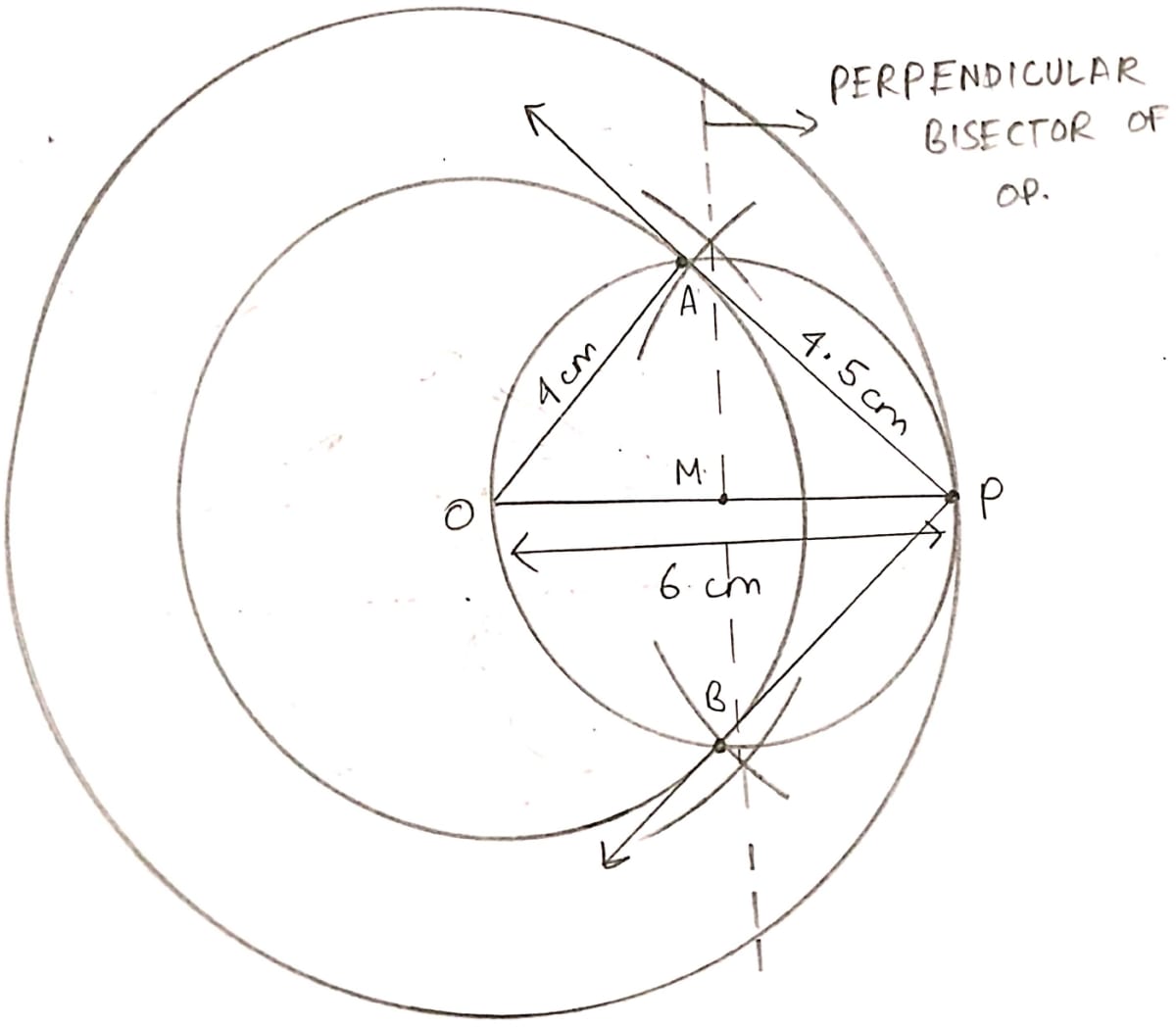
Construct a tangent to a circle of radius 4 cm from a point on the concentric circle of radius 6 cm and measure its length. Also verify the measurement by actual calculation. Constructions, ML Aggarwal Understanding Mathematics Solutions ICSE Class 10.

Calculation of length of PA

Join OA

In △OAP, ∠OAP = 90° (As angle in semicircle = 90°.)

By pythagoras theorem we get,

     OA2 + PA2 = OP2
⇒ PA2 = OP2 - OA2
⇒ PA2 = 62 - 42 = 36 - 16 = 20 cm.

PA = 20\sqrt{20} = 4.5 cm.

Hence, the length of tangent = 4.5 cm.

Question 4

Draw a circle of radius 3 cm. Take two points P and Q on one of its extended diameter each at a distance of 7 cm from its centre. Draw tangents to the circle from these two points P and Q.

Answer

Steps of Construction :

  1. Draw a circle of radius = 3 cm with centre as O.

  2. Extend the diameter (AB) of the circle on both the sides and mark points P and Q on opposite sides such that OP = OQ = 7 cm.

  3. Draw perpendicular bisector of OP and OQ such that they meet OP and OQ at M and N respectively.

  4. Construct circle with M as centre and OM or MP as radius. Let this circle touch the circle with centre O at points C and D.

  5. Construct circle with N as centre and ON or NQ as radius. Let this circle touch the circle with centre O at points E and F.

  6. Join PC, PD, QE and QF.

Draw a circle of radius 3 cm. Take two points P and Q on one of its extended diameter each at a distance of 7 cm from its centre. Draw tangents to the circle from these two points P and Q. Constructions, ML Aggarwal Understanding Mathematics Solutions ICSE Class 10.

Hence, PC, PD, QE and QF are the tangents from point P and Q to the circle with centre as O.

Exercise 16.2

Question 1

Draw an equilateral triangle of side 4 cm. Draw its circumcircle.

Answer

Steps of construction :

  1. Draw a line segment BC = 4 cm.

  2. With centers B and C, draw two arcs of radius 4 cm which intersect each other at A.

  3. Join AB and AC. Hence, equilateral triangle ABC is formed.

  4. Draw the perpendicular bisectors of AB and BC. Let these bisectors meet at the point O.

  5. With O as center and radius equal to OA, draw a circle. The circle so drawn passes through the points A, B and C, and is the required circumcircle of △ABC.

Draw an equilateral triangle of side 4 cm. Draw its circumcircle. Constructions, ML Aggarwal Understanding Mathematics Solutions ICSE Class 10.

Question 2

Using a ruler and a pair of compasses only, construct :

(i) a triangle ABC, given AB = 4 cm, BC = 6 cm and ∠ABC = 90°.

(ii) a circle which passes through the points A, B and C and mark its centre as O.

Answer

(i) Steps of construction :

  1. Draw a line segment BC = 6 cm.

  2. Draw the perpendicular from point B and cut AB from that perpendicular such that AB = 4 cm.

  3. Join points A, B and C.

Hence, the △ABC is formed.

(ii) Steps of construction :

  1. In the above triangle, draw the perpendicular bisector of AB and BC. Let these bisectors meet at the point O.

  2. With O as center and radius equal to OA, draw a circle. The circle so drawn passes through the points A, B and C, and is required circumcircle of △ABC.

Using a ruler and a pair of compasses only, construct (i) a triangle ABC, given AB = 4 cm, BC = 6 cm and ∠ABC = 90°. (ii) a circle which passes through the points A, B and C and mark its centre as O. Constructions, ML Aggarwal Understanding Mathematics Solutions ICSE Class 10.

Question 3

Use ruler and compass, construct a triangle ABC where AB = 3 cm, BC = 4 cm and ∠ABC = 90°. Hence, construct a circumcircle circumscribing the triangle ABC. Measure and write down the radius of the circle.

Answer

Steps of construction :

  1. Draw a line segment AB = 3 cm

  2. From B draw a ray BX such that ∠XBA = 90°.

  3. From B draw an arc of 4 cm cutting XB at C.

  4. Join AC. ABC is the required triangle.

  5. Construct perpendicular bisectors of AB and BC, such that they intersect at O.

  6. With O as center and OA as radius draw a circle passing through A, B and C.

  7. Measure OA.

Hence, above is the required circumcircle of triangle ABC.

Use ruler and compass, construct a triangle ABC where AB = 3 cm, BC = 4 cm and ∠ABC = 90°. Hence, construct a circumcircle circumscribing the triangle ABC. Measure and write down the radius of the circle. Constructions, ML Aggarwal Understanding Mathematics Solutions ICSE Class 10.

On measuring we get OA = 2.5 cm

Hence, the length of the radius of the circle = 2.5 cm.

Question 4

Using ruler and compasses only :

(i) Construct a triangle ABC with the following data :

Base AB = 6 cm, AC = 5.2 cm and ∠CAB = 60°.

(ii) In the same diagram, draw a circle which passes through the points A, B and C, and mark its centre O.

Answer

(i) Steps of construction :

  1. Draw a line segment AB = 6 cm.

  2. Cut an arc of 5.2 cm from A.

  3. Draw a line segment from B such that angle between the line and AB = 60°.

  4. Mark the point as C where the arc from A and line segment from B meets.

  5. Join points A, B and C. Hence, the △ABC is formed.

(ii) Steps of construction :

  1. In the above triangle, draw the perpendicular bisector of AB and BC. Let these bisectors meet at the point O.

  2. With O as center and radius equal to OA, draw a circle. The circle so drawn passes through the points A, B and C, and is required circumcircle of △ABC.

Using ruler and compasses only (i) Construct a triangle ABC with the following data Base AB = 6 cm, AC = 5.2 cm and ∠CAB = 60°. (ii) In the same diagram, draw a circle which passes through the points A, B and C, and mark its centre O. Constructions, ML Aggarwal Understanding Mathematics Solutions ICSE Class 10.

Question 5

Using ruler and compasses only, draw an equilateral triangle of side 5 cm and draw its inscribed circle. Measure the radius of the circle.

Answer

Steps of construction :

  1. Draw a line segment BC = 5 cm.

  2. From B and C cut an arc of 5 cm.

  3. Mark the point as A which is intersection of the two arcs.

  4. Join A, B and C. Hence, the equilateral △ABC is formed.

  5. Draw the (internal) bisectors of ∠B and ∠C. Let these bisectors meet at point I.

  6. From I, draw IN perpendicular to the side BC.

  7. With I as centre and radius equal to IN, draw a circle. The circle so drawn touches all the sides of the △ABC, and is the required incircle of △ABC.

Using ruler and compasses only, draw an equilateral triangle of side 5 cm and draw its inscribed circle. Measure the radius of the circle. Constructions, ML Aggarwal Understanding Mathematics Solutions ICSE Class 10.

On measuring IN, we get the radius of the incircle.

Hence, the radius of the incircle = 2.3 cm.

Question 6(i)

Construct a triangle ABC with BC = 6.4 cm, CA = 5.8 cm and ∠ABC = 60°. Draw its incircle. Measure and record the radius of incircle.

Answer

Steps of construction :

  1. Draw a line segment BC = 6.4 cm.

  2. Cut an arc from C of 5.8 cm.

  3. From B construct angle 60° and extend the line and mark the point A where it meets arc from C.

  4. Join A, B and C. Hence, the △ABC is formed.

  5. Draw the (internal) bisectors of ∠B and ∠C. Let these bisectors meet at point I.

  6. From I, draw IN perpendicular to the side BC.

  7. With I as centre and radius equal to IN, draw a circle. The circle so drawn touches all the sides of the △ABC, and is the required incircle of △ABC.

Construct a triangle ABC with BC = 6.4 cm, CA = 5.8 cm and ∠ABC = 60°. Draw its incircle. Measure and record the radius of incircle. Constructions, ML Aggarwal Understanding Mathematics Solutions ICSE Class 10.

On measuring IN, we get the radius of the incircle.

Hence, the radius of incircle is 1.6 cm.

Question 6(ii)

Construct a △ABC with BC = 6.5 cm, AB = 5.5 cm, AC = 5 cm. Construct the incircle of the triangle. Measure and record the radius of the incircle.

Answer

Steps of construction :

  1. Draw a line segment BC = 6.5 cm.

  2. Cut an arc from C of 5 cm and an arc of 5.5 cm from B.

  3. Mark the point as A where the arcs from B and C intersect.

  4. Join A, B and C. Hence, the △ABC is formed.

  5. Draw the (internal) bisectors of ∠B and ∠C. Let these bisectors meet at point I.

  6. From I, draw IN perpendicular to the side BC.

  7. With I as centre and radius equal to IN, draw a circle. The circle so drawn touches all the sides of the △ABC, and is the required incircle of △ABC.

Construct a △ABC with BC = 6.5 cm, AB = 5.5 cm, AC = 5 cm. Construct the incircle of the triangle. Measure and record the radius of the incircle. Constructions, ML Aggarwal Understanding Mathematics Solutions ICSE Class 10.

On measuring IN, we get the radius of the incircle.

Hence, the radius of incircle is 1.5 cm.

Question 7

Using ruler and compasses only, construct a triangle ABC in which BC = 4 cm, ∠ACB = 45° and the perpendicular from A on BC is 2.5 cm. Draw the circumcircle of triangle ABC and measure its radius.

Answer

Steps of construction :

  1. Draw a line segment BC = 4 cm.

  2. At B, draw a perpendicular and cut off BE = 2.5 cm.

  3. From E, draw a line EF parallel to BC.

  4. From C, draw a ray making an angle of 45° which intersects EF at A.

  5. Join AB.

  6. Draw a line AD parallel to BE. This AD is the perpendicular bisector of BC.

  7. Draw the perpendicular bisectors of sides BC and AC intersecting at O.

  8. With centre O and radius OB or OC or OA draw a circle which will pass through A, B and C. This is the circumcircle of △ABC.

Using ruler and compasses only, construct a triangle ABC in which BC = 4 cm, ∠ACB = 45° and the perpendicular from A on BC is 2.5 cm. Draw the circumcircle of triangle ABC and measure its radius. Constructions, ML Aggarwal Understanding Mathematics Solutions ICSE Class 10.

On measuring OB we get the radius of the circumcircle.

Hence, the radius of circumcircle = 2 cm.

Question 8

Using ruler and compasses only, construct a △ABC such that BC = 5 cm, AB = 6.5 cm and ∠ABC = 120°.

(i) Construct a circumcircle of △ABC.

(ii) Construct a cyclic quadrilateral ABCD such that D is equidistant from AB and BC.

Answer

(i) Steps of construction :

  1. Draw a line segment AB = 6.5 cm.

  2. From B construct angle 120° and extend the line such that BC = 5 cm.

  3. Join points A, B and C. Hence, the △ABC is formed.

  4. Draw the perpendicular bisector of AB and BC. Let these bisectors meet at the point O.

  5. With O as center and radius equal to OA, draw a circle. The circle so drawn passes through the points A, B and C, and is required circumcircle of △ABC.

(ii) We know that locus of point equidistant from two sides is the angle bisector of the angle between the lines.

Steps of construction :

  1. Draw the angle bisector of ∠ABC.

  2. Mark the point as D where the angle bisector of ∠ABC meets the circumcircle.

  3. Join AD and CD.

  4. ABCD is the cyclic quadrilateral.

Using ruler and compasses only, construct a △ABC such that BC = 5 cm, AB = 6.5 cm and ∠ABC = 120°. (i) Construct a circumcircle of △ABC. (ii) Construct a cyclic quadrilateral ABCD such that D is equidistant from AB and BC. Constructions, ML Aggarwal Understanding Mathematics Solutions ICSE Class 10.

Question 9

Construct a regular hexagon of side 4 cm. Construct a circle circumscribing the hexagon.

Answer

We know that each angle in a regular hexagon = 120°.

  1. Draw a line segment AB = 4 cm.

  2. At A and B draw rays making an angle of 120° each and cut off AF = BC = 4 cm.

  3. At F and C, draw rays making angle of 120° each and cut off EF = CD = 4 cm.

  4. Join ED. Hence, ABCDEF is the required hexagon.

  5. Draw the perpendicular bisector of AB and BC. Let these bisectors meet at the point O.

  6. With O as center and radius equal to OA or OB draw a circle which passes through the vertices of the hexagon. This is the required circumcircle of hexagon ABCDEF.

Construct a regular hexagon of side 4 cm. Construct a circle circumscribing the hexagon. Constructions, ML Aggarwal Understanding Mathematics Solutions ICSE Class 10.

Question 10

Draw a regular hexagon of side 4 cm and construct its incircle.

Answer

We know that each angle in a regular hexagon = 120°.

  1. Draw a line segment AB = 4 cm.

  2. At A and B draw rays making an angle of 120° each and cut off AF = BC = 4 cm.

  3. At F and C, draw rays making angle of 120° each and cut off EF = CD = 4 cm.

  4. Join ED. Hence, ABCDEF is the required hexagon.

  5. Draw the angle bisectors of A and B which intersect each other at O.

  6. Draw OL ⊥ AB.

  7. With centre O and radius OL, draw a circle which touches the sides of hexagon. This is the required incircle of hexagon ABCDEF.

Draw a regular hexagon of side 4 cm and construct its incircle. Constructions, ML Aggarwal Understanding Mathematics Solutions ICSE Class 10.

Chapter Test

Question 1

Draw a circle of radius 3 cm. Mark its centre as C and mark a point P such that CP = 7 cm. Using ruler and compasses only, construct two tangents from P to the circle.

Answer

Steps of construction :

  1. Construct a circle with centre as C and radius = 3 cm.

  2. Mark a point P at a distance of 7 cm from the centre. Join CP. Draw its perpendicular bisector to meet CP at M.

  3. With M as centre and CM (or MP) as radius, draw a circle. Let this circle intersect the circle with C as centre at points A and B.

  4. Join PA and PB.

Draw a circle of radius 3 cm. Mark its centre as C and mark a point P such that CP = 7 cm. Using ruler and compasses only, construct two tangents from P to the circle. Constructions, ML Aggarwal Understanding Mathematics Solutions ICSE Class 10.

Hence, PA and PB are tangents to the circle with centre C.

Question 2

Draw a line AQ = 7 cm. Mark a point P on AQ such that AP = 4 cm. Using ruler and compasses only, construct :

(i) a circle with AP as diameter

(ii) two tangents to the above circle from the point Q.

Answer

(i) Steps of construction :

  1. Draw a line segment AQ = 7 cm. Mark the point as AP = 4cm.

  2. Draw perpendicular bisector of AP let it meet AP at O. Such that AO = OP = radius of circle with centre O..

  3. With O as centre and radius AO draw a circle. This is the circle with AP as diameter.

(ii) Steps of construction :

  1. Join OQ.

  2. Draw perpendicular bisector of OQ to meet OQ at M.

  3. With M as centre and OM (or MQ) as radius, draw a circle. Let this circle intersect the circle with O as centre at points C and D.

  4. Join QC and QD.

Draw a line AQ = 7 cm. Mark a point P on AQ such that AP = 4 cm. Using ruler and compasses only, construct (i) a circle with AP as diameter (ii) two tangents to the above circle from the point Q. Constructions, ML Aggarwal Understanding Mathematics Solutions ICSE Class 10.

Hence, QC and QD are tangents to the circle with centre O from the point Q.

Question 3

Using ruler and compasses only, construct a triangle ABC having given c = 6 cm, b = 7 cm and ∠A = 30°. Measure side a. Draw the circumcircle of the triangle.

Answer

We know that a = BC, b = AC and c = AB.

Steps of construction :

  1. Draw a line segment AB = 6 cm.

  2. Construct ∠A = 30°. Extend segment from A to point C such that AC = 7 cm and ∠CAB = 30°.

  3. Join C and B. Hence, △ABC is formed.

  4. Draw perpendicular bisectors of AB and BC. Let these meet at O.

  5. Now using O as centre and OA or OB as radius, draw a circle touching all the vertices of triangle ABC. This is the circumcircle of triangle ABC.

Using ruler and compasses only, construct a triangle ABC having given c = 6 cm, b = 7 cm and ∠A = 30°. Measure side a. Draw the circumcircle of the triangle. Constructions, ML Aggarwal Understanding Mathematics Solutions ICSE Class 10.

On measuring side BC we get, BC = 3.5 cm. Since a = BC,

∴ a = 3.5 cm.

Hence, the length of side a = 3.5 cm.

Question 4

Using ruler and compasses only, construct an equilateral triangle of height 4 cm and draw its circumcircle.

Answer

Steps of construction :

  1. Draw a line XY and take a point D on it.

  2. At D, draw perpendicular and cut off DA = 4 cm.

  3. From A, draw rays making an angle of 30° on each side of AD meeting the line XY at B and C.

  4. Now draw perpendicular bisector of AB intersecting AD at O.

  5. With centre O and radius OA or OB or OC, draw a circle which will pass through A, B and C.

This is the required circumcircle of △ABC.

Using ruler and compasses only, construct an equilateral triangle of height 4 cm and draw its circumcircle. Constructions, ML Aggarwal Understanding Mathematics Solutions ICSE Class 10.

Question 5

Using ruler and compasses only :

(i) Construct a triangle ABC with the following data :

BC = 7 cm, AB = 5 cm and ∠ABC = 45°.

(ii) Draw the inscribed circle to △ABC drawn in part (i).

Answer

(i) Steps of construction :

  1. Draw a line segment BC = 7 cm.

  2. At B draw a ray BX making an angle of 45° and cut off BA = 5 cm.

  3. Join AC.

Hence, the required triangle ABC is formed.

(ii) Steps of construction :

  1. Draw the angle bisectors of ∠B and ∠C intersecting each other at I.

  2. From I draw a perpendicular ID on BC.

  3. With centre as I and radius ID, draw a circle which touches all the sides of △ABC.

This is the required inscribed circle to △ABC.

Using ruler and compasses only, (i) Construct a triangle ABC with the following data BC = 7 cm, AB = 5 cm and ∠ABC = 45°. (ii) Draw the inscribed circle to △ABC drawn in part (i). Constructions, ML Aggarwal Understanding Mathematics Solutions ICSE Class 10.

Question 6

Draw a triangle ABC, given that BC = 4 cm, ∠C = 75° and that radius of circumcircle of △ABC is 3 cm.

Answer

Steps of construction :

  1. Draw a line segment BC = 4 cm.

  2. Draw the perpendicular bisector of BC.

  3. From B, draw an arc of 3 cm which intersects the perpendicular bisector at O.

  4. Draw a ray CX making an angle of 75°.

  5. With centre O and radius 3 cm draw a circle which intersects the ray CX at A.

  6. Join AB.

Draw a triangle ABC, given that BC = 4 cm, ∠C = 75° and that radius of circumcircle of △ABC is 3 cm. Constructions, ML Aggarwal Understanding Mathematics Solutions ICSE Class 10.

Hence, the required triangle ABC is formed.

Question 7

Draw a regular hexagon of side 3.5 cm. Construct its circumcircle and measure its radius.

Answer

We know that each angle in a regular hexagon = 120°.

  1. Draw a line segment AB = 3.5 cm.

  2. At A and B draw rays making an angle of 120° each and cut off AF = BC = 3.5 cm.

  3. At F and C, draw rays making angle of 120° each and cut off EF = CD = 3.5 cm.

  4. Join ED. Hence, ABCDEF is the required hexagon.

  5. Draw the perpendicular bisector of AB and BC. Let these bisectors meet at the point O.

  6. With O as center and radius equal to OA or OB, draw a circle which passes through the vertices of the hexagon. This is the required circumcircle of hexagon ABCDEF.

Draw a regular hexagon of side 3.5 cm. Construct its circumcircle and measure its radius. Constructions, ML Aggarwal Understanding Mathematics Solutions ICSE Class 10.

On measuring we get OA = 3.5 cm.

Hence, the required hexagon with circumcircle of radius 3.5 cm. is formed.

Question 8

Construct a triangle ABC with the following data :

AB = 5 cm, BC = 6 cm and ∠ABC = 90°.

(i) Find a point P which is equidistant from B and C and is 5 cm from A. How many such points are there ?

(ii) Construct the inscribed circle of △ABC drawn above.

Answer

(i) Steps of construction :

  1. Draw a line segment BC = 6 cm.

  2. At B, draw a ray BX making an angle of 90° and cut off BA = 5 cm.

  3. Join AC.

  4. Draw the perpendicular bisector of BC.

  5. From A with 5 cm radius, draw arc which intersects the perpendicular bisector of BC at P and P'.

There are two points (P and P') equidistant from B and C and at a distance of 5 cm from A.

(ii) Steps of construction :

  1. Draw the angle bisectors of ∠B and ∠C intersecting at O.

  2. From O, draw OD ⊥ BC.

  3. With centre O and radius OD, draw a circle which will touch the sides AB and BC.

Hence, the required inscribed circle of △ABC is formed.

Construct a triangle ABC with the following data AB = 5 cm, BC = 6 cm and ∠ABC = 90°. (i) Find a point P which is equidistant from B and C and is 5 cm from A. How many such points are there ? (ii) Construct the inscribed circle of △ABC drawn above. Constructions, ML Aggarwal Understanding Mathematics Solutions ICSE Class 10.

Question 9

Use ruler and compasses for the following question taking a scale of 10 m = 1 cm.

A park in the city is bounded by straight fences AB, BC, CD and DA.

Given that AB = 50 m, BC = 63 m, ∠ABC = 75°. D is a point equidistant from the fences AB and BC. If ∠BAD = 90°, construct the outline of the park ABCD.

Also locate a point P on the line BD for the flag post which is equidistant from the corners of the park A and B.

Answer

We know that,

The locus of a point equidistant from two intersecting lines is pair of bisectors of the angles between the two lines.

The locus of a point which is equidistant from two given points is actually the perpendicular bisector of the segment that joins the two points.

Given,

Scale : 10 m = 1 cm

BC = 63 m = 6310\dfrac{63}{10} = 6.3 cm.

AB = 50 m = 5010\dfrac{50}{10} = 5 cm.

Steps of construction :

  1. Draw a line BC = 6.3 cm.

  2. Draw ∠ABC = 75° such that AB = 5 cm.

  3. Draw BE, angle bisector of ∠ABC.

  4. Construct ∠BAF = 90°, intersecting BE at D.

  5. Join ABCD.

  6. Construct XY, the perpendicular bisector of AB, intersecting BE at P.

Use ruler and compasses for the following question taking a scale of 10 m = 1 cm. ICSE 2025 Maths Solved Question Paper.
PrevNext