Multiple Choice Questions
The points A(9, 0), B(9, 6), C(-9, 6) and D(-9, 0) are the vertices of a
rectangle
square
rhombus
trapezium
Answer
We know that,
Distance-Formula = (x2−x1)2+(y2−y1)2
Given, A(9, 0), B(9, 6), C(-9, 6) and D(-9, 0)
Calculating the length of sides by distance formula.
AB=(9−9)2+(6−0)2=0+36=6 units.BC=(−9−9)2+(6−6)2=(−18)2+02=324=18 units.CD=(−9−(−9))2+(0−6)2=0+36=36=6 units.DA=(9−(−9))2+(0−0)2=182+0=324=18 units.
Since, AB = CD and BC = DA means opposite sides are equal.
Hence, Option 1 is the correct option.
If P(3a,4) is the mid-point of the line segment joining the points Q(-6, 5) and R(-2, 3), then the value of a is
-4
-6
12
-12
Answer
We know that,
Mid-point formula = (2(x1+x2),2(y1+y2))
Given, P is the midpoint of line segment QR. Putting the values in mid-point formula for x-coordinate we get,
⇒3a=2−6+(−2)⇒a=2−8×3⇒a=−4×3⇒a=−12.
Hence, Option 4 is the correct option.
If the end points of a diameter of a circle are A(-2, 3) and B(4, -5) then the coordinates of its centre are
(2, -2)
(1, -1)
(-1, 1)
(-2, 2)
Answer
We know that,
Mid-point formula = (2(x1+x2),2(y1+y2))
Given A and B are end points of the diameter so by mid-point formula the coordinates of the centre of the circle are,
⇒(2−2+4,23+(−5))⇒(22,2−2)⇒(1,−1).
Hence, Option 2 is the correct option.
If one end of a diameter of a circle is (2,3) and the centre is (-2, 5), then the other end is
(-6, 7)
(6, -7)
(0, 8)
(0, 4)
Answer
Let B(x, y) be the other end of the diameter, whose one end is A(2, 3)
∴ The mid-point of AB is (2x+2,2y+3)
The center of the circle is (-2, 5).
Since, the centre of the circle is the mid-point of AB,
⇒22+x=−2 and 2y+3=5⇒2+x=−4 and y+3=10⇒x=−4−2 and y=10−3⇒x=−6 and y=7.
∴ Coordinates of other end are (-6, 7).
Hence, Option 1 is the correct option.
If the mid-point of the line segment joining the points P(a, b - 2) and Q(-2, 4) is R(2, -3), then the values of a and b are
a = 4, b = -5
a = 6, b = 8
a = 6, b = -8
a = -6, b = 8
Answer
The mid-point of the line segment joining the points P(a, b - 2) and Q(-2, 4) is 2a+(−2),2b−2+4.
Given R(2, -3) is the mid-point.
Comparing the values of mid-point we get,
2a+(−2)=2 and 2b−2+4=−3
⇒ a - 2 = 4 and b + 2 = -6
⇒ a = 4 + 2 and b = -6 - 2
⇒ a = 6 and b = -8.
Hence, Option 3 is the correct option.
The point which lies on the perpendicular bisector of the line segment joining the points A(-2, -5) and B(2, 5) is
(0, 0)
(0, 2)
(2, 0)
(-2, 0)
Answer
The point which lies on the perpendicular bisector of the line segment is the mid-point of the line.
Mid-point formula = (2x1+x2+2y1+y2)
Putting values to find mid point of AB,
=(2−2+2,2−5+5)=(0,0).
Hence, Option 1 is the correct option.
The coordinates of the point which is equidistant from the three vertices of △AOB (shown in the adjoining figure) are
(x, y)
(y, x)
(2x,2y)
(2y,2x)
Answer
Since the triangle AOB is the right angled triangle the point which is equidistant from O, A and B is the mid-point of AB. Let that mid-point be D.
Applying mid-point formula, coordinates are,
=20+2x,22y+0=22x,22y=(x,y).
Hence, Option 1 is the correct option.
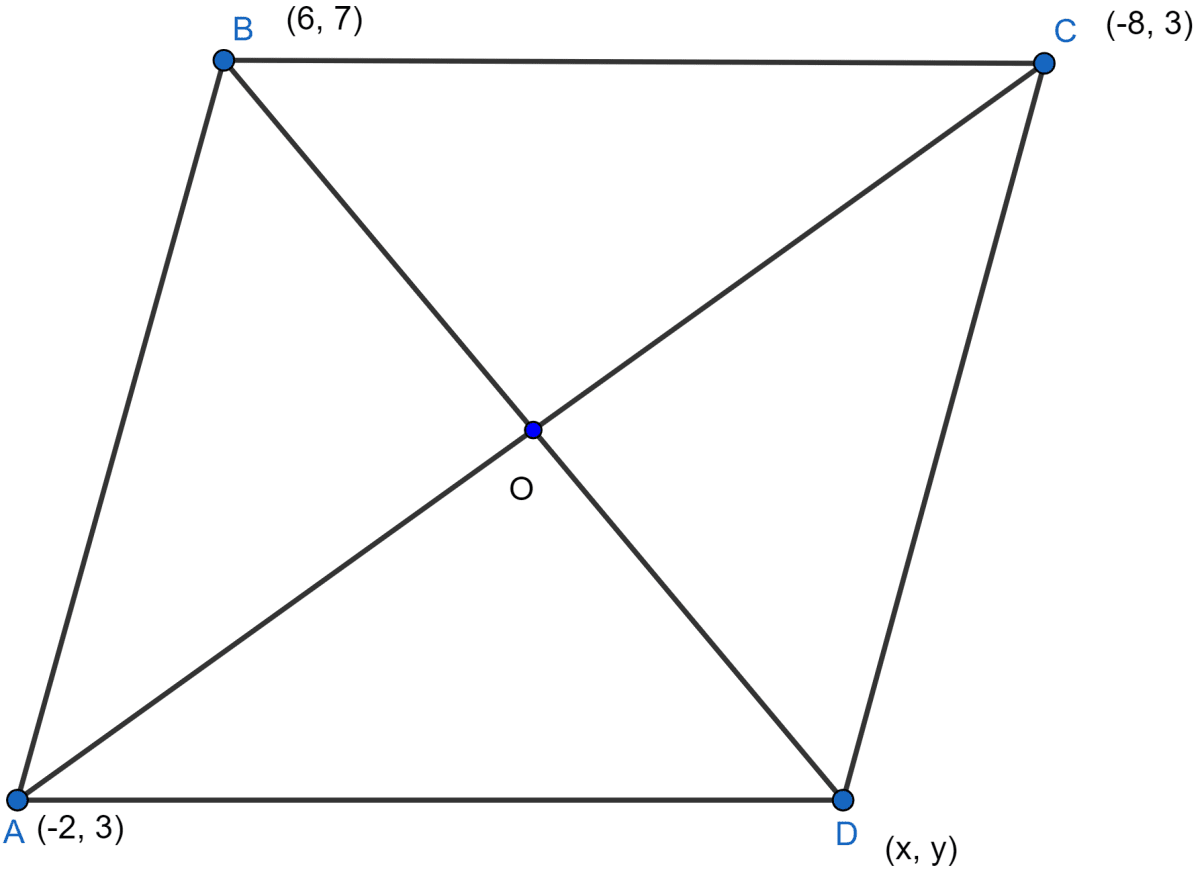
The fourth vertex D of a parallelogram ABCD whose vertices are A(-2, 3), B(6, 7) and C(8, 3) is
(0, 1)
(0, -1)
(-1, 0)
(1, 0)
Answer
ABCD is a parallelogram whose three vertices are A(-2, 3), B(6, 7) and C(8, 3). Let coordinates of its fourth vertex D be (x, y).
The diagonals AC and BD bisect each other at O so O is the mid-point of AC as well as BD.
So, by mid-point formula the coordinates of O are,
=(2−2+8,23+3)=(26,26)=(3,3).
Since, (3, 3) is the mid-point of BD so,
⇒3=2x+6 and 3=2y+7⇒6=x+6 and 6=y+7⇒x=6−6 and y=6−7⇒x=0 and y=−1.
∴ Coordinates of D are (0, -1).
Hence, Option 2 is the correct option.
The point which divides the line segment joining the points (7, -6) and (3, 4) in the ratio 1 : 2 internally lies in the
Ist quadrant
IInd quadrant
IIIrd quadrant
IVth quadrant
Answer
Let P(x, y) be the point which divides the line segment joining the points.
Given, A(7, -6) and B(3, 4) is divided by P in ratio 1 : 2.
By section formula,
x=m1+m2m1x2+m2x1 and y=m1+m2m1y2+m2y1=1+21×3+2×7 and 1+21×4+2×(−6)=33+14 and 34−12=317 and −38.
We see that x is positive and y is negative.
∴ It lies in the fourth quadrant.
Hence, Option 4 is the correct option.
The centroid of the triangle whose vertices are (-4, -2), (6, 2) and (4, 6) is
(2, 2)
(2, 3)
(3, 3)
(0, -1)
Answer
By formula,
Centroid of triangle = (3x1+x2+x3,3y1+y2+y3)
Centroid of triangle ABC (G)
=(3−4+6+4,3−2+2+6)=(36,36)=(2,2).
Hence, Option 1 is the correct option.
A(1, 4), B(4, 1) and C(x, 4) are the vertices of △ABC. If the centroid of the triangles is G(4, 3), then x is equal to
2
1
7
4
Answer
By formula,
Centroid of triangle = (3x1+x2+x3,3y1+y2+y3)
Substituting values we get :
⇒(4,3)=(31+4+x,34+1+4)⇒(4,3)=(3x+5,39)⇒(4,3)=(3x+5,3)⇒4=3x+5⇒x+5=12⇒x=12−5=7.
Hence, option 3 is the correct option.